Developing discipline-specific study skills for
Pharmacy students learning anatomy and
physiology.
Nicole B. Reinkea, Victoria Llewelynb, Nerida Firthb
Corresponding author: [email protected]
aSchool of Veterinary and Biomedical Sciences, James Cook University, Townsville QLD 4811, Australia bSchool of Pharmacy and Molecular Sciences, James Cook University, Townsville QLD 4811, Australia
Keywords: discipline-specific study skills, attrition, assessment performance, pharmacy, anatomy and physiology
International Journal of Innovation in Science and Mathematics Education, 22(1), 57-66, 2014.
Abstract
Most new students in anatomy and physiology have minimal prior learning in either discipline, and lack appropriate study strategies for optimal learning in these disciplines. The purpose of this two-year study was to develop both learning strategies and materials to assist level one Bachelor of Pharmacy students at James Cook University in their learning of anatomy and physiology. The first year of this study introduced discipline-specific study skills sessions, incorporating active learning techniques and key anatomy and physiology concepts. Additional study aids, including a Libguide and a suite of interactive online activities were introduced in the second year of the study to support and encourage learning. Students completed a questionnaire which collected information about their demographics, study practices, and perceptions of learning in this subject. Average academic achievement increased by approximately 11% and subject failure rate decreased by approximately 23% over the two years. It is likely that the development of discipline-specific skills combined with the supply of interactive learning resources contributed to improved academic outcomes.
Introduction
New tertiary students have varied past experiences which have moulded their study strategies (Prosser & Trigwell, 1999); some students adopt strategies that will serve them well when studying at a tertiary level, whilst others struggle academically or withdraw from study due to the consequences of poor study habits. In response to this, most universities now provide ‘how to study’ programs to assist new students in their transition to tertiary study. There are also numerous publications available to assist the motivated student to develop more effective study strategies (e.g. Rhoden & Starkey, 1998; Cottrell, 2008). However, despite the availability of these resources, many are not delivered in an ideal format: they tend to employ passive learning techniques, are conducted in locations where students will not be learning during semester (e.g. library meeting rooms), they require students to be motivated enough to attend, engage and apply themselves, and are usually designed for application across multiple disciplines.
difficult. The secondary school system also covers little anatomy and physiology, thus it is unlikely students have developed strategies to learn these disciplines. This is different to other sciences, such as chemistry or mathematics, which are learned in secondary school, allowing students the opportunity to develop successful learning strategies for these subjects. With no or limited anatomy and physiology education at secondary school, learning these disciplines at university becomes arduous and results in a steep and daunting learning curve.
Knowledge of anatomy and physiology is vital to pharmacists as these disciplines underpin all facets of human health and therapeutics. The introductory anatomy and physiology subject offered in the Pharmacy program at James Cook University (JCU) provides the student with the foundation knowledge for further studies in human anatomy, physiology and pharmacology. This subject covers a diversity of functions of the human body divided into four modules: cells and tissues, renal and blood, musculoskeletal and nervous system anatomy and physiology. The normal functions of these systems are evaluated within the context of homeostasis. Students are also introduced to scientific writing, including literature searching, data analysis, and the application of basic statistics. This subject provides a scaffold for students’ later understanding of the pathophysiology of disease, principles of drug development and therapeutic interventions.
Active learning is directly linked to enhanced understanding and academic outcomes (Yoder & Hochevar, 2005; Cherney, 2008) thus to help students discover and practise how to learn, active learning techniques should be employed. Further, in order to motivate student learning, it is important for students to experience their motivation intrinsically, which is accomplished through having the students see the relevance of the techniques that they are learning (Kember, Ho & Hong, 2008). Finally, generic study strategies that may be applied to a variety of disciplines may not be suitable for the disciplines that are not well understood by students, and so require specialised learning approaches. For students to develop the specialised study strategies required to learn disciplines such as anatomy and physiology, it follows that they should learn and practise study strategies using anatomical and physiological terms, texts and concepts, in an environment where learning will take place during the teaching period.
Emotions also play a vital role in learning by influencing academic motivation, the choice of learning strategies that are employed, and academic achievement (Pekrun, 2008). For example, affective emotions such as enjoyment may increase the practice of flexible strategies that students apply to their learning (Pekrun, Frenzel, Goetz &Perry, 2007). The students’ enjoyment of, and interest in particular topics affects their engagement and the depth of the understanding achieved (Organisation for Economic Co-operation and Development, 2004). Interest has clear motivational and goal components, particularly influencing exploration, information seeking, and learning (Krapp, 1999). Thus, if a student experiences interest in a particular topic, and this interest is combined with a feeling of capability to succeed, the student will enjoy learning the material (Pekrun et al., 2007). It is then possible that if strategies to improve the affective aspects of students' learning experiences are put in place, student achievement may be positively affected.
The aims of this project were to promote the academic performance and investigate enjoyment of learning of Bachelor of Pharmacy students at JCU who are undertaking study in anatomy and physiology. To achieve these aims, two components of teaching and learning were addressed:
2. the supply of learning aids that promote enjoyment in the learning of anatomy and physiology.
Several criteria were examined to gauge success, including student enjoyment of learning in the subject, interaction with study aids, and academic performance. These factors were monitored by examining student academic achievement, access to study aids and examination of questionnaire responses.
Methods
Discipline-specific study skills
Early in the semester, anatomy- and physiology-specific study skills were introduced to the students and practiced during practical classes, in addition to the prescribed practical activities. These discipline-specific activities included: how to use the prescribed textbook, active studying, summarizing and highlighting, asking questions, researching answers, reading and answering questions. Study skills were used to learn some of the key introductory concepts of anatomy and physiology such as: form fits function, homeostasis, concentration, anatomical terminology, biological hierarchy of organization, diffusion, osmosis, tonicity, cell membrane structure and transport. These study and learning techniques were developed and then reinforced throughout the semester, when learning the anatomy and physiology of other body systems. These activities were completed by two cohorts in consecutive years of this two-year study.
Learning Resources
A variety of resources were traditionally used for learning anatomy and physiology in this subject. These included lectures, lecture slides, practical classes, textbook, review questions and online simulations. In the second year of this study, additional online resources were added, including online interactive resources, and a Libguide. A wide range of tasks were provided to the students in the form of online activities. These tasks involved direct recall, problem solving and the application of knowledge. Activities included animations, puzzles, word and naming games, animated games, quizzes and simulations, and were designed to connect directly with the material delivered in lectures and practical classes for each module in the subject. These activities were included to promote student engagement with the curriculum, anticipating that exposure to the content via a more entertaining gateway would stimulate interest, learning and enjoyment. Many of these online activities provided feedback to students on the accuracy of their responses, often with explanation or reference for further inquiry.
Libguides are online guides that contain listings of recommended resources for finding information, such as databases, journals, books, etc. The Libguide was developed with the express aim of providing the students with an overview of each of the subject modules, whilst also assisting them to divide each module into manageable pieces. This Libguide was used to introduce the subject, organise the subject content into modules, provide contact details of academic and support staff, outline the learning objectives, offer links to online activities for each module, as well as to suggest guidelines for how to approach learning content and concepts of each module. The majority of this material was also presented during lectures or practical classes, however the Libguide provided a convenient repository for this information.
Data Collection and Analysis
Discipline-specific study skills were introduced to the 2011 cohort of first–semester, first– year Human Anatomy and Physiology students within the Bachelor of Pharmacy programme at JCU. Student grades and entrance scores of this 2011 cohort were obtained from official university records. The 2012 cohort of this subject were given access to online activities and the Libguide, in addition to the discipline-specific study skills instruction. Data collection from the 2012 cohort included student grades and entrance scores from official university records, access records to online resources and student questionnaire responses. An information sheet describing the aims and methods of the study was distributed to students at the conclusion of a lecture in the last week of semester when students were invited to participate. Student grades and entrance scores of the 2010 cohort were obtained for comparison.
The questionnaire was developed from literature analyses of current research, and collected information about student demographics, study practices and learning history. Participants were asked to rank the first semester subjects on order of difficulty, where ‘1’ represented the most difficult subject to learn, and ‘4’ represented the least difficult subject to learn. Participants were asked to rank the modules contained within the anatomy and physiology subject based on enjoyment to learn, where ‘1’ represented the most enjoyable to learn, and ‘4’ represented the least enjoyable module to learn. Participants indicated their degree of agreement to four statements concerning the reasons for their enjoyment of learning in the different anatomy and physiology modules on a ten-point Likert scale where ‘10’ = higher agreement. The questionnaire was tested for face validity by a panel of academics, and had been tested for response validity on students enrolled in other degree programs.
All data were analysed using IBM SPSS Statistics 20 statistical software. Demographic and academic achievement data were investigated by using descriptive statistics: categorical variables were investigated by using frequencies; continuous variables were investigated using means (M), standard deviations (SD), minimum and maximum. Student entrance scores and grades (percentages) were analysed using one-way analysis of variances (ANOVA’s). Sample sizes were not equal therefore post hoc Scheffé tests were used to further investigate relationships between subgroups (Sheskin, 1997). Grade distributions were examined using chi-square tests followed by z-tests. When less than five observed frequencies were present in each cell, a Fischers’ exact test was performed to examine the relationships between variables. This research project was approved by the Human Research Ethics Committee at JCU (Approval Number H4485). Participation was voluntary and responses were anonymous and confidential.
Results
significantly different from 2011 (64.2 ± 12.7) and 2012 (67.9 ± 11.6). Academic achievement by the 2011 and 2012 cohorts did not differ significantly from each other.
Table 1: Tertiary entrance rank (Overall Position score) and academic performance of Pharmacy students studying anatomy and physiology. Data are mean ± SEM (N).
Grade 2010 2011 2012
Tertiary entrance rank* Subject percentage
6.6 ± 2.6 (90) 56.7 ± 12.8 (95)
7.5 ± 3.2 (66) 64.2 ± 12.7 (73)
7.4 ± 2.9 (35) 67.9 ± 11.6 (48) *The overall position (OP) score is a rank order position from one (highest) to 25 (lowest) based on the overall achievement. The OP score is used to rank students for entrance to courses at tertiary institutions (Queensland Studies Authority, 2012). A percentage of each cohort did not receive an OP score.
Figure 1: Grade distribution of the 2010, 2011 and 2012 cohorts of Pharmacy students studying anatomy and physiology.
The percentage achieved by each student was categorized into grades at the end of semester by the following criteria: High distinction (85-100%), Distinction (75-84%), Credit (65-74%), Pass (50-64%) and Fail (0-49%). Figure 1 depicts the proportion of students awarded each grade category. The proportion of students awarded these grades was significantly different across the three years, χ2 (8, n=214) = 26.58, p<.005. Post hoc comparisons (z-tests) indicated that the proportion of the students awarded a grade of Fail were significantly smaller in 2011 (13.7%) and 2012 (6.5%) compared to 2010 (29.5%; p<0.05); significantly more students passed the subject following the introduction of discipline-specific study skills and online resources to the subject in 2011. The proportion of students awarded a grade of Distinction were significantly higher in the 2012 cohort (28.3%) compared to the 2011 (16.4%) and 2010 (8.4%) cohorts (p<.05), and the proportion of students awarded High Distinction were significantly greater in 2011 (6.9%) and 2012 (8.7%) compared to the 2010 cohort (0%; p<0.05).
0% 10% 20% 30% 40% 50% 60% 70% 80% 90% 100%
2010 2011 2012
P
er
ce
n
t of C
oh
or
t
Year
High distinction
Distinction
Credit
Pass
The 2012 cohort of students were invited to complete a questionnaire; 48 students were invited to participate, of which 30 responded, representing 62.5% of the enrolled students.
Table 2: Characteristics of survey participants studying anatomy and physiology as part of Bachelor of Pharmacy program in 2012.
Characteristic N
Age, (M ± SD) years (min/max) years
30 30
20.3 ± 3.3 18/32
Sex, (male/female) % 30 66.6/33.3
Private study for anatomy & physiology, (M ± SD) hours/week Study load, (M ± SD) subjects/semester
Previous anatomy/physiology learning*, (M ± SD)
30 29 30
6.3 ± 2.3 3.7 ± 0.6 3.2 ± 2.4 * measured on a 1 to 10 scale where ‘1’ = no previous learning and ‘10’ = at least one complete semester-long high school subject
The age of participants ranged from 18 to 32 years, with a mean age of 20.3 years (Table 2). Two thirds of the participants were male which reflects the cohort ratio. Participants devoted on average 6.3 hours to private study for anatomy and physiology per week. Approximately two thirds of respondents reported little previous exposure to learning anatomy and physiology, indicating that they had studied less than one third of a high school one semester anatomy and/or physiology subject (Table 2). One student had completed an entire anatomy and/or physiology semester-long subject prior to enrolling in the subject of this study.
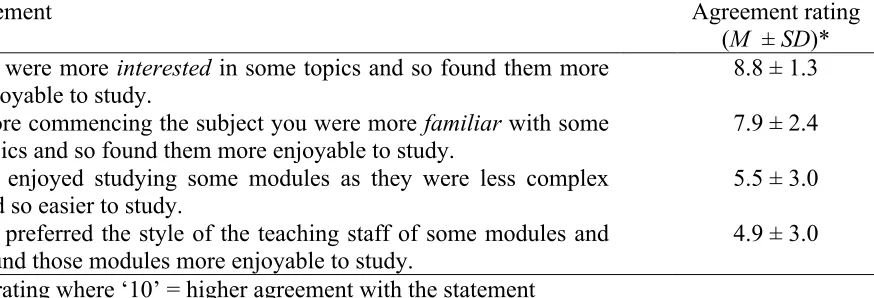
The first semester subjects of the Pharmacy program were rated by participants (N = 25) in descending order of difficulty, with 68% of participants ranking anatomy and physiology as the most difficult subject of all the first semester subjects. Participants showed a preference for certain modules within the anatomy and physiology subject (Table 3); approximately sixty-three percent of precipitants ranked the blood and renal module as the most enjoyable to study. Participants were asked to indicate their agreement to up to four statements underlying their preference for learning a particular module. The strongest influences underlying module enjoyment were previous familiarity with the subject matter and interest in the subject matter (Table 4).
Table 3: Ranking of anatomy and physiology modules based on enjoyment (N = 30).
Factor Percentage of
participants raking ‘1’* Module
Blood and renal anatomy and physiology Nervous system anatomy and physiology Muscle anatomy and physiology
Cells and tissues
Table 4: Reasons for participant’s enjoyment of learning specific modules in anatomy and physiology (N = 30).
Statement Agreement rating
(M ± SD)* You were more interested in some topics and so found them more
enjoyable to study.
Before commencing the subject you were more familiar with some topics and so found them more enjoyable to study.
You enjoyed studying some modules as they were less complex and so easier to study.
You preferred the style of the teaching staff of some modules and found those modules more enjoyable to study.
8.8 ± 1.3
7.9 ± 2.4
5.5 ± 3.0
4.9 ± 3.0
*of rating where ‘10’ = higher agreement with the statement
Student access to the Libguide and other online activities were examined at the end of the teaching period for the 2012 cohort. All students engaged with online simulations and concept review activities a minimum of 7 times during the semester. Some modules contained a greater number of activities than others. These resources were accessed a similar number of times for each module activity across the semester, with a total of 440 hits. The Libguide was not accessed as often as the other online resources; class access to each of the modules in the Libguide ranged from 11 to 42 hits over the semester. The number of hits was highest for modules delivered early in semester (cells and tissues), and declined over time, so that the module delivered at the end of semester (blood and renal anatomy and physiology) received the lowest number of hits. Total libguide access for the semester was 144 hits.
Discussion
Generic resources provided to assist academic transition from high school to university may be effective in assisting students in developing skills such as time management, writing and note taking. However, these resources may fail to help students develop the discipline-specific study skills and strategies necessary for performance in specialised subject areas. This is especially relevant for students studying disciplines such as anatomy and physiology, to which students have had little previous exposure. Whilst some relevant concepts may be superficially introduced in Australian high school subjects including biology, personal development or health and physical education, there are no specialised anatomy and physiology subjects offered for study.
In the initial year of this study, first-year Pharmacy students studying anatomy and physiology at JCU participated in discipline-specific study skills sessions. The use of active techniques to learn strategies to study anatomical and physiological concepts were introduced and practiced during class. Students were guided through activities which introduced and reinforced some of the key concepts of anatomy and physiology and encouraged students to practice a variety of study techniques. In the second year of the study, the new cohort of students was provided with access and encouraged to engage with online learning and review activities, in addition to the study skills sessions. The online components were established with the aims of improving student enjoyment of, and academic success in studying anatomy and physiology.
Within the context of the Bachelor of Pharmacy, a solid foundation in anatomy and physiology allows students to appreciate the interplay between organ systems, both during times of health and in disease. This knowledge directly supports learning of pharmacology, drug design and therapeutics, which are introduced during the later years of the degree. Integral to success and understanding of these applied subject areas is a solid foundation knowledge in human anatomy and physiology. Without a combination of anatomy and physiology, students have difficulty understanding pharmacologic and pathophysiological concepts, and may struggle to apply them to more than one organ system at a time.
The introduction of discipline-specific study skills sessions and online resources to the curriculum corresponded with a significant increase of approximately 11% in average academic achievement by pharmacy students studying anatomy and physiology. The mean tertiary entrance scores were consistent from prior to this study (2010) through the duration of the study (2011 and 2012; Table 1), thus it is anticipated that prior achievement had little influence on the change in student performance over time. Introduction of these initiatives also corresponded with a significant reduction in student failure in the subject (from ~30% in 2010 to ~7% in 2012) and a significant shift in the proportion of students achieving the upper grade categories of distinction (75-84%) and high distinction (85-100%).
It is critical to give students alternative ways to approach the learning of disciplines such as physiology (Silverthorn et al., 2006). Good learners are able to manage their own learning and apply a collection of personalised learning strategies in an effective manner (OECD, 2004). Thus, by guiding students through a series of learning activities requiring a range of approaches, students may discover skills and strategies that are effective in helping them personally to learn and apply anatomical and physiological concepts. This guided exploration may be expressly important for students who have had little previous exposure to anatomical and physiological concepts and terminology, such as those participating in the present study. Developing study techniques and strategies specific for anatomy and physiology give students direct experience at approaching anatomical and physiological concepts, and discovering techniques that work for them, as individuals, to learn, understand and apply these concepts. The discipline-specific study skill sessions introduced to this anatomy and physiology subject of the Pharmacy program engaged the students in the content early in the semester and encouraged students to assess their own progress through feedback provided during these sessions.
assortment of ways to approach learning and to gain additional feedback. Methods by which students can monitor their own learning help them to adjust their learning throughout the process. Students may monitor their learning by checking what they have learned, and discovering what they have not learned (OECD, 2004). These online resources provided students a means of doing this. Student access to the simulations and other online activities (puzzles, animations, quizzes etc) was consistent across the module activities. Student access to the Libguide showed more hits on the modules covered early in semester and then declined as the semester progressed. This is consistent with the purpose of the Libguide, that is, to provide a repository for subject information and to organise this information into logical and manageable chunks. Thus as the students became more familiar with the delivery methods of the subject and developed their own approaches to learning as the semester progressed, the need to check back with the Libguide was reduced.
Enjoyment is important for student learning; enjoyment of the performance and completion of learning tasks can enhance motivation to learn (Pekrun, 2008). Participants studying anatomy and physiology ranked the modules of the subject based on how enjoyable they were to learn. There was a clear preference for some modules over others. Previous familiarity with the content/topics covered in the module influenced the enjoyment of modules. The concepts and terminology of anatomy and physiology are difficult and specialised; thus if students had some sense of familiarity with the content, it may have made learning those concepts more enjoyable. Many participants agreed that they found the topics covered by some modules to be more interesting compared to others, and for this reason they experienced greater enjoyment when studying those ‘interesting’ modules (see Table 4). Interest in and enjoyment of particular topics affects both the amount and continuity of student engagement in learning and the depth of understanding reached (OECD, 2004). It would be interesting to examine if a relationship exists between achievement in specific modules and the modules that the students found interesting and enjoyable.
Conclusions
Acknowledgements
The authors acknowledge funding from the Higher Education Participation and Partnerships Program.
References
Cherney, I. (2008). The effects of active learning on students' memories for course content. Active Learning in Higher Education, 9(2), 152-171.
Cottrell, S. (2008). The study skills handbook (3rd ed.). New York: Palgrave Macmillan.
Courtenay, M. (1991). A study of the teaching and learning of the biological sciences in nurse education.
Journal of Advanced Nursing, 16(9), 1110-1116.
Organisation for Economic Co-operation and Development (2004). Student learning: attitudes, engagement and strategies. Learning for tomorrow’s world – first results from Programme for International Student
Assessment 2003 (pp. 110-158). France: OECD Publications.
Kember, D., Ho, A., & Hong, C. (2008). The importance of establishing relevance in motivating student learning. Active Learning in Higher Education, 9, 249-263.
Krapp, A. (1999). Interest, motivation and learning: An educational-psychological perspective. European Journal of Psychology of Education, 14, 23-40.
Pekrun, R. (2008). The impact of emotions on learning and achievement: Towards a theory of cognitive/motivational mediators. Applied Psychology: An International Review, 41(4), 359-376.
Pekrun, R., Frenzel, A.C., Goetz, T., & Perry, R.P. (2007). The control-value theory of achievement emotions. In P.A. Schutz & R. Pekrun (Eds.), Emotion in education (pp. 13-36). Burlington: Academic Press.
Prosser, M., & Trigwell, K. (1999). Learning and teaching in higher education. In M. Prosser & K. Trigwell (Eds.), Understanding Learning and Teaching: the experience in higher education. (pp. 1-9). Buckingham, England: The Society for Research into Higher Education and Open University Press.
Queensland Studies Authority, (2012). Student connect. Overall positions. Retrieved on November 15, 2012 from https://studentconnect.qsa.qld.edu.au/12657.html.
Rhoden, C., & Starkey, R. (1998). New skills – note taking in lectures and labs. In C. Rhoden & R. Starkey (Eds.), Studying science at university: everything you need to know. (pp. 47-58). St. Leonards, Australia: Allen & Unwin.
Sheskin, D. (1997). Handbook of parametric and nonparametric statistical procedures. Boca Raton: CRC Press LLC.
Silverthorn, D., Thorn, P., & Sivinicki M. (2006). It is difficult to change the way we teach: Lessons from the integrative themes in physiology curriculum module project. Advances in Physiology Education, 30, 204-214.
Sturges, D., Maurer, T., & Cole, O. (2009). Understanding protein synthesis: A role-play approach in large undergraduate human anatomy and physiology classes. Advances in Physiology Education, 33, 103-110. Yoder, J., & Hochevar, C. (2005). Encouraging active learning can improve students’ performance on