Knowledge Dynamics
Constantin BRĂTIANU Academy of Romanian Scientists Bucharest University of Economic Studies 6 Piaţa Romană, sector 1, 010374, Bucharest, Romania
Abstract. The purpose of this paper is to present a new perspective on knowledge dynamics. This perspective is based on the energy metaphor and the theory of multifield knowledge spectrum. That makes a significant step forward with respect to all the other knowledge dynamics models, which are based on the stocks and flows metaphor since the new perspective uses the entropy principle from thermodynamics and not the Newtonian logic. While the metaphor of knowledge flows leads to the physical motion in space, the metaphor of knowledge energy allows us to interpret dynamics as an irreversible transformation between two well-defined fields. Also, the paper presents the entropic transformation of the potential organizational knowledge into the operational organizational knowledge performed by organizational integrators.
Keywords: knowledge field, rational knowledge, emotional knowledge, spiritual knowledge, transformation.
Introduction
Before starting any discussion about the knowledge dynamics it is necessary to accept as a basic hypothesis the fact that thinking is a metaphorical process (Lakoff & Johnson, 1980, 1999; Moser, 2000). That is demonstrated by all the new discovery of cognitive sciences, based on which Lakoff and Johnson (1999, p.3) assert that:
(a) The mind is inherently embodied. (b) The thought is mostly unconscious.
(c) Abstract concepts are largely metaphorical.
Knowledge Dynamics
Andriessen (2006, 2008, 2011) and Andriessen and Boom (2007) focus on the consequences of our metaphorical thinking on understanding and trying to define the concept of knowledge, and reveal the fact that using the concept of knowledge is related unconditionally by the metaphor used in defining it: “Knowledge is not a concept that has a clearly delineated structure. Whatever structure it has it gets through metaphor. Different people from different cultures use different metaphors to conceptualize knowledge. They may be using the same word; however, this word can refer to totally different understandings of the concept of knowledge” (Andriessen & Boom, 2007, p.3). That means that when we operate with the concept of
knowledge we have to understand the framework of the conceptual metaphor, including its limitations.
The purpose of this paper is to present a new perspective on knowledge dynamics which opens new directions for research and applications in the fields of knowledge management, intellectual capital, and organization studies. The structure of the paper is as following: section 2 presents some basic ideas used to explain the knowledge dynamics models in the literature; section 3 presents the Nonaka’s knowledge dynamics model and its limitations; section 4 presents the new ideas introduced by the energy metaphor and thermodynamics in understanding the multifield theory of knowledge; section 5 presents the main ideas of the entropic model of knowledge dynamics. Finally, there are some conclusions and future directions for research.
Metaphors and meanings used for knowledge dynamics
exists and where it is located to how and where it is needed. This is the concept of knowledge flows”. In the author’s view, knowledge flows
represents more than just a metaphor, it explains the phenomenon of how knowledge moves through an organization.
Ikujiro Nonaka and Hirotaka Takeuchi (1995) used in their theory of knowledge dynamics the iceberg metaphor, which assigns the visible part of the iceberg to the explicit knowledge and the hidden part which is underwater to the tacit knowledge. It is a very intuitive metaphor but it is static. In order to support their dynamic model, they introduced the idea of knowledge as a process which has been developed in more details some years later (Nonaka, Toyama & Hirata, 2008). According to the new interpretation, “The most prominent feature of knowledge, compared with physical resources and information, is that it is born of human interaction. It is not a self-contained substance waiting to be discovered and collected. Knowledge is created by people in their interactions with each other and the environment” (Nonaka et al., 2008, p.7). Thus, knowledge is a result of social interaction in a given context. According to the analysis of Kianto (2007), that is the first interpretation of dynamic intellectual capital: interaction of resources in value creation process. The second interpretation is that of activities in which intangibles are imbedded and demonstrated. “The focus of this interpretation is on the particular activities in which intangible resources are used, acquired and developed in organizations” (Kianto, 2007, p.349). Finally, the third interpretation is that of the process of changing intangibles in the effort of realizing a competitive advantage. As underlined by Kianto (2007, p.351), “The dynamic capability approach focuses on understanding the sources and processes leading to the competitive advantage during conditions of rapid change”. Although there are three different interpretations to the dynamic dimension of knowledge and intellectual capital, they are based on two metaphors: knowledge flows and knowledge processes. Both metaphors are supported by the Newtonian logic, although processes may go sometimes beyond it. That means that the main limitations of these interpretations of knowledge dynamics come from the followings:
- Flow suggests a motion in space, respectively a motion of knowledge through the entire organization. However, the authors using the flow metaphor do not explain the forces which generate and control the knowledge flow.
Knowledge Dynamics
- Knowledge processes refer mostly to explicit knowledge, or to the conversion of tacit knowledge into explicit knowledge, which reflects rational thinking.
These above limitations will be found in the models proposed for explaining the organizational knowledge dynamics and also in the attempt to evaluate intellectual capital based on the Newtonian logic.
Knowledge dynamics in the vision of Ikujiro Nonaka
Ikujiro Nonaka (1991, 1994) developed the first comprehensive model for knowledge dynamics based on the metaphors discussed in the previous section. This model has been developed further by Nonaka and his colleagues being today the most known model for organizational knowledge dynamics (Nonaka & Takeuchi, 1995; Nonaka & Konno, 1998; Nonaka et al., 2000; Nonaka & Toyama, 2003; Nonaka et al., 2006; Nonaka et al., 2008; Nonaka & Von Krogh, 2009; Nonaka et al., 2014). The theory developed by Nonaka and his colleagues is based on two fundamental forms of knowledge: explicit knowledge and tacit knowledge. Explicit knowledge is that form of knowledge that can be expressed in a natural or symbolic language and transferred in verbal and written communication in any social context. Tacit knowledge is more difficult to define since it reflects our experience and unconscious cognitive work: “Tacit knowledge is highly personal and hard to formalize, making it difficult to communicate or to share with others. Subjective insights, intuitions, and hunches fall into this category of knowledge. Furthermore, tacit knowledge is deeply rooted in an individual’s action and experience, as well as in the ideals, values, or emotions he or she embraces” (Nonaka & Takeuchi, p.8).
Socialization is considered as an initial process of knowledge creation since it stimulates learning through exchange of tacit knowledge. In the view of Nonaka and Takeuchi (1995), creating and exchanging tacit knowledge represents the most important process of knowledge dynamics within the Japanese companies. Experience is a rich source of knowledge creation at the individual level and the responsibility of knowledge management is to stimulate the exchange of it as tacit knowledge. Externalization is the next sequence, in which the acquired new knowledge by an individual is transformed into explicit knowledge through a mental process. “It is a quintessential knowledge-creation process in that tacit knowledge becomes explicit, taking the shapes of metaphors, analogies, concepts, hypotheses, or models” (Nonaka & Takeuchi, 1995, p.64). The combination means exchanging explicit knowledge in a given social context by using a natural or symbolic language. Through combination, knowledge advances from individual level to the group and organization levels. This way it is expanded, amplified and restructured to generate new organizational knowledge. The combination is the only process that can be easily analyzed due to its tangible manifestation. Internalization is the last process of this model. It is the process in which explicit knowledge is transformed into tacit knowledge at the individual model. Thus, it may be considered as the reverse process of externalization. Internalization is a learning process realized in a given social context Ba. Following the four processes of socialization-externalization-combination-internalization for several times knowledge describes a spiral which suggests its continuous amplification and development.
Knowledge Dynamics
The multifield theory of knowledge
The new model of knowledge dynamics is based on the energy metaphor
proposed by Bratianu and Andriessen (2008) and developed further by Bratianu (2011, 2013, 2015), and Bratianu and Orzea (2013a). The metaphor has energy in the source domain and knowledge in the target domain, which means that it transfers some of the main attributes of energy toward the knowledge. The main attributes transferred from the energy domain are the following:
(a) Energy is a field. It is a non-substance manifestation of matter.
(b) Energy can be found in nature in different forms (i.e. mechanical energy, thermal energy, electrical energy, nuclear energy etc.).
(c) One form of energy can transform into another form.
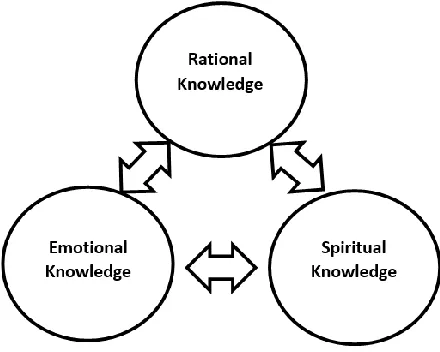
The first attribute leads us to the assertion that knowledge is a field. That means that knowledge can be viewed more easily as being intangible since a field cannot be seen, and cannot be touched like a physical object. The second attribute of energy leads us to the idea that knowledge may be considered in different forms. We defined three fundamental fields of knowledge: rational knowledge, emotional knowledge, and spiritual knowledge. These forms have different nature and they can be found at any level in the organization structure from micro to macro levels. The third attribute suggests that any of the defined knowledge fields can transform into another knowledge field, generating these way a complex manifestation of knowledge. Thus, the fundamental knowledge fields are in a continuous interaction and transformation. Thus, the meaning of
knowledge dynamics has been extended beyond the two forms of tacit and explicit knowledge and the processes of externalization and internalization approaching this way the complexity of human mind and of organizational knowledge.
seen or touched, but only because they are understood, I see clearly that there is nothing which is easier for me to know than my mind” (Descartes, 1997, p.147). The Cartesian dualism of body and mind has been so powerful that even today many authors discussing knowledge have in their mind only rational knowledge (Bratianu, 2015). Rational knowledge is considered to be objective and this attribute made it suitable for developing scientific and technological knowledge. Also, education in the western countries has been conceived in objective terms and stressed the importance of science and technology which means the primacy of rational knowledge.
Emotional knowledge emerged as a component of tacit knowledge especially after the work of Michael Polanyi (1983). In his seminal book about the tacit dimension of knowledge, Polanyi considers our direct experience with the environment as a source of knowing. It is a bodily experience which generates emotional information through perception, information which becomes then emotional knowledge. “I said that by elucidating the way our bodily processes participate in our perceptions we will throw light on the bodily roots of all thought, including man’s highest creative powers” (Polanyi, 1983, p.15). Unlike the European philosophy based for centuries on the Cartesian dualism of body and mind, the Japanese philosophy of life has been developed on the idea of oneness of body and mind, supported by three pillars (Kaufman, 1994; Nakagawara, 2004; Nonaka & Takeuchi, 1995; Nonaka et al., 2008):
(a) Oneness of humanity and nature. (b) Oneness of body and mind. (c) Oneness of self and others.
Knowledge Dynamics
2004; Damasio, 1994, 1999, 2012; Ekman, 2003; Gardner, 1983; Gladwell, 2005; Goleman, 1995; Hill, 2008; Kahneman, 2011; LeDoux, 1999; Pinker, 1997). The difference between emotions and feelings is well-explained by Damasio (1999, p.42): “I have proposed that the term feeling should be reserved for the private, mental experience of an emotion, while the term emotion should be used to designate the collection of responses, many of which are publicly observable”. Thus, Damasio (1999) emphasizes the fact that the representation of the external environment in our brain is possible due to the emotional information we receive through our body and its sensory system. This information is processed by our emotional intelligence (i.e. intrapersonal and interpersonal intelligence according to multiple intelligence models proposed by Gardner, 1983). In a synthesis, emotional intelligence is defined by Salovey and Caruso (2004, p.197) as being “The capacity to reason about emotions, and of emotions to enhance thinking”.
successful strategies and in achieving competitive advantage. Spiritual knowledge is intrinsically related to the concept of Corporate Social Responsibility, a concept requesting a responsible governance and a vision driven by social values and not profit maximization (Basu & Palazzo, 2008; Benston & Hartgraves, 2002; Branson, 2011; Lange, 2008; Pinto et al., 2008; Wang et al., 2011).
The new dynamics of knowledge
The multifield theory of knowledge is based on the assumption that at both the individual level and organizational level there are three basic fields of knowledge: rational, emotional, and spiritual. The new dynamics of knowledge is based on the basic assumption that these three fields of knowledge are in a continuous interaction and knowledge from each field can be transformed into the knowledge of any other field. Also, we may consider the transformation of tacit knowledge into explicit knowledge, regardless of the nature of that form of knowledge. For explaining each of these fundamental transformations we will use the energy metaphor, exploring its full potential (Bratianu, 2011, 2015).
The transformation of tacit knowledge into explicit knowledge and vice versa. These transformations follow from the metaphor in which we assign potential mechanical energy to the tacit knowledge and kinetic mechanical energy to the explicit knowledge. A good example can be the watermill, where the potential energy of water is transformed into kinetic energy when it is falling down over a wheel and is turning it producing mechanical work. This transformation has been considered by Nonaka and Takeuchi (1995) in the SECI model but they could not explain it because they used the iceberg metaphor, where the iceberg is solid without any possibility of performing any transformation of the type potential – kinetic energy. This transformation may be used also in explaining the transformation of the total potential organizational knowledge into effective or operational organizational knowledge through the work of integrators (Bratianu, 2008, 2015).
Knowledge Dynamics
the making decisions as demonstrated by cognitive science. According to Hill (2008, p.2), “Breakthrough in brain science have revealed that people are primarily emotional decision makers…Emotions are central, not peripheral, to both marketplace and workplace behavior”.
The transformation of rational knowledge into spiritual knowledge and vice versa. For this type of knowledge transformation, we will consider the transformation of mechanical energy into electrical energy in concordance with the laws of electricity. For mechanical energy, we assign the rational knowledge and for electrical energy, we assign spiritual knowledge. In physics, this transformation is known as the piezoelectric effect, a phenomenon in which a variation of a mechanical field induces a variation of an electrical field generating an electrical current. In knowledge dynamics, rational knowledge is used in formulating value judgments, and values are used currently in the decision making process. The concept of Corporate Social Responsibility reflects very well this type of knowledge transformation.
The transformation of emotional knowledge into spiritual knowledge and vice versa. For this type of knowledge transformation, we will consider the transformation of thermal energy into electrical energy and vice versa. The transformation can be illustrated by the physical phenomenon of the thermocouple, when a variation of a thermal energy field generates electricity by using a couple of two conductors made of different materials. In psychology, this phenomenon can be illustrated by the Budhists monks who try through hard physical and mental work to reduce their negative emotions in order to increase their state of happiness. Mathieu Ricard (2007), the French Budhist monk who is considered by many people the happiest person in the world, explains what happiness means to him: “By happiness I mean here a deep sense of flourishing that arises from exceptionally healthy mind. This is not a mere pleasurable feeling, a fleeting emotion, or a mood, but an optimal state of being. Happiness is also a way of interpreting the world, since while it may be difficult to change the world, it is always possible to change the way we look at it” (Ricard, 2007, p.19).
Figure 1. The knowledge dynamics structure
Conclusions
The paper purpose is to present a new perspective on knowledge dynamics which goes beyond the well-known model proposed by Ikujiro Nonaka and his colleagues. While the Nonaka’s model is based on the iceberg metaphor and the stocks and flows metaphor, the new perspective is based on the
energy metaphor. The new framework is based on the following assumptions: (a) knowledge is a field; (b) there is three fundamental fields of knowledge: rational, emotional, and spiritual; (c) knowledge from one field can transform into knowledge from any other field. Thus, these fields are in a continuous interaction and transformation. For a better understanding of these transformations, we can use the energy metaphor and make the following assignments: potential energy – tacit knowledge; kinetic energy – explicit knowledge; mechanical energy – rational knowledge; thermal energy – emotional knowledge; electrical energy – spiritual knowledge. Transferring the main attribute of energy and the main principle of transformation coming from thermodynamics in the knowledge domain we get a deeper understanding og knowledge dynamics which overcome many barriers from the knowledge dynamics model proposed and developed by Ikujiro Nonaka and his colleagues.
Knowledge Dynamics
References
Andriessen, D. (2006). On the metaphorical nature of intellectual capital: A textual analysis. Journal of Intellectual Capital, 7(1), 93-110.
Andriessen, D. (2008). Stuff or love? How metaphors direct our efforts to manage knowledge in organizations. Knowledge Management Research & Practice, 6(1), 5-12.
Andriessen, D. (2011). Metaphors in knowledge management. Systems Research and Behavioral Science, 28(2), 133-137.
Andriessen, D., and Boom, M.d. (2007). Asian and western intellectual capital in encounter. Paper presented at IC-Congress 2007, Inholland University of Applied Sciences, Haarlem, The Netherlands.
Basu, K., and Palazzo, G. (2008). Corporate social responsibility: A process model of sensemaking, Academy of Management Review, 33(1), 122-136.
Benston, G.J., and Hartgraves, A.L. (2002). Enron: What happened and what we can learn from it, Journal of Accounting and Public Policy, 21(2), 105-127.
Bereiter, C. (2002). Education and mind in the knowledge age. London, UK: Erlbaum. Branson, R. (2011). Screw business as usual. London: Virgin Books.
Brătianu, C. (2007). Thinking patterns and knowledge dynamics. In B. Martinis and D. Remenyi (Eds.), Proceedings of the 8th European Conference on Knowledge
Management (Vol.1, pp.152-157). Reading: Academic Conference Limited. Brătianu, C. (2008). A dynamic structure of the organizational intellectual capital. In
M. Naaranoja (Ed.). Knowledge management in organizations (pp.233-243). Vaasa: Vaasan Yliopisto.
Brătianu, C. (2009). The frontier of linearity in the intellectual capital metaphor.
Electronic Journal of Knowledge Management, 7(4), 415-424.
Brătianu, C. (2010). A critical analysis of Nonaka’s model of knowledge dynamics.
Electronic Journal of Knowledge Management, 8(2), 193-200.
Brătianu, C. (2011). Changing paradigm for knowledge metaphors from dynamics to thermodynamics. Systems Research and Behavioral Sciences, 28(2), 160-169.
Brătianu, C. (2013). The triple helix of organizational knowledge. Management Dynamics in the Knowledge Economy, 1(2), 207-220.
Brătianu, C. (2015). Organizational knowledge dynamics: Managing knowledge creation, acquisition, sharing, and transformation. Hershey, PA: IGI Global. Brătianu, C., and Andriessen, D. (2008). Knowledge as energy: A metaphorical
analysis. In Harorimana, D. and Watkins, D. (Eds.), Proceedings of the 9th
European Conference on Knowledge Management (pp.75-82). Reading: Academic Publishing Limited.
Brătianu, C., and Orzea, I. (2013a). The entropic intellectual capital model.
Knowledge Management Research & Practice, 11(2), 133-141.
Brătianu, C., and Orzea, I. (2013b). Emotional knowledge: The hidden part of the knowledge iceberg. In Proceedings of the 14th European Conference on
Caruso, D.R., and Salovey, P. (2004). The emotionally intelligent manager: How to developand use the four key emotional skills of leadership. San Francisco, CA: Jossey-Bass.
Collins, J., and Porras, J.I. (2002). Built to last: Successful habits of visionary companies. New York, NY: Harper Business essentials.
Damasio, A. (1994). Descartes’ error: Emotion, reason, and the human brain. New York: Putman.
Damasio, A. (1999). The feelings of what happens: Body and emotion in the making of consciousness. New York: Harcourt.
Damasio, A. (2012). Self comes to mind: Constructing the conscious brain. New York: Vintage Books.
De Geus, A. (2002). The living company: Growth, learning and longevity in business. London: Nicholas Brealey Publishing.
Descartes, R. (1997). Key philosophical writings. Hertforshire: Wordsworth Editions. Edvinsson, L. (2002). Corporate longitude. What you need to know to navigate the
knowledge economy. London: Prentice Hall.
Ekman, P.E. (2003). Emotions revealed: Recognizing faces and feelings to improve communication and emotional life. New York: Times Books.
Gardner, H. (1983). Frames of the mind: The theory of multiple intelligences. New York: Basic books.
Gladwell, M. (2005). Blink: The power of thinking without thinking. New York: Back Bay Books.
Glisby, M., and Holden, N. (2003). Contextual constraints in knowledge
management theory: The cultural embeddedness of Nonaka’s knowledge-creating company. Knowledge and Process Management, 10(1), 29-36. Goleman, D. (1985). Emotional intelligence. New York: Bantam.
Gourley, S. (2006). Conceptualizing knowledge creation: A critique of Nonaka’s theory. Journal of Management Studies, 43(7), 1415-1436.
Gourley, S., and Nurse, A. (2005). Flaws in the “engine” of knowledge creation. In B. Anthony and P. Fleming (Eds.), Challenges and issues in knowledge
management (pp.293-251). Greenwich, CT: Information Age Publishing. Hill, D. (2008). Emotionomics: Leveraging emotions for business success. Revised
Edition. London: Kogan Page.
Kahneman, D. (2011). Thinking, fast and slow. New York: Farrar, Straus and Giroux. Kaufman, S.F. (1994). The martial artist’s book of five rings: The definitive
interpretation of Myiamoto Musaschi’s classic book of strategy. Boston, MA: Tuttle Publishing.
Kianto, A. (2007). What do we really mean by the dynamic dimension of intellectual capital?. International Journal of Learning and Intellectual Capital, 4(4), 342-356.
Lakoff, G., and Johnson, M. (1980). Metaphors we live by. Chicago, IL: The University of Chicago Press.
Lakoff, G., and Johnson, M. (1999). Philosophy in the flesh: The embodied mind and its challenges to the western thought. New York: Basic Books.
Lange, D. (2008). A multidimensional conceptualization of organizational corruption control. Academy of Management Review, 33(3), 710-729. LeDoux, L. (2002). The emotional brain: The mysterious underpinnings of emotional
Knowledge Dynamics
Mathur, S.S., and Kenyon, A. (1998). Creating value: Shaping tomorrow’s business. Boston, MA: Butterworth Heinemann.
Maxwell, N. (2007). From knowledge to wisdom: A revolution for science and humanities. 2nd Edition. London: Prentice Hall.
Nakagawara, C. (2004). The Japanese garden for the mind: The ‘bliss’ of paradise transcend. Stanford Journal of East Asian Affairs, 4(2), 83-103.
Nissen, M.E. (2006). Harnessing knowledge dynamics. Principled organizational knowing & learning. Hershey, PA: IRM Press.
Nonaka, I. (1991). The knowledge creating company. Harvard Business Review, 69(1), 96-104.
Nonaka, I. (1994). A dynamic theory of organizational knowledge creation.
Organization Science, 5(1), 14-37.
Nonaka, I., and Takeuchi, H. (1995). The knowledge-creating company: How Japanese companies create the dynamics of innovation. New York: Oxford University Press.
Nonaka, I., and Konno, N. (1998). The concept of “Ba”: Building a foundation for knowledge creation. California Management Review, 40(3), 40-54. Nonaka, I., Toyama, R., and Konno, N. (2000). SECI, Ba and leadership: A unified
model of dynamic knowledge creation. Long Range Planning, 33(1), 5-34. Nonaka, I., and Toyama, R. (2003). The knowledge-creating theory revisited:
Knowledge creation as a synthesizing process. Knowledge Management Research & Practice, 1(1), 2-10.
Nonaka, I., von Krogh, G., and Voepel, S. (2006). Organizational knowledge creation theory: Evolutionary paths and future advances. Organization Studies, 27(8), 1179-1208.
Nonaka, I., Toyama, R., and Hirata, T. (2008). Managing flow. A process theory of the knowledge-based firm. Houndmills: Palgrave Macmillan.
Nonaka, I., and von Krogh, G. (2009). Tacit knowledge and knowledge conversion: Controversy and advancement in organizational knowledge creation Theory.
Organization Science, 20(3), 635-652.
Nonaka, I., Kodama, M., Hirose, A., and Kohlbacher, F. (2014). Dynamic fractal organizations for promoting knowledge-based transformation – A new paradigm for organizational theory. European Management Journal, 32(1), 137-146.
Pinker, S. (1997). How the mind works. London: Penguin.
Pinker, S. (2008). The stuff of thought: Language as a window into human nature. New York: Pinguin Books.
Pinto, J., Leana, C.R., and Pil, F.K. (2008). Corrupt organizations or organizations of corrupt individuals? Two types of organizational-level corruption. Academy of Management Review, 33(3), 685-710.
Polanyi, M. (1983). The tacit dimension. Gloucester: Peter Smith.
Ribeiro, R., and Collins, H. (2007). The bread-making machine: Tacit knowledge and two types of action. Organization Studies, 28(9), 1417-1433.
Ricard, M. (2007). Happiness. New York: Little, Brown and Company.
Russell, B. (1972). A history of western philosophy. New York: Simon and Schuster. Song, J., and Lee, K. (2014). The Samsung way: Transformational management
Wang, L., Malhotra, D., and Murnigham, J.K. (2011). Economics education and greed.
Academy of Management Learning & Education, 10(4), 643-660.
Zohar, D., and Marshall, I. (2000). Spiritual intelligence: The ultimate intelligence. London: Bloomsbury.
Zohar, D., and Marshall, I. (2004). Spiritual capital: Wealth we can live by. San Francisco: Berrett-Koehler Publishers.