Journal of Applied Linguistics and Language Research Volume 3, Issue 1, 2016, pp. 167-177
Available online at www.jallr.com ISSN: 2376-760X
* Correspondence: Tayebe Sarlak, Email: [email protected] © 2016 Journal of Applied Linguistics and Language Research
The Effect of Project Work on the Speaking Ability of Iranian
EFL beginner Students
Esmail Zare-Behtash
Associate Professor, Chabahar Maritime University, Iran Hooshang Khoshsima
Associate Professor, Chabahar Maritime University, Iran Tayebe Sarlak *
MA in TEFL, Chabahar Maritime University, Iran
Abstract
EFL learning context stresses on the speaking skill as a vital communicative tool. The students will be more proud if they are able to interact with the other interlocutors. Since the Iranian students are far from the native context and the most of their learning happens in the classroom, application of an appropriate teaching method increases motivation, self-confidence, autonomy, and consequently speaking skill as whole. The present research endeavored to illustrate the effect of PW on students’ speaking skill. The participants were selected from a mixed-class students enrolled a general English course in Islamic Azad University of Chabahar (IAUC). The pre-test was administered and indicated that the students were homogeneous and at the elementary level. Then, one of the classes was assigned as control group and the other was the experimental group who respectively underwent conventional teaching method (teacher-centered method) and PW (student-centered method). After 10 sessions, the post-tests were administered for both groups in order to measure their speaking achievement. The outcomes demonstrated that while the control group and the experimental group were homogeneous before the treatment, their speaking performances were significantly different after implementing PW. Therefore, the researcher concluded that PW influences total speaking ability of elementary adult EFL students.
Keywords: speaking foreign language, project work, teaching speaking method
INTRODUCTION
the language students are considered successful language learner, if they can speak FL. Manurung (2015) explained the speaking skill as a significant skill of language learning. He stated that the speaking provides opportunity for language users to state their meaning orally. Speaking a language is a useful tool to transfer feeling. This Indonesian prober (Manurung) uttered his overall description of speaking in this way that “speaking is a process of massage and of information that lead to produce utterances orally to meet special purposes” (2015, p. 45). Many EFL students demand to communicate with FL orally, but they cannot. Due to the difficulty of learning FL speaking, some language students possess poor FL speaking ability. A solution for speaking improvement is selecting an appropriate method which focuses on communicative orally. The well-organized teaching method is necessary to enhance speaking skill by endorsing self-confidence, motivation, and attitude and lessening their anxiety as well as collaborating in group. Group work is available in project work (PW) method. Richards and Rodgers (2004) categorized PW as a technique of cooperative approach. They argued the use of PW is a useful tool which helps foreign language students to improve their speaking capability. To depart speaking problem of students, the current research attempted to seek the effectiveness of project work on speaking dilemmas. Eventually its result encourages foreign language teachers to choose PW in their curriculum.
REVIEW OF LITERATURE
Since 1980s people have made contact with other people from different countries more than before. They have required and demanded to communicate with native speakers of other languages (Richards & Rodgers, 2004). People considered that knowing a language means speaking it (Richards & Renandya, 2002). Hence, students regarded speaking skill as communicative competence (Chastain, 1988). Because of importance of communication, it is regarded as the foremost goal of the FL instruction. Thus, instructors should apply a method which provides students chance to communicate. Traditionally, to improve speaking skill, the teacher asked the students to write an essay about a topic. New methods suggested that the teacher pays more attention to factors which facilitate learning speaking (Richards & Renandya, 2002). Each human beings who is learning FL possesses distinctive characters such as self-confidence, autonomy, motivation, attitude, and anxiety. Numerous studies have indicated that learning speaking is depended on affective factors, too. For example, Dincer, Yesilyurt, and Takkac concluded that FL students are silent and cannot speak FL because their anxiety is high while their self-confidence and motivation are low (2012). Krashen (1981) introduced affective factors as mediator variable which affect relationship between input of FL learning and students’ ability (as cited in Henter, 2014). To promote learning a language, the teacher should take account to affective factors.
provide learners opportunity to speak and facilitate learning. As a result, the learners obtain desired outcome and become motivated in communication.
Attitude is another affective factor of FL learning. Lee McKay and H. Horenberg described attitude as an outcome of persons' beliefs and values about activities in which they should participate (2009). Beliefs determine that a person can learn language or not. Positive attitude toward language learning improve learning, but negative attitude doesn’t (Henter, 2014). Thus, attitude toward language learning is crucial and the teacher should take consideration to attitude and try to help students take a positive attitude toward foreign language and language learning to be successful in learning course. PW makes the learners' attitude positive toward language learning and their speaking ability promotes.
Anxiety, another main affective factor, can prevent language learning. There are five factors which cause speaking-in-class anxiety (Henter, 2014): 1) students fear negative evaluation, 2) they feel uncomfortable when they speak with native speakers, 3) they have negative attitude towards English learning, 4) they evaluate themselves negatively, and 5) they fear that they do not achieve successful results. PW makes a comfortable learning environment which decreases students’ fear because the students are not evaluated individually, but their group will be assessed. Therefore, their anxiety will be decreased. Bailey (1983) added that the competition is another reason of their speaking anxiety (as cited in Mak, 2011). PW decreases competitive and enhances cooperative among students to remove speaking anxiety.
Project Work
PW is launched by Dewey in 1938 (Lam, Cheng, & C.Choy, 2010). Buck Institute for Education (2007) noted that PW is originated from Dewey’s philosophy work (as cited in Cheng, 2013). PW is a method because PW specifies the role of the teacher and students, and students' behavior. PW does not provide any nature of language and language learning like an approach, but PW follows theory of language and learning of cooperative approach. Also it is not like a technique because a technique refers to widespread activities through the teaching procedure. Technique doesn’t determine role of the teachers and students while PW determines them. Consequently, the present researcher called PW as a method in this study. PW is a wide spread teaching method (Ergul & Kargin, 2014). Gulteking (2007) claimed that PW can be developed individually or in group (as cited in Ergul & Kargin, 2014). PW is characterized by different specialists (Fernandes, 2014; Ergul & Kargin, 2014; Zhou, Chen, & Luo, 2014; Brown, 2007) as follows:
The students attend in learning situation actively.
The students are responsible for their own learning. Zhou, Chen, and luo expressed that students construct and reconstruct their knowledge network actively (2014).
PW is a student-centered method. Teachers are as facilitator and guider rather than providing knowledge.
Students can increase their communicative ability. Then they can cooperate in real life to identify their need and solve large- scale open-ended projects.
PW enables the students to think critically and manage projects.
Students not only read and listen to content knowledge, but they use them in real life. In other word, PW relates theory to practice in real world. Consequently it causes deep-level learning.
PW prepares students for future life. PW is interdisciplinary.
Main factors of PW are increasing willing to take risk, participating in social activities and helping each other.
In 2007, Brown arranged roles of the teacher in a string that begin from controller, director, manager, facilitator to resource. At the beginning of the course, the teacher acts as the controller, then the director, next the manager, the facilitator and at the end of the course the resource. The teacher should conduct activities which engage students in interaction. The most known interactive teacher exist in group work.
METHODOLOGY
The basic aim of the study was the examination of the effect of PW on speaking ability of Iranian elementary adult EFL students. The speaking ability is the dependent variable in which the researcher is going to measure its progress. The researcher attempted to evaluate changes in the speaking ability with some instruments such as pre-test and post-test after and before using the independent variable. Independent variable is PW which is expected to affect the speaking skill, the dependent variable. The participants were selected from a mixed-class students enrolled a general English course in IAUC. According to proficiency test, the proficiency level of all students was elementary and they were homogeneous. Students in the experimental group were exposed to the treatment (project work) while the students in the control group were involved in traditional method, teacher-centered method; the experience shows that it is the current teaching method in Iran.
scaled from zero to four scores. Next, to assess the reliability of the pre-test, the researcher asked three experienced English teachers to rate the students’ performance in the speaking test. Then the researcher calculated the reliability of rating the speaking test via Pearson conduct moment. Inter-rater reliability equals 0.94. It demonstrated that rating scores are related to each other strongly.
RESULTS
Among different techniques to analyze data, the independent sample t-test and the paired sample t-test were chosen to estimate similarities and differences between the participants' scores before and after the treatment. There were four groups of scores: 1) the pre-test scores of the control group, 2) the pre-test scores of the experimental group, 3) the post-test scores of the control group, and 4) the post-test scores of the experimental group. The independent sample t-test analysis was applied twice: between the scores of the pre-tests for the control and the experimental groups, and the post-tests for the control and the experimental groups. On the other hand, the paired sample t-test compared: between the score of the pre-test and the post-test of the control group, and the pre-test and the post-test of the experimental group.
Table 1 shows descriptive statistic of the speaking performance of the groups in the pre-test. The number of people of the control group and the experimental group is 20 and 25 people respectively. Numbers of students in groups are different. This research has taken account the mean of the students' performance not the individual number of students in groups. As a result, the difference in number of cases is not important. Table 1 shows that mean of the control group is 4.35 and of the other group is 3.58.
Table 1. Descriptive statistic of the pre-test for the control and experimental groups
N Mean Std. Deviation Std. Error
pretest 25 3.5800 20 4.3500 5.92256 6.80770 1.18451 1.5225
Table 2. Independent sample t-test of pre-test of both experimental and control groups
Levene's Test for Equality of
Variances
t-test for Equality of Means
F Sig. t df
Sig. (2-taile d) Mea n Diffe renc e Std. Error Differenc e 95% Confidence Interval of the
Difference Lower Upper Equal variances
assumed .237 .629 -.406 43 .687 -.77 1.89868 -4.599 3.059
Equal variances
not assumed -.399 37.9 .692 -.77 1.92881 -4.674 3.135
The teacher administered the post-test and, then, conducted the paired t-test for the post-test and the pre-test of the control group to determine the effect of the conventional teaching method on the speaking ability of the participants. Table 3 presents the outcomes where the Sig. (2-tailed) value is less than 0.05. It means that the participants in the control group showed different performances before and after the treatment.
Table 3. Paired sample t-test of the pre-test and the post-test of the control group Paired Differences
t df Sig. (2-tailed) Mean Deviation Std. Std. Error Mean
95% Confidence Interval of the
Difference
Lower Upper
Post-test
pre-test 2.5500 2.6253 .58703 1.321 3.779 4.344 19 .000
Again paired sample t-test was used to compare means of the post-test and the pre-test of the speaking scores of the experimental group. Table 4 reports the mean difference is 8.58. Also Sig. (2-tailed) is 0.00 < 0.05. The researcher concluded there is different between the students' performance in the pre-test and the post-test.
Table 4. Paired sample t-test for the experimental group in the pre- and post-tests
Paired Differences
t df Sig. (2-tailed) Mean Deviation Std.
Std. Error Mean
95% Confidence Interval of the
Difference
Lower Upper
posttest –
pretest 8.5800 3.39632 .67926 7.17807 9.98193 12.63 24 .000
participants. It demonstrates that mean of the experimental group is 12.16 and their standard deviation is 5.63. The mean difference is 5.26.
Table 5. Group statistics of the post-test for both experimental and control group
Group N Mean Std. Deviation Std. Error Mean
Posttest Experimental 25 12.160 Control 20 6.9000 5.83005 5.63235 1.30364 1.12647
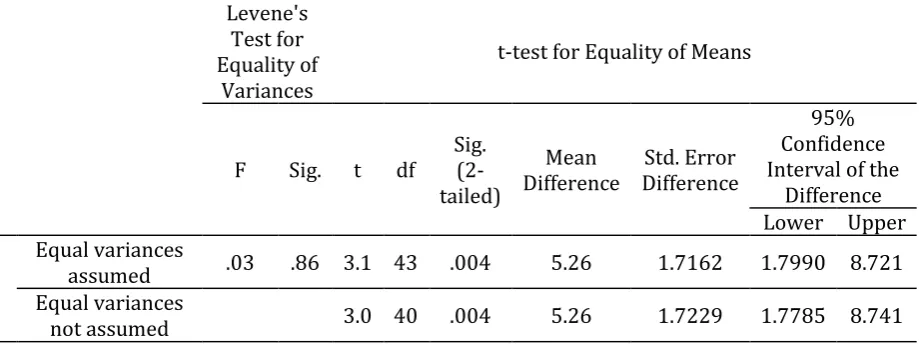
Table 6 shows that significant value of 2-tailed was less than 0.05 (.004≤ 0.05) and mean difference is 5.28. As a result there is significant difference between the speaking performances of the experimental group and the control group. Eta square equals 0.18. Therefore, the magnitude of difference is large. Then, the null hypothesis is rejected. Table 6. Independent samples test for post-test of experimental and control group
Levene's Test for Equality of
Variances
t-test for Equality of Means
F Sig. t df Sig. (2-tailed)
Mean
Difference Difference Std. Error
95% Confidence Interval of the
Difference Lower Upper Equal variances
assumed .03 .86 3.1 43 .004 5.26 1.7162 1.7990 8.721
Equal variances
not assumed 3.0 40 .004 5.26 1.7229 1.7785 8.741
DISCUSSION
As it was mentioned, the present study made an effort to examine the following research question: Does the PW method influence speaking ability of Iranian elementary EFL adult learners? Based on the research question, the following hypothesis is conducted: The PW method does not influence speaking ability of Iranian elementary EFL adult learners.
conclusion. Then, the research compared the students’ achievement in both groups by SPSS 20th.
The quantitative findings of comparison between students' performance in the control and experimental groups exhibited a significant difference in speaking mean scores of both groups (Table 6). Therefore, the research hypothesis is rejected. So the researcher concludes PW is a useful recommendation to promote the speaking ability. The findings of the present study supported the previous works (Balagiu and his colleague, 2014) which claims that the speaking ability is available through employing PW. Iranian researchers such as Soleimani, Rahimi, and Sadeghi (2015) and Shafaei and Abdul Rahim (2015) probed the impact of PW.
Maftoon, Birjandi, and Ahmadi (2013) confirm that the PW enhances learners' motivation in their work. Beccarie et.al (2014), Cheng (2013), Colomar and Guzman (2009), and Ahluwalia (2010) approve the influence of PW on self-confidence, motivation, attitude, and autonomy. Then PW enables learners to develop their speaking skill because Ellis (2008) states that affective factors affect speaking ability positively. With respect to the above line, the present researcher selects PW to investigate the effectiveness of the mentioned teaching method on progress of the speaking ability. Thus the researcher as an observer observes implementing PW. It provides a fun learning setting. The students were happy. This fun learning environment decreases anxiety. This observation makes the researcher more rely on the other works which discover that PW increase motivation, self-confidence, autonomy, and attitude.
CONCLUSION
Speaking FL is considered as one of chief factor of successful EFL learning. Willing and need to speak English cause the teacher is interested to apply a teaching method which enables the EFL students to speak English. A suitable teaching speaking method is one that the EFL students have opportunity to practice speaking. The splendid characters of PW method such as enhancing motivation, self-confidence, autonomy, communication competence, students' involvement, and decreasing anxiety make PW method as a useful method to develop the level of speaking ability. Consequently, the research recommended PW method as a helpful teaching speaking method. The result of the research indicated that PW method impact on learning speaking rather than traditional methods.
The result shows that Iranian EFL students possess poor speaking ability because of lack of applying inappropriate teaching speaking method. Language teachers select appropriate method to solve EFL students' specific problems. Inasmuch as learning FL happens in different contexts and varied needs, the language teachers should acquaint with methods. Then teachers choose a method that fulfills students' need.
The splendid characters of PW such as enhancing motivation, self-confidence, autonomy, communication competence, students' involvement, and decreasing anxiety makes PW as a useful method to develop level of the speaking ability. This reason causes that the research recommended PW as a helpful teaching speaking. The result of the research demonstrated that PW impact on learning speaking rather than the traditional methods. The students noticed that they could speak more fluently and comprehensibility. Besides they used more vocabulary in their speaking with correct grammar. This work determined that PW leads to progress the speaking ability if the teachers diagnose needs of students correctly.
REFERENCES
Brown, H. (2007). Principles of language learning and teaching (3rd ed.). Pearson Education, Inc.
Ahluwalia, G. (2010). Language learning with internet-based projects: a student-centered approach for engineering students. ESP world, 9(1).
Beccaria, L., Kek, M., Huijser, Rose, J., & Kimmins, L. (2014). The Inter-relationship between student approachand group work. Nurse Education Today, 1094-1103. Balagiu, A., Marutelu, l., Patasan, M., & Zechia, D. (2014). Group project for english
language evaluation. Procedia Social and Behavioral Science, 112, 986-990.
Chastain, K. (1988). Developing second language skills theory and practice (third ed.). Harcourt Brace Jovanich.
Cheng, S.-Y. ". (2013). An emperical investigation of the effectiveness of project based course learning within hospitality programs: The mediating role of cognitive engagement . Journal of Hospitality, Leisure, Sport & Tourism Education , 213-225. Dincer, A., Yesilyurt, S., & Takka, M. (2012). The effects of autonomy-supportive climate
on efl learners' engagement, achievement and competence in english speaking classroom. Procedia - Social and Behavioral Sciences 46 , 3890-3894.
Ellis, R. (2008). The study of second languageacquisition. Oxford University Press Oxford. Ergul, N., & Kargin, E. K. (2014). The effect of project based learning on students' science
success. Procedia Social and Behavioral Science, 537-541.
Fernandes, S. R. (2014). Preparing graduates for professional practice: Findings from a Case study of project based learning. Procedia Social and Behavioral Science, 219-226.
Lam, S.-F., Cheng, R. W.-y., & C.Choy, H. (2010). School support and teacher motivation to implement project based learning. Learning and Instruction, 487-497.
Henter, R. (2014). Affective factors involved in learning a foreign language. Procedia - Social and Behavioral Sciences , 373-378.
Lee McKay, S., & H. Hornberger, N. (2009). Sociolinguistics and language teaching. New York: Cambridge University Press.
Maftoon, P., Birjandi, P., & Ahmadi, A. (2013). The relationship between project-based instruction and motivation: A study of efl learners in iran. theory and practice in language studies, 3, 1630-1638.
Mak, B. (2011). An exploration of speaking-in-class anxiety with chinese esl learners.
system, 202-214.
Manurung, K. (2015). Improving the speaking skill using reading contextual internet-based instructional materials in an EFL class in Indonesia. Procedia - Social and Behavioral Sciences, 176, 44-51.
Musa, F., Mufti, N., Abdul Latif, R., & Mohamed Amin, M. (2011). Project based learning: promoting meaningful language learning for workplace skills. Procedia Social and Behavioral Science, 18, 187-195.
Richards, J. C., & Renandya, W. A. (2002). Methodology in language teaching. In J. C. Richards, & W. A. Renandya, Teaching Speaking (pp. 201-234). Cambridge University Press.
Richards, J., & Rodgers, W. (2004). Approaches and methods in language teaching.
Cambridge University press.
Shafaei, A., & Abdul Rahim, H. (2015). Does project-based learning enhance Iranian EFL learners’ vocabulary recall and retention? Iranian Journal of Language Teaching Research, 3(2), 83-99.
Shokri, N. M. (2010). Team project facilitate language learning. Procedia Social and Behavioral Science, 7, 555-564.
Şimon, S. (2014). Enhancing the English oral communication skills of the 1st year students of the bachelor’s degree program “communication and public relations".
Procedia - Social and Behavioral Sciences, 1(16), 2481-2484.
Soleimani, H., Rahimi, Z., & Sadeghi, H. (2015). Project-based learning and its positive effects on iranian intermadiate efl learners' reading ability and vocabulary achaivement. International Journal of English Language and Literature Studies, 4(1), 1-9.