Do the rich (really) consume higher quality goods?
Evidence from international trade data
Vincenzo Merella
yDaniel Santabárbara
zMarch 2017
Abstract
Using unit values (average import prices) as proxies for quality, the international trade
literature …nds empirical support to the positive theoretical relationship between importer
income and quality of imports. Several authors, however, argue that such empirical evidence
might be spurious, since unit values could be a¤ected by other factors than product quality.
We circumvent this issue by building on Khandelwal’s (2010) discrete choice approach,
where quality is inferred by quantitative market shares as well as unit values. We develop
a model that delivers a positive relationship between income and the alternative quality
measure, and validate our prediction using the Eurostat’s COMEXT database, which collects
disaggregated customs data reported by EU countries. Our …ndings suggest that a positive
alternative quality-income link exists, and is robust to a number of di¤erent speci…cations
and controls. Based on our estimates, we are also able to develop a novel indicator of
import quality upgrading as importer income rises, which may prove useful when addressing
practical matters even at the sectoral level.
Keywords: export quality, import shares, unit values, nested logit demand
JEL Classi…cations: F12, F14, L15
We would like to thank Paola Bertoli, Esteban Jaimovich, Monika Junicke, Pantelis Kazakis, Giovanni Mas-trobuoni, Alessio Moro and Miroslav Zajicek for comments and suggestions, as well as seminar participants at the Bank of Spain, the SAEe meeting (Santander), the SIE meeting (Bocconi) and the University of Economics Prague. This paper was written while Vincenzo Merella was a Research Fellow at the Bank of Spain, whose …nancial support is kindly acknowledged.
yUniversity of Cagliari and BCAM, University of London. Mailing address: Department of Economics and Business, Viale Sant’Ignazio 17, 09123 Cagliari, Italy. Email: [email protected].
1
Introduction
Understanding the determinants of import structure is a fundamental concern of the international
trade literature. A prominent role in shaping importer behavior is attributed to product quality.
Particular attention is paid to the relationship between importer income and quality of imports,
and its e¤ect on importer demand. This paper contributes to shed light on the determinants of
the international demand structure by providing novel evidence on this relationship. We develop
a model in which richer consumers demand goods of higher quality. The model yields a product
quality measure that is inferred from data on prices and market shares, and is positively related
to consumer income. We are therefore able to test the link between quality and income departing
from the assumption that information on quality is fully embedded in prices.
In a number of theoretical contributions, the relationship between product quality and
con-sumer income is found to be an important determinant of import and export ‡ows [e.g., Flam and
Helpman (1987); Murphy and Shleifer (1997); and, more recently, Fajgelbaum, Grossman and
Helpman (2011); Jaimovich and Merella (2012, 2015)]. In all these articles, the main prediction
is invariably the following: richer importers tend to trade more with exporters producing higher
quality goods. The link between importer income and quality of imports also appears to …nd
support in the empirical literature: product quality correlates positively with consumer income
[e.g., Hummels and Klenow (2005); Hallak (2006); Bastos and Silva (2010); Flach (2014)]. The
extent to which such empirical …ndings actually relate to the theoretical prediction is, however,
controversial. The crux of the matter is that observed average import prices are typically used
as proxies for the quality levels of the imported goods.
Average import prices (or unit values) are calculated at the product level as the ratio between
the total value and the total volume traded from a source country (exporter) to a destination
country (importer). The rationale for using a unit value as a proxy for quality hinges on a
num-ber of arguments: e.g., higher quality goods would require more costly inputs, hence be more
expensive; a market price di¤erential between two similar goods may hold only if their quality
levels di¤er. Several authors, however, argue that the correlation between prices and income
may actually be determined by factors other than quality [e.g., Hallak and Schott (2011);
may command heterogeneous tari¤s and trade costs. Furthermore, exporters may charge
var-ied markups in di¤erent markets (pricing-to-market), which could lead to systematically higher
prices imposed in more developed economies. Finally, even products that are regarded as close
substitute may exhibit some distinctive characteristics, which could result in a certain residual
degree of horizontal di¤erentiation.
Building on this criticism, part of the literature attempts to construct alternative quality
measures that do not rely solely on prices. For example, Khandelwal (2010) and Pula and
Santabárbara (2012) use quantitative market shares to obtain a quality measure for the goods
exported by a given country; Hallak and Schott (2011) bring in trade balances. The idea behind
these two approaches is to extract information on quality from trade volumes holding prices
constant, building on the intuition that consumers care about price relative to quality in choosing
among products. Hence, two goods with the same price but di¤erent trade volumes should have
di¤erent levels of quality.
This paper follows (by gathering information on quality from volumes of trade and import
prices) and extends (by letting willingness to pay for quality rise with income) the …rst of these
two approaches. We use a nested logit demand system to infer information on quality from
quantitative market shares as well as import prices. Consumers face a set of vertically and
horizontally di¤erentiated goods, produced by monopolistically competitive …rms. They have
objective taste for quality, whose di¤erent levels are identi…ed on the vertical dimension, and
idiosyncratic tastes for the speci…c characteristics that horizontally di¤erentiate products with
the same level of quality. To this standard representation, we add a preference feature that allows
for willingness to pay for quality to rise with income. Therefore, our framework allows for the
valuation of quality to be income-dependent.
From a theoretical standpoint, our predictions are in line with those found in the literature:
richer importers purchase their goods from exporters producing higher quality products. The
novel feature in our approach is how this theoretical prediction is validated empirically. Instead
of studying the link between importer income and average import price, we investigate the
relationship between importer income and a quality measure, derived from the model, that takes
into account products’quantitative market shares as well as prices.
database, which provides information on each EU member state’s imports from 240 partner
economies at the CN-8 digit product level (approximately 8500 product headings). This
infor-mation is used to obtain a highly disaggregate measure of the product quality levels (for each
8-digit product and every exporter) imported by each EU country. The underlying strategy is to
consider di¤erent members of the EU as consumers operating in a single market. We can then
test the relationship between quality and income using countries GDP per capita as a proxy for
the latter.
Our …ndings suggest a robust positive correlation between income and product quality.
Specif-ically, as we illustrate in Section 3, our results are robust to di¤erent speci…cations, do not rely
on any particular sector, and are also robust to a number of controls and alternative
instrumen-tation strategies. Furthermore, our estimates allow us to develop a novel indicator of import
quality upgrading as importer income rises. As we discuss in greater details in Section 3.3, by
providing a key practical …gure, this indicator represents a promising tool for illustrating and
analyzing the ‘quality’ dimension of demand structure even at the sectoral level. According to
the indicator, for example, we can infer that import quality rises on average by about 2:75%
relative to the length of its quality ladder (i.e., the space of available qualities) in response to a
ten percent increase in importer income.
Related literature
A large strand of the literature provides evidence of a positive correlation between quality of
imports and importer GDP. Using cross-sectional data for bilateral trade among 60 countries in
1995, Hallak (2006) shows that rich economies tend to import relatively more from exporters
that produce high-quality goods. Fieler (2011) uses an even richer dataset (about 160 countries
in the period 1995-2007) to illustrate the positive link between income per capita growth and
the rise in quality levels. Choi, Hummels and Xiang (2009) exploit household income data (26
countries in 2000) and document that di¤erent quality distributions map into di¤erent income
distributions, in a way that is consistent with rising willingness to pay for quality.1
The common feature of all these contributions is that unit values are used as proxies for
1Further evidence that richer consumers typically purchase product of higher quality can be found, for example,
quality levels. Several studies point out that unit values may capture other links to the importer’s
income per capita than product quality. Khandelwal (2010) argues that import prices may re‡ect
variations in manufacturing costs, and expensive goods may be traded only because they exhibit
particular features that match idiosyncratic preferences of a small fraction of consumers in the
destination country. Simonovska (2010) investigates the role of pricing-to-market in determining
import prices and, using data on prices of more than two hundreds identical goods sold in about
thirty countries, shows that variable markups account for up to a third of the observed
cross-country price di¤erentials.2 In addition, heterogeneity in tari¤s and transportation costs are a
well documented source of di¤erences in the prices of tradables. For these reasons, we choose
to depart from the existing literature investigating the link between quality and per capita
GDP by adopting an alternative quality measure, and study the relationship between consumer
income and product quality inferring the latter from prices and relative volumes traded in the
international markets.
There are two main approaches in the literature that attempt to construct alternative quality
measures. On the one hand, Hallak and Schott (2011) infer relative product quality by positing
that countries with trade surpluses o¤er higher quality than countries running trade de…cits,
holding observed import prices constant. On the other hand, Khandelwal (2010) deduces quality
levels by exploiting trade volumes, postulating that higher-quality products attract higher market
shares, conditional on price. We choose to follow more closely the second approach, because the
richness of observations in our dataset allows for a more re…ned analysis than that based on
world-level exports.3 Hence, our paper di¤ers from Hallak and Schott (2011) as we infer product quality
by exporter at the sectoral level rather than looking at each country as a whole. Furthermore,
we depart from both approaches in that we explicitly let willingness to pay for quality rise as
consumer income increases. Jointly considered, the alternative approach to quality measurement
and the nonhomothetic structure of demand represent the main novelty of our paper relative to
the existing studies in the literature.
2Alessandria and Kaboski (2011) provide further evidence of this phenomenon, showing that US exporters
ship the same goods to low-income countries at lower prices.
3We are aware that a “disadvantage is that [. . . ] one-way ‡ows to a single country are likely to be substantially
Finally, our paper relates to those contributions building on the tradition of models with a
nested logit demand structure, …rst proposed by McFadden (1973), and later developed by Berry
(1994) and Berry, Levinsohn, and Pakes (1995). This modeling strategy has been applied to
international trade by Goldberg (1995) and Verboven (1996) and, more recently, by Verhoogen
(2008) and Khandelwal (2010). Here, we extend these works by introducing a mechanism that
leads to a link between product quality and consumer income. It should be noted that
Fajgel-baum, Grossman and Helpman (2011) also introduce willingness to pay for quality in a model
with a nested logit demand system. Their focus, however, is very di¤erent from ours. Their
study is exclusively theoretical, and aims to explain why richer countriesexport higher-quality
goods, whereas our quantitative model is designed to empirically test the link between product
quality andimporter income.4
The remaining of the paper is organized as follows. Section 2 illustrates the model from which
we derive our predictions. Section 3 describes our empirical strategy, shows that our estimations
support the theoretical predictions of the model, and o¤ers a discussion about the meaning and
the implications of our …ndings. Finally, section 4 concludes.
2
Theoretical framework
This section builds on the tradition of the nested logit discrete choice models.5 Most features
of our model are standard: (i) we consider a partial equilibrium world economy where a large
number of independent markets exist; (ii) throughout the whole theoretical analysis, we restrict
our attention to a single, representative, market;6 (iii) products are potentially sourced from,
and destined to, several countries: to simplify matters, we only consider two source countries,
denoted N and S, and two destination countries, denotedH and L. The novel feature of our
approach is that (iv) we allow for willingness to pay for quality to rise with income.
Within every source country there is a unit mass of …rms, indexed by j, each producing a
4In fact, the divergence in the goal of the two papers entails a fundamental di¤erence in the modeling strategy.
Fajgelbaumet al.(2011) develop a general equilibrium model where idiosyncratic tastes have a generalized extreme value (GEV) distribution, whereas we opt for a partial equilibrium model with idiosyncratic tastes having a type I extreme value distribution.
5For a textbook description of this model, see Tirole (1988).
6The arguments discussed here naturally extend to all sectors considered in our empirical investigation, which
di¤erentiated good. Labor inputs are immobile (which allows for di¤erent wages inNandS) and
technologies di¤er across countries. We assume that countryN enjoys higher wages (wN > wS)
and technological capabilities (AN > AS) than countryS. Every destination country is populated
by a continuum of consumers. The two countries di¤er in their income levels and (possibly) size,
and we assume that countryH is richer (yH > yL) than countryL. Size is denoted by and
expressed in relative terms, hence the destination region has size one, and L 1 H. Two additional features complete the model. First, outside sectors determine wages and incomes.
Second, domestically produced outside varieties are available to consumers in every sector of
each destination country.
By di¤erentiating their products, …rms in the source region engage in monopolistic
competi-tion. They exercise their degree of market power by setting the prices of their products taking
consumer demand into account. For this reason, we begin our analysis by studying consumer
choice. Each individual i in country M = fH; Lg may consume one unit of a di¤erentiated good (j; X), produced by …rm j in country X = fM; N; Sg. Good (j; X) is shipped to M in the quality levelqM
j;X (which is agreed upon by all consumers) and with speci…c horizontal traits
(whose valuation is instead consumer-speci…c).
Valuation of good (j; X) by consumer i in country M is represented by the indirect utility function:
Vj;Xi;M = Mqj;XM pMj;X+"i;Mj;X (1)
where M re‡ects the country-M consumers’ (common) valuation for quality, pM
j;X is the price
of good (j; X) when traded in countryM, represents consumers’ (worldwide common) price sensitivity and "i;Mj;X is the valuation for the horizontal di¤erentiation term. We introduce the
concept of rising willingness to pay for quality as income increases by assuming that valuation
for quality is an increasing function of income.
Assumption Valuation for quality M (yM)is such that (0)>0and@ (yM)=@yM >0. As a result, the largeryM, the higher M, and the greater the willingness to pay for quality, all
other conditions holding constant.
Under the assumption that the horizontal valuation term"i
the expected aggregate demand for good(j; X)by countryM is:
cMj;X = M
exp Mj;X
P
Y=fM;N;Sg R1
0 exp
M k;Y dk
(2)
where Mj;X MqM
j;X pMj;X represents the average valuation of good(j; X), which is indepen-dent ofn"i;Mj;Xosince idiosyncratic elements vanish when aggregating across consumers.7
In each country of the source region, …rms compete by producing vertically and horizontally
di¤erentiated goods. Vertical di¤erentiation consists of choosing a particular quality version
of the supplied good. To produce one unit of quality q, a …rm in country X faces the cost
wX +q2=(2AX). (Recall that AX is a country-speci…c technological parameter, and wages
wX are determined by an outside sector and, as such, are exogenous.) Horizontal di¤erentiation
consists of choosing whether to embed speci…c characteristics to further individualize the supplied
good. All …rms horizontally di¤erentiate goods at no additional cost.
Each …rmj in countryX take country-M consumer demand (2) into account when choosing
pricepM
j;X and qualityqMj;X to maximize pro…ts:
M
j;X = max
p;q p wX
q2
2AX
Mexp M
q p
P
Y=fM;N;Sg R1
0 exp
M k;Y dk
(3)
(Atomless) …rms cannot in‡uence the equilibrium allocations, so the optimal price charged is:
pMj;X = 1 +wX+
qM j;X
2
2AX
(4)
and the optimal quality is:
qj;XM =
M
AX
(5)
From (4) and (5), we may note that: (i) all …rms within each source country optimally supply
to countryM goods of the same quality level (qMj;X =qXM, 8j), which are hence equally priced (pMj;X =pMX,8j); (ii) sinceAN > AS, goods produced inN are always of higher quality than those
produced inS; (iii) by replacing (5) into (4) it turns out thatpM
X =wX+ M
2
AX= 2 2 +1= and, sincewN > wS, goods produced inN are also more expensive than those produced inS.8
Recall that valuation for quality is an increasing function of consumer income. Considered
in conjunction with (5), this feature of the model delivers the central prediction of our paper,
which we may summarize as follows.
Proposition. Goods sourced from countryX to the destination countryH are always of higher quality than those sourced toL:
qHX > qXL; 8X
Proof. The result immediately follows from noticing that, sinceyH > yL, then H > L from Assumption 1, henceqH
X = HAX= > LAX= =qXL from (5).
This result implies that richer consumers (highery), displaying higher willingness to pay for
quality (larger ), have a di¤erent demand structure than poorer consumers and, in particular,
tend to import higher quality goods. The central prediction of our model is therefore in line with
those found in the literature: product quality and importer income should be positively related.
The novel feature in our approach is how this theoretical result translates into an empirical
test. As we discussed in the previous section, empirical contributions investigating the correlation
between importer’s income and consumption goods’ quality typically use unit values (average
import prices) as proxies for quality. We depart from the literature and infer product quality
from (quantitative) market shares in a direct fashion, once unit values are controlled for.
In order to o¤er a more accurate description of the link between theoretical prediction and
empirical test, it proves convenient to derive how import volumes translate into quantitative
market shares, relative to the domestic market share. To do so, …rst notice that we may obtain
total consumptioncM in the destination countryM by summing up aggregate demand (2) across
source countries:
cM X
X=fM;N;Sg M
exp MX
P
Y=fM;N;Sgexp M Y
= M
We then derive the market share of the source country X in the destination country M by
computing the ratio between the relevant aggregate demand and total consumption:
sMX c
M X
cM =
Mexp MX P
Y=fM;N;Sgexp M Y
1
M
=
exp MX
P
Y=fM;N;Sgexp M Y
(6)
Following the literature, we can further simplify this expression by normalizing to zero the
average valuation of the domestically produced goods(j; M), which amounts to imposing MM =
M
qM
M pMM = 0. Using (6), the domestically produced goods market share is:
sMM =
exp MM P
Y=fM;N;Sgexp M Y
=P 1
Y=fM;N;Sgexp M Y
(7)
As a result, the relative quantitative market share of the source country X in the destination
countryM is given by the ratio of (6) to (7):
sMX sM M
=
exp MX
P
Y=fM;N;Sgexp M Y
0
@P 1
Y=fM;N;Sgexp M Y
1 A
1
= exp MX (8)
Taking logarithms, and using the de…nition of average valuation for good(j; X)in the destination countryM to replace MX, we obtain the equation that we bring to the data in order to infer our
measure of product quality and its relationship with importer income:
lnsMX lnsMM = MX = MX pMX (9)
where M
X MqXM is the observationally relevant variable.9
This result, implied by the logistic nature of the model, represents the cornerstone of this
type of models. From an empirical point of view, since quantitative market shares and prices are
observable whereas qualities are not, the latter may be inferred by market shares once the e¤ect
of price is accounted for. That is, not only for a given quality the ability to obtain a larger market
9This de…nition is due to the impossibility to identify M andqM
X separately. This caveat does not represent
a major issue, since: (i) M is the same for all goods imported by a given country, hence it works as a mere scale factor applied to a measure (quality) that is ordinal by nature; (ii) when comparing goods imported by di¤erent regions, this scale factor only magni…es the di¤erence between (ordinal) quality levels: the mapping between
qM X and
MqM
X is monotonic sinceq M
share is stronger if the product is available at a lower price since, for M
X = lnsMX lnsMM+ pMX to hold constant,sM
X andpMX must be negatively related. But most importantly, for a givenpMX (andsMM) quality is deduced to be higher if the product captures a larger market share, since by
(9)sMX and MX must be positively related.
The novelty of our analysis lies in investigating the relationship between consumer income
and product quality within this framework, where the newly developed quality measures replace
average import prices as proxies for quality. In this context, with rising income, even if the
relative market share remained constant, the higher capability and willingness to pay for quality
would entail a simultaneous rise in both quality and price of the importer good. Formally, if
lnsM
X lnsMM held constant, then an increase in MX (in turn due to a growing M
with yM)
would require a proportional rise inpM
X to keep the right-hand side of (9) …xed. In fact, quality
of imports might rise even if the relative market share declined, provided that a su¢ ciently large
increase in price would also be observed. Speci…cally, if the rise in the term pMX were larger
than the decrease in the termlnsMX lnsMM, then MX would have to grow for the equality in (9) to hold.
3
Empirical approach
As we have shown in the previous section, our model predicts that the quality embodied in each
traded good is an increasing function of importer income. This prediction can be empirically
tested using (9). Since market shares and prices are observable, quality may be inferred by
(quantitative) market shares once the price e¤ect is taken into account. In what follows, we …rst
illustrate the data that we use to test our prediction, and describe how we develop our estimations.
We then present our empirical results. Finally, we interpret these results by reviewing a number
of their features, which lead us to develop a novel indicator of the response of product quality to
variations in importer income.
3.1
Dataset and estimation strategy
We estimate the demand function (9) for each sector using data from the Eurostat’s COMEXT
informa-tion on all trade ‡ows reported by each EU country. It is a disaggregated data source, which
provides trade data at the CN8-digit product level.10 In particular, this database contains values
and quantities of all imports for each EU country. For a more homogeneous data availability
and to obtain a properly balanced panel, in our empirical exercise we consider …ve developed
countries among the EU members, namely: Germany, France, Italy, Spain and the UK.11 Accord-ingly, our database is four dimensional: it contains import data for 5 destination EU countries
(M) under 8500 product labels (g) from 240 trade partners (X) for the 1995-2007 period (t). In
what follows, we denote the good imported under product labelg from countryX as a variety
z= (g; X). As such, in our analysis a variety can be seen as the basic unit of importer choice.12
In our analysis, all varieties belonging to undi¤erentiated products are dropped, as building
a quality index based on such varieties would make little sense; furthermore, since our theory
concerns consumers, we keep only varieties belonging to consumer-good intensive categories. The
varieties are selected using Rauch’s (1999) di¤erentiated products classi…cation on the one hand,
and the Eurostat’s Main Industrial Groupings on the other.13 Table 1 gives an overview of the database at a 2-digit level. Overall, the database contains 40 four-digit sectors. On average,
per equation, we have 42 products g, nearly three thousands varieties z and more than forty
thousands observations(z; t). The coverage of the database varies signi…cantly across the 2-digit sectors. For example, the wearing apparel sector has on average almost ten thousands varieties
per equation, while the publishing sector has just over three hundreds.14
In order to guarantee a certain homogeneity in the demand function for the di¤erentiated
products, we estimate a separate demand function for each NACE 4-digit sector.15 Due to data
1 0For example, we are able to distinguish within the men’s knitted shirt category (CN 4 digit code 6105) by
material: cotton (61051000), synthetic …bre (61052010), arti…cial …bre (61052090), wool (61059010), or other material (61059090).
1 1These …ve countries are the largest markets within EU, which guaratees that they import a comparable set of
products from their trade partners. Besides, the selected countries are among the richest in the world (the relevant per capita GDP …gures are well above 30,000 international dollars; source: World Bank, 2013), and display fairly similar income distributions (e.g., the relevant Gini coe¢ cients range from 0.28 to 0.35; source: Eurostat, 2012).
1 2Note that horizontal di¤erentiation, as discussed in the previous section, occurs at the product level. As a
result, every varietyzincludes each di¤erentiated goodsj, belonging to labelg, produced in source countryX.
1 3Since considering only consumer-good intensive varieties signi…cantly reduces the size of the database, for
robustness we also perform our empirical analysis using all di¤erentiated varieties, regardless their end-use catego-rization. The results hold qualitatively intact. We report the relevant …ndings in the Online Appendix, available at http://sites.google.com/site/vincenzomerella/research/…les/OnlineAppendixDRCHQG.pdf.
1 4While our estimates are based on a large but not particularly balanced panel of data, this fact does not
represent an issue since, as we discuss below, each sector is by construction independently considered.
correspon-No. of importers
(M)
No. of exporters
(X)
15 Food 18 715 29,479 5 243 324,634 96 3,909 44,266
16 Tobacco 1 9 463 5 131 4,690 9 463 4,690
17 Textile 5 119 40,469 5 229 116,397 32 2,097 31,477
18 Wearing apparel 5 309 30,318 5 244 493,637 100 9,712 167,569
19 Leather and shoes 2 87 13,490 5 229 93,673 42 3,436 47,615
22 Publishing 1 4 3,696 5 123 3,647 4 316 3,647
24 Chemicals 3 153 22,856 5 212 105,746 57 2,508 35,987
35 Other transport 2 33 8,650 5 195 33,547 18 1,226 17,707
36 Furniture and other 3 44 16,316 5 216 53,841 25 1,681 28,964
40 1,473 165,737 5 202 1,229,812 42 2,816 42,436
Note.The table reports several descriptive statistics of the sample, for each 2-digit sector. A variety is defined as a product (according to the 8-digit classification) imported from a given country. All sectoral references are based on the NACE classification. S ource. Authors' calculations based on the dataset described in Section 3.1.
Table 1. Summary statistics.
S ector (NACE-2)
No. of 4-digit sectors
No. of products
(g)
No. of varieties
(z)
No. of observ. (M,z,t)
No. of products
per eq. No. of varieties
per eq. No. of observ. per eq.
Total
availability, the number of separate equations we can actually estimate reduces from 40 to 39.
Taking all the speci…cs of our database into consideration, we can rewrite (9) as:
lnsz;t lns0;t= z+ t+ M + y pz;t+ lnnsz;t+ z;t (10)
This is the equation that we estimate separately for each NACE 4-digit sector. In each destination
country, sz;t measures the market share of variety z relative to total consumption of goods in
the relevant 4-digit sector, in turn computed as the sum of domestic production and imports,
minus exports. The market share is calculated in quantitative terms. We also consider an outside
variety, required by the demand system, as the domestic substitute for imports in each country,
whose market share,s0;t, is calculated as one minus the sectoral overall import penetration.16 In equation (10), we estimate quality — the term M
X in (9)— as the sum of …ve components:
(i) the time invariant component ( z), captured by variety …xed e¤ect; (ii) the common trend
component ( t), captured by year …xed e¤ect; (iii) the destination market component, captured
dence tables provided by EUROSTAT.
1 6The sectors are identi…ed by the NACE 4-digit classi…cation because this is the most disaggregated level at
by importer dummy ( M); (iv) an unobserved component ( z;t), captured by the estimation
error term; and (v) the income e¤ect component, y lnyM, obtained by introducing the log of importer per-capita GDP as a regressor in (10). The parameter is the central object of
interest of our analysis. In equation (10), this parameter governs how a market share relate to
product quality. Since our model predicts that product quality increases with importer income,
we expect >0.
The demand function (10) allows for di¤erent degrees of substitutability across products. In
fact, in a nested logit speci…cation of demand, di¤erent substitutability patterns may arise among
groups of varieties or ‘nests’, which must however be determinedex-ante. We let product labelsg
serve as nests. In particular, it is assumed that varieties within the same product exhibit a higher
degree of substitutability than varieties of di¤erent products. For example, a Vietnamese cotton
shirt is assumed to be a closer substitute to a Chinese cotton shirt than a Chinese nylon shirt.17
The nest termnsz;tis calculated as the import share of varietyzin the total imports of product
g(the nest), and is introduced to limit the extent of the issues arising from the independence of
irrelevant alternatives in traditional logit models.18
The substitution parameter can be interpreted as follows. If approached one, there would
be perfect substitution among varieties within the nest (e.g., between Chinese and Vietnamese
cotton shirts), but no substitution across nests (e.g., no substitution between cotton and nylon
shirts). As a result, if the price of a given variety increased, importers would substitute it with
varieties from the same nest but not from other nests. On the one hand, this would imply that
the varieties’relative market share would change within the nest, but not outside the nest, and
thus changes in the overall market sharesz;t would be exclusively determined by the sharensz;t
within the nest.19 In fact, in the case of an increase in its relative price, a variety easier to substitute would have a stronger decline in its market share, even if no change occurred in its
1 7In this example, cotton shirts and nylon shirts are two distinct nests. 1 8Theoretically,ns
z;tshould be calculated as a market share in consumption. However, given that we have no
information on the size of the domestic market at the product level, we calculate it as an import share,i.e., as the share of varietyz import in the total imports of productg. This is equivalent to the assumption that each product market in a given sector exhibits the same import penetration.
1 9In the example introduced above, if the price of the Chinese cotton shirt went up, importers would substitute
relative quality. On the other hand, market shares of varieties in a given nest would not be
in‡uenced by price variations occurring to varieties in other nests. Of course, if approached
zero, then the opposite would occur.
Given that the price pz;t and the nest share nsz;t are endogenous, i.e., contemporaneously
correlated with the residual z;t, in order to obtain consistent estimates of (10) we consider a
number of instruments. For the unit values, pz;t, we use two sets of instruments. Given that
the COMEXT database contains neither variety-level transportation costs nor non-rival variety
characteristics (which are widely used instruments in the literature since Hausman, 1997), our
…rst set of instruments relies on non-variety speci…c data, and in particular on country level
data, namely the bilateral exchange rate and a proxy for transportation costs calculated as the
interaction of bilateral country distances and the oil price.20 This set of instruments has the
advantage of being available for the whole sample. The second set of instruments is
variety-speci…c, and consists of the average unit values of each variety observed on alternative EU
markets. The idea behind using these so called Hausman instruments is that changes in unit
values in third markets can be assumed to re‡ect cost shocks and thus be used as instruments for
prices with regard to the EU member state market under consideration.21 The nest share,ns
z;t,
is instrumented with the number of varieties within the nest and with the number of varieties
exported by the source country.
In what follows, we compare the results obtained using three methods: the ordinary least
square estimation (labelled ‘OLS’), which does not deal with endogeneity issues; and two
instru-mental variable estimations, one making use of the subset of non-variety-speci…c instruments only
(‘IV1’); and the other using the full set of variety and non-variety speci…c instruments (‘IV2’).
3.2
Estimation results
To give an overview of the goodness of the regressions, Table 2 reports a summary of the
esti-mation results, focusing on the coe¢ cient of our variable of interest, i.e., the log of per capita
2 0Bilateral exchange rates are taken from IFS database; distances are from the CEPII database.
2 1We use average unit values in order to minimise the e¤ect of parallel trade potentially in place among the
OLS
log GDP coefficient 2.620 -0.621 2.636 6.031
log GDP coefficient, p-value 0.043 0.000 0.000 0.000
observations per equation 31,020 5,904 20,501 36,720
R2 0.79 0.73 0.79 0.86
No. of observations 1,209,783
69%
No. of equations 39
log GDP coefficient 3.006 -0.737 2.255 5.220
log GDP coefficient, p-value 0.141 0.000 0.007 0.217
overidentifying restrictions, p-value 0.319 0.000 0.117 0.728 observations per equation 29,774 5,632 19,547 34,977
R2 0.33 0.12 0.32 0.53
No. of observations 1,161,195
46%
No. of equations 39
log GDP coefficient 2.371 -0.715 2.453 5.912
log GDP coefficient, p-value 0.073 0.000 0.000 0.031
overidentifying restrictions, p-value 0.120 0.000 0.000 0.162
observations per equation 24,499 4,570 14,441 28,242
R2 0.53 0.38 0.56 0.67
66%
No. of observations 955,480
59%
No. of equations 39
Hausman Test , p-value 0.702 0.314 1.000 1.000
59% S hare of equations with positive and significant GDP coefficient
S hare of observations with positive and significant GDP coefficient
IV1 (non-variety specific instruments)
88%
Table 2. Summary of benchmark estimation results: coefficients of log GDP.
mean 1st quartile median 3rd quartile
Note.The table reports several moments of the distribution of the estimates of the log of importer's per capita GDP coefficients, based on a separate demand function for each NACE 4-digit sector. The dependent variable is the log of the variety market share in a given sector. A variety is defined as a product (according to the NACE 8-digit classification) imported from a given country. The variety unit value and a nest term (computed as the variety import share for a given product) are included as regressors, along with other determinants of quality, namely: variety, year and importer effects. The component of quality measure unrelated to income is estimated as the sum of these three effects plus the error term. Each panel of the table refers to a different set of regressions: the top panel summarizes the results obtained using the ordinary least square (OLS) estimator; the mid panel those obtained with an instrumental variable estimator using a subset of non-variety specific instruments only (IV1); the bottom panel those obtained with an instrumental variable esti- mator using the full set of variety and non-variety specific instruments (IV2). The Hansen-Sargan test is used to assess the over-identifying restrictions. The Hausman test assesses the validity of the full set of instruments. S ource.Authors' calculations based on the dataset described in Section 3.1.
IV2 (full set of instruments: non-variety and variety specific instruments)
S hare of equations with positive and significant GDP coefficient S hare of observations with positive and significant GDP coefficient
S hare of equations with positive and significant GDP coefficient
OLS IV1 IV2
2.620 3.006 2.371
p-value 0.021 0.006 0.028
no. of observations 39 39 39
mean of log GDP coefficient
Note.M ean test conducted by regressing the log GDP coefficients (originating from the set of estimates summarized in Tables 2 and 6) on a constant, assuming a heteroscedastic distribution of the coefficients. S ource. Authors' calculations based on the dataset described in Section 3.1.
Table 3. Mean test for log GDP coefficients.
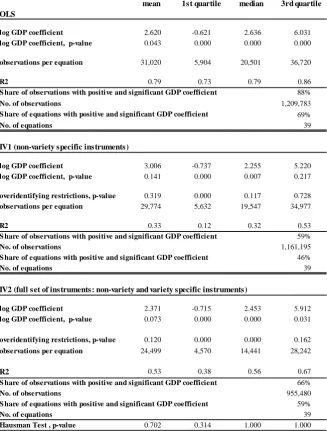
GDP (hereafter, GDP coe¢ cient).22 Given the relatively large number of separate equations,
one per 4-digit sector, the table shows the distribution of the coe¢ cients and of the associated
p-values across our estimations.23 From top to bottom, the three boxes in Table 2 illustrate the results of the OLS estimation and of the two sets of IV estimations, the …rst one considering
only non-variety speci…c instruments (IV1), and the second one with the full set of instruments
(IV2). Hereafter, we refer to the IV2 approach as the benchmark estimation, since it deals with
endogeneity using a wider set of instruments, thereby providing more e¢ cient estimates.
As expected, the mean of the GDP coe¢ cient is positive in all di¤erent estimation strategies,
suggesting that richer countries’consumers tend to import higher quality goods from their trade
partners. The result of our estimations is not driven by just a few sectors: across the 39 estimated
equations, the share of positive and statistically signi…cant GDP coe¢ cients is 59%, and involves
66% of the nearly one million observations in our sample. Table 2 also reports the distribution of
the p-values associated to the GDP coe¢ cient estimates. These …gures represent the measure of
statistical signi…cance for single equations. To assess the joint signi…cance of our GDP coe¢ cients
we need to run a formal test, whose results are shown in Table 3, separately for each approach.
It is straightforward to notice that all our estimates are signi…cantly di¤erent from zero. All
statistical exercises thus lend support to our prediction that product quality rises with importer
income.
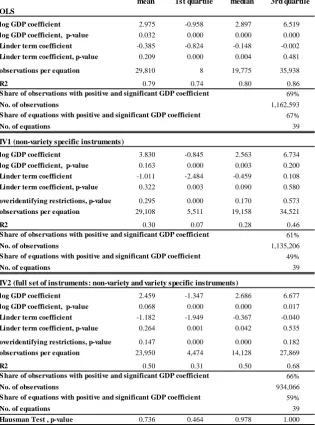
We also conducted a number of exercises to assess the robustness of our results. The …rst one
determines to what extent the Linder hypothesis may bias the quality estimates and, hence, might
distort the relationship between quality and income. The Linder hypothesis postulates that
OLS
log GDP coefficient 2.975 -0.958 2.897 6.519
log GDP coefficient, p-value 0.032 0.000 0.000 0.000
Linder term coefficient -0.385 -0.824 -0.148 -0.002
Linder term coefficient, p-value 0.209 0.000 0.004 0.481
observations per equation 29,810 8 19,775 35,938
R2 0.79 0.74 0.80 0.86
69%
No. of observations 1,162,593
67%
No. of equations 39
log GDP coefficient 3.830 -0.845 2.563 6.734
log GDP coefficient, p-value 0.163 0.000 0.003 0.200
Linder term coefficient -1.011 -2.484 -0.459 0.108
Linder term coefficient, p-value 0.322 0.003 0.090 0.580
overidentifying restrictions, p-value 0.295 0.000 0.170 0.573
observations per equation 29,108 5,511 19,158 34,521
R2 0.30 0.07 0.28 0.46
61%
No. of observations 1,135,206
49%
No. of equations 39
log GDP coefficient 2.459 -1.347 2.686 6.677
log GDP coefficient, p-value 0.068 0.000 0.000 0.017
Linder term coefficient -1.182 -1.949 -0.367 -0.040
Linder term coefficient, p-value 0.264 0.001 0.042 0.535
overidentifying restrictions, p-value 0.147 0.000 0.000 0.182
observations per equation 23,950 4,474 14,128 27,869
R2 0.50 0.31 0.50 0.68
66%
No. of observations 934,066
59%
No. of equations 39
Hausman Test , p-value 0.736 0.464 0.978 1.000
S hare of observations with positive and significant GDP coefficient
S hare of equations with positive and significant GDP coefficient
S hare of observations with positive and significant GDP coefficient
S hare of observations with positive and significant GDP coefficient
S hare of equations with positive and significant GDP coefficient
Note.The table reports several moments of the distribution of the estimates of the coefficients of the log of importer's per capita GDP and of a Linder term (computed as the absolute value of the difference in per capita GDP between importer and exporter), based on a separate demand function for each NACE 4-digit sector. The dependent variable is the log of the variety market share in a given sector. A variety is defined as a product (according to the NACE 8-digit classification) imported from a given country. The variety unit value and a nest term (computed as the variety import share for a given product), are included as regressors, along with other determinants of quality, namely: variety, year and importer effects. The component of quality measure unrelated to income is estimated as the sum of these three effects plus the error term. Each panel of the table refers to a different set of regressions: the top panel summarizes the results obtained using the ordinary least square (OLS) estimator; the mid panel those obtained with an instrumental variable estimator using a subset of non-variety specific instruments only (IV1); the bottom panel those obtained with an in- strumental variable estimator using the full set of variety and non-variety specific instruments (IV2). The Hansen-Sargan test is used to assess the over-identifying restrictions. The Hausman test assesses the validity of the full set of instruments. S ource.Authors' calculations based on the dataset described in Section 3.1.
IV2 (full set of instruments: non-variety and variety specific instruments) S hare of equations with positive and significant GDP coefficient
IV1 (non-variety specific instruments)
Table 4. Summary of estimation results: coefficients of log GDP and Linder term.
OLS IV1 IV2
1.062 0.228 0.830
p-value 0.038 0.007 0.013
-10.944 -2.673 -8.837
p-value 0.039 0.007 0.011
no. of observations 1,209,784 1,161,196 955,481
mean of log GDP coefficient
constant
Note.The table reports the OLS estimates of the coefficients of the log of importer's per capita GDP and of a constant. The dependent variable is a measure of product quality that abstracts from the income component, and is computed as the sum of variety, year and importer effects plus the error term; the results of the set of regressions from which these effects originate are summarized in Table 9. Each column of the table refers to a different regression: the left column summarizes the results obtained using the ordinary least square (OLS) estimator; the mid column those obtained with an instrumental variable estimator using a subset of non-variety specific instruments only (IV1); the right column those obtained with an instrumental variable estimator using the set of variety and non-variety specific instruments (IV2). S ource.Authors' calculations based on the dataset described in Section 3.1.
Table 5. Regressions of quality measures on importer's log GDP.
tries with similar per capita GDP, displaying similar demand structures, would trade more with
each other. In this perspective, any destination country would exhibit an inverse relationship
between the market shares captured by exporters from a particular source country and the per
capita GDP gap between the two countries. To check whether our results might be mainly
driven by this occurrence, we perform again our estimation exercise including as an additional
regressor a ‘Linder term’, computed as the absolute value of the di¤erence between the log of
per capita GDPs of the relevant importer and exporter. Table 4 reports the results relative to
the GDP coe¢ cients and the Linder terms.24 As expected, the Linder term is negative (though, on average, not statistically signi…cant), but its introduction seems to have little in‡uence on
the GDP coe¢ cients, which remain positive and signi…cant, and actually exhibit a slight rise in
their average magnitudes relative to those delivered by our benchmark exercises.
As a further robustness exercise, we test the relationship between quality and income
follow-ing a two stage approach. First, we estimate product quality without considerfollow-ing the income
term y in (10), in line with the original Khandelwal (2010) speci…cation. Then, we assess the
relationship between quality estimates and importer income by means of a OLS regression. Table
5 summarizes the results that we obtain on aggregate.25 Once again, these results show that
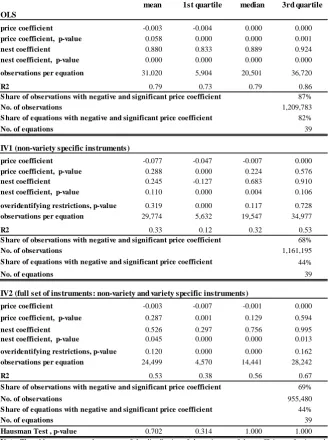
2 4Table 8 in Appendix B reports the results relative to the coe¢ cients of prices and nest terms.
the relationship between product quality and importer’s income per capita is positive and highly
signi…cant.
3.3
Discussion
In our estimations, the GDP coe¢ cient captures how our quality measure changes with the log
of the importer’s per capita income. As such, we can interpret its magnitude in terms of
semi-elasticity: that is, a ten percent increase in importer income produces, on average, approximately
a0:23units rise in product quality.26
Of course, our main interest is actually in whether the estimated magnitude of the GDP
coe¢ cient should be considered as sizeable or negligible. As it is often the case with
semi-elasticity, pinpointing a benchmark against which to compare the …gure would help in obtaining
a more transparent assessment. Furthermore, our …gure refers to the average of the income
semi-elasticities of quality across heterogeneous sectors. In order to get a more reliable assessment, the
benchmark should then be determined at the sectoral level, and the average should be computed
on the sectoral …gures ‘standardized’against the relevant benchmarks.
We identify the benchmark as the length of the sectoral quality ladder. A quality ladder is
de…ned as the set of available (or, in this case, observed) qualities in a given market (here, the
relevant sector). Its length is measured by the di¤erence between the highest and the lowest
quality levels. Divided by the length of the quality ladder, an (appropriately scaled down as
above) sectoral GDP coe¢ cient is interpretable as the percentage distance covered by moving
from consuming a product to another across the sectoral quality ladder, in response to a given
percentage increase in importer income. The resulting sectoral …gures are
‘adimensional’statis-tics, hence their mean produces a fairly transparent and reliable indicator of imports’ average
product quality upgrading as importer income rises.
The newly developed quality upgrading indicator reveals that a ten percent increases in
importer income produces a shift of the products consumed across the quality ladders that
and the results relative to the coe¢ cients of log GDP at the sectoral level of the second-stage estimation.
2 6Due to the linear-log relationship between product quality and per capita GDP, the …gure reported in the
covers, on average, 2:75% of their length. This implies that an importer that is twice as rich as another enjoys products sitting, on average, in a position20% higher in the sectoral quality ladders; and that in order for the shift in the product consumed to cover 50% of the quality ladder, an importer should be 5:6 times as rich. Thanks to the quality upgrading indicator, we may also deduce more concrete …gures. For example, we can infer that the 2013 per capita
income distribution interdecile ratio produces a shift in the products imported that covers an
average distance across the sectoral qualities ladders of about56%in France and Germany;71%
in Italy;74%in Spain; and68%in the UK. If we dared bringing our quality upgrading indicator out of sample, the average distance covered across the sectoral quality ladders would be ranging
from less than50%in Iceland and Denmark to well over80%in the United States and Chile.27
Another noteworthy aspect arising from our estimates is that the magnitude of the GDP
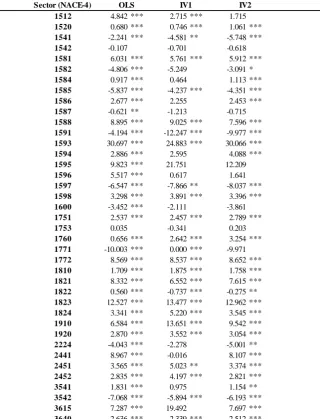
coe¢ cients is rather varied across sectors. This might be partly due to the fact that, at a 4-digit
disaggregation level, products are quite heterogeneous in some sectors; and partly to the mere
fact that the dataset is admittedly somewhat noisy. To put things into perspective, we may focus
our attention to those sectors where products are relatively ‘homogeneous’(i.e., cross-products
substitutability is estimated to be relatively high), and demand is ‘well-behaved’(i.e., negatively
related to the product price): that is, sectors where the nest share coe¢ cient, , is estimated
to be positive; the price coe¢ cient, , negative; and both coe¢ cients statistically signi…cant.
The share of sectors with positive and signi…cant GDP coe¢ cients raises from59%to70%when ‘homogeneous’ sectors are considered, and up to 83% if we also condition on ‘well-behaved’ demand.
A further possible reason for the observed heterogeneous magnitude of the GDP coe¢ cients
may arise from the sectoral di¤erences in thescopefor quality upgrading. For example, if higher
quality products are relatively inexpensive in a given sector, then there could be more scope
for purchasing them even with a limited rise in the importer income, and vice versa. We may
think of the length of a sectoral quality ladder also as an observable measure of the scope for
quality upgrading, since by de…nition it reveals the largest possible quality range for a given
2 7The 2013 interdecile ratios of the income distribution in the cited countries are:6:9in France,6:8in Germany,
income di¤erential: the one between the richest and the poorer importer.28 In this context, one
could expect GDP coe¢ cients to be larger in those sectors exhibiting longer quality ladders. For
the generality of sectors, the correlation between the two variables is however not statistically
signi…cant ( 0:19with p-value0:24). If we condition on ‘homogeneous’and ‘well-behaved’sectors (in the sense speci…ed above), then the correlation becomes positive and signi…cant (0:75 with p-value0:005) as expected.
Finally, a note on potentially interesting further development and investigation of the link
between product quality and importer income within the framework used in this paper. The
theory presented here relies on the assumption that some products are imported because, though
ine¢ ciently produced, they meet the idiosyncratic taste of some consumers. Such products are
therefore expensive and capture small markets shares, thus are accordingly assigned a low quality
level. In the presence of a bell-shaped income distribution in the destination country, however,
our empirical results on the link between import quality and importer income are suggestive of
a competing explanation for niche products. Although e¢ ciently produced, some top quality
products might be so expensive to be a¤ordable only for a thin fraction of rich importers. These
products are also assigned a low quality level though, since they command high prices and
small (quantitative) market shares. Unfortunately, we are at present unable to disentangle
the two groups of products, since the available data include neither end user characteristics
of the importer, nor su¢ cient elements to determine whether the exported goods are e¢ ciently
produced.
It should be noted, however, that this caveat should not substantially a¤ect our …ndings.
Fail-ure to identify the quality level of high segment products would in fact shorten the quality ladder,
if anything underestimating the scope for quality upgrading. In this perspective, the estimated
GDP coe¢ cients might actually be interpreted as a lower bound to the magnitude of the actual
link between product quality and importer income. Furthermore, it should be noted that the
quality upgrading indicator developed above would be in‡uenced by the identi…cation issue both
at thenumerator(downward-biased GDP coe¢ cient) and at thedenominator (downward-biased
2 8In terms of primitives, the link between importer income and quality ladder length stems from the connection
quality ladder length). Under the assumption that the two biases are not too disproportionate,
one may conjecture that this indicator might provide not only a more transparent …gure, but
also a more reliable measure of the relationship between import quality and importer income
than our estimated GDP coe¢ cients, even at the sectoral level.
4
Conclusion
This paper provides theoretical support and empirical evidence to one of the major issues in
the international trade literature: whether quality of imports rises systematically with importer
income. Our framework builds on the discrete choice models approach. The novelty of the
paper lies in the joint consideration of two results stemming from our framework. First, product
quality is income dependent and, in particular, their relationship is positive. Second, our quality
measure depend not only on product prices but also on market shares; hence, in our estimations,
we depart from the traditional assumption that prices are proxies for quality.
We test our hypothesis on a dataset consisting of import data of …ve EU countries (namely:
France, Germany, Italy, Spain and the UK), and over a 13-year time span,i.e., 1995-2007.
The main contribution of the paper is that we …nd a positive and signi…cant relationship
between the per capita GDP of the selected countries and the alternative quality measure
de-livered by the model. Our estimates are robust to a number of controls and to three di¤erent
methodological approaches, based on di¤erent instrumental variable strategies.
As an additional contribution, we derive from our estimates a novel, fairly transparent and,
under certain assumptions, reliable indicator of import quality upgrading as importer income
rises. Based on this indicator, our …ndings reveal that doubling importer income brings about an
average product quality upgrading of20%, relative to the length of the quality ladders. Looking at the 2013 per capita incomes in our …ve destination countries, this in turn implies that moving
up from the …rst to the ninth decile of the income distribution generates a ‘in-sample’product
Appendices
A
Proof of theoretical results
A.1
Derivation of aggregate demand (2)
Consider the choice of a generic good(j; X)over all possible alternatives in the market, namely
f(k; Y)g, with k6= j whenY =X. Given (1), the decision rule for consumer i in country M
is as follows: consume good (j; X)only if Vj;Xi;M > Vk;Yi;M,8(k; Y)6= (j; X). Our task is thus to compute the probability:
Pr (j; Xji; M) = Pr "i;Mj;X > max
Y=fN;S;Mg maxk n
M k;Y +"
i;M k;Y
M j;X
o
(k;Y)6=(j;X) !
The term on the right-hand side represents the joint probability that horizontal di¤erentiation
of good(j; X)is valued by consumeriin countryM more than that of any other good. We can therefore write:
Pr (j; Xji; M) =
Z +1
1
f "i;Mj;X exp
Z
k6=j
ln
Z "i;Mj;X+ M j;X Mk;X
1
f "i;Mk;X d"i;Mk;X
!
dk
+ X
Y6=X
Z 1
0
ln
Z "i;Mj;X+ M j;X Mk;Y
1
f "i;Mk;Y d"i;Mk;Y
!
dk
1
Ad"i;Mj;X (11)
where, exploiting the properties of the exponential function, we have expressed the product of a
generic sequencezh as:
Y
h
zh= Y
h
exp (ln (zh)) = exp X
h
(ln (zh))
The term R" i;M j;X+
M j;X Mk;Y
1 f "
i;M k;Y d"
i;M
k;Y is the cumulative distribution function (CDF) of
"i;Mk;Y up to the value"i;Mj;X + Mj;X Mk;Y. Since"i;Mk;Y is a Gumbel random variable, we have:
Z "i;M j;X+ M j;X M k;Y 1
f "i;Mk;Y d"i;Mk;Y = Pr "i;Mk;Y < "i;Mj;X + Mj;X Mk;Y
Replacing this value into (11) yields:
Pr (j; Xji; M) =
Z +1
1
f "i;Mj;X exp
Z
k6=j
exp h"i;Mj;X + Mj;X Mk;Xi dk
X
Y6=X
Z 1
0
exp h"i;Mj;X + Mj;X Mk;Yi dk
1
Ad"i;Mj;X (12)
Also, the probability density function (PDF) of a Gumbel random variable is:
f "i;Mj;X = exp "i;Mj;X exp "i;Mj;X
Plugging this expression into (12), and rearranging, we obtain:
Pr (j; Xji; M) =
Z +1
1
exp "i;Mj;X exp "i;Mj;X 1 +
Z
k6=j
exp Mk;X Mj;X dk
+ X
Y6=X
Z 1
0
exp Mk;Y Mj;X dk d"i;Mj;X
=
Z +1
1
exp "i;Mj;X exp "i;Mj;X
X
Y=fN;S;Mg
Z 1
0
exp Mk;Y Mj;X dk d"i;Mj;X (13)
where in the last equation we have exploited the fact that1 = exp (0) = exp Mj;X Mj;X . Denote:
$ X
Y=fN;S;Mg
Z 1
0
exp Mk;Y Mj;X dk
and:
g "i;Mj;X exp "i;Mj;X $exp "i;Mj;X
Note thatg "i;Mj;X is the PDF of a Gumbel random variable with CDF:
since:
dexp $exp "i;Mj;X =$
d" =
exp $exp "i;Mj;X
$ $exp "
i;M j;X
= exp "i;Mj;X $exp "i;Mj;X =g "i;Mj;X
Thus, we can use the last equation to rewrite (13) as:
Pr (j; Xji; M) = P 1
Y=fN;S;Mg R1
0 exp
M
k;Y Mj;X dk 2
4exp
0
@ exp "i;Mj;X X
Y=fN;S;Mg
Z 1
0
exp Mk;Y Mj;X dk
1 A 3 5 +1 1
where the term in square brackets vanishes since its limit value for"i;Mj;X !+1equals one, and for"i;Mj;X ! 1equals zero. Finally, we multiply and divide byexp Mj;X to get:
Pr (j; Xji; M) =
exp Mj;X
P
Y=fN;S;Mg R1
0 exp
M k;Y dj
Noting that countryM has measure M, integrating over consumers, (2) obtains.
A.2
Derivation of optimality conditions (4) and (5)
Di¤erentiating (3) with respect top, and setting the resulting expression equal to zero, yields:
1 pMj;X wX
q2
2AX
Mexp M
q pM
j;X P
Y=fM;N;Sg R1
0 exp
M k;Y dk
= 0
simplifying and rearranging, (4) straightforwardly obtains. Di¤erentiating (3) with respect toq,
and setting the resulting expression equal to zero, we get:
"
qM j;X
AX
+ M p wX
qM j;X
2
2AX !#
Mexp Mqj;XM p P
Y=fM;N;Sg R1
0 exp
M k;Y dk
Simplifying this expression returns:
qM j;X
AX
= M p wX
qM j;X
2
2AX !
Using (4) to substitute forp=pMj;X, simplifying and rearranging leads immediately to (5).
For completeness, we might also compute the (average) valuation of good (j; X)in countryM. Plugging (4) into the de…nition of Mj;X, we have:
M
j;X =qMj;X M
2AX
qj;XM 1 wX
Then, using (5) to substitute forqMj;X, and rearranging we get:
M j;X =
M 2A X
2 1 wX (14)
We may note that all …rms within each source country optimally supply to country M goods
that are, on average, equally valued ( Mj;X = MX,8j). Furthermore, by comparing (14) computed for the two countries, it follows that and goods from N are given larger valuation than those
fromS if
M 2(A
N AS)
2 > (wN wS) (15)
since either consumers’valuation for quality must be su¢ ciently high, or technological capabilities
inN su¢ ciently superior, to overcome its disadvantage in manufacturing costs.
A.3
Auxiliary derivations for Section 3.3
GDP coe¢ cients and quality ladder length. Consider a sector s with a quality space of measure s (hereafter, quality ladder length), and suppose that the following relationship
between quality (qs) and per capita GDP (Y) holds at the sectoral level:
where s is a …xed sectoral parameter. For a given change in per capita GDP, say from Y0 to
Y1 gY0, quality vary fromq0
s toq1s according to the expression:
qs qs1 q0s= slnY1 slnY0= sln Y1=Y0 = slng (16)
In the text, we refer to the average value of the GDP coe¢ cient, ^s ( s) = 2:371, where
( )here denotes the arithmetic mean operator across sectors. By averaging both sides of (16), we obtain:
^
qs ( qs) = ^slng
Hence, for a 10% growth in per capita GDP (g = 1:1), we have a rise in quality of q^s =
2:371 0:095 = 0:23units.
We may ‘standardize’(16) by dividing both sides by s, to get:
s
qs s
= s
s
lng= slng
where s s= s. Here, s can be interpreted as the distance covered by the quality variation
relative to the quality ladder length. We can average both sides of the last expression to obtain:
^s= ^slng
In the data, ^s is 0:29. Hence, for a10% growth in per capita GDP (g = 1:1), the quality ladder is on average climbed up by^s= 0:29 0:095 = 2:75%. If per capita GDP doubles (g= 2), then ^s = 0:29 0:69 = 20%. To cover, on average, half of the quality ladder (^s= 50%), per capita GDP should grow by the factorg=e^s=^s =e0:50=0:29= 5:6.
Regarding the 2013 interdecile ratios of the income distribution in the cited countries, we
obtain an average climbing up the quality ladder of about ^s = 0:29 ln 6:9 = 56% in France,
^s= 0:29 ln 6:8 = 55:6%in Germany,^s= 0:29 ln 11:4 = 71%in Italy,^s= 0:29 ln 12:7 = 74%
in Spain,^s= 0:29 ln 10:6 = 68%in the UK;^s= 0:29 ln 5 = 47%in Iceland,^s= 0:29 ln 5:3 = 48% in Denmark,^s= 0:29 ln 18:5 = 85% in the United States, and ^s = 0:29 ln 20:6 = 88%
Cost of quality upgrading and quality ladder length. In order to explicitly di¤erentiate the cost functions across sectors, let a sectoral parameter s(where the subscriptsidenti…es the
sector under consideration) enter the cost function, to obtain:
wX+ sq2
2AX
Di¤erentiating this expression with respect toqand using (5) yields the sectoral measure of the
cost of quality upgrading:
s s
AX
Finally, de…ning the sectoral quality ladder in a given destination country M as the di¤erence
between the highest and the lowest quality levels of the goods imported byM, the model yields
L M
N MS . Using the de…nition of MX and once again (5), we may rewrite this expression
as:
Ls L s; M = M
s M
(AN AS) =
1
s M
(AN AS)
It is then immediate to notice the inverse relationship between the length of the ladderLsand the
cost of quality upgrading s: hence, a sector characterized by a lower cost of quality upgrading