DEVICE SPECIFICATIONS
NI USB-6212
M Series Data Acquisition: 16 AI, 2 AO, 32 DIO Bus-Powered USB
The following specifications are typical at 25 °C, unless otherwise noted. For more information about the NI USB-6212, refer to the NI USB-621x User Manual available from ni.com/manuals.
Caution The input/output ports of this device are not protected for electromagnetic interference due to functional reasons. As a result, this device may experience reduced measurement accuracy or other temporary performance degradation when connected cables are routed in an environment with radiated or conducted radio frequency electromagnetic interference.
To ensure that this device functions within specifications in its operational electromagnetic environment and to limit radiated emissions, care should be taken in the selection, design, and installation of measurement probes and cables.
Analog Input
Number of channels 8 differential or 16 single ended
ADC resolution 16 bits
DNL No missing codes guaranteed
INL Refer to the AI Absolute Accuracy section
Sample rate
Single channel maximum 400 kS/s Multichannel maximum (aggregate) 400 kS/s
Minimum 0 S/s
Timing resolution 50 ns
Timing accuracy 50 ppm of sample rate
Input coupling DC
Input range ±0.2 V, ±1 V, ±5 V, ±10 V
Maximum working voltage for analog inputs (signal + common mode)
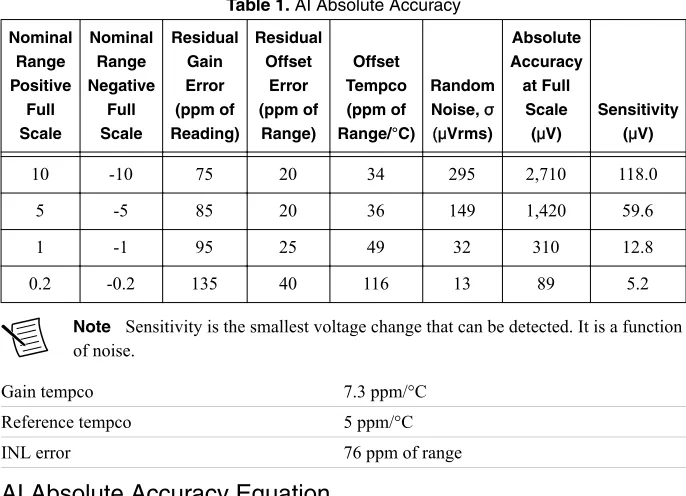
CMRR (DC to 60 Hz) 100 dB Input impedance
Device on
AI+ to AI GND >10 GΩ in parallel with 100 pF AI- to AI GND >10 GΩ in parallel with 100 pF Device off
AI+ to AI GND 1,200 Ω
AI- to AI GND 1,200 Ω
Input bias current ±100 pA
Crosstalk (at 100 kHz)
Adjacent channels -75 dB
Non-adjacent channels -90 dB Small signal bandwidth (-3 dB) 1.5 MHz
Input FIFO size 4,095 samples
Scan list memory 4,095 entries
Data transfers USB Signal Stream, programmed I/O
Overvoltage protection for all analog input and sense channels
Device on ±30 V for up to two AI pins
Device off ±20 V for up to two AI pins
Input current during overvoltage condition ±20 mA maximum/AI pin
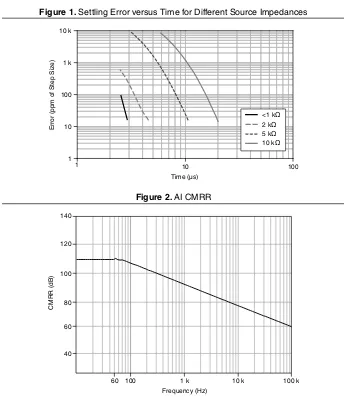
Settling Time for Multichannel Measurements
Accuracy, full-scale step, all ranges
Typical Performance Graphs
Figure 1. Settling Error versus Time for Different Source Impedances
1 10 100 1 k 10 k
1
10 100
Time (µs)
Error (ppm of Step Siz
e)
<1 kΩ
2 kΩ
5 kΩ
10 kΩ
Figure 2. AI CMRR
40 60 80 100 120
60 100 1 k 10 k 100 k Frequency (Hz)
CMRR (dB)
140
AI Absolute Accuracy
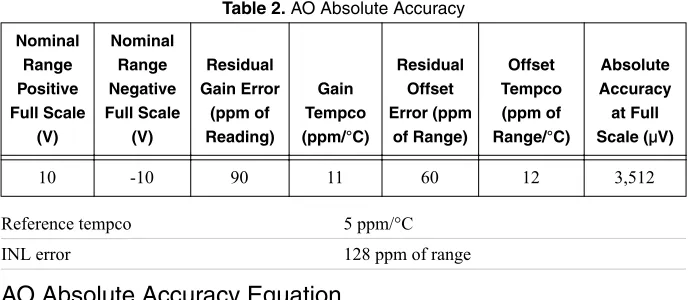
Table 1. AI Absolute Accuracy Nominal
Range Positive
Full Scale
Nominal Range Negative
Full Scale
Residual Gain Error (ppm of Reading)
Residual Offset
Error (ppm of
Range)
Offset Tempco (ppm of Range/°C)
Random Noise, σ (μVrms)
Absolute Accuracy at Full
Scale (μV)
Sensitivity (μV)
10 -10 75 20 34 295 2,710 118.0
5 -5 85 20 36 149 1,420 59.6
1 -1 95 25 49 32 310 12.8
0.2 -0.2 135 40 116 13 89 5.2
Note Sensitivity is the smallest voltage change that can be detected. It is a function of noise.
Gain tempco 7.3 ppm/°C
Reference tempco 5 ppm/°C
INL error 76 ppm of range
AI Absolute Accuracy Equation
AbsoluteAccuracy = Reading · (GainError) + Range · (OffsetError) + NoiseUncertainty GainError = ResidualAIGainError + GainTempco · (TempChangeFromLastInternalCal)
+ ReferenceTempco · (TempChangeFromLastExternalCal) OffsetError = ResidualAIOffsetError + OffsetTempco ·
(TempChangeFromLastInternalCal) + INLError NoiseUncertainty = Random Noise ⋅ 3
100 for a coverage factor of 3 σ and averaging
100 points.
AI Absolute Accuracy Example
Absolute accuracy at full scale on the analog input channels is determined using the following assumptions:
• TempChangeFromLastExternalCal = 10 °C • TempChangeFromLastInternalCal = 1 °C • number_of_readings = 100
• CoverageFactor = 3 σ
For example, on the 10 V range, the absolute accuracy at full scale is as follows: GainError = 75 ppm + 7.3 ppm · 1 + 5 ppm · 10 = 132 ppm
NoiseUncertainty = 295 µ� ⋅ 3
100 = 88.5 µV
AbsoluteAccuracy = 10 V · (GainError) + 10 V · (OffsetError) + NoiseUncertainty = 2,710 µV
Analog Output
Number of channels 2
DAC resolution 16 bits
DNL ±1 LSB
Monotonicity 16 bit guaranteed
Maximum update rate
1 channel 250 kS/s
2 channels 250 kS/s per channel
Timing accuracy 50 ppm of sample rate
Timing resolution 50 ns
Output range ±10 V
Output coupling DC
Output impedance 0.2 Ω
Output current drive ±2 mA
Overdrive protection ±30 V
Overdrive current 2.4 mA
Power-on state ±20 mV
Power-on glitch ±1 V for 200 ms
Output FIFO size 8,191 samples shared among channels used
Data transfers USB Signal Stream, programmed I/O
AO waveform modes Non-periodic waveform, periodic waveform regeneration mode from onboard FIFO, periodic waveform regeneration from host buffer including dynamic update
Settling time, full-scale step, 15 ppm (1 LSB)
32 µs
Slew rate 5 V/µs
Glitch energy
Magnitude 100 mV
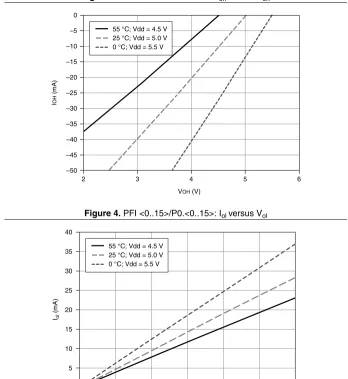
AO Absolute Accuracy
Absolute accuracy at full-scale numbers is valid immediately following internal calibration and assumes the device is operating within 10 °C of the last external calibration.
Note Accuracies listed are valid for up to one year from the device external calibration.
Table 2. AO Absolute Accuracy Nominal
Range Positive Full Scale
(V)
Nominal Range Negative Full Scale
(V)
Residual Gain Error
(ppm of Reading)
Gain Tempco (ppm/°C)
Residual Offset Error (ppm
of Range)
Offset Tempco (ppm of Range/°C)
Absolute Accuracy at Full Scale (μV)
10 -10 90 11 60 12 3,512
Reference tempco 5 ppm/°C
INL error 128 ppm of range
AO Absolute Accuracy Equation
AbsoluteAccuracy = OutputValue · (GainError) + Range · (OffsetError)
GainError = ResidualGainError + GainTempco · (TempChangeFromLastInternalCal) +
ReferenceTempco · (TempChangeFromLastExternalCal)
OffsetError = ResidualOffsetError + AOOffsetTempco ·
(TempChangeFromLastInternalCal) + INLError
Digital I/O/PFI
Static Characteristics
Digital input or output (Screw Terminal) 32 total, 16 (P0.<0..15>), 16 (PFI <0..7>/P1.<0..7>, PFI <8..15>/P2.<0..7>) Digital input or output
(Mass Termination/BNC)
24 total, 8 (P0.<0..7>), 16 (PFI <0..7>/P1.<0..7>, PFI <8..15>/P2.<0..7>)
Pull-down resistor 50 kΩ typical, 20 kΩ minimum Input voltage protection ±20 V on up to 8 pins1
PFI Functionality
Functionality Static digital input, static digital output, timing input, timing output
Timing output sources Many AI, AO, counter timing signals Debounce filter settings 125 ns, 6.425 µs, 2.56 ms, disable; high and
low transitions; selectable per input
Maximum Operating Conditions
IOL output low current 16 mA maximum IOH output high current -16 mA maximum
Digital Input Characteristics
Level Minimum Maximum
VIL input low voltage 0 V 0.8 V
VIH input high voltage 2.2 V 5.25 V
IIL input low current (Vin = 0 V) - -10 μA
IIH input high current (Vin = 5 V) - 250 μA
Positive-going threshold (VT+) - 2.2 V
Negative-going threshold (VT-) 0.8 V
-Delta VT hysteresis (VT+ - VT-) 0.2 V
Digital Output Characteristics
Figure 3. PFI <0..15>/P0.<0..15>: Ioh versus Voh
I
OH
(mA)
–30 –5 –10 –15 –20 –25
–35 –40 –45
VOH (V) 0
–50
55 °C; Vdd = 4.5 V 25 °C; Vdd = 5.0 V 0 °C; Vdd = 5.5 V
6
2 3 4 5
Figure 4. PFI <0..15>/P0.<0..15>: Iol versus Vol
10 35
30
25
20
15
5 40
0
1.2 0 0.2 0.4 0.6 0.8 1
Vol (V) Iol
(mA)
General-Purpose Counters/Timers
Number of counter/timers 2
Resolution 32 bits
Counter measurements Edge counting, pulse, semi-period, period, two-edge separation
Position measurements X1, X2, X4 quadrature encoding with Channel Z reloading; two-pulse encoding Output applications Pulse, pulse train with dynamic updates,
frequency division, equivalent time sampling Internal base clocks 80 MHz, 20 MHz, 0.1 MHz
External base clock frequency 0 MHz to 20 MHz
Base clock accuracy 50 ppm
Inputs Gate, Source, HW_Arm, Aux, A, B, Z,
Up_Down
Routing options for inputs PFI <0..15>, many internal signals
FIFO 1,023 samples
Data transfers USB Signal Stream, programmed I/O
Frequency Generator
Number of channels 1
Base clocks 10 MHz, 100 kHz
Divisors 1 to 16
Base clock accuracy 50 ppm
Output can be available on any output PFI terminal.
External Digital Triggers
Source PFI <0..15>
Polarity Software-selectable for most signals
Analog input function Start Trigger, Reference Trigger,
Analog output function Start Trigger, Pause Trigger, Sample Clock, Sample Clock Timebase
Counter/timer function Gate, Source, HW_Arm, Aux, A, B, Z, Up_Down
Bus Interface
USB USB 2.0 Hi-Speed or full-speed2
USB Signal Stream 4, can be used for analog input, analog output, counter/timer 0, counter/timer 1
Current Limits
+5 V terminal as output3Voltage 4.6 V to 5.2 V
Current (internally limited) 50 mA maximum, shared with digital outputs +5 V terminal as input3
Voltage 4.75 V to 5.35 V
Current 350 mA maximum, self-resetting fuse
Caution Do not exceed 16 mA per DIO pin.
Protection ±10 V
Power Requirements
Input voltage on USB port 4.5 V to 5.25 V in configured state
Maximum inrush current 500 mA
No load typical current 320 mA at 4.5 V
2 If you are using an USB M Series device in full-speed mode, device performance will be lower and you will not be able to achieve maximum sample/update rates.
Maximum load
Typical current 400 mA at 4.5 V
Suspend current 260 μA typical
Physical Characteristics
Dimensions (includes connectors)Screw terminal enclosure 16.9 cm × 9.4 cm × 3.1 cm (6.65 in. × 3.70 in. × 1.20 in.) Mass Termination 19.3 cm × 9.4 cm × 3.1 cm
(7.61 in. × 3.68 in. × 1.20 in.) BNC enclosure 23.5 cm × 11.2 cm × 6.4 cm
(9.25 in. × 4.40 in. × 2.50 in.) Weight
Screw Terminal 206 g (7.2 oz)
Mass Termination 227 g (8.0 oz)
BNC 950 g (33.5 oz)
OEM 76 g (2.6 oz)
I/O connectors
Screw terminal 4 16-position combicon
Mass Termination 1 68-pin SCSI
BNC 19 BNCs and 26 screw terminals
USB connector Series B receptacle
Screw terminal wiring 16 to 28 AWG
Torque for screw terminals 0.22 to 0.25 N · m (2.0 to 2.2 lb · in.)
Calibration
Recommended warm-up time 15 minutes
Calibration interval 1 year
Environmental
Operating temperature 0 ºC to 45 ºC
Humidity 10% RH to 90% RH, noncondensing
Maximum altitude 2,000 m
Pollution Degree 2
Indoor use only.
Maximum Working Voltage
Maximum working voltage refers to the signal voltage plus the common-mode voltage.
Channel-to-earth ground 11 V, Measurement Category I
Measurement Category I is for measurements performed on circuits not directly connected to the electrical distribution system referred to as MAINS voltage. MAINS is a hazardous live electrical supply system that powers equipment. This category is for measurements of voltages from specially protected secondary circuits. Such voltage measurements include signal levels, special equipment, limited-energy parts of equipment, circuits powered by regulated low-voltage sources, and electronics.
Caution Do not use for measurements within Categories II, III, or IV.
Note Measurement Categories CAT I and CAT O (Other) are equivalent. These test and measurement circuits are not intended for direct connection to the MAINS building installations of Measurement Categories CAT II, CAT III, or CAT IV.
Safety
This product is designed to meet the requirements of the following electrical equipment safety standards for measurement, control, and laboratory use:
• IEC 61010-1, EN 61010-1 • UL 61010-1, CSA 61010-1
Note For UL and other safety certifications, refer to the product label or the Online Product Certification section.
Electromagnetic Compatibility
This product meets the requirements of the following EMC standards for sensitive electrical equipment for measurement, control, and laboratory use:
• EN 61326-2-1 (IEC 61326-2-1): Class A emissions; Basic immunity • EN 55011 (CISPR 11): Group 1, Class A emissions
• FCC 47 CFR Part 15B: Class A emissions • ICES-001: Class A emissions
Note In the United States (per FCC 47 CFR), Class A equipment is intended for use in commercial, light-industrial, and heavy-industrial locations. In Europe, Canada, Australia and New Zealand (per CISPR 11) Class A equipment is intended for use only in heavy-industrial locations.
Note Group 1 equipment (per CISPR 11) is any industrial, scientific, or medical equipment that does not intentionally generate radio frequency energy for the treatment of material or inspection/analysis purposes.
Note For EMC declarations and certifications, and additional information, refer to the Online Product Certification section.
CE Compliance
This product meets the essential requirements of applicable European Directives, as follows: • 2014/35/EU; Low-Voltage Directive (safety)
• 2014/30/EU; Electromagnetic Compatibility Directive (EMC) • 2011/65/EU; Restriction of Hazardous Substances (RoHS)
Online Product Certification
Refer to the product Declaration of Conformity (DoC) for additional regulatory compliance information. To obtain product certifications and the DoC for this product, visit ni.com/ certification, search by model number or product line, and click the appropriate link in the Certification column.
Environmental Management
NI is committed to designing and manufacturing products in an environmentally responsible manner. NI recognizes that eliminating certain hazardous substances from our products is beneficial to the environment and to NI customers.
For additional environmental information, refer to the Minimize Our Environmental Impact
Waste Electrical and Electronic Equipment (WEEE)
EU Customers At the end of the product life cycle, all NI products must be disposed of according to local laws and regulations. For more information about how to recycle NI products in your region, visit ni.com/environment/weee.
电子信息产品污染控制管理办法(中国
RoHS
)
中国客户 National Instruments符合中国电子信息产品中限制使用某些有害物
质指令(RoHS)。关于National Instruments中国RoHS合规性信息,请登录
Device Pinouts
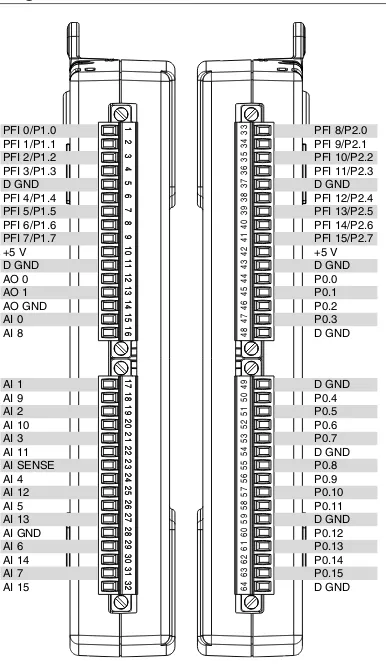
Figure 5. NI USB-6212 Screw Terminal Pinout
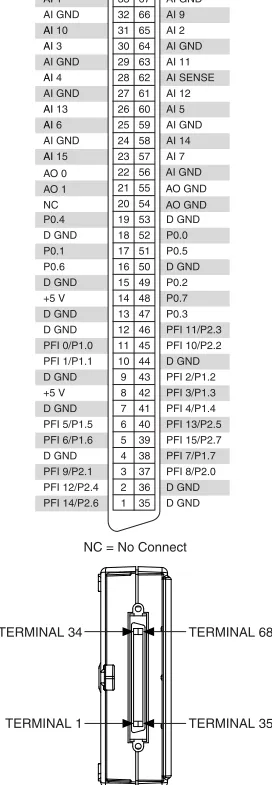
Figure 6. NI USB-6212 Mass Termination Pinout PFI 14/P2.6 PFI 12/P2.4 PFI 9/P2.1 D GND PFI 6/P1.6 PFI 5/P1.5 D GND +5 V D GND PFI 1/P1.1 PFI 0/P1.0 D GND D GND +5 V D GND P0.6 P0.1 D GND P0.4 NC AO 1 AO 0
AI 15 AI GND
AI 6
AI 13 AI GND
AI 4 AI GND
AI 3
AI 10 AI GND
AI 1
AI 8 D GND PFI 8/P2.0 PFI 7/P1.7 PFI 13/P2.5 PFI 4/P1.4 PFI 3/P1.3 PFI 2/P1.2 D GND PFI 15/P2.7 D GND PFI 10/P2.2 PFI 11/P2.3 P0.3 P0.7 P0.2 D GND P0.5 P0.0 D GND AO GND AO GND AI GND AI 7 AI 14 AI GND AI 5 AI 12 AI SENSE AI 11 AI GND AI 2 AI 9 AI GND
AI 0
Figure 7. NI USB-6212 BNC Pinout
NI USB-6212/6216
AI x +
AI x – GS
0.1 µF 5 kΩ
AI GND FS +
–
USB-621x Device Floating
Source
AI x +
AI x – GS
0.1 µF 5 kΩ
AI GND FS +
–
USB-621x Device