World Maritime University
The Maritime Commons: Digital Repository of the World
Maritime University
World Maritime University Dissertations Dissertations
1991
Towards a port marketing plan for Kingston
Terminal Operators Limited
Claudia K. Gordon
World Maritime University
Follow this and additional works at:http://commons.wmu.se/all_dissertations
Part of theMarketing Commons, and theTransportation Commons
This Dissertation is brought to you courtesy of Maritime Commons. Open Access items may be downloaded for non-commercial, fair use academic purposes. No items may be hosted on another server or web site without express written permission from the World Maritime University. For more information, please [email protected].
Recommended Citation
Gordon, Claudia K., "Towards a port marketing plan for Kingston Terminal Operators Limited" (1991).World Maritime University Dissertations. 541.
WORLD MARITIME UMIVERS ITY
Malmoe, Sweden
TOWARDS A PORT MARKETING PLAN FOR
KINGSTON TERMINAL OPERATORS LIMITED
by
CLAUDIA K. , OORDOM
JAMAICA
A dissertation submitted to the World Maritime
University in partial fulfilment of the requirements
for the award of the:
Degree of Master of Science in
Ports and Shipping Administration
I certify that all material in this dissertation which is not my own work has been identified and that no material is included for which a degree has been previously conferred upon me.
The contents of this dissertation reflect my personal views and are not necessarily endorsed by the University.
OFFICE: Course Professor
WORLD MARITIME UNIVERSITY
Co-assessed by:
NAME : E. POLLOCK
VISITING PROFESSOR
Signature:
Date:
it J/P./.9J.
Supervised and assessed by:
NAME: P. M. Alderton
A C I C I S r O W L E D G H I M E l S r T
This dissertation presents the ideal forum for the author to
express her gratitude for the contribution of those individuals
and or institutions which, in one v/ay or the other, made her
study at the World Maritime University possible, as well as those
who assisted in the preparation of this paper. While it is
impossible to name everyone, special mention has to be made of the following:
Firstly, to the Canadian International Development Agency
(CIDA) , for providing the necessary* funding during the tv70 years
of study.
The contributions of the course professor
and lecturer Dr. H. E. Haralambides
knov/ledge, advice and overall guidance v highly appreciated.
essor P. M. Alderton
in terms of shared
of great benef i t and
My sincere gratitude to Professor E. Pollock v/ho took time
out of his busy schedule on several occasions to share with me
his enormous experience as a port marketing consultant and
offered valuable suggestions and comments during the production
of'this paper. Assistance given me by Professors P. Houssin, H.
Beth v;ere also greatly appreciated.
The management and staff of Kingston Terminal Operators
Limited, for their encouragement and support. In this regard,
special mention needs to be made of Messrs M. Belcher, W.
Sweeney, A. Mitchell, N. Lindo and E. Banks; Mrs. V. Stennett
and Ms. M. Brown.
The Management and staff of Associated British Ports (ABP)
and in particular Messrs Alasdair Clarke and Joe Besch with v/hom
I did my month's On-The-Job training. Thanks also to the
Felixstowe and South Hampton v/ho were very kind in accommodating
my special visits and sharing with me their wealth of experience
in marketing their respective ports.
Finally, my gratitude to Mrs. 0. Daniels, Mr. H. Mack
Ms. N. Wiltshire for their invaluable comments, suggestions
over all technical assistance in the actual preparation of
dissertation.
and
and
this
CLAUDIA K. GORDON
Malmoe, Sweden
A B S T R A C T
The objectives of this dissertation are two-fold.
Firstly, it attempts to demonstrate the relevance of a
comprehensive marketing approach to. the improvement of the
performance of Kingston Terminal Operators Ltd (KTO), and
secondly to present guidelines for the development of a marketing
plan for the Terminal. For analytical purposes, the paper is
divided into seven chapters.
Chapters 1 to 3 attempt to set the scene. The first two are
concerned with evaluating the impact of containerization on the
shipping and port sectors. While chapter 3, reviews the current
trends in both the macro environment and the shipping industry,
and their implications for ports.
Chapters 4 and 5 present a basic introduction to KTO and
appraise its performance to date. This serves to evaluate the
current problems being faced by the Terminal, and presents the
framework for subsequent proposals.
Chapter 6 addresses the question of the relevance of port
marketing in improving the performance of ports. Some general
marketing concepts are first presented, followed by discussions
of their application in ports. Where possible, examples from
other ports are furnished to demonstrate applicability. Although
the emphasis here is on container facilities, it is intended that
the general principles outlined can be applied, in varying
degrees, to other types of ports.
The final section of the paper, chapter 7, takes the form of
an illustrated manual outlining the steps to be taken in
developing a marketing plan for KTO. It incorporates all the
analyses of the previous chapters to develop the methodology
t a b l e : o e * c o m t e :n t s
CHAPTE3R PAGE
1. CONTAINERIZATION & SHIPPING 1
1.1 Port Consolidation
1.2 Amalgamation of Services & Routes
1.3 Mergers, Joint Ventures & Other Agreements
2. CONTAINERIZATION AND PORTS 11
2.1 The Transhipment Decision: Port Perspective
3. CURRENT TRENDS IN CONTAINER SHIPPING AND IMPACT
3.1 The Environment
3.2 The Shipping Industry
3.3 Implications For Ports
4. INTRODUCTION TO THE KINGSTON CONTAINER TERMINAL 38
-4.1 Brief History
4.2 The Operating Agreement
4.3 The K'iTxgston Industrial Freezone ( IFZ)
4.4 The KingsVqn Container Terminal
5. ANALYSIS OF KTO'S PERFORMANCE 59
5.1 Throughput & Service Performance
5.2 Productivity
5.3 Impact of Costs on Tariffs S Profitability
6. THE ROLE OF PORT MARKETING 85
6.1 A definition of Marketing and General
Marketing Concepts.
6.2 The Role of Marketing in Ports.
6.3 Developing The Marketing Strategy
6.4 Role of the Marketing Mix in Achieving
Port Objectives
6.5 Controlling the Marketing Strategy
-7. TOWARDS A MARKETING PLAN FOR KTO
7.1 Recomraendations of a Marketing Department For KTO.
7.2 Towards a Marketing Strategy for KTO.
BIBLIOGRAPHY
121
C H A P T E R 1
COrsiXAIIMERIZ<SiXIOISI AND S H I R R I N G
INTRODUCTION
Since their inception in the 1950s containers have experienced widespread use and a-F-Forded vast economies to the shipping industry. The -First and most noticeable bene-Fit was the reduction in time vessels spent at ports - -From weeks to hours. In the face of increased trade flows following the second world war, the labour intensive nature of port operations represented a significant bottleneck in the through carriage of cargo. It was thus economically impractical for vessel operators to invest in larger tonnage since this would almost have certainly meant at least a proportionate increase in port time. Containerization, with its speedy and efficient operations, meant that larger ships could be employed and economies of scale achieved.
In contrast to conventional break-bulk operations, containership operations meant substantial investment on the part of both port and ship operators. Formerly, the level of port investment ran merely to the provision of a safe berth/pier, with cargo movements from ship to shore and vice versa, being provided largely by the ship's gear. Movement from quayside to transit area was very labour intensive, employing about 25 men per gang to unload a 15000 deadweight vessel. The level of port mechanization required to handle unitized operation therefore meant vast and unprecedented outlay of capital. This represented one of the reasons for the initial slow development of container port facilities as in many cases the level of available traffic did not justify the investment. As a means to supplement domestic traffic and therefore make investment more feasible, ports have had to cast their nets wider than the domestic market to encompass those of other countries and regions - thus acting out a
transhipment role.
While the possibilities -for transhipment cargo made investment worthwhile, port operators soon realized that it also represented a sti-f-Fly competitive arena, with hardly any guarantee o-f continued viability. In -Fact ship operators given the new ability to -funnel cargo to selective ports, have tended to trade ports of-F against each other, thus i ntensi-Fy i ng the competition.
In a similar situation o-F heavy investment, ship operators, in order to ensure the levels o-F loading which would a-Fford the desired cost savings through economies o-F scale, have -Found the answer in cargo and port consolidation. Two things became clear:
(i) It was quite uneconomic -For large vessels to make direct calls to outlying ports with small cargo volumes. Such practice would in -Fact totally erode any benefits to be accrued from large scale operation.
<ii) It is far cheaper to gather cargo from the outlying ports and absorb the inland transport cost rather than make direct calls.
Shippers were therefore quoted freight rates covering the entire movement and relieved of the responsibility of transporting cargo to the port. The total transport concept as provided by shipping companies, gave them control over ports from which cargo is shipped, thereby removing the long established revenue base of most ports - their captive cargo. Thus the concepts of door-to-door service, intermodalism and through transport gained widespread application.
The fact that the idea of transhipping was not novel, meant of course that the actors in the industry were aware of
excess capacity or underutilization in ports - a new problem had emerged.
To e-ffectively compete and cope with the deflationary impact of excess tonnage in the market on freight rates, shipping lines have had to devise new and innovative strategies, which enabled them to retain their market share (or improve it) through continued frequency of service as well as maintain financial viability. Broadly speaking, operating strategies employed were:
a) Port Consolidation
b) Amalgamation of services and routes
c) Mergers, Joint Ventures and other Agreements
1.1 PORT CONSOLIDATION
The vast investment in larger and faster ships for the container trade, required for a reasonable return on investment, a high degree of cargo density and minimum number of calls. As a means of achieving this, one option is to reduce the frequency of calls so as to gain fuller cargo loads. However, this has its problems in* shipper dissatisfaction and loss of market to competitors.
Another alternative was to reduce the number of ports on the itinerary, primarily those with light traffic flows. Again, the obvious disadvantage with this strategy is that it could leave the door wide open for other carriers to enter the market, taking up the slack at the 'unselected’ ports. A more viable solution was found by funnel.ing ( by sea or otherwise) cargo from the ports not on the itinerary, to selected ports which became the hub of their activities.
1.1.2 . PORT SELECTION
The decision as to which port to consolidate activities, will depend on a trade-off between the various factors which
a-F-Fect the economics o-F the port call. The relevant literature highlights the following as being paramount in the shaping of route itineraries
i) Liner Pricing Policy
ii) The relative cost of sea transport iii) Transport convexity ratio
iv) Consignment and ship size v) Port Pricing
vi) The quality of port services
i) Liner Pricing Policy ; In liner shipping, the practice of equalization pricing is employed wherein the freight charged for shipping a given cargo from a port at one end of the route to any of the range of base ports at the opposite end, was the same. As mentioned previously, it was the shipper’s responsibility and cost to get the cargo to a port frequented by the Line. This meant that in order to minimize their costs the port closest to the cargo source would often be selected. This also meant that to secure this cargo ships had to call at the ports. The elimination of traditional ports of call would therefore lead to increased transportation cost to shippers not sited near the hub port.
In order to implement a selective port call system without incurring a loss of customers, a form of absorption pricing was used: The inland transport cost was subsidized by the sea freight or the resultant savings gained'on the long haul leg was used to subsidize feedering costs.
ii) Relative cost of Sea transport: The decision whether to transport cargo overland or make an additional port call will depend on the cost and time trade-off of the different modes of transport. In general, the cost of transport by sea tends to be 10 to 50 times cheaper than land based.modes. The cost of sea transport is also affected by
ship size, speed and age.
iii) Transport convexity ratios; As an input into the decision process the convexity ratio measures the relationship between marine distances saved or incurred as a result o-F making or not making a call. This is particularly useful where one port serves as a minor cargo area. In general an additional call is feasible if the distance the ship has to divert to make the call is less than that of feedering over land. = Of course, if maritime transport is decided best, based on this criterion, the question of whether to use a mainline or feeder vessel is relevant.
i v) call, the Therefore the ship diversion multiport ships than be shipped
Consignment and average ship size: For each port entire ship and her attendant costs are involved, the greater the cargo available and or the smaller size the more economical it becomes to make a to include a port in the itinerary. Thus a itinerary tends to be-more feasible for smaller mainliners. The average distance the cargo is to will also affect the decision of ship size.
Port with later
pricing and quality of on in this paper.
port services will be dealt
From the above it will be seen that each of these criteria of themselves will not be sufficient to create an optimal solution but rather a simultaneous optimizing of each variable. Obviously, an additional port call should not only enhance the line’s revenue inflow, but impact positively on its profit position as well. Therefore, the decision to extend an itinerary involves a constant balancing of to be incurred and potential revenues to be gained. That is, the impact of the additional call on the entire system.
1.2 AMALGAMATION OF SERVICES AND ROUTES
The e-F-fect of containerization on ship size has already been highlighted: Container ships had far more carrying capacity and operate at higher speeds than the conventional general cargo ships, spent less time in port and were therefore more productive. In order to maintain the desired service frequency and fill these substantially larger vessels, changes had to be made to some of the former operating practices. One such change involved the amalgamation of routes and services. A brief look at the impact of containerization on the route itineraries and services offered by shipowners is relevant.
The effect of selective port calling on shipping itineraries and operations can be readily seen: Instead of multi-port calling, it became economical to call at a few ports located strategically along the route, where cargo was concentrated and fed to various other ports. The most far reaching change in ship itineraries since containerization has been the introduction of the global strategy originally by two operators: Evergreen and US Lines. Far reaching, since at the time of its introduction in 1984/85 the container routes were already experiencing massive over tonnaging, and based on the logistics of such a global service, some 34 new ships of larger than average capacity appeared on the market for the new Round-the-world (RTW) service.
is the possibility to cross subsidize di-f'Ferent trade routes thereby ensuring not only stimulation o-F trade but high vessel utilization. ® In -fact, this is the crucial element in any RTW strategy and the US Lines -Failed largely because by adopting a unidirectional service route compared with Evergreen's east and west—about, they were unable to -Fill their substantially larger vessels. ^
A concomitant o-F the move to load centering is the development o-F door—to—door services by ship operators so that shippers not located close to the selected port will not be disadvantaged. Thus a through rate is quoted covering the movement of cargo from consignor to consignee regardless of the various modes of transport used to achieve this. This gave rise to the concepts of intermodalism/multimodalism and large investment by some of the larger operators in road and rail networks ( and even recently into air transport) to facilitate inland on-carriage. Thus the use of double stacked train in the carriage of containerized cargo between the US East and West coasts became a feature of APL, and piggyback operators are a regular feature of the roads.
The development of a reliable information network through EDI allowed for smoother transportation logistics and more recently the Just In Time (JIT) concept. What JIT affords is the ready availability of goods to various manufacturers and retailers, where needed and when needed, thus keeping inventory costs down.
The ship operator providing these services can be seen as a transport specialist who will employ any mode of transport (and not necessarily including sea transport) to get cargo to the client on time. The role and responsibility of the ship
= Traffic & Competition on Round-The-World Container Routes. Page 61-62. Drewry Shippinrg Consultants. January, 1986.
^ Round-The-World Services: Its All Square. Containerization International. November, 1982. Page 65.
operator has signi-ficantly changed -from the days where it began and end at the ship's rail and included just voyage -from A to B and possibly loading and discharge o-f cargo. This change o-F responsibility is amply re-Flected in the IMO Convention on Multimodal ism. Today, the total transport concept is more active since the ship owner has integrated both backwards and -Forwards, the services it supplies to its clients.
1.3 MERGERS, JOINT VENTURES AND OTHER AGREEMENTS
At this juncture, it is necessary to look at the impact of containerization on the liner shipping conferences as this will place in perspective the new forms of cooperation and organizational designs which emerged.
Conferences have existed in the deep sea liner trade since the 1870s when the Calcutta - UK conference was established.= The primary aim of such an organization is to stabilize the market served (in terms of shipping tonnage and thus freight rates) and guarantee revenue to its members. The need for a stabilized market is a result of the inherent problems faced by companies offering liner service, that is, frequency of sailing at fixed tariffs (in the short run).
Fixed schedules imply a. commitment to sail at a particular time and this is true whether a full ship load is received or not. The load factor is again dependent on frequency of sailing of not just a particular line, but also its competitors. Hence a situation of over tonnaging can occur on a route where there is no regulation of tonnage as exemplified by the open conference system in US trade.
The formation of a cooperative organization by shipowners
regulating the availability o-F supply o-F shipping services and guaranteeing revenue to each member (through a cargo sharing ■Formula) was a means o-F ensuring the desired stability (both ■From shipowner and shipper’s viewpoint), by placing a limit on the competition between member lines.
O-F course, the objective o-F tonnage regulation meant that not all lines desirous o-F joining the con-Ference were accepted. This ability to dispense or re-Fuse membership and there-Fore to some extent determine the financial viability of new lines was a powerful tool and often used. This was a prime reason for the UNCTAD international code of conduct, dictating mandatory admission of national shipping lines to conferences serving their country’s trade.
Conferences not only regulated tonnage but tariffs, frequency, fleet size and ports of call. Tariffs were established on a commodity basis with the higher value cargo attracting a higher rate and therefore subsidizing the lower valued ones. Schedules and frequencies are organized to prevent intra-conference competition (eg. two conference ships should not call at the same port at the same time). Market share of liner cargo is allotted to each member and if exceeded the revenue has to be handed over to the conference for redistribution to members.
Conferences therefore developed into a powerful force within a trade and under the conventional liner system it was rare that ’outsiders' could survive. As a new line in a trade, there was the choice of trying to develop a market by securing a port and shippers which could take a long time (depending on the strength of the existing conference) and outsiders largely went bankrupt. Another option was to seek to join the conference and be given a share of the conference trade and have a more or less secure revenue base.
The advent of containerization has seen a considerable weakening in the power of conferences and the growth of outsiders. Whereas in the 1950s conferences controlled over
70% o-f trade on most routes, today its between 40 and 60%. "Competition with the conference in the days of conventional vessels required the acquisition of substantial expertise on shore and at sea for the handling and stowage of cargo". With containerization, the emphasis is on marketing, the efficiency and flexibility of service now rest with the ports.
Other factors that have limited the power of conferences are the emergence of shipper’s councils with negotiating powers regarding freight rates, and service quality; governmental intervention primarily through the UNCTAD Code of Conduct and cargo reservation practices; different ship sizes, designs and cost structures. The latter is important. For a conference to exist or work at all, its members should have similar cost curves and hence no incentive to compete on pr i ce.
It is within this scenario of weakening conference powers and loss of control on capacity, that shipping companies have sought new and innovative methods of survival. With the massive capital investment required to operate a container fleet, the stability of revenue became even more vital. But the power of the* conference is so weakened that vicious competition from both within and from outsiders, resulted in loss of conference market share, excess tonnage (further exacerbated by the mandatory admittance of national lines to conferences under the Liner Code) that operators had to resort to other means of cooperation. Such cooperation may be found in the establishment of shipping pools, joint ventures and consortia, joint service, slot chartering and other operating agreements.
C H A R T E R 2
COMT AIIMERI Z AT IOM AIMD R O R T S
Be-fore discussing the impact of containerization on ports it is important to review the general functions of ports as a link in the transportation chain. This will serve to better illustrate whether, and to what extent the basic functions of ports have altered.
The transport chain can be viewed as a system with three major subsystems:
a) the nodes, which consist of interfaces between different modes or link of the chain
b) the links which consists of railroads, highways, air routes, inland waterways, marine routes, and
c) the flows which involves the movement of the different means of transport along these routes with cargo and people.
The marine port represents a very important node in the total transport system as it is the interface between the sea link and the land link. It is here that the largest possibilities for inefficiencies exist, since large amounts of cargo (or people) are transferred from one means of transport, processed/stored and passed on in smaller quantities to another mode of transport. This implies that to prevent bottlenecks, congestion and increased costs, adequate facilities will need to be made available.
This does not mean the provision of port facilities
should be o-F the order to cover any conceivable volume o-f tra-F-Fic. Rather, such a strategy would certainly result in very high port costs and therefore the aim of minimizing cost in the total transport system would still be frustrated. Instead, it becomes necessary for a trade-off to be made between the cost of providing a given level of port facilities as against the cost of not doing so. For example, the cost of a ship waiting for a berth (and the probability of loss of business to the port) against the cost of provision of an additional berth. This will depend on the port's objectives.
If the aim is to attract transhipment traffic, then this becomes more important.
The foregoing has two implications: Firstly, the port authority must view the port as a part of the entire transportation system in order to properly evaluate exactly where additional investment in the expansion of facilities is required. Another example will serve to illustrate; It must be carefully investigated whether the long lines of lorries awaiting receival or delivery of cargo is a result of too small a gate complex to accommodate the peaks, or whether it is the congestion on roadways which have caused a 'lumping' of arrivals. While the former . reason would necessitate an expansion/reorganization of the gate complex the latter would suggest that improvements need to be made to the road infrastructure. In such a case the upgrading of the port facility would actually result in a worsening of the situation.
Secondly, the trade off situation implies that sub optimalities will necessarily have to occur in the different subsystems in order to minimize the cost of the whole. And conversely, that optimalities in the parts will not necessarily constitute minimization of the whole.
o-F transport, the following may also be said of ports;
<i) They are the point where change of economic and commercial systems occur such as customs formalities, payment of duties and taxes, change of ownership, quality
control-inspection and so on.
(ii) They generate economic activity within a country and facilitate trade. In addition to its facilitation role, port activities themselves tend to generate the development of commercial activities relating to the various support services required by shipping. Such as ship chandlering, warehousing, bunkering, agencies and forwarders, banking and insurance, drydocking and so on.
With the post war trade boom, the advent of containerization and the possibility to use larger ships and high technology cargo handling equipment to achieve improved productivity, the volume of cargo passing through ports have experienced quantum increases; between 1970 and 1984 world container fleet increased at an annual rate of 18’/. with capacity moving from 195,000 TEUs to 2 million, and containerized cargo from 47 million tonnes to over 225 million - an annual growth rate of 127.. ^ Since these containers will have to be handled at ports, at least a similar growth rate in throughput can be concluded^
This rapid and rather widespread growth in container traffic is placing considerable pressures on port authorities and port operators. Not only in terms of providing new facilities, adapting old ones or expanding present facilities,
but also in terms of operational organization, as the increased volume of cargo now being handled means that the
^ Improving Port Performance; Container Terminal Development. A project of UNCTAD S< SIDA. Page 3.
possibilities for congestion is now magnified.
Under the conventional system where ship size was constrained, the depth alongside required was relatively shallow, and ships were often equipped with their own cargo handling gear, the port’s role was limited primarily to the provision of stevedores, forklifts and warehouses for cargo. Indeed the geography of ports in this era was characterized by massive shed structures, some owned by consignees, from which cargo was sold. Thus the level of investment in port facilities was moderate and extended primarily to land and
buildings.
Container operations on the other hand, are highly dependent on high capacity specialized equipment and therefore high investment cost to port developers. This is not merely a function of initial capital outlay but operating and maintenance costs as well (eg. approximately $ 6 - 9 million a year for equipment costing say $30 million). ®
Further, the features of conventional berths with their narrow aprons have disappeared and are replaced by the vast expanse of land required for stacking containers. The fact that ports lie in cities with vibrant commercial activities means that the cost of such prime and often scarce land for port expansion is quite considerable. This has frequently meant large investments in land reclamation.
Also serving to increase the cost of container operations relative to conventional, is the increase in ship’s draft. The newest container vessels have draft exceeding 12m and in many cases this has meant extensive and expensive dredging
== Operating Maintenance Features of Container Handling Systems. Researched by B. J. Thomas & D. Keith Roach for UNCTAD. Page 3.
tidal ports, maintenance dredging is also considerable.
These -factors have led to the emergence o-F new concepts in the management and operation of ports:
(i) The Terminal as a system. Here the concept of the port as a subsystem of the total transport system needed to be developed further to embrace the new operational requirements dictated by containers. In order for the container port to carry out its function effectively the entire operation within the terminal needed of itself to be viewed as that of a system with its own subsystem, complementary and interdependent. This relationship is depicted below.
The type of quay transfer system used will determine the quantity of storage space required, which in turn will impact on the efficiency of the loading and discharging operation and in turn be determined by the rate at which cargoes clear the port. The output of the whole system is therefore constrained by the capacity of its weakest link.
(ii) The Terminal Operator: Cargo passing through a conventional general cargo port was handled and facilitated by several organizations, such as the stevedoring company for shipboard activities, a cargo handling company for quay transfer, port authority for transit shed and so on. Each
own
with its own objectives, management structures and administrative procedures. Coordination o-F activities was there-Fore poor and duplication often occurred. In order to obtain the economies afforded by containerization and dictated by the scale of investments, it became essential that the integrated nature of the various activities be recognized and a coordinated approach adopted - that is unity of command should prevail in the management of port facilities.
The high level of investment in both infra and superstructure in most countries, and especially in the case of the developing world, meant that this responsibility has fallen to the government. Thus government (central or local) became owners of the port and can choose to operate the facility. This was however not often the case. Operation of the conventional facilities were often carried out by private companies and thus the necessary expertise in port operations resided with private operators. Therefore, they were often contracted by governments to operate the container facility. Thus the concept of the Terminal operator emerged where port facilities were either leased out by the port authority on a
long term basis to terminal operators or an operating company is established jointly between the port authority and stevedoring companies.
Containerization necessitated changes not only in port operational and management practices but had far reaching effect on the requirement for and the level of port labour employed. The conventional system of employment of often casual labour was well suited to an industry of largely unpredictable activities (due to unpredictable vessel arrivals) fluctuations in trade, the relatively unskilled nature of tasks and the general availability of labour in excess of demand. Liner services afforded some level of predictability in traffic and thus labour requirements could be calculated. So dock workers were registered, rostered and
experiencBd some stability o-F tenure and earnings. Later, in order to ensure an economic level o-F earnings (especially in some countries where registered dock workers numbered tens o-f thousand) manning levels in excess o-F the actual required was often laid down by unions.
The combined unitization of cargo and speciali cargo handling equipment served not only to increase productivity per gang but reduce the number of men required per gang from roughly 26 to something within the- range of 12 to 14. Additionally, the introduction of the through transport system has meant that much of the traditional dock work is devolved to consignees/consignors, ICD's and other off—dock cargo processing facilities.
The social, economic and political consequences are enormous, and with the displacement of labour which .ensued,
labour discontent in the form of strikes and go slows can ruin a port if proper management techniques are not applied to manage this change. The level of skill required of today's dock worker is now of a high level and preferably multi faceted. This new breed of dock worker is remunerated handsomely and it is frequently found that crane drivers are among the most highly paid port employees.
2.1 THE TRANSHIPMENT DECISION: PORT PERSPECTIVE
From the discussion in chapter 1, it was seen that the decision to tranship was that of the carrier as a part of his operating strategy. The primary benefit to him being the ability to serve a wider market, parts of which would not have been economical to service via direct calls with mainline vessels. The decision to tranship was based on economic factors such as load level, diversion distances and so on, as well as characteristics of the various ports to be served. In
the discussion o-F the impact of containerization on ports, the vast capital investment required to develop a container terminal was mentioned and that in many developing countries the only entity that can obtain finance on such a scale is the government.
Containerized cargo is primarily manufactured cargo, and the production centre for these is usually located in the developed market economies and more recently in Asia’s Newly Industrialized Countries (NIC). Exports of the developing countries tend on the other hand, to be mostly of primary products such as ores and agricultural produce (most of which does lend themselves to containerization) although some limited amount of manufacturing exports does take place. Thus in many cases the actual or potential level of container cargo may not be sufficient to justify the level of investment required in even a single container terminal facility.
Port planners are therefore faced with the decision: should the country construct a container terminal and try to attract transhipment traffic in order to make it economically viable and therefore justify its existence, or should they allow their trade to be transhipped via another country/port and feedered to them thus requiring relatively minimal investment. Obviously the decision will be based on a complex mix of political and socio-economic cost benefit considerations.
2.1.1 RISKS AND BENEFITS OF TRANSHIPMENT
Based on a UNCTAD report on transhipment ports, ® the risks and benefits of a transhipment port may be said to affect primarily shippers, shipping lines and in addition to these, the national economy. The benefits attributed to the
shippers are:
a) reduction in maritime transport cost will result in cheaper services. Here it is assumed that economy o-f scale achieved by carriers will be passed on to the shipper in the -Form o-F reduced rates and this o-F course depends on the contestability o-F the market.
b) greater sailing frequencies
c> connections with a wider range of foreign ports and thus
d) the possibility of new trade markets.
The primary disadvantages is that those on the feedering end of the service may have longer transit times, increased probability of cargo loss or damage due to multiple handling and ports and that disruption at the transhipment port imperils the security of supply. These constituted the primary grounds for shippers resistance in the beginning, to having their cargoes transhipped.
The major disadvantage to national shipping lines is the possible inability to compete with the larger carriers calling at the port, in terms of securing long haul cargoes. In such a case national lines may find their role relegated to the feedering option not in terms of increased market opportunity but for survival.
Local shipping lines can however, also derive some benefits from transhipment activities of a port. The improved efficiency afforded by modern cargo handling facilities and dictated by the fast turnaround time and increased productivity for vessels necessary at a transhipment port, will also accrue to national lines and serve to strengthen
their competitive position. Transhipment also o-F-fers new markets -For local lines through the possibility to set up ■Feedering operations if the mainline carriers do not have their own feeder networks.
The foregoing merits and demerits of the transhipment option will likewise impact on the national economy in varying degrees. Additionally, the existence of a transhipment facility generating increased port activity and traffic growth and establishing wide trade links, will serve to encourage the development of industrial services within the port estate, such as export processing zones, which in turn increases port activity.
A transhipment port is also a very lucrative means of earning foreign exchange and this is very important in the
developing world where this is often a scarce commodity.
Finally, the use of feeder* vessels allows access to smaller ports thereby affording the option (as far as the load centre country is concerned) of wider distribution of cargo by the cheaper water means and relieving the pressure on inland transport. For countries on both end of the feedering services, it also affords greater spread in the development of the country and serves to promote intra regional trade.
2.1.2 MINIMUM REQUIREMENTS FOR A TRANSHIPMENT PORT
try and attract transhipment traffic, the following criteria are also relevant, more so because the majority of these are largely within the ability of the port to furnish or influence:
a) The level of national trade
b) Potentially available traffic volume c) Physical location
d) Port facilities
e) Efficiency and Organization of port operations f) Competitive arena ( national and regional) g) Pricing
h) Existence of Free Zone/Port, storage and assembly processing of cargo
i) Range of container and -other shipping services available
j) Availability of feeder services to and from relevant feeder port; level of hinterland development and inland transportation.
k) Customs procedures (fast and efficient)
l) Freedom of trade and the existence of market/preferential trade agreements with other countries.
m) Government regulations.
These requirements are largely self explanatory. However the following points need to be made. While a high level of domestic traffic is not a prerequisite for being selected as a transhipment port, it has already been shown that the cargo uplift factor is considered by ship operators. Therefore a good cargo base relative to neighbouring countries enhances the potential of being selected.
What is most important however, is the -Future tra-F-Fic potential. Here the analysis is not limited to that o-F the country/port hinterland under consideration, but the entire region. It is regional trade which creates transhipment opportunities -For ports and not necessarily domestic trade. This point is repeatedly demonstrated in ports such as Singapore and Colombo whose actual trade relative to other countries for which they serve as transhipment points (India, Thailand etc) is quite small, yet today they are flourishing regional transhipment ports.
Of course this brings heavily into play the factor of government regulations which might adversely affect the ports possibilities for developing the transhipment trade. For example, one of the reasons for Colombo being used as a transhipment port for cargo destined for India is because of
Indian Government regulations re transhipment.
In an effort to minimize voyage costs, the port that will be of interest to ship operators will tend to be that which offers the minimum deviation from the major trade routes. Thus port planners, especially in countries with large land mass should also bear this in mind when deciding where to establish a port.
Port .facilities should be well maintained and of sufficient capacity to accommodate the expected vessel sizes. This means that tugs, where needed should be available; handling equipment, storage facilities, cranes and berths. . In the transhipment business where the whole aim of the exercise is cost reduction, this assumes even greater importance to the success of the port.
importantly, a degree o-F -Freedom and -Flexibility in decision making. For example, the level of authority accorded to management must not merely extend to the repetition of goals, objectives and rates. Instead especially in the case of the
latter, they must be in a position to use discretion in negotiating these rates in accordance with prevailing market situation (charging what the market can bear). Of course to implement such decisions without it being disastrous to the company, the decision maker must be aware of all the elements which enter into play, namely the cost structure of the ports and the basis of the established tariffs.
2.1.3 UNDERUTILIZATION IN CONTAINER PORTS
Notwithstanding the vast investment required to set up container facilities and the general shortage of capital in developing countries the number of world container ports have increased rapidly since the 1770s. This is because following on the rationale of cost justification in the face of low domestic volume, many countries/ports have decided to bid for the available transhipment traffic. Obviously if several ports within a region develop transhipment facilities then there is that much less traffic available to each. Thus the situation of overcapacity and underutilization (different sides of the same coin) is evident in far too many ports.
A large part of the reason for overcapacity rests with port planners and decision makers. In order to justify the cost level very optimistic forecasts are sometimes used, or competition understated, if mentioned at all. Also the lure of scarce foreign exchange inflows expected from such a service is enough to make the need for in depth analysis of the market secondary.
In developing terminal facilities, the level of increase
in regional and national trade expected over the planning horizon will greatly determine the terminal capacity required. However, whilst trade projections may or may not materialize, the -facility, once constructed can rarely be altered. A fourth reason is the influence of shipowners. In deciding whether or not a market will exist for its proposed transhipment facility, port planners often rely on the feedback it receives from the prospective users - the ship operators. The fact that it is in the interest of the shipowners to have a wide choice of ports at which to call will generally mean that the response received by the port planners is very positive. In fact it is in their interest not to discourage ports which are willing to provide transhipment facilities. The tendency is to encourage as many ports as are willing to make the investment and need not choose from among them before they have all made the necessary investment, and even the favoured one will find that the decision, of necessity, is not permanent, so the inter-port competition can be exploited in the future. ^ While the creation of such a cut throat atmosphere may impact favourably on the efficiency of the competing ports, the same cannot however be said for the financial performance of the unselected ports.
2.1.4 ROLE OF AGREEMENTS
The only means of protecting port investment is to have a guaranteed traffic volume or a guaranteed level of facility usage. This may be possible through agreements between;
a) The port and the ship operator; This normally involves joint development of port facilities and therefore spreads the investment risk and assures the port of a level of
usage. While contracts/agreements of this nature are widespread in the developed world, it is a rare occurrence in developing countries (Singapore the major exception) and may only occur if the port is in such a dominant position and expected to generate much traffic. In which case one may argue that the port would not necessarily need the contract and should probably go for a common user approach. From a carrier’s point of view such contracts restrict flexibility and endanger the competition between ports on which they rely for improved port efficiency.
b) Agreements between ports. Ports compete not only on efficiency but on pricing. Thus published tariffs and actual charge will tend to differ from customer to customer. While this flexible approach is in accordance with that advocated earlier, it is often found that the size of the variation is dependent on how desperate the pbrt management is to secure a particular line and not necessarily because this is what the market will bear.
There is scope therefore for ports to restrict competition among themselves through the charging of not dissimilar prices. In effect the formation of a cartel similar to conferences. This approach has several drawbacks. The effective functioning of any cartel assumes a similar cost structure for its members so that there is little incentive to reduce prices to lure cargo.
Unlike shipping different management affect cost levels, employ its stevedores as, and when needed, than that port which base he can reduce p detriment of the next
lines, ports are disparate entities with structures and policies which greatly For example, a Terminal which does not directly but subcontracts this function will have a lower level of fixed costs employs them directly. With a lower cost rices and still make a profit, to the
port.
25
It can be argued that such an environment will -Force other ports to seek economies through cost reductions. However the structure o-F port relationships is o-Ften dictated by government and can take decades to change (as exempli-Fied by the registered dock worker scheme in the UK). O-F course, assuming similar cost structures and a willingness to cooperate, the problem of policing the actual rates charged would also emerge.
Another alternative arrangement that can be made between ports is the possibility for joint investment in return for a share in both the control of operation and profit. This is probably a more feasible alternative to that presented earlier, since it would avoid, in the initial stages, unnecessary waste of capital while accruing the benefits of transhipment. This would however (like the price fixing agreement) work best between ports of the same country in terms of operational logistics. It must be stated that while the proposed agreements between ports has obvious advantages, hardly any inclination at cooperation between ports along these lines has been shown to date.
c h#=»r x e:r 3
CURRENT,TRENDS IN CONTAINER BHIPPINS AND IMPACT ON PORTS
The two previous chapters were concerned with presenting a picture of the impact of containerisation on the evolution of ports. In particular, it was shown that historically the port’s role in the change process has been typified by reactionary measures. They were not innovators but facilitators. This behaviour may be seen as very much in line with the generic function of ports, that is, as facilitators of trade and the interface between maritime and other transport modes. Thus the impetus for change - technological and operational - resided with the carriers, and the survival of the ports depended on their ability to anticipate, and respond effectively to this challenge, in order to prevent being marginalised and indeed survival was often at stake.
However, the all-powerful role of carriers in trade/transport has been significantly diluted over the years due particularly to the decline in conference power and the rise to power of shippers' organizations. While the ports themselves have not really gained power, it may be said
that they are nevertheless in a stronger position by virtue of the carriers being in a less dominant one. However, they are still a long way off from, and may never be in the position of calling the shots.
.In this chapter, based on recent trends, an attempt will be made to forecast the general environment in which ports will have to operate in the future and where appropriate, the response of some ports to the challenge.
3.1 n-E ENVIRQM^ENT
The demand for shipping and port services is derived based on the need and ability of geographically disparate nations to trade, and in turn is affected by fluctuations in trade. Trade, on the other hand, is affected by a host of factors encompassing the more obvious economic and
political, technological ones as well as the unpredictable, such as natural disasters. Thus an analysis of the more predictable of these * leading indicators' can offer invaluable insight to industry management by not only indicating tsfiat future demand for port services will be, but by offering hints as to where the markets are and how they may tailor the port's services to respond to these changes.
By and large, it is agreed that the prospects for future trade is one of sustained healthy growth in the 90s. It is expected that world economic growth will average 3.2 to 3.5 percent per annum While this remains in keeping with the general growth of the '80s, the pjattern of trade is expected to c±»ange mainly ckae to:
1. THE STATE OF THE US ECONOMY
The growth of the '80s was led by US imports - largely from the Asian economies. However, with the yawning trade deficit and softening of the Dollar, as well as the strengthening of the Asian currencies, there is in progress a realignment of trade on a more bDalanced level. That is, US imports are expected to decline while their exports increase.
2. REGIONALISATION OF TRADE
The impending economic integration of Western Europe will make it into the single largest trading group in which there will be free movement of persons, goods, services and capital, which is in turn expected to fuel economic growth of the region. The removal of all tariff barriers between the community memhers will mean that trade between them is more competitive relative to non-members. This in itself constitute a barrier to trade as far as non-members are concerned. It has also resulted in what is increasingly referred to as the globalisation of production, which has the irresistible benefits of increasing investment inflows to the region, thereby stimulating both production and employment.
‘World trade to the year 2000. Implications for shipping: Asian Shipbuilding in the 1990s Conference. By Ben Hackett S< Doug Beck. Page
The indirect disbenefit may well be that unless the trade CDff between technological efficiency in production (thus reduced costs) and the relatively higher cost of European labour (especially in the more northerly states) is positive, the European consumer may be faced with higher costs for locally produced commodities. This will of course render
imports more competitive, given a constant level of tariff on imports. In this regard one can expect the 'industrial banana' (great prodicing areas of Europe) to shift to the south where labour is cheaper.
Not only has the EC been a catalyst to the decentralisation of production, but the potential benefits of such integration has not entirely escaped the notice of other regions. There has been an increase in the number of agreements - bilateral and multilateral - aimed at accruing these same benefits. Witness for example the USA — Canada Free Trade Agreement and the proposed America's Initiative. For economic unions that already existed, new purpose has been added, thus the
resurgence of activity in say CARICCM (Caribbean Cormion Market).
Other factors' besides collective political action are at work to undermine international trade in favour of regional trade: Namely, the unequal development of the different countries within a region. In almost every region with maybe the exception of Africa, there exists a marked distinction in the economic development of the countries. For example Northern Europe versus Southern Europe, West more developed than East; USA and Canada more developed than Central, South America and the Caribbean;
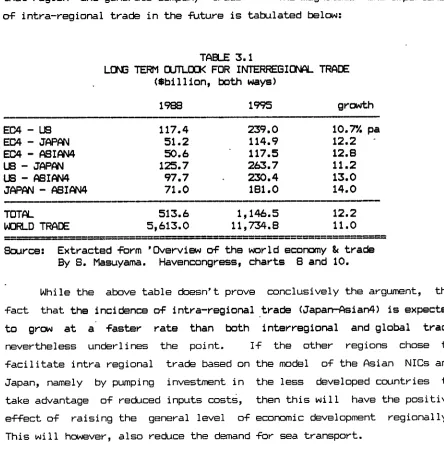
In Asia, Japan and increasingly South Korea are ahead (in terms of econmic development) of say China, ASEAN, India and so on. Granted, this position has always existed, but its importance is now underlined in this movement towards regional trade which it facilitates, by virtue of the presenting the possibility for investors to exploit the various comparative advantages of the different countries (sub region). Thus 'the fastest interregional trade growth should occur between Japan and the Asian NICs, as the Asian NICs will increasingly become a feeder of the fast growing Japanese appetite for imported products, and Japanese direct investment in
that region and generate company trade’ = The magnitude and importance of intra-regional trade in the -future is tabulated below:
TABLE 3.1
LONG TEF31 OUTLOOK FOR INTERREGIONAL TRADE ($blllion, both ways)
1988 1995 growth
EC4 - US 117.4 239.0 10.7V. pa
EC4 - JAP«\J 51.2 114.9 12.2
EC4 - f s i f m 50.6 117.5 12.8
US - JAPWM 125.7 263.7 11.2
US - ASIW4 97.7 230.4 13.0
JAPAN - ASIWM4 71.0 181.0 14.0
TOTAL 513.6 1,146.5 12.2
WORLD TRADE 5,613.0 11,734.8 11.0
Source: Extracted form ’Overview of the world economy & trade By S. Masuyama. Havencongress, charts 8 and 10.
While the above table ckDesn't prove conclusively the argument, the fact that the incidence of intra-regional trade (Japan-Asian4) is expected to grow at a faster rate than both interregional and global trade nevertheless underlines the point. If the other regions chose to facilitate intra regional trade based on the model of the Asian NICs and Japan, namely by pumping investment in the less developed countries to take advantage of reduced inputs costs, then this will have the positive e-fFect of raising the general level of economic development regionally. This will however, also reduce the demand -for sea transport.
3. EAST - WEST DETENTE
The end of the cold war which had created a bi-polarisation in the world economy in -former years should serve to boost world economic growth and a -further restructuring of trade.
Firstly, the COMECON barter trade has collapsed under the new free