University of New Orleans Theses and
Dissertations Dissertations and Theses
5-21-2004
Under-Prepared College Students' Perceptions of the Impact of
Under-Prepared College Students' Perceptions of the Impact of
Technology Integration in a Developmental Reading Course
Technology Integration in a Developmental Reading Course
Deborah Darby
University of New Orleans
Follow this and additional works at: https://scholarworks.uno.edu/td
Recommended Citation Recommended Citation
Darby, Deborah, "Under-Prepared College Students' Perceptions of the Impact of Technology Integration in a Developmental Reading Course" (2004). University of New Orleans Theses and Dissertations. 155.
https://scholarworks.uno.edu/td/155
This Dissertation is protected by copyright and/or related rights. It has been brought to you by ScholarWorks@UNO with permission from the rights-holder(s). You are free to use this Dissertation in any way that is permitted by the copyright and related rights legislation that applies to your use. For other uses you need to obtain permission from the rights-holder(s) directly, unless additional rights are indicated by a Creative Commons license in the record and/ or on the work itself.
A Dissertation
Submitted to the Graduate Faculty of the University of New Orleans in partial fulfillment of the requirements for the degree of
Doctor of Philosophy in
The Department of Curriculum and Instruction
by
Deborah W. Darby
B.A., Louisiana State University at New Orleans, 1972 M.Ed., University of New Orleans, 1987
ii
This study is dedicated to the memory of my maternal grandparents, Mrs. Naomi Junius
and Mr. Albert Junius, Sr., who reared me from a very young age. My grandparents helped to
nurture my love for God and humanity, a factor that has had a profound impact on my life as
an educator. This study is also dedicated to the memory of my father, Mr. Oliver Wendell
White, who always loved his children and wanted the best for them. This study is also
affectionately dedicated to my husband, Reverend Andrew Darby, Jr., my companion, and
my friend. I thank my husband for his unwavering support and encouragement in this, and
countless other endeavors. Finally, I dedicate this study to two persons who are very dear to
iii
This study was accomplished through the loving support of my family and friends. I
express sincere gratitude to Dr. Richard B. Speaker, Jr., my major professor, for his guidance
and support during my doctoral journey. He was always available to assist me whenever I
needed him in charting my course through the deep doctoral waters. Words cannot express
my appreciation to Dr. Speaker. I thank both Dr. Speaker and Mrs. Penelope Speaker for
opening the doors of their home and for sharing their time and knowledge with me.
I sincerely thank Dr. April Bedford for the nurturing she provided during the course of
my dissertation. Her emotional embrace was strengthening as I entered this new endeavor. I
will remember her fondly, always.
I truly thank Dr. Roger DeSanti as I come to the end of this phase of my lifelong quest as
an educator. Dr. DeSanti recommended me for my first job on campus as a graduate
assistant. He has remained extremely helpful to me, especially during my doctoral studies.
I am indebted to Dr. Marydee Spillett for sharing her vast knowledge of qualitative
research. I feel that I would have sustained a great loss in the area of qualitative research
without the assistance of Dr. Spillett. Such descriptors as compassionate, patient, and caring
bespeak the character of Dr. Spillett.
I sincerely thank Dr. Renee Casbergue for her guidance and support. I humbly cherish the
many words of encouragement that I received from Dr. Casbergue. Her words will forever
iv
LIST OF TABLES... ii
ABSTRACT... iii
CHAPTER I ...1
Introduction...1
Statement of Thesis...1
Statement of Purpose ...1
Theoretical Framework...2
Statement of the Problem...4
Research Question ...5
Method of Investigation...5
Need for the Study ...6
Significance of the Study ...7
Definitions of Terms ...7
Educational Technology ...7
Technology Integration...9
Attribution Theory of Motivation ...9
Teacher-Researcher Methodology ...10
Limitations of the Study...10
Summary and Overview of the Study...11
CHAPTER II...12
Review of Literature ...12
Focus of Research on Educational Technology...12
Grades Kindergarten Through Twelve ...12
University Students in College Level Courses ...14
Faculty Use of Technology in Higher Education ...14
Technology Integration and Under-prepared College Students...17
Need for Additional Research...17
Characteristics of Under-prepared Students ...18
Using Computers as a Motivational Tool ...19
General Benefits of Technology Integration in Instruction ...20
Specific Benefits of Technology Integration for Under-prepared Students ...20
v
Use of Spreadsheets ...25
Use of the Internet...26
Use of Email and Internet Relay Chat ...27
Conclusion ...27
CHAPTER III ...30
Context...30
Teacher...31
Looking Back: Influences on Teacher Approach ...33
Observations: Proliferation of Technology...33
Observations Regarding Professional Development ...34
Observations Regarding Academic Experiences as a Graduate Student ...35
Observations Regarding Philosophy of Education ...36
Observations Regarding Prior Teaching Experiences ...41
The Institutional Context ...44
The University Setting ...44
The Junior Division...45
Academic Enhancement Courses...46
Course Selection ...46
Course Content...47
Class Procedures ...49
Specific Grading Policy ...49
The Instructional Context ...50
The Participants ...50
Teacher Approach...50
Curriculum Overview ...52
CHAPTER IV ...57
Methodology...57
Introduction...57
Teacher Research ...57
Teacher as Researcher...58
The Researcher Perspective ...59
Participants...60
Instrumentation and Procedure ...60
Data Analysis Procedures ...67
Research Question ...69
Selection of Focal Students...69
Summary ...70
Organization of the Remainder of the Study ...70
vi
Introduction...71
Overview...71
Brief Description of the Participants...72
Four Major Assignments...73
Additional Artifact ...116
Qualitative Data: Interview Question Analysis ...127
CHAPTER VI ...138
Discussion...138
Analytic Question ...142
Organization of the Chapter...142
Findings and Conclusions of the Study ...142
Examination of Data Streams of Focal Students ...142
Influences on Teacher-Researcher...145
Influences Exhibited in Practice of the Teacher-Researcher ...145
Need for More Technology in Courses...146
Implications for Future Research...150
Implications for Future Practice...150
Conclusions...154
REFERENCES ...152
APPENDICES ...158
vii
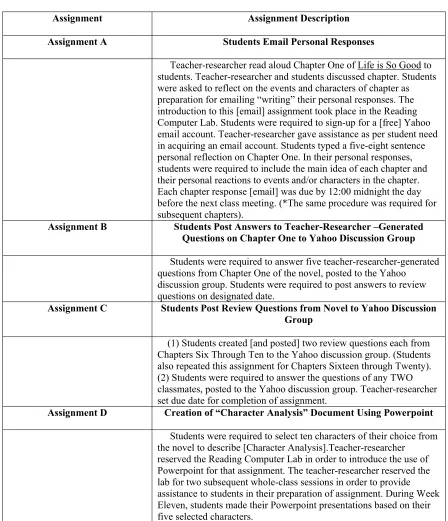
Table 1: Major Assignments...56
viii
Data collection included the following primary data streams: large group and
small group class discussions, electronic submissions of personal reflections, answers to
teacher-researcher-generated questions and questions and answers to student-generated questions posted
to a Yahoo Discussion Group, a Character Analysis document using Powerpoint, and an
tape of a whole class discussion. Also included in the data streams was an excerpt of an
audio-taped session of a whole class discussion of a segment of the novel. All of the above activities
were based on the novel, Life is So Good, by George Dawson and Richard Glaubman. Data
collection also included audio-tapes of interviews of the focal students.
Preliminary analysis of data streams for the focal students revealed the emergence of six themes
based on participants’ perceptions of the impact of technology integration in a Developmental
Reading Course: participants perceived the advantages of using technology to enhance learning
in, and beyond, their Developmental Reading Course; participants perceived the
difficulties/disadvantages regarding the use of technology in the course; students expressed a
gradual development or increase in competence and comfort with the use of technology through
the course; students expressed a general preference for the use of computers rather than pen and
paper in completion of course assignments; students valued their technology experience enough
to express a need for extending policy throughout the University; and, students expressed
increased motivation regarding completion of course assignments when using technology.
Moreover, two meta-themes emerged based on a re-analysis of the data: technology motivated
ix
associated with active learning styles. Results showed that participants generally
exhibited limited participation in regular classroom discussions and activities, but
exhibited active and engaged participation in completing computer-based, content-driven
CHAPTER ONE
INTRODUCTION
Statement of Thesis
In an age of ever-increasing technological advances, the impact of technology can be seen in every aspect of society. And, the field of education is no exception. Thus, the teacher-researcher contended that the challenge for educators was to seize the opportunity to use
technology effectively in instructional activities in order to foster optimal student learning within and beyond the university’s four walls. (For the purpose of this study, the term technology
referred primarily to computers, with some additional use of peripherals). Of particular interest to this teacher-researcher was the potential benefit of technology integration within course content for many under-prepared [developmental] college students. One of the characteristics
exhibited in many under-prepared students is a lack of self-confidence in their academic ability, resulting in a passive learning style (Morrison, 1999). Through a teacher-researcher study, this
teacher-researcher investigated students’ perceptions of the impact of technology integration in a developmental reading course.
Statement of Purpose
This study investigated the perceptions of under-prepared college students of the impact of technology integration in a Developmental Reading Course in terms of increasing their
display the following characteristics: Passive learners are: (1) less focused in attention to task, easily distracted and more likely to not complete a task; (2) less tolerant of change and new ideas; (3) passive and prefer repetitive-type tasks; (4) less experienced in critical thinking skills;
(5) motivated by the expectations of others and more dependent on others for direction and help to fulfill only what is asked of them to do; (6) less likely to accept responsibility for successes or
failures and blame others for their lack of success; and (7) more likely to fulfill minimum expectations for achievement.
Thus, this study examined available research studies in the areas of educational
technology integration and under-prepared students’ perceptions of its impact in a developmental reading course. This teacher-researcher discussed some of the characteristics of under-prepared
students that hinder their academic success. Finally, based on current research, the teacher-researcher presented findings regarding students’ perceptions of the impact of technology integration in their Developmental Reading Course.
Theoretical Framework of the Study
The theoretical framework of this study is based on Weiner’s (1985) attribution theory of motivation. According to this theory, students attribute successes and failures to ability, task
difficulty, and luck. Weiner suggested that these factors exist on three dimensions: locus of control (internal or external), stability (stable or unstable), and controllability (controllable or
uncontrollable). Moreover, Weiner suggested that under-prepared students attributed their success (or failure) to forces beyond their control, such as task difficulty and/or luck. As a result, many under-prepared students adopted passive learning behaviors. An examination of these
may impact their chances of success. Attributions have consequences for motivation and self-esteem.
Coupled with Weiner’s attribution theory of motivation, the theoretical framework of this
study is based on a more recent trend in motivation research, which is the use of goal theory. Goal theory examines the part that the purpose of an act or situation plays in determining
motivation (Ford, 1992). Anderman and Maher (1994) contend that what learners consider the primary purpose of an act directly correlates with their level and quality of involvement. The two goals that were studied in the research on goal theory were “task-focused goals” and
“ability-focused goals.” Task-“ability-focused goals stress mastering a task and learning for intrinsic reasons; whereas, ability-focused goals stress demonstrating individual ability and surpassing the
academic ability of other learners (Ames, 1992; Maehr & Pintrich, 1991). This
teacher-researcher focused on the task-focused goals component of goal theory. Ability-focused goals exist in stark contrast to task-focused goals. In task-focused goals: 1) Success is defined as
individual progress and mastery; 2) value is placed on personal effort, especially in difficult tasks; 3) reasons for effort is based on personal meaning for the activity for the individual; and, 4) errors are viewed as a part of the growing process, and not as evidence of failure or a lack of
ability.
Completion of instructional activities via computers was a part of the underlying
conceptual framework of this study. Researchers suggest that the use of computers in the classroom, as a tool, can enhance student learning, help to build students’ confidence, and heighten students’ active participation in instructional activities. Some researchers suggest the
Glover, 1987; Norton & Sprague, 2001; Geisert & Futrell, 2000; Collis, 1998; Hunter, 1985; Masalski, 1999). In addition, the use of computers has the flexibility to allow students to
participate in creating their own knowledge base, a noted component of the constructivist theory
(Halpin, 1999; Jonassen, Peck, & Wilson, (1999). Bruner (1990) contends that the basic claim of constructivism is that knowledge is “right” or “wrong” based on a learner’s perspective.
Moreover, Bruner (1990, p.25) suggests that rights and wrongs of this nature do not constitute absolute truths and falsehoods. Bruner also indicates that is it important for students to be aware of their own perspectives and the perspectives of others when they make their claims of
“rightness and wrongness,” p. 25). Moreover, Roblyer, Edwards, and Havriluk (1997) suggest that students can work together with their instructors to construct their knowledge base. Within
the theory of constructivism, various software applications, if used effectively, could allow the students to have control over their learning as they investigate the content of any given subject area.
Statement of the Problem
Many under-prepared students have been traditionally characterized as having low self-esteem, learned helplessness, and a passive learning style resulting from repeated failure. As a
basis for this study, Berryman (1993) defines passive learning: “Passive learning means that learners do not interact with problems and content and thus do not receive the experiential
feedback so key to learning.” Within the context of Weiner’s (1979, 1985) attribution theory of motivation which is concerned with a search for the causes of persons’ successes and failures, passive learners attribute their success or failure to external forces. They often attribute their
no simply disappear when these learners decide to enter college. Upon entering college, they bring with them those attributes that may preclude their success in college. Thus, steps must be taken to remediate those negative attributes held by some under-prepared students, and
technology integration within course content may be an agent of change for these students. The potential impact of technology integration could be increased student engagement and effort in
instructional activities. Moreover, as active learners, students would be more willing to address problems and course content, thus, putting themselves in a position to receive feedback, which is critical to learning. From the foregoing discussion, this teacher-researcher developed the
research question for this study.
Research Question
Based on the aforementioned characteristics of many under-prepared students, in this study the teacher-researcher sought to answer the following research question:
What are the perceptions of under-prepared college students of the impact of
technology integration in a Developmental Reading Course?
Method of Investigation
This study used a qualitative research methodology within a teacher-researcher
framework. The study used several intact classes of a college developmental reading course. This study employed a pre-survey regarding computer usage as a screening device only. This study
employed four technology-based assignments including: 1) a Powerpoint document describing ten characters of students’ choice from the novel, Life is So Good; 2) email to submit personal responses to chapters in novel; 3) a Yahoo [asynchronous] discussion group through which
teacher-researcher-made review questions based on reading the assigned novel. The questions, and answers, posted by students, served as material for review for further in-class discussions and for test preparation on the novel. The electronic postings allowed students to study at times
and places that were convenient for them. The above assignments required the use of technology within the context of a developmental reading course. The developmental reading course was
assigned to students who did not achieve the established ACT or SAT exemption scores. Specifically, students who scored less than nineteen on the Reading section of the ACT were required to take a developmental reading course. Placement was determined at initial advisement
at the University.
Need for the Study
Despite the wealth of information and research studies available regarding technology
integration in grades kindergarten through twelve, few empirical research studies focus on technology integration in higher education. Moreover, even fewer empirical research studies
focus on technology integration in developmental courses in higher education. Herein rests the importance of this study – to highlight the need for more intensive investigation of the impact, if any, that technology integration has on under-prepared college students’ active engagement in a
developmental reading course, and the effects of technology integration for under-prepared students in the remediation of those negative attributes that may preclude academic success for
those under-prepared college students. The results of this study could serve as a baseline measure for future studies of the impact of technology integration in college developmental courses. Additionally, the results of this study could serve to inform practice as educators work to
Significance of the Study
This study focused on college under-prepared students and technology integration, an area in which there has been limited empirical research. This study would add to the body of
knowledge in this area and would fill a gap in the research literature in this area.
Definitions of Terms
Educational Technology
As a basis for this study, it was necessary to offer a broad definition of educational technology. It is interesting that the attempt to define ‘educational technology’ is not new, for Saettler (1990) points out that “Educational Technology…can be traced back to the time when
tribal priests systematized bodies of knowledge, and early cultures invented pictographs or sign writing to record and transmit information…It is clear that educational technology is essentially
the product of a great historical stream consisting of trial and error, long practice and imitation, and sporadic manifestations of unusual individual creativity and persuasion.” And, for many educators today, the mention of technology in education immediately brings to mind the
computer equipment. (It does for me). Saettler suggests that in the view of most authors, researchers and educators, any useful definition of ‘educational technology’ must focus on the
process of applying tools for educational purposes, as well as the tools and materials that are used. As an additional note, Eisele and Eisele (1990) discuss a 1970 report submitted to
President Nixon and the U.S. Congress by the Commission on Instructional Technology, which
offers, in the authors’ estimation, a ‘more eloquent’ definition of educational technology than many other authors. Instructional Technology is defined in two ways. In its more familiar sense,
it means media born of the communications revolution that can be used for instructional
defined as a systematic way of designing, carrying out, and evaluating the total process of learning and teaching in terms of specific objectives, based on research in human learning and communications, and employing a combination of human and non-human resources to bring
about more effective instruction (Eisele & Eisele, 1990). And, finally, Eisele and Eisele state that as we moved into the 1990s, educators who had become involved, in the 1970s, with media,
audiovisual communications, and instructional systems in directing the course of research and development in educational ‘computing, began to see computers as part of a combination of technology resources, including media, instructional systems, and computer-based support
systems. At that point, educational computing became known as ‘educational technology (Roblyer, Edwards, & Havriluk, 1997). These authors state that the organization that represents
this view of technology in education is the International Society for Technology in Education (ISTE).
Technology Integration
There is evidence (Enghagen, 1997; Kozma & Johnston, 1991) that technology integration enhances individual classes and subject areas, and that that infusion of technology acts as a “catalyst” for the qualitative enrichment of the learning experience.
As an added perspective regarding a definition of technology integration, this researcher included a compilation of definitions from several fellow practicing educators, definitions
acquired through informal conversations. Addressing the question, “What is technology integration?” they respond:
“Technology Integration in the classroom is nothing new; we’ve had it for years. What is
classroom. So, technology integration is using this resource in the classroom to help students learn and grow with the world.” M.A.
“Seamless is the buzz word…but, I would prefer words such as incorporate, or even
assimilate technology. Yes, we should assimilate technology into our lives…It should be as natural as using a pencil and paper, overhead projector, TV, VCR, etc.” G.S.F.
“Technology Integration involves the incorporation of computers, and peripherals, in instructional activities…embodies new ideas, new problem-solving techniques, new
communication methods, and above all, new ways of thinking about the world. It is an
opportunity to use computers in education to make sweeping changes in how we facilitate student learning.” D.D.
Attribution Theory of Motivation
The attribution theory of motivation is concerned with a search for the causes of one’s successes and failures. Weiner (1985) indicated that students attributed successes and failures to
ability, effort, task difficulty, and luck. He suggested that these factors exist on three dimensions: locus of control (internal or external), stability (stable or unstable), and controllability
(controllable or uncontrollable). If the locus of control is an internal one, then success (and
failure) will be attributed to either ability or effort. If the locus is external, then success (and failure) will be attributed to either task difficulty or luck. Regarding the issue of stability,
expectations for future outcomes can be based on unstable causes, such as effort and/or luck, or stable causes, such as ability or task difficulty. If a student’s success (or failure) is attributed to a stable factor, then he or she will expect the same from the future as from the past. But, if failure
attribute that is completely under a person’s control, citing that many under-prepared students exert less effort in achieving academic success than their counterparts.
Teacher-Researcher Methodology
In the teacher-researcher methodology, the teacher-researchers often study their own classrooms with the purpose to improve “schooling” experiences for their students. This type of
research generally removes the confusion over role. The teacher-researcher’s role is either autobiographical, that is, centering on the teacher-researcher’s own beliefs and behaviors and those of students in his class or the role is acknowledged by colleagues as an important role for
the organization. This lessens potential political challenges because the knowledge gained is either knowledge to guide the teacher-researcher’s own teaching or open knowledge from which
the group as a whole learns and forms new direction (Glesne, 1999). Finally, in a
teacher-researcher methodology, the teacher-teacher-researcher being part of the organization is vital because the research is generally a beginning stage, in a longer, change-oriented process (p. 27).
Limitations of Study
The institution in this study was a historically African-American university, a fact that could limit the generalizability to other populations. Another possible limitation of this study
may have been a variation in the technological skill levels of participants that could skew the results of the study. Future studies could address the issue of variations in participants’
technological skill levels. Another limitation of this study revolves around the assertion of a lack of overall effective assessments of learning processes in higher education. As a result, this researcher was not able to identify a clear point of reference for the study. The literature suggests
disadvantages of integrating technology in instructional activities, in regular or developmental college courses. This teacher-researcher sought to find literature presenting opposing views. Except for scant references, an appreciable amount of information was not found. Another
limitation of the study was that it did not take into account the “instructor” factor that could impact the study. Future studies could address the impact that the training, preparation and
overall effectiveness of the instructor could have on the study. Finally, although several software applications were employed in this study, more, or different, findings and/or results might come to light if other computer software applications were used in future studies.
Summary and Overview of the Study
This study examined and reported the attitudes and perceptions of under-prepared college students’ perceptions of technology integration in their Developmental Reading Course.
Moreover, this study investigated what impact, if any (as reported by students), did technology integration have on their engagement and effort in course activities. This study did not address
CHAPTER TWO
Review of Literature
The literature review for this study focuses on a broad discussion of the use of educational technology at the K-12 level and the university level [developmental and non-developmental courses]. The review gives an overview of each of these topics as they relate to
this study. In addition, the review presents some examples of the use of educational technology in instructional activities.
Focus of Research on Educational Technology
Grades Kindergarten Through Twelve
Many of the studies regarding technology integration have focused on the K-12 setting.
These studies often present initiatives that have been undertaken to assist elementary school teachers and administrators in integrating technology in the curriculum. One such study by Ertmer and Hruskocy (1999) discusses the development of an effective partnership between
university and elementary school personnel to facilitate the integration of technology within teachers’ curricula. The partnership would also provide ongoing responsive professional,
instructional, and technical support to classroom teachers. Specifically, this study examined the impact of a university-school partnership, designed to support technology integration efforts, on a) teachers’ attitudes toward, and uses of, technology; b) students’ confidence with technology,
implementation, including the use of student-trainers. The results of the study indicated that there was an increase in technology use by teachers, for both professional and instructional purposes, from fall to spring. Yet the study noted that these increases did not appear to be accompanied by
any related shifts in instructional approaches or processes. In general, the changes that teachers noted related to increases in comfort, confidence, and interest rather than to changes in teaching
methods or classroom organization.
Several additional studies (Boxie & Maring, 2001; Halpin, 1999) discuss preparing pre-service teachers, technologically, to interact effectively with elementary school children. The
study by Boxie and Maring (2001) investigates whether pre-service teachers can provide effective mentoring for elementary students when the mentoring occurs in cyberspace (e.g.
websites and e-mail). Based on quantitative indicators of student learning, the study indicated that the cyber-mentoring (websites and e-mail) in the use of literacy strategies had a clear and impressive impact on student learning. Based on qualitative indicators of student learning
indicated that cyber-mentoring efforts and literacy strategies were not simply add-ons to the curriculum; instead, they were perceived by teachers, undergraduates and students as integrated within the curriculum. The study by Halpin (1999) focuses on the question of whether computer
literacy (of elementary pre-service teachers) should be taught as an isolated topic or integrated into the pre-service methods courses. The results of this study indicate that integration of
University Students in College Level (Non-Developmental) Courses
Another body of research regarding technology integration focuses on technology use by undergraduates enrolled in “regular” (non-developmental) courses. One study by Zhang and
Espinoza (1998) examines the relationships among (a) computer self-efficacy, (b) attitudes toward computers, and (c) perceptions of desirability of learning computers among
undergraduate students. The results of this study indicated that students’ desirability of learning
computer skills could be predicted by their self-recognition of the usefulness of computers and their perception of advanced level of computer technologies. Another study by Inque
(1999-2001) examines the university student’s preference for learning by computer-assisted instruction, focusing on three questions: 1) Do significant differences exist in the preference for computer-assisted instruction (CIA) between males and female students? 2) Do significant differences exist
in the preference for computer-assisted instruction between undergraduate and graduate students (academic status); and 3) Does an interaction exist between gender and academic status? Again,
the focus is on prepared, as opposed to under-prepared, college students. The results of this study showed that graduate students favored CIA more than did undergraduate students, confirming the researcher’s assumptions that graduate students had more experiences. From the study, Inque
concluded that the option of mixing CIA and traditional lectures was the key to the success of any institution of higher learning.
Faculty Use of Technology in Higher Education
The last general body of research scantily addresses technology use by educators in higher education. One study by Groves and Zemel (2000) examines the extent to which faculty
teaching assistants rated their knowledge high for technologies that were supported by personal computers: word processing, e-mail, computer spreadsheets, and internet use, and they were more apt to use these technologies in their own teaching. They ranked knowledge low in
technologies that used other equipment attached to computers, or specialized software, and participants were less likely to use these technologies in their own teaching. Another study by
Schutte (1999) attempts to investigate the effects of face-to-face versus virtual professor-student interaction, on the test performance of students. The quantitative results of the study indicated that the virtual class scored an average of twenty percent higher than the traditional class on two
exams standardized between the two groups. One last study by Grasha and Yangarber-Hicks (2000) examines the effects of instructional technology in the classroom on teaching and
learning styles. Of particular interest to Grasha and Yangarber-Hicks was whether the presence of instructional technology (no one specific technology) in the classroom was associated with variations in teaching and learning styles. The results of the study suggest that the introduction of
instructional technology in the classroom does affect the relationship patterns among variables related to teaching and learning.
Although this teacher-researcher highlighted several studies that focused on the use of
technology by faculty in higher education, there was support for this researcher’s stance that there was still an insufficient amount of research focusing on educational technology integration
in higher education. Moreover, of the existing studies, the majority of those studies focused on faculty, not student, use of and comfort level with technology. Spotts and Bowman (1995) stated that because little empirical evidence existed regarding the use of instructional technologies in
study (conducted at a Midwestern public university) showed that faculty had the highest levels of knowledge and experience with word processing and video and also used these most frequently. A majority of the faculty members rated technology as important to teaching, but fewer than half
(696 total participants in study) predicted they would use a new technology in their teaching in the coming year. Spotts and Bowman contend that the results of their research contribute to a
void in the literature about instructional technology use in higher education. Several additional authors (Ely, 1989; Snider, 1992) contend that while today’s technologies of pocket calculators and desktop computers are gradually becoming more widely used in grades K-12, they have met
with only limited success in colleges and universities. Spotts and Bowman (1995) further contend that although the 1990s have seen much of this new technology (such as information
centers which include television, videodisc with playback/record capabilities, a personal
computer, plus interconnectivity capabilities with cable and direct satellite reception), it has not yet had a pervasive influence on higher education. In one final study, Garland (1999-2000)
discusses the results of a survey of computer skills of faculty and undergraduate and graduate students of the University of New Hampshire Education Department. The findings of the study indicate that the University of New Hampshire educators are more likely to use computers for
research than for teaching. These foregoing studies again speak to the need of greater use of technology by faculty in higher education for instructional purposes.
Despite the limited faculty use of technology for instructional purposes in higher
education, several studies (Speaker, Dermody, Knighten, Suzuki, Wan, & Parigi, 2001; Wang & Speaker 2002) suggest an increase in this area. Speaker and Wang (2002) examine the beliefs
their experiences after participation in a year-long project to integrate technology in their instructional activities. Moreover, the study highlights examples of effective technology integration within course content. The project centered on training university faculty and
pre-service teachers in the areas of presentation software, web design, Internet in the classroom, and video on the web (Speaker et al, 2001). Components of the training included summer institutes,
one-on-one mentoring, and a number of mini-sessions. The overall findings of the study indicated that technology integration in instructional activities impacts both learners and
teachers. As a result of the study, participants began to assess (re-assess) their ways of teaching
and learning vis-à-vis a new “global” society.
Technology Integration and Under-prepared College Students
Need for Additional Research
Given the apparent limited use of technology in standard (non-developmental) college
courses, this researcher believes that, in addition to the need of further empirical research in this area, there exists an urgent need for (evidenced by a profound gap in) empirical research in the area of technology integration in instructional activities in college developmental courses. This
researcher suggests that those students entering college academically prepared for college level courses could very well matriculate with or without the infusion of technology in their courses of
study. However, the infusion of technology in instructional activities in developmental courses (which are the first courses under-prepared students must take) just might be the “life-line” that many under-prepared students need to foster self-confidence in their academic ability and
Characteristics of Underprepared Students
This section of the literature review identifies some of the characteristics of under-prepared learners (who are placed in college developmental courses), for the purpose of
investigating whether technology could possibly impact student engagement in instructional activities. One study by Morrison (1999) characterizes under-prepared students in terms of
Weiner’s (1985) attribution theory, a part of which finds that some under-prepared students believe that they are not in control their academic success and/or failure. According to this theory, such students attribute outcomes to stable factors such as luck; they seldom mention their
own effort as the cause for lack of academic success; and, they seem to accept their
underachievement as normal and evidence little concern about outcomes perceived to be out of
their hands. As a result, many of these students adopt a passive rather than an active learning style. Other researchers (Smith & Price, 1996) discuss the attribution theory in relation to under-prepared college students. The results of their study indicate that developmental students
described themselves and their experiences in terms that also fit Weiner’s attribution theory. More specifically, regarding academic pursuits, Smith and Price also found that under-prepared students believe that success and/or failure is beyond their immediate control, and attribute
outcomes to stable factors such as task difficulty and uncontrollable factors such as luck. Smith and Price indicate that the students seldom mention their own effort as a cause for academic
success or failure. Turnbull (1986) further suggests that under-prepared students may have adopted a passive learning style as a result of repeated failure, and he contends that this passive learning style may preclude students’ willingness to invest the time, energy, and effort necessary
Morrison (1999) examines factors related to student motivation using seventeen independent motivational scales. The Academic Confidence scale measures a student’s perception of his or her ability to perform well in school, especially in testing situations.
Morrison suggests that a positive self-concept is an essential component of a self-disciplined personality, and students who see themselves in a positive way can devote themselves to
academic tasks with minimal anxiety about how others see them. Morrison reveals that seventy-five percent of the scores of the unprepared students in her study fell below the mean of the larger freshmen population. Morrison contends that this suggests that educators must provide
students in developmental courses with opportunities for successful academic experiences. This researcher attempted to determine whether students viewed the use of technology in instructional
activities as an opportunity for successful academic experiences, experiences that could assist them in adopting an active learning style. In stark contrast to students who exhibit a passive learning style, Messick (1984) asserts that students who exhibit an active learning style are: (1)
self-motivated and directed for learning for the sake of learning; (2) responsible for their own successes and/or failures; (3) less affected by others’ values; (4) focused in their attention to the task and not easily distracted; and (5) tolerant of new ideas and unusual approaches.
Using Computers as a Motivational Tool
As with any tool, in this case computers, it is the responsibility of the person or persons
using the tool to make optimal use of it. Computers should not be viewed, in and of themselves, as the cure-all for academic endeavors. Given those facts, many studies have shown that using computers in the classroom has added excitement and increased motivation for learning
(Gilliver, Randall, & Pok, 1998; Hakkarainen, Lipponen, Jarvela, & Niemivirta, 1999).
can wane, especially if learners view computers as a means to an end, i.e., a tool (McKinnon, Nolan, & Sinclair (2000). However, it is the belief of this researcher that coupled with a quality curriculum, motivation can garner the attention of students, evidenced by active student learning,
resulting in the potential for greater student achievement.
General Benefits of Technology Integration in Instructional Activities
This researcher strongly believes that, at any level, learning can be fun, and that students can be encouraged to become active learners, given an environment that promotes active
engagement in the learning process. And, generally addressing the subject of how educators can
best use computers in making learning fun, Hentrel and Harper (1985) suggest that educators can combine fun and education, moving beyond either play or work. Since the computer can aid and
add to [our] intelligence, educators can assist students in developing thinking strategies, learning strategies, creativity, adaptation to change, and communication skills. Moreover, Hentrel and Harper suggest, and this researcher agrees, that technology integration in instructional activities
allows educators the opportunity to teach thinking processes through problem-solving, as well as discovery and experimentation. At any level, including at the college level, Hentrel and Harper suggest that educators can interest students, provide an environment which can motivated
students, teach required concepts, demonstrate functions of the computer, provide challenges, then step aside and allow students to process on their own, using guided practice and
experimentation.
Specific Benefits of Technology Integration for Underprepared Students
Regarding this section of the literature review, this researcher has encountered much
specifically addressing under-prepared college students. This researcher recognizes the apparent gap in the literature in this area.
One unpublished pilot study by Darby (2001) examines the impact of technology
integration on under-prepared students’ self-confidence in their academic and computer abilities within the context of a college developmental reading course. In the study, Darby (as a
researcher-teacher) administered pre-treatment and post-treatment questionnaires to students designed to assess students’ confidence level in using technology and in their academic ability. As a part of the treatment, students enrolled in the developmental reading course were given a
content-based assignment that they were to complete using Powerpoint (a presentation software application). Students received step-by-step guided instructions for integrating Powerpoint in the
assignment. Upon completion of the assignment, students were given a post-treatment
questionnaire in order to assess the change, if any, in students’ self-confidence in their academic and/or computer abilities. Moreover, through subsequent informal conversations, approximately
ninety percent of the participants indicated they had “fun” completing the assignment. They also indicated they would use Powerpoint again on their own for other classes.
Contrary to the suggestion that computers can make learning fun, Stoll (1999) contends
that the statement “Technology makes learning fun” is a lie. He contends that most learning: is not fun; takes work, discipline, commitment, from both teacher and student. “There is no
shortcut to a quality education. And the payoff isn’t an adrenaline rush, but a deep satisfaction arriving weeks, months, or years later. Equating learning with fun says that if you don’t enjoy yourself, you’re not learning.” (p. 12) Stoll further contends that computers direct students away
classroom numbs the questioning minds with graphical games in which quick answers and fast action take the place of understanding, and “the trivial is promoted as educational.” (p. 13)
This researcher does acknowledge limitations in this study, such as, convenience
sampling and the use of intact developmental classes – to name a few. However, despite the limitations of this pilot study, this researcher believes this study can serve as a starting point in
examining more intensively the possibilities technology integration might hold for this population.
Examples of Technology Integration in Instructional Activities
Despite a lack of available research that supports technology in developmental courses in this literature review (in its present form), this researcher has identified literature which suggests
how the use of computers has been integrated in to various curricula. And, despite the fact that this researcher has not used all of the software applications presented in this section, they are listed as further evidence supporting the use of technology in instructional activities. This
sections examines word-processing, databases, spreadsheets, the Internet, use of e-mail and relay chat.
Several authors (Engahagen, 1997; Kozma & Johnston, 1991) suggest that technology
enhances individual classes and subject areas, and that infusion of technology acts as a “catalyst” for the qualitative enrichment of the learning experience. A number of authors (Roblyer,
Edwards, & Havriluk, 1997; Keith & Glover, 1987; Norton & Sprague, 2001; Geisert & Futrell, 2000; Collis, 1998; Hunter, 1985; Masalski, 1999) suggest use of basic software applications for instructional activities, such as, word processing, spreadsheets, and databases to teach content in
Despite a lack of available research that supports technology in developmental courses in this literature review (in its present form), this researcher has identified literature which suggests how the use of computers has been integrated in to various curricula. And, despite the fact that
this researcher has not used all of the software applications presented in this section, they are listed as further evidence supporting the use of technology in instructional activities.
Use of Word Processing
Roblyer, Edwards, & Havriluk (1997) believe that no other technology has had as great an impact on education as word processing. The authors suggest that not only does this tool offer
a great deal of versatility and flexibility but, it is also “model free” instructional software, that is, it reflects no particular instructional approach; an instructor can use it to support any kind of
directed activity or constructivist activity. Answering the query of when to use word processing in a class, the authors indicate that students can use word processing for almost any written work, regardless of content area, work that they would otherwise write by hand. Roblyer et al. also
contend that word processing alone cannot improve the quality of students’ writing but, it can help them make corrections more efficiently, and this can motivate them to write more and take more interest in improving their written work. This teacher-researcher believes that anything that
can bring about more student interest (especially for the under-prepared student) is a “plus” in the field of education. Norton and Sprague (2001) acknowledge that research on the use of word
processors in the classroom does not always support educators’ enthusiasm, but some
generalizations have been made. Geisert and Futrell (2000) note that when students use word processors, they tend to write more, revise more, and develop a better attitude toward the writing
Adding to this discussion, Bender and Bender (1996) suggest that during all phases of learning, motivation of at-risk students is an important consideration. The authors contend that computers can be used as a motivator for many under-prepared students, provided they
[computers] are used effectively. Computers can be used for much more than simply “a reward” for whatever the reason. The authors suggest a motivation activity that uses the assets of the
computer to integrate technology into the student’s curriculum, so that the student becomes aware of the benefits of this technology. This can be the most desirable reinforcement use of the computer. To shed light on this tenet, MacArthur (1994) asserts that word-processing software is
a useful classroom tool that will motivate many students. MacArthur further asserts that students who have difficulty with spelling and grammar quickly learn that they can successfully use
word-processing packages to produce a finished paper, often in less time than writing it by hand. Student use of word-processing applications can also allow for the ease of creation and revision of work. Bender et al. (1996) assert that word-processing software can reduce the physical
requirements of writing. Moreover, with word-processing, students spend more time on composing rather than on the actual mechanics of writing. The authors suggest that this is certainly an advantage for “slower-to-write” at-risk [under-prepared] students or students who
may strongly fear the writing process. And, research has shown that word-processing helps to change students’ attitudes about writing, resulting in more positive attitudes toward writing and
school in general (Daiute, 1986; Montague & Fonseca, 1993). Moreover, these researchers have found that the use of multi-sensory software can be useful for some under-prepared students who are easily distracted or who have short attention spans. Also, the use of graphics can help
the Center for Academic Technology at Florida Community College at Jacksonville, cites longstanding pedagogical claims that students tend to learn faster and retain more information the more they see, hear, and interact in the learning process, “precisely the kinds of multi-sensory
involvement that technology can promote.”
Use of Databases
A second computer-based tool involves the use of databases in instructional activities. Several authors present observations. Collis (1998) states that when educators use databases as an instructional strategy within the context of content learning, they are promoting the
development of process skills – skills or procedures used to process information as students think through problems and make decisions. These skills include information-related tasks such as
analyzing, observing, classifying, communicating, comparing and contrasting, defining, describing, evaluating, generalizing, inferring, interpreting, and extrapolating. Hunter (1985) suggests that process skills come to life when students use databases to discover commonalities
and differences among groups of events or things, analyze relationships, look for trends, test and refine hypotheses, organize and share information, keep lists up to date, and arrange information in useful ways.
Use of Spreadsheets
Regarding the use of spreadsheets in instructional activities, Norton and Sprague (2001)
present an interesting feature of this application. First of all, spreadsheet programs can be used at all levels of education (word processing and databases as well). Although educators tend to associate spreadsheet use with mathematics or business courses say Norton and Sprague, these
allow students to move away form the drill-and-practice software commonly used to teach mathematics and into an environment that allows them to gather, record, manipulate and display data while seeking reasonable solutions to a problem.
Use of the Internet
Several authors (Leshin, 1998; Jonassen, Peck, & Wilson, 1999) attempt to illustrate how
the Internet can be used to increase [underprepared] students’ confidence in their academic ability and to promote optimal student learning. Cynthia Leshin (1998) presents the Internet as a tool for teaching and learning with very practical, hands-on, “at-your-fingertips” activities ready
for almost immediate use (much like a menu). Specifically, Leshin teaches thematic units in Social Studies, offering online and off-line activities that encourage an active approach to
learning. Leshin purports that thematic units offer many opportunities for students to analyze information, distinguish between fact and opinion and identify cause and effect as they learn the content of selected thematic units.
Another example of using the Internet for classroom instruction is discussed by the authors Jonassen, Peck, and Wilson (1999). The authors attempt to illustrate how the Internet can facilitate engaging learners in “active, constructive, intentional, authentic and cooperative
learning.” These authors present Internet projects initiated by practicing educators who have used open-ended, student-directed research projects to expose their students to the Internet’s vast
information bank to learn about topics, generally in order to produce some original work using their new knowledge. The authors indicate that open-ended refers to the fact that students are encouraged to learn as much as they can about the topic, rather than simply to find answers to
This researcher offers a final note regarding the examples presented. Although the
aforementioned activities are not necessarily reflective of actual instructional activities in college developmental courses, the impact of these computer-assisted activities in college developmental
courses warrants attention.
Use of E-mail and Internet Relay Chat
Use of e-mail has become as common to many persons as making a telephone call. Heide and Henderson (2001) suggest that e-mail is the “hook” that gets many people started using computers, even those who have been resistant to the idea. According to the authors, e-mail has
become the primary way that most persons keep up to date with both work and social commitments. In an academic arena, students and teachers can use e-mail to ask and answer
questions about assignments; students can collaborate with peers; and teachers can give feedback to students.
Internet relay chat (IRC) allows for “real time” (synchronous) interaction, which can be
motivating, but can also become challenging. An experienced moderator is recommended for directing and ordering incoming questions and comments. Students can use IRC to collaborate with peers on a common project; chat with teachers or peers; access information and opinions
from outside the classroom; and interview an expert.
Conclusion
Based on the literature review, researchers (Weiner, 1985; Morrison, 1999; Smith & Price, 1996) agree that some under-prepared students exhibit characteristics that may preclude their confidence in their academic ability. These students attribute outcomes to stable factors
that some researchers (Hentrel & Harper, 1985; Enghagen, 1997; Kozma & Johnston, 1991) concur that integrating technology in instructional activities has the potential to positively impact under-prepared students’ confidence in their academic ability. Other authors (Robyler, Edwards,
& Havriluk, 1997; Keith & Glover, 1987; Norton & Sprague, 2001; Geisert & Futrell, 2000; Collis, 1998; Hunter, 1985; Masalski, 1999) suggest, as does this researcher, use of basic
software applications for instructional activities, such as word processing, spreadsheets, and databases to teach content in various subject areas, promote computer literacy, and boost students’ confidence in their academic ability.
In conclusion, as a result of a review of the literature, this researcher finds a void in the number of empirical research studies in higher education regarding the impact of technology
integration on student learning. This researcher finds an even greater void in the number of empirical research studies in higher education regarding the impact of technology integration on student learning for under-prepared students (students who are placed in developmental courses).
One recommendation for future study should be an examination of the impact of
technology integration in developmental courses on: under-prepared students’ self-confidence in their academic ability; remediation of those passive learning behaviors that many under-prepared
students exhibit; and, under-prepared students’ knowledge of course content. More research in this area could bring to light the “pros and cons” of integrating technology in developmental
courses.
Another recommendation for future study should be an examination of other possible benefits of technology in developmental courses, such as, increased comfort levels of
under-prepared students?” Yet another recommendation for future study should be an examination of the impact that the instructor has on the integration of technology in instructional activities.
Finally, within in the context of future study possibilities, there should be an examination
of the potential disadvantages of technology integration in developmental courses for under-prepared students. This researcher found it extremely difficult to find plentiful information in the
literature, empirical or otherwise, regarding the drawbacks of using technology in instructional activities. However, Stoll (1999) suggests general disadvantages of the use of computers in the classroom. He states that the
Although this literature review does not present conclusive [empirical] evidence that technology integration in developmental courses positively impacts under- prepared students’
self-confidence in the academic ability nor the amount of effort that these students exert in their learning process, hopefully the computer-based activities presented will convince the reader that technology integration in developmental courses – though not a panacea for the educational ills
of under-prepared students – can at least foster self-confidence in their academic ability, engage students more actively in their individual learning experiences, which can result in optimal student learning. And, that integration of technology within course content could be just the
CHAPTER THREE
Context
As this teacher-researcher study is qualitative research, it is essential to discuss the context within which this study was conducted. Qualitative research attempts to portray persons and events in as natural a setting as possible in order to ascertain a true picture of events under
investigation. Kincheloe (1991) described some of the characteristics of qualitative research: One of the most important aspects of qualitative research is concerned with context.
Human experience is shaped in particular contexts and cannot be understood if removed from these contexts. Thus, qualitative research attempts to be as naturalistic as possible, meaning that contexts must not be constructed or modified. Research must take place in
the normal, everyday contexts of the subjects under study. (Kincheloe, 1991, p.144). It is important that the teacher-researcher include information regarding the various contexts that
are integral parts of the study. Information is needed regarding the students, the teacher, the perspective and influences on [her] approach to teaching, and the institutional and instructional contexts. The aforementioned aspects of the contexts are included in this section which provides
discussion regarding the teacher, the teacher’s observations regarding her professional development, the academic background that influences [her] approach to teaching; the
instructional approach, including the school setting and course selection; the institutional
Teacher
My experience in the field of education reflects my self-portrait as a life-long learner-teacher. From community-based tutorial and enrichment programs to formal school settings, I
have had a variety of teaching and teaching-related experiences prior to proposing this study, which include eight years at a local multi-cultural, multi-ethnic community college comprised of
approximately eleven thousand students. For the past four years, I have taught at a local historically black university.
Prior to a specific discussion of my teaching experience, a brief description of early
literacy experiences, and the effects on my educational philosophy, is necessary. As a young child, my parents, specifically, my grandparents, adopted the philosophy that says “Train up a
child in the way that he should go, and when he is old, he will not depart from it.” My
grandparents nurtured me physically, emotionally, economically, spiritually, and educationally. All of my needs and many of my wants were provided for. My academic background was rich
with family opportunities for growth and development. Moreover, the love that I have for Storytelling today had its genesis in the fact that my grandmother consistently read to me as a child; provided many children’s books for my reading pleasure; and exposed me to other cultures
and environments through yearly summer vacations. And, even though my grandfather was unable to read, without the strong support that he provided for our family, I know that it would
have been virtually impossible for me to have reached the “heights” in life that I have to this present day.
Another crucial aspect of my early literacy development involved [and presently
serves as the primary, and for many years, the only institution through which African-Americans had the opportunity to “learn how to read” and to obtain some semblance of an education. And, my active involvement in the black Baptist church, under the guidance of my grandparents,
provided my very basic formative education. This initial education served as a solid academic foundation as I entered “formal” school. As a part of this early literacy stage, I attended Sunday
School, Baptist Training Union; learned to play the piano; engaged in ‘on-the-job’ training as one of the musicians of the church at the age of thirteen. As a teenager, I was given assignments to “teach” the younger Sunday School children. Thus, I was encouraged by my grandparents,
pastor, and staff of the church to “Study to show myself approved unto to God, rightly dividing word of truth.” Thus, as I taught, I continued to grow spiritually and academically. For it has
been said that as one teaches, he learns twice.
As an extension of my childhood-young adult preparation, I attended many local, regional, and national conferences and participated in public speaking forums and vocal and
instrumental workshops. These areas of involvement captivated my interest and fueled my desire to acknowledge my vocation as a life-long “learner-teacher.”
Building upon the foundation laid by my grand-parents, my K-12 formal educational
years only added to my love for education. My grandparents, family, school administrators, and teachers demanded the best of me, and thankfully, I produced. I graduated in the top five percent
at St. Paul the Apostle Elementary School, and I graduated Number Three from St. Mary’s Academy High School.
As I entered College, I majored in French Liberal Arts, simply for the love of languages,
happened to change my life, and eventually, my chosen discipline. My grandmother, the love of my life, died. After attempting to complete the beginning stages of graduate studies in the area of French, the stress of my grandmother’s death was too great at that time, so I abandoned my
graduate studies at that point, but, only temporarily. I pursued several jobs in the interim; however, I eventually returned to school and received my Master’s degree in the field of
education. Subsequently, I worked at a local community college for eight years, and from 1999 to the present, I have been employed at a local university in New Orleans.
As I engaged in these teaching experiences, I developed a desire to enhance my personal
professional development and to broaden my educational perspective. Subsequently, I entered the doctoral program in Curriculum and Instruction, with an emphasis on Educational
Technology.
Looking Back: Influences on Teacher’s Approach
Engaging in teacher-research in my course mandates that I reflect on the many
experiences that have impacted my approach to teaching. The following experiences mark only a few of the many influences on my overall perspective on teaching and on my use of technology
in the classroom and also in community programs.
Observations: Proliferation of Technology
One of the major influences on my approach to teaching has been the era of the technology explosion. Although the world has witnessed technological advances across the
effective use of technology in the classroom for optimal student learning is of the utmost importance to me. I submit that I can no longer simply rely (nor do I wish to) on the textbook and the blackboard to capture the minds and hearts of my students. Just as students use high-tech
instruments on a daily basis, my approach to teaching seeks to incorporate technology into the classroom as seamlessly as it exists in the daily lives of my students.
Observations Regarding Professional Development
As it relates to my professional development, my participation in college-sponsored technology workshops, institutes, and conferences has greatly influenced my approach to
teaching. I have attended numerous workshops focusing on a variety of subjects, including word-processing, multi-media presentations, e-communication, powerpoint, web design, and on-line
course design. The workshops were designed to assist instructors who were interested in incorporating these technologies in their classrooms.
Another extremely valuable professional development experience that has greatly
influenced my approach to teaching was my participation in the New Orleans Consortium for Technology Integration in Teacher Education (NOCTIITE) Project. My participation in the NOCTIITE project was especially beneficial to me because it allowed me an opportunity for
hands-on experiences with using new and unfamiliar technologies. It has been said that, “One cannot teach what he does not know, nor can he lead where he does not go.” Thus, I welcomed
the invitation to enhance my personal knowledge of technology and to learn effective ways to integrate technology in instructional activities.
In addition to hands-on activities, this project incorporated a ‘before & after’ assessment
activities based on the NOCTIITE initiative. Opportunities for networking with other educators and students were plentiful and fruitful.
Prior to NOCTIITE, I had some knowledge in the areas of basic operation of computers,
word-processing, powerpoint, desktop publishing software, e-mail, and some digital imaging. I also had some experience with LCD projectors. As I began participation in NOCTIITE during
the Summer Institute 2000, I was exposed to a wealth of knowledge, ideas, contacts, and hands-on opportunities. I was introduced to software programs, such as, Inspiratihands-on, Hyperstudio, Dreamweaver, Claris Works, Frontpage – to name a few. The opportunity to actually experiment
with the DVD player, laser disc, document reader, and especially the digital camera, benefited me greatly. As one of the final components of the NOCTIITE project, I collaborated with other
participants to create a project which required applying the new knowledge gained during the Institute.
In addition to honing my technological skills as a result of participation in NOCTIITE,
my comfort level with technology has increased tremendously. I credit NOCTIITE for so much of the knowledge that I have gained, and, now endeavor to implement. Subsequently, my challenge is not so much to teach the ‘product’ of education as it is to teach [facilitate] the
‘process’ of education. And, I believe that the knowledge and expertise that I have acquired can help me to meet this challenge.
Observations Regarding Academic Experiences as a Graduate Student
In addition to the aforementioned professional development experiences, my academic experiences at the Master’s and Doctoral level have provided the impetus for my present study.