The University of San Francisco
USF Scholarship: a digital repository @ Gleeson Library |
Geschke Center
Master's Theses Theses, Dissertations, Capstones and Projects
1995
A Typology of the Income-Generating Activities of
Nonprofit Organizations in Marin and Sonoma
Counties
Carolyn Stayton
University of San Francisco
Follow this and additional works at:https://repository.usfca.edu/thes
Part of theNonprofit Administration and Management Commons
This Thesis is brought to you for free and open access by the Theses, Dissertations, Capstones and Projects at USF Scholarship: a digital repository @
Recommended Citation
Stayton, Carolyn, "A Typology of the Income-Generating Activities of Nonprofit Organizations in Marin and Sonoma Counties" (1995).Master's Theses. 1169.
The author of this thesis has agreed to make available
to the University community and the public a copy of this dissertation project.
Unauthorized reproduction of any portion of this dissertation is prohibited.
The quality of this reproduction is
contingent upon the quality of the original copy submitted.
University of San Francisco Gleeson Library/Geschke Center
2130 Fulton Street
A Typology of the Income-Generating Activities of Nonprofit Organizations in Marin and Sonoma Counties
A THESIS SUBMITIED
by
Carolyne Stayton
In Partial Fulfillment of the Requirements
for the Degree of
Master of Nonprofit Administration
The University of San Francisco
A Typology of Income-Generating Activities
' ( I of Nonprofit Organizations in Marin and Sonoma Counties
/ {
This thesis written by
Carolyne Stayton
This thesis, written under the guidance of the Faculty Advisory Committee, and approved by all its members, has been accepted in partial fulfillment of the requirements for the degree of:
Master of Nonprofit Administration
at the
University of San Francisco
T7iis
G~:rtc
'cct
1
~~---~--_1_5
__
Chairperson ' ,
~P/. c0~~'
---~Q~L&li~----
/.
P/r/r)-Program Director Date
oe~~~~~---
cJ (\ \ (\
c::;TABLE OF CONTENTS
Abstract... i v
Vita Auctoris... .. . . .. .. ... .. .. . . .. .. .. .. ... .. .. .. .. .. .. .. .. ... .. .. .. .. .. .. .. ... ... . v i
Acknowledgements... v i i
List of Tables... v i i i
List of Charts... x
List of Appendices... x i
Chapter One: Introduction... 1
Chapter Two: Review of Related Literature... 1 7
Chapter Three: Methodology... 44
Chapter Four: Results... 53
Chapter Five: Summary and Conclusions... 7 7
References... 9 4
ABSTRACT
This study examines the income-generating activities of
nonprofit organizations. Since the early 1980s, income-generating activities have been increasing due in part to: government funding cut-backs; encouragement from government and big business; incursion into traditional nonprofit areas by for-profit business; and, more recently, economic recession. The increase in activities has apparently cut into for-profit terrain, and small businesses in particular have reacted negatively.
In the last decade the commercial income-generating activities of nonprofits have been cited by small business as a primary
concern. Debates over the issue have been waged in Congress
between small business advocates and nonprofit supporters. As few studies have been conducted on the impact of commercial income-generating activities on for-profit business, both Congress and the IRS appear reluctant to make significant changes in legislation or tax laws.
This study attempts to secure data on the prevalence, extent, and type of income-generating activities that nonprofit
organizations have conducted in recent years or are planning for the future. By ascertaining the extent and prevalence of
income-generating activities this study may shed some light on the larger issue: whether or not the small business sector suffers a legitimate threat from the income-generating activities of nonprofit
organizations.
Sonoma counties that had annual revenues of $100,000 or more was
conducted in April 1995. Results showed that income-generating
activities were prevalent and generated substantial portions of the
organizations' bottom-line revenues. Almost 90 percent reported
conducting at least one income-generating activity and on average,
38 percent of their bottom-line revenues were generated by
income-generating activities. Fee-for-service was listed with most
frequency as the largest source of funding. Of particular interest is
that an average of 22 percent of the organizations' bottom-line
revenues were generated by commercial income-generating
activities and 72 percent of all of the income-generating activities
conducted in the last five years were profitable. Although the
results of the survey provide only a small part of the necessary data
on the issue, the data do support the assertion that
income-generating activities by nonprofit organizations are prevalent and
profitable, and that their impact on for-profit business warrants
Name:
Date of Birth:
High School:
Baccalaureate Degree:
College:
Graduated:
Teaching Credential:
College:
Graduated:
Vita Auctoris
Carolyne Stayton
November 11 , 1952
St. Mary's High School Calgary, Alberta, Canada
Bachelor of Philosophy and English
University of Manitoba Winnipeg, Manitoba, Canada
1975
K - 12
Notre Dame University
Nelson, British Columbia, Canada
ACKNOWLEDGMENTS
This thesis could not have been possible without the support and encouragement of the following people. They all receive my heart-felt thanks.
• To Neil Harvey and Jeremy Stayton for their love, understanding and patience.
• To John Stayton for his steady encouragement and constructive suggestions.
• To my mother for her continued support.
• To my advisor Dr. Robert Manis and my second reader Carol Schilling for encouraging me through various stages and offering me sound advice.
• To Dr. Michael O'Neill for his direction and valuable critiques.
Table 1
Table 2
Table 3
Table 4
Table 5
Table 6
Table 7
Table 8
Table 9
Table 10
Table 11
LIST OF TABLES
Number and Percentage of Respondents Reporting Income-Generating Activity
Ranked by Annual Revenue... 55
Types of Nonprofits Conducting Some
Income-Generating Activity... 56
Three Types of Respondents by
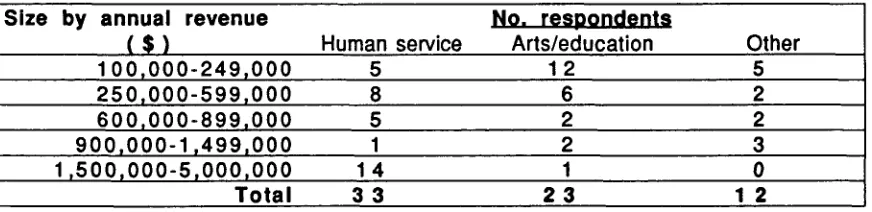
Revenue Size... 5 7
Average Percentage of Total Bottom-Line Income Derived from
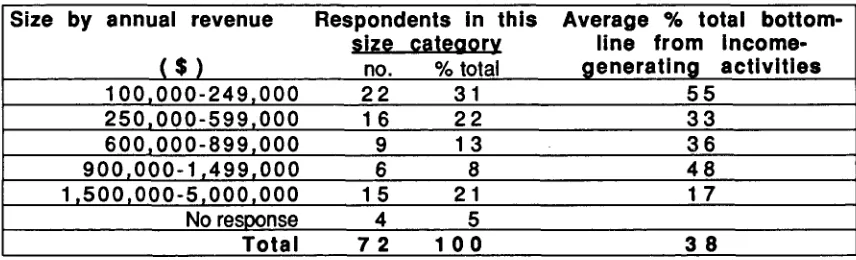
Income-Generating Activities by Revenue Size.. 58
Average Percentage that Income-Generating Activities Contribute to Total Bottom-Line for Types of
Non profits by Revenue Size... 59
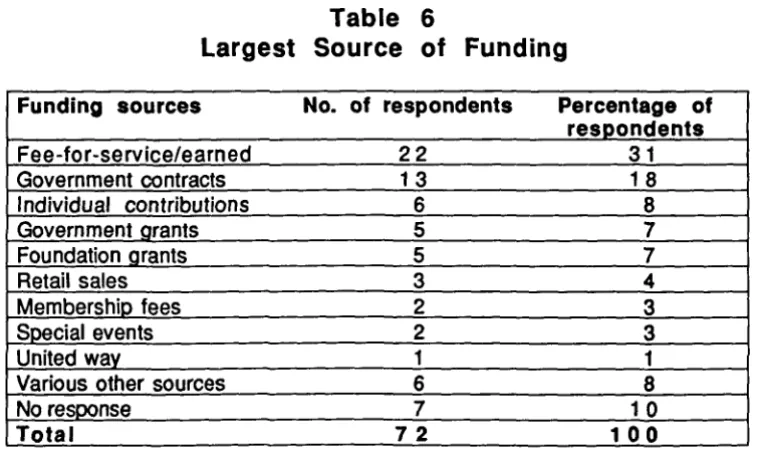
Largest Source of Funding... 6 0
Largest Source of Funding for the
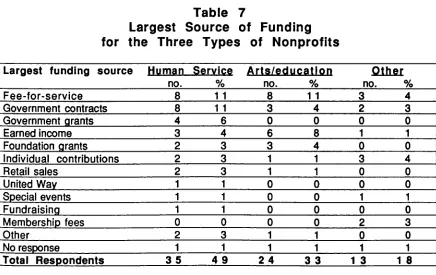
Three Types of Nonprofits... .... ... 61
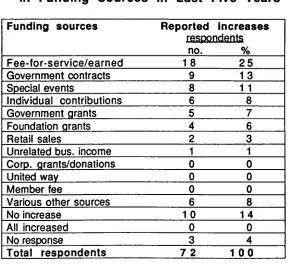
Most Significant Increases in Funding
Sources in Last Five Years... 6 2
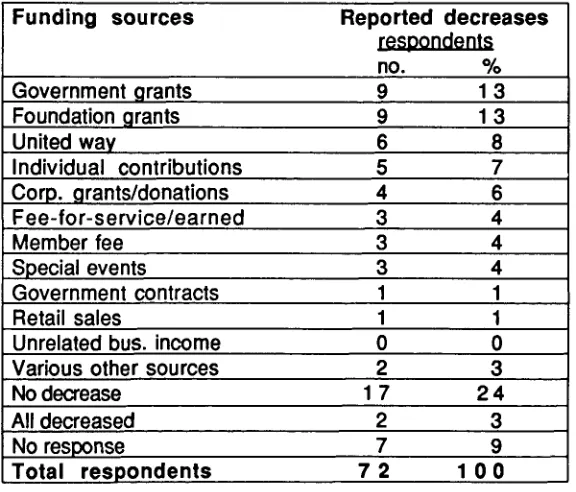
Most Significant Decreases in Funding
Sources in Last Five Years... 6 3
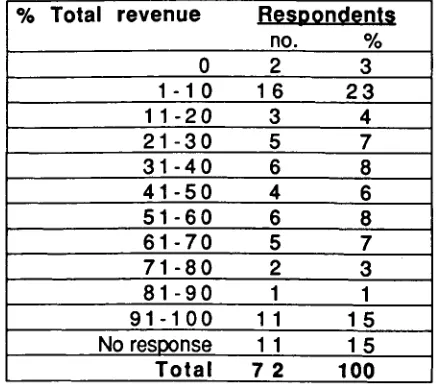
Income-Generating Activities as Percent of Total Revenue for
Respondents... 6 5
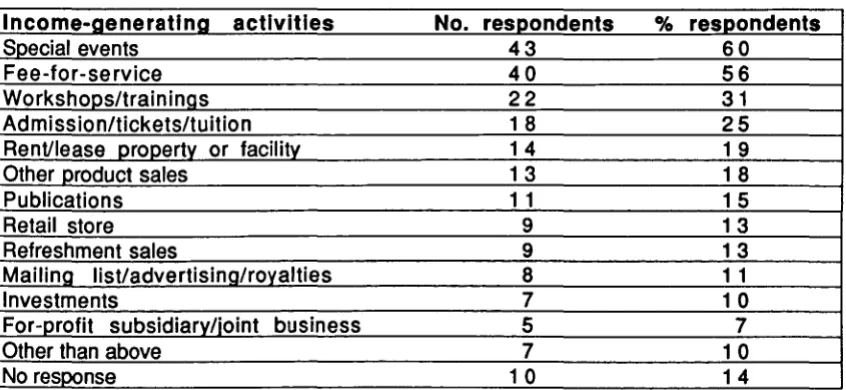
Income-Generating Activities of
Table 12
Table 13
Table 14
Table 15
Table 16
Table 17
Table 18
Table 19
Number of Income-Generating Activities Respondents Have
Conducted in Last Five Years... 6 7
Number of Respondents in the Four Categories of Implementation of
Income-Generating Activities... 6 9
Most Profitable Income-Generating
Activities... 7 1
Income-Generating Activities Being
Planned for the Future... 7 2
Commercial Income-Generating
Activities... 7 3
Commercial Income-Generating Activities as Percentage of Total
Revenue... 7 4
Percentage of Respondents Using
Business Plan Components... 7 5
Entrepreneur Responsible for Profitable Income-Generating
LIST OF CHARTS
Chart 4.1 Income categories of respondents... 1 23
Chart 4.2 Types of nonprofit organizations... 1 24
Chart 4.3 Increases in funding sources... 1 25
Chart 4.4 Decreases in funding sources... 1 2 6
Chart 4.5 Income-generating activities... 1 27
Chart 4.6 Most profitable income-generating
activities... 1 2 8
Chart 4.7 Respondents planning
income-generating activity... 1 2 9
Chart 4.8 Commercial income-generating
activities... 1 3 0
Chart 4.9 Business plan components... 1 31
Chart 4.10 Entrepreneur facilitated these
activities... 1 3 2
Chart 4.11 Special events... 1 3 3
Chart 4.12 Fee-for-service... 1 3 4
Chart 4.13 Workshops, exhibits, fairs, etc... 1 3 5
Chart 4.14 Admission, tickets, tuition... 1 3 6
Chart 4.15 Rent/lease of facility or property... 1 3 7
Chart 4.16 Retail store... 1 3 8
LIST OF APPENDICES
Appendix A ... Survey Questionnaire
Appendix 8... Letter to Survey Participants
Appendix C... Listing of Agencies Included in the Sample
Appendix 0... Summary of Legislation and Judicial Decisions Regarding Income-Generating Activities
CHAPTER ONE: INTRODUCTION
Background of the Issue
Virtually all not-for-profit organizations, from cultural institutions to social service centers, are in deep financial trouble. . . . However vulnerable they may be, not-for-profit organizations must now do two things to ensure their survival: stabilize their budgets and diversify their revenue bases
(Skloot, 1983, p. 20).
To diversify their revenue bases nonprofit organizations have,
among other strategies, created and implemented income-generating
activities. This movement into income-generating activities is a
trend that appears to be growing. Studies have indicated increasing
numbers of nonprofits are engaged in income-generating activities.
A 1981-1982 survey conducted by James C. Crimmins and Mary Keil
revealed that at that time 69 percent of their respondents had
established an income-generating activity within the last 12 years
and 60 percent generated a portion of their revenues from
income-generating activities (Crimmins & Keil, 1983, p. 14). Another survey
of 300 Chicago nonprofits, conducted by the Urban Institute,
concluded that almost one in five of the organizations were
considering the establishment of a for-profit subsidiary over the
following two-year period (Wilson, 1988, p. 11 ).
The increase in income-generating activities, as well as the
sophistication and the success of the activities, has met with
opposition from small business. When only a few nonprofits
"meddled" in enterprise activities, there was no substantial loss of
business were few and far between. Now, with heightened and purportedly more successful income-generating activities,
enterprising nonprofit organizations, small business, the IRS, and government are sorting out who should have what piece of the profit pie. Nonprofit organizations would argue that they have been
economically squeezed into income generation, encouraged to
undertake it, and obliged to do whatever they can to keep their doors open to meet the increasing demand for services. Small business would argue that nonprofits can indeed do whatever it takes to keep their doors open except step into profit-making territory.
Consequently, small businesses have wanted activities that resemble profit-making activities examined and taxed.
A basic fear, echoed by Henry Hansmann, a respected researcher, is that given their tax breaks, nonprofits could take over for-profit industries and put them out of business (Hansmann, 1981, p. 378). His research showed that nonprofit organizations were making significant headway in certain industries while some of their for-profit counterparts in the same industries were losing ground. This startling discovery grabbed the attention of small business
advocates who proceeded to make their grievances known through well-organized and intensified lobbying. Complaints from business, the IRS, and politicians about nonprofits engaging in unfair
competition were debated in Congress and the courts. The first laws and regulations which resulted, while tightening up some loopholes, generally created a favorable climate for income-generating
1980s that more stringent tax laws were seriously considered. In 1989 the IRS revised the tax form 990 to require an analysis of all income-generating activities including unrelated business income. This form also required documentation on how income was expended and explanation of how income contributed to the accomplishment of the exempt purposes. The form met with the criticism, according to Streckfus and Jakubowicz (1993), that the IRS allowed nonprofit organizations to complete the form using any accounting method they chose (p. 692). In reaction to the latitude that this free choice allowed, the Financial Accounting Standards Board issued a set of accounting requirements for nonprofit organizations (Alexander, 1991, p. 62). To date standards have not been put into law but are expected to be implemented shortly ("These rules will," Streckfus &
Jakubowicz, 1993, p. 6).
The tougher reporting requirements and standards revolved primarily around one type of income-generating activity-the
to the profit sector. This perceived threat to for-profit business is the heart of the controversy over the income-generating activities of nonprofit organizations today.
Interestingly, in concert with the intensified protest by small business over income-generating activities, the 1990s saw a
proliferation of coalitions and partnerships between big business and nonprofit organizations. While small business opposed the income-generating activities of nonprofit organizations, big
business sought out entrepreneurial nonprofit organizations. In fact, big business began a new way of doing business in the 90s. What started as "cause-related" marketing, which linked a corporate identity with a good cause, blossomed to become "cause-marketing" business which marketed the cause along with the business
(Oldenburg, 1992, p. 22). To succeed with doing business while doing good, more corporations began seeking out nonprofit organizations to align with and to create cooperative business ventures with. Thus a split in sentiments was created within the for-profit sector itself towards nonprofit organizations. One business faction harbored intense opposition to profitable commercial ventures by nonprofit organizations, while the other faction supported and encouraged them.
sector. They presented "how-to" workshops, workbooks, books, and lectures on assessing, planning, and implementing
income-generating activities. Success stories about how struggling nonprofits were "turned around" created hopeful anticipation that implementing business practices could compensate for funding cuts. Several consultants, including Landy (1989), Steckel (1989), and Skloot (1988), emphasized that the success of any
income-generating activity largely relied on tried and true business practices. The two most prominent recommendations they made were: Develop a business plan for income-generating activities; and, hire or appoint a savvy entrepreneurial type of individual, an
"enterprise champion," to see the new enterprise through to fruition. Crimmins and Keil stressed the correlation between a successful enterprise and a person with the essential entrepreneurial qualities of "energy, creativity, determination and perseverance" (1983, p. 1 03). They stated that, "Where we found enterprises performing well, the real story was often in the human factors rather than in the numbers, since it takes individuals, entrepreneurs-to make enterprises succeed" (p. 9).
Not only did big business and nonprofit consultants help
single item except federal funding" (Brinckerhoff, 1988, p. 8). Government did not stop with encouraging nonprofits only. According to a study done by Pires on the competition between the nonprofit and for-profit sectors, "government policies directly and indirectly encourage for-profit 'incursion' into nonprofit arenas" (1985, p. 11 ). Pires gives the example that the federal government in recent years encouraged for-profit firms to compete for human service contracts. The Small Business Administration (SBA) took this opening and used its authority to preclude human service
nonprofits from competing for federal government contracts in some areas altogether (p. 11 - 12). Consequently, losing some of their client base to their for-profit counterparts, nonprofit organizations have been compelled to make their income-generating activities more profitable.
Whether by encouragement or necessity, nonprofit organizations have successfully created new income streams, some of them
through commercial income-generating activities, to the chagrin of small business. What appears to be lacking in most of the arguments against the income-generating activities of nonprofit organizations, however, is empirical evidence as to the extent, type, profitability and commerciality of the activities.
Crimmins and Keil found that securing usable data was nearly impossible for their 1981-82 study on enterprise due to the
aware that they have enterprises . . . [or] have figures that are so kind to enterprise as to be unusable" (1983, p. 9). However
concealed and indistinct the income-generating activities of nonprofits may be, data collection is essential for resolving the arguments surrounding the issues of nonprofit organizations' engagement in these activities.
Statement of the Issue
Nonprofit organizations have faced severe funding cuts over the last decade. Increasing numbers of nonprofit organizations vying for a piece of the shrinking government grant and corporate donation pies have forced nonprofit organizations to consider or implement new income strategies. In concert with this strained economic situation, government encouraged nonprofit organizations to become self-sufficient and for-profit businesses to bid for contracts
traditionally given to nonprofits exclusively. Fueled by
encouragement and necessity, nonprofits sought advice from the business community and began to assume more business-like practices. As some nonprofits achieved success with new income strategies, small business began to complain.
By the end of the 1980s the situation for nonprofit organizations was summed up in the following statement:
and become more self-sufficient in order to ensure their future. Yet, the more adept they become at doing so, the more disturbed small businesses become (Millman, 1989, p. 33).
According to Millman it is clear that the income-generating activities of nonprofits have become an issue of contention with small business. Fueled by Hansmann's research (1981 ), which concluded that the income-generating activities of nonprofit organizations posed a serious threat to small business, the small business advocates took the issue to Congress to be resolved. Although pro and con arguments were waged, there was inadequate information about the nature and extent of the income-generating activities of nonprofit organizations.
In order to begin to answer the question, Do income-generating activities of nonprofit organizations pose a legitimate threat to
for-profit businesses?, comparable data are needed to ascertain the prevalence and extent of income-generating activities, as well as the profitability and commerciality of those activities. Also of interest is whether or not nonprofits successful in income-generating activities have applied the business practices that nonprofit business consultants have most stressed as factors leading to a greater chance for success; namely, placing an
entrepreneur at the helm, and following a well-crafted business plan.
This study attempts to collect data about the nature and prevalence of the income-generating activities of nonprofit
activities, this study does help to determine the actual extent to which the income-generating activities of nonprofit organizations exist.
Normative Definitions
The income-generating activities of nonprofit organizations are called by many different names. The IRS has classified these
activities with a set of names. Authors have called these activities by many other names. It is therefore necessary to define the
different terms as they pertain to this study and to note that the broad base of income activities are referred to, in this paper, as "income-generating activities." This is an umbrella term that encompasses all of the various names.
Following are definitions that clarify the distinctions among the different income-generating terms and definitions of the other variables used in this study.
Nonprofit Organization: For purposes of this study "nonprofit
organization" refers to any organization with the Internal Revenue Code 501 (c)(3) classification.
Size of organization: Both annual revenue and number of
Funding sources: Nonprofit organizations typically secure income from a variety of funding sources other than income-generating activities.
Income-generating activities: Many nonprofits engage in
various activities other than securing grants and eliciting donations to generate income. "Income-generating activities" is a broad
category that includes all of these activities.
Unrelated business income: Income that is not "substantially" related to the nonprofit organization's mission is referred to by the IRS as unrelated business income and is subject to tax.
Related business income: This term is used by the IRS to refer to income that is substantially related to the nonprofit
organization's exempt purpose. This income is not subject to income tax.
Enterprise: "Those income-producing activities that are beyond the normal mission of an institution" (Crimmins & Keil, 1983, p. 1 0).
Commercial enterprise or Commercial income-generating activities: Profit-making activities conducted by a nonprofit organization that are also found in the for-profit sector are called commercial enterprises. The income produced by commercial
"related" or "unrelated" business income, depending on the relation of a particular enterprise to the organization's tax-exempt purpose.
Earned or program-related income: Income that is derived from
the pursuit of the nonprofit organization's mission and objectives is called earned or program-related income. This income is always "related business income" and includes such revenues as fees for service, tuition, and admission charges but does not include such revenues as donations, grants etc. Earned or program-related income can be either commercial or noncommercial in nature.
For-profit subsidiary: The IRS has designated a percentage of
total income that can be derived from unrelated business activities. The unrelated business income activities could jeopardize a
nonprofit organization's exempt status at this maximum point. To curtail this a "spin-off" for-profit business is often created. This spin-off business or "profit subsidiary" becomes a separate profit business and is subject to the same tax laws that other for-profit businesses are subject to. A "for-profit subsidiary" can also be formed initially, if the intention of the parent nonprofit
organization is to create a profitable unrelated business.
Business plan: A business plan is a formal document that provides
plans.
Joint venture: A business partnership between a nonprofit
organization and a profit sector business, in this study, is referred to as a joint venture. The venture can be an earned or program-related activity, an unprogram-related business income activity, or a for-profit subsidiary.
Entrepreneur, Enterprise champion or Director of
Enterprise: Nonprofit business consultants generally agree that a highly motivated, entrepreneurial type of person is necessary to see a major income-producing activity through to success and profit.
Specification of the Research Objectives
To determine whether or not nonprofit income-generating activities are significant, this research will attempt to answer the following questions:
Section I. What types and sizes of nonprofit organizations are engaged in income-generating activities? Do larger nonprofit organizations rely more heavily on income-generating activities than do the smaller ones? What is the largest source of funding for the survey respondents? Are there differences in the largest
Do certain types of nonprofit organizations conduct more income-generating activities that other types? Have organizations had significant increases and decreases in funding sources in recent years?
Section II. What are the income-generating activities that nonprofit organizations are actually engaged in? How much income do these income-generating activities contribute to the
organization's bottom-line? Are more activities being planned for the future? If so, what are they? How many of the
income-generating activities are commercial in nature? What percent of the organization's bottom-line do these commercial activities
represent?
Section Ill. Do the more profitable income-generating activities employ an entrepreneur or utilize business planning techniques?
Importance of the Study
conducted by the U. S. General Accounting Office (1987) surveyed for-profit firms about the issue of nonprofit competition. Although more than half of the respondents reported competition was more intense in 1985 than in 1980, the study did not determine the impact of income-generating activities on existing for-profit businesses. The study did reveal that little is known about the extent of income-generating activities and pointed to the need for more in-depth analyses (1987, pp. 30-36). Compiled data on the extent of income-generating activities by nonprofit organizations could benefit both the nonprofit and business sectors.
This study does not actually determine whether or not income-generating activities of nonprofit organizations are harmful to for-profit businesses. It does provide some of the research needed to quantify the type, prevalence, and revenue of income-generating activities that are currently in operation or in the planning stages. Recommendations might then be made, based upon such quantifying data.
In the current climate of economic restraint, the dwindling of donated dollars from traditional sources, and the increased
background information about the issues that surround income-generating activities and provide a typology of past, current, and planned income-generating activities that could be useful to both nonprofit organizations and small business.
The information obtained from this research could further provide a foundation upon which future studies could be developed. It may also generate hypotheses that could be tested out in a later study.
Limitations of the Study
There are four main limitations to this study. These limitations are:
One, the study will not be generalizable. The nonprofit
organizations of Marin and Sonoma counties that responded to the survey questionnaire may or may not be representative of other organizations and activities in the San Francisco Bay area, California, the United States, or of the non-responding survey recipients, for that matter.
Two, the study is a typology of the types of organizations that are implementing income-generating activities, their funding
sources, and the types of activities they are conducting. Although there may be causal relationships, the study is descriptive in nature and will not test for significance.
inconsistencies in terminology regarding income-generating activities, and in accounting practices utilized by nonprofit
organizations. Because neither the terminologies· nor the practices are standardized, information may not be comparable in some cases. The survey questionnaire attempts to give examples and clarify questions so that responses will be standardized and data will be comparable.
Four, the survey instrument itself has inherent weaknesses. The artificiality of the survey format makes validity of the research somewhat problematical. Inaccuracies of mailing lists, postal
CHAPTER TWO: REVIEW OF RELATED LITERATURE
Introduction
The literature concerning nonprofit involvement in income-generating activities is largely devoted to two propositions, that (1) such involvement by nonprofits constitutes unfair competition, and (2) that nonprofit organizations engaged in profit-making activities should observe fundamental business practices. Most commentary on the first point has been written by small business concerns,
whereas literature concerning the second point has been written predominantly by nonprofit business consultants.
The literature on the subject of for-profit activity of nonprofit organizations may be categorized into five subject areas: (1)
Circumstances that have pressed nonprofits towards the creation of income-generating activities. These include government funding cuts, competition for funding, incursion of for-profit business, entrepreneurial encouragement, cause-marketing businesses and mutually beneficial partnerships, economic recession, and blurring of the sectors. (2) Competition between nonprofits and small
business. (3) Advantages and disadvantages that both nonprofits and small business are purported to have in income-generating
activities. (4) Strategies for successful income-generating
I. Circumstances Leading to the Increase of Income-Generating Activities by Nonprofit Organizations
Government: Funding Cuts and Entrepreneurial Encouragement
Several writers, Bennett and DiLorenzo (1989), Steckel (1989), and Farrell (1983), agree that the governmental funding cuts of the early 1980s were the primary cause that catapulted nonprofits into income-generating activities. A few writers claim that not only did governmental funding cuts turn nonprofit organizations towards profit-making activities, but that government and nonprofit boards and foundations created a climate in which nonprofits were
encouraged to become more self-sufficient. For-profit businesses, however, did not react favorably to the new nonprofit profile. Kevin Farrell, in his article Competition from Nonprofits: Are For-Profit Businesses at an Unfair Disadvantage? quotes a Senate Small Business Committee aide as saying, " . . . These [nonprofit]
organizations have been encouraged to help themselves, and now that they're really doing it, businesses are complaining" (1983, p. 176). Wellford and Gallagher second this sentiment in an excerpt from their report:
[The] government and for-profit business sectors are sending opposite signals to the nonprofit community. On the one hand, the government encourages entrepreneurial activity as a means of improving self-sufficiency; on the other, the for-profits complain of unfair competition when nonprofits engage in
A 1985 study by Pires reported that government foundations and
business all supported and encouraged nonprofit organizations to
take care of themselves. The report pointed out,
Directly, both government and business, and many foundations for that matter, encourage nonprofits to be more "businesslike,"
entrepreneurial and self-sufficient. Many of the nonprofit
enterprise activities we found in our survey were encouraged and supported by government, business, and/or foundations. Indeed, they would not have been possible without financial and technical backing from those sectors (Pires, 1985, p. 8).
The report goes on to say that particularly in recent years, " . . .
government and business have argued that enterprise can reduce the
dependency of nonprofits on government and corporate cash
assistance: they encourage the development of more active and
self-sustaining partnerships" (Pires, 1985, p. 8).
Competition for Funding
The escalation of community service needs has caused an
increase in the numbers of nonprofit organizations.
Because of the broadened scope of community needs and increased demands, there has been a proliferation of not-for-profit organizations-ranging from additional health and human care agencies to grass-roots advocacy groups to arts and
cultural associations. As this rapid expansion has taken place, there has not been attendant increase in the level of giving from individuals (who account for 83 percent of all donations), or from corporations, foundations, bequests, or other new funding sources needed to support these expanded initiatives (Overkamp, 1990,' p. 23).
The insufficient funding base has affected some nonprofit
notable and worthy nonprofit organizations, such as arts, education, and recreation organizations, have found it increasingly difficult to compete with nonprofit organizations that attempt to alleviate human suffering. For those organizations that do receive grants, the grant amounts awarded are often much smaller than requested.
To make the difficult choices about which organizations to fund, funders are having to scrutinize nonprofit organizations more
closely. They want to avoid duplication of efforts and ensure that their money goes to the organization that is able to make the
greatest impact. Usually older, more stable nonprofits can promise this and many new and experimental nonprofits are left out of the grant-making process altogether (Steckel, 1989, p. 1 0).
With fewer donated dollars to go around, nonprofit
organizations have a stark choice: Scale down their operation, or pursue new profit-making avenues.
Incursion of For-Profit Business
There is a scant amount of literature on the "incursion" of for-profits into the nonprofit arena. Peter C. Brinckeroff claimed that for nonprofit organizations, "one of the most crucial [trends] is increased competition from commercial firms" (1988, p. 8). The traditionally nonprofit dominated fields of health care and
education, for instance, have seen the growing intrusion of profit-sector business. Dr. Richard Steckel points out that, "Postal service, correctional facilities, health care, elder care, child care,
and other traditional nonprofit areas are being invaded by private enterprise" {1989, p. 1 0). In some cases, government contracts, which were previously offered to nonprofits, were offered only to small business to the exclusion of nonprofit organizations
altogether {Wellford & Gallagher, 1988, p. 6). Some businesses have even begun to champion social issues. According to one author, "Business will be more and more directly involved in social issues . becoming a major player in the arena once dominated by government and the voluntary sector" (Overkamp, 1990, p.22).
A contrary view on the matter is given by Jay Finegan {1987). Finegan asserts that unfair competition from nonprofits is the number three concern of small business. In the past two decades several small businesses have had to seek other markets when the nonprofit competition· offered comparable goods at a lower price. This type of crowding-out phenomena elevated competition by
nonprofits to one of the top agenda items of the SBA {Finegan, 1987). Despite the controversy, nonprofit organizations continued
Cause-Marketing Businesses and Mutually Beneficial Partnerships
While many for-profit businesses and nonprofit organizations were moving in on each other's turf, corporate business in general appeared to be taking a more charitable turn. American Express led the way in the late 1980s by promising its credit card users that a percentage of the amount they charged would help refurbish the Statue of Liberty. This marketing strategy gave birth to the popular trend known as "cause-related marketing." A survey published in 1992 by the Public Relations Society showed that "cause-related marketing ranked at the top of a list of the ten hottest trends in the industry" (Oldenburg, 1992, p. 22). D. Sizemore-EIIiott writes,
"Companies realize that reputations, particularly as they relate to key social issues, affect profitability" (1990, p. 26).
The cause-related marketing trend was further molded by two demands. One demand sprung from a new trade association, Business for Social Responsibility, the other from the growing number of activist-minded baby-boomer consumers. These two demands fundamentally affected how business was conducted in the 1990s.
In the spring of 1992, several representatives of major
companies formed Business for Social Responsibility (BSR) which took cause-related marketing to its next step. BSR introduced "cause-marketing" as a means for making a difference in society through the leveraging of business power and resources. To
than marketing itself as merely being aligned with a cause, as in "cause-related," the company would market itself and the cause, calling for social change and providing the means for achieving it. One prominent advertising executive, Carol Cone, was quoted as saying, "What's happening is that leading edge companies are
believing that they have to have a corporate soul" (Oldenburg, 1992, p. 22). From the practical standpoint, the motivation for this shift was summed up in the words of one of the new BSR members: "You can't run a healthy company in an unhealthy society for long" (p. 22).
The change in business conscience was perhaps propagated by the same population of baby-boomers who were, on the one hand, new executives of companies, and on the other hand, a powerful and growing consumer group. As a consumer group they demanded that companies demonstrate their commitment to a cause by producing results, not just giving lip service. A company of the 1990s now has the task of convincing savvy consumers that it really does care
about the consumer and societal issues. To do this, Oldenburg
suggests that, "a cause-marketing company must align itself with a credible nonprofit group, make a long-term commitment, and take on a super cause, an issue of urgency and national dimensions"
(Oldenburg, 1992, p. 23). He further states, "It [cause-marketing business] aligns all the needs-the company, the nonprofits, the
consumer-and puts them all into a strategic alignment and it gives a very powerful message" (p. 22).
However, a growing number of companies have aligned themselves with nonprofit groups, as Oldenburg suggested, forming "mutually beneficial" relationships. Steve Rabin (1992) defines this new nonprofit and business partnership: "A partnership is not a charity. By definition, a partnership is a two-way relationship: the partners pool their resources in order to share mutual benefits and achieve common objectives" (pp. 32-33). A nonprofit lends expertise and credibility to the partnership. Business provides new income streams for the nonprofit partner and tremendous resources to leverage the cause. Together the corporation and the nonprofit each extend each other's reach, and as Rabin puts it, "When carefully crafted, these alliances provide a win-win situation for both
partners and for the public" (1992, p. 32) Two successful alliances cited by Rabin are between the Dr. Scholl footwear company and the American Association for Retired Persons (AARP), and between the Kellogg Company and the National Cancer Institute. Dr. Scholl and the (AARP) launched a consumer education program called "Walking for Fitness," which promoted the interests of the business by
fostering brand loyalty among older people. The campaign also promoted the interests of the nonprofit group by emphasizing
Economic Recession
In the last few years, another element has impacted the bottom-line of nonprofit organizations. The general economic recession of the country has driven more people to seek nonprofit services. "Nonprofits are seeing more clients, often in more dire condition, with fewer funds to meet their needs" (Steckel, 1992, p. 44). This increase in the number of clients has underscored, for many nonprofits, how important it is for them to keep their doors open and secure income from any source they can.
Blurring of the Sectors
Cause-marketing businesses, retired executives consulting nonprofit organizations, and community service programs for
employees are all examples of recent charitable developments in the business sector. Conversely, nonprofit organizations are becoming more business-like. They are operating profit-making enterprises and forming partnerships with businesses. Government too, with the new push to be "reinvented" and become more efficient and
businesslike, is beginning to seek profitable means of carrying out its responsibilities. What we seem to be witnessing is a blurring of traditional boundaries between the sectors.
S. J. Overkamp, senior vice-president of United Way of America, predicts that,
in social issues (such as education, illiteracy, substance abuse, and AIDS), becoming a major player in an arena once dominated by government and the voluntary sector . . . More coalitions involving business, government, education and the nonprofit sector will emerge to address social problems such as beyond government's ability to address alone (1990, pp. 22-23).
Is redefinition of the public, private and nonprofit sectors in sight? Or, is this blurring of the sectors a trend that will continue? If it is to continue, will the income-generating activities of
nonprofit organizations increase more rapidly?
II. The Issue of Competition between Nonprofit Organizations and Small Businesses
The issue of competition between nonprofits and small business is complex and controversial. A review of the evolution of the issue reveals scarcely a mention of the subject before 1982; conversely, in the last thirteen years, an escalating amount has been written. The 1980s saw a diverse array of articles and research works
written by those who supported nonprofit business enterprise and by those who opposed it. The paper battle between the interests was heavily waged during the decade and was complemented with
tax changes.
Literature from small business interests on the subject of unfair competition has substantially outweighed the literature from nonprofit organizations on the subject. Much literature from
nonprofit interests can be found, however, on the subject of starting a for-profit enterprise.
Several articles and studies written in the early 1980s, Skloot (1983), Crimmins and Keil (1983), and Simons, Miller, Lansfelder (1984), and Brown (1986) pointed nonprofit organizations in the direction. of income-generating activity, providing valuable information on business start-up opportunities and pitfalls. Nonprofit organizations that heeded the call to create income-generating activities, "how-to" books and articles like those mentioned above, and the advent of workshops on how nonprofits should select and start businesses, no doubt galvanized the caustic response from small business.
A report issued by the Small Business Administration in 1984 articulated the issue of unfair competition and started the ball of contention rolling towards more restrictive legislation. Entitled Unfair Competition by Nonprofit Organizations With Small Business: An Issue for the 1980s the report contended that nonprofits which engage in commercial activities and earn all, or part, of their income from sales or fees, as opposed to gifts and donations, compete unfairly with small business (Walters, 1984, p. 66). The report charged that nonprofits have unfair advantages in the
at the lowest corporate rate for unrelated business income, postal rate reductions, and fewer regulations, not to mention a public favorable to charitable causes.
The report claimed that as nonprofit organizations embark on commercial enterprise under the umbrella of corporate income tax exemption, fundamental questions need to be examined: "What are the rationales for granting nonprofits tax-exempt status, and are they still valid? What is the level of commercial activity by
In looking at the issue raised by the second question, "What is the level of commercial activity by nonprofits in various
industries?" (SBA, Office of the Chief Counsel for Advocacy, 1984, p. 2), the report cited case studies of nonprofit organizations in
diverse fields, noting that in all of the commercial fields mentioned, marked increases in the size and scope of the nonprofit sector were evident. In 1987 the U. S. General Accounting Office (GAO)
attempted to obtain information on the level of nonprofit
competition in six industries by surveying profit sector firms. The study found that nonprofit competition was evident in all six
industries but the intensity varied across the industries (Bennett &
DiLorenzo, 1989, p. 34).
Some of the literature from small business concerns suggested that untaxed commercial enterprise activity by nonprofits unleashed could destroy, or at least greatly impede, the growth of the private sector. Henry Hansmann wrote in 1981, "If the for-profit firms in the industry are subject to income taxation, then it will be more likely that nonprofit firms will ultimately take over the industry" (Hansmann, 1981, p. 378). It has been advised that nonprofit organizations that engage in income-generating activities meet a "commerciality test." If the income-generating activity is found in the for-profit sector, then that activity should be " . . . taxable under the corporate income tax even if the nonprofit claims that the
current and historical thinking about nonprofit tax exemption"
(Wellford & Gallagher, 1988, p.6). Although not passed into law, the commerciality test has had an impact. Some IRS critics have
already cited cases in which "Judges just label an activity as 'commercial' and conclude that it is unrelated and, if substantial, then the organization loses or is denied tax-exempt status"
(Streckfus, 1992, p. 928).
Very little analysis has been done pertaining to the third question, "What is the economic effect of the tax exemption and other factors on competition between nonprofit and for-profit firms?" (SBA, Office of the Chief Counsel for Advocacy, 1984, p. 2), although the need for it was evident, the report found.
In response to the controversial SBA report, a 1985 study
commissioned by the National Assembly of National Voluntary Health and Social Welfare Organizations, Competition Between Nonprofit and For-Profit Sectors (Pires, 1985), looked further at the issue of competition between the nonprofit and for-profit sectors.
According to Pires,
Nonprofit enterprise has been increasing in recent years due to the shortfall in the more traditional funding streams, increased competition for funds and an increased demand for services. . . . For many nonprofits, enterprise activity has emerged as the only viable alternative to cutting programs, cutting clients or
reducing quality of services (1985, p. 8).
for-profit firms to compete with nonfor-profits for federal grants and
contracts. The SBA, too, had entered the arena by using its authority to reserve federal contracts for for-profit businesses. This
excluded nonprofit organizations from competing. In response, some nonprofits created for-profit subsidiaries so that they could be eligible to bid on these particular contracts {see discussion pp. 11-12).
In their book, Unfair Competition: The Profits of Nonprofjts {1989), Bennett and Dilorenzo contend that the present arrangement that nonprofits enjoy has serious repercussions in the marketplace and needs to be changed. According to the authors, in 1985, the nonprofit sector was comprised of approximately 1 .2 million organizations. Of that number only 1 0 percent had the charitable objectives of serving the poor, unemployed, hungry, or unfortunate; the remainder were religious, educational, research, scientific
organizations, or trade unions and business associations {1989, p. 3). Bennett and Dilorenzo cite a Newsweek article from 1987 which reported tax-exempt organizations were one of the fastest growing segments in the economy. The authors contend that as the sector grows, its commercialization becomes dangerous to the rest of the economy. In a 1988 article in Business and Society Review Bennett and Dilorenzo state "Not only is competition from the commercial nonprofit sector damaging existing firms, it also discourages the formation of new ones" {p. 41 ).
was seen by other authors, Mclaughlin {1991 ), Steckel {1992), and Byrne (1990), as a positive trend. Mclaughlin said that the nonprofit sector supported the economy by employing a significant number of workers. In 1987 the 907,000 public charities he examined
"employed 7.4 million people, or 6 percent of the entire workforce" (Mclaughlin, 1991, p. 5). The sheer size and scope of the nonprofit sector give it an economic power of its own. One author cites the nonprofit sector to be comprised of nearly one million nonprofit organizations or about half of the organizations and enterprises in the United States {Dabbs, 1991, p. 68). Together these nonprofits possess $1 trillion in assets, account for 6 percent of the gross national product, and employ 7 million people {Zagorin, 1993, p. 36). With annual expenditures of nonprofit organizations exceeding $130 billion in recent years (Dabbs, 1991, p. 68), it follows that the well-being and financial security of the nonprofit sector is important to the economic well-being of the country.
Not only an important contributor of jobs in this country, the nonprofit sector also provided leadership. In an article by Steckel (1992), Peter Drucker is quoted as saying, "Our nonprofit
organizations are becoming America's management leaders . . . They are practicing what American businesses only preach . . . working out the policies and practices that business will have to learn
tomorrow" (p. 44). Echoing Drucker, John Byrne (1990), in a Business
Week cover story, stated that nonprofit organizations are some of
to the benefit of business.
While the above authors cite some of the benefits given to the
economy and to business by the nonprofit sector, Bennett and
Dilorenzo provic;fe a number of arguments and examples about the
harm to our economic structure when unfair competition from
nonprofits is allowed. They claim that small businesses are the
most susceptible to nonprofit competition and, "In many cases,
existing profit-seeking firms have been driven from the market or
have suffered economic losses, and new firms have been discouraged
from entering markets in which nonprofits operate" (1989, p. 2).
Bennett and Dilorenzo further emphasize that, "because small firms
are the primary sources of both new jobs and innovations in the U. S ..
economy, unfair competition from nonprofits has slowed economic
growth and technical change and has reduced economic
opportunities" (p. 2). The authors' sentiment was, perhaps,
summarized in their following statements:
The issue is not competition per se, but unfair competition. Whenever a nonprofit produces goods and services in
competition with for-profits, simple equity demands that the nonprofit be subject to the same tax laws, pay the same postal rates, and be governed by the same regulations as its
profit-seeking counterparts. In short, if a nonprofit wants to operate a
commercial enterprise, it should set up a for-profit subsidiary (p. 3).
Two other authors who have approached the issue of unfair
competition through the narrower perspective of the human service
and social welfare fields, Harrison Wellford and Jayne Gallagher,
Organizations, Wellford and Gallagher concluded that tax exemption "does not afford nonprofit organizations a significant competitive advantage, and that proposals to change the basis for exemption, modify the concept of "unrelated business," limit non profits' ability to compete for government contracts, and other remedies proposed by small business advocates are not warranted" (1985, p. iv). The authors presented a similar perspective in their later work, U nfaj r Competition? The Challenge to Charitable Tax Exemption (1988) and complemented their view with a historical review of charitable organizations and the tax laws state by state.
The two above-mentioned works by Wellford and Gallagher were based on two rationales, the "public purpose" rationale and the
"relieving a government burden" rationale. These rationales for tax exemption could be justified by the majority of human health and social welfare organizations but could not be so easily transferred to nonprofit organizations in some of the other fields that Bennett and Dilorenzo investigated. Both rationales are articulated in the statement, "The exemption from taxation accorded nonprofit organizations recognizes the public purpose and numerous
contributions to community life made by nonprofit organizations, and it acknowledges that voluntary organizations often substitute for the government in providing services" (Wellford & Gallagher, 1988, p. iv). Bennett and Dilorenzo would argue that the rationales that had been employed to grant tax exemption can no longer be applied to nonprofits engaged in commercial activities.
(1990), have argued that both nonprofit organizations and
government agencies have taken advantage of their tax-exempt status and have provided services and products that the profit sector could easily provide. This charge was brought out perhaps most vehemently in the SBA report of 1984 that spurred the debates of the 1980s. That report had a larger issue in mind than that of unfair competition by nonprofit organizations. It stated,
The issue of competition by nonprofits with small business is part of the much larger problem of government competition with the private sector. To the extent that the Federal government subsidizes nonprofit organization activity through the corporate income tax exemption in the Internal Revenue Code, nonprofit activity represents a· form of indirect government competition with the private sector. This can be distinguished from direct government competition with the private sector, in which the government supplies to itself commercial goods and services which are available from the private sector (Office of the Chief Counsel for Advocacy, 1984, pp. 1-2).
Jll. Advantages and Disadvantages for Nonprofits and Small Business
Both nonprofit interests and small business interests have accused each other of having advantages in the marketplace. Wellford and Gallagher (1985) cited several small business advantages. They stated that,
The SBA guarantees loans to small businesses that cannot
obtain ordinary bank loans. The set-aside program permits only small businesses to compete for certain federal contracts, and the Office of Advocacy promotes the interests of small
The authors also remarked that nonprofit organizations operate
income-generating activities under several constraints that
for-profit businesses are free of. The most important constraint was
that a nonprofit "must devote its income to carrying out its public
purpose" (p. 14). Secondly, a nonprofit that was operated primarily
for commercial purposes will lose its tax-exempt status (p. 8). A
third constraint mentioned was "The Internal Revenue Code also
prohibits nonprofits from operating to enrich any private interest"
(p. 9). The authors asked, with these constraints and the advantages
that small businesses have as mentioned above, what advantages
could nonprofits have in the marketplace?
The most significant advantage that nonprofits are purported to
have is illustrated in the example from Toni Goodale's article which
appeared in Fundraising Management. The article pointed out the
fundamental distinction between a for-profit organization and a
nonprofit organization in the same field. It stated, "If one publisher
has to pay taxes on its profits and another does not, the first
publisher is, in effect, subsidizing the business of the second"
(1988, p. 72). As well as nonprofit organizations being subsidized
by their competitors, Donald Bacon (1989) stated that nonprofits
also enjoy lower postal rates, receive special treatment with
unemployment insurance, minimum wage, securities, bankruptcy, and
anti-trust matters. To top these advantages off, James Cook (1990)
claimed that the "nonprofit designation is itself a powerful
marketing tool . . . what the for-profit sector calls the halo effect"
The advantages that nonprofits do enjoy may not be inherently unfair but when applied to nonprofit organizations that are operating the same or similar enterprises as those found in the profit sector, the advantages may seem to give nonprofits an unfair edge.
Consequently, the SBA and other small business coalitions have been frenetic in stating their grievances and calling for legislative
changes with regard to income-generating activities of nonprofit organizations. According to the Frederick Rothman in Tax-Exempt Organizations Face New Hurdles--Part II, a House Ways and Means Oversight Subcommittee was formed in June of 1987 to begin
discussion and hold hearings on the for-profit activities of nonprofit organizations {Rothman, 1988, p. 40).
Hopkins {1987), Rothman {1988), and Millman (1989) were
increases in postal rates for nonprofits, the predictions of the above authors certainly seem to be coming true. Many of the perceived advantages that nonprofit organizations have in relation to for· profit enterprise may soon be a thing of the past.
IV. Suggested Strategies for Successful Income-generating activities
Despite all the furor, new legislation, and increased scrutiny, the current economic climate will continue to compel many
nonprofit organizations to consider income-generating activities in the 1990s. With increased competition from within the nonprofit sector itself and heightened competition from without, the nonprofit organization that chooses income-generating activities better be equipped, not only to overcome the tax hurdles, but to compete and win in an increasingly competitive market.
To help nonprofit organizations succeed in business, consultants with business expertise and savvy have found a growing market for their skills and ideas. One such consultant, Richard Steckel, former director of the Children's Museum of Denver and current president of the business consulting firm AddVenture Network, Inc., believes that all nonprofits should be run as businesses. His view is, "You can only beg so much, and it's no fun" (Skrzycki, 1984, p. 65). Steckel's strict for-profit business view might be summarized in the following
. . . We have three tenets: fairness, competitiveness, and greed" (p. 38). Although Steckel's message to nonprofits may be somewhat tongue-in-cheek, it does ring of his own success. Beginning with his directorship, the Children's Museum skyrocketed from nearly closing its doors to producing 95 percent of its income through for-profit enterprise (Calonius et al., 1987, p. 38).
To the struggling nonprofit, Steckel's business style might look very appealing. To the Small Business Administration, however, it may appear rather threatening. Peter C. Brown, a business
consultant who specializes in entrepreneurship in corporations and nonprofit organizations, would temper Steckel's business-for-its-own-sake approach and encourage nonprofits to meld "the mission and sensitivities of the nonprofit sector with the risks, rewards, and bottom-line discipline of the for-profit sector" (Brown, 1986, p. 13). He calls this regenerative funding. "Unlike entrepreneurship," Brown further states, "making money is not the ultimate priority of regenerative funding-achieving the agency's mission is the real ultimate goal" (p. 13).
Not all nonprofits can or should venture into for-profit enterprise, according to Edward Skloot (1983) in Should Not-for-Profits Go into Business?. Unless a nonprofit has something to sell, a market that will buy it, expertise to manage it, trustees to
virtually demands the pursuit of earned income" (p. 20).
Although Skloot (1983), Steckel (1989) and Brown (1986) may
not agree on all points, they would agree that a for-profit enterprise
should utilize, from its conception, business tools and principles.
While Steckel may encourage nonprofits generally to pursue
for-profit enterprise and move toward self-sufficiency, Brown and
Skloot would encourage only a few. All three of these consultants,
however, emphasize the importance of thorough planning and
recommend the preparation and implementation of a business plan.
The importance of a thorough business plan cannot be
underestimated. Leslie Wilson (1988) states that, "Today over half
of all new businesses fail within the first· two years of operation,
and over 90 percent fail within the first 10 years" (p.11 ). Wilson
says, "According to bankers and lenders, one of the major reasons
for these failures is lack of planning" (p. 11 ).
Most authors agree that planning is an essential ingredient for
success, but as one author puts it, "the greatest plan won't make
your business a success. That part is up to you" (Woolley, 1989, p.
125). According to Steckel (1989), Landy (1987), Skloot (1988), and
Humphrey (1987) a champion is needed for the venture to succeed.
Humphrey says that "new ideas either find a champion or they die"
(1987, p. 1 02). Steckel nearly echoes Humphrey and adds, "the
department must have a full-time (or very close to full-time)
champion, a captain who gives the department backbone and
direction; someone whose primary responsibility is to sell ventures