
Introduction
334
0
0
Full text
(2) Buffer Zones:. THEIR PROCESSES AND POTENTIAL IN WATER PROTECTION The Proceedings of the International Conference on Buffer Zones September 1996. Edited by: Nick Haycock Haycock Associates Limited, UK Tim Burt University of Durham, UK Keith Goulding IACR – Rothamsted, UK Gilles Pinay CNRS, Université de Rennes, France. Haycock Associated Limited 11 Edison Close, St. Albans, Herts. AL4 0RB © 1997 (Book Version) © 2001 (Electronic Version).
(3) Buffer Zones: Their Processes and Potential in Water Protection First Published by Quest Environmental, PO Box 45, Harpenden, Hertfordshire, AL5 5LJ, UK (Business changed names to Haycock Associated Limited, April 2000) Electonic PDF Version Published by Haycock Associated Limited March 2001 Hardcopy Copyright © 1997 Quest Environmental, PO Box 45, Harpenden, Hertfordshire, AL5 5LJ, UK Tel: (0)1727 852665, Fax: (0)1727 866181 email: [email protected] Electronic Verion © 2001 Copyright transferred to Haycock Associated Limited, 11 Edison Close, St. Albans, Herts. AL ORB. Tel: +44 (0) 1727 852665, Fax: +44 (0) 1727 866181 email: [email protected] All rights reserved. No part of this publication may be reproduced in any form or by any means without the prior written permission of Haycock Associated Limited. Except in the case of A. Tytherleigh (1997) Chapter 26: The Establishment of Buffer Zones – The Habitat Scheme Water Fringe Option, UK, which is covered in its entirety by © Crown Copyright. Great care has been taken throughout this book to ensure accuracy. However, Haycock Associated Limited accepts no responsibility for any errors that may have occurred. Any comments or corrections should be addressed to Haycock Associated Limited at the address given above. Haycock Associated Limited accepts no responsibility for any loss or damage arising from the interpretation or use of the information, or reliance upon views contained within this book.. British Library Cataloguing in Publication Data A catalogue record for this book is available from the British Library ISBN: 0 9530051 0 0. Indexes, proof reading and figures: Design and origination: PDF Version Printing and binding:. Quest Environmental (1997) Mac Graphics, Harpenden, Herts., UK Haycock Associated Limited, Herts., UK White Crescent Press Ltd, Luton, Beds., UK. Cover photograph:. The River Save, a tributary of the River Garonne, Toulouse, by Nick Haycock.
(4) Acknowledgements These proceedings were financially supported by Quest Environmental and the Environmental Agency R&D Programme on “Land Management Techniques”. The Environment Agency continues to be actively involved with the scientific and management issues associated with buffer zones. This book builds on the Environment Agency’s booklet “Understanding Buffer Strips”, 1996 (available from all Environment Agency regional offices) and previous publications on this subject, notably Large, A.R.G. and Petts, G.E., 1992, Buffer zones for conservation of rivers and bankside habitats, Project 340/5/Y. This and other Environment Agency R&D publications are available from the Foundation for Water Research, Allen House, The Listons, Listons Road, Marlow, Bucks, SL7 1FD, UK. The members of the conference steering group are acknowledged for focusing the debate and securing funds, namely: Kay Schofield and Richard Smith, Environment Agency; Rob Jarman, The National Trust; Richard Knight, FWAG; Mary Gibson, English Nature; Rex Agg, FWR; Paul José, RSPB; Caroline Drummond, LEAF and finally Art Gold, Univ. of Rhode Is., USA and Wendell Gilliam, NCSU, USA. For those who attended the conference, we are sure you would appreciate us thanking both The Earl of Cranbrook, Chairman of English Nature, for his opening address and Jonathan Peel, Deputy Chairman of the National Trust and Chairman of the Broads Authority, for his conference dinner speech. Thanks also go to: Peter Leeds-Harrison, Cranfield University; Richard Vivash and Martin Janes, River Restoration Project; Andy Mayled and Richard Morris, The National Trust; Rupert Burr, Roves Farm and Ian Bowyer, The Radnor Arms, for their involvement in the conference tours. We would also like to thank the loyal band of conference helpers. Finally a special thanks goes to Val Mitchell and the conference centre staff at the National Westminster Bank Staff Training College, Heythrop. We would like to thank all the authors of the oral and poster presentations for their work. A selection of the poster presentations is included in this book but a full listing of the conference posters can be found in Appendix I. Thanks go to the Ministry of Agriculture, Fisheries and Food and ADAS for permission to publish “The Establishment of Buffer Zones – The Habitat Scheme Water Fringe Option” by A. Tytherleigh. We also acknowledge the US Environmental Protection Agency, Chesapeake Bay Program, for permission to use figures 2, 6 and 7 from EPA 903-R-95-004 (see chapters by Dillaha and Inamdar, and also Lowrance). Permission from ASA-CSSA-SSSA was given for figures 2 and 4 in the chapter by Gold and Kellogg. In the creation of this book, thanks must go to all our authors and also to Laura Haycock, for compiling their many excellent contributions into published form. I am sure we are all grateful for the efficiency of the editors which has enabled us to publish this book so soon after the conference..
(5) Contents List of Contributors 1. Introduction N.E. Haycock, T.P. Burt, K.W.T. Goulding and G. Pinay. 1. Part I: The Processing of Target Chemicals Within Buffer Zones 2. Buffer Zones and Water Quality Protection: General Principles D.L. Correll. 7. 3. The Hydrological Role of Floodplains within the Drainage Basin System T.P. Burt. 21. 4. Buffer Zones as Sediment Traps or Sources T.A. Dillaha III and S.P. Inamdar. 33. 5. The Interactions of Buffer Zones and Phosphorus Runoff J. Uusi-Kämppä, E. Turtula, H. Hartikainen and T Yläranta. 43. 6. Nitrogen Dynamics and Buffer Zones J.W. Gilliam, J.E. Parsons and R.L. Mikkelsen. 54. 7. Pesticide Contamination of Surface Waters – The Potential Role of Buffer Zones G.L. Harris and A. Forster. 62. 8. Grassed Buffer Zones to Limit Contamination of Surface Waters by Pesticides: Research and Action in France J.J. Gril, B. Real, L. Patty, M. Fagot and I. Perret. 70. 9. The Relationship between Land Use, River Bank Quality and Lotic Macroinvertebrate Community B. Gumiero and G. Salmoiraghi. 74. 10 Contaminant Effects on Microbial Functions in Riparian Buffer Zones P.M. Groffman. 83. 11 The Influence of Sedimentation on Vegetation Structure J. Girel and G. Pautou. 93. Part II: The Potential of Habitat Types to Act as Buffer Zones 12 The Potential Role of In-Stream and Hyporheic Environments as Buffer Zones A.R. Hill. 115. 13 The Potential Role of Riparian Forests as Buffer Zones R. Lowrance. 128. 14 Effectiveness of Buffer Strips for Attenuation of Ammonium and Nitrate Levels in Runoff from Pasture Amended with Cattle Slurry or Inorganic Fertiliser A. Núñez Delgado, E. López Períago and F. Díaz-Fierros. 134.
(6) 15 The Potential Role of Ponds as Buffer Zones S. Fleischer, A. Joelsson and L. Stibe. 140. 16 The Potential Role of Wet Meadows and Grey Alder Forests as Buffer Zones U. Mander, K. Lõhmus, V. Kuusemets and M. Ivask. 147. 17 The Potential Role of Riverine Wetlands as Buffer Zones C.A. Johnston, J.P. Schubauer-Berigan and S.D. Bridgham. 155. 18 The Potential Role of Mid-Field Forests as Buffer Zones L. Ryszkowski, A. Bartoszewicz and A. Kedziora. 171. 19 Modelling Internal Processes of Riparian Buffer Zones A.J. Gold and D.Q. Kellogg. 192. 20 Modelling the Interaction between Buffer Zones and the Catchment P. Merot and P. Durand. 208. Part III: The Creation, Restoration and Long-term Sustainability of Buffer Zones 21 Ecorestoration of Riparian Forests for Non-point Source Pollution Control Policy and Ecological Considerations in Agroecosystem Watersheds B.C. Dickson and D.J. Schaeffer. 221. 22 Economically Viable Buffer Zones – The Case for Short Rotation Forest Plantations D. Riddell-Black, G. Alker, C.P. Mainstone, S.R. Smith and D. Butler. 228. 23 A Critical Review of the Value of Buffer Zone Environments as a Pollution Control Tool T. Addiscott. 236. 24 Long and Short Roads to Riparian Zone Restoration: Nitrate Removal Efficiency M.T. Downes, C. Howard-Williams and L.A. Schipper. 244. 25 The Establishment of Buffer Zones – The Habitat Scheme Water Fringe Option, UK A. Tytherleigh. 255. 26 The Potential Impact of Buffer Zones in Agricultural Practice R.J. Cook. 265. 27 Buffer Zones and Farming Systems J. Baudry. 275. 28 Integrating Vegetative Buffer Zones within Catchment Management Plans J.L. Gardiner and C. Perala-Gardiner. 283. 29 Encouraging Implementation of Riparian Buffer Schemes – The New Zealand Experience A.B. Cooper, N.I. Ngapo, T.G. Parminter and M.J. Stroud. 295. 30 Buffer Zones: Current Concerns and Future Directions N.E. Haycock, G. Pinay, T.P. Burt and K.W.T. Goulding. 305. Appendix 1. 313. Indexes: Location, Organism, General. 317.
(7) List of Contributors T. Addiscott, IACR-Rothamsted, Harpenden, Herts., AL5 2JQ, UK B. Alker, Soil, Waste and Groundwater Group, WRc plc, Medmenham, Henley Road, Marlow, UK and Department of Civil Engineering, Imperial College London, College Road, London, UK A. Bartoszewicz, Research Centre for Agricultural and Forest Environments, Polish Academy of Science, ul. Bukowska 19, 60809 Poznan, Poland J. Baudry, National Institute for Agronomic Research, Sad-Armorique Research Unit, 65 rue de Saint-Brieuc, 35042 Rennes Cedex, France S.D. Bridgham, Department of Biological Sciences, University of Notre Dame, Notre Dame, IN 46556, USA T.P. Burt, Department of Geography, University of Durham, Science Laboratories, South Road, Durham, DH1 3LE, UK D. Butler, Department of Civil Engineering, Imperial College London, College Road, London, UK R.J. Cook, Morley Research Centre, Morley, Wymondham, Norfolk, NR18 9DB, UK A.B. Cooper, National Institute of Water and Atmospheric Research, Hamilton, New Zealand D.L. Correll, Smithsonian Environmental Research Center, PO Box 28, Edgewater, MD 21037, USA F. Díaz-Fierros, Department Edafoloxía e Química Agrícola, Fac. Farmacia, Campus Univ. S/N, 15706 Santiago de Compostela, Spain T.A. Dillaha III, Department of Biological Systems Engineering, Virginia Polytechnic Institute and State University, Blacksburg, VA 24061 – 0303, USA B.C. Dickson, Confluence Ecological, PO Box 292, Reno, PA 16343, USA M.T. Downes, NIWA, PO Box 8602, Christchurch, New Zealand P. Durand, Institut National de la Recherche Agronomique (INRA), Unité de Science du Sol et de Bioclimatologie, 65 route de saint Brieuc, 35042 Rennes Cedex, France M. Fagot, Ministry of the Environment, Water Directorate, Paris, France S. Fleischer, County Administrative Board, S 301 86 Halmstad, Sweden A. Forster, Huntingdon Life Sciences, PO Box 2, Huntingdon, Cambridgeshire, PE18 6ES, UK J.L. Gardiner, Department of Geography and Environmental Management, Middlesex University, Queensway, Enfield, London, EN3 4SF, UK J.W. Gilliam, North Carolina State University, Department of Soil Science, Box 7619, Raleigh 27695-7619, USA J. Girel, UPR-ES 592 Laboratoire Ecosystèmes Alpins, Groupe Hydrosystèmes Alpins, Université Joseph Fourier, Centre de Biologie Alpine, B.P. 53, 38041 Grenoble (cedex 9), France and ESA C.N.R.S. 5023 (Ecologie des Eaux douces et des Grands Fleuves) A.J. Gold, Department of Natural Resources Science, University of Rhode Island, Kingston, RI 02881, USA K.W.T. Goulding, IACR-Rothamsted Experimental Station, Harpenden, Herts., AL5 2JQ, UK J.J. Gril, Institut de recherche pour l’ingéniérie de l’agriculture et de l’environnement (Cemagref), Water Quality Division, 3 bis quai Chauveau CP110, F-69336, cedex 09, Lyon, France P.M. Groffman, Institute of Ecosystem Studies, Box AB, Millbrook, NY 12545, USA B. Gumiero, Department of Biology, University of Bologna, Via Selmi. 3, Bologna 40126, Italy G.L. Harris, ADAS Land Research Centre, Meden Vale, Mansfield, Notts., NG20 9PF, UK H. Hartikainen, University of Helsinki, Department of Applied Chemistry and Microbiology, Finland N.E. Haycock, Quest Environmental, PO Box 45, Harpenden, Herts., AL5 5JL, UK A.R. Hill, Department of Geography, York University, 4700 Keele Street, North York, Ontario, M3J 1P3, Canada C. Howard-Williams, NIWA, PO Box 8602, Christchurch, New Zealand S.P. Inamdar, USDA-ARS Southeast Watershed Research Laboratory, PO Box 946, Tifton, GA 31793, USA M. Ivask, Environmental Protection Institute, Estonian Agricultural University, 5 Kreutzwaldi St. EE-2400 Tartu, Estonia A. Joelsson, County Administrative Board, S 301 86 Halmstad, Sweden C. A. Johnston, Natural Resources Research Institute, University of Minnesota, 5031 Miller Trunk Highway, Duluth, MN 55811, USA A. Kedziora, Research Centre for Agricultural and Forest Environments, Polish Academy of Science, ul. Bukowska 19, 60809 Poznan, Poland D.Q. Kellogg, Department of Natural Resources Science, University of Rhode Island, Kingston, RI 02881, USA V. Kuusemets, Institute of Geography, University of Tartu, 46 Vanemuise St., EE2400 Tartu, Estonia.
(8) K. Lõhmus, Institute of Geography, University of Tartu, 46 Vanemuise St., EE2400 Tartu, Estonia E. López Períago, Department Edafoloxía e Química Agrícola, Fac. Farmacia, Campus Univ. S/N, 15706 Santiago de Compostela, Spain R.L. Lowrance, USDA-Agricultural Research Service (ARS), Tifton, GA 31793, USA C.P. Mainstone, Ecological Assessment Group, WRc plc, Medmenham, Henley Road, Marlow, UK U. Mander, Institute of Geography, University of Tartu, 46 Vanemuise St., EE2400 Tartu, Estonia P. Merot, Institut National de la Recherche Agronomique (INRA), Unité de Science du Sol et de Bioclimatologie, 65 route de saint Brieuc, 35042 Rennes Cedex, France R.L. Mikkelsen, North Carolina State University, Department of Soil Science, Box 7619, Raleigh 27695-7619, USA N.I. Ngapo, Environment Bay of Plenty, Whakatane, New Zealand A. Núñez Delgado, Department Edafoloxía e Química Agrícola, Fac. Farmacia, Campus Univ. S/N, 15706 Santiago de Compostela, Spain T.G. Parminter, AgResearch, Hamilton, New Zealand J.E. Parsons, North Carolina State University, Department of Soil Science, Box 7619, Raleigh 27695-7619, USA G. Pautou, UPR-ES 592 Laboratoire Ecosystèmes Alpins, Groupe Hydrosystèmes Alpins, Université Joseph Fourier, Centre de Biologie Alpine, B.P. 53, 38041 Grenoble (cedex 9), France L. Patty, Insitut Technique des Céréales et des Fourrages, Lyon, France C. Perala-Gardiner, Salix International Ltd, 18 Woodridge Close, Enfield, Middlesex, EN2 8HJ, UK I. Perret, Ministry of Agriculture, Rural Areas and Forestry Directorate, Paris, France G. Pinay, Laboratoire d’évolution des systéms naturels et modifiés, URA ECO Bio 1853, Campus de Beaulieu, Université de Rennes I, 35042 Rennes Cedex, France D. Riddell-Black, Soil, Waste and Groundwater Group, WRc plc, Medmenham, Henley Road, Marlow, UK B. Real, Insitut Technique des Céréales et des Fourrages (ITCF), Estrées-Mons, France L. Ryszkowski, Research Centre for Agricultural and Forest Environments, Polish Academy of Science, ul. Bukowska 19, 60809 Poznan, Poland G. Salmoiraghi, Department of Biology, University of Bologna, Via Selmi. 3, Bologna 40126, Italy D.J. Schaeffer, Department of Veterinary Medicine/Biosciences, University of Illinois, Urbana, IL 61801, USA, L.A. Schipper, Landcare Research NZ Ltd., Private Bag 3127, Hamilton, New Zealand J.P. Schubauer-Berigan, Belle W. Baruch Institute for Marine Biology and Coastal Research, University of South Carolina, Columbia, SC 29208, USA and Winyah Bay-North Inlet National Research Reserve, PO Box 1630, Georgetown, SC 29442, USA S.R. Smith, Soil, Waste and Groundwater Group, WRc plc, Medmenham, Henley Road, Marlow, UK L. Stibe, County Administrative Board, S 301 86 Halmstad, Sweden M.J. Stroud, National Institute of Water and Atmospheric Research, Hamilton, New Zealand E. Turtula, Agricultural Research Centre of Finland, Institute of Crop and Soil Science, Finland A. Tytherleigh, ADAS Statutory Centre, Staplake Mount, Starcross, Devon, EX6 8PE, UK J. Uusi-Kämppä, Agricultural Research Centre of Finland, Institute of Soils and Environment, FIN – 31600, Jokoinen, Finland T Yläranta, Agricultural Research Centre of Finland, Institute of Soils and Environment, FIN – 31600, Jokoinen, Finland.
(9) 1. Introduction N.E. Haycock1, T.P. Burt2, K.W.T. Goulding3 and G. Pinay4 Quest Environmental, PO Box 45, Harpenden, Herts., AL5 5JL, UK Department of Geography, University of Durham, Science Laboratories, South Road, Durham, DH1 3LE, UK 3 IARC Rothamsted Experimental Station, Harpenden, Herts., AL5 2JQ, UK 4 Laboratoire d’évolution des systéms naturels et modifiés, URA ECO Bio 1853, Campus de Beaulieu, Université de Rennes I, 35042 Rennes Cedex, France 1 2. INTRODUCTION We decided to organise this conference for a number of reasons. Most importantly, there had not been an opportunity for all those engaged in research and implementation of buffer zones to meet formally and exchange ideas, problems and hopefully some solutions. Research into how and why buffer zones work was reaching a critical stage. Over 10 years of detailed research had been conducted (see Correll, this volume) and it was over 20 years since the merits of buffer zones for water quality were first discussed in western literature (e.g., Waikato Valley Authority, 1973). It is against this backdrop of scientific interest and a rising level of concern from land managers and government agencies that the conference was called. In the words of The Earl of Cranbrook, Chairman of English Nature and the opening speaker for the conference: “English Nature believe that buffers must be an important element of any overall strategy… Perhaps the most important challenge, which we must not lose sight of, is to develop an overall strategy for land use. Such a strategy will identify in which landscapes buffer zones are best suited. Only then can we achieve the level of protection and enhancement of our river systems that is needed.” We were overwhelmed by how positive the response was to the conference. All our first-choice speakers accepted the invitation to give papers and over 70 poster presentations were made, bringing together the best in the field. Overall, 21 nationalities were represented, a truly “international” conference. The principal aim of the conference was to further our understanding of the value of buffer zone landscapes by examining the processes occurring within buffer zones in relation to their potential to conserve, enhance and protect the water environment. The use of natural buffer zones to protect freshwater from pollution has attracted considerable interest within the European Union and elsewhere. However, the factors accounting for the pollution retention capacity of buffer zones are diverse and, therefore, the performance of a buffer zone within a catchment is difficult to predict. In recent years there has been a drive to integrate the results from research into management solutions that control diffuse pollution and protect the water environment. Some politically-driven initiatives have, thankfully, accelerated the debate on buffer zones but have, at the same time, stretched us to the limits of our knowledge on buffer zones. This drive for “solutions” has culminated in recent years in a number of major reviews. The first was a synthesis of Swedish research published in a special issue of Ambio (1994, volume 23, number 6) which documented the potential of a range of wetland habitats to trap nitrogen (also see Fleischer et al., this volume). The second major review was the result of work within the Chesapeake Bay Program, Eastern USA (Lowrance et al., 1995; Lowrance, this volume). Key summaries of the hydrogeological framework of riparian buffer zone investigations were developed as well as statements on the competence of riparian zones in these various hydrogeological settings. The third major publication, a combination of review paper and management document, was from the National Institute of Water and Atmospheric Research (NIWA), New Zealand (Collier et al., 1995). This. Buffer Zones: Their Processes and Potential in Water Protection. Edited by N.E. Haycock, T.P. Burt, K.W.T. Goulding and G. Pinay. ISBN 0 9530051 0 0 © 1997 Quest Environmental.. 1.
(10) N.E. Haycock, T.P. Burt, K.W.T. Goulding and G. Pinay. document included a synthesis of scientific data as well as management implications for farmers and agencies responsible for river and stream protection. The combination of scientific and practical advice should be central to any implementation policy and we were delighted when members of the New Zealand group accepted the invitation to present their work at the conference (Cooper, this volume; Downes et al., this volume).. STRUCTURE OF THE BOOK The proceedings consist of three parts: Part I, the processing of target chemicals within buffer zones; Part II, the potential of habitat types to act as buffer zones; Part III, the creation, restoration and longterm sustainability of buffer zones. We have drawn together in the book most of the spoken papers together with a small selection of the poster presentations. The titles of all the posters presented at the conference can be found in Appendix I.. Part I, the processing of target chemicals within buffer zones This section seeks to review the key processes that account for the retention, transformation and ultimate fate of waterborne pollutants within buffer zones. Speakers were asked to focus on a key water quality parameter and review how this parameter is controlled within a range of habitats. Of key concern was the effect of buffer zone structure on its ability to function and what habitats are best for sediment, nitrogen, phosphorus or pesticide retention? Speakers were asked to comment on the optimal design or attributes required of a buffer zone, in order to achieve a particular function and also to comment on the limits of our current knowledge with suggestions of topics that need to be explored. There were also special concerns about how the ecology and microbiology would react to nutrient inputs. Groffman focuses on the microbiological aspects and Dr. Chris Newbold (English Nature, Peterborough) spoke at the conference on the response of the vegetation complex (this paper is likely to be published elsewhere later this year).. Part II, the potential of habitat types to act as buffer zones Here the focus is on specific habitats: in-stream, riparian, ponds, wetlands etc.; their potential to act as buffer zones is examined. Authors were asked to describe the principal features, hydrological regime and vegetation complexes of a particular habitat and comment on how these factors influence the dynamics of nutrient uptake. The authors were then asked to consider where in the catchment these habitats could be located to achieve their optimum potential and whether they need to be managed to sustain the key processes? Finally, we asked authors to discuss whether we know enough to make firm recommendations on how to preserve or restore these environments and, if so, what their outline suggestions would be for their chosen habitat. The concluding papers in Part II develop similar themes but were asked to take a more global perspective; namely, to what extent can we model buffer zones (Gold and Kellogg) and the interactions between buffer zones and their catchment (Merot and Durand).. Part III, the creation, restoration and long-term sustainability of buffer zones Part III sought to examine the strategies required to preserve or create buffer zones and the implications of buffer zone creation. The creation of buffer zones to control pollution is a change of land use which has a direct and multiple impact on the farmer. Dickson and Schaeffer and also Cook looked at the consequences of establishing buffer zones in the context of a farm. Tytherleigh discusses the lessons learnt from MAFF’s Habitat Scheme Water Fringe Option, a pilot project which seeks to establish set-aside land along selected rivers in England. At the conference Dr. Terry Tooby (Pesticide Safety Directorate, UK) discussed in detail the problems of developing concepts of buffer zones in relation to the regulations on the use of pesticides. Tooby was unable to provide a written paper, but. 2.
(11) Introduction. readers are directed to papers by Harris and Gril et al. (both in Part I) for a review of work on pesticide impacts and their fate within buffer zones. Downes et al. sought to examine the practical implications of restoring nitrogen buffers, while Addiscott was asked to take a critical look at whether buffer zones are a serious tool for the control of diffuse pollution. The final papers in this section sought to take a more strategic overview of the whole process. Gardiner and Perala-Gardiner discuss the role of integrated planning frameworks, particularly the role of catchment management plans, whilst Baudry looks at farm and landscape interactions. The section is concluded with a paper by Cooper who offers an insight into the New Zealand experience of encouraging implementation of buffer zones. The editors have the final word and we present a concluding summary of the current concerns, as well as our own overview of what work needs to be done for the future development of the buffer zone concept. We believe there is now a sufficient basis in the literature to develop ideas and practices for buffer zone restoration. These proceedings give an insight into that foundation of knowledge.. REFERENCES Ambio (1994) Special Edition: Wetlands as Nitrogen Traps. Ambio, 23(6), 320-386. Collier, K.J., Cooper, A.B., Davies-Colley, R.J., Rutherford, J.C., Smith, C.M. and Williamson, R.B. (1995) Managing Riparian Zones: A contribution to protecting New Zealand’s rivers and streams. Volumes I & II. NIWA, Department of Conservation, Science Publications, P.O. Box 10, 420 Wellington, New Zealand. Lowrance, R., Altier, L.S., Newbold, J.D., Schnabel, R.R., Groffman, P.M., Denver, J.M., Correll, D.L., Gilliam, J.W., Robinson, J.L., Brinsfield, R.B., Staver, K.W., Lucas, W.C. and Todd, A.H. (1995) Water quality functions of riparian forest buffer systems in the Chesapeake Bay Watersheds. U.S. Environmental Protection Agency, Chesapeake Bay Program Report. EPA 903-R-95-004. Waikato Valley Authority (1973) Lake Taupo – catchment control scheme. Final Report. Published by WVA Hamilton, New Zealand.. 3.
(12) 4.
(13) Part I The Processing of Target Chemicals Within Buffer Zones. 5.
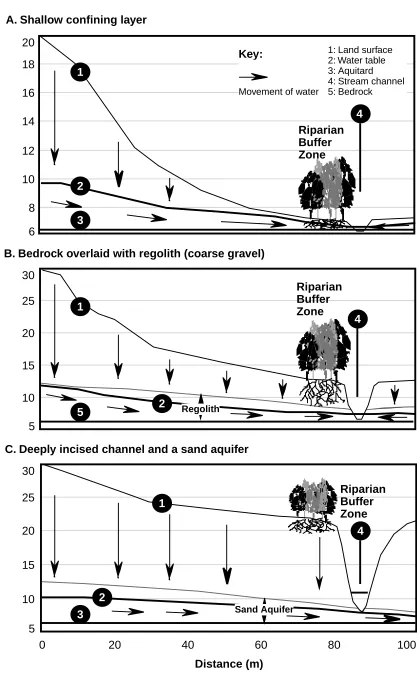
(14) 6.
(15) 2. Buffer zones and water quality protection: general principles D.L. Correll Smithsonian Environmental Research Center, P.O. Box 28, Edgewater, MD 21037, USA. Abstract Riparian buffer zones (RBZ) improve water quality in different ways depending upon the pathway of delivery of water to the RBZ. Groundwater passing through the RBZ may be cleansed of nitrate and acidity due to a combination of denitrification, biostorage and changes in soil composition. Overland storm flows entering laterally from the uplands may be cleansed of suspended particulates, with adhering nutrients, inorganic toxins, and pesticides, as well as some dissolved nutrients and toxins. Sometimes these overland flows will also infiltrate within the RBZ and become a part of the groundwater, thus also obtaining the benefits associated with groundwaters in the RBZ. During stream flooding events, waters flooding out into the RBZ may also be cleansed of sediments, nutrients and toxic materials as a result of particulate trapping and the binding of materials on the leaf litter and soils within the RBZ. The RBZ is also an important source to the stream of high quality dissolved and particulate organic matter which is delivered both vertically and laterally. Forested RBZs also provide shade and evaporative cooling to streams, maintaining lower summertime temperatures critical to some biota. Factors which limit the effectiveness of the functions can be divided into internal and external. Factors external to the RBZ include watershed area and gradient, stream channel morphology, soil mineralogy and texture, bedrock type and depth, and climate. Factors internal to the RBZ include width and type of vegetation, waterlogging and organic content of soils, hydraulic conductivity, soil nutrient content and geochemistry. These water quality functions of RBZs and the factors which limit their effectiveness in various settings are reviewed from the world literature.. INTRODUCTION Only a few papers which explicitly reported the results of studies of the water quality buffering effects of vegetated riparian zones were published prior to the early 1970s (Fig. 1). Although it is very difficult to draw sharp boundaries around this subject, there are now over 400 such papers and the rate of publication is about 30 to 35 papers per year. Despite this increasing rate of publication, our knowledge base concerning the water quality buffering effects of riparian zones is far from adequate. For descriptive aspects such as the removal of nitrate and particulate matter from the waters traversing the riparian zone or the release of organic matter to these waters we have considerable data but lack knowledge for how these functions change with climate or watershed management; species composition and age of the plant community; or how and when these functions will be saturated or exceeded. More fundamentally, we usually do not have an adequate understanding of the basic mechanisms involved in these processes or the controls over the rates of these processes. Lacking this understanding of mechanisms, we are in danger of being overconfident of our ability to predict system behaviour and response to major changes in inputs, invasions by exotic biota, or altered climate. With this situation in mind I will endeavour to review the world literature on riparian buffer zones, with my emphasis on streams and water quality. If we look at riparian vegetation and the soils in which they grow as a part of the landscape (Lowrance et al., 1985; Jordan et al., 1986; Correll et al., 1992), we can examine factors that control the health and functioning of these ecosystems and delimit them spatially. Some of these factors are internal or. Buffer Zones: Their Processes and Potential in Water Protection. Edited by N.E. Haycock, T.P. Burt, K.W.T. Goulding and G. Pinay. ISBN 0 9530051 0 0 © 1997 Quest Environmental.. 7.
(16) D.L. Correll. endogenous to the riparian ecosystems, while other factors are external or exogenous (associated with either the drainage basin or the stream channel) (Correll and Weller, 1989). Geomorphic factors may be internal (soil physics and chemistry, slope within the riparian zone) or external (watershed area and gradient, soil mineralogy and texture, bedrock type and depth, volume and composition of groundwater inputs, channel morphology). Watershed area and gradient are major determinants of the volume and kinetics of external inputs to riparian zones. Soil mineralogy is a very important determinant of the chemical composition of external inputs, whereas soil texture to a large extent determines the relative proportions of surface water and groundwater inputs. Lateral overland storm flows may be effectively cleaned by forested RBZs when these flows arrive as sheet flows from relatively small fields with slopes of 5% or less (Peterjohn and Correll, 1984), but when the fields are larger and storm flows become concentrated, they may erode channels through forested RBZs (Jordan et al., 1993). Some success has been reported in treating these larger concentrated storm flows by the use of level spreaders and grassed filter strips prior to forested RBZs (Franklin et al., 1992).. Figure 1. Number of publications related to riparian zones. 40. Number of publications per year. 35 30 25 20 15 10 5. 1995. 1990. 1985. 1980. 1975. 1970. 1965. 1960. 1955. 1950. 1945. 1940. 1935. 1930. 0. Year. HYDROLOGY OF THE RIPARIAN BUFFER ZONE Since the water quality effects of the Riparian Buffer Zone (RBZ) are highly dependent upon the volume and pathway of water movement through this zone, it is obvious that an understanding of hydrology is important (Fig. 2; Mitsch et al., 1977; LaBaugh, 1986; Chescheir et al., 1988; Correll and Weller, 1989; Dosskey and Bertsch, 1994). The major climatic control factors are the components of the hydrological cycle: precipitation, runoff, and evapotranspiration (ET) (Correll and Weller, 1989). ET is, in turn, governed primarily by such factors as vegetation, humidity, temperature, wind and sunlight. Thus, to some extent the riparian vegetation has a feedback to the hydrological cycle. The output of the external watershed equals precipitation minus ET minus infiltration to non-communicating deep aquifers. Depending upon the situation, some of this watershed output will be directly into the riparian zone from upslope areas and some of the output will be to the adjacent stream channel. Channel waters will have various amounts of inputs to the riparian zone via groundwater or surface flooding, depending upon stream discharge rate. The output of the riparian zone equals precipitation plus surface and groundwater inputs minus ET minus infiltration to deeper layers. If the local groundwater passes beneath the RBZ or the whole stream system at too great a depth, the riparian. 8.
(17) Buffer zones: general principles. Figure 2. Watershed cross-sections.. A. Shallow confining layer 20. 1: Land surface 2: Water table 3: Aquitard 4: Stream channel Movement of water 5: Bedrock. Key:. 18. 1. 16. 4. 14. Riparian Buffer Zone. 12 10. 2. 8 3 6 B. Bedrock overlaid with regolith (coarse gravel) 30 25. Riparian Buffer Zone. 1. 4. 20 15 10. 2. 5. Regolith. 5 C. Deeply incised channel and a sand aquifer 30 25. Riparian Buffer Zone. 1. 20. 4. 15 2. 10. Sand Aquifer. 3 5 0. 20. 40. 60. 80. 100. Distance (m). 39.
(18) D.L. Correll. zone cannot interact (Fig. 2C; Denver, 1991; Staver and Brinsfield, 1991). In some cases overland storm flows entering the RBZ infiltrate the soils and become groundwater (Cooper et al., 1995; Correll et al., 1996). If this infiltration is not detected, data are easily misinterpreted. Stable isotope studies have shown that the source of water for ET of stream bank trees is sometimes lateral shallow groundwater flows rather than water from the channel (Dawson and Ehleringer, 1991). In a number of studies hydrological tracers such as bromide have been injected into the groundwater in order to demonstrate that sampling points downgradient were actually along the path of groundwater flow (Hill, 1990, 1991; Jordan et al., 1993; Hubbard and Lowrance, 1994; Lockaby et al., 1994). These tracer methods are usually qualitative rather than quantitative. In some cases (Triska et al., 1989, 1990a ; Simmons et al., 1992; Nelson et al., 1995) the tracer was mixed with a nutrient such as nitrate or ammonium and was added to the system continuously for an extended time. Then ratios of nutrient to tracer were measured down gradient to detect nutrient transformations and to correct for the inevitable effects of dilution. An inadequate understanding of the hydrology of RBZ study sites usually limits the quantitative interpretation of study results.. OXIDATION / REDUCTION POTENTIAL OF THE SOILS Many of the characteristics of riparian zones, such as the species composition of the vegetation and rates of processes such as denitrification, require that the soils be anaerobic or of low oxidation/reduction potential (Eh) at least part of the year. The vegetation of the riparian zone is of fundamental importance in maintaining this low Eh. The below-ground processes which result in this low Eh are composed of a series of biogeochemical reactions that occur in a defined order (Billen, 1976). These reactions transfer electrons from organic matter, released from the plants, to various terminal electron acceptors. The availability of terminal electron acceptors determines which level in the series will dominate below-ground processes at any one time and place in the riparian zone. Some of the more commonly important reactions are manganate ion reduction, denitrification, ferric iron reduction, sulphate reduction, and methanogenesis. They occur in this order as a result of thermodynamic considerations. None of these reactions can proceed in the presence of molecular oxygen. Once oxygen has been consumed by processes such as respiration, and sulphide and ammonium ion oxidation, then manganate reduction may proceed. Once all manganate is reduced or if none occurs at the site, then denitrification can proceed, and so on. The reversibility of many of the reactions is limited by the production of volatile end products or changing pH. These factors and others produce a series of negative feedback mechanisms which tend to limit the further progress of a given below-ground process (Correll and Weller, 1989). For example, in the case of sulphate reduction, as the ratio of electron acceptor to product decreases (e.g. SO4=/S=), the equilibrium Eh required for the reaction to proceed declines. As the absolute concentration of sulphate declines, Eh must also decline for the reaction to proceed. As the pH rises, due to consumption of hydronium ions in the reaction, the Eh must decline for the reaction to proceed. At the same time the rates of entry of oxygen and other more easily reduced electron acceptors, such as nitrate, continue at previous rates, which will raise the Eh if sulphate reduction rates begin to slow down. Another example is denitrification. As the reaction proceeds, pH rises due to hydronium ion consumption in the reaction, and nitrate is converted to dinitrogen and nitrous oxide gases which evolve from the system, and the rate of denitrification slows while the rates of other processes such as nitrification may increase. For the riparian zone to maintain a low Eh it is therefore essential in the long run that the plants have a high primary productivity and that enough of the resulting photosynthate be released below-ground to provide enough electrons to drive these reactions at high rates. Despite the relative ease of measuring soil Eh, few studies have reported this critical parameter. Exceptions include Jacobs and Gilliam (1983, 1985), Davidson and Swank (1986), Pinay et al. (1989), Jordan et al. (1993) and Correll et al. (1996).. 10.
(19) Buffer zones: general principles. RIPARIAN EFFECTS ON THE GROUNDWATER ENTERING THE STREAM Most of the water flowing down the channel of most streams reached the channel at some point as groundwater moving from a recharge area to the stream. This groundwater may move as shallow lateral flows (Fig. 2A) or as deeper flows that surface in the channel from strata below the channel (Fig. 2B). Of course a little of the rain water is deposited directly in the channel (channel interception) and some arrives as overland storm flows. The overland storm flows are of short duration following intense rain events and are usually less than 30% of the annual stream discharge, with the exception of systems with very heavy clay soils where infiltration is very limited. Thus, the quality of the water in the channel during baseflow periods between major storms is highly dependent upon processes within the RBZ. As used here the RBZ includes much of what is sometimes referred to as the hyporheic zone.. Nitrogen transformations The first studies which directly measured nitrate concentration decreases in groundwater as it moved through riparian zones along streams were in the Coastal Plain of North Carolina (Gilliam et al., 1974; Gambrell et al., 1975). High concentrations of nitrate in shallow groundwater percolating out of row crop fields declined rapidly before reaching the stream channels and streams in these areas did not have the high nitrate concentrations one would expect from the watershed land use. In the early 1980s these results were repeated and more directly related to the presence of deciduous hardwood forests in the RBZs at three Atlantic Coastal Plain sites: Little River watershed near Tifton, Georgia (Lowrance et al., 1983; Lowrance et al. 1984a, 1984b, 1984c), two sites in North Carolina (Jacobs and Gilliam, 1983, 1985), and the Rhode River watershed in Maryland (Correll, 1983; Correll et al., 1984; Peterjohn and Correll, 1984). All of these sites were in regions of the Coastal Plain where most of the discharge from agricultural fields moves as shallow lateral groundwater flows to stream channels. Thus, it moves through the rooting zone of riparian forests in soils that are often waterlogged and maintain a low oxidation/reduction potential. These studies led to mass balances for total nitrogen retention of 74 kg N/ha yr or 89% of inputs at the Rhode River site and 26 kg N/ha yr or 67% of inputs at the Little River site. At the Beaverdam Creek site in North Carolina nitrate retention was 30 kg N/ha or 85% of nitrate inputs. These early studies were of great interest to both environmental scientists and land managers. Within a few years similar studies were publishing results from a series of new and different sites. These include the Garonne River and its tributaries in France (Pinay and Décamps, 1988; Pinay et al. 1989); intensively managed sheep pastures in New Zealand with grassed RBZs (Cooke and Cooper, 1988; Cooper, 1990; Schipper et al., 1994a, 1994b); grassed and forested RBZs in England (Haycock and Burt, 1993a, 1993b; Haycock and Pinay, 1993); forested RBZs in Rhode Island (Groffman et al., 1991, 1992; Hanson et al., 1994); the Mahantango Creek watershed in the Ridge and Valley area of Pennsylvania (Schnabel, 1986; Schnabel and Stout, 1994); forested and grassed RBZs in Illinois (Osborne and Kovacic, 1993); Ontario, Canada (Warwick and Hill, 1988), and two additional sites in the Atlantic Coastal Plain on the eastern shore of Maryland (Jordan et al., 1993; Correll et al., 1996). At all of these sites lateral flows of groundwater had decreases in nitrate concentration as they moved through the RBZ. More limited studies were also reported from Germany (Knauer and Mander, 1989) and Estonia (Mander et al., 1989).. Mechanisms of nitrate removal or transformation in the RBZ The mechanisms responsible for these widely documented retentions of nitrate have proven rather elusive. Candidate mechanisms include denitrification, assimilation and retention by the vegetation, and transformation to ammonium and organic nitrogen followed by retention in the soils of the RBZ (Fig. 3). It is quite clear in a number of studies that the nitrate is not simply converted to other soluble forms of nitrogen and discharged in the stream channel (e.g. Lowrance et al. 1983, 1984a, 1984b, 1984c ; Peterjohn and Correll, 1984; Correll and Weller, 1989; Jordan et al., 1993; Correll et al., 1996). Few studies have accurately measured the amount of nitrate removed by any one of these mechanisms at a given site and no study has measured the removal rate by all three mechanisms.. 11.
(20) D.L. Correll. Figure 3. Mechanisms of nitrate removal in riparian buffer zones.. N2. 1: Denitrification 2: Nitrification 3: Assimilation (plants / microbes) 4: Assimilation 5: Mineralisation. N2O. NO NH4+. 2. 1. SO4=. 4. NITRATE. SOIL. 5. CHEMICAL S= ORG-C. 3. ORG-N. WOOD. BIOLOGICAL CO2. Denitrification is most often invoked as the primary mechanism of nitrate retention; however the extreme spatial and temporal variability of denitrification rates in RBZs make it very difficult to determine accurate fluxes (Correll, 1991; Weller et al., 1994). Laboratory incubations of soil samples demonstrate the potential for denitrification, but these measurements are hard to extrapolate to the field. The products of denitrification include dinitrogen, nitrous oxide and nitric oxide and the proportions of these products are highly variable. Most studies do not measure all of these products. Instead they use chemical inhibitors to stop the production of dinitrogen. These inhibitors may cause more artefacts. Field studies of nitrate mass balance show that nitrate is effectively removed: a) at all times of the year in temperate climates; and b) from groundwaters moving in subsoils at depths of several metres. Studies of potential denitrification in riparian soils find that most of this potential is in the top few centimetres of soil (Ambus and Lowrance, 1991; Ambus, 1993; Pinay et al., 1993). Conditions in the deeper subsoil include low temperature, low pH and low concentrations of dissolved organic matter. These facts lead some to scientists to conclude that assimilation by the vegetation is the primary mechanism of nitrate removal (e.g. Fail et al., 1986). While the vegetation may be very important in explaining the nitrate removal, nitrate is removed in the winter at sites where the vegetation is hardwood deciduous forest that is dormant in the winter. Further, measurements of nitrogen accumulation in the annual accretion of woody biomass was only 12 to 20 kg N/ha yr (Peterjohn and Correll, 1984; Correll and Weller, 1989). Thus, even if all of the nitrogen for this biomass came from nitrate in the groundwater it would only account for about 30% of the nitrate removal. It is highly likely that some of the nitrogen assimilation occurred from other sources. Jacobs and Gilliam (1983) also found that accumulation of nitrogen in riparian vegetation explained a relatively minor portion of the nitrate that was removed at their sites. These facts make it likely that assimilation and storage in woody biomass is a significant mechanism, but not the primary mechanism. However, it is possible that assimilation by the vegetation and recycling to the forest floor as litter is important in unravelling the overall primary mechanism. The rate of assimilation at the Rhode River site was 77 kg N/ha yr and litter fall plus throughfall was 66 kg N/ha yr (Peterjohn and Correll, 1984). Thus, assimilation by. 12.
(21) Buffer zones: general principles. the forest could be the primary mechanism of nitrate removal from groundwater during the growing season and the flux of organic nitrogen delivered to the forest floor as litter could be gradually mineralised and denitrified at the soil surface. Such a mechanism would, however, not explain nitrate removal during the winter. Studies in New Zealand have shown high rates of dissimilative nitrate reduction to ammonium, which is then bound to the soils of the RBZ (Schipper et al., 1994a). Some scientists believe that nitrate removal from the groundwater traversing RBZ subsoils is accomplished by chemical rather than biological denitrification (Mariotti et al., 1988). Strong reducing agents such as iron sulphides may react with nitrate to produce dinitrogen and sulphate. Certainly some RBZs at times reduce sulphate to sulphide (Correll and Weller, 1989; Jordan et al., 1993), and at times sulphide is oxidised back to sulphate and released (Correll and Weller, 1989). If chemical denitrification does take place, it still would depend, in the long–term, upon adequate supplies of organic matter in the subsoils of the RBZ to maintain a low enough Eh. Understanding the primary mechanism of nitrate removal is very important. If this is the primary mechanism at such sites, the system’s soils will eventually become nitrogen saturated. Some evidence of potential nitrogen saturation has been demonstrated at sites in Rhode Island (Hanson et al., 1994). If RBZs do become nitrogen saturated and cease to carry out their nitrate removal function the result would be very serious declines in receiving water quality. In some RBZs soil Eh is not low enough some of the time to allow denitrification at significant rates. This may be short–term, as associated with periods between rainfall events, or longer-term due to extended drought, or it may be a seasonal phenomenon. It may also be spatially very patchy (e.g. Weller et al., 1994). In such situations an alternation of denitrification and nitrification are observed (e.g. Duff and Triska, 1990; Triska et al., 1990b, 1993; Jones et al., 1994). In both processes significant nitrogen losses as nitrous oxide and nitric oxide occur in addition to the production of dinitrogen by denitrification. Some researchers believe that this alternation of nitrification and denitrification help to explain the large nitrate removals observed in RBZs.. Other effects on groundwater quality Although RBZ effects on nitrogen, especially nitrate, are often emphasised in studies of riparian buffering, there are other significant water quality effects. The pH of groundwater is often significantly altered. Below-ground processes often consume or release hydronium ions (Correll and Weller, 1989). In non-calcareous, poorly buffered soils, such as are found on parts of the Atlantic Coastal Plain, groundwater draining from row crops is quite acidic, due to the effects of nitrification in the fields and acid deposition (Correll et al. 1987). As it moves through RBZs both plant assimilation of nitrate and denitrification consume hydronium ions and the pH increases to values less toxic to aquatic animals (Peterjohn and Correll, 1986; Jordan et al., 1993). These pH changes, when coupled to other data, can be used to calculate metabolic rates (e.g. Jones Jr. et al., 1994). Dissolved phosphorus and organic carbon concentrations usually increase as groundwater moves through RBZs (Correll and Weller, 1989; Jordan et al., 1993). This is the result of the low Eh in these riparian soils.. SEDIMENT, NUTRIENT AND PESTICIDE TRAPPING ON THE SURFACE The role of riparian vegetation in trapping sediments and adhering phosphorus was reported in widely cited articles by Karr and Schlosser (1978) and Schlosser and Karr (1981a, b). Riparian Vegetation facilitates the removal of suspended sediments, along with their nutrient contents, from two types of surface water: a) overland storm water entering laterally (Mitsch et al., 1979; Peterjohn and Correll, 1984; Lowrance et al., 1988; Klarer and Millie, 1989; Chescheir et al., 1991; Parsons et al., 1994); and b) flood waters entering from the stream channel (Kitchens et al., 1975; Hart et al., 1987; Kleiss et al., 1989; Hupp and Morris 1990; Hupp et al., 1993; Johnston, 1993; Brunet et al., 1994). In both cases riparian vegetation plays an important role in removing and retaining particulates. Increased friction with soil surfaces can cause reduced velocity and consequent sedimentation of particulates, but riparian vegetation and the layer of litter it deposits on the soil surface are much more effective at slowing the velocity of the surface waters. The fine roots of the plants, which are concentrated on or. 13.
(22) D.L. Correll. near the surface, and the microbial communities on the surfaces of the soil, litter, and above-ground plant organs also are able to assimilate dissolved nutrients from the surface waters (Peterjohn and Correll, 1984). Relatively few studies have examined the effectiveness of RBZs in trapping pesticides and other toxic materials from overland storm flows. Early work by Correll et al. (1978); Rhode et al. (1980), and Asmussen et al. (1977) found that most of the herbicides atrazine, alachlor, trifluralin, and 2,4-D were removed from cropland discharges. More recently Schultz et al. (1994) found that a reconstructed three-tiered riparian buffer in Iowa was effective in removing atrazine from cropland discharges.. IS THE VEGETATION IMPORTANT OR NECESSARY? Questions are often asked about the efficacy or necessity for vegetation in the RBZ. Does it matter whether vegetation is present? Is woody vegetation more effective than grass or herbaceous vegetation? Are broad-leaved hardwoods better than coniferous trees? How wide a zone of vegetation is needed? These are all good questions for which we have few good answers. Although there was general agreement among studies of riparian forest buffers in the Atlantic Coastal Plain that nitrate was efficiently removed from shallow groundwater (Jacobs and Gilliam, 1983; Lowrance et al. 1983; Peterjohn and Correll, 1984), this in itself did not prove that the forest was necessary for this process. Studies on the North Carolina Coastal Plain found that fields could be cropped right up to the stream channel and nitrate removal would still occur efficiently, if controlled drainage structures were used to prevent the drying of the riparian soils (Gilliam et al., 1979, 1986). Groffman et al. (1991) reported that denitrification potentials in surface soils of grassed RBZs in Rhode Island were somewhat higher than in forested RBZs. Further, Haycock and Burt (1993a, 1993b) found that grass riparian zones in England were very effective in nitrate removal from groundwater. Haycock and Pinay (1993) found that poplar forested RBZs were somewhat more effective at nitrate removal than grass, especially in the winter. Osborne and Kovacic (1993) found that forested RBZs in Illinois were more effective than grass for nitrate removal, but less effective for removal of phosphate and dissolved organic phosphorus from groundwater. Finally, Correll et al. (1996), in a comparison of two adjacent RBZ sites in Maryland, one grassed and one forested, found that they had similar nitrate removal efficiencies. While there is considerable uncertainty on the exact role of riparian vegetation and the relative efficacy of various types of vegetation, it seems clear that grass or dense herbaceous vegetation is more effective at trapping particulates from overland storm flows (Osborne and Kovacic, 1993; Parsons et al., 1994), but that woody vegetation may be more effective at removing nitrate from groundwater. In the long term it is clear that riparian vegetation is necessary to maintain the organic matter in riparian soils, which is needed for maintaining low Eh and processes such as denitrification. Woody vegetation, especially forest, is also more effective at providing organic matter in the deeper subsoils, where it is needed for effective denitrification in groundwater. However, changes in soil chemistry are slow and therefore the effects of present land management may not be apparent for decades.. RIPARIAN VEGETATION AS A SOURCE OF ORGANIC MATTER TO THE CHANNEL Most stream channels are partially heterotrophic ecosystems which rely on organic matter inputs from the riparian zone and watershed for much of the organic matter used as an energy source to drive their food webs (Fisher and Likens, 1973; Minshall, 1978; Triska et al., 1982; Conners and Naiman, 1984; Cuffney, 1988; Kleiss et al., 1989). Many studies have shown that most of the particulate organic matter and much of the dissolved organic matter inputs are derived from areas immediately adjacent to the stream channel (Sedell et al., 1974; McDowell and Fisher, 1976; Winterbourn, 1976; Triska et al., 1984; Sidle, 1986; King et al., 1987; Chauvet and Jean-Louis, 1988; Cushing, 1988; Gurtz et al., 1988; Benson and Pearson, 1993; Sweeney, 1993). Vegetation along the stream bank and overhanging the channel contributes vertical litter fall and vegetation near the bank contributes litter by downslope. 14.
(23) Buffer zones: general principles. lateral movement. The relative proportion of these two types of input varies dependent upon the local situation.. Role of riparian vegetation in stream temperature control Riparian forests reduce solar heating of stream water by shading, especially in low order streams (Brown and Krygier, 1970). Any riparian vegetation provides cooling by evapotranspiration of soil water and shallow groundwater (Beschta, 1984; Theuer et al., 1984; Sinokrot and Stefan, 1993). This cools waters flowing into the stream channel laterally and waters exchanging between the channel and the hyporheic zone. The evapotranspiration cooling is greatest when the vegetation is forest, since forest has the highest leaf area index and consequently the highest evapotranspiration rates. Hardwood deciduous riparian forest in temperate climates has evapotranspiration rates as high as 118 cm per year (Peterjohn and Correll, 1986).. Riparian vegetation as a source of large woody debris Stream channels benefit from a steady input of woody branches and tree trunks. This debris and the debris dams that result bring about complexity in channel morphology and more useful habitats for stream biota (Minshall, 1978). The necessary woody debris originates almost entirely in the riparian zone (Webster, 1977). This literature will not be reviewed here; for a comprehensive review see Harmon et al. (1986).. RIPARIAN BUFFERS AND FORESTRY When forested watersheds are clear-cut the rates of erosion and nutrient leaching increase until the vegetation begins to recover. Studies of the effects of clear-cuts on stream water quality have been reviewed by Vitousek (1981) and Webster et al. (1992) and will not be discussed here. However, in a few studies paired forested watersheds were subjected to experimental logging. Typically, the streams draining all would be monitored for several years, then one or more would be clear-cut, some would be clear-cut but a forest buffer strip would be retained, and at least one would be maintained as a forested control. Following the logging the water quality of the streams would be monitored to document the speed of recovery. Examples of such studies include West Virginia (Aubertin and Patric, 1974), Pennsylvania (Lynch and Corbett, 1990); and western Australia (Borg et al., 1988); the results were similar. If a forested buffer was maintained, only small increases in suspended sediments and nutrients were observed in the streams compared with controls and complete clear-cuts.. RESTORATION OF FORESTED RIPARIAN BUFFERS Once land managers became aware of the benefits to be gained from RBZs, a movement began to restore these vegetated buffers in areas where they had been destroyed. Two research projects in the United States have been attempting to re-establish native hardwood forest in stream riparian zones while monitoring their effectiveness. Several projects are under way on the Little River watershed in Georgia and early results indicate some success both in establishing forest and intercepting agricultural pollution (Hubbard et al., 1995; Lowrance et al., 1995). Another project on the White Clay Creek watershed in Pennsylvania encountered more difficulty in re-establishing hardwood forest, but is now making progress (Sweeney, 1993). In some cases the sapling trees need protection from browsing and girdling as well as intense competition from exotic plants before they can become re-established.. SUMMARY The efficacy of RBZs in removing pollutants from surface and groundwater is highly dependent upon hydrology. For effective removal of particulates and dissolved nutrients and toxic materials, surface flows must occur as sheet flow rather than highly focused flows. For effective removal of nitrate and. 15.
(24) D.L. Correll. acidity, groundwater must move through the RBZ at a slow speed and at a shallow enough depth to be within the rooting zone of riparian vegetation. The vegetation in the RBZ must provide enough friction to surface flows to improve the efficiency of particulate trapping and provide surface litter to facilitate the assimilation of dissolved nutrients and toxic materials. The vegetation must also release enough organic matter at the depth of the groundwater to maintain a low enough Eh to allow rapid rates of denitrification. Riparian vegetation also provides shading and evaporative cooling of the stream channel. Cooling is most effective if the vegetation has a high leaf area index which reaches a maximum in hardwood deciduous forest. Vegetation also provides the stream channel communities with litter and large woody debris.. REFERENCES Ambus, P. (1993) Control of denitrification enzyme activity in a streamside soil. FEMS Microbial Ecol., 102, 225-234. Ambus, P. and Lowrance, R. (1991) Comparison of denitrification in two riparian soils. Soil Sci. Soc. Am. J., 55, 994997. Asmussen, L.E., White, A.W., Hansen, E.W. and Sheridan, J.M. (1977) Reduction in 2,4-D load in surface runoff down a grassed waterway. J. Environ. Qual., 6, 159-162. Aubertin, G.M. and Patric, J.H. (1974) Water quality after clear cutting a small watershed in West Virginia. J. Environ. Qual., 3, 243-249. Benson, L.J. and Pearson, R.G. (1993) Litter inputs to a tropical Australian rainforest stream. Aust. J. Ecol., 18, 377383. Beschta, R.L. (1984) TEM84: A computer model for predicting stream temperatures resulting from the management of streamside vegetation. Report WSDG-AD-00009, USDA ForestService, Watershed Systems Development Group, Fort Collins, CO, 76 pp. Billen, G. (1976) The dependence of the various kinds of microbial metabolism on the redox state of the medium. In: Biogeochemistry of Estuarine Sediments, UNESCO, Paris, France, pp. 254-326. Borg, H., Hordacre, A. and Batini, F. (1988) Effects of logging in stream and river buffers on watercourses and water quality in the southern forest of Western Australia. Australian For., 51, 98-105. Brown, G.W. and Krygier, J.T. (1970) Effects of clear-cutting on stream temperature. Water Resources Res., 6, 11331139. Brunet, R.C., Pinay, G., Gazelle, F. and Roques, L. (1994) Role of the floodplain and riparian zone in suspended matter and nitrogen retention in the Adour River, south-west France. Regulated Rivers; Research and Management, 9, 55-63. Chauvet, E. and Jean-Louis, A.M. (1988) Production de litiere de la ripisylve de la Garonne et apport au fleuve. Acta Oecologia, Oecologia Generalis, 9, 265-279. Chescheir, C.M., Skaggs, R.W., Gilliam, J.W. and Broadhead, R.G. (1988) Hydrology of wetland buffer areas for pumped agricultural drainage water. In: Hook, D.D. (Ed.) The Ecology and Management of Wetlands. Timber Press, Portland, OR, pp. 260-274. Chescheir, C.M., Gilliam, J.W. Skaggs, R.W. and Broadhead, R.G. (1991) Nutrient and sediment removal in forested wetlands receiving pumped agricultural drainage water. Wetlands, 11, 87-103. Cooke, J.G. and Cooper, A.B. (1988) Sources and sinks of nutrients in a New Zealand catchment. III. Nitrogen. Hydrol. Proc., 2, 135-149. Cooper, A.B. (1990) Nitrate depletion in the riparian zone and stream channel of a small headwater catchment. Hydrobiologia, 202, 13-26. Cooper, A.B., Smith, C.M. and Smith, M.J. (1995) Effects of riparian set-aside on soil characteristics in an agricultural landscape: Implications for nutrient transport and retention. Agric. Ecosyst. Environ., 55, 61-67. Conners, M.E. and Naiman, R.J. (1984) Particulate allochthonous inputs: relationships with stream size in an undisturbed watershed. Canad. J. Fish. Aquat. Sci., 41, 1473-1488. Correll, D.L., Pierce, J.W. and Wu, T.L. (1978) Studies of the transport of atrazine and alachlor from minimum till corn fields into Chesapeake Bay tidal waters. Proc. Northeast. Weed Sci. Soc., 32(sup.), 21-32. Correll, D.L. (1983) N and P in soils and runoff of three coastal plain land uses. In: Lowrance, R., Assmussen, L. and Leonard R. (Eds.) Nutrient Cycling in Agricultural Ecosystems. Univ. Georgia Press, Athens, GA, pp. 207-224. Correll, D.L. (1991) Human impact on the functioning of landscape boundaries. In: Holland, M.M., Risser, P.G. and Naiman, R.J. (Eds.) The Role of Landscape Boundaries in the Management and Restoration of Changing Environments. Chapman and Hall, New York, pp. 90-109. Correll, D.L., Goff, N.M. and Peterjohn, W.T. (1984) Ion balances between precipitation inputs and Rhode River watershed discharges. Bricker, O. (Ed.) Geological Aspects of Acid Deposition. Ann Arbor Science, Ann Arbor, MI, pp. 77-111.. 16.
(25) Buffer zones: general principles. Correll, D.L., Miklas, J.J., Hines, A.H. and Schafer, J.J. (1987) Chemical and biological trends associated with acidic atmospheric deposition in the Rhode River watershed and estuary. Water Air Soil Pollut., 35, 63-86. Correll, D.L. and Weller, D.E. (1989) Factors limiting processes in freshwater wetlands: an agricultural primary stream riparian forest. In: Sharitz, R.R. and Gibbons, J.W. (Eds.) Freshwater Wetlands and Wildlife. USDOE, Oak Ridge, TN, USA, pp. 9-23. Correll, D.L., Jordan, T.E. and Weller, D.E. (1992) Nutrient flux in a landscape: Effects of coastal land use and terrestrial community mosaic on nutrient transport to coastal waters. Estuaries, 15, 431-442. Correll, D.L., Jordan, T.E. and Weller, D.E. (1996) Failure of agricultural riparian buffers to protect surface waters from groundwater contamination. In: Gibert, J. (Ed.) Groundwater-Surface Water Ecotones. Cambridge Univ. Press, London, in press. Cuffney, T.F. (1988) Input, movement and exchange of organic matter within a subtropical coastal blackwater river-floodplain system. Freshwater Biol., 19, 305-320. Cushing, C.E. (1988) Allochthonous detritus input to a small, cold desert spring-stream. Verh. Internatl. Theoret. Angewan. Limn., 23, 1107-1113. Davidson, E.A. and Swank, W.R. (1986) Environmental parameters regulating gaseous nitrogen losses from two forested ecosystems via nitrification and denitrification. Applied Environ. Microbiol., 52, 1287-1292. Dawson, T.E. and Ehleringer, J.R. (1991) Streamside trees that do not use stream water. Nature, 350, 335-337. Denver, J.M. (1991) Groundwater-sampling network to study agrochemical effects on water quality in the unconfined aquifer. In: Groundwater Residue Sampling Design. Amer. Chem. Soc. Symp. #465, pp. 139-149. Dosskey, M.G. and Bertsch, P.M. (1994) Forest sources and pathways of organic matter transport to a blackwater stream: a hydrologic approach. Biogeochemistry, 24, 1-19. Duff, J.H. and Triska, F.J. (1990) Denitrification in sediments from the hyporheic zone adjacent to a small forested stream. Can. J. Fish. Aquatic Sci., 47, 1140-1147. Fail, J.L., Hamzah, M.N., Haines, B.L. and Todd, R.L. (1986) Above and below ground biomass, production, and element accumulation in riparian forests of an agricultural watershed. In: Correll, D.L. (Ed.), Watershed Research Perspectives. Smithsonian Press, Wash. DC, pp. 193-224. Fisher, S.G. and Likens, G.E. (1973) Energy flow in Bear Brook, New Hampshire: an integrative approach to stream ecosystem metabolism. Ecol. Monogr., 43, 421-439. Franklin, E.C., Gregory, J.D. and Smolen, M.D. (1992) Enhancement of the Effectiveness of Forested Filter Zones by Dispersion of Agricultural Runoff. Report No. UNC-WRRI-92-270, Water Resources Res. Inst., Raleigh, NC, 28 pp. Gambrell, R.P., Gilliam, J.W. and Weed, S.B. (1975) Denitrification in subsoils of the North Carolina coastal plain as affected by soil drainage. J. Environ. Qual., 4, 311-316. Gilliam, J.W., Daniels, R.B. and Lutz, J.F. (1974) Nitrogen content of shallow ground water in the North Carolina coastal plain. J. Environ. Qual., 3,147-151. Gilliam, J.W., Skaggs, R.W. and Weed, S.B. (1979) Drainage control to diminish nitrate loss from agricultural fields. J. Environ. Qual., 8, 137-142. Gilliam, J.W., Skaggs, R.W. and Doty, C.W. (1986) Controlled agricultural drainage: An alternative to riparian vegetation. In: Correll, D.L. (Ed.), Watershed Research Perspectives, Smithsonian Press, Wash. DC, pp. 225-243. Groffman, P.M., Axelrod, E.A., Lemunyon, J.L. and Sullivan, W.M. (1991) Denitrification in grass and forest vegetated filter strips. J. Environ. Qual., 20, 671-674. Groffman, P.M., Gold, A.J. and Simmons, R.C. (1992) Nitrate dynamics in riparian forests: Microbial studies. J. Environ. Qual., 21, 666-671. Gurtz, M.E., Marzolf, G.R., Killingbeck, K.T., Smith, D.L. and McArthur, J.V. (1988) Hydrologic and riparian influences on the import and storage of coarse particulate organic matter in a prairie stream. Can. J. Fish. Aquat. Sci., 45, 655-665. Hanson, G.C., Groffman, P.M. and Gold, A.J. (1994) Symptoms of nitrogen saturation in a riparian wetland. Ecol. Appl., 4, 750-756. Harmon, M.E., Franklin, J.F., Swanson, F.J., Sollins, P., Gregory, S.V., Lattin, J.D and Anderson, N.H. (1986) Ecology of coarse woody debris in temperate ecosystems. Adv. Ecol. Res., 5, 133-302. Hart, B.T., Ottaway, E.M. and Noller, B.N. (1987) Magela Creek system, northern Australia. II. Material budget for the floodplain. Aust. J. Mar. Freshwater Res., 38, 861-876. Haycock, N.E. and Burt, T.P. (1993a) The sensitivity of rivers to nitrate leaching: The effectiveness of near-stream land as a nutrient retention zone. In: Thomas, D.S.G. and Allison, R.J. (Eds.), Landscape Sensitivity, Wiley, London, pp. 261-272. Haycock, N.E. and Burt, T.P. (1993b) Role of floodplain sediments in reducing the nitrate concentration of subsurface runoff: a case study in the Cotswolds, UK. Hydrol. Processes., 7, 287-295. Haycock, N.E. and Pinay, G. (1993) Groundwater nitrate dynamics in grass and poplar vegetated riparian buffer strips during the winter. J. Environ. Qual., 22, 273-278. Hill, A.R. (1990) Ground water flow paths in relation to nitrogen chemistry in the near-stream zone. Hydrobiologia, 206, 39-52.. 17.
(26) D.L. Correll. Hill, A.R. (1991) A ground water nitrogen budget for a headwater swamp in an area of permanent ground water discharge. Biogeochemistry, 14, 209-224. Hubbard, R.K. and Lowrance, R.R. (1994) Spatial and temporal patterns of solute transport through a riparian forest. In: Riparian Ecosystems in the Humid U.S., Functions, Values and Management, Natl. Assoc. Conserv. Districts, Wash. D.C., pp. 403-411. Hubbard, R.K., Vellidis, G., Lowrance, R., Davis, J.G. and Newton, G.L. (1995) Using riparian buffers to treat animal waste. In: Steele, K. (Ed.), Animal Waste and the Land-Water Interface, Lewis, New York, pp. 127-134. Hupp, C.R. and Morris, E.E. (1990) A dendrogeomorphic approach to measurement of sedimentation in a forested wetland, Black Swamp, Arkansas. Wetlands, 10, 107-124. Hupp, C.R., Woodside, M.D. and Yanosky, T.M. (1993) Sediment and trace element trapping in a forest wetland, Chickahominy River, Virginia. Wetlands, 13, 95-104. Jacobs, T.C. and Gilliam, J.W. (1983) Nitrate loss from agricultural drainage waters: Implications for nonpoint source control. University of North Carolina, Raleigh, NC. 208 pp. Johnston, C.A. (1993) Material fluxes across wetland ecotones in northern landscapes. Ecol. Appl., 3, 424-440. Jones Jr., J.B., Holmes, R.M., Fisher, S.G. and Grimm, N.B. (1994) Chemoautotrophic production and respiration in the hyporheic zone of a Sonoran Desert stream. In: Stanford, J.A. and Valett, H.M. (Eds.), Proc. Second Internatl. Conf. Groundwater Ecology, Amer. Water Res. Assoc., Bethesda, MD, pp. 329-338. Jordan, T.E., Correll, D.L., Peterjohn, W.T. and Weller, D.E. (1986) Nutrient flux in a landscape: the Rhode River watershed and receiving waters. In: Correll, D.L. (Ed.), Watershed Research Perspectives, Smithsonian Press, Wash. DC, pp. 57-76. Jordan, T.E., Correll, D.L. and Weller, D.E. (1993). Nutrient interception by a riparian forest receiving inputs from adjacent cropland. J. Environ. Qual., 22, 467-473. Karr, J.R. and Schlosser, I.J. (1978) Water resources and the land-water interface. Science, 201, 229-234. King, J.M., Day, J.A. and Davies, B.R. (1987). Particulate organic matter in a mountain stream in the south-western Cape, South Africa. Hydrobiologia, 154, 165-187. Kitchens Jr., W.M., Dean, J.M., Stevenson, L.H. and Cooper, J.H. (1975) The Santee Swamp as a nutrient sink. In: Howell, F.G., Gentry, J.B. and Smith, M.H. (Eds.), Mineral Cycling in Southeastern Ecosystems, Savannah River Ecology Lab., Aiken, GA, pp. 349-366. Klarer, D.M. and Millie, D.F. (1989) Amelioration of storm-water quality by a freshwater estuary. Arch. Hydrobiol., 116, 375-389. Kleiss, B.A., Morris, E.E., Nix, J.F. and Barko, J.W. (1989) Modification of riverine water quality by an adjacent bottomland hardwood wetland. In: Fisk, D.W. (Ed.), Wetlands: Concerns and Successes, Amer. Water Resources Assoc., Bethesda, MD, USA, pp. 429-438. Knauer, N. and Mander, U. (1989) Studies on the filtration effect of differently vegetated buffer strips along inland waters in Schleswig-Holstein. 1. Information: Filtration or nitrogen and phosphorus. Zeit. fur Kulturtechnik und Landentwicklung, 31, 52-57. LaBough, J.W. (1986) Wetland ecosystem studies from a hydrologic perspective. Water Resources Bull., 22, 1-10. Lockaby, B.G., McNabb, K.L. and Hairston, J.E. (1994) Changes in groundwater nitrate levels across a land-use drainage continuum. In: Riparian Ecosystems in the Humid U.S., Functions, Values and Management, Natl. Assoc. Conserv. Districts, Wash. DC, pp. 412-421. Lowrance, R.R., Todd, R.L. and Asmussen, L.E. (1983) Waterborne nutrient budgets for the riparian zone of an agricultural watershed. Agricult. Ecosyst. Environ., 10, 371-384. Lowrance, R.R., Todd, R.L. and Asmussen, L.E. (1984a) Nutrient cycling in an agricultural watershed. I. Phreatic movement. J. Environ. Qual., 13, 22-27. Lowrance, R.R., Todd, R.L. and Asmussen, L.E. (1984b) Nutrient cycling in an agricultural watershed. II. Stream flow and artificial drainage. J. Environ. Qual., 13, 27-32. Lowrance, R.R., Todd, R.L., Fail Jr., J., Hendrickson Jr., O., Leonard, R. and Asmussen, L. (1984c) Riparian forests as nutrient filters in agricultural watersheds. Bioscience, 34, 374-377. Lowrance, R., Leonard, R. and Sheridan, J. (1985) Managing riparian ecosystems to control nonpoint pollution. J. Soil & Water Conserv., 40, 87-97. Lowrance, R., McIntyre, S. and Lance, C. (1988) Erosion and deposition in a field/forest system estimated using Cesium-137 activity. J. Soil & Water Conserv., 43, 195-199. Lowrance, R., Vellidis, G. and Hubbard, R.K. (1995) Denitrification in a restored riparian forest wetland. J. Environ. Qual., 24, 808-815. Lynch, J.A. and Corbett, E.S. (1990) Evaluation of best management practices for controlling nonpoint pollution from silvicultural operations. Water Resour. Bull., 26, 41-52. Mander, U.E., Metsur, M.O. and Kulvik, M.E. (1989) Storungen des Stoffkreislaufs, des Energieflusses und des Bios als Kriterien fur die Bestimmung der Belastung der Landschaft. Petermanns Geographische Mitteilungen, 133, 233-244. Mariotti, A., Landreau, A. and Simon, B. (1988) 15N isotope biogeochemistry and natural denitrification process in groundwater: Application to the chalk aquifer of northern France. Geochim. Cosmochim. Acta, 52, 1869-1878.. 18.
Figure



+7





Outline
EXPERIMENTAL RESULTS CONCERNING THE EFFICIENCY OF BUFFER ZONES AS P TRAPS
CONCLUSIONS
DISCUSSION AND CONCLUSIONS
EFFECTIVENESS OF GBZs
CONCLUSIONS AND RECOMMENDATIONS
DISCUSSION AND CONCLUSION
ALTERATION AND RESTORATION OF RIVERINE WETLANDS
EVAPOTRANSPIRATION AND SUBSURFACE WATER FLU
CONTROL OF NUTRIENT FLUXES IN GROUNDWATER BY MID-FIELD WOODLAND
CONCENTRATIONS IN WATER OUTPUTS FROM SMALL WATERSHEDS
Related documents
The emotion caused by what for a moment seemed almost a diplomatic incident was diverted by the appearance of two Chinese servants in long silk robes and four-sided hats
[r]
InternationalizationofHigherEducationandStudyAbroadintheUnitedStates Si ncethe19thcentury,i nternati onal i zati onofhi ghereducati onandstudentmo- bi l i tyhasbeenani
• I started to develop the One Page Term Sheet while I was CEO of BC Advantage Funds – a seed stage venture capital fun • My strategy was to co-invest with Angels • That required
One dimension-Gas Chromatography (1D-GC) analysis was, until recently, the most used method to analyze volatiles in different matrices. The increased development of 2D-GC,
Tell me just one thing I should know about you... I don't like to be called
In the polar cap, the geomagnetic field lines are open and connect to the solar wind, whereas the field lines in the auroral oval are closed and map to the plasma sheet and the
