VOLUME 36, ARTICLE 38, PAGES 1109
−
1148
PUBLISHED 6 APRIL 2017
http://www.demographic-research.org/Volumes/Vol36/38/ DOI: 10.4054/DemRes.2017.36.38
Research Article
How kinship systems and welfare regimes shape
leaving home: A comparative study of the United
States, Germany, Taiwan, and China
Bernhard Nauck
Nicolai Groepler
Chin-Chun Yi
© 2017 Bernhard Nauck, Nicolai Groepler & Chin-Chun Yi.
This open-access work is published under the terms of the Creative Commons Attribution NonCommercial License 2.0 Germany, which permits use, reproduction & distribution in any medium for non-commercial purposes, provided the original author(s) and source are given credit.
1 Introduction 1110
2 Societal differences between the United States, Germany, Taiwan, and China
1111
3 Explaining societal differences in home-leaving 1114
4 Data and methods 1119
4.1 Databases 1119
4.2 Measurement issues with ‘leaving the parental home’ 1120
4.3 Operationalization 1122
4.4 Analytic strategy 1125
5 Empirical results 1125
5.1 Age-specific prevalence of household constellations 1125 5.2 Timing of leaving the parental home 1128 5.3 Determinants of first departure from the parental home in the
United States, Germany, China, and Taiwan
1132
6 Discussion 1135
7 Acknowledgments 1139
How kinship systems and welfare regimes shape leaving home:
A comparative study of the United States, Germany, Taiwan, and
China
Bernhard Nauck1 Nicolai Groepler2 Chin-Chun Yi3
Abstract
OBJECTIVE
This paper aims to explain societal differences in the event of leaving the parental home as part of the transition to adulthood, in the United States, Germany, China, and Taiwan. It proposes bridge hypotheses between societal characteristics such as kinship system and welfare regime and home-leaving behavior, and tests them with nationally representative panel studies.
METHODS
Four panel studies (NLSY97 for the USA; PAIRFAM for Germany; CFPS for China; TYP for Taiwan) were harmonized for similar cohorts, with an age span of 15 to 30 years. Testing was based on age-specific tabulations of household composition and separate discrete-time event history models.
RESULTS
The prevalence of home-leaving is highest in the United States, followed by Germany, China, and then Taiwan. Timing is earlier in the United States than in Germany, and earlier in China than in Taiwan. Gender-specific coincidence of home-leaving with entry into higher education, the work force, cohabitation, and marriage can be conclusively related to differences in kinship system and welfare regime, and regional opportunity disparities.
CONTRIBUTION
The empirical results point to significant cultural differences between home-leaving in collectivistic, patrilineal societies (China, Taiwan) and individualistic, bilineal societies
1
Corresponding author: Technische Universität Chemnitz, Germany. E-Mail:[email protected].
2
(USA, Germany). Whereas neolocal housing signifies an important step in the transition to adulthood in the latter societies, continuous intergenerational housing, or even an early return to it, is normatively supported in collectivistic cultures. Differences between the United States and Germany on the one hand, and China and Taiwan on the other, point to variation in welfare regimes and differences in urbanization.
1. Introduction
Leaving the parental home is a significant event in the status passage between youth and adulthood, at both the individual and the societal level (Huang 2013). At the individual level, this transition is interdependent with other biographical transitions (Billari 2001: 120). During the completion of formal education and training and then entry into gainful employment it is partly ‘public’, while simultaneously, with potential entry into an intimate relationship, cohabitation, marriage, or parenthood, it is partly ‘private’ (Konietzka 2010: 115). At the societal level this transition implies a change in status, i.e., from membership of the parental household to some other household. The destination household composition may vary considerably; for example, a single or couple household, a flat-share, or an institutionalized residence such as a dormitory or barracks. Additionally, this transition often changes the proximity to other family members, which may, in turn, alter the quality of the mutual exchange taking place in these intergenerational relationships (Rossi and Rossi 1990; Bengtson 2001).
Existing studies commonly link demographic, situational-biographical, and family-of-origin characteristics to home-leaving behavior in single societies (de Jong Gierveld, Liefbroer, and Beekink 1991; Goldscheider, Thornton, and Young-DeMarco 1993; Goldscheider and Goldscheider 1994, 1998, 1999; Raymore, Barber, and Eccles 2001; Thornton, Young-DeMarco, and Goldscheider 1993; Sandberg-Thoma, Snyder, and Jang 2015; Ting and Chiu 2002; Huang 2013; Jacob and Kleinert 2008; Juang, Silbereisen, and Wiesner 1999; Windzio 2011). Cross-national comparative analysis is less common and often concentrates on culturally homogeneous areas such as Europe or East Asia (Aassve et al. 2002; Aassve, Arpino, and Billari 2013; Billari, Philipov, and Baizán 2001; Holdsworth 2000; Iacovou 2002, 2010; Le Blanc and Wolff 2006; Mulder, Clark, and Wagner 2002; Wolbers 2007; Chu, Xie, and Yu 2011). The rare cross-cultural investigations that compare different institutional contexts are based either on census data (Yi et al. 1994) or on literature reviews (Furstenberg 2013), while cross-cultural research making use of longitudinal data is still lacking.
societal differences across various dimensions such as the prevailing kinship system and welfare regime are systematically related to differences in observable patterns of leaving home, and to what extent these societal differences moderate that process.
The following empirical analyses investigate leaving the parental home as part of the transition to adulthood in a cross-cultural comparative perspective using individual-level panel data. The four countries were chosen for their systematic variation in geographical characteristics, socioeconomic development, welfare state regulations, and institutionalized kinship structures. The pursuit of an educational or occupational career can be an important incentive to leave the parental home, while a country’s geography, wealth, and policies generate country-specific opportunity structures for leaving home. On the other hand, kinship systems shape normative intergenerational obligations that may constitute barriers to young people’s mobility (Windzio and Aybek 2015: 107) or imply a parental obligation to provide accommodation in various phases of the transition to adulthood.
2. Societal differences between the United States, Germany, Taiwan,
and China
According to the 2013 Human Development Index, a composite measure of social and economic development which ranks 187 countries, the United States is ranked 5th (0.914), Germany 6th (0.911), Taiwan 20th (0.882), and China 91st (0.719) (United Nations Development Programme 2015). In 2015, gross domestic product per capita was 8,141 USD in China, 22,263 USD in Taiwan, 40,952 USD in Germany, and 56,084 USD in the United States (International Monetary Fund 2016). This variation provides different opportunity structures for educational and occupational attainment. In Taiwan and Germany education is saturated, so that investment in an academic degree barely pays off in terms of earnings in the labor market. By contrast, in the United States and China there are still large returns on educational investment (Xu and Xie 2015: 503f.). The enormous size of the United States and China and their considerable regional differences in population density often make it necessary for those in more remote areas to leave the parental home in order to pursue further education or work (Mulder, Clark, and Wagner 2002). In smaller and more densely populated countries like Germany and Taiwan, educational and job opportunities are often more easily accessible.
welfare state regime (Esping-Andersen 1990) renders young adults largely dependent on family structure and resources, resulting in a significant stratification of living conditions. Germany, with a lower score of 67 on the individualism scale, is also generally considered to be an individualistic society. However, its corporatist welfare regime provides greater socioeconomic support for new households and opportunities for individual choices independent of the market or familial resources. Furthermore, strong insurance schemes protect individuals from social risks, and education up to university level is more or less free, thus equalizing opportunity structures and increasing individual mobility options.
Taiwan and China are strongly influenced by collectivistic cultural values, scoring 17 and 20 respectively on the individualism scale. East Asian welfare states differ from the Western models described by Esping-Andersen’s (1990) tripartite typology. The strict subordination of social policy to overriding economic policy objectives is a distinct feature of East Asian productivist welfare states (Holliday 2000), which are characterized by heavy investment in education and training and lower levels of expenditure on social protection. The welfare state targets only the politically important groups of state employees and industrial workers (Kim 2016). Because of its spatial and population size relative to its current state of economic development, China has large regional disparities in educational and occupational opportunities, which have been aggravated by disproportional investment in educational expansion in urban centers. Accordingly, in urban centers the economic and social capital resources of families have become a precondition for the access to educational attainment of offspring (Zhao 2006). The specific welfare regimes of China and Taiwan differ in many ways (Kim 2016: 9ff.). China follows a ‘dualist productivist’ welfare regime with a combination of (strong) self-help expectations and risk-pooling but low population coverage rates, while redistributive measures are much more pronounced in Taiwan’s ‘inclusive productivist’ welfare regime. In Taiwan, almost total enrollment of adolescents in higher education generates a ‘ceiling effect’ of keen competition in educational attainment and labor market entry, and families’ cultural and social capital resources also serve as a precondition for the maintenance of intergenerational status. Moreover, being an island of limited size favors a relatively homogeneous social structure and production regime (Kim 2016; Huang and Ku 2011; Feng and Han 2010). China’s welfare regime leans more toward the United States, whereas Taiwan’s shows similarities with Germany in terms of redistribution and social inclusion.
authority favors individual choice for offspring, whereas high parental authority limits it. In China, the normative complex of ‘filial piety’ legitimizes parental demands (Fricke, Chang, and Yang 1994; Hashimoto and Ikels 2005; Schwarz et al. 2010; Yeh et al. 2013). To some extent, these differences are a consequence of the respective kinship systems: Whereas the bilineal system in Germany and the United States results in individualized kindred and bilineal inheritance patterns, the patrilineal system in China and Taiwan results in definitive membership, clear kinship boundaries, and unilineal inheritance patterns (Nauck 2010). Mutual obligations between generations are thus implemented more forcefully in China and Taiwan. Furthermore, gender differences in the kinship structure are more pronounced in patrilineal kinship systems than in bilineal kinship systems. In patrilineal societies, women change kinship membership with marriage and usually follow patrilocal patterns of residence, whereas neolocal housing of young couples is characteristic of bilineal kinship systems such as the United States and Germany (Nauck 2007, 2010, 2014; Nauck and Arránz Becker 2013).
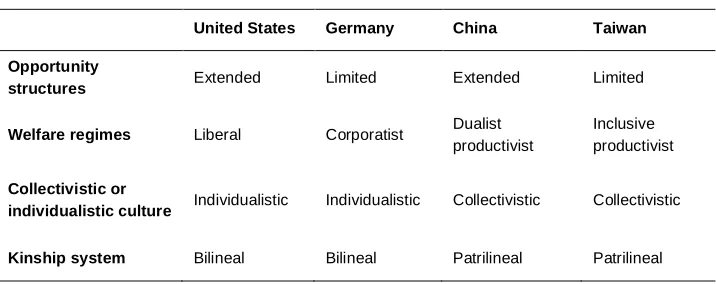
Table 1 summarizes the distinctions between the four societies considered in this research. Each respective combination of societal dimensions sets up specific preconditions for the transition to adulthood in general and for leaving the parental home specifically. In the following section these societal differences are related to individual behavior, and hypotheses on how they affect leaving home are formulated.
Table 1: Welfare regimes, kinship systems, and opportunity structures for mobility
United States Germany China Taiwan
Opportunity
structures Extended Limited Extended Limited
Welfare regimes Liberal Corporatist Dualist
productivist
Inclusive productivist
Collectivistic or
individualistic culture Individualistic Individualistic Collectivistic Collectivistic
3. Explaining societal differences in home-leaving
Leaving the parental home is part of the transition to adulthood and is intertwined with two other trajectories, the transition from education to occupation and the transition from singlehood to the establishment of a consolidated partnership, i.e., cohabitation, marriage, parenthood. In turn, these trajectories are embedded in the societal institutions of the life course. Previous research has concentrated primarily on how family of origin shapes home-leaving. For example, empirical research ‒ especially in the United States since the 1980s ‒ has identified a series of decision-making factors in the complex process of leaving the parental home. These ‘push-pull’ factors at the individual- and family-level are summarized below.
- Individuals coming from divorced and stepparent families leave the parental home earlier than those from families with two biological parents (Aquilino 1990, 1991; Goldscheider and Goldscheider 1993, 1998; Kiernan 1992; Cherlin, Kiernan, and Chase-Lansdale 1995; Blaauboer and Mulder 2010; Mencarini, Meroni, and Pronzato 2012).
- The higher the number of siblings, the greater the likelihood of an early home-leaving (Kerckhoff and Macrae 1992; Blaauboer and Mulder 2010). - Unemployment is accompanied by a longer stay in the parental home,
whereas economic independence through education or occupation accelerates home-leaving (Goldscheider and DaVanzo 1986; Wolbers 2007; Jacob and Kleinert 2008).
- The more a young individual’s intimate relationship consolidates and institutionalizes, the higher the likelihood of leaving the parental home (Goldscheider and DaVanzo 1985).
Whether and how individual decision-making factors relate to cultural and institutional conditions at the societal level remains largely unexplored. This concerns both compositional differences between societies, such as the respective proportions of separated, divorced, and remarried families or opportunity structures in the educational, labor, and housing markets, and moderation effects between the societal and the individual levels. Hence, an open theoretical and empirical question is whether the incentives for and barriers to leaving the parental home identified by intra-societal studies are indirectly influenced by the respective institutional settings of each society.
home, a lack of job opportunities for young adults and low enrolment in tertiary education may have an adverse impact. Furthermore, it can be assumed that a sufficient supply of affordable rental apartments in the housing market directly and positively affects opportunities for leaving the parental home, in comparison to societies where housing is primarily based on home ownership or renting is prohibitively expensive.
As for the moderating effects of institutional settings, it can be assumed, for example, that the connection between economic independence and the timing of leaving the parental home is only important if home-leaving is perceived as a normatively successful part of the transition to adulthood, as in individualistic cultures. By contrast, in collectivistic cultures economic success is not necessarily connected to home-leaving, but instead reorganizes intergenerational exchange relationships by increasing the contribution of the younger generation to the shared household. It can also be assumed that the connection between unemployment and staying in the parental home is moderated by the institutionalization of welfare support; i.e., the incentives for staying are higher in societies with smaller safety nets (Mitchell 2006).
The aim of the following analysis is to contribute to the understanding of how individual home-leaving behavior (micro-level) is related to institutional settings at the societal level (macro-level). This analysis is driven by the basic assumption that the institutionalization of the life course opportunity structures determine how closely connected leaving the parental home is to other transitions. Institutionalized normative expectations regulate whether home-leaving should happen before, in conjunction with, or after life course transitions such as the creation and consolidation of intimate relationships. Opportunity structures vary primarily with regard to regionally uneven distribution of access to higher education and gainful employment. They thus provide differential incentives for regional mobility and hence leaving the parental home, at least temporarily. To understand these effects on home-leaving, several parameters have to be taken into account (Modell, Furstenberg, and Hershberg 1976): the timing of the event and its coincidence with other events in the life course, and the prevalence and variability of this event.
and China than in Taiwan and Germany, which are not only smaller in size but are also highly urbanized.
Young people in the United States and China leave the parental home earlier than those in Germany and Taiwan (H1a).
At the intra-societal level, incentives for leaving the parental home early are higher in rural areas because of scarcer opportunities for higher education and jobs. As rural-urban disparities are more pronounced in China and the United States than in Taiwan and Germany, it should be that:
The effect of early home-leaving in rural areas is stronger in the United States and China than in Germany and Taiwan (H1b).
Moreover, at the household level, affluence plays a role in home-leaving behavior, but it may operate in opposing ways. On the one hand, affluence is associated with comfortable housing conditions that incentivize young people to stay (Goldscheider and Goldscheider 1999; Mulder and Clark 2000), whereas poor and uncomfortable households are an incentive to leave early (Sandberg-Thoma, Snyder, and Jang 2015). On the other hand, affluent families of origin are more able to subsidize housing for their offspring to pursue education or occupations in distant locations. A family’s economic resources should be more crucial when young people move to a place far away in order to pursue education or job opportunities. In societies where higher education and jobs are available nearby, young people may opt for a cheaper and equally beneficial alternative in the vicinity, and therefore may depend less on their parents’ financial support. Thus, the interaction between affluence and the societal structures underpinning educational and occupational opportunities will differ.
In the United States and China, affluence is positively associated with early home-leaving, whereas it has no (or even a negative) effect on home-leaving in Taiwan and Germany (H1c).
independent of economic constraint (Mulder, Clark, and Wagner 2002). Accordingly, poverty of the family of origin or unemployment of the young adult delay parental home-leaving in liberal and productivist welfare states more than in corporatist welfare states.
Economic constraints delay home-leaving more in liberal or productivist welfare states like the United States, China, and Taiwan than in corporatist welfare states like Germany (H2a). Individual preferences for home-leaving, being based on the quality of intergenerational relationships, are more prevalent in corporatist welfare states like Germany than in liberal or productivist welfare states like the United States, China, and Taiwan (H2b).
Collectivistic vs. individualistic cultures. The institutionalization of the life course varies between societies. Increasing individualization and individualistic values are associated with de-standardization of the life course (Kohli 1985: 24), resulting in greater variation in life course transitions based on individual positions in the social structure, preferences, or life circumstances (Cherlin 2004; Settersten and Gannon 2009). Collec-tivistic cultures should show greater life course standardization and hence lower variability; i.e., stages in the life course should follow a highly predictable order and the timing of transitions should be less affected by individual preferences and situational circumstances.
In our analysis, this assumption translates into an expected reduction in the effects of individual preferences or situational factors. The liberal welfare regime and more individualistic culture of the United States places more emphasis on individual resources than in Germany. The degree of individualization of the life course should therefore be higher in the United States than in Germany. In his comparison between Germany and the United States, Rindfuss (1991: 502) states: “Some of the diversity in the work/school sphere in the contemporary United States reflects different patterns in the timing of schooling, which in turn reflect our ideology that everyone should have as many chances as possible to achieve his or her maximum potential. For example, our educational system allows and encourages dropouts to return. The formal educational systems in England and Germany, in contrast, are far less fluid or forgiving”.
Kinship system. Patrilineal and bilineal kinship systems differ in their incentive structures for leaving the parental home. In patrilineal kinship systems there are strong incentives for male offspring to reside with their parents even after union formation, whereas women change their kinship membership with marriage and likely reside with in-laws. By contrast, bilineal kinship systems with strong institutionalization of neolocal residence provide strong incentives for home-leaving in connection with union formation for both sexes (Goody 1983; Laslett 1977; Duranton, Rodriguez-Pose, and Sandall 2009; Ruggles 2007, 2011). In societies with bilineal kinship systems, leaving the parental home and neolocal housing indicate a successful transition to adulthood as well as economic independence, self-achievement, and autonomy. However, successful transition to adulthood in patrilineal societies implies shifts in obligations in intergenerational functional solidarity from the older to the younger generation, requiring them to stay close, if not in the same home (Caldwell 1982). Finally, patrilineal societies provide stronger incentives for parents to invest selectively in the education of sons than societies with bilineal kinship systems (Chu and Yu 2010: 135ff). As a result, if higher education is not available in the vicinity, home-leaving to obtain higher education is more likely for sons than for daughters.
In Taiwan and China the prevalence of leaving the parental home is lower than in Germany and the United States (H4a). In Germany and in the United States, men and women show no difference in the prevalence and timing of education-related home-leaving and no difference in the prevalence of home-leaving related to neolocal union formation, but differences in timing because of men entering into unions later than women (H4b). In China and Taiwan the rates of education-related home-leaving are higher for males than for females (H4c).
According to the normative pattern of ‘one household, (only) one marriage’ (Laslett 1977), neolocal kinship systems also emphasize a strong sequence of leaving the parental home before union formation, or at latest at the incidence of marriage, for both sons and daughters. In patrilineal kinship systems with patrilocal residence norms, home-leaving at the time of union formation only applies to daughters.
In the United States and Germany the timing of leaving the parental home is strongly related to entry into cohabitation and marriage for both sons and daughters. In China and Taiwan the timing of leaving the parental home is related to union formation only for daughters (H4d).
cultures. Some dimensions may have opposing effects on home-leaving behavior within one country. In China, the productivist welfare system combined with educational and occupational mobility is an incentive for early home-leaving, whereas the pronounced intergenerational obligations and patrilocal housing patterns of a collectivistic patrilineal culture may constrain home-leaving. Evidence-based knowledge about how these dimensions interact with each other in their effect on home-leaving behavior is absent from social research. Moreover, which of these dimensions is most influential is an open empirical question. For example, one may assume that the institutionalization of the respective kinship system moderates the effect of disruptive events in the family of origin on the prevalence of early home-leaving. Whereas in bilineal kinship systems like North America and Europe it has been repeatedly reported that parental separation, divorce, and remarriage have a strong positive effect on early home-leaving for both sexes, in patrilineal kinship systems this is only expected for daughters, while sons are likely to stay even longer with a parent after parental separation or remarriage.
The following empirical analyses have two broad objectives: 1) to test the hypothesis that macro-social conditions in the four societies predict patterns in the timing and prevalence of young people’s home-leaving, and 2) to test the moderating effects of these macro-societal conditions on individual-level incentive structures, opportunities, and barriers to home-leaving.
4. Data and methods
4.1 Databases
The empirical analysis is performed on four datasets that have several characteristics in common and so are suitable for comparative analysis. All are panel studies based on initial nationally representative samples and all survey similar birth cohorts, which reduces possible biases of intervening period effects. Moreover, all include individuals aged 15 to 30 years old, which is the decisive period for leaving the parental home. All four datasets also have common independent variables, making comparative hypothesis testing possible. These empirical indicators were harmonized ex post to obtain comparable results.
- The NLSY97 started in 1997 with an initial sample of 8,984 respondents from birth cohorts 1980‒1984. Our analysis uses 16 waves, covering the observation period from 1997‒2014 (http://www.bls.gov/nls/nlsdoc.htm). - PAIRFAM started in 2008 with an initial sample of 12,402 respondents from
birth cohorts 1971‒1973, 1981‒1983, and 1991‒1993. Data was collected annually (Huinink et al. 2011; Brüderl et al. 2016). Seven waves of the two younger cohorts were used in our analysis, covering the observation period 2008‒2015 (http://www.pairfam.de/en). The multivariate analysis uses additional retrospective information.
- The TYP started in 2000 with an initial sample of 5,541 respondents from birth cohorts 1984‒1987. Data was collected annually in the first 9 waves, while from wave 10 onwards the observation window was every 2 years. The analysis used 11 waves, covering the period 2000‒2014 (http://www.typ.sinica.edu.tw/E).
- The CFPS started in 2010 with an initial sample of 42,590 respondents. Unlike the other three data sets, CFPS is not a cohort study but covers the entire life span of all members of the sampled households. Therefore, only the 6,963 respondents within the age range 15 to 30 in the first of the two available waves were used for the analysis (http://www.isss.edu.cn/cfps/en).
4.2 Measurement issues with ‘leaving the parental home’
does it cover the case where parents leave their children behind (with other relatives), as in countries with high adult (parental) external or internal migration (such as China). Regarding the state after the transition event, it is unclear whether ‘home-leaving’ implies the founding of a separate, autonomous household or not. This is particularly relevant to institutionalized living forms resulting from education, voluntary social service, or military service, because population statistics count individuals in such situations as members of the parental household but respondents themselves may or may not perceive this temporal state as “having left” the parental home, perhaps depending on whether they commute back regularly. Goldscheider and DaVanzo (1986) label such special states as ‘semiautonomy,’ and find that they are a frequent sequence between sharing a household with parents and founding an ‘autonomous’ household.
Connotations of the concept ‘leaving the parental home’ may vary considerably in cross-cultural comparisons. For example, intergenerational relations and obligations (“filial piety”; Fricke, Chang, and Yang 1994; Hashimoto and Ikels 2005) in collectivistic cultures may result in individuals perceiving the time point of home-leaving as later (if at all) than individuals from individualistic cultures that favor early independence and self-reliance of the offspring and perceive home-leaving as a ‘successful’ transition.
4.3 Operationalization
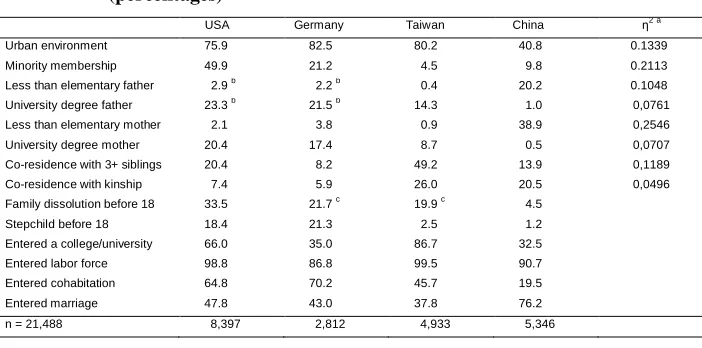
Output harmonization was performed for all variables used in each dataset (Hoffmeyer-Zlotnik and Warner 2014). The analysis is based on structural factors and individual perceptions of intergenerational relationships (Table 2). Time-independent structural factors include sex of the respondent, rural or urban environment of the family of origin’s living context, educational level of the parents, majority-minority status, household income, number of siblings, and family of origin type at the start of the home-leaving process. Time-dependent factors include educational and occupational transitions and the gradual strengthening of intimate relationships. Quality of intergenerational relationships is measured as the respondents’ perceptions of intergenerational solidarity.
The variables were operationalized as follows, with the time-independent variables collected in the first waves of each respective panel study, i.e., before the event of leaving the parental home.
Urbanity. The US data identifies areas as urban or rural according to the Census Bureau’s 1990 standards: “urbanity” comprises “urbanized areas” and “places” with a population of at least 2,500. For Germany, a population of 5,000 was chosen as the threshold separating “urban” from “rural” municipalities, a value similar to the United States but resulting in a “rural” population large enough for meaningful statistical analysis. In Taiwan, urbanity was based on a classification of counties as either core cities or urban counties, classified as “urban”, or rural counties classified as “rural.” In China the distinction was based on the Statistical Office’s official distinction. Whereas Germany, Taiwan, and the United States (based on a rather low cut-off point) were classified as predominantly “urban”, the urbanity level of China is significantly lower (Table 2).
Minorities. For the United States, all self-identified Black, Hispanic, Native American, Inuit, Asian, and Pacific Islander respondents as well as those of mixed race were classified as “minority”. In Germany, “minority” applies to those foreign-born or with at least one foreign-born parent. For Taiwan, the respondent was classified as “belonging to a minority” if the parents were both members of the “Hakka”, Aborigines, or of other non-Chinese or non-Taiwanese backgrounds. Minority membership in China comprised any non-Chinese ethnic membership, based on the respondent’s self-assessment. Whereas about half of the American respondents were classified as minority members, this share is much lower in Germany, and even lower in Taiwan and China.
show a similar high level of education for the US-American and German parents, with only small differences between fathers and mothers. The educational level of parents in Taiwan ranked next, but showed stronger gender differences. The educational level of the Chinese parents was much lower, with less than 1% holding a university degree, and around 20% of fathers and twice as many mothers with no university degree. In the analysis the mean of the mothers’ and fathers’ scores was used.
Parental income. The estimate of parents’ income was based on different indicators. In the United States, China, and Taiwan the gross parental income was used, whereas for Germany only the net income of the family household was available. In order to make this information comparable the income was categorized in percentiles, which allowed for a country-specific ranking of the household income but not for cross-country differences in income level.
Co-resident siblings. This included biological and step-, foster, and half-siblings. Co-resident kinship members.This dummy variable measures whether the young person lived in a household consisting of nuclear family members only or whether the household was lineally or laterally extended, including also grandparents, uncles and aunts, and married brothers or sisters (in-law).
mother/father your secrets and private feelings?” and “How often do you feel for your mother/father great affection even if you happen to be angry with her/him?” were measured on a 5-point scale. To standardize the data across countries the respective value range was categorized in percentiles.
Table 2: Overview of the distribution of tested predictors of home-leaving (percentages)
USA Germany Taiwan China η2 a
Urban environment 75.9 82.5 80.2 40.8 0.1339
Minority membership 49.9 21.2 4.5 9.8 0.2113
Less than elementary father 2.9b 2.2b 0.4 20.2 0.1048
University degree father 23.3b 21.5b 14.3 1.0 0,0761
Less than elementary mother 2.1 3.8 0.9 38.9 0,2546
University degree mother 20.4 17.4 8.7 0.5 0,0707
Co-residence with 3+ siblings 20.4 8.2 49.2 13.9 0,1189
Co-residence with kinship 7.4 5.9 26.0 20.5 0,0496
Family dissolution before 18 33.5 21.7c 19.9c 4.5
Stepchild before 18 18.4 21.3 2.5 1.2
Entered a college/university 66.0 35.0 86.7 32.5
Entered labor force 98.8 86.8 99.5 90.7
Entered cohabitation 64.8 70.2 45.7 19.5
Entered marriage 47.8 43.0 37.8 76.2
n = 21,488 8,397 2,812 4,933 5,346
a)
Pearson’s Eta is a measure of proportional reduction in error (PRE).
b)
Difference between the two countries marked is not significant; all other differences are significant.
c)
Difference between the survival functions of the two countries marked is not statistically significant.
young adults under the age of 30 had joined the labor force, but about 10% of the Chinese and Germans had never had a full-time job. Clear country-differences also existed with regard to cohabitation and marriage. Cohabitation was least frequent in this age range in China, while at the same time young Chinese adults got married more frequently than in any of the other countries. The United States had the second highest rate of marriage, accompanied by a relatively high rate of cohabitation. The young Germans exhibited the highest share of transitions to cohabitation, but only around 40% had entered marriage by the age of 30. Even more delayed (or entirely absent) is marriage among the young Taiwanese, who experienced the second lowest rate of cohabitation and the lowest rate of marriage by age 30.
4.4 Analytic strategy
For the multivariate event history analysis we used discrete-time logistic regression models to estimate the impact of time-constant and time-dependent predictors on the timing of leaving the parental home (Allison 1982; Singer and Willet 2003). Separate models were run for each country. Respondents without an event in the observation window were treated as censored after their last interview. Because the age-dependency and the shape of the hazard rates varied considerably by country (Figure 2), the models included age dummies.
We used multivariate imputation (Acock 2005), replacing missing data for each country separately through chained equations (MICE). Research demonstrates that this method yields less-biased results and more efficient estimates than complete case analysis or other traditional approaches (Young and Johnson 2015; Johnson and Young 2011). Datasets were generated by means of an imputation model, regressing incomplete covariates on the other covariates in the analysis (including interaction terms) and the outcome. As recommended by White and Royston (2009), the binary event indicator and the Nelson-Aalen estimator of the cumulative baseline hazard at the time of the event (or censoring) were included in the imputation model to adequately represent the outcome.
5. Empirical results
5.1 Age-specific prevalence of household constellations
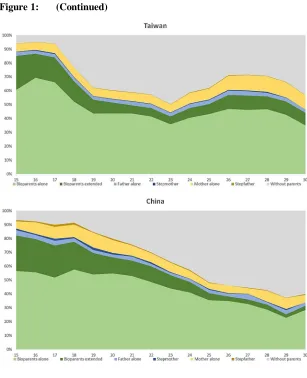
of young people was calculated who lived 1) in a household with both biological parents, 2) with both biological parents in a laterally (with uncles, aunts, sisters-in-law, or brothers-in-law) or lineally extended (with grand or great-grand-parents) household, 3) with the father alone, 4) with a stepmother, 5) with the mother alone, 6) with a stepfather, or 7) with none of these (Figure 1). As these are cross-sectional results they do not represent the first event of home-leaving in the life course, but may be the result of returning to the parental household. Foster and adoptive-parent constellations were reported only for the United States and Germany, and were grouped less than 1% in Germany and 2% in the United States for any age, and therefore were omitted from the analysis.
There were obvious differences in initial household composition between the different types of societies. Whereas 85% of young Taiwanese and 82% of young Chinese lived with both biological parents at age 15, this was the case for 70% of the Germans, and only 53% of the American respondents. Even more pronounced were differences between both pairs of societies with regard to extended households. 26% of Chinese and 25% of Taiwanese respondents lived in extended households, but this was only the case for 4% of young Germans and 2% of young Americans. Conversely, single and step-parenthood was more frequent in Germany and especially the United States, where 24% of the sample lived with their mother alone and 11% with a stepfather (4% with the father alone and 3% with a stepmother). The patrilineal organization of the Chinese and Taiwanese kinship systems shapes the relative proportion of those staying with either parent: the likelihood of staying with the mother (and getting a stepfather) was roughly twice as high as staying with the father in China and Taiwan, 7 times higher in the United States, and 8 times higher in Germany.
At the end of the observation period, i.e., approaching age 30, differences were also pronounced among young adults. Whereas 89% of German and 86% of American young adults did not live with their parents at this age, this was true for only 60% of Chinese and 43% of Taiwanese. Also, living in extended households continuously decreased in China. However, in Taiwan a special development in intergenerational housing in young adulthood could be observed. Living with parents decreased sharply at age 17 and this lasted until age 23, after which living with parents increased again to peak at age 27, beyond which the percentage living with parents decreased moderately until age 30. Simultaneously, living in extended households or with the mother alone showed a bi-modal distribution, with an increase between the ages of 25 and 30 related to a temporal interruption of the life course, in which intergenerational housing plays an important role. The specific age at this interruption is the obvious result of leaving the parental home temporarily for higher education.
process continued to age 28. In China the proportion of young people not living with parents continuously increased from age 18 to 29, a pattern in sharp contrast to the Taiwanese institutionalized temporary home-leaving between ages 19 and 26. Despite these temporary differences, the final result was almost 90% of the young adults leaving the parental home by age 30 in the United States and Germany, while in China and Taiwan about half still lived in or had returned to the parental home by that age.
Figure 1: (Continued)
5.2 Timing of leaving the parental home
systems, Figure 2 displays separate smoothed hazard rates for sons and daughters, unadjusted for covariates.
The results for the United States are in line with previous findings of earlier home-leaving for daughters than sons, which culminates in the first half of their 20s. For sons the curve was less steep, and the home-leaving process is extended to the second half of their 20s. Moreover, comparison with hazard rates in the other three countries reveals that offspring in the United States left the parental home earliest in the life course and with the highest prevalence.
In Germany the apex of the home-leaving process was significantly later than in the United States, peaking around age 25 for daughters and around 27 for sons. The German pattern resembles that of the United States regarding the significant gender differences, albeit with flatter hazard curves, signifying an extended parental home-leaving phase that is far from finished by the end of the 20s, especially for sons. It also signifies a less standardized transition to adulthood compared with the United States.
China displays a home-leaving pattern that differs in several ways from the United States and Germany. First, the home-leaving process started much earlier, with a relatively high risk in the teenage years and a peak at around age 21. Second, the age-specific hazard rates never exceeded .15, whereas the respective high values for the United States and Germany are beyond .21 and .16 for daughters, and .18 and .14 for sons. Third, until age 25 the hazard rates for young Chinese men and women are similar. Gender differences only appear in the second half of the 20s, with higher rates of home-leaving for sons than for daughters.
Compared with China, home-leaving in Taiwan is less frequent overall: the age-specific hazard rate never exceeded .11 for both sons and daughters. The pattern resembled that of China insofar as the home-leaving process had already started in the late teenage years, culminating at the age of 20. Moreover, until age 24 no significant gender differences are observed. However, Taiwanese young adults showed a unique gender-specific pattern of home-leaving in the second half of their 20s: the hazard rate remained constant at about .08 for sons, but increased to a second peak of about .11 for daughters.
Figure 2: Hazard rates of leaving the parental home for sons and daughters
Comparing the results of survival analyses (not shown) with the cross-sectional distributions of household constellations (Figure 1) yields an estimation of subsequent returns to the parental home after having moved out. Up to age 30, 8% of American youth had never moved out, while at age 30 16% were living with parents – the gap representing the 8% who moved out and returned. Young Germans showed the same percentage for those never leaving, but only 11% were living with parents at the age of 30; i.e., return rates were higher in the United States than in Germany. The likelihood of remaining in and returning to the parental home is markedly higher in China and Taiwan. At the age of 30, 40% of the Chinese were living with their parents, most of them with no intermittent home-leaving. As Figure 1 has already revealed, returning behavior is most prominent in Taiwan, where only 11% of the sample never left their parents and 57% were living with at least one parent in the same household at the age of 30.
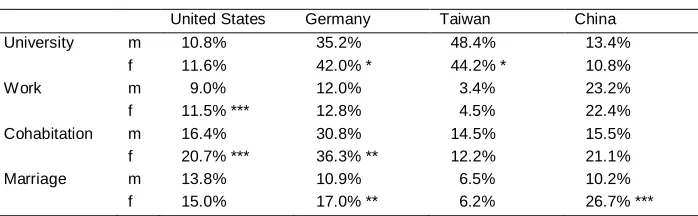
The connections between leaving the parental home and other life course transitions in the four societies are displayed in Table 3, calculated as the percentages of those
0 .0 2 .0 4 .0 6 .0 8 .1 .1 2 .1 4 .1 6 .1 8 .2 .2 2
15 20 25 30 Age
Men Women
Hazard Estimates: China
0 .0 2 .0 4 .0 6 .0 8 .1 .1 2 .1 4 .1 6 .1 8 .2 .2 2
15 20 25 30 Age
Men Women
Hazard Estimates: Germany
0 .0 2 .0 4 .0 6 .0 8 .1 .1 2 .1 4 .1 6 .1 8 .2 .2 2
15 20 25 30 Age
Men Women
Hazard Estimates: Taiwan
0 .0 2 .0 4 .0 6 .0 8 .1 .1 2 .1 4 .1 6 .1 8 .2 .2 2
15 20 25 30 Age
Men Women
between 15 and 30 years of age who experienced entry into college or university, first gainful employment, cohabitation, or marriage (whatever came first) in the same year they left the parental home.
Table 3: Proportion of life course transitions at the same age as leaving the parental home
United States Germany Taiwan China
University m 10.8% 35.2% 48.4% 13.4%
f 11.6% 42.0% * 44.2% * 10.8%
Work m 9.0% 12.0% 3.4% 23.2%
f 11.5% *** 12.8% 4.5% 22.4%
Cohabitation m 16.4% 30.8% 14.5% 15.5% f 20.7% *** 36.3% ** 12.2% 21.1%
Marriage m 13.8% 10.9% 6.5% 10.2%
f 15.0% 17.0% ** 6.2% 26.7% ***
Note: Gender differences: * = p ≤ .05; ** = p ≤ .01; *** = p < .001
5.3 Determinants of first departure from the parental home in the United States, Germany, China, and Taiwan
Using discrete-time event history models, the moderating impact of opportunity structures, institutional settings, and individual transitions in the life course on leaving the parental home was assessed for each country separately (Table 4).
Table 4: Determinants of first departure from parental home in the United States, Germany, Taiwan, and China, results from the discrete-time logistic model1)
USA Germany Taiwan China
Urban environment ‒0.13*** ‒0.11 ‒0.33*** ‒0.34***
Minority membership ‒0.19*** ‒0.34*** ‒0.13 ‒0.44***
Educational level parents 0.03*** 0.05*** 0.04*** ‒0.01
Poverty 0.08+ 0.15 ‒0.11+ 0.38***
Affluence ‒0.09* 0.16+ ‒0.01 ‒0.23*
Coresiding siblings 0.06*** .04 0.02 0.01
Coresiding kinship 0.01 0.14 0.09* ‒0.19*
Intergenerational solidarity ‒0.05*** ‒0.06** ‒0.01 ‒0.07**
Female 0.27*** 0.62*** 0.09 ‒0.05
Family dissolution2) 0.18*** ‒0.05 ‒0.01 ‒0.12
Family dissolution × female2) ‒0.07 0.07 0.15 ‒0.44
Stepchild2) 0.30*** 0.40** ‒0.09 0.06
Stepchild × female2) ‒0.04 0.06 0.26 0.41
College/university entry2) 0.28*** 0.03 ‒0.52*** ‒0.43**
College/university entry × female2) ‒0.11* 0.04 ‒0.04 ‒0.03
Labor force entrance2) 0.21*** 0.33** ‒0.16* ‒0.74***
Labor force entrance × female2) ‒0.04 ‒0.23+ ‒0.17+ 0.12
Cohabitation2) 1.06*** 0.38** 0.03 0.05
Cohabitation × female2) ‒0.01 ‒0.12 0.44* 0.48*
Marriage2) 0.96*** 0.38 0.26 ‒0.36**
Marriage × female2) 0.06 ‒0.45 0.96*** ‒0.41*
n = 21,488 8,397 2,812 4,933 5,346
Note:1) Controlled for age (not shown);2) time-dependent covariate
A general result of these analyses is that the patterns of leaving the parental home in the four countries did not only follow cultural differences; i.e., the distinction between collectivist, patrilineal societies on the one hand and individualistic, bilineal societies on the other. They also followed the distribution of opportunity structures related to the welfare state regime, with the necessities of regional mobility also playing an important role. This already becomes apparent looking at the time-independent structural determinants of home-leaving.
- Living in a rural environment had a strong negative influence on leaving the parental home, especially in Taiwan and China, but also in the United States. In Germany, however, individuals from families living in an urban environment were not significantly less likely to leave the home.
- Being a member of a minority generally decreased the likelihood of leaving the parental home, although not significantly so in Taiwan. Minority members in the United States and Germany live mostly in urban centers and are restricted in home-leaving intentions by the economic resources of their families, whereas minorities in China predominantly live in rural areas and are more traditionally patrilocal.
- All else controlled for, the educational level of the parents had a significant positive effect on leaving the parental home in the United States, Germany and Taiwan, indicating additional (educational) mobility between urban centers. In China, the educational level of the parents did not make a significant difference to the timing of leaving home.
- The economic situation of family income, relative to the rest of the country, significantly reduced home-leaving in the United States and China, i.e., an affluent family functioned as a pull-factor and a family in poverty as a push-factor (the p-value for poverty only slightly exceeds the conventional significance level in the case of the United States). In Taiwan and Germany the economic situation of the family of origin hardly had any additional effect on home-leaving, and instead only the urban-rural disparity and the educational level of the parents were determinants.
- The household composition of the family of origin in the United States incentivizes leaving the parental home earlier if there are several siblings or extended kinship members, signifying potential economic hardship, space restrictions, or conflict. In Germany, by contrast, individuals from such families did not leave the parental home significantly sooner. Whereas respondents from extended households left the parental household earlier in Taiwan, an extended household was associated with a longer stay in China.
adolescents who had a close and supportive relationship with their parents were less likely to leave the home early. This effect is observable in the individualistic societies of the United States and Germany, but also in China.
The inclusion of events in parallel life course trajectories helps to understand their interaction with home-leaving and to analyze whether home-leaving took place prior to or after transitions in these trajectories. Because of variation in kinship systems, significant gender differences between societies were expected in the timing of all events in the transition to adulthood. Accordingly, gender-specific interaction effects were calculated for each event, with sons serving as the reference category. In general, daughters left the parental home earlier than sons in the United States, Germany, and Taiwan. The exception of China signifies that early home-leaving in this country was related to a preference to send sons to higher education. Because in some countries there was a small number of certain events, such as parental separations, step-parenthood (Figure 1), cohabitation, and marriage, the effects in Table 4 may lack statistical significance.
- Family dissolution prior to the home-leaving, i.e., separation, divorce, or death of one of the parents, had a push-effect only in the United States and was not significant for home-leaving in the other three countries.
- Remarriage of a parent, i.e., becoming a stepchild, had a strong push-effect on both daughters and sons in the United States and Germany. No significant effect is observed for China and Taiwan. Thus, in the two patrilineal societies a remarriage of the parent did not affect the home-leaving of either daughters or sons.
norm of neolocal union formation. In the patrilineal societies this applied only for women, following the patrilocal housing pattern after union formation. Basically the same pattern presented itself for marriage, which also had an equally strong effect on sons and daughters leaving the parental home in bilineal societies. In Taiwan, the patrilocal effect on daughters leaving was even stronger after marriage than after cohabitation. In China, however, the effect of marriage pointed in the opposite direction, and even more so for women than for men. This may reflect a higher likelihood of Chinese couples as compared with Taiwanese couples to co-reside with the female partner’s family after marriage if she has not already left to live with the male partner’s family in anticipation of marriage (Chu, Xie, and Yu 2011).
6. Discussion
The presented empirical analysis has its limitations. It is based on panel studies planned and carried out independently of each other, with different designs, ranging from a national household survey with few waves (CFPS) to national cohort panel studies of youth with different numbers of waves and not starting precisely at the same time (TYP, NLSY97, and PAIRFAM). There were a limited number of empirical indicators that could be harmonized. Moreover, the age range in the analysis was restricted to between 15 and 30, and the measure of home-leaving was a composite of retrospective and panel information. Especially in the case of Germany, where home-leaving occurred rather late, and Taiwan, where a bimodal distribution of home-leaving was observed, an extension of the age range observed would have been helpful and should be subject to further empirical investigation.
(2002) report that 50% of Chinese men and 30% of Chinese women live with parents at that age. However, in the case of women it remains unclear whether this refers to parents or in-laws. Lin and Yi (2013: 306) provide an indirect confirmation of differences between China and Taiwan according to the East Asian Social Survey, in which co-residence of adult children and their parents is shown to be half as prevalent in China as in Taiwan. The results also indirectly confirm Chu, Xie, and Yu (2011) by showing that the Chinese Family Panel Study reveals higher rates of intergenerational co-residence in Taiwan than China, with a higher prevalence of living with the husband’s parents in Taiwan and with the wife’s parents in China.
The congruence in the empirical results extends the validity of the theoretical explanations provided. These explanations focus on hypotheses that bridge four dimensions of societal characteristics in these four societies, namely the kinship divide, the individualism-collectivism divide, the opportunity structures divide, and the welfare state divide. Individual characteristics, a common focus in intra-societal analysis, were only analyzed against the backdrop of these bridge hypotheses (Wippler and Lindenberg 1987; Esser 1998).
The second set of hypotheses relates to welfare regimes. The liberal welfare regime in the United States and the productivist welfare regime in China should make young people more reliant on parental resources and thus limit their home-leaving choices (H2a), whereas the more redistributive welfare regime of Germany should provide more freedom in home-leaving and place more importance on the quality of intergenerational relationships (H2b). However, the empirical findings provide scarce support for these assumptions. Taiwan was the only country where adolescent perceptions of intergenerational solidarity and closeness were not a significant reason to delay home-leaving. Neither the economic situation nor the household composition with regard to co-residing siblings or kinship varied systematically in the assumed direction with home-leaving. On the contrary, poverty of the family of origin, and in the case of the United States also living together with many siblings, was especially tied to early home-leaving in the United States and China. To conclude, the welfare regime of the respective country had no direct and only minor indirect effects on the home-leaving process when tested against this data (little support for H2a and H2b). The indirect effects are related to neolocal housing opportunities, which especially vary with the availability of (cheap, subsidized) rented flats, which are more common in Germany than in the other societies. Obviously, these theoretical indirect effects were superseded by factors of individual preferences and social norms.
models. The results suggest that family disruption has no effect on home-leaving, which may also be explained by the fact that in these countries widowhood is a more likely disruption than divorce. Whereas divorce is the more critical life event for children, widowhood creates incentives for intergenerational cohabitation, as it reduces total housing costs (Chu, Xie, and Yu 2011).
The fourth set of hypotheses is related to kinship system. The bilineal kinship system of the United States and Germany associates with neolocal residence after union formation, while the patrilineal system of China and Taiwan favors patrilocal housing. In general, it was expected that the prevalence of home-leaving would be higher in bilineal kinship systems (H4a), whereas the patrilineal kinship system favors selective investments in male descendants, resulting in higher home-leaving rates for sons in connection with higher education (H4b and H4c) and higher home-leaving rates for daughters in connection with union formation (H4d). Descriptive results from Figure 1 reveal that neolocal housing in the United States and Germany resulted in much higher percentages of young people living apart from their parents than in China and especially Taiwan (supporting H4a). In Taiwan young adults returned to the parental home systematically after having finished education, which resulted in the unprecedented finding that more young adults lived with their parents in their late 20s than in their early 20s. Results from Figure 2 and Table 3 show that home-leaving in Taiwan was strongly associated with entry into higher education for both sons and daughters (in Taiwan H4c extends beyond sons), whereas the association between home-leaving and marriage occurred only for daughters (supporting H4d). This resulted in a second peak of home-leaving at the end of the observation period (Figure 2) and a strong timing effect of cohabitation and marriage on home-leaving for daughters only, even when controlled for various other factors (Table 4). In China, patrilocal housing resulted in the coincidence of cohabitation and marriage with leaving the parental home for young women only (Table 3, support of H4d).
education or the work force were unexpectedly low in both countries. The assumption that patrilineal kinship systems result in selective investment in male descendants (H4c) was thus not supported.
This empirical analysis extends knowledge of the process of home-leaving beyond simplistic black-and-white comparisons of ‘Western’ and ‘Eastern’ societies. Instead, via bridge hypotheses, it systematically relates societal characteristics such as welfare and kinship systems, mobility opportunities, and cultural values, with home-leaving behavior, and thus contributes to theoretical explanations of variation in home-leaving behavior. The inclusion of four societies demonstrates that home-leaving behavior is far from uniform in both the patrilineal, collectivistic and the bilineal, individualistic societies.
The empirical analysis also sheds light on the cultural limitations of the mainstream conceptualization of parental home-leaving, which is guided by normative implications based on the neolocal pattern of the bilineal kinship system (viz. a ‘Western’ perspective). In the Western cultural tradition, leaving the parental home is a strong marker of detachment from parents, psychological individuation, economic independence, and self-reliance, and a precondition for union formation and parenthood. Thus, leaving home ‘on time’ is an important and positively evaluated step towards adulthood (Billari and Liefbroer 2007). Accordingly, age norms in conjunction with pressure from social networks will define ‘too early’ and ‘too late’ cases as problematic and jeopardizing efficacy in the transition to adulthood. Results from China and especially Taiwan demonstrate that in these countries the normative link between the transition to adulthood and leaving the parental home does not exist in the same way, since filial piety does not emphasize individuation but rather reinforces children’s obligations toward their parents in adulthood, and favors coresidence. Thus, adulthood is primarily defined by contributing economically and taking on filial obligations, even under conditions of advanced economic development and urbanized living conditions. This implies that home-leaving is not a necessary step in the transition to adulthood.
7. Acknowledgments
References
Aassve, A., Arpino, B., and Billari, F.C. (2013). Age norms on leaving home: Multilevel evidence from the European Social Survey. Environment and Planning A45(2): 383‒401.doi:10.1068/a4563.
Aassve, A., Billari, F.C., Mazzuco, S., and Ongaro, F. (2002). Leaving home: A comparative analysis of ECHP data. Journal of European Social Policy 12(4): 259‒275.doi:10.1177/a028430.
Acock, A.C. (2005). Working with missing values. Journal of Marriage and Family. 67(4): 1012‒1028.doi:10.1111/j.1741-3737.2005.00191.x.
Allison, P.D. (1982). Discrete-time methods for the analysis of event histories. Sociological Methodology 13(1): 61‒98.doi:10.2307/270718.
Aquilino, W.S. (1990). The likelihood of parent-adult child coresidence: Effects of family structure and parental characteristics.Journal of Marriage and the Family 52(2): 405‒419.doi:10.2307/353035.
Aquilino, W.S. (1991). Family structure and home-leaving: A further specification of the relationship.Journal of Marriage and the Family 53(4): 999‒1010.doi:10.2307/ 353003.
Bengtson, V.L. (2001). Beyond the nuclear family: The increasing importance of multigenerational bonds.Journal of Marriage and Family 63(1): 1‒16.doi:10.11 11/j.1741-3737.2001.00001.x.
Bengtson, V.L. and Roberts, R.E.L. (1991). Intergenerational solidarity in aging families: An example of formal theory construction.Journal of Marriage and the Family53(4): 856‒870.doi:10.2307/352993.
Billari, F.C. (2001). The analysis of early life courses: Complex descriptions of the transition to adulthood. Journal of Population Research 18(2): 119‒142.
doi:10.1007/BF03031885.
Billari, F.C. and Liefbroer, A.C. (2007). Should I stay or should I go? The impact of age norms on leaving home.Demography44(1): 181‒198.doi:10.1353/dem.2007.00 00.
Blaauboer, M. and Mulder, C.H. (2010). Gender differences in the impact of family background on leaving the parental home. Journal of Housing and the Built Environment25(1): 53‒71.doi:10.1007/s10901-009-9166-9.
Brüderl, J., Hank, K., Huinink, J., Nauck, B., Neyer, F.J., Walper, S., Alt, P., Buhr, P., Castiglioni, L., Fiedrich, S., Finn, C., Hajek, K., Herzig, M., Huyer-May, B., Lenke, R., Müller, B., Peter, T., Salzburger, V., Schmiedeberg, C., Schütze, P., Schumann, N., Thönnissen, C., Wetzel, M., and Wilhelm, B. (2016). The German Family Panel (pairfam). Cologne: GESIS Data Archive. (ZA5678 Data file Version 7.0.0).doi:10.4232/pairfam.5678.7.0.0.
Caldwell, J.C. (1982).Theory of fertility decline. New York: Academic Press.
Cherlin, A.J. (2004). The deinstitutionalization of American marriage. Journal of Marriage and Family66(4): 848‒861.doi:10.1111/j.0022-2445.2004.00058.x.
Cherlin, A.J., Kiernan, K.E., and Chase-Lansdale, P.L. (1995). Parental divorce in childhood and demographic outcomes in young adulthood. Demography32(3): 299‒318.doi:10.2307/2061682.
Chu, C.Y.C., Xie, Y., and Yu, R.R. (2011). Coresidence with elderly parents: A comparative study of southeast China and Taiwan. Journal of Marriage and Family73(1): 120‒135.doi:10.1111/j.1741-3737.2010.00793.x.
Chu, C.Y.C. and Yu, R.-R. (2010). Understanding Chinese families: A comparative study of Taiwan and southeast China. Oxford: Oxford University Press.
doi:10.109acprof:oso/9780199578092.001.0001.
Conger, R.D. and Elder, Jr., G.H. (1994). Families in troubled times: The Iowa Youth and Families Project. In: Conger, R.D. and Elder Jr., G.H. (eds.). Families in troubled times: Adapting to change in rural America. New York: de Gruyter: 3‒ 19.
DaVanzo, J. and Goldscheider, F.K. (1990). Coming home again: Returns to the parental home of young adults.Population Studies44(2): 241‒255.doi:10.1080/00324720 31000144576.
de Jong Gierveld, J., Liefbroer, A.C., and Beekink, E. (1991). The effect of parental resources on patterns of leaving home among young adults in the Netherlands. European Sociological Review7(1): 55‒71.doi:10.1093/oxfordjournals.esr.a036 577.
Esping-Andersen, G. (1990).The three worlds of welfare capitalism. Cambridge: Polity Press.
Esser, H. (1998). Why are bridge hypotheses necessary? In: Blossfeld, H.-P. and Prein, G. (eds.). Rational choice theory and large-scale data analysis. Boulder: Westview Press: 94‒111.
Feng, J.Y. and Han, W.-H. (2010). Maternity leave in Taiwan.Family Relations59(3): 297‒312.doi:10.1111/j.1741-3729.2010.00603.x.
Fricke, T.E., Chang, J.-S., and Yang, L.-S. (1994). Historical and ethnographic perspectives on the Chinese family. In: Thornton, A. and Lin, H.-S. (eds.).Social change and the family in Taiwan. Chicago: University of Chicago Press: 22‒48.
Furman, W. and Buhrmester, D. (1985). Children’s perceptions of the personal relationships in their social networks. Developmental Psychology21(6): 1016‒ 1024.doi:10.1037/0012-1649.21.6.1016.
Furstenberg, Jr., F.F. (2013). Transitions to adulthood: What we can learn from the West. The Annals of the American Academy of Political and Social Science646(1): 28‒ 41.doi:10.1177/0002716212465811.
Goldscheider, F.K. and DaVanzo, J. (1985). Living arrangements and the transition to adulthood.Demography22(4): 545‒563.doi:10.2307/2061587.
Goldscheider, F.K. and DaVanzo, J. (1986). Semiautonomy and leaving home in early adulthood.Social Forces65(1): 187‒201.doi:10.2307/2578942.
Goldscheider, F.K. and Goldscheider, C. (1993). Leaving home before marriage: Ethnicity, familism, and generational relationships. Madison: University of Wisconsin Press.
Goldscheider, F.K. and Goldscheider, C. (1994). Leaving and returning home in 20th century America.Population Bulletin48(4): 1‒33.
Goldscheider, F.K. and Goldscheider, C. (1998). The effects of childhood family structure on leaving and returning home.Journal of Marriage and Family60(3): 745‒756.doi:10.2307/353543.
Goldscheider, F. and Goldscheider, C. (1999). The changing transition to adulthood: Leaving and returning home. Thousand Oaks: Sage.doi:10.4139781452234014. n5.
Goldscheider, F., Goldscheider, C., St. Clair, P., and Hodges, J. (1999). Changes in returning home in the United States, 1925‒1985.Social Forces78(2): 695‒720.
Goldscheider, F., Thornton, A., and Young-DeMarco, L. (1993). A portrait of the nest-leaving process in early adulthood. Demography 30(4): 683‒699.
doi:10.2307/2061813.
Goody, J. (1983). The development of the family and marriage in Europe. Cambridge: Cambridge University Press.doi:10.1017/CBO9780511607752.
Goody, J. (1990).The oriental, the ancient and the primitive: Systems of marriage and the family in the pre-industrial societies of Eurasia. Cambridge: Cambridge University Press.doi:10.1017/CBO9780511621703.
Hashimoto, A. and Ikels, C. (2005). Filial piety in changing Asian societies. In: Johnson, M.L. (ed.).The Cambridge handbook of age and ageing. Cambridge: Cambridge University Press: 437‒442.doi:10.1017/CBO9780511610714.046.
Hoffmeyer-Zlotnik, J.H.P. and Warner, U. (2014). Harmonising demographic and socio-economic variables for cross-national comparative survey research. Dodrecht: Springer.doi:10.1007/978-94-007-7238-0.
Hofstede, G. (2001).Culture’s consequences: Comparing values, behaviors, institutions, and organizations across nations. Thousand Oaks: Sage.
Holdsworth, C. (2000). Leaving home in Britain and Spain. European Sociological Review 16(2): 201‒222.doi:10.1093/esr/16.2.201.
Holliday, I. (2000). Productivist welfare capitalism: Social policy in East Asia.Political Studies48(4): 706‒723.doi:10.1111/1467-9248.00279.
Huang, C.-C. and Ku, Y.-W. (2011). Effectiveness of social welfare programmes in East Asia: A case study of Taiwan.Social Policy and Administration45(7): 733‒751.
doi:10.1111/j.1467-9515.2011.00794.x.
Huang, L.-W. (2013). When young adults leave home: Dependency or autonomy? In: Yi, C.-C. (ed.). The psychological well-being of East Asian youth. Dordrecht: Springer: 223‒242.doi:10.1007/978-94-007-4081-5.
Huinink, J., Brüderl, J., Nauck, B., Walper, S., Castiglioni, L., and Feldhaus, M. (2011). Panel analysis of intimate relationships and family dynamics (pairfam): Conceptual framework and design. Zeitschrift für Familienforschung23(1): 77‒ 101.
Iacovou, M. (2010). Leaving home: Independence, togetherness and income.Advances in Life Course Research15(4): 147‒160.doi:10.1016/j.alcr.2010.10.004.
International Monetary Fund (2016). World Economic Outlook Database [electronic resource]. Washington: International Monetary Fund.http://www.imf.org/exter nal/pubs/ft/weo/2016/02/weodata/index.aspx
Jacob, M. and Kleinert, C. (2008). Does unemployment help or hinder becoming independent? The role of employment status for leaving the parental home. European Sociological Review24(2): 141‒153.doi:10.1093/esr/jcm038.
Johnson, D.R. and Young, R. (2011). Toward best practices in analyzing datasets with missing data: Comparisons and recommendations. Journal of Marriage and Family73(5): 926‒945.doi:10.1111/j.1741-3737.2011.00861.x.
Juang, L.P., Silbereisen, R.K., and Wiesner, M. (1999). Predictors of leaving home in young adults raised in Germany: A replication of a 1991 study. Journal of Marriage and the Family61(2): 505‒515.doi:10.2307/353765.
Kerckhoff, A.C. and Macrae, J. (1992). Leaving the parental home in Great Britain: A comparative perspective.Sociological Quarterly33(2): 281‒301.doi:10.1111/j.1 533-8525.1992.tb00376.x.
Kiernan, K.E. (1992). The impact of family disruption in childhood on transitions made in young adult life.Population Studies46(2): 213‒234.doi:10.1080/0032472031 000146206.
Kim, M.M.S. (2016).Comparative welfare capitalism in East Asia: Productivist models of social policy. Basingstoke: Palgrave Macmillan.doi:10.1057/9781137471857.
Kohli, M. (1985). Die Institutionalisierung des Lebenslaufs: Historische Befunde und theoretische Argumente.Kölner Zeitschrift für Soziologie und Sozialpsychologie 37(1): 1‒29.doi:10.1007/978-3-322-80354-2_12.
Konietzka, D. (2010). Zeiten des Übergangs: Sozialer Wandel des Übergangs in das Erwachsenenalter. Wiesbaden: Verlag für Sozialwissenschaften.doi:10.1007/97 8-3-531-92229-4.
Laslett, P. (1977).Family life and illicit love in earlier generations: Essays in historical sociology. Cambridge: Cambridge University Press.doi:10.1017/CBO978051152 2659.
le Blanc, D. and Wolff, F.-C. (2006). Leaving home in Europe: The role of parents’ and children’s incomes. Review of Economics of the Household 4(1): 53‒73.