Digital Learning Environment 11th –13th January 2006 DRTC, Bangalore
Paper: W
Brihaspati: An Open Source e-learning platform
Dr. Yatindra Nath Singh Department of Electrical Engineering
IIT Kanpur [email protected]
Abstract
2
1. Introduction
The evolution of Internet and World Wide Web (WWW) has affected all part of life dramatically. One of the important functions in a society i.e., education is also affected. Previously, student used to spend their time in library searching for information in books and journals. Now a day, they use search engines and figure out the websites containing the required information. The information sharing has become a very easy task due to Internet.
Before delving any further into the impact of Internet on education, let us try to understand the terms teaching, education and learning. In order to understand these, one need to know how a person acquires the knowledge. An immediate observation is that teaching, education and learning all have a common purpose, i.e., to impart knowledge to the students to enable her/him to do certain tasks. Elaborating further, the learning is done by student. Teaching is the effort done by teacher (instructor). The system where teaching and learning both happens in a harmonious fashion is education. Consequently, education is a paradigm. Let us also see how learning happens. The learning process involves cognitive abilities of students, which leads to learning via the experience from all the senses.
Teaching in essence produces an environment, which leads to learning experience for the student. The ability of teacher lies in the fact that he can produce an environment, which leads to a certain desired experience for the student. In the conventional scenario, the teacher takes the feedback from students by evaluating the examination given to the student or by the question asked by the students. On the basis of this feedback, the environment is modified to enable the student to learn.
Here one important point is that all the components except teacher and students of an education system are dependent on technology and has evolved over the development of civilization. With the evolution of Internet and proliferation of computing devices all over with the progression of time, the tools are going to change. But their basic essence is going to remain same. One can classify the tools of an education system as follows:
• Study material - can be in form of book, can be delivered online, web pages etc
• Interactivity tools - Black board, white board with writing tool (chalk etc.)
• Infrastructure for operation of educational system classroom space and associated facilities. In this paper, e-learning platform in open source freeware domain being developed at IIT Kanpur has been presented. It is expected to provide IT based system for teacher and learner interaction.
2. Infrastructure for E-education
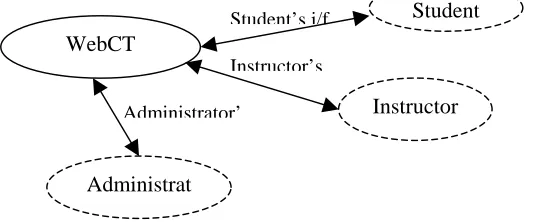
The basic setup for the e-education in IIT Kanpur needed the creation of facilities, which can be used by student with ordinary x-terminals over Unix/ Linux or Windows machines. Since web browsers can be assumed omnipresent, the system should be such that at student-end web browser should suffice. The basic system schematic is shown in Dashed ellipse implies only browser requirement
Administrator’
Instructor’s Student’s i/f
WebCT
Student
Administrat
Instructor
3
4
In order to implement such a system in IIT Kanpur, we decided to go for open source platform due to obvious flexibility provided with open source nature of system. We had the capability to tweak with the open source platform available and hence surveyed to pick up one. We chose Manhattan (1), but it showed performance problem as the cgi scripts were loaded each time a request used to come to server. As the cgi scripts were written in C, it has portability problems. Consequently, we decided to work for our own platform.
In order to build a reliable and effective system, we decided to make it open source freeware. The project was codenamed Brihaspati (2). We kept on releasing the code as it was being developed. We also used the latest build in IIT Kanpur, to get the initial feel of whatever we were developing. Now, there are many institute and organization that have adopted it. Consequently, the platform got tested while we were developing. Important feedback kept us focused on important things during development and we save lot of our time, which might have got wasted on features, which are not much used. We also got many student projects done for implementation of many features in it. Trained manpower was a useful byproduct of this effort.
2.1 Brihaspati
In the most basic system, Brihaspati (2) is used. Brihaspati allows the creation of separate web space for each of the courses. For each course, there are two types of users, a) Instructor, and c) students. Instructor is given permission to maintain student database and make changes to it. Both the types of users need to use only web browser with javascript and java support. In this mechanism, instructor creates the course notes in MS-word, Powerpoint, LATEX, html, pdf, ps or any other electronic format. All the materials are uploaded to the course area by the instructor.
5
machines. The students are provided appropriate access permissions in various course areas. In order to interact with classmates and instructor individually or in groups, email and newsgroup facilities provided in communication tools can be used. For real time interaction, chatting tool and whiteboard derived from Babylon (3) is also integrated. These can be used to hold live discussions. This will be very useful when components of the class i.e., instructor and students are scattered in space.
In essence, this basic system provides online mode of learning material delivery and can be used in addition to conventional classroom structure. Limited online interaction is possible via chat and whiteboard.
2.2 Brihaspati-2
Existing version of Brihaspati is in use in IIT Kanpur for last three years. We have seen continuous growth of users. The faculty and students have provided valuable feedback which consisted of new feature requests, problems, and bugs. As a result of this feedback, we had come up with many innovative solutions. After this experience, we started working on second version called Brihapati-2. Here content author and course instructor are conceptually separate. They were earlier treated as single entity. This allows the use of same material in different course, making the sharing of same material possible across many courses.
As a result, the concept of content repository is implemented. The authors put up their contents in this and sets permission for various users. The instructors can publish this content in their courses depending on the permission set for them.
Next logical step is to build the SCORM content packager and SCORM runtime engine to play such content. For better interaction between students, a collaborative authoring system has also been provided as Wiki tailored for Brihaspati.
6
faced the lake of content. We are currently building a feature of remote course based on caching mechanism suited for disconnected operations. An organization ‘A’ can get in agreement with organization ‘B’ and both of them can configure the remote course mechanism for a certain course. The server at ‘A’ can periodically synchronize the content from server at ‘B’. The connection between them is desirable but not mandatory all the time. Whenever the connection is possible, the server synchronizes the content.
2.3 Online lecture delivery
Along with the web based e-learning platform, there is requirement for software system, which can be used to conduct live classroom over communication network. As any such information system will use transportation of multiple information types in digital format over Internet. Due to scalability and efficiency requirements, the system should use the multicast support of the network.
We have been working on such a software system codenamed Brihaspati sync. It is synchronous component, which can be used along with Brihaspati-2. Both web-based and synchronous tool uses same database at the backend.
3. What’s more?
All the three open source builds are made available at sourceforge.net (2). It has been realized that simply distributing the code is not enough. Support in form of code maintenance, customization, and training is required for effective use by most of the institutions. For this purpose, we are trying to setup a commercial support system.
7
Another vision is to make the Brihaspati into an intelligent tutoring system, which can decide the learning path for each individual student based on testing and evaluation feedback. This will also need to content authoring system in which this metadata about multiple learning paths can also be added to the content.
4. Acknowledgement
This paper is result of the work done by many people involved in the project. I would like to acknowledge them for their contributions. I would also like to thank Indian Institute of Technology, Kanpur and Ministry of Information Technology, Govt. of India for funding this activity.
5. Reference
1. Manhattan. http://manhattan.sourceforge.net