DESlDOC Bulletin of lnformatim7echnology, Vol. 20, No. 5, September 2000, pp. 3-20 @ 2000, DESEDOC
Mass Storage Technologies for
Libraries & information Centres
A Lakshmana Moorthy &
CR
KarisiddappaAbstract
To overcome growing requirements for additional space and for archival storage of less used, old and important documents, libraries have been using compact or dormitory storage and microfilming techniques. Of late, information technologies have come to their rescue. Many technologies-magnetic as well as optical have been tried for the past many years for mass storage of information. While magnetic drum and tape are,heading towards obsolescence, optical' technologies with their enormous storage capacities are trying to fill the gap.
This paper overviews the various 'technologies available for mass storage in the library environment. The paper covers the magnetic storage devices including magnetic tape, magnetic disc, cartridge tape and digital audio tape. The optical disc storage technologies including read-only, write once read many and erasablelre- writeable media have been described. The role of optical discs in making electronic publishing a popular technology has also been described. Future trends in the mass storage technologies like volume holographic technology, electronic trap and proximal probe technologies, and fluorescent multi-layered technology which are under various stages of development have also been briefly discussed. Applications of these technologies in library and information centres. have been listed.
1.
INTRODUCTION
Archival storage has been a major problem for libraries and librarians. As the stock of a library grows year by year, several problems arise. Major problems associated with conventional print media include the need for a large shelf space, longer retrieval times, expensive maintenance, durability, and wear and tear. These problems made some of the libraries, especially those situated in large cities where addition of extra space is difficult and large libraries with huge collections to resort to either weeding out at regular intervals documents which are not active or create dormitory collection to store unused and less used documents. These factors coupled .with the everchanging technological advances in the electronics and computer technology paved the way for the development of mass storage
systems, Advances in these fields have resulted in the optical data storage devices, which have a long archival life, high resolution, and simplicity in handling, and above all, enormous storage capacity. In, an ever-growing library environment, mass storage is necessary to meet the following needs C1):
(a) Providing large-volume digital storage for archival management;
(b)
Providing users with immediate access to the rap'idly growing volume of data and information that is .stored in digital information systems and is likely to be distributed on optical media in the future; (c) Providing users with access to multimediainformation quickly and interactively through the integration of technologies; and
(d) Transferring large volumes of data and/or files from one system to another.
In addition, mass storage media are needed for the distribution of bibliographic databases of library holdings to customers and member libraries in a wide area network environment.
A number of mass storage media are available in the market for a long time. Libraries have been using microfilm, microfiche and ultra-fiche which help store large volumes of data in a comparatively lesser space than the print media. In recent times, computer-based mass storage technologies have been developed to address information storage and retrieval problems faced by libraries and librarians. Broadly, computer storage technologies can be grouped into magnetic and non-magnetic (optical) technologies. This paper overviews briefly the various magnetic and optical storage media having applications in the library environment.
2.
MAGNETIC STORAGE
TECHNOLOGY
The magnetic storage devices came into the scene simultaneously with the arrival of microcomputers during the early 1980s. These include the primary storage hard discs/drives and the secondary (or auxiliary, removable) floppy discs. Their capacities have changed with the advances in technology. There are a variety of magnetic storage media available for the users to choose. These include: magnetic drum, magnetic and cartridge tapes (both analogues), digital audio tapes (DATs), floppy discs, magnetosptical discs and removable hard discs. Whereas the 17 GB hard disc drives are common with the latest computers, the 5.25-inch (1.2 MB) and 3.5-inch (1.44 MB) floppy discs became standard drives with personal computers (PCs). Although the 5.25-inch discs are disappearing slowly, the 3.5-inch version is here to stay for some more time as the LS120 discs and Imation's Super Disc (both of 120 MB capacity) are of the same size and are compatible with these drives.
The oldest primary storage medium in use is magnetic drum. It facilitates direct random access of data. Introduced around 1947-48, these have been in use since 1950s. However,
4
presently their use is rather very limited. These are typically 8 to 20 inch in diameter, 2 to 4 feet in length and revolve at 1,500 to 4,000 revolutions per minute (rpm). They allow densities of 4,000 bpi and high access rates up to 3 million characters per second. Although they hold condderably less volume of data compared to magnetic tapes, they allow random access with typical access times of
5-1 0 ms.
In the beginning, when the IBM invented the disc drive in 1956, ferrite heads (U-shaped magnets) were used for reading and writing data. During 1970s, the storage capacity of 200 megabits per square inch (Mbpsi) was thought to be the ultimate capacity of magnetic storage media. In due course of time, the ferrite heads gave way to thin-film inductive heads, which in turn gave way to magneto-resistive (MR) heads in 1989, and to the giant MR heads in 1997. By 1989, the new MR technology made it possible to achieve 1 billion bpsi (i.e., 1 Gbpsi) storage capacity. This was followed by 5 Gbpsi by 1996, and 11.6 Gbpsi by December 1997, an incredible storage capacity equivalent to 725,000 double-spaced pages of text, which would stack up higher than 18-storey building (2). For the past few years, the number of bits per unit disc surface area in disc drives has been increasing at a rate of 60 per cent a year. The super magnetic limit at a density between 20 and 40 Gbpsi is being attempted. Currently efforts are on for the development of a combined optical and magnetic technique. The IBM along with 10 other companies has been making efforts to reach 100 Gbpsi storage capacity using traditional magnetic storage technologies.
2.1
Magnetic Disc
disc drives in 1980; it reached 2.5 GB in 1996. Since 1950s, the average capacity of a new computer's memory has grown 30 per cent mainly to facilitate storing more data. Since 1991, the capacity of the magnetic hard disc drives in the best of the PCs has accelerated to 60 per cent (3); it has moved from a few MB to a few GB. Hard disc devices have faster access time (1 0-80 ms) and can hold several gigabytes of data.
There are many magnetic disc storage devices. IBM developed the conventional floppy discs (or diskettes) in 1965 for iinternal use. These became the popular random access secondary memory for microcomputers and are available in 3.5; 5.25- and 8-inch sizes in single, double and high densities. These are inexpensive and each disc can hold more than a million characters recording at 3,200 bits per inch (bpi). The 5.25-inch floppy disc was introduced in 1976. Its cousin, the 3.5-inch floppy drive was introduced by Sony in 1984. These facilitate a data transfer rate of 1.25 to 8 Megabits per second (Mbps) depending on disc rotation speed and an access time of less than 20 ms. The floppy disc became an integral part of the computers right from its introduction. These became undisputed standards for removable storage and found wide acceptance due to their inexpensive price tag and cheaper transportability for sending textual data, articles, books, reports, etc. to distant locations; they still remain unchanged. The Perfect PC of IBM, launched in 1981 had a single-sided 160 KB, 5.25-inch floppy disc drive. The 400-KB 3.5-inch discs with their higher capacity and hard outer jacket came to be preferred over the bigger floppy discs. Although 3.5-inch drives of 20 MB capacity and the LS-120 drives with 120 MB capacity were introduced, these are expensive and have not found wide acceptance.
2.2
Magnetic Tape
Magnetic tape is a sequential access storage medium. It is the slowest mass storage technology currently in use and i s one of the cheapest storage media. The low cost per bit of stored data and large capacity makes it a popular archival medium. The recording medium is a thin polyester tape between
DESIDOC Bulletrn of Inf Technol, 2000,20(5)
0.38 and 2.54 cm wide, about 0.25 mm thick and coated with magnetic particles. The 0.5-inch, 2,400-feet (730 m) tape has been the industry standard since it was first introduced commercially in 1953. The 9-track magnetic tape at 6,250 bpi has a capacity to hold one billion bits of data depending upon block and record sizes. It records data at 9 bits per frame, although1 8-track (1 8 bits per frame) high density cartridge tapes fully enclosed in 5 ~ 4 x 1 -inch cartridge boxes are also available.
Steps are afoot to make, in the next few years, the magnetic tape more like random access medium and compatible to magnetic discs. Tape-It of PGSoft company and Direct Tape Access (DTA) of Seagate company are two such efforts in this direction. The DTA, a software utility, provides quicker access to tape-based files. It relieves the user from using dedicated backup software for storing and retrieving files and is also available on Windows platform (4). The data stored on a tape is either longitudinal (fixed-head technology) or helical (rotary-head technology); the latter allows higher density of data storage. By using data compression techniques, the storage capacity of a tape can be improved. The storage densities range from as low as 800 to 6,250 bpi, although 38,000 bpi is also possible with some newer tapes (5).
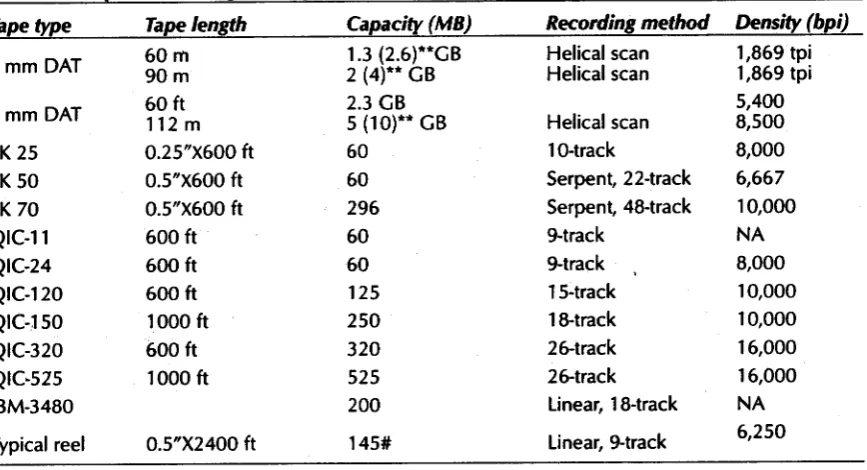
Magnetic tapes and cartridges are used to store very large amounts of data that will not be used frequently. In a library environment, magnetic tapes can be used to take backup of files/databases, online public access catalogue, in-house developed software, backup of archival files like circulation and acquisition data. These may also be used for exchange of large databases between liharies. A comparison of parameters of different magnetic tapes is provided in Table 1.
2.3
Cartridge Tape
Table 1: Comparison of magnetic tapes
Tape O'Pe Tape length
60 m 1.3 (2.6)**GB Helical scan 1,869 tpi
4 mm OAT
9 0 m 2 (4)** GB Helical scan 1,869 tpi
8 mm DAT 60 ft
112 m Helical scan
1 0-track
Serpent, 22-track Serpent, 48-track 9-track
9-track , 1 Etrack 18-track 26-track 26-track Linear, 18-track
Typical reel 0.5"X2400 ft 145# Linear, 9-track 6,250 -
-*: Data from sunsite.informatik.rwth-aachen.de/fortran/ch5-7.html& www.cit.ac.nz/smac/hfl00/hfl00m5a.html
**: with compressed software;QlC: quarter inch cartridge tape; #: group coded recording
data. O f late, 4-mm and 8-mm video tapes are also being used. These are lowcost and have longer access time than the floppy discs. A typical tape cassette can hold u p to 50 M B of data with a density range of 6,400-10,000 bpi. In contrast, a mainframe cartridge can store at 38,000 bpi and a 550-feet tape cartridge can hold one GB data, the same amount as the 2400-feet, 0.5-inch tape (6). Cartridges (of the same size) with shorter length hold less data; but they are more reliable because the influence of one tape winding on other windings is less due to larger separation of the magnetic coating.
A standard IBM 3480 magnetic tape cartridge (5X4X1-inch) can hold 10 GB data. The Zip cartridge tape drives of lomega company offered 100 M B each when they were introduced in 1995. lomega had a base of over 20 million Zip drives and 100 million discs, when in 1999 it introduced the Zip 250 M B cartridge discs.
drive, introduced in 1999, offers 30 GB for cartridge.
A 50 GB version has also been designed for computer servers. These cartridges, due to their inherent slow access time, are not ideal for digital audio or video users. But they can facilitate full backup of the largest of the present day's hard disc drives (7).
2.4
Digital Audio Tape
It is the most common device used for archival storage and retrieval of large volumes of data. Digital recording on magnetic tape was developed for use in sound recordings in the 1970s and for the consumer market by the late 1980s. Digital recorders convert audio signals into digital data on a magnetic tape by means of a microprocessor (an analogue-todigital converter) and reconvert the data back into analogue audio signals (by means. of a digital-to-analogue converter) for playback with the amplifier of a conventional stereo sound The Jazz drives of lomega offered initially
1 GB storage; they are now available with 2 GB In digital recording, sound waves are cartridges, which can store up to 4 GB using sampled several thousand times per second and compression software. The OnStream cartridge transformed into a series of pulses that
correspond to patterns of binary numbers that are recorded on tape (or optical disc). Digital recordings provide higher-fidelity sound reproduction-greater dynamic range and frequency response and less distortion-than conventional analogue methods.
The only successful form of DAT recorder commercially available at present is effectively a miniature version of a video recorder, with special metal particlecoated tape, 4 mm wide, and can be carried in a very small cassette. Data is recorded using a helical scan diagonally across the tape's surface. Each cartridge can hold several GB of data that can be accessed quickly.
Although intended for ordinary domestic use, the system has not been successful with the general public, but it is now widely used for professional purposes, including sound recording for motion pictures. DAT machines have also been adapted for the recording of digital computer data, and to record sound, which would not be picked up using other means (8).
3.
OPTICAL DISC STORAGE
TECHNOLOGY
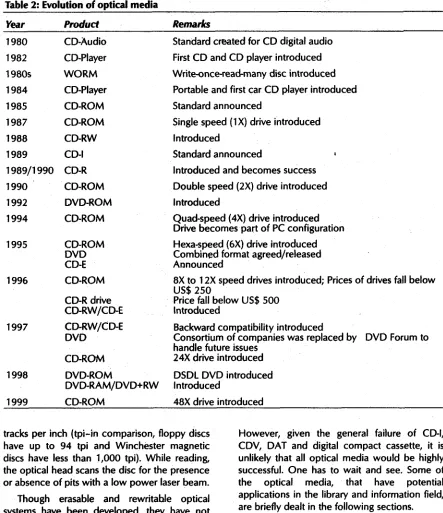
With the technological developments in computers and opto-electronics, optical storage media have become popular. Although a variety of technologies like magnetic tapes, cartridge tapes, digital audio tapes, floppy discs, removable hard discs, magneto-optical and optical discs are available for use, users generally prefer optical media due to their obvious advantages like accessing time, versatility, multimedia capabilities, compactness, transportability, etc. The major features of optical mass storage media include: high optical as well as mechanical stability, high optical resolution, easy handling, low recording energy with high recording sensitivity, rewrite and/or duplicate, and short recording time. Other features include relative low cost, ease of handling, compact size, and high portability. Table 2 shows the chronology of developments in the optical disc technology.
Compact Disc-Read Only Memory (CD-ROM) appeared in market in 1985. Many types of optical media, which flooded the market in the past few years, met with variable degrees of success. However, the success of CD-ROM was phenomenal. Till recently CD-ROM was synonymous with optical media and electronic publishing. A wide range of optical devices/ technologies are available to suit every need of the user. Broadly, the media can be grouped into three categories, viz., read-only, write once-read many (WORM), and erasable/ rewritable. y o s t of these are being used in libraries, publishing, multimedia products, and software/database distribution.
Read-only media includes analogue and digital video discs, CD-audio, CD-ROM, hybrid discs, LV-ROM, CD-Interactive (CDI), CD-Interactive Video (CD-IV), CD-Video (CD-V), Digital Video Interactive (CVI), Digital Video/Versatile Disc (DVD), Photo-CD, Data and Optical ROM (DROM and OROM), optical card, optical film and optical tape; the WORM media include write once-read many discs, CDRecordable (CD-R), CD-PROM, recordable videodiscs, digital optical discs (with diametres of 5.25, 8, 12 and 14 inches), optical card, and optical paper; and the erasable/rewritable media include Erasable Programmable Memory (EPROM) discs, CD-Erasable (CD-El also known as CD-Rewritable, CD-RW) discs, phase change and magneto-optic devices (1,9). Most of these have a typical 650 MB storage capacity although a few (for example, erasable discs and DVD) have capacities up to and above 2 GB, with an exception of optical card, the storage capacity of which is 2 MB upwards.
Optical discs are nonmagnetic, removable devices. The various optical recording techniques include pit forming (ablative), alloy mode, bubble forming, dye polymer, magneto-optical and phase change. However, the pit forming technique is widely employed. In this process, a laser beam is focussed on the recording layer, which creates enough heat to melt a spot (pit), where the data is recorded. The pits thus created are in the range of 0.6 to 1 .I micron wide and 0.1 2 micron d e e ~ . The The Compact Disc (CD) technology is spiral tracks created are 1.6 microns apart (from around for about 18 Years. The first CD (audio) each other) corresponding to about 16,000 was released in the market in 1982. The
Table 2: Evolution of optical media
Year Product Remarks
1980 CD-Audio Standard created for CD digital audio
1982 CD-Player First CD and CD player introduced
1980s WORM Write-once-read-many disc introduced
1 984 CD-Player Portable and first car CD player introduced
1985 CD-ROM Standard announced
1987 CD-ROM Single speed (1 X) drive introduced
1988 CD-RW Introduced
1989 CD-I Standard announced I
1989/1990 CD-R Introduced and becomes success
1990 CD-ROM Double speed (2X) drive introduced
1992 DVD-ROM Introduced
1994 CD-ROM Quad-speed (4X) drive introduced
Drive becomes part of PC configuration
1995 CD-ROM Hexa-speed (6X) drive introduced
DVD Combined format agreedlreleased
CD-E Announced
1996 CD-ROM 8X to 12X speed drives introduced; Prices of drives fall below US$250
CD-R drive Price fall below US$ 500
CD-RWICD-E Introduced
1997 CD-RW/CPE Backward compatibility introduced
DVD Consortium of companies was replaced by DVD Forum to
handle future issues
CD-ROM 24X drive introduced
1998 DVD-ROM DSDL DVD introduced
DVD-RAM/DVD+RW lntroduced
1999 CD-ROM 48X drive introduced
tracks per inch (tpi-in comparison, floppy discs have up to 94 tpi and Winchester magnetic discs have less than 1,000 tpi). While reading, the optical head scans the disc for the presence or absence of pits with a low power laser beam.
Though erasable and rewritahle optical systems have been developed, they have not become affordable to common user and so are slow in making their entry in the market place. Most of the existing optical discs are read-only or recordable type. Once information is recorded in these discs, it is permanent. This disadvantage has becodme advantageous in cases such as distribution of software, document storage and retrieval, and consumer
However, given the general failure of CD-I, CDV, DAT and digital compact cassette, it is unlikely that all optical media would be highly successful. One has to wait and see. Some of the optical media, that have potential applications in the library and information field, are briefly dealt in the following sections.
3.1
Read-Only Optical Media
3.1.1Videodisc
Videodiscs are read-only media used for distribution and display of analogue video information. Videodiscs allow random access, and are aimed at domestic market. However, as they do not allow recording, they have not yet -. applications like games and entertainment.
become as poplar as Video Cassette Recorders (VCRs) which the videodisc players were expected to replace. The most commonly used videodisc system is known as a laser disc system.
Videodiscs are available in two sizes, in 8- and l2-inch diametre, the latter being more common. Information is recorded in microscopic pits and a l2inch disc contains about 14 billion pits in about 54,000 spiral tracks on each side of the disc. In the constant linear velocity (CLV) recording, the drive speed ranges from 600 to 1,800 rpm with the innermost track hdding one frame and outer most track three frames. In the Constant Angular Velocity (CAV) recording, each track holds only one frame and the drive speed is constant at 1,800 rpm. The CAV discs allow random access, freeze frame, step frame, and multi-speed play back. Audio information can also be recorded along with video (mostly motion pictures). As the main objective is to provide maximum play back time, the CLV mode recording is used, and a 12-inch disc can hold 60 minutes video on each side. The CAV discs are used in interactive environments such as training and education, and how-to-do type applications (9,lO). Efforts have been made in examining the use of interactive videodiscs as publishing medium. These link a videodisc player with a microcomputer and allow the interfacing of computer graphics with text and moving pictures. The potential of such a technology in the educational field is immense.
Other major types of videodiscs include the Video High Density- (VHD), Capacitance Electronic Disc (CED), Optical Memory Disc Recorder (OMDR) and Direct-Read-After-Write (DRAW). Each of these differs from the standard videodisc in some way. DRAW discs are compatible with the laser disc and are made by recording directly on a specially prepared disc.
3.1.2
Compact Disc-Read Only Memory
In recent times, CD-ROM drives have become a part of the standard configuration of a PC, be it for corporate, academic, R&D or home usage. It has become a de facto drive along with the 3.5-inch floppy disc drive. The growth of multimedia tides, names,
entertainment and cheap availability of videodiscs, and the latest trend in software distribution through CDs made CD-ROM discs and drives more popular. Also, there is a gradual increase in the digital information component in R&D, corporate and academic libraries, which are moving towards handling digital information slowly, New libraries are also joining the stream by slowly introducing CD-ROM databases. It is the first practical technology for mass distribution, which is suited to the developing countries where the communication infrastructure is rather poor. All these factors are making CD-ROM more and more popular for the office as well as home usage.
The CD-ROM, a 12cm and 1.2-mm thick disc can hold approximately 650-680 million characters (650680 MB) equal to about 2,70,000 pages of (A4) plain text or about 60,000 suitably compressed images. The advantages of CD-ROM are its huge storage capacity, durability, transportability, light weight, easy and faster (-200 ms) access to and noncorruptibility of stored information, immunity to magnetic fields and amenability for parallel searching by multiple users in a Local Area Network (LAN) or Wide Area Network (WAN) environment. CDROM, the 'digital' papyrus, has become synonymous with electronic publishing. Due to these qualities, the publishers of scholarly periodicals, reference books (including encyclopedias, dictionaries, handbooks, catalogues, etc.), multimedia products, and bibliographic databases have increasingly used it. Almost all software released in the market is now distributed on CD-ROM.
The popular applications and pknetration of CD-ROM in the market can be observed from the number of CD-ROM discs, drives and products sold during the last few years. About 1.1 million CDROM discs were pressed in January 1992 which by December 1992 rose four-fold to 4.4 million. The number of CD-ROMs sold during the last quarter of 1993 was more than the total number sold during the previous three quarters of the year.
The installed base of CD-ROM drives was 2.3 million in 1990 (1 1) which in 1995 rose to
37 million and was expected to reach 100 million drives by 1998 (1 2). Due to the use of multimedia products, this is increasing further. A majority of PCs sold are bundled with CD-ROM drives. A 63 per cent growth of CD-ROM titles was achieved during 1992 and 1993, and it was expected to grow more than 300 per cent during 1993 and 1995. According to the 1 995 edition of the CD-ROM Directory of TFPL, there were about 9,500 titles in market in the autumn of 1994 (this includes published titles only and does not include out of print discs and in-house published titles), which represents 50 per cent growth over the titles available in the previous year (avtumn of 1993).
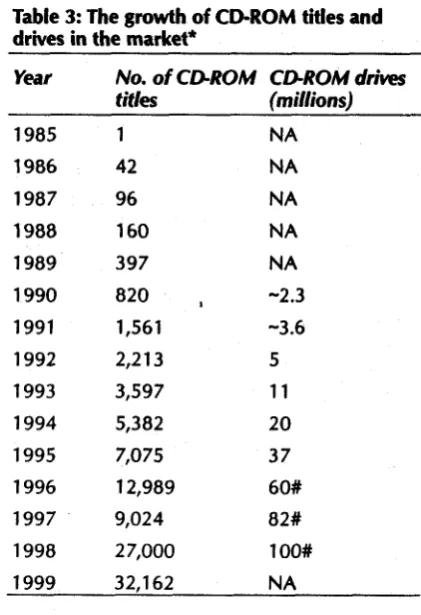
In general, full text databases (titles) account for 40 per cent sources followed by bibliographic (25 per cent) and reference works (1 6 per cent) respectively (1 3, pp. 118-1 24). Table 3 shows the growth of CD-ROM drives and titles during 1985-1999. The New Media Directory of the Waterlow New Media Information lists 3,269 publishers (out of a total of 3,642) who are involved in e-publishing using CD-ROM format, and 32,162 titles including DVD-ROMs and DVD-Videos. Language-wise, English accounts for little over 77 per cent (24,850 titles) followed by German (- 10 per cent, 5,519 titles) and French (- 9 per cent, 2,789 titles). Of these, 36 per cent account for prices ranging between US$ 1-50 (14, p. 294, 296).
The speed of CD-ROM drives has changed a lot from the time they were introduced in the late1980s. The single speed (1X) drive (at a transfer rate of 150 kbps) of 1987 has been replaced by the double-speed (2X) drives in the early 1990s which in turn gave way to 4X drives in 1 994, 6X drives in 1995, and 8X, 1 OX and 12X drives in 1996 which were replaced by 24X drives (a transfer rate of 3.6) in 1997. Now CD drives up to 48X speeds are available in the market. This speed is progressing further.
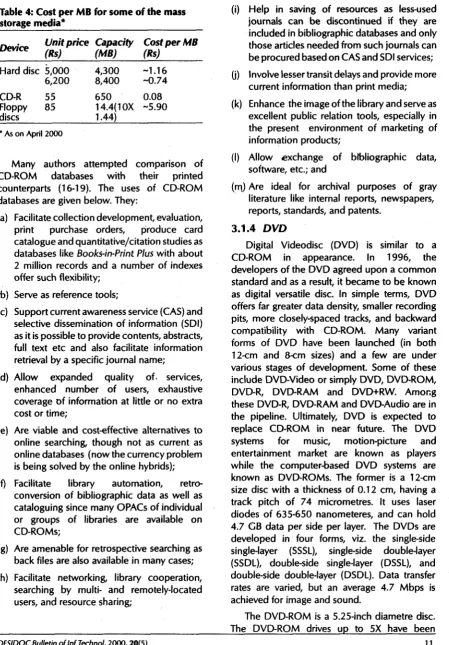
The prices of CD-ROM discs and drives are also falling steeply making it within the reach for many home users. Table 4 shows the cost per MB storage of three media. The high cost of hard disc off-sets its highest retrieval speed.
Table 3: The growth of CD-ROM titles and drives in the market*
Year No. of CDROM CD-ROM drives titles (millions)
1985 1 NA
1986 42 NA
1987 96 NA
1988 1 60 NA
* Note : Adapted from Herther (12), Purcell ( I 1) and de Stricker (1 5); NA : not available, # : estimated. The number of CD-ROM titles (quoted here from de Stricker ( 1 5) may vary depending upon the directory the author is quoting The authors came across three difterent directories quoted by authors of papers and all the figures with respect to the CD-ROM titles are different. It has been observed that the figures are higher in the CDROM Directory published by TFPL, UK. This may be due to the scope, coverage and
perception of the publisher as to what is to be included in the directory.
3.1.3 Library Applications of
CD-ROM
The contents of CD-ROM products generally include abstracts, databases, full-length articles, images, audio and software. CD-ROM databases are cost-effective. CD-ROMs have many library-specific applications. CD-ROM offers a number of advantages as well as avenues for applications and not surprisingly, libraries are major customers of CD-ROM products.
Table 4: Cost per MB for some of the mass storage media*
Device Unit price Capacity Cost per MB
(Rs) (MB) (Rs)
Hard disc 5,000 4,300 -1.1 6 6,200 8,400 -0.74
CDR 5 5 650 0.08
Floppy 85 14.4(1 OX -5.90
discs 1.44)
As on April 2000
Many authors attempted comparison of CD-ROM databases with their printed counterparts (16-19). The uses of CD-ROM databases are given below. They:
(a) Facilitate collection development, evaluation, print purchase orders, produce card catalogue and quantitativelcitation studies as databases like Books-imprint Plus with about 2 million records and a number of indexes offer such flexibility;
(b)
Serve as reference tools;(c) Support current awareness service (CAS) and selective dissemination of information (SDI) as it is possible to provide contents, abstracts, full text etc and also facilitate information retrieval by a specific journal name;
(d) Allow expanded quality of. services, enhanced number of users, exhaustive coverage of information at little or no extra cost or time;
(e) Are viable and cost-effective alternatives to online searching, though not as current as online databases (now the currency problem is being solved by the online hybrids); (f) Facilitate library automation, retro-
conversion of bibliographic data as well as cataloguing since many OPACs of individual or groups of libraries are available on CD-ROMs;
(g) Are amenable for retrospective searching as back files are also available in many cases; (h) Facilitate networking, library cooperation,
searching by multi- and remotely-located users, and resource sharing;
DESIDOC Bulletin of Inf Technol, 2000,20(5)
(i) Help in saving of resources as less-used journals can be discontinued if they are included in bibliographic databases and only those articles needed from such journals can be procured based on CAS and SDI services; (j) Involve lesser transit delays and provide more
current information than print media; (k) Enhance the image of the library and serve as
excellent public relation tools, especially in the present environment of marketing of information products;
(I) Allow exchange of bibliographic data, software, etc.; and
(m) Are ideal for archival purposes of gray literature like internal reports, newspapers, reports, standards, and patents.
3.1.4 DVD
Digital Videodisc (DVD) is similar to a CD-ROM in appearance. In 1996, the developers of the DVD agreed upon a common standard and as a result, it became to be known as digital versatile disc. In simple terms, DVD offers far greater data density, smaller recording pits, more closely-spaced tracks, and backward compatibility with CD-ROM. Many variant forms of DVD have been launched (in both 12-cm and 8 c m sizes) and a few are under various stages of development. Some of these include DVD-Video or simply DVD, DVD-ROM, DVD-R, DVD-RAM and DVD+RW. A m o ~ g these DVD-R, DVD-RAM and DVD-Audio are in the pipeline. Ultimately, DVD is expected to replace CD-ROM in near future. The DVD systems for music, motion-picture and entertainment market are known as players while the computer-based DVD systems are known as DVD-ROMs. The former is a 12cm size disc with a thickness of 0.12 cm, having a track pitch of 74 micrometres. It uses laser diodes of 635-650 nanometeres, and can hold 4.7 GB data per side per layer. The DVDs are developed in four forms, viz. the single-side single-layer (SSSL), single-side double-layer (SSDL), double-side single-layer (DSSL), and double-side double-layer (DSDL). Data transfer rates are varied, but an average 4.7 Mbps is achieved for image and sound.
tested and higher speeds are expected. Unlike CD-ROM drives where each X represents a data transfer of 150 kbps, in DVD drives it equals 1350 kbps, i.e., 9 times that of the CD-ROM data transfer speed. The use and popularity of DVD-ROM is steadily growing. It is estimated the demand for it in the market is expected to grow steeply in the coming years (20, 21). According to a forecast in the PC Magazine, by the year 2000, the sale of DVD-ROM drives should surpass the sales of CD-ROM drives (22). It was reported that twenty per cent of desktop computers received by PC World each month for review are fitted with DVD-ROM drives. It is also possible to upgrade CD-ROM drives to DVDROM drives (23). The CD-ROM drives may become 'obsolete' but not the CD-ROMs as the DVDROM drives have backward read compatibility with CD-ROMs, and forward compatibility with future read/write and write-once discs. Thus one can play a CD-ROM on a DVD drive, but DVD discs cannot be played on CDROM drives. Also, DVD-Video cannot be able to play a DVD-ROM. Some of the features of DVD have been compared with that of CD-ROM in Table 5.
The first generation, SSSL DVD with its 4.7 GB capacity can accommodate the entire Encyclopedia Britannica in 15 languages with index to every word. The DSDL DVD holds 17 GB of information (25 times the storage capacity of a CDROM), equivalent to 8 hours full-motion video including sound and additional data tracks. The use of DVD-R discs at present are restricted to data archiving,
Table 5: Comparison of features of CD-ROM *
and DVD
Feature CD-ROM DVD
Diametre 12 cm 12 cm
Thickness 1.2 mm (2x0.6 mm) 1.2 mm
Laser Wavelength 780 mm 635 nm Track Pitch 1.6 microns 0.74 microns
Track Length 5.4 km 12 km
Data Layers One One or two
Data Sides One One or two
DataTransfer Rate NA 1 3 50 kbps
distribution and DVD content development. This is mainly because of prohibitive costs of DVD-R recorders. The application of DVD-RAM and DVD+RW include data archiving, software development, video and audio editing, and recording one's own optical discs (24).
Although CD-ROM publishing is still going strong, many publishers are looking towards DVD as the new medium for e-publishing. Multimedia publications like encyclopedias need more than one CD; this necessitates user to swap CDs while accessing information. This problem is solved by using DVD. The market is encashing this advantage as revealed by the growth in the number of companies involved in DVD publishing. The DVD Directory of the Waterlow New Media Information covered more than 1220 companies active in DVD publishing in May 1999, a growth of 20 percent from the previous year (14). The multimedia industry i s already exploiting the technokgy.
Many reference sources have been made available on DVD. MEDLlNE Advanced, bibliographic database of hlternational biomedical literature containing ober 8 million citations and abstracts of a r t i c k from 3,700 journals published from 70 comries has been brought out by Silver Platter; The December 1997 issue of E-Media Prof&sional listed 400 DVD titles (1 5). These hclude Multimedia Encyclopedia of Graphic Zone/Grolier, Animal Planet of Discovery Channel, Vanishing Wonders of
the
Sea of kmeria, Encyclopedia of Electronica of Xiphias, etc. The 1999 edition of the Directory incluckd 2318 DVD-Videos and 11 8 DVD-ROM titles. Film studios are releasing moreDVb
Videos year after year, leading to the rapid growth of the DVD industry; they accounted for 20 per cent growth in 1999. The Directory 7999 lists 99 companies involved in DVD-ROM publishing and 77 companies who brinz out OVD-Videos (1 4).Recently some DVD multimedia
encyclopedias such as Microsoft Encarta Rekrence Suite (containing Encarta 99, Encarta Virtual Globe 99, and Microsoft Bookshelf 99x), Webster's International DVD Encyclopedia, Encyclopedia Electronica, Funk & Wagnall's Multimedia Encyclopedia, Britw131:a DVD 99 and Crolier Multimedia Encyclopedia have been
published. All the volumes of 109 years of the National Geographic Magazine has been accommodated on just 4 DVDs.
Some of the benefits of DVD are:
(a) Its use as a single interchange standard to provide unification for computer, consumer electronics and entertainment industry;
(b) Its backward read compatibility with existing CDs, and future compatibility with readlwrite and WORM discs;
(c) Its utility as a single file system for all disc types;
(d) Its low cost;
(e) It does not need for mandatory containers for playing discs;
(f) Its reliability in data storage and retrieval including error correction capability for ROMs and rewritable discs;
(g) Its high online capacity of 8.5 GB on a single side (or 17 GB on both sides);
(h) Its high performance for sequential and non-sequential data (20).
If the rapid developments in the field are any indication, we can expect notebook PCs with built-in DVDROM drives (with backward compatibility to use CD-ROMs) in the near future.
3.1.5 Optical Tape
In general, tapes are characterised by high volumetric density. A tape uses its surface area more effectively than a disc. While 80 per cent of a 0.5-inch tape is available for recording, only 50 per cent of a 5.25-inch disc is available for data recording. Further, the tape substrates are gradually going thinner, from 0.076 to 0.013 mm. By using optical recordindretrieval techniques, it is possible to achieve higher storage in tapes (than magnetic technology) just as it is achieved in the case of optical discs. And for the same areal density, optical tape has 25 times the volumetric density of CDs now and probably 75 times their density in future. Optical tapes also support high data transfer by using parallel readlwrite channels. The optical tape is expected to be a low-cost storage medium and give way to optical cartridges in
DESIDOC Bulletin of Inf Technol, 2000,20(5)
near future. The optical tape will become acceptable medium for long-term archiving, as the magnetic medium is prone to degradation by creep, track deformation and print-through, and necessitates data transfer to new magnetic tapes once in a few years. The present data transfer rates of 3 Mbps is expected to reach to about 10 Mbps by the year 2000. By reducing tape thickness to 0.025 mm and using lasers of 415 nm wavelength one would be able to record 200 GB data on optical tapes in the near future (25).
4
3.2
Write OnceRead Many Media
When introduced in the early 1980s, no standard format was available and WORM optical discs appeared in 5.25-, 8-, 12- and 14-inch sizes. However, in the 1990s the 5.25- and 12-inch discs and drives started stabilising. The data storage capacities depend upon the number of recording surfaces, which can vary from one to four. A 5.25inch disc can hold 400 MB to 1.2 GB whereas its 12-inch counterpqrt can hold from 2 to 6.6 GB of data. Using jukebox technology, this could be increased further for archival storage of enormous volumes of data (9,26). CD-R and DVD-R are the two important WORM technologies having potential applications in libraries.
Initially the WORM optical discs were not meant for publishing applications; rather these were introduced for use in digital audio and video market. Later, after realising their potential, these were adapted for low cost, high capacity, computer storage peripherals. In a WORM disc, data can be recorded only once, but can be retrieved any number of times. The recorded data is immune to erasure and rewriting is not possible. So, WORM discs are ideally suited for archival applications in libraries, banking and insurance sectors.
WORM) in the market in recent times, makes the medium much cheaper. While the earliest WORM discs were of 100 or 200 MB capacity, the latest ones (CD-R) can store up to 600 MB of data. Standardised in 1989, CD-R became a tremendous success with corporate and professional set-ups. It is fast catching up with CD-ROM in popular acceptance and usage. It has been estimated that there were 2 million units of CD-R hardware (as against 37 million CD-ROM drives) in 1995 which was expected to reach 27 million (against 100 million CD-ROM drives) by 1998 (1 2). If the market trend is any indication, the gap between the two w w l d be lesser than the predicted one. Just as the blank audio and video cassettes and floppy discs outsell the prerecorded ones, CD-Rs too are expected to outsell CD-ROMs in a few years.
The cheap availability of CD-R drives which were too expensive till recently, makes it easy to create a CD-ROM of one's own databases for a paltry sum. JVC's Personal RomMaker, HP Sure Store CD-Writer 4020i, Olympus Deltis CD-R2/ISA, Optima Discovery 650 CD-R, Sony Spressa 920 and Philip's CDD 522 Compact Disc Recorder are a few recording devices. Each of these includes suitable software bundled with them which allows users to pre-master and master their own CD-ROMs inhouse. These are available on both PC and Mac versions.
Even mastering of CD-ROM has come of age with cheaper mastering costs under clean laboratory conditions (27,28). Appropriate software is used to record information on the CD-R as per a CD standard. A number of indigenous retrieval software are also available ranging from as less as Rs 5,000. The recorded CD-Rs can be used in the same way as the CD-ROMs.
Starting 1996, the prices of CD-R hardware as well as blank discs have been slashed. This has, no doubt, encouraged in-house production system. This is economical and versatile as producing one's own CD takes only about 45 minutes to an hour. At present 8X (i.e.,1200 kbps) speed is common. This may further improve when the recording speeds increase (supported by user-friendly CD-writer software)
and when the CD-R hardware is customized to include built-in hard drives or tape drives to make recording more convenient.
CD-R is found to be useful for in-house publishing of large data files, creating multimedia products, downloading and distribution of shareware. It is an ideal archiving medium for in-house databases, as the user can simply download the data from the computer system on to the recordable disc. CDR is also a medium for capturing, storage and retrieval of coded data, text, scanned images and even voice. However, it is not a primary publishing medium.
3.2.2
DVD-RDVD-ROM is a read-only format and does not allow the creation of back up of huge data files or distribution discs of software, etc. To fill this gap DVD-R and DVD-RAM have been introduced in the market in 1998. DVD-R discs, analogous to CD-R, allow information to be written once and read subsequently any number of times.
3.3
Erasable/Rewritable Media
The erasable optical media is regarded as the third generation optical storage device technology. There are two types of optical discs, viz., CD-Rewritable (CD-RW, also known as CD-Erasable or CD-E) and DVD-RAM/ DVD+RW, which are amenable for writing, erasing, and rewriting data any number of times.
3.3.1 CD-RW
Although introduced in 1988, CD-RW technology was made available in 1996 and met with tremendous success. CD-RW discs differ with WORM discs in that these allow erasing and rewriting over stored data. In the 5.25-inch size, they resemble magnetic discs and provide random access. However they are slower with about 650 kbps data transfer rate and access time of 70-120 ms (as against 1.25-8 Mbps and <20 ms, respectively for magnetic discs). These discs like magnetic media, are amenable to store, read, record, erase and re-record data on the same area of the disc any number of times. This property makes it a potential contender for computer
peripheral applications, where the files are regularly retrieved and re-recorded. This technology is expected to compete with magnetic disc storage as it offers higher storage capacity, lowcost drives, durability, unlimited off-line storage and automatic disc handling through jukebox. Due to falling prices, the CDRW drives have become affordable making them ideal alternative mass storage devices. This trend would continue as the multi-read specifications make. CD-RW media read-compatible with CD-R and in future with CDROM and drives. Although the market for CDROM is still growing, it is expected that, by the year 2000, the recordable and rewritable optical storage will represent up to 40 per cent of the total optical disc drive market (7). A CD- RW can hold about 2.5 GB per side, i.e., 5 GB per disc. By the year 2000, a DSDL CDRW disc may be available which can hold 10 GB of data. While CD-R discs are cheap (in India Rs 55 approx), CD-RW discs are costly (US$ 10-1 5 each). Table 6 shows the current and projected sales of CD-RW drives (29).
Table 6: Sales of CD-RW and DVD+RW drives during 1998-2002
Year
CD-RW DVD+RW
1998 4.1 0.1 12
1999 10.5 0.545*
2000** 1 7.3 1.5
2002** 22.5 7.3
' till September 1999; " estimated
3.3.2
DVD-RAM and DVDkRW
The DVDRAM disc permits an unlimited number of writings on to and reading from the disc, and is analogous to the CD-RW format. Whereas DVD-R discs can hold 3.9 GB of data, the capacity of DVDRAM holds 2.6 GB. DVD+RW, a variant of DVD-RAM, is also a read/rewrite disc with a capacity of 3 GB. The main difference between the two f6rmats is that the DVD-RAM requires a special cartridge to hold the disc since handling can spoil the sensitive surface of the disc; this cartridge is not required by DVD+RW (24). This is the result of
two different groups of developers with compositions of different companies that are behind DVD-RAM and the DVD+RW formats. In the DVDRAM, data are recorded both within the grooves and on the lands between grooves, whereas in the latter the data recording is done only inside the grooves. Also, both have different ways for recording physical address information which resulted in increased capacity of DVD+RW format (30). DVD+RW is compatible with most of the DVD players whereas the DVD-RAM is not. This is reflected in the ac~eptance and sales (Table 6) of DVD+RW (29). DVD-RAM drives can copy 3 1 5 MB of data in about 1 2 minutes. These are flexible for reading and writing DVDRAM discs (up to 5.2 GB). These drives can also read CD-ROM, CDR, CD-RW and DVD-ROM discs. However, they cannot create discs in CDROM, CD-R or CD-RW formats. Some newer (and not the older) DVD-ROM drives can read the DVD-RAMS. The DVD+RW drives are compatible with DVD-ROM, CD-ROM, CD-R, and CD-RW, but are not compatible with DVDRAM.
3.3.3
Optical Discs and Electronic
Publishing
Optical discs have become synonymous with electronic publishing (e-publishing). CD-ROMs, videodiscs and online bibliographic databases form a major part of the e-publishing field. CD-ROMs have penetrated all branches of professional and scholarly publishing. This is because of success of the CD-ROM as the optical medium of choice for the publishing industry and also due to its acceptance by major libraries around the world. Durability, capability to hold large volumes of data, and affordability are the importah factors for the success of CD-ROMs. Many publishers including McGraw-Hill, Wiley, Elsevier, North-Holland, Meckler, Grelier, Prentice-Hall, Oxford University, etc. have all ventured in this area. CDROMs are slowly inching towards replacing microform documents primarily due to their versatility, low cost and ease of use. The usability of CDROMs in a networking environment made this technology more attractive and acceptable to the library community.
Electronic publishing replaced the printed reference sources to a large extent; secondary and some tertiary periodicals followed suit. The primary journals embraced CD-ROM rather slowly. Many publishers like Elsevier, ADONIS, IEEE, Chemical Abstract Service, Cambridge Science Abstracts, SCI, BIOSIS, UMI, INSPQC, etc. are distributing primary, peer-reviewed periodicals in CD-ROM format. The full-text databases produced on CD-ROM during 1993 accounted for 47 per cent of the total CD-ROM titles. In the coming few years, all the reference, primary and secondary periodicals are expected to be brought out as dual publications (in both print and electronic forms) which later on will be brought out in electronic form only.
In recent times CD-ROM publishing systems have been on the rise. Besides creating searchable versions of databases and storing them on CD-ROM, these allow anyone to become a CD-ROM publisher/prqducer. These systems facilitate libraries and other institutions that are involved in creating databases of their holdings (and archives) to produce CD-ROM- based searchable products and to market them. The availability of recordable CD/DVD drives has facilitated in house CD publishing. However, these products do not find a place in directories as the efforts are isolated, mostly meant for internal use and are neither marketed nor publicised.
The latest development in e-publishing is the Web publishing. The World Wide Web is offering limitless opportunities for becoming one's own publisher. The Web provides seamless access to the (published) information, without any restriction. Many document publishing systems enable lnternet publishing and even support the indexing of unstructured documents while providing full text searching capabilities for users. lnternet document publishing process, features of document publishing systems including list of a few such systems and document publishirlg on the Web have been dealt in detail elsewhere (31-33). The advent of Web publishing has facilitated speedy publishing. Although initially these were distributed in ASCII text files through listservs, the Web browsers like Mosaic and Gopher or
FTP protocols later started providing access to e-journals on the Net Current technology provides hypertext links which connect references to other articles/journals and other Web files.
3.3.4
Hybrids
The choice of publication medium changes as per the situational need and depends upon various considerations including cost, availability of equipment, frequency of updation, and other factors. In situations where text, graphics and video (including animation) are part of a publication, CD-ROM emerged as the best medium for e-publishing. Networks, intranets and lnternet became the publishing media when the environment warranted continuous updation. In such an hybrid environment, CD-ROMs combined with online networks have become popular and acceptable hybrid publication media.
The CD-ROM/online hybrids allow the user searching a database or an encyclopedia on CD-ROM to get connected through lnternet to forums, e-publications, news services and chat rooms relevant to the subject. Thus, Crolier Electronic Encyclopedia includes more than 12,000 links through CompuServe (now with America Online, AOL). World Book Encyclopedia (1998) of IBM links to a site offering current news and updates to the CD.
Many major encyclopedias of 1998 offer online connections. Database vendors like Knight-Ridder On-Disc (Dialog), and LEXIS-NEXIS allow users access updated information on their files being searched; these also allow users of the respective CD-ROMs save search strategies and then log on to the online files to search and download results. A number of CD-ROM periodicals (for example, Medio Magazine) with online links have been introduced. Some have links to Internet. AOL also offers Compton's Interactive Encyclopedia, and 2Market-a hybrid CD-ROM shopping service; Time Almanac, multimedia games and buyers guides (34). The Multimedia and CD-ROM Directory of TFPL Multimedia listed 600 hybrid titles in mid-1997, an increase of 160 per cent from January 1997 (1 5). It is likely that the same trend will be observed in future
too. Also many CDROM publishers are offering their publications on Internet.
3.4
Volume Holographic Storage
Technology
-
Holographic storage technique facilitates 3-0 storage of data as against the 2-D storage achieved by magnetic or optical routes. In holographic memory, information is stored as a pattern generated by two mutually coherent beams split from the same laser source. A plane wave serves as the reference beam.-When the two beams intersect in a photosensitive material, they form an interference, or fringe pattern which is trapped by the material. At the time of retrieval, when the recorded fringe pattern is illuminated by the original reference beam, the spatially modulated pattern is produced through optical diffraction. In volume holography, by exploiting the Bragg effect, multiple interference fringe patterns are superimposed in the same volume and reconstructed without cross talk. To pack several fringe patterns into one bcation, each is recorded using a reference beam with a Bragg angle unique to the pattern. This is achieved by employing any of the three techniques in use.
In the first, a rotating mirror is employed to deflect reference beam to different angles. The second technique uses
.
a 2-0 array of surfaceemitting semiconductor lasers to generate angularly distinct beams. A third technique employs lenses to convert the spatial position of a beam source into a distinct angle. Photo-polymers and photo-refractive class of materials are used as volume holographic materials. A 30x30 mm holographic card can hold 1 GB data. Future developments in the laser array, spatial light modulator, and volume holographic paterial technologies would greatly facilitate the success of volume holographic storage as an acceptable mass storage technology (25).4.
FUTURE TRENDS
The latest trend in optical media is towards .High Density CD (HDCD), DVD, and 1 'introducing a 24 GB disc. These drives when fit into jukeboxes, for greater automated access of
DESlDOC Bulktin of Inf Technd, 2000,20(5)
data, may provide thousands of GI3 (depending
upon the number of platters in a jukebox). Hybrid jukeboxes which can accept CDs, optical discs, or digital linear tapes to provide storage capacities of the order of a few Terabytes (TB) are being developed. While CD-R brought the premastering and mastering to the desktop; efforts are underway to develop variant products of CD and DVD with enhanced or new features. The DVD family is expected to replace CD-ROM and its variants.
An erasable or rewritable medium has potential multimedia applications. The digital technology is diminishing the gap between entertainment and information, and education and recreation, With enhanced data transfer rates and a few GB online capacity, DVD is being seen as a replacement to VCR. By the turn of the century, the market for CDROM is expected to be surpassed by DVD drives which is likely to touch 80 millions (20). DVD drives include an add-in card to handle MPEG-2 (Motion Picture Expert Group-2) video and this will make it popular for home viewers in the years to come. A DVD recorder may be used to record programmes digitalfy instead of on videotapes.
However, it should be pointed out that the multiplicity of players always led to disagreement in standards resulting in customer confusion. Except for the 800 to 1,600 bpi magnetic tape, which withstood the test of time, others have been fraught with disagreement and incompatibility, amongst their developers. Optical storage, unlike the magnetic media which was regarded as long-term archival standard, is used both for online and archival applicatiops. This broad range coupled with competition for market share, resulted in a variety of form factors, speeds, media formats, capacities and the resulting disagreement on standards. Until an agreement on a common standard for the various factors is evolved, these pose problems to the end-users.
One more problem raised by the technology concerns with the shelf life. Many optical -media claim a shelf life of 100 years and more. Since no single standard is available for long-term storage, the technology obsolescence factor is
to' be taken into consideration. The rate of technological advances coupled with merges, sell outs, and closures over the last few years in these areas makes one to wonder if any of these vendors will be there to support their technology even a few decades from now. It is also difficult to expect that the current technology does not change further and will be viable for a long period of time (35).
The magnetwptic technology is expected to play a vital role in mass storage applications in the near future. Also, volume holographic storage, which is 3-D storage as against the present 2-D storage, may be a strong contender for mass storage (25). The scene may move from-MBs and GBs to TBs and PBs (Petabytes). Electronic trap technology and proximal probe techniques using atomic force microscope or scanning tunneling microscope are being pursued towards finding an ideal mass storage technology for the future. It may well be said that we do not know as yet the technology for mass storage in the year, say 201 0 (4).
4.1
FMPROM
The latest in the storage technology area is the development of the Fluorescent Multi-layered (FM) technology. It enables to store 140 GB on a single disc of regular-sized (1 2 cm) FMD-ROM (Fluorescent Multi-layering Disc-Read Only Memory). Unlike the CD-ROM technology which is based on 2-0 optical memory, the FMD technology is based on 3-0 fluorescence of chemicals in the pits and grooves. When stimulated by a laser beam, the fluorescent chemicals produce coherent and incoherent light Data is stored only in incoherent light, which allows multi-layering making the device to have multi layers of stored data that can be read simultaneously. The technology is expected to be available in about a year when FMD-ROM, a regular sized IOlayer disc of 140 GB and a 30cm 1Wayer FMD-WORM will be launched in the market (36).
5.
CONCLUSION
Libraries are the major purchasers of printed publications (book-like documents, periodicals and microforms) and are facing budgetary constraints. They are hardly able to cope up 18
with the research output in conventional me and resort to cancellation programmes suffer in the collection development front. introduction of m e d i a is straining the libra further, since these too are treated as libr materials and rarely extra budgets are provid
The irony is the ever growing e-media. products competing for a larger share of the budget for conventional media. And so the subscription to journals are declining on an average by
3-5
per cent per year which may result in, a few years from now, many ceased publications. Though there is an exponential increase in the electronic products and publications available in the market, print publications are not decreasing; the market for printed information at the end of 1997 was substantially larger than yhat it was in 1992 (37). This makes it imperative that, the print-on-paper documents will still be in the field for some more time. Electronic journals distributed online or on CD-ROM have tremendous potential as complimentaries and companions to their printed counterparts.Scholarly paper publication is doubling every few years ranging from 5 to 10 years depending upon the nature of the subject field. This amounts to about 15 to 7 per cent annual increase which is much less than the speed of microprocessors which doubles every 18 months (amounting to about 60 per cent growth per year). In recent years, magnetic storage capacities (tape) more than doubled from 5 to 11 -6 Gbpsi and is racing towards 40 Gbpsi. Digital storage of information was a problem in the past.
achieved in the years 2022 and 2030, respectively.
The areal density of computer memory (hard disc) had a tremendous growth; from a mere 2 kbpsi in the late 1950s it rose to 2 Mbpsi by 1981 and to the current 500 Mbpsi (although some highend PCs offer 1.4 Gbpsi). in the coming decade, this
is
expected to reach between 50-1 00 Gbpsi. The super-paramagnetic limit may curtail further improvement since the magnetic effect may not be stable at this areal density at room temperature (4). For the same areal density, today's optical tapes offer 25 times the volumetric density of CDs and possibly 75 times their density in future. These developments will be having their implications for the libraries as well.The pace of developments and the falling prices make it possible to store all the world's output in a basic subject field at moderate expenses. Odlyzko (39) observed that all the papers published in mathematics in both journal and book form in a year would require about 4 GB. This means that a magnetic disc or a DVD would be sufficient for storing this information. He also observed that the cost of storing all the world's key mathematical literature published till now will be less than the subscription charges of a single core journal in the subject field. It has been estimated that all the mathematical papers published over the preceding centuries may require about 50 GB space only (if they were all in TW) for archival purposes; however, for reliable access it may need 1000 GB. In the near future the storage requirements are likely to become more ordinary and we can start thinking PCs with 1000 GB disc drives available in a decade or so (39)) making anyone to have all the mathematical papers on the desktop. As the costs are coming down, this may make more number of libraries and individual users, to own a particular core journal or all the documents published in a given subject.
ACKNOWLEDGEMENTS
The authors are thankful to Dr Mohinder Singh, Director, DESIDOC for providing facilities and permission to publish this paper.
DLSIDOC Bu//etin of lnf Techno!, 2000,20(5)
Thanks are also due to Smt K Shailaja Reddy for her secretarial assistance.
REFERENCES
1. Chen, Ching-Chih. Multimedia technologies. In World information report 1997/98. Unesco, Paris,l 997. Chapter 16, pp. 206-25.
2. Tristram, Claire. The big, bad bit stuffers of IBM. Technology Review, July-August 1998, 1 01 (4), 445 1
.
3. The Economist, 11-1 7 November 1995, 84, 107-09.
4. Stone, David M. Looking forward: Future mas's storage; (and) emerging mass storage-even faster and smaller. PC Magazine, 25 March 1997, 16(6), 182-89. 5. Freeman, David N. Auxiliary memory. In
Encyclopedia of computer science, Ed. 3, 2V, edited by Anthony Ralston. Edwin D Reilly, New York, 1993. pp. 855-62.
6. Plesset, Michael; Theis, Douglas & chin, Peter P. Computer storage technology. In McGraw-Hill encyclopedia of science and technology, Ed. 7, Vol. 4. McCraw-Hill, New York, 1992. pp. 266-76.
7. O1MalIey, Chris. The gig is up. Popular Science, February 1999,6870.
8. Encarta Encyclopedia, 1998.
9. Hendley, Tony. An introduction to the range of optical storage media. In CD-ROM: Fundamentals to applications, edited by Charles Oppenhieim. Buttorworths, London, 1 988. pp. 1-38. 10. Press, Laurence. Videodisc. I n
Encyclopedia of computer science, Ed.3, 2
V. edited by Anthony Ralston. Edwin D Reilly, New York, 1993. pp. 141 5-1 6. 11. Purcell, Lee. Super CD-ROM madness.
Sams, Indianapolis, 1995. p. 1 1.
12. ~ e r t h e r , Nancy K. CD-ROM at ten: The technology and the industry mature: Online, March-April 1995, 19(2), 86-93. 13. Brown, David J. (Cornp). Electronic
publishing and libraries: Planning for the impact and growth to 2003. Bowker-Saur, London, 1996.200 p.
14. Cater, Bethan. Facts and figures. Online & CD-ROM Review, October 1999, 23(5),
15. de Stricker, Ulla. New information technologies: Possible implications for libraries. Computgrs in Libraries, February 1998,6145.
6. El-Hadidy, Bahaa. The breakeven point for using CD-ROM versus online: A case study for database access in a developing country. )I. Am. Soc. Inf Sci, May 1994, 45(4), 273-83.
17. Schmidt, D. & Davis, E.B. CD-ROM use in a science library. Sci. Tech. Lib., 1994, 12(2), 29-41.
18. Sreedhar, M.S. Library applications of CD-ROM with a case study of CD-ROM system at ISRO Satellite Centre Library. Paper presented in Workshop on CD-ROM Technology, Bangalore, 22-24 February 1995. NAL, Bangalore,l995. pp. N1-N15. 19. Welsh, John J. Evaluation of CD-ROM use
in a government research library. CD-ROM Professional, November 1 989, 55-61. 20. Herther, Nancy K. Taking the compact disc
to new heights in power and function. Online, September-October 1 996, 20(5), 89-98.
21. Herther, Nancy K. CD-ROM to DVDROM. Database, April-May 1 998, 26-36.
22. Karney, James. CD-ROMs: Here today & tomorrow. PC Magazine, 21 January 1997, 16(2), 1 72-81.
23. Goodwin, Michael. Taking DVD for a spin. PC World, February 1 999, 7(2), 143-54. 24. Shakkarwar, Rajesh. Host-based DVD:
Arriving on PC platforms today. intel
insight, 1998, 2(1), 8-1 9.
(http://developer.intel.com/ solutions.tech/ dvd/dvdprl 0.pdf).
25. Asthana, Praveen & Finkelstein, Blair. Super dense optical storage. IEEE Spectrum, August 1995,32(8), 25-31.
26. Ranade, Sanjay. Data storage media and data recording devices. In Mass storage
technologies. Meckler, Westport, 1 991 145 p. Chapter 2, pp 21-57.
27. Angus, Gordon & Thornton, Carl Do-it-yourself CD-ROMs. PC Worl January 1996, t6(l), 1 73434.
28. Hyon, Jason J- & Martin, Michael D. Sta of the art: CD it yourself. Byte, June 19 21 (6), 105-1 2.
29. Computers Today, 1-1 5 September 1999, 15(186), 25.
30. van Houten, Henk & Schleipen, Jean. Optical data storage. Physics World, October 1998, 33-37.
31. Cox, Jell. Publishing databases on the Internet. Aslib Managing Information, May, 1995, 2(4), 30-32.
32. Marloux, Y. and Sevigny, M. Why SGML? Why now? )I. Am. Soc. Inf Sci., 1997, 48(7), 58492.
33. Rowley, Jennifer. Qocument publishing systems. A review of current issues. Online & CD-ROM Review, February 1999, 23(1), 3-9.
34. Pack, Thomas. Greater than the sum of their parts: CD-ROM/Online hybrids.. Online, March/April 1996, 20(2), 70-74. 35. Koulopoulos, Thomas M. & Frappaolo,
Carl. Imaging In Electronic document management systems: A portable consultant. McGraw-Hill, New York, 1995. 3 13 p. Chapter 4.
36. Madan, Pragya. 140 GB on one disk! PC Quest, December 1 999,314.
37. Crawford, Walt. Being analog: Building tomorrow's libraries. 1999. 245 p.
38. Gilheany, Steve. The meaning of publishing, speed, capacity and processing power. Lib. Hi Tech.,. January 1'999, 17(1), 75-88.
39. Odlyzko, A. Tragic loss or good riddance?: The impending demise of traditional scholarly journals. (Ftp://netlib.att.com/ netlib.att.rnath. odlyzko/tragic.loss).
Contributors Shri A Lakshmana Moorthy is Scientist E and Joint Director, DESIDOC, Metcalfe House, Delhi.
Dr CR Karisiddappa is Professor, Dept of Library and lnformation Science, Karnatak University, Dharwad.