Copyright © The Author(s). All Rights Reserved. Published by American Research Institute for Policy Development DOI: 10.15640/jmm.v6n1a8 URL: https://doi.org/10.15640/jmm.v6n1a8
Buying Decision in the Consumers of Automatic Motorcycle in Yogyakarta, Indonesia
Amron Amron
1Abstract
The aim of the study was to test the effect of word of mouth (WOM), product quality, and price on the buying decision of automatic motorcycle product in Yogyakarta, Indonesia. The research involved 100 respondents who owned automatic motorcycles in Yogyakarta, Indonesia. The first research result was that WOM has positive effect on consumer’s buying decision. The second result refers to the finding that product quality positively influenced consumer’s buying decisions. The third research result refers to hypothesis test which proved that competitive price has positive effect on buying decision with the significance level. Surprisingly, the research found the fact that word of mouth (WOM) had greater effect compared with the variables of product quality and price. The study recommends the managements of motorcycle companies not to only consider product quality and price, but they also have to strive to build positive word of mouth (WOM) to influence consumer’s buying decision in their promotional programs.
Keywords: WOM, product quality, price, buying decision 1.Introduction
Currently, motorcycle business competition has been very tight, so it makes consumers have many choices to determine the types of motorcycle that will be used (Zhao, 2017). People prefer motorcycles to cars because they are relatively cheap, low fuel consumption, and low operational costs. In addition, the advantages of using a motorcycle are that they are faster, easy parking, and easy to avoid jams (Katadata, 2016). Along with the technological developments, many motorcycle manufacturers produce the automatic type with the characteristic of easy to operate because it does not use manual transmission operated by the legs. It uses the gas in hand and is able to be riden at high speed. Currently, many types of automatic motorcycles are manufactured in various brands. For example, Yamaha motor company launched a scooter matic product with the brand of Mio and the type of NMAX. Mio matic motor was officially launched in Indonesia in 2012. Its launching by Yamaha was followed also by its competitors, such as Honda with the matic motor type of Beat and Vario, and other motorcycle companies. As a result, motorcycle competition in Indonesia is increasingly tight. In 2016, the motorcycle market share in Indonesia has been dominated by the brands of automatic motorcycles. It can be seen from the data of motorcycle sales in 2016 (Katadata, 2016). Rank 1 to 9 out of the best 10 of the motorcycle sales in Indonesia were dominated by automatic motorcycles. Honda Beat occupied the first rank with the sales reaching more than 800 thousand units, while Yamaha matic only ranked 6 with the sales of 350 thousand units.
1Dr. Amron Amron is an Associate Professor at Dian Nuswantoro University, Semarang, Indonesia, and he currently serves as
In the next five years, the Indonesian automatic motorcycle market is expected to be a huge market for matic motorcycle brands. It is supported by the number of Indonesian population reaching more than 200 million (katadata, 2016). For that reason, it is necessary to investigate the factors that influence consumer’s buying decision in buying automatic motorcycles. Buying decision is a decision made by individuals or groups to buy or not to buy certain goods (Bowen and Lihchen, 2001). Consumers have the right to determine their attitudes toward the goods offered by manufacturers. The better the information the consumer gets, the more likely the consumer decides to buy the product. Producers have the challenge of influencing buying decisions by continually improving their product quality and offering competitive prices for consumers to trust and decide to buy. Various ways have been conducted by producers to take the steps approaching to consumers to find out their behaviors (Bowen and Lihchen, 2001).
There have been considerable studies on buying decisions made by previous researchers by associating them with several aspects. For example, Kudeshia and Kumar (2017) explored customer decisions in buying products by associating them with word of mouth or called WOM. The other researchers, such as Baruk and Iwanicka (2015), had examined buying decisions in terms of product quality. Similarly, Nguyen and Meng (2016) conducted a research on buying decisions viewed from price factor. Therefore, this study was aimed to examine the effect of WOM, product quality, and price on the purchasing decision of matic motorcycle in Yogyakarta, Indonesia. Meanwhile, the benefit of this study was aimed at the managements of automotive companies in preparing their motorcycle sales promotion program. In addition, it was aimed at the marketers to always provide interesting and clear information about product quality and price, and to build a positive WOM so that consumers are confident to always decide to buy matic motorcycles.
2.The Theoretical Framework 2.1 WOM and Buying Decision
Buying decision is generally defined as a consumer interest in buying or not to buy a product (Bowen and Lihchen, 2001; Vila and Ampuero, 2007). Buying decision is also defined as individual or group decisions to consume products with regard to the resources they have (Bowen and Lihchen, 2001). Buying decision refers to the processes made by consumers by involving information, knowledge, and resources that ultimately lead to the option to buy (Vila and Ampuero, 2007). According to Shekhar and Raveendran (2013), buying decision starts from the information that stimulates consumers to decide to buy.
Consciously or unconsciously, every day consumers make buying decision, including decision making and seeking information. Consumers will decide when they have enough information used as the basis of deciding to buy. Instead, marketers also have an interest to know the behavior of consumers in buying goods by analyzing their behaviors (Amron, 2017). Consumer behavior in buying can be traced by analyzing their behavior through several factors, such as product quality and price level (Baruk and Iwanicka, 2015; Shekhar and Raveendran, 2013). In addition, the factors that can be used to analyze consumer’s buying decision is by using WOM media (Kudeshia and Kumar, 2017). WOM is a form of communication among individuals through word of mouth information and informal in nature (Brown et al., 2007; Henning-Thurau et al., 2004). WOM is also defined as a communication between one person and another about a particular product (Brown et al., 2007). WOM is often informative or recommends something personal from one party to another. Information can be positive or negative depending on the experience level of the informers (Brown et al., 2007).
WOM from reliable sources such as family, experts, religious leaders, formal and non-formal leaders, and one's experience will greatly influence potential customers. The company needs to anticipate that WOM can be used for corporate marketing purposes (Henning-Thurau et al., 2004). Various studies on WOM associated with purchasing decisions have been done by many researchers. For example, research Jalilvand and Samiei (2012) examines the effect of WOM on purchasing decisions on automotive business in Iran. The result WOM positive effect on purchasing decisions. In addition Kudeshia and Kumar (2017) also examine the influence of WOM on the buying decision of smart phone products in India. The result WOM has a significant influence on purchasing decisions. Basing on to that researcher formulate hypothesis: H1: WOM has a positive relationship with motor matic purchasing decision.
2.2 Product Quality and Buying Decision
Product quality is a proof that the product has a superior function (Vila and Ampuero, 2007). In addition, product quality is also defined as the ability of a product to show its existence (Shekhar and Raveendran, 2013). A product categorized as qualified or not is determined by buyer's perception. A buyer who has the experience in consuming a product will give his or her appraiser that a product has good quality or not (Vila and Ampuero, 2007). The attributes that often indicate product quality include: ease, durability, and functionality. Company's obligation is to offer a quality product, while buyer will determine the quality level of the goods (Shekhar and Raveendran, 2013). Buyers love quality products, particularly the products with high quality, but with competitive prices. Product quality will determine the level of consumer perception in buying a product. Quality products will further encourage consumers to decide to buy. The right information about product quality will be the consideration of consumers to buy a product (Vila and Ampuero, 2007).
Many researchers conducted the studies by placing product quality as a predictor of buying decision. For example, Baruk and Iwanicka (2015) examined the effect of product on buying decision in Poland. The result was that product quality is positively and significantly associated with buying decision. Foroughi et al. (2016) examined product quality as a consumer predictor in buying products in Iran. The result was that product quality can be a good predictor for buying decision. Concerning the matters above, the researcher formulated the following hypothesis; H2: Product quality has a positive effect on the buying decision of matic motorcycle.
2.3 Price and Buying Decision
Price is a certain nominal value that consumers use to obtain goods (Damay, 2008). Price is also defined as the value of goods or services to be obtained by consumers (Kacen et al., 2012). A number of values deemed worthy of representing goods and services are called price. Price is based on consumer perceptions to be exchanged for the goods or services offered by producers (Damay, 2008; Amron and Mahmud, 2017). In terms of producers, price is a revenue source (Kacen et al., 2012), and in terms of consumers, price is a number of sacrifices incurred to get goods (Damay, 2008). In general, price may change at any time, so sometimes price will determine the value of a product at that time. Price is closely related to producer’s offering strategies associated with the right time (Kacen et al., 2012; Amron, 2017). When the price offered is in accordance with the time desired by a consumer, it will be regarded as a reasonable value based on time (Amron and Usman, 2016). Consumers will be satisfied with the price offered and not reluctant to decide to buy the goods. Appropriate and competitive price will encourage consumers to decide to buy (Sternquist et al., 2004).
Various studies that put the price variable as a determinant of consumer’s buying decisions had been conducted. Muratore (2016) examined the effect of prices on buying decision in France. The result showed that price has a positive and significant effect on buying decision. Then, the research of Nguyen and Meng (2016) found a positive effect between price and consumer’s buying decisions. Based on the description, the researcher concluded that there is a positive association between competitive price and buying decision. Therefore, the research hypothesis is formulated as follows: H3: Price has a positive and significant association with the buying decision of matic motorcycle.
3. Methodology
The second ones contained the questions with the answers ranging from 1 to 5. The number 1 represented the answer of strongly disagree and the number 5 (the highest) for the answer of strongly agrees. The data collected were processed using data tabulation and data analysis. To test the data, the SPSS program tool was used.
4.Results and Discussion 4.1 Description of Respondents
A total of 110 questionnaires had been distributed to the respondents, and 100 questionnaires were declared eligible for processing. Based on the data obtained, 52 per cent of the respondents was male, and the remaining 48 per cent was female. The largest percentage of the respondent's age was dominated by the age of 20-30 years (45 per cent), 32 per cent of them aged 31-40 years, 23 per cent aged 41-50 years. 47 per cent of them graduated from high school, 26 per cent of them were undergraduate educated, 10 per cent of them had post-graduate degree, and the remaining 17 per cent graduated from elementary school or junior high school. In terms of employment, 32 per cent of them was entrepreneurs, 45 per cent of them worked in private sector, 12 per cent as civil servants, and the remaining 11 per cent in informal sector.
4.2 Validity and Reliability Test
Based on the data with the SPSS program, the fact was obtained that the value of r count ranged from 0.523 to 0.688 meaning that it is greater than r table of 0.197, or it can be said that the questionnaires were declared valid as a variable measuring tool at a significant level of 0.05. Therefore, all questionnaires were valid to measure WOM variable, product quality, price, and buying decision. The reliability test was conducted using the cronbach's alpha value. The results of the cronbach's alpha of this study ranged from 0.763 to 0.796. Thus, the reliability test is acceptable because all cronbach's alpha values are higher than 0.7. It indicates that the questionnaires used in this study were stated reliable. In other words, the questionnaires used on the variables of WOM, product quality, price, and buying decision were stated reliable.
4.3 Normality, Heteroscedasticity, and F-Test
The normality test results using kolmogorov smirnov test show the sig value of the kolmogorov smirnov test of 0.998. The sig value obtained is higher than 0.05, so it can be concluded that the regression model is normally distributed. While the result of heteroscedasticity test shows that the sig. value of WOM is 0.186, product quality of 0.869, and price of 0.812. The sig value of each variable is greater (>) than 0.05 so that heteroscedasticity did not occur in the regression model. Besides, based on multicolinearity test, it shows that the tolerance value of each variable over 0.1 is the lowest in the figure of 0.123 and the highest is 0.157. Then, the VIF value is lower than 10, which ranges from 6.433 to 8.208, so it can be concluded that multicollinearity do not occur in the variables of WOM, product quality, and price. This study used F-Test to prove the effects of WOM, product quality, and price on buying decision collectively. Based on the F-Test results, a figure of 191.460 was obtained with sig. 0.000. With the sig value. smaller (<) than 0.05, it means that the regression model of this study states that WOM, product quality, and price simultaneously have the effect on buying decision.
Table 1. Results of Multiple Regression
Model Unstandardized
Coefficients Standardized Coefficients
T Sig.
B Std. Error Beta
1 (Constant) ,053 ,441 ,120 ,905
WOM ,407 ,104 ,386 3,936 ,000
Product Quality ,309 ,108 ,302 2,847 ,005
Price ,261 ,105 ,271 2,444 ,016
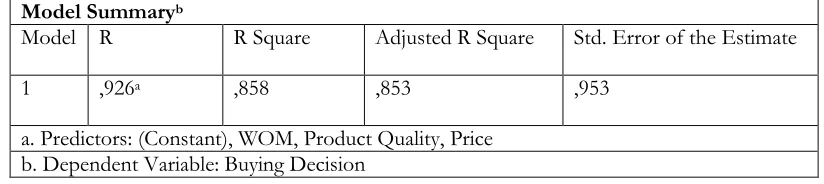
Table 2. Determination Coefficient Model Summaryb
Model R R Square Adjusted R Square Std. Error of the Estimate
1 ,926a ,858 ,853 ,953
a. Predictors: (Constant), WOM, Product Quality, Price b. Dependent Variable: Buying Decision
Source: Processed Primary Data 5.Discussion
This study was aimed to examine the effects of WOM, product quality, and price on the decision to purchase matic motorcycle in Yogyakarta, Indonesia. The results of this study proved that WOM, product quality, and price can influence consumer’s buying decision in a positive direction. Surprisingly, WOM has a greater effect than the other two variables in influencing consumer’s decisions to buy automatic motorcycle product (see Table 1). The first research result was that WOM has positive effect on buying decision, with the significance level of 0,000 <0,05 (see Table 1). The positive results obtained can be interpreted that the better the WOM positive built, the higher the increase of the decision to purchase matic motorcycle by consumers. WOM is a word of mouth communication by people who have the experience using a product (Brown et al., 2007, Henning-Thurau et al., 2004). The more often the WOMs inform the advantages of a product, it will make consumers consider buying the product because the much-discussed product has an interesting side to buy and to use (Brown et al., 2007). This study is in line with the previous studies by Jalilvand and Samiei (2012) and Kudeshia and Kumar (2017). However, this study had the differences with previous studies; the respondents assume that the recommendation of friends plays a very important role in buying matic motorcycles. The role of close people, especially friends become the main reference compared with the recommendations given by family, even that of superior and experts. Therefore, it is suggested to company managements to build a positive WOM. The trick is to establish good relationships with consumers who made a purchase by providing better after-sales services, such as providing more authorized workshops, so that consumers can make repairs or service at the workshop close to their places. The other way is to distribute the spare parts completely so that consumers do not have to wait long when doing parts replacement due to the delivery.
The second result refers to the finding that product quality positively influenced buying decisions, with a significance level of 0.005 < 0.05 (see Table 1). The positive relationship between product quality and the buying decision of automatic motorcycle means that the more qualified the product offered, the happier the consumer to buy automatic motorcycles. Product quality is a product's ability to perform its functions (Vila and Ampuero, 2007; Shekhar and Raveendran, 2013). The products that provide the functions in accordance with the intended value offered will be selected or purchased by consumers. The high-quality product assessment is based on consumer ratings that see automatic motorcycle using cutting-edge technology with economical fuel consumption. The results of this study are consistent with Baruk and Iwanicka (2015) and Foroughi et al. (2016) which asserts that there is an association between product quality and buying decision. Then, the difference of this study from previous studies is that the respondents saw that product quality on matic motorcycles is identical with the management capability of the company to provide automatic motorcycle with the ability of advanced technology but economical fuel. This research suggests to the company's managements to always make innovations in order to be able to provide motorcycle with efficient fuel but superior in terms of technology. One way is to innovate sustainably to produce superior motorcycles compared to the conventional ones in both the technology and fuel.
It means that consumers are not satisfied with the price offered. Consumer’s price valuation is based on the assessment that the offered price has fulfilled consumer's purchasing power. Based on consumer rating to the price of matic motorcycles, the company managements need to offer more affordable price by having a promo program, including giving advance payment and installment facility so that consumers feel assisted in buying automatic motorcycles.In addition, to provide quality-appropriate prices, they should provide the quality of comfort in riding it. For example, they should provide better physical facilities, but with competitive prices, such as using softer rear shock so that it is comfortable to ride. The other example is to multiply the features that bring more benefits to consumers, such as indentations for side mirrors, lights, and so forth. The value of the determination coefficient (see Table 2) can be seen in the Adjusted R Square of 0.853. The result implies that the capabilities of WOM, product quality, and price in explaining buying decision are 85.3% (0.852 x 100%), while 14.7% (100% - 85.3%) is the other factors out of WOM, product quality, and price.
6. Managerial Implication
In accordance with the results of the first study which states that WOM is able to influence consumer’s buying decision in a positive direction, it provides the managerial implications to the company's managements to always build a positive WOM. The way is to establish the relationships with the consumers who have made purchases of matic motorcycles. The form of the relationship by providing excellent after-sales service facility can be an option. The other form is to distribute spare parts completely so that consumers do not have to wait long when doing parts replacement due to the delivery.
The second finding of this study states that product quality is able to influence buying decisions in a positive direction. Therefore, the management implication of this research is that the study recommends the company managements to make every effort to improve the quality of their matic motorcycles so that the consumers are more interested in buying them. The way is that the company's managements must present the matic motorcycle products with advanced technology but economical fuel. The respondents of this study put product quality identical with technology and economical fuel.
The managerial implications of the three refer to the finding of competitive price to have a positive effect on buying decision. The researcher suggested to the managements of matic motorcycles in order to provide price facilities to their consumers. The ways is to carry out a promo program by providing a cut of advances and installments so that they can offer more affordable prices. They should also provide the price according to the quality, for example; the quality in terms of the riding comfort in the form of softer and stronger seat in addition to the latest types of machines but at affordable prices. By providing the facilities, consumers will always be happy to decide to buy matic motorcycles.
7. Conclusion
This study examined in depth the effects of WOM, product quality, and price of matic motorcycles on buying decision in Yogyakarta, Indonesia. The main findings of this study proved that there is a significant relationship in WOM, product quality, and price with consumer’s buying decisions. Surprisingly, this study found that the variable of WOM had greater effect on buying decisions than the variables of product quality and price. This research suggests to company managements not only to focus on the effort to improve product quality and to give competitive price in making promotion program, but they also have to work hard to build positive WOM. The WOM which is positively formed will affect consumers to always be sure and happy to decide to buy automatic motorcycle products. One way is to always maintain good relations with buyers, especially in providing excellent after-sales facilities.
References
Amron, A. (2017). Marketing Challenge of Import Insurance Product in Indonesia. Advance Science Letters, 3(8), 7243-7245.
Amron, A. & Mahmud, M. 2017. Developing Marketing Strategy in Property Insurance Business. International Business Management, 11(1),177-182.
Amron, A and Usman, U. 2016. Customer Satisfaction in the Marketing of Inland Transit Insurance Service. International Journal of Applied Business and Ecomonic Research, 14(12), 8311-8321.
Baruk, A.I. and Iwanicka, A. (2015). Polish final purchasers’ expectations towards the features of dairy product packaging in the context of buying decisions. British Food Journal, 117(1), 178-194.
Bowen, J. and Lihchen, S.H. (2001). Relationships between customer loyalty and customer satisfaction. International Journal of Counter Porary Management, 13(1), 253-275.
Brown, J., Broderick, A. J. and Lee, N. (2007). Word of mouth communication within online communities: Conceptualizing the online social network. Journal of interactive marketing, 21(3), 2-20.
Damay, C. (2008). What is the meaning of ‘price’ and ‘being expensive’ for children?. Young Consumers, 9(3), 179-188.
Foroughi, B., Nikbin, D., Hyun, S.S. and Iranmanesh, M. (2016). Impact of core product quality on sport fans’ emotions and behavioral intentions. International Journal of Sports Marketing and Sponsorship, 17(2),110 – 129.
Henning-Thurau, T., Gwinner, K.P., Walsh, G. and Gremler, D.D. (2004). Electronic word-of-mouth via customer opinion platform: what motivates consumers to articulate themselves on the internet. Journal of Interactive Marketing, 18(1), 38-52.
Jalilvand, M.R. and Samiei, N. (2012). The effect of electronic word of mouth on brand image and purchase intention An empirical study in the automobile industry in Iran. Marketing Intelligence & Planning, 30(4), 460-476. Kacen, J., Hess, J. and Walker, D. (2012). Spontaneous selection: the influence of product and merchandising factors
on consumer impulse purchases. Journal of Retailing and Consumer Services, 19(6), 578-588. Katadata, (2016). Matic Motor 2016 Data. [Online] Available:
https://databoks.katadata.co.id/datapublish/2017/01/12/skuter-matik-kembali-merajai-motor-terlaris-2016. (January 04, 2017).
Kudeshia, C. and Kumar, A. (2017). Social eWOM: does it affect the brand attitude and purchase intention of brands?. Management Research Review, 40(3), 310-330.
Muratore, I. (2016). Teens as impulsive buyers: what is the role of price?. International Journal of Retail & Distribution Management, 44(11), 1166-1180.
Nguyen, A. and Meng, J. (2016). How source of funds affects buyer’s judgments of price fairness and subsequent response. Journal of Product & Brand Management, 25(7), 710 – 720.
Shekhar, S.K. and Raveendran, P.T. (2013),. Role of packaging cues on consumer buying behavior. International Journal of Engineering and Management Sciences, 4(1), 61-69.
Sternquist, B., Byun, S.E. and Jin, B. (2004). The dimensionality of price perceptions: a crosscultural comparison of Asian consumers. International Revue of Retail, Distribution and Consumer Research, 14(1), 83-100.
Vila, N. and Ampuero, O. (2007). The role of packaging in positioning an orange juice. Journal of Food Products Marketing, 13(3), 21-48.