www.ijicse.com 19
THE IMPROVING POWER EFFICIENCY IN WIRELESS SENSOR NETWORK USING ANT BASED ROUTING ALGORITHM
M.SANTHOSH, N.V.CHINNASAMY
Department of Computer Science,
Sri Vijay Vidyalaya College of Arts and Science, Dharmapuri. [email protected]
ABSTRACT
Wireless Sensor Networks consisting of nodes with limited power are deployed to gather useful information from the field. In WSN, it is critical to collect the information in an
efficient manner. WSN is a collection of tiny, large number of densely deployed sensor node;
these sensor nodes are smart, effective which is very powerful and versatile networking
where traditional wired and wireless networking is unable to deploy. The lifetime of a WSN
significantly depends on the batteries of nodes and a long lifetime is vital in most of WSN
applications. It is applied in routing and difficult power supply area or area that cannot be
reached and some temporary situations, which do not need fixed network supporting and it
can fast deploy with strong anti-damage. In order to avoid the problem we proposed a new
technique called FN node mechanism for routing. ACO is one of the FN node mechanisms.
ACO is a dynamic and reliable protocol. Therefore, energy efficient routing is important in
WSN. Here, we are designing Ant Colony Optimization (ACO) algorithm for energy efficient
routing in WSN. Routing protocols for wireless sensor networks are responsible for
maintaining the energy efficient paths in the network and have to ensure extended network
lifetime. It provides energy-aware, data gathering routing structure in wireless sensor
network. It can avoid network congestion and fast consumption of energy of individual node.
Then it can prolong the life cycle of the whole network. ACO algorithm reduces the energy consumption. It optimizes the routing paths, providing an effective multi-path data
transmission to obtain reliable communications in the case of node faults. The main goal is to
maintain the maximum lifetime of network, during data transmission in an efficient manner.
This paper defines implementation of WSN and comparison of its performance with DSR
routing protocol based on ANT algorithm is done in terms of packet delivery ratio,
throughput and energy level.
Keywords: Routing protocols, Wireless sensor networks, Large-scale systems, Network
www.ijicse.com 20
I. INTRODUCTION
A Wireless Sensor Network is a
collection of nodes using a wireless medium
to communicate, and cooperate together to
make possible the communication between
any pair of nodes in the network, without
using any pre-existing infrastructure or central administration. The opening of the
communication medium and the possible
mobility are the most important
characteristics, which make an ad hoc
network easy and less expensive to deploy.
The Wireless sensor network is a collection
of sensors that are spread over large
geographic regions.
A Wireless Sensor Networks (WSN),
or better a mesh WSN, usually consists of
one sink (or base station) able to manage all
the communications between other nodes.
This kind of network has fixed routes,
excepting when there are nodes failures.
Thus, the base station determines and
optimizes the paths of communication in the network. Instances of WSN are networks
monitoring a bridge, the temperature in
several parts of a city (although this case is
more complex due to the big area to monitor)
or an ancient monument.
Wireless Sensor Networks have
recently emerged as a hot, new research area
in the broad field of (wireless) computer
networking. Research interest in WSNs has
been stimulated by the very recent advances
in the Micro-Electro-Mechanical Systems
(MEMS) and the wireless communications
technology, which have made it possible to
produce low-cost, tiny-sized sensors with
wireless networking capabilities WSNs are
expected to be ubiquitous in the future, with
wide deployment both in the military and the
commercial sectors.
The WSN is built of "nodes" – from a
few to several hundreds or even thousands,
where each node is connected to one (or
sometimes several) sensors. Each such
sensor network node has typically several
parts: Size and cost constraints on sensor
nodes result in corresponding constraints on
resources such as energy, memory,
computational speed and communications
bandwidth.
II. RELATED WORK In our proposed system, we are
introducing Efficient-Ant Colony Algorithm,
Re-Route Processing Algorithm and RSA
Algorithm. In this EACO process, the
data-packets will be passed in efficiently without any packet loss. Re-routing will act as, if
there is an attacker node while routing this
algorithm will change its path and sends the
information to destination. The main process
is RSA Algorithm it will act as encryption
and decryption process. So the Security will
be high when this process is added.
The proposed routing protocol
consists of four stages which are listed as
www.ijicse.com 21
(I) Route discovery
(II) Route selection
(III) Route security
(IV) Data forwarding.
WSNs have many real-life
applications such as military applications, healthcare applications, forest and habitat
monitoring, fire, heat, and pressure
monitoring in a given area Selection and
delivery of data packets from source to
destination is one of the important tasks in
WSN. Researchers have proposed many
routing mechanisms so however, majority of
WSN routing protocols are application
dependent without any consideration for
security aspect. Security concern is gaining
significant attention and many secure
mechanisms have been proposed for WSN.
However, many of these security
mechanisms operate at different layers to
counter specific risk situation. To counter
network layer security attacks, secure routing is more appropriate security mechanism. In
last few years, variety of secure routing
protocols is proposed for sensor networks.
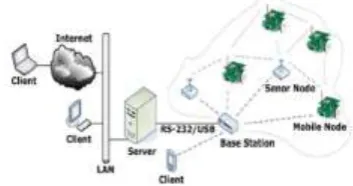
Fig 1: Architecture of WSN
III. POWER EFFICIENCY IN WIRELESS SENSOR NETWORKS 3.1 Route Discovery
The Router Discovery Protocol,
which is an extension to the Internet Control
Message Protocol (ICMP), allows hosts to
discover routers on their networks and determine which router to use as the default
router. When a host needs to send a packet to
another network, it first sends the packet to a
router that forwards the packet toward the
destination. To accomplish this, the host
needs to know where the routers are on its
network and which one to send packets to.
When you configure the router
discovery mechanism, the router advertises
itself with periodic ICMP router
advertisement messages. Then the host
listens to this message and decides whether
to use a router as the default router.
You can configure the host to solicit
the router advertisement on attached
networks. All participating routers then reply to the inquiry. By collecting those replies,
the host discovers the routers on the network
and determines which router to use.
A host might not select the best
router (the router with the optimal path) to
forward packets to a specific destination.
When a router receives a packet from a host
that is better forwarded to another router on
the network, the router uses an ICMP
Redirect message to notify the host of the
www.ijicse.com 22
NetWare routing software provides
both host and router implementations of the
Router Discovery Protocol. The mode of
operation of the Router Discovery Protocol
is determined by whether the IP Packet
Forwarding parameter is enabled. If IP
Packet Forwarding is enabled, the Router Discovery Protocol sends Router
Advertisement messages. If IP Packet
Forwarding is disabled, the Router
Discovery Protocol sends Router Solicitation
Messages.
.3.2 Route Selection
Crucial to the proper ability of hosts
to exchange IP packets is the correct
selection of a route to the destination. The
rules for the selection of route path are
traditionally made on a hop-by-hop
basis based solely upon the destination
address of the packet. Linux behaves as a
conventional routing device in this way, but
can also provide a more flexible capability.
Routes can be chosen and prioritized based on other packet characteristics.
The route selection algorithm under
linux has been generalized to enable the
powerful latter scenario without
complicating the overwhelmingly common
case of the former scenario.
3.3 Route Security
The unit option is an optional function
that is called at the beginning of every request. It
is not given any special arguments.
This method serves as a gatekeeper for
the remaining middleware in the stack. It should
parse the request for authorization information
and setup the request for further middleware..
3.4 Route Forwarding
This chapter describes the level of
support that Cisco ANA provides for Virtual Routing and Forwarding (VRF), as follows:
• Technology Description
• Information Model Objects (IMOs)
• Vendor-Specific Inventory and IMOs
• Network Topology
• Service Alarms
3.5 Simulation Results
IV. CONCLUSION We studied the application of the Ant
Colony Optimization metaheuristic to solve
the routing problem in wireless sensor
networks. A basic ant-based routing
algorithm was proposed, and several
improvements, inspired by the features of
wireless sensor networks (low energy levels,
low processing and memory capabilities),
were considered and implemented. The
resulting routing protocol, called
Energy-Efficient Ant Based Routing (EEABR), uses
www.ijicse.com 23
between the sensor nodes and the sink nodes,
which are optimized in terms of distance and
energy levels. These special ants minimize
communication loads and maximize energy
savings, contributing to expand the lifetime
of the wireless network. The experimental
results showed that the algorithm leads to very good results in different WSN
scenarios. As future work we intend to study
the initialization method to populate the
routing tables with initial pheromone levels.
As shown in the literature such mechanisms
can increase even more the efficiency of the
networks. Another approach to be studied is
the integration of multiple sink-nodes.
REFERENCES
1) Estrin, D., et al., “Embedded, Everywhere: A
research Agenda for Network Systems of Embedded Computers”, National Research Council Report, 2001. 2) Handy, M., Haase, M., Timmermann, D., “Low
Energy Adaptive Clustering Hierarchy with
Deterministic Cluster-Head Selection,” 4th IEEE International Conference on Mobile and Wireless Communications Networks, Stockholm, 2002. 3) Lindsey, S., Raghavendra, C., “PEGASIS: Power Efficient Gathering in Sensor Information Systems”,
ICC, 2001.
[4] Lindsey, S., Raghavendra, C., Sivalingam, K., “Data Gathering in Sensor Networks using the EnergyDelay Metric”, 2000.
5) Intanagonwiwat, C., Govindan, R., Estrin, D., “Directed Diffusion: a scalable and robust communication paradigm for sensor networks”, ACM
Press, 2000.
6) Jeon, P., Rao, R., Kesidis, G., Two-Priority Routing in Sensor MANETs Using Both Energy and Delay Metrics in preparation, 2004.
7) Di Caro G., Dorigo M., "AntNet: Distributed Stigmergetic Control for Communications Networks", Journal of Artificial Intelligence Research (JAIR), Vol. 9, Pag. 317-365, 1998.
8) Zhang, Y., Kuhn, L., Fromherz, M.,
„Improvements on Ant Routing for Sensor Networks”. In: Ants 2004, Int. Workshop on Ant
Colony Optimization and Swarm Intelligence, Sept. 2004.
9) Singh, G., Das, S. Gosavi, S., Pujar, S., “Ant Colony Algorithms for Steiner Trees: An Application
to Routing in Sensor Networks”, Recent
Developments in Biologically Inspired Computing, Eds. L. N. de Castro, F. J. von Zuben, Idea Group Publishing, pp. 181-206, 2004.
10) Zuniga, M. Z.; Krishnamachari, B. "Integrating Future Large-Scale Wireless Sensor Networks with the Internet" - Department of Electrical Engineering, UNiversity of Southern California, 2002.
11) Alonso, J., Dunkels, A., Voigt. T, „Bounds on the energy consumption of routings in wireless sensor nodes” WiOpt'04: Modeling and Optimization in
Mobile, Ad Hoc and Wireless Networks, Cambridge, UK, March 2004.
12) Ye, W., Heidemann, J., "Medium Access Control in Wireless Sensor Networks" in Wireless Sensor Networks, Kluwer Academic Publishers, 2004.
13) Dorigo, M., Stützle, T., “Ant Colony
Optimization”, ISBN 0262042193, MIT Press, 2004.
14) Network Simulator-2,