VOLUME 41, ARTICLE 51, PAGES 1437
-
1452
PUBLISHED 17 DECEMBER 2019
https://www.demographic-research.org/Volumes/Vol41/51/ DOI: 10.4054/DemRes.2019.41.51
Descriptive Finding
The relation between cardiovascular mortality
and development: A study of small areas in
Brazil, 2001
‒
2015
Emerson Augusto Baptista
Bernardo Lanza Queiroz
© 2019 Emerson Augusto Baptista & Bernardo Lanza Queiroz.
This open-access work is published under the terms of the Creative Commons Attribution 3.0 Germany (CC BY 3.0 DE), which permits use, reproduction, and distribution in any medium, provided the original author(s) and source are given credit.
1 Introduction 1438
2 Data and methods 1439
2.1 Data source and level of analysis 1439
2.2 Bivariate maps 1440
3 Results 1440
4 Discussion 1443
References 1446
The relation between cardiovascular mortality and development:
A study of small areas in Brazil, 2001
‒
2015
Emerson Augusto Baptista1
Bernardo Lanza Queiroz2
Abstract
BACKGROUND
Cardiovascular disease (CVD) is one of the most serious health issues and the leading cause of death in Brazil, accounting for 30% of all deaths. Previous research shows that CVD mortality rates are not uniformly distributed across Brazil and have been changing over time. There is also previous evidence from other countries that economic development and improvements in the educational level have important effects in reducing CVD mortality.
OBJECTIVE
The goal of this paper is to contribute to this discussion by investigating the relation between CVD mortality and economic development over time and space, measured by gross domestic product (GDP) per capita, in Brazilian micro-regions from 2001 to 2015.
METHODS
We used data from the Mortality Information System (SIM-DATASUS) from 2001 to 2015. GDP data by micro-region were extracted from the Sistema IBGE de Recuperação Automática (SIDRA). Bivariate maps were used to establish the relationship between CVD mortality and GDP per capita.
RESULTS
The results show that GDP per capita increased in all micro-regions between 2001 and 2015. The results also suggest a rapid decline in CVD mortality in the South and Southeast micro-regions and a slower decline in the Central-West region. Meanwhile, the less developed North and Northeast regions showed an increase in CVD mortality over time. This spatial heterogeneity over the examined period appears to be associated with access to proper healthcare and strongly related to socioeconomic factors. In
addition, males have higher mortality rates than females in approximately 72% of micro-regions.
CONTRIBUTION
This study provides useful clues for policymakers establishing public health planning and effective measures for the prevention of deaths from cardiovascular disease. The reduction of CVD mortality can positively impact GDP growth because it can increase life expectancy and consequently enable people to contribute to the Brazilian economy for a longer time.
1. Introduction
Deaths from cardiovascular diseases (CVD) are increasing and CVD is the leading cause of death worldwide; that is, more people die annually from CVDs than from any other cause (Franco et al. 2011; Lozano et al. 2012; Roth et al. 2015, 2017a, 2017b). In the last twenty-seven years the estimated number of deaths from CVDs increased from approximately 12.0 million in 1990 to 17.8 million in 2017. These numbers represent around 25.6% and 31.8% of all global deaths, respectively (Global Burden of Disease Collaborative Network 2019). In recent years, Lopez and Aidar (2019) have observed a slowdown in the rate of decline in CVD mortality in high-income countries. This pattern and these recent changes are a combination of several factors, such as population growth, aging, education, behavior, climate, access to health services, epidemiologic changes in CVD, and income (GDP) (Timæus 1993; Lopez, Caselli, and Valkonen 1995; Lopez et al. 2006a, 2006b; Vallin and Meslé 2004; Jerrett et al. 2005; Marmot 2010; WHO 2014; Roth et al. 2015; Baptista and Queiroz 2019; Lopez and Aidar 2019).
According to the World Health Organization (WHO) (2016), over three-quarters of deaths from CVD take place in low- and middle-income countries (Franco et al. 2011), like Brazil. While the number of deaths from CVD in Brazil increased from 258,338.97 in 1990 to 388,268.09 in 2017, the percentage has remained fairly stable, 28.89% and 28.78%, respectively (Global Burden of Disease Collaborative Network 2019). However, despite CVD being the main cause of mortality in Brazil (Lotufo 2019), CVD mortality rates are not uniformly distributed within the country (Borges 2017; Baptista, Queiroz, and Rigotti 2018; Baptista and Queiroz 2019). Brazil is marked by important regional disparities resulting from socioeconomic inequality and limited access to health services (Souza et al. 2018).
investigate the relationship between CVD mortality and gross domestic product (GDP) per capita in the adult population (over 30 years of age), by sex, in Brazilian micro-regions from 2001 to 2015. This is an attempt to advance the recent study by Baptista and Queiroz (2019), who investigate the spatial pattern of deaths from CVD across small areas in Brazil by performing a spatial analysis of CVD mortality, identifying regions with high levels of mortality, and showing how they have changed over recent periods of time. The results show temporal clockwise change in the concentration of high–high regions (where there is a high level of CVD mortality not only in the region but also in the neighborhood) from the South to the Northeast. Baptista and Queiroz (2019) speculate that these changes may be related to socioeconomic and cultural factors. Following their study, in this paper we aim to investigate associated factors that may explain recent changes in mortality by cardiovascular disease. More specifically, we study the relationship between changes in CVD mortality and a measure of income (GDP) over time and space.
Income, often expressed as gross domestic product (GDP) per capita, is one of the most widely used socioeconomic predictors of mortality/health, and this relationship has been widely discussed in the literature (Preston 1975; Murray and Lopez 1997; Berger and Messer 2002; Mackenbach et al. 2004; Subramanian and Kawachi 2006; James et al. 2012). We introduce an adapted bivariate choropleth map using software R to investigate the temporal and spatial relationship between CVD mortality and GDP per capita in Brazil.
2. Data and methods
2.1 Data source and level of analysis
We use cause-specific mortality from cardiovascular disease from the Tenth Revision of the International Classification of Diseases (ICD-10), Chapter IX, publicly available in the Sistema de Informações sobre Mortalidade (SIM), DATASUS. The data are organized by sex (males and females), age (population over 30 years and in 5-year groups up to 80 years or more), and cause of death, as well as by the geographical micro-region where the deceased resided. In addition, GDP data by micro-region were extracted from the Sistema IBGE de Recuperação Automática (SIDRA), which is also publicly available. We use nominal GDP, not adjusted for inflation, in Brazilian Reais (R$). Unfortunately, the IBGE only reports price indexes for country and various metropolitan areas, and not for municipalities or at the state level.
organized by age and sex were obtained from the 2010 Census and intercensal estimates from the Brazilian Institute of Geography and Statistics (IBGE). We use standardized death rates for each micro-region, using the Brazilian population in 2010 as the standard.
The units of analysis are the 558 Brazilian micro-regions, as proposed by the IBGE. The micro-regions are statistical constructions aggregated using regional, natural, and socioeconomic similarities, i.e., geographic micro-regions do not constitute political or administrative entities (Cravo, Becker, and Gourlay 2015; Lima and Silveira Neto 2016). One of the advantages of using this type of unit is that their boundaries were constant throughout the research period. Thus, it was possible to monitor and study the 558 areas between 2001 and 2015.
2.2 Bivariate maps
A univariate choropleth map uses colors that portray the spatial variation of a single attribute in the geographic region under study. Fertility rate by county, crime rate by state, and aging rate by country are some examples. Bivariate choropleth maps follow the same concept but display two variables simultaneously (Carstensen 1986). In fact, bivariate maps go further in that they indicate estimates of the degree or spatial pattern of cross-correlation between variables, something that to our knowledge has not yet been explored in demographic studies.
We introduce an adapted bivariate choropleth map based on Grossenbacher and Zehr’s tutorial (2019) in R software to evaluate the degree of relationship between mortality by cardiovascular disease and GDP per capita at the micro-region level. To match the nine different colors with appropriate classes we calculate 1/3-quantiles for both variables. The micro-regions are then put into the appropriate class corresponding to their average CVD mortality and GDP per capita.
3. Results
Figures 1 (males) and 2 (females) show the relationship between CVD mortality and GDP per capita in the three 5-year periods studied, by micro-region, through bivariate maps.
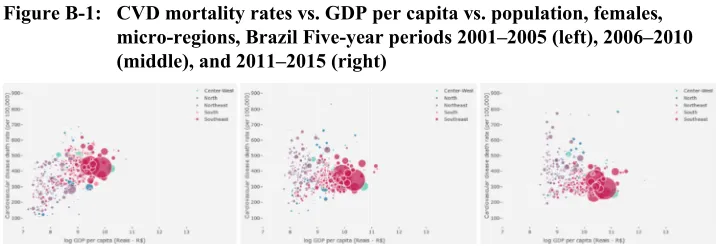
CVD mortality overtime (see Figures A-1 and B-1 in the supplementary material). This spatial heterogeneity over the period appears to be associated with access to proper healthcare and strongly related to socioeconomic factors (Mansur and Favarato 2016; Baptista, Queiroz, and Rigotti 2018; Lotufo 2019). In addition, males have higher mortality rates than females in approximately 72% of micro-regions.
Figure 1: CVD mortality rates vs. GDP per capita, males, micro-regions, Brazil. Five-year periods 2001–2005 (left), 2006–2010 (middle), and 2011–2015 (right)
Figure 2: CVD mortality rates vs. GDP per capita, females, micro-regions, Brazil. Five-year periods 2001–2005 (left), 2006–2010 (middle), and 2011–2015 (right)
the period. On the other hand, analysis of the period 2001–2015 found an increase in the crude mortality rate from cardiovascular disease (CMRCVD). As these are less developed regions, the increase in CVD mortality rates might be related to the population’s increased life expectancy and an increased prevalence of cardiovascular risk factors such as educational level, health conditions, institutional factors, the environment, and the socioeconomic situation to which the population is exposed (Roth et al. 2015; Borges 2017; França et al. 2017; Lotufo 2019), as well as improvements in death registration and vital statistics (Mathers et al. 2005; França et al. 2008; Luy 2010; Queiroz et al. 2017; Schmertmann and Gonzaga 2018).
In the Central-West region the relationship between CVD and GDP per capita is clearer. The region is an important and increasingly mechanized agricultural frontier, and a significant contributer to the country’s GDP. The CMRCVD is high in the first 5-year period but shows signs of decline (albeit slower than in the South and Southeast regions) in the most recent period. This decrease in rates is stronger and more noticeable from the first to the second 5-year period, for both sexes. In a few micro-regions the rates increase between the second and third 5-year period, but there is no return to the high rates of the initial period. The Central-West region has undergone profound changes in recent decades because of agricultural expansion into the interior (Hosono 2019). This development has brought epidemiological changes, changes in the population age structure, and improvements in access to and quality of health services and in the quality of vital statistics, all of which may help to explain the relationship studied.
In the Southeast region, where the three largest economies are located, there is more variation in relative income level and mortality. Minas Gerais, for example, has a low relative GDP per capita in the North and Northeast regions of the state, as opposed to a medium/high relative GDP per capita in the other regions. The region saw a decline in CMRCVD over the period, and this reduction tended to occur first among women (Brant et al. 2017). We speculate that the fall in CMRCVD in more developed regions of the country may be explained by the control of risk factors, improved education and health conditions, early diagnosis of cardiovascular risk, and the search for a better quality of life (Ribeiro, Minardi Mitre Cotta, and Rocha Ribeiro 2012; Rasella et al. 2014; Lotufo 2019).
capita, we can add that the decline in risk factors associated with policies such as tobacco control and better preventive care of high blood pressure (França et al. 2017; Brant et al. 2017), as well as the quality of hospital care, play an important role in the declining trend, and that there are large regional differences in quality (Ribeiro et al. 2016; Brant et al. 2017) should also be considered.
In summary, we would characterize Figures 1 and 2 as showing a shift from light gray (low relative GDP per capita and low CMRCVD) to red (low relative GDP per capita and high CMRCVD) in the North and Northeast regions, and a shift from purple (high relative GDP per capita and high CMRCVD) to blue (high relative GDP per capita and low CMRCVD) over time in the South and Southeast regions.
4. Discussion
Mortality by cardiovascular diseases is related to population age structure, prevalence of risk factors, health conditions, institutional factors, the environment, and the socioeconomic situation to which the population is exposed (Roth et al. 2015; Ribeiro et al. 2016; Lopez and Adair 2019). In Brazil, CVD mortality presents important regional variation and is strongly related to socioeconomic factors (Lotufo 2000; Godoy et al. 2007; Guimarães et al. 2015; Mansur and Favarato 2016; Brant et al. 2017; Baptista and Queiroz 2019). One of the most widely used socioeconomic predictors of mortality/health is GDP (Preston 1975; Murray and Lopez 1997; Berger and Messer 2002; Mackenbach et al. 2004; Subramanian and Kawachi 2006; James et al. 2012).
There is also the important question of reverse causality. Suhrcke and Urban (2010) show that increasing CVD morbidity can affect economic growth because it limits productivity and labor force participation. In this paper we do not have evidence to suggest the direction of causality. Our results indicate an association between GDP per capita and CVD mortality across regions in Brazil. Through bivariate maps, we show that over the examined period there is a decline in CVD mortality in the South and Southeast micro-regions of Brazil, significantly the most developed regions of the country. To a lesser extent, the Central-West region also saw a decrease in mortality rates from cardiovascular disease. On the other hand, CVD mortality increased in the states with poor socioeconomic conditions (the North and Northeast) at the same time as there was an increase in public health programs aimed at controlling chronic diseases and individual behaviors (Ribeiro, Minardi Mitre Cotta, and Rocha Ribeiro 2012; França et al. 2017). GDP per capita might be working as a proxy for inequalities in the social environment, behavioral risk factors such as smoking, obesity, physical inactivity, disease prevalence, and healthcare access and treatment.
The inverse relationship between mortality and GDP per capita – increases in GDP related to a decline in mortality – is parallel to that observed in the relationship between CVD mortality and education in other countries. As the educational level rises the more educated individuals have more resources to avoid disease, and their survival increases. In Brazil, public health measures providing information and additional resources to more vulnerable populations had an important impact on reducing CVD mortality among the less wealthy population. However, CVD mortality decline is slower in the less developed areas of the country, indicating that income level plays an important role in this disease (Lotufo et al. 2013; Ribeiro et al. 2016; França et al. 2017). In addition, the slowdown in the mortality decline suggests that alternative public health measures should be put in place.
They note that the country is among those in which the increase of CVD mortality attributable to population growth and aging has been offset by a reduction in age-specific rates of death. They also find that CVD mortality does not have a consistent geographic pattern, although some states in the Northeast have high rates, and that the decline in age-standardization has been higher among women than among men. Borges (2017) points out that changes in CVD mortality have benefited older adults in all regions and have had an important impact in reducing overall mortality levels for women, especially in southern regions of the country. Brant et al. (2017) show that there was a reduction in CMRCVD between 1990 and 2015, although not uniformly across all Brazilian states. The decline was higher in the southeastern and southern regions of the country and in the Federal District, while the lowest reductions occurred in the northern and northeastern regions where the socioeconomic conditions are the worst. Baptista, Queiroz, and Rigotti (2018) analyze the recent evolution of mortality due to cardiovascular disease and decompose the effects of changes in the levels of mortality rates and age structure of the population. They note an increased concentration of high mortality rates from this disease in the Northeast. Finally, Baptista and Queiroz (2019) evaluate the spatial patterns of deaths from CVD in Brazilian micro-regions between 1996 and 2015. They find a decrease in high–high spatial clusters in the Southeast and South regions. Meanwhile, the micro-regions of the Central-West, North, and Northeast regions in general have seen an increase in mortality rates over the years.
References
Baptista, E.A. and Queiroz, B.L. (2019). Spatial analysis of mortality by cardiovascular disease in the adult population: a study for Brazilian micro-regions between 1996 and 2015.Spatial Demography 7(1): 83‒101.doi:10.1007/s40980-019-000 50-6.
Baptista, E.A., Queiroz, B.L. and Rigotti, J.I.R. (2018). Decomposition of mortality rates from cardiovascular disease in the adult population: A study for Brazilian micro-regions between 1996 and 2015. Revista Brasileira de Estudos de População.doi:10.20947/S102-3098a0050.
Berger, M.C. and Messer, J. (2002). Public financing of health expenditures, insurance, and health outcomes.Applied Economics 34(17): 2105‒2113.doi:10.1080/0003 6840210135665.
Borges, G.M. (2017). Health transition in Brazil: regional variations and divergence/convergence in mortality. Cadernos de Saúde Pública 33(8): E00080316.doi:10.1590/0102-311x00080316.
Brant, L.C.C., Nascimento, B.R., Passos, V.M.A., Duncan, B.B., Bensenõr, I.J.M., Malta, D.C., Souza, M.F.M., Ishitani, L.H., França, E., Oliveira, M.S., Mooney, M., Naghavi, M., Roth, G., and Ribeiro, A.L.P. (2017). Variations and particularities in cardiovascular disease mortality in Brazil and Brazilian states in 1990 and 2015: Estimates from the global burden of disease.Revista Brasileira de Epidemiologia 20(Suppl 01): 116–128.
Carstensen, Jr., L.W. (1986). Hypothesis testing using univariate and bivariate choropleth maps.The American Cartographer 13(3): 231‒251.doi:10.1559/152 304086783899935.
Cravo, T.A., Becker, B., and Gourlay, A. (2015). Regional growth and SMEs in Brazil: A spatial panel approach.Regional Studies 49(12): 1995‒2016.doi:10.1080/00 343404.2014.890704.
Fontes, G.G., Simões, R.F., and Hermeto Camilo De Oliveira, A.M. (2010). Urban attributes and wage disparities in Brazil: A multilevel hierarchical model. Regional Studies 44(5): 595‒607.doi:10.1080/00343400902926367.
França, E. B. et al. (2017). Cause-specific mortality for 249 causes in Brazil and states during 1990–2015: a systematic analysis for the global burden of disease study 2015.Population Health Metrics 15(1): 39.doi:10.1186/s12963-017-0156-y. Franco, M., Cooper, R.S., Bilal, U., and Fuster, V. (2011). Challenges and opportunities
for cardiovascular disease prevention.The American Journal of Medicine 124(2) 95‒102.doi:10.1016/j.amjmed.2010.08.015.
Global Burden of Disease Collaborative Network (2019). Global burden of disease study 2017 (GBD 2017) results. Seattle: Institute for Health Metrics and Evaluation (IHME). Available fromhttp://ghdx.healthdata.org/gbd-results-tool. Godoy, M.F. et al. (2007). Mortalidade por doenças cardiovasculares e níveis
socioeconômicos na população de São José do Rio Preto, Estado de São Paulo, Brasil.Arquivos Brasileiros de Cardiologia 88(2): 200–206. doi:10.1590/S0066-782X2007000200011.
Grossenbacher, T. and Zehr, A. (2019). https://github.com/grssnbchr/bivariate-maps-ggplot2-sf.
Gu, D., Gerland, P., Andreev, K.F., Li, N., Spoorenberg, T., and Heilig, G. (2013). Old age mortality in Eastern and South-Eastern Asia.Demographic Research 29(38): 999‒1038.doi:10.4054/DemRes.2013.29.38.
Guimarães, R.M., Andrade, S.S., Machado, E.L., Bahia, C.A., Oliveira, M.M., and Jacques, F.V. (2015). Regional differences in cardiovascular mortality transition in Brazil, 1980 to 2012.Revista Panamericana de Salud Pública 37(2): 83–89. Haddad, E.A. (2018). Regional inequality and structural changes: Lessons from the
Brazilian experience. London: Routledge.doi:10.1201/9780429449406.
Hosono, A. (2019). Economic and social impacts of Cerrado agriculture: Transformation for inclusive growth through clusters and value chains. In: Hosono, A., Hamaguchi, N., and Bojanic, A. (eds.). Innovation with spatial impact: Sustainable development of the Brazilian Cerrado. Singapore: Springer: 19–68.doi:10.1007/978-981-13-6182-1_2.
Jerrett, M., Burnett, R., Ma, R., Pope, C., Krewski, D., Newbold, K., Thurston, G., Shi, Y., Finkelstein, N., Calle, E., and Thun, M. (2005). Spatial analysis of air pollution and mortality in Los Angeles. Epidemiology 16(6): 727–736. doi:10.1097/01.ede.0000181630.15826.7d.
Lima, R.C.D.A. and Silveira Neto, R.D.M. (2016). Physical and human capital and Brazilian regional growth: a spatial econometric approach for the period 1970– 2010. Regional Studies 50(10): 1688–1701. doi:10.1080/00343404.2015.1053 447.
Lopez, A.D. and Adair, T. (2019). Is the long-term decline in cardiovascular-disease mortality in high-income countries over? Evidence from national vital statistics. International Journal of Epidemiology. Online firstdoi:10.1093/ije/dyz143. Lopez, A.D., Caselli, G., and Valkonen, T. (1995). Adult mortality in developed
countries: From description to explanation. Oxford: Oxford University Press. Lopez, A.D., Mathers, C.D., Ezzati, M., Jamison, D.T., and Murray, C.J.L. (2006a).
Measuring the global burden of disease and risk factors, 1990–2001. In: Lopez, A.D., Mathers, C.D., Ezzati, M., Jamison, D.T., and Murray, C.J.L. (eds.). Global burden of disease and risk factors 1: 1–14.
Lopez, A.D., Mathers, C.D., Ezzati, M., Jamison, D.T., and Murray, C.J.L. (2006b). Global and regional burden of disease and risk factors, 2001: Systematic analysis of population health data. The Lancet 367(9524): 1747–1757. doi:10.1016/S0140-6736(06)68770-9.
Lotufo, P.A. (2000). Mortalidade pela doença cerebrovascular no Brasil. [Stroke: mortality rates in Brazil].Rev Bras Hiperten 7(4): 387–391.
Lotufo, P.A. (2019). The pace of reduction of cardiovascular mortality in Brazil (1990 to 2017) is slowing down.Sao Paulo Medical Journal 137(1): 3‒5.doi:10.1590/ 1516-3180.2018.1371090219.
Lotufo, P.A., Fernandes, T.G., Bando, D.H., Alencar, A.P., and Benseñor, I.M. (2013). Income and heart disease mortality trends in São Paulo, Brazil, 1996 to 2010. International Journal of Cardiology 167(6): 2820‒2823. doi:10.1016/j.ijcard. 2012.07.006.
Luy, M.A. (2010). Classification of the nature of mortality data underlying the estimates for the 2004 and 2006 United Nations’ world population prospects. Comparative Population Studies 35(2): 315–334.
Mackenbach, J.P., Martikainen, P., Looman, C.W.N., Dalstra, J.A.A., Kunst, A.E., Lahelma, E. and members of the SEdHA working group (2004). The shape of the relationship between income and self-assessed health: An international study.International Journal of Epidemiology 34(2): 286‒293.doi:10.1093/ije/dy h338.
Mansur, A.D.P. and Favarato, D. (2016). Trends in mortality rate from cardiovascular disease in Brazil, 1980‒2012.Arquivos Brasileiros de Cardiologia 107(1): 20‒ 25.doi:10.5935/abc.20160077.
Marmot, M. (2010). Fair society, healthy lives. In: Marmot, M. (ed.).Strategic review of health inequalities in England post-2010. London: Department of Health. Mathers, C.D., Ma Fat, D., Inoue, M., Rao, C., and Lopez, A.D. (2005). Counting the
dead and what they died from: An assessment of the global status of cause of death data.Bulletin of the World Health Organization 83(3): 171–179.
Murray, C.J. and Lopez, A.D. (1997). Alternative projections of mortality and disability by cause 1990–2020: Global Burden of Disease Study.The Lancet 349(9064): 1498‒1504.doi:10.1016/S0140-6736(96)07492-2.
Preston, S.H. (1975). The changing relation between mortality and level of economic development. Population Studies 29(2): 231‒248. doi:10.1080/00324728.1975. 10410201.
Queiroz, B.L., Miranda de Araujo Freire, F.H., Gonzaga, M.R., and Campos de Lima, E.E. (2017). Completeness of death-count coverage and adult mortality (45q15) for Brazilian states from 1980 to 2010.Revista Brasileira de Epidemiologia 20: 21–33.doi:10.1590/1980-5497201700050003.
Rasella, D., O’Harhay, M., Pamponet, M.L., Aquino, R., and Barreto, M.L. (2014). Impact of primary health care on mortality from heart and cerebrovascular diseases in Brazil: A nationwide analysis of longitudinal data.BMJ 349(4014). doi:10.1136/bmj.g4014.
Ribeiro, A.L.P., Duncan, B.B., Brant, L.C.C., Lotufo, P.A., Mill, J.G., and Barreto, S.M. (2016). Cardiovascular health in Brazil: Trends and perspectives. Circulation 133(4): 422–433.doi:10.1161/CIRCULATIONAHA.114.008727. Roth, G.A. et al. (2015). Demographic and epidemiologic drivers of global
cardiovascular mortality. New England Journal of Medicine 372(14): 1333– 1341.doi:10.1056/NEJMoa1406656.
Roth, G.A. et al. (2017a). Global, regional, and national burden of cardiovascular diseases for 10 causes, 1990 to 2015. Journal of the American College of Cardiology 70(1): 1–25.
Roth, G.A. et al. (2017b). Trends and patterns of geographic variation in cardiovascular mortality among US counties, 1980–2014. JAMA 317(19): 1976–1992. doi:10.1001/jama.2017.4150.
Schmertmann, C.P. and Gonzaga, M.R. (2018). Bayesian estimation of age-specific mortality and life expectancy for small areas with defective vital records. Demography 55(4): 1363–1388.doi:10.1007/s13524-018-0695-2.
Souza, M.D.F.M.D., Malta, D.C., França, E.B., and Barreto, M.L. (2018). Changes in health and disease in Brazil and its States in the 30 years since the unified healthcare system (SUS) was created.Ciencia & Saude Coletiva 23(6): 1737– 1750.
Souza, M.D.F.M.D., Timerman, A., Serrano Jr, C.V., Santos, R.D., and de Pádua Mansur, A. (2001). Trends in the risk of mortality due to cardiovascular diseases in five Brazilian geographic regions from 1979 to 1996.Arquivos Brasileiros de Cardiologia 77(6): 569–575.doi:10.1590/S0066-782X2001001200007.
Subramanian, S.V. and Kawachi, I. (2006). Being well and doing well: On the importance of income for health.International Journal of Social Welfare 15: S13‒S22.doi:10.1111/j.1468-2397.2006.00440.x.
Suhrcke, M. and Urban, D. (2010). Are cardiovascular diseases bad for economic growth?Health Economics 19(12): 1478‒1496.doi:10.1002/hec.1565.
Timæus, I.M. (1993). Adult mortality. In: Foote, K.A., Hill, K.H., and Martin, L.G. (eds.).Demographic change in sub-Saharan Africa. Washington, D.C.: National Academy Press: 218–255.
World Health Organization (2014). Noncommunicable diseases (NCD). Country profiles. https://apps.who.int/iris/bitstream/handle/10665/128038/978924150750 9_eng.pdf?sequence=1.
Supplementary material
Figure A-1: CVD mortality rates vs. GDP per capita vs. population, males, micro-regions, Brazil. Five-year periods 2001–2005 (left), 2006–2010 (middle), and 2011–2015 (right)