VOLUME 38, ARTICLE 56, PAGES 1699
,
1732
PUBLISHED 24 MAY 2018
http://www.demographic-research.org/Volumes/Vol38/56/ DOI: 10.4054/DemRes.2018.38.56
Research Article
Cohort fertility and educational expansion in the
Czech Republic during the 20
thcentury
Kryštof Zeman
© 2018 Kryštof Zeman.
This open-access work is published under the terms of the Creative Commons Attribution 3.0 Germany (CC BY 3.0 DE), which permits use, reproduction, and distribution in any medium, provided the original author(s) and source are given credit.
1 Introduction 1700
2 Education and fertility: Theoretical considerations 1701
3 Economic, institutional, and cultural background 1703
3.1 Female employment and gender roles 1703
3.2 Educational expansion 1705
3.3 Family policies and public childcare 1708
3.4 Other cultural and institutional factors 1710
3.5 Concluding remarks and research questions 1711
4 Data and methods 1713
4.1 Census data on parity of women by education 1713
4.2 Completed cohort fertility and the decomposition 1714
5 Results 1716
5.1 Completed cohort fertility by education 1716
5.2 Decomposition of changes in completed cohort fertility 1719
5.3 Parity distribution 1720
6 Discussion and conclusions 1722
7 Acknowledgements 1724
Cohort fertility and educational expansion
in the Czech Republic during the 20
thcentury
Kryštof Zeman1
Abstract
BACKGROUND
During the 20th century the Czech Republic went through profound changes in female
employment, gender roles, population and family policies, and public childcare. The educational structure of the female population changed tremendously. At the same time, completed cohort fertility fluctuated between 1.8 and 2.2 children per woman.
OBJECTIVE
This article analyses the changes in the level of completed cohort fertility by education, during educational expansion in the Czech population under the economic, cultural, and institutional background of the state socialist regime, and after its breakdown.
METHODS
The changes in the level of completed cohort fertility by education are analysed by means of decomposition, complemented by the analysis of parity composition.
RESULTS
During the 20th century, education-specific completed cohort fertility increased, rather
than declined. Fertility levels converged upwards, contributing to high uniformity within educational categories. The overall changes in fertility levels were driven by changes in the educational structure. These trends resulted in the dominance of the two-child family, while large families were disappearing and two-childlessness dropped to the biological minimum.
CONCLUSIONS
An egalitarian economic system with traditional family-friendly policies, in combination with a family-unfriendly labour market, developed into a male breadwinner model of low gender equity. Future family policies should focus on the reconciliation of work and family.
1 Wittgenstein Centre for Demography and Global Human Capital (IIASA, VID/ÖAW, WU), Vienna
CONTRIBUTION
The study contributes to the discussion on links between education and fertility, adding a new picture to the mosaic of country-level analyses. The Czech Republic is an example of a country with high educational homogeneity of fertility behaviour where the education-specific levels of fertility converged upwards.
1. Introduction
One of the most important societal changes of the 20th century was educational
expansion. Increasing educational attainment has been regarded as the most important factor in fertility decline in recent decades (Lutz and K.C. 2011). A negative relationship between women’s education and fertility is consistently reported in the literature (e.g., Rindfuss, Bumpass, and John 1980; Blossfeld and Huinink 1991; Liefbroer and Corijn 1999; Kravdal 2004; Skirbekk 2008; Neels and De Wachter 2010).2 The two influential theories explaining the link between education and fertility
decisions – New Home Economics and the Second Demographic Transition – were developed in the context of Western societies. The following section discusses the relevance of these theories in the context of the 20th century Czech Republic, a society
living under a regime of state socialism. Section 3 discusses the economic, institutional, and cultural background of fertility change. We discuss particularly the economic context of the labour market and female employment. The institutional context refers to population policies, especially family policies, and we extensively discuss the availability of public childcare. The cultural context involves gender roles, their division in the family and at work, and social norms, values, and attitudes towards woman’s role in general. Educational expansion interacts with these three contexts, to influence the level of cohort fertility. Section 4 evaluates the data and formalises the method of decomposition of completed cohort fertility to the effect of changes in educational structure and in education-specific fertility levels. Section 5 analyses the changes in the level of completed cohort fertility by means of decomposition, complemented by the analysis of parity composition by education. In Section 6 the results are discussed and put in the context of historical change, resulting in important conclusions and comparison to studies from other countries.
2 Some recent studies indicate that the negative association between women’s education and fertility is
2. Education and fertility: Theoretical considerations
The New Home Economics theory argues that an increase in women’s education increases the cost of children (Becker 1960, 1981). Children are regarded as a consumption good, where childcare competes with other activities in women’s allocation of their time. More-highly educated women face higher opportunity costs of becoming mothers, as a job interruption after childbirth can result in loss of wages or have negative consequences for career development. Opportunity costs can lead to a quality–quantity trade-off, where highly educated women invest in a higher quality of fewer children. This argument regards education as a proxy measure for human capital and is therefore closely linked to the labour market (Martín-García 2008). Through these two mechanisms, women with higher education arguably have fewer children. In contrast, the New Home Economics income effect hypothesis claims that having and raising children is more affordable for families with higher income. However, household income is dependent on the income (and education) of both partners, and therefore the income effect of woman’s education is expected to be weaker than the effect of opportunity costs (Merz and Liefbroer 2009).
The theory was contested or further developed by various authors in subsequent decades (e.g., Lappegård and Rønsen 2005; Martín-García 2008; Esping-Andersen and Billari 2015). The static view of the New Home Economics framework was enhanced by the dynamics of the societal and institutional context, gender roles, and the timing of live events (Liefbroer and Corijn 1999; Neels and De Wachter 2010). Societal and institutional context refers to the balancing of income effect and opportunity costs based on the compatibility of labour force participation and family formation (fertility, in our context). The impact of opportunity costs thus differs in countries with different family policies, values, and traditions (Merz and Liefbroer 2009). In other words, opportunity costs are shaped by welfare systems – the way in which welfare is produced and allocated between state, market, and family (Esping-Andersen 1999). Esping-Andersen (1999) initially defined three welfare regimes (liberal, social-democratic, conservative-corporatist), which were expanded by Fenger (2007) (among others), who found the post-communist Eastern European welfare regime to be similar to conservative-corporatist regime in that they had low levels of governmental programmes and social services, but different in that they were highly egalitarian. In the next section we will show that during socialism, wages in the Czech Republic were low compared to Western Europe,3 but were largely equal. Education below university level did not have
a significant impact on wages, so education did not pay off as much as in Western societies. Also, career possibilities for university-educated women were limited and wage increases during careers were constrained. We thus argue that in a state-socialist
context the opportunity cost and income effect mechanisms have less weight. On the other hand, the reproduction of social and cultural capital compensated for the limited possibilities of wealth transfer – better-educated parents invested more in the quality of children – so the quality–quantity trade-off mechanism was important. However, after 1989 the liberalisation of the economy and labour market significantly changed the societal and institutional context.
Gender equity theory claims that female educational levels change the way a woman perceives the impact of having a baby as being unfair in the given institutional context. McDonald (2013: 986) argues that “more women will consider the impact to be unfair in countries where social institutions do not provide strong support to the combination of work and family.” Such an impact depends not only on family policies that shape gender roles (income transfers lowering the direct costs of childbearing, workplace policies, provision of public childcare) but also on societal norms and attitudes regarding the employment of young mothers. The fertility level is higher in countries that make it easier for women to combine work with being a mother (Rindfuss, Choe, and Brauner-Otto 2016), and lower in countries that continue to support the male breadwinner model (Klüsener, Neels, and Kreyenfeld 2013). The conservative family policies of socialist Czechoslovakia supported traditional gender roles that enforced the norm of women as mothers and housewives. They were fairly generous, and encouraged mothers with young children to stay at home. As we will demonstrate, many of these gender stereotypes continue under the current regime.
The Second Demographic Transition (SDT) is another influential theory explaining the link between education and fertility decisions (Lesthaeghe and Van de Kaa 1986; Van de Kaa 1987; Lesthaeghe 2014). This theory was developed in the context of female emancipation and increasing individual autonomy in Western societies in the 1960s and stresses the importance of values, attitudes, and knowledge for individual preferences towards childbearing. Postmaterialist processes, such as secularisation and individualism, result in women being less family-oriented, while the availability of contraception leads to lower fertility. More-educated women usually have more knowledge about contraceptive use and better access to contraception in general (Cleland and Rodriguez 1988). In the Czech Republic the SDT only began in the 1990s, after the establishment of democracy (Sobotka, Zeman, and Kantorová 2003).
Because of the later onset of childbearing the completed fertility of higher-educated women is usually lower, although the recuperation of fertility at older ages diminishes the cumulative impact of late motherhood (Hoem 1986; Lappegård and Rønsen 2005; Kravdal and Rindfuss 2008). Moreover, the income effect varies throughout the life of a woman, depending on the earning curves over age (Liefbroer and Corijn 1999). Less-educated women tend to have jobs with flat earning curves, while more-highly Less-educated women tend to have jobs with steep career paths and increasing wages over the life course. On the other hand, opportunity costs may decrease at older ages when the career path is already well established.
3. Economic, institutional, and cultural background
This article analyses fertility behaviour through most of the 20th century via the fertility
careers of women born in 1900–1970, or, more specifically, the period between 1918 and 2011 when these cohorts had their children. This section discusses the main historical events and related developments in female employment and gender roles, educational expansion, work–family relations, gender issues, family policies, and the availability of public childcare, as well as values and attitudes in relation to fertility.
3.1 Female employment and gender roles
Independent Czechoslovakia was established in 1918 at the end of the First World War. This so-called First Republic consisted of what is now the Czech Republic, Slovakia, and Carpathian Ruthenia (now part of Ukraine). However, in demographic research the Czech Republic has always been analysed separately because of its distinct socioeconomic development and its clear geographic boundaries (Fialová, Pavlík, and Vereš 1990). Interwar Czechoslovakia was a modern democratic country with the most developed industry in Central Europe, along with Germany (Kučera 1994). In the 1920s the number of working women increased. The world economic crisis of the 1930s triggered high long-term unemployment and impoverishment but increased women’s employment as a cheaper workforce than men: women received less than two-thirds of men’s wages. At that time it was still common for women to work only until marriage (Rákosník and Šustrová 2016). The First Republic ceased to exist in 1938 when Czechoslovakia was occupied by Nazi Germany.
for mandatory work in German factories (a total of 640,000, according to Kučera 1994). Unemployment dropped rapidly at the beginning of the Second World War, and female employment increased as a result of mandatory work and the ‘total war’ effort of Nazi Germany. During this time the gender wage gap levelled out.
After the war around two million ethnic Germans were expelled from Czechoslovakia (Kučera 1994), substantially changing the structure of the population. In February 1948 the Communist Party seized power in a reunited Czechoslovakia and started building a socialist state.4 The ‘liberation’ and emancipation of women through
participation in the labour market was official ideology and a political goal of the Communist Party (Scott 1974). The ensuing family policy was motivated by political and economic rather than demographic or social goals (Kučera 1994). However, the increasing employment of women was not a result of sudden push factors, but rather a continuous process, which started in the 1920s and was completed in the 1960s. In 1946 women already made up 36% of the workforce. By 1968 it was 47% and the labour market was practically saturated (Rákosník and Šustrová 2016). In the 1950s women still worked largely in industry or agriculture, but by the 1960s they were more typically in administration and services, often in highly qualified positions requiring higher education. The policy of full employment led to ‘overemployment’ in the late 1960s, estimated at almost one million superfluous workplaces (Kučera 1994), or 20% of the labour force (Scott 1974).
Women were incentivised to enter the workforce by the need for a double income, especially after monetary reform in 1953, which wiped out savings and put vulnerable segments of the population at risk of poverty. The double-income family became standard, but female income during socialism was on average 25% lower than male income (Wynnyczuk and Uzel 1999).
The Soviet occupation of August 1968 violently interrupted the relative democratisation and societal liberalisation. The political and cultural repression that followed was accompanied by improved social benefits, aimed at pacifying and demobilising society (Hašková and Saxonberg 2011). The 1969–1989 period, known as the ‘normalisation’, brought extensive pronatalist measures that led to a baby boom in the 1970s (see next section). Normalisation also resulted in economic stagnation and stagnation in cultural and social life, which continued until the end of the 1980s.
After the fall of the Iron Curtain in 1989 the Czech Republic underwent intense economic and societal transformation with the establishment of democracy and transition to a market economy. The collapse of the communist regime and the almost instant liberalisation of society were accompanied by increasing cohabitation, declining first marriage rates, increased use of modern contraception (especially among young
4 Throughout this article we use the term ‘communist’ to describe the ruling party, regime, and establishment,
people), and prolonged educational enrolment. These changes, which triggered postponement of family formation and fertility and a fast decline in period fertility levels, have been interpreted as an accelerated Second Demographic Transition that lagged two decades behind that in Western Europe (Sobotka, Zeman, and Kantorová 2003). Establishment of democracy was a crucial and “decisive step” in a long chain of events that included the contraceptive revolution and shifts in moral values and attitudes (Sobotka, Zeman, and Kantorová 2003). However, some important prerequisites of the SDT had already happened during the 1950s–1980s, such as secularisation, liberalisation of divorce and abortion, and premarital conception.
Unlike in Western Europe, under socialism the large majority of employed women worked full-time, and after the establishment of a free labour market only 14% of employed women were working part-time in 2015 (CZSO 2016). Until recently the lack of part-time employment opportunities was a constraint on women who wanted to combine work and childcare – in 2014 only 11% of mothers with children under three worked, far below the OECD average of 45% (OECD 2017).
3.2 Educational expansion
Compulsory education for children aged 6 to 14 was introduced in the Czech lands as early as 1869, and by 1921 only 2.6% of the adult population were illiterate5 (Fialová, Pavlík, and Vereš 1990). Among women born in 1900, university education was the exception. Only 3% of women had higher secondary education and only 0.4% were university-educated. However, the 1900 cohort can be considered as the first in which women had substantial access to higher education and therefore this cohort was chosen as the starting point for our analysis (see Figure 1 and Table 1).
During the First Republic the common perception of secondary and tertiary education as a male domain gradually faded as secondary and tertiary schools rapidly developed and more female students were admitted to universities. Interwar Czechoslovakia formally supported equal access to education for men and women; however, women in tertiary education were still rare: in the mid-1930s only 14% of university students were women (Rákosník and Šustrová 2016). Generally, higher education remained restrictive, highly exclusive, and costly (Nieuwbeerta and Rijken 1996). Two percent of women born in 1920 were university-educated, two-thirds of that generation had only primary education, a quarter had lower secondary education, and just 9% had higher secondary education.
5 The first population census that covered educational attainment was conducted in 1950 (Bartoňová 2007). In
Figure 1: Distribution of women by highest attained level of education, cohorts 1900–1970
Table 1: Distribution of women by highest attained level of education, cohorts 1900–1970
Cohort Primary secondaryLower secondaryHigher University Average level*
1900 89% 8% 3% 0.4% 1.1
1930 51% 34% 11% 3% 1.7
1950 25% 34% 32% 8% 2.2
1970 6% 37% 41% 16% 2.7
Note: Average level is computed as weighted average assigning numerical values of 1 to 4 to the educational levels.
During the Second World War education was entirely under the control of the Nazi Protectorate and the universities and some higher secondary schools were closed.
and schooling (Scott 1974). Gender quotas and social class quotas were imposed for admission to secondary and higher education (Nieuwbeerta and Rijken 1996); female university quotas were lower than male university quotas.
Due to this educational reform the share of women born in 1930 that reached secondary education was much higher than ever before. The proportion of women with only primary education gradually declined, first shifting to lower secondary education and then increasingly to higher education (Figure 1). The proportion of women with lower secondary education stabilised at around 35%, and the proportion of women who graduated from higher secondary schools with a certificate quickly caught up.
In the 1970s, new universities were established and the proportion of female students neared 50%, while gender differences in the choice of subjects studied persisted (Havelková 2009). However, under the socialist egalitarian regime the extent to which education increased earnings and career prospects was limited, and career prospects for university-educated women were also limited. Compared to Western Europe, wages were low, and highly equalised. There were no significant differences between the wages of primary-educated and secondary-educated women, and only university-educated women received increased wages – which were similar to the wages of secondary-educated men (Scott 1974). In 1968 the wage gender gap was 20% among the university-educated and 35% among the primary-educated. The weak stratification of wages and limited possibilities for wealth transfer were compensated by the reproduction of social and cultural capital: better-educated parents invested more into the schooling of their children (Kraaykamp and Nieuwbeerta 2000). Educational attainment positively correlated with parents’ education and status, and with Communist Party membership.
University admission quotas were abolished in 1989 and the structure of study programmes shifted from technical studies to social sciences and the humanities, with the opportunity to study abroad (Fialová 2011). After the collapse of the communist system the perceived importance of education increased. The transformation to a market economy generated the need for a highly educated workforce, and investment in education became economically advantageous not only because of increasing income stratification but also because it reduced the risk of unemployment. Tertiary education boomed during the societal changes of the 1990s and 2000s,6 while primary-educated
women became an increasingly socioeconomically disadvantaged group, which shrank to 6% in the 1970 cohort. Greater higher education opportunities led to young people spending longer in education and education at specific levels becoming extended.
Previous research in the Czech context has confirmed that the main source of fertility differentiation is female education (Kučera 1994; Rychtaříková 2004). More
6 For example, the share of tertiary-educated women reported in the 2011 census was 31% for the 1980 cohort
detailed analyses of the tempo and quantum of fertility are only available for developments since the 1990s. According to Klasen and Launov (2006) the impact of higher education on the postponement of births increased and was associated with a higher probability of having only one child. According to Kantorová (2004), in the 1990s the impact of women’s education on the timing of entry into motherhood intensified as the period between completion of studies and entry into motherhood lengthened, especially among university graduates.
3.3 Family policies and public childcare
Social policies during the First Republic were primarily targeted at improving the social situation of workers and families. An eight-hour working day and unemployment benefits were introduced in 1918 (Wynnyczuk and Uzel 1999). Family benefits for civil servants were introduced as early as 1888 and were further extended in 1924, accompanied by sick pay and disability and old-age insurance (Kučera 1994). A maternity leave of 12 weeks was first introduced in 1920 (Rákosník and Šustrová 2016). However, after the onset of the Great Depression in 1929 these measures were often outweighed by high unemployment and poor economic conditions.
The Second World War did not result in improved family policies, but nuptiality and fertility levels increased for other reasons. Newlywed couples with young children were exempt from mandatory work in Czech or German factories (Wynnyczuk and Uzel 1999), which led to an acceleration of marriages and first births among young people. Mothers of small children were also entitled to extra food rations (Rákosník and Šustrová 2016).
After the Second World War the communist governments immediately decided on policies that would encourage full employment of both men and women (Scott 1974). Maternity leave was gradually extended – to 18 weeks in 1948, 26 weeks in 1968, and 30 weeks in the 1970s. Declining period fertility levels during the 1950s and 1960s led the government to expand family-related policies, with the objective of providing financial benefits and welfare incentives to encourage childbearing while enabling mothers to remain in the labour force (Scott 1974; Sobotka et al. 2008). Extended maternity leave with job protection7 was first introduced in 1966, initially only for second- and higher-order children and up to the child’s first birthday. In 1970 it was expanded to all children under two and in 1989 to three years, placing Czechoslovakia among the countries with the longest parental leave in the world. However, until
7 Hereafter, we use the term ‘parental leave’. In Czech legislation the term ‘extended maternity leave’ was
recently all these measures were exclusively for mothers, not for fathers (Havelková 2009).
The parental leave benefit was in lump sum payments, independent of the woman’s previous salary, which is why it was relatively advantageous for women of lower education. According to a survey from the mid-1980s, only 60% of university-educated mothers made use of the full term of the leave, while among those with primary education it was almost 100% (Rákosník and Šustrová 2016). On the other hand, family benefits have always been low and never compensated for the lower income of families with stay-at-home housewives. According to Rychtaříková (2004), women with medium and higher education reacted very pragmatically to these policies, adjusting their fertility timing and spacing so as to maximise the revenues from maternity and parental leave. The model of one long parental leave followed directly by another leave with a second child has been strongly established in Czech society since the 1970s (Kocourková 2002). This contributed to “egalitarian fertility behaviour” (Rychtaříková 2004), with the two-child family and low childlessness being the typical model for all population groups in the Czech Socialist Republic. On the other hand, university-educated women and those with only primary education remained childless more often (Rychtaříková 2004).
Another reason for the popularity of parental leave was the lack of nursery schools. In the Czech Republic, views on mothers with children below the age of three participating in the labour force are conservative (Testa 2007), sharing a popular Central European belief that toddlers under the age of 3 suffer from parental absence (Mitchell 2011). This borderline of 3 years of age can be traced back to a decision in the Austro-Hungarian Empire in 1872, when a two-tier model of separate care for younger and older pre-school children was incorporated. This division was maintained throughout the First Republic, when around 20% of children aged 3–5 attended kindergarten (Hašková and Saxonberg 2011), and after 1948, when kindergartens for children aged 3–6 were put under the supervision of the Ministry of Education and nursery schools for children under the age of 3 fell within the competence of the Ministry of Health. Kindergartens were used heavily – at the end of the 1980s, enrolment rates for 3–6-year-olds reached 80% (Kocourková 2002) – while nursery school attendance never exceeded 20% under communist rule. In this context, Hašková and Saxonberg (2011) talk about the “phenomenon of kindergartens”, which is deeply rooted in the framework of Czech population policy.
policies that developed through the 1970s and 1980s were fairly generous and encouraged mothers with young children to stay at home. After 1989, conservative policies encouraging traditional gender roles continued or even strengthened: socialist and post-socialist family policies were closely connected (Hašková and Saxonberg 2011). Priority continues to be given to parental leave, which in the Czech Republic is still one of the longest in Europe and was even extended to four years in 1995. The only departure from the conservative path was when a multiple-speed system was introduced in 2007, but in fact only a minority of mothers have been choosing the fast-track option. Fathers have been allowed to share parental leave only since 1996.
3.4 Other cultural and institutional factors
Abortion in Czechoslovakia was legalised in 1957,8 similar to other socialist countries, and following the legalisation in the Soviet Union in 1955 (Scott 1974; Havelková 2009). However, since the 1930s, tens of thousands of illegal abortions had been performed yearly, typically without harsh punishment (Kučera 1994). The abortion legalisation preceded the spread of contraception, but even when contraceptives were available, abortion was still a frequent phenomenon, commonly labelled as “contraception ex post” (Wynnyczuk and Uzel 1999). Oral contraception has been produced in Czechoslovakia since 1966 and was available free of charge on prescription (initially only to mothers of at least two children), but never enjoyed great popularity because of very limited supply, limited choice, and a negative image (Scott 1974). The intra-uterine device and sterilisation were equally limited. On the other hand, condoms had been legal and widely available since the First Republic, and their use has always been common in the Czech lands. Several surveys from the 1960s to the 1980s showed the crucial role of education in contraceptive knowledge and usage (Rákosník and Šustrová 2016; see also Sobotka et al. 2008).
Another accomplishment of state socialism was relatively easy access to divorce, fully legalised in 1949 and further simplified in 1955. In this context, it should be mentioned that religion did not play as important a role in Czech society as in neighbouring Poland and Slovakia. During the First Republic many members of the Roman Catholic Church converted to the newly established Czechoslovak Hussite Church and other, mainly Protestant churches (Kučera 1994). Under the communist regime the role of religion diminished further: between the 1950 and 1991 censuses the Roman Catholic proportion of the population declined from 76% to 39%, while the number of people without religion increased from 6% to 51%. This proportion was
highest among those with university education (66% in 1991) and lowest among those with primary education (42%).
Czechoslovakia was the only country in Europe where the supply of housing decreased between 1950 and 1961 (Rákosník and Šustrová 2016). The long-term housing shortage was particularly acute for young couples, who often had to live with their parents or in-laws. Living conditions only improved during the period of normalisation in the 1970s, through massive building of housing projects. This can also be seen as a pronatalist measure, given the preferential distribution of flats to newlyweds and young families with children. Other pronatalist measures enacted in the early 1970s were special loans for newlyweds (partly amortised after each childbirth) and further development of childcare facilities (Kocourková 2002). The retirement age for women was adjusted according to the number of children they had ever had.
3.5 Concluding remarks and research questions
During the 20th century, women in the Czech Republic first caught up with men in completing higher secondary and tertiary education, and then outnumbered them. However, in many cases family policies, labour markets, availability of public childcare, and social norms pertaining to gender roles, have still not caught up with this development. For most of the 20th century the Czech Republic had an egalitarian economic system with traditional family policies directed towards the two-child family model. The government followed a conservative, “general family support” model (Saxonberg and Szelewa 2007), with parental leave and flat-rate benefits inducing mothers to leave the labour market for long periods.
Czech family policies were unusually generous to dual-earner families where the working father was the main breadwinner and the mother a second earner, whose wages were three-quarters that of the male (Scott 1974; Havelková 2009) and who took long absences from work for childrearing. This made for a combination of family-unfriendly labour market and childcare policies with conservative, family-friendly parental-leave policies.
(Sobotka 2016) and are trapped in the “incomplete gender revolution” (Esping-Andersen 2009).
We seek to answer three research questions concerning developments in the level of completed cohort fertility and parity composition in these economic, institutional, and cultural contexts – complemented below by the respective hypotheses:
RQ1: What is the effect of educational expansion on the levels of completed cohort fertility?
Hypothesis 1: We hypothesise that there was a convergence in fertility levels over educational strata, which came to an end during the economic and societal transformation after 1989. We expect the increasing educational level of the female population to have a significant structural effect in terms of decreasing fertility.
RQ2: How has parity distribution by education evolved?
Hypothesis 2: We hypothesise that under the egalitarian state socialist regime the two-child norm developed across all educational strata, together with very low childlessness. However, we expect to find a higher share of large families among less-educated women and a higher share of one-child families among those with university education, as better-educated parents tended to invest more in the quality of children. After 1989 we expect a pluralisation of family forms, especially an increase in childlessness, and a broadening of educational fertility differences, involving younger cohorts.
RQ3: At which educational level does the crucial step that changes fertility behaviour occur, and why?
4. Data and methods
4.1 Census data on parity of women by education
The Czech Republic has a long tradition of high-quality censuses going back to 1869. A question asking the number of children a woman has ever had was introduced in 1930 and was retained in all the censuses that followed after 1950 at roughly 10-year intervals. The data analysed in this article is from the 1980, 1991, 2001, and 2011 population censuses; specifically from the tabulation of women by birth cohort, highest educational level attained, and number of children ever born.9 All input data is available
online at the Cohort Fertility and Education database (CFE 2017, http://cfe-database.org/, see also Zeman et al. 2017).
Table 2: Overview of data from Czech Republic censuses (women aged 15+)
Census date Number of
women Birth cohort Parity
Unknown parity
Unknown cohort
Unknown education
Analysed cohorts
1.11.1980 4,126,347 1880–1965 0–25 1.7% 0.1% 0.7% 1900–1935
3.3.1991 4,245,836 1881–1976 0–20 1.5% 0.0% 1.0% 1910–1945
1.3.2001 4,442,131 1894–1986 0–15 6.2% 0.0% 1.2% 1920–1955
26.3.2011 4,601,815 1910–1996 0–18 3.8% 0.3% 4.6% 1930–1970
An overview of the data and proportion of unknown cases is given in Table 2. It is notable that the share of “unknown” responses to the number-of-children question was fairly high in 2001 (6.2%) and in 2011 (3.8%). As shown elsewhere (Zeman 2015), it is very likely that a large majority of the women who did not report their number of children were in fact childless, and should thus be regarded as childless (for a general evaluation of this problem, see El-Badry 1961). The number of women with an unknown year of birth is very small and these cases were therefore disregarded. The proportion of women with unknown education level has steadily increased through censuses (4.6% in 2011), and these cases are not included in the analysis. In general, the quality of the censuses is high and response rates to the questions on year of birth, educational attainment, and number of children are sufficient (Krausová 2012).
Definitions of the highest attained educational level have been harmonised to ensure comparability across censuses and to avoid educational groups being too small.
9 In 1930, the question regarding the number of children was asked of married women only. In 1950, 1961,
Initial educational categories were merged into the following four groups, using the 1997 International Standard Classification of Education (ISCED-97). The ISCED-97 classification was first used in the 2001 census but the categories used in the 1980 and 1991 censuses are fully convertible (Bartoňová 2007):
∂ Primary education: ISCED codes 0–2 (No education, Primary school, Unfinished secondary school).
∂ Lower secondary education: ISCED code 3C (Apprenticeship training, Secondary technical schools without certificate).
∂ Higher secondary education: ISCED codes 3B, 3A and 4 (Vocational school with certificate, Higher general or technical secondary school with certificate, Post-secondary non-tertiary education).
∂ University education: ISCED codes 5–6 (Higher technical school, University with bachelor, masters, or doctoral degree).
4.2 Completed cohort fertility and the decomposition
Completed cohort fertility is the most frequently used, and also the best directly accessed, aggregate cohort fertility indicator from census data. Educational attainment is a time-constant variable – it captures the cultural, economic, and social potential, but not the actual socioeconomic status (Lutz, Goujon, and Doblhammer-Reiter 1998). The average number of children to women aged 45 or more provides a very accurate indicator of their total fertility. Because education is usually completed well before the age of 45, census data on completed cohort fertility by education does not suffer either of the two problems otherwise inherent in period indicators: first, inconsistencies between the numerator (number of births by education of mother) and the denominator (educational structure of women of childbearing ages) in fertility rates (Handcock, Huovilainen, and Rendall 2000); and second, the need to deal with the fertility of women still in education and to make assumptions about their future educational attainment (Sobotka et al. 2008; Ní Bhrolcháin and Beaujouan 2012). Consequently, the problems of causality between education enrolment drop-out and childbirth (Cohen, Kravdal, and Keilman 2001) and incomplete educational histories (Kravdal 2004) do not affect the results of this study.
the 1900 cohort is at the local minimum of 1.8 after the continuous fertility decline of the first demographic transition but before a temporary increase towards 2.2 (Kučera 1994). Second, 1900 was around the last cohort where the vast majority of women had only primary education or below, as this was right before the start of the 20th century
educational expansion (Table 1). Third, cohort behaviour captures the whole period of interest, which is the historical period between 1918 and recently, with a focus on the 20th century. The values of indicators for cohorts 1900–1970 are computed as averages
over values derived from the relevant censuses, considered for women who were at least 45 (and thus had already finished their fertility careers)10 and at most 80 years old.
The resulting values are averages over all censuses used (see last column of Table 2), while results from different censuses are comparable (Zeman 2015).
Women older than 80 years did not enter the analysis, as selectivity due to mortality and migration by education could influence the results. At high ages, especially above age 85, the numbers begin to be less reliable, owing to small sample sizes (depending on the population) and to increasing selectivity attributable to mortality and migration (United Nations 1983; Van Bavel 2014). Earlier studies have identified a higher mortality of women with lower education in the Czech Republic (Zeman 2006; Bartoňová 2007). However, at ages up to 80, selectivity by education and parity is generally negligible (Hurt, Ronsmans, and Thomas 2006). External migration has never been a major force of demographic change in the Czech Republic, with the exception of the expulsion of ethnic Germans after the Second World War. Women of German nationality showed a slightly lower cohort fertility (by 0.1) and higher childlessness (by 3%–5%) than the Czech population (Kučera 1994: Table 16).
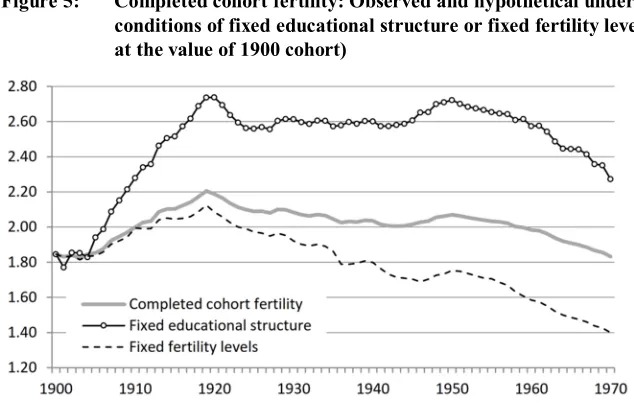
The development in the completed cohort fertility rate (CFR) can be decomposed into partial components. This decomposition is motivated by the question of whether the observed changes in cohort fertility were driven by a change in fertility levels specific to educational categories, or by an increase in educational attainment at the population level (i.e., by a change in structure). The difference in completed cohort fertility between cohortc1 andc2 is thus decomposed into the change in fertility levels ∆CFRFERT(c1,c2) and the change in structure of the female population∆CFRSTR(c1,c2)
adapting the method of Kitagawa (1955) as formalised by Das Gupta (1993: 6, formulae 2.7–2.9):
(c ) − (c ) = ∆ (c , c ) = ∆ (c , c ) + ∆ (c ,c ) (1)
∆ = ∑ [∆ ∙ ] (2)
10 With the exception of cohort 1970, which was 40–41 years old at the last 2011census. The contribution of
∆ = ∑ [ ∙ ∆ ] (3)
where ωedu is the proportion of women by education, and edu is the educational category; the fixed values of proportion by education ωedu and fertility levels CFRedu
are computed as an average value over all cohorts 1900–1970.
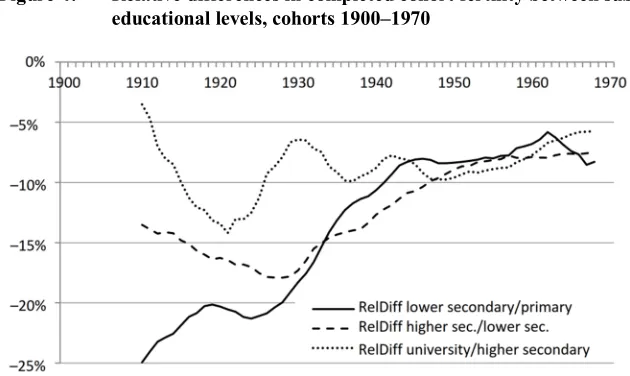
Relative differences in completed cohort fertility between subsequent educational levels (Figure 4) are computed as 5-year moving-average smoothed proportions of respective completed fertility levels of neighbouring educational categories:
( ) / = ∑ CFR ⁄∑ CFR (4)
5. Results
5.1 Completed cohort fertility by education
The modern decline in fertility in the Czech lands began as early as the second half of the 18th century, but the significant decline in fertility levels dates from the 1870s
(Fialová, Pavlík, and Vereš 1990). Completed fertility fell below the replacement level of 2.1 around cohorts 1890–1895 (Kučera 1994). The level of completed cohort fertility for cohorts born in 1900 and 1970 was at a similar level of 1.8. Between these two end points, however, cohort fertility first increased to a level of 2.2 around cohort 1920 and then steadily declined to around 2.0 where it stabilised for the cohorts 1940–1960, before declining again to 1.8 for the 1970 cohort. At the same time the period total fertility rate (TFR) showed considerable fluctuation, reacting more instantly to the economic, cultural, and institutional contexts triggered by historical changes in the 20th
Figure 2: Completed cohort fertility (CFR) of cohorts 1900–1970 and total fertility rate (TFR) in the period 1925–1995
We have identified three specific stages according to the nature of the developments in cohort fertility levels (see Figure 3 and Table 3). From cohort 1900 to 1930 the level of fertility increased among all educational groups. The overall completed fertility level increased from 1.8 to 2.2 in the 1920 cohort, and then declined slightly to 2.1. These were women whose childbearing period was during the First Republic and the Second World War, in a context of expanding lower secondary education at the expense of primary education. At the same time, fertility differences between educational groups were increasing (Figure 4).
Between cohorts 1930 to 1950, fertility stabilised at 2.1. There was a rapid convergence between groups due to continuing increased fertility among higher educational groups. The childbearing period of these women was in the time of state socialism, in a context of expanding higher secondary education at the expense of primary education.
Figure 3: Completed cohort fertility by highest attained level of education, cohorts 1900–1970
Table 3: Completed cohort fertility by highest attained level of education, cohorts 1900–1970
Cohort Primary Lower secondary Higher secondary University Total
1900 1.93 1.18 1.05 0.98 1.85
1930 2.35 1.90 1.59 1.47 2.08
1950 2.32 2.11 1.91 1.75 2.07
1970 2.04 1.91 1.78 1.69 1.83
Figure 4: Relative differences in completed cohort fertility between subsequent educational levels, cohorts 1900–1970
5.2 Decomposition of changes in completed cohort fertility
In conclusion, the increasing education of women led to a continuous decline in fertility rates as the population structure progressed towards higher educational categories in which the level of fertility is generally lower. At the same time, these education-specific fertility levels first increased among all categories, followed by a peak at cohorts 1950–1960 (earlier for those with primary education) and later a decline towards cohort 1970.
Table 4: Decomposition of changes in completed cohort fertility
Stage Total change Change in fertility levels Change in structure by education
1900 to 1930 +0.24 +0.47 –0.23
1930 to 1950 –0.01 +0.13 –0.15
1950 to 1970 –0.24 –0.17 –0.07
1900 to 1970 –0.01 +0.43 –0.44
Figure 5: Completed cohort fertility: Observed and hypothetical under the conditions of fixed educational structure or fixed fertility levels (fixed at the value of 1900 cohort)
5.3 Parity distribution
among childless women and two-child families. Among women born in 1900, overall childlessness was at 20%, while among those with higher education (still very rare at that time), childlessness was as high as 40%–50% (30% among women with lower secondary education). A strong convergence between educational levels, accompanied by a decline in childlessness to below 10%, was characteristic of population development under communist rule, and the level of childlessness did not go much above 10% until recently, with the notable exception of women with primary education (17% in cohort 1970).
Figure 6: Parity distribution by level of education for cohorts 1900 to 1970
a) Childless b) One child
c) Two children d) Three or more children
In the Czech Republic another important characteristic of the fertility model is the strongly established two-child family model. The proportion of women with two children has increased rapidly, from about 20%–30% in all educational categories to 60%. The proportion of two-child families was highest around cohort 1960, followed by a slow decline and shift towards one-child families and childless women. The only exception is women with primary education, where the initial increase in the proportion of two-child families reversed from just below 50% around cohort 1940 and declined to 34% in cohort 1970.
women who ended up with only one child was high – around 30%. When the social pressure to become a mother increased, some higher-educated women who would otherwise have preferred to remain childless opted for having a single child.
Families with three and more children show the biggest and most persistent heterogeneity across educational groups – only 10% of higher secondary and university-educated women end up with three or more children. This share has been stable at 20%–25% among women with lower secondary education and at 30%–40% among primary-educated women.
Two main features are important to highlight: first, the high uniformity between educational groups, characterised by very low childlessness, a high proportion of two-child families, and a low proportion of large families. The second feature is the exclusion of primary-educated women, who are becoming a marginal group with contrasting extremes – high childlessness and a high proportion of large families.
6. Discussion and conclusions
20th-century educational expansion in the Czech Republic, accompanied by
developments in the labour market, gender roles, family policies, and in the economic, cultural, and institutional context in general, has entailed significant changes in cohort fertility. While the overall level of completed cohort fertility hardly changed between the 1900 and 1970 cohorts, there were significant fluctuations in the level and structure of fertility during this time. Fertility levels between educational groups converged upwards, contributing to the high uniformity and homogeneity of fertility behaviour between educational categories. While the overall trend in fertility level convergence and the homogenisation of family forms confirmed our hypotheses, the upward direction of convergence was still a surprise.
While in Western Europe, increasing women’s education and labour force participation led to improvement of women’s status and female autonomy, labour force participation in the state-socialist countries brought a double burden for women and less autonomy, as female wages were significantly lower than those of males and increasing education brought limited increase in status. The state-socialist project of female emancipation through employment was unsuccessful: instead of female liberation and increasing gender equality it resulted in a double or triple burden of work, childcare, and housework (Rákosník and Šustrová 2016). That is why fertility did not decline among educational groups, and why there was a convergence upwards to relatively high levels.
two-child family, with a declining number of large families and two-childlessness dropping to the biological minimum. After 1989 we witnessed pluralisation of family forms, in particular increased childlessness and one-child families, and a broadening of educational fertility differences involving younger cohorts of women born after 1960– 1965. These findings confirmed our second hypothesis.
We were also interested in which educational level is the crucial step that results in a change in fertility behaviour. We found that in the Czech Republic, during socialism and even more after the 1989 liberalisation, primary-educated women have been the most excluded group, with contrasting extremes – both high childlessness and a high proportion of large families. Primary-educated women are increasingly select, not only socially but also ethnically – many women with only primary education remain single mothers and do not even cohabit with the child’s father (Zeman 2009), and Roma women usually have lower education and higher fertility than the majority population (Langhamrová and Fiala 2003).
Women who finish at least secondary education are very similar in respect to their parity distribution. The only significant differences are the higher childlessness of university-educated women and the higher proportion of big families among lower-secondary-educated women. We therefore conclude that the completion of secondary education (lower or higher) marks the most crucial point in fertility level decline.
The decomposition revealed that in the Czech Republic the changes in cohort fertility levels were driven primarily by changes in the population structure by education, especially by the decline in the proportion of women with primary education. Similar mechanisms in cohort fertility decline due to a changing educational composition have been identified in Italy (Cicali and Santis 2002; Breschi, Fornasin, and Manfredini 2013), Poland (Brzozowska 2014), Belgium (Van Bavel 2014), and Brazil (Lam and Duryea 1999). On the other hand, the effect of declining education-specific fertility levels prevails in Iran (McDonald et al. 2015), Spain (Requena and Salazar 2014), Britain (Berrington, Stone, and Beaujouan 2015), and South Korea (Yoo 2014).
(Brzozowska 2015), or declined while retaining constant inter-educational fertility differences, as was the case in Spain (Requena and Salazar 2014) and Britain (Berrington, Stone, and Beaujouan 2015). Merz and Liefbroer (2009) find that the negative educational gradient in Eastern European countries did not change significantly across cohorts, suggesting that the reconciliation of parenthood and labour force participation in these societies is difficult at all educational levels.
Throughout this article we have extensively discussed the role of educational expansion, especially through the contexts of female employment, family policies, and availability of public childcare. However, the most important contextual factor proved to be gender roles. During a recent attempt at quantifying gender equity through comparison in an “index of conditions for work and family reconciliation,” the Czech Republic scored at the tail end of thirty European countries, just above Malta, Greece, and Portugal (Matysiak and Węziak-Białowolska 2016: 497). Dearing (2016: 241) developed an “equal gender division of labour indicator” in which the Czech Republic scored lowest, together with Hungary, Switzerland, and Russia. And Frejka and Gietel-Basten’s overview article (2016: 24–25) labelled Czech family policy as belonging to the male breadwinner model, where employers tend to discriminate against (potential) mothers: “This model might have developed unintentionally, but has become a reality.”
If the current direction of Czech family policies remains unchanged, cohort fertility levels may decline to around 1.65 for cohort 1990. While the two-child model will still prevail, childlessness and the share of one-child families are going to increase. This will happen especially among people with university and higher secondary education, whose share will increase at the same time. The decline in cohort fertility will thus be fuelled both by the change in the population’s educational structure and by the change in education-specific fertility rates. “Fertility falls to very low levels when women must make stark choices between work and family” (McDonald 2013: 991). Future family policies should therefore focus on the reconciliation of work and family (Luci-Greulich and Thévenon 2013; Sobotka 2016) in order to provide more highly educated women with the opportunity to reach their intended number of children.
7. Acknowledgements
References
Andersson, G., Rønsen, M., Knudsen, L.B., Lappegård, T., Neyer, G., Skrede, K., Teschner, K., and Vikat, A. (2009). Cohort fertility patterns in the Nordic countries. Demographic Research 20(14): 313–352. doi:10.4054/DemRes.2009. 20.14.
Bartoňová, D. (2007). Vzestup úrovně vzdělání podle dat sčítání lidu 1961–2001 v České republice [The rise in educational levels according to census data from 1961–2001 in the Czech Republic].Demografie 49(1): 25–40.
Becker, G.S. (1960). An economic analysis of fertility. In: NBER (ed.).Demographic and economic change in developed countries. Princeton: National Bureau of Economic Research: 209–240.
Becker, G.S. (1981).A treatise on the family. Cambridge: Harvard University Press. Berrington, A., Stone, J., and Beaujouan, É. (2015). Educational differences in timing
and quantum of childbearing in Britain: A study of cohorts born 1940–1969. Demographic Research 33(26): 733–764.doi:10.4054/DemRes.2015.33.26. Blossfeld, H.-P. and Huinink, J. (1991). Human capital investments or norms of role
transition? How women’s schooling and career affect the process of family formation.American Journal of Sociology 97(1): 143–168.doi:10.1086/229743. Breschi, M., Fornasin, A., and Manfredini, M. (2013). Patterns of reproductive behavior
in transitional Italy: The rediscovery of the Italian fertility survey of 1961. Demographic Research 29(44): 1227–1260.doi:10.4054/DemRes.2013.29.44. Brzozowska, Z. (2014). Fertility and education in Poland during state socialism.
Demographic Research 31(12): 319–336.doi:10.4054/DemRes.2014.31.12. Brzozowska, Z. (2015). Female education and fertility under state socialism in Central
and Eastern Europe.Population 70(4): 689–725.
Chaloupková, J. and Mitchell, E. (2009). Návraty do zaměstnání po rodičovské dovolené: rozdíly podle rodinného uspořádání [Re-entry to work after parental leave: differences by family situation].FÓRUM sociální politiky 3.
CFE (2017). Cohort fertility and education database [electronic resource]. Vienna: Vienna Institute of Demography.http://www.cfe-database.org.
Cleland, J. and Rodriguez, G. (1988). The effect of parental education on marital fertility in developing countries. Population Studies 42(3): 419–442. doi:10.1080/0032472031000143566.
Cohen, J.E., Kravdal, Ø., and Keilman, N. (2001). Childbearing impeded education more than education impeded childbearing among Norwegian women. Proceedings of the National Academy of Sciences 108(29): 11830–11835. doi:10.1073/pnas.1107993108.
CZSO (2016). Employment and unemployment as measured by the Labour Force Survey: Annual averages 2015. Prague: Czech Statistical Office.
Das Gupta, P. (1993). Standardization and decomposition of rates: A user’s manual. Washington, D.C.: US Department of Commerce, Economics and Statistics Administration, Bureau of the Census.
Dearing, H. (2016). Gender equality in the division of work: How to assess European leave policies regarding their compliance with an ideal leave model. Journal of European Social Policy 26(3): 234–247.doi:10.1177/0958928716642951. El-Badry, M.A. (1961). Failure of enumerators to make entries of zero: Errors in
recording childless cases in population censuses. Journal of the American Statistical Association 56(296): 909–924. doi:10.1080/01621459.1961.1048 2134.
Esping-Andersen, G. (1999). Social foundations of postindustrial economies. Oxford: Oxford University Press.doi:10.1093/0198742002.001.0001.
Esping-Andersen, G. (2009). Incomplete revolution: Adapting welfare states to women’s new roles. Cambridge: Polity.
Esping-Andersen, G. and Billari, F.C. (2015). Re-theorizing family demographics. Population and Development Review 41(1): 1–31. doi:10.1111/j.1728-4457. 2015.00024.x.
Fenger, H.M. (2007). Welfare regimes in Central and Eastern Europe: Incorporating post-communist countries in a welfare regime typology. Contemporary Issues and Ideas in Social Sciences 3(2): 1–30.
Fialová, L. (2011). The history of the education on the territory of the Czech Republic. Demografie 53(4): 344–359.
Frejka, T. and Gietel-Basten, S. (2016). Fertility and family policies in Central and Eastern Europe after 1990. Comparative Population Studies 40(5): 3–56. Handcock, M.S., Huovilainen, S.M., and Rendall, M.S. (2000). Combining
registration-system and survey data to estimate birth probabilities.Demography 37(2): 187– 192.doi:10.2307/2648120.
Hašková, H. and Saxonberg, S. (2011). The institutional roots of post-communist family policy: Comparing the Czech and Slovak Republics. In: Krook, M.L. and Mackay, F. (eds.). Gender, politics and institutions: Towards a feminist institutionalism. Basingstoke: Palgrave Macmillan: 112–128. doi:10.1057/9780 230303911_7.
Havelková, B. (2009). Gender equality under Socialism. In: Bobek, M., Molek, P., and Šimíček, V. (eds.).Communist law in Czechoslovakia: Chapters from the history of injustice. Brno: Masaryk University: 179–206.
Hoem, J.M. (1986). The impact of education on modern family-union initiation. European Journal of Population 2(2): 113–133.doi:10.1007/BF01796886. Hurt, L.S., Ronsmans, C., and Thomas, S.L. (2006). The effect of number of births on
women’s mortality: Systematic review of the evidence for women who have completed their childbearing. Population Studies 60(1): 55–71. doi:10.1080/ 00324720500436011.
Kantorová, V. (2004). Education and entry into motherhood: The Czech Republic during the state socialism and the transition period (1970–1997).Demographic Research Special Collection 3(10): 245–274.doi:10.4054/DemRes.2004.S3.10. Kitagawa, E.M. (1955). Components of a difference between two rates.Journal of the
American Statistical Association50(272): 1168–1194.
Klasen, S. and Launov, A. (2006). Analysis of the determinants of fertility decline in the Czech Republic. Journal of Population Economics 19(1): 25–54. doi:10.1007/s00148-005-0030-2.
Klüsener, S., Neels, K., and Kreyenfeld, M. (2013). Family policies and the Western European fertility divide: Insights from a natural experiment in Belgium. Population and Development Review 39(4): 587–610. doi:10.1111/j.1728-4457.2013.00629.x.
Kocourková, J. (2002). Leave arrangements and childcare services in Central Europe: Policies and practices before and after the transition. Community, Work and Family 5(3): 301–318.doi:10.1080/1366880022000041793.
Kraaykamp, G. and Nieuwbeerta, P. (2000). Parental background and lifestyle differentiation in Eastern Europe: Social, political, and cultural intergenerational transmission in five former socialist societies. Social Science Research 29(1): 92–122.doi:10.1006/ssre.1999.0655.
Krausová, T. (2012). Quality of the 2011 Population and Housing Census.Demografie 54(4): 369–381.
Kravdal, Ø. (2004). An illustration of the problems caused by incomplete education histories in fertility analyses. Demographic Research Special Collection 10(3): 135–154.doi:10.4054/DemRes.2004.S3.6.
Kravdal, Ø. and Rindfuss, R.R. (2008). Changing relationships between education and fertility: A study of women and men born 1940 to 1964.American Sociological Review 73(5): 854–873.doi:10.1177/000312240807300508.
Kučera, M. (1994). Populace České republiky 1918–1991 [Population of the Czech Republic 1918–1991]. Prague: Czech Academy of Sciences.
Lam, D. and Duryea, S. (1999). Effects of schooling on fertility, labor supply, and investments in children, with evidence from Brazil. Journal of Human Resources 34(1): 160–192.doi:10.2307/146306.
Langhamrová, J. and Fiala, T. (2003). Kolik je vlastně Romů v České Republice? [How many Romanies live actually in the Czech Republic].Demografie 45(1): 23–32. Lappegård, T. and Rønsen, M. (2005). The multifaceted impact of education on entry
into motherhood. European Journal of Population 21(1): 31–49. doi:10.1007/ s10680-004-6756-9.
Lesthaeghe, R. and Van de Kaa, D.J. (1986). Twee demografische transities? In: Van de Kaa, D.J. and Lesthaeghe, R. (eds.). Bevolking: Groei en krimp. Deventer: Van Loghum Slaterus: 9–24.
Liefbroer, A.C. and Corijn, M. (1999). Who, what, where and when? Specifying the impact of educational attainment and labour force participation on family formation. European Journal of Population 15(1): 45–75. doi:10.1023/A: 1006137104191.
Luci-Greulich, A. and Thévenon, O. (2013). The impact of family policies on fertility trends in developed countries. European Journal of Population 29(4): 387–416. doi:10.1007/s10680-013-9295-4.
Lutz, W., Goujon, A., and Doblhammer-Reiter, G. (1998). Demographic dimensions in forecasting: Adding education to age and sex. Population and Development Review 24(1): 42–58.doi:10.2307/2808050.
Lutz, W. and K.C., S. (2011). Global human capital: Integrating education and population.Science 333(6042): 587–592.doi:10.1126/science.1206964.
Martín-García, T. (2008). A reassessment of the role of women’s education in existing fertility research.Genus 1–2(64): 131–157.
Matysiak, A. and Węziak-Białowolska, D. (2016). Country-specific conditions for work and family reconciliation: An attempt at quantification. European Journal of Population32(4): 475–510.doi:10.1007/s10680-015-9366-9.
McDonald, P. (2013). Societal foundations for explaining low fertility: Gender equity. Demographic Research 28(34): 981–994.doi:10.4054/DemRes.2013.28.34. McDonald, P., Hosseini-Chavoshi, M., Abbasi-Shavazi, M.J., and Rashidian, A. (2015).
An assessment of recent Iranian fertility trends using parity progression ratios. Demographic Research 32(58): 1581–1602.doi:10.4054/DemRes.2015.32.58. Merz, E.M. and Liefbroer, A. (2009). Report on analysis of ESS data on cross-national
differences in perceived norms concerning fertility-related behaviour. Vienna: Vienna Institute of Demography (REPRO Deliverable 6).
Ministry of Education (2012).Statistic yearbook of schools and education 2010/2011. Prague: Ministry of Education, Youth and Sports of the Czech Republic.
Neels, K. and De Wachter, D. (2010). Postponement and recuperation of Belgian fertility: How are they related to rising female educational attainment? Vienna Yearbook of Population Research 8: 77–106. doi:10.1553/populationyearbook 2010s77.
Ní Bhrolcháin, M. and Beaujouan, É. (2012). Fertility postponement is largely due to rising educational enrolment. Population Studies 66(3): 311–327. doi:10.1080/ 00324728.2012.697569.
Nieuwbeerta, P. and Rijken, S. (1996). Educational expansion and educational reproduction in Eastern Europe, 1940–1979. Czech Sociological Review 4(2): 187–210.
OECD (2017). OECD family database [electronic resource]. OECD: Paris.http://www. oecd.org/social/family/database.
Rákosník, J. and Šustrová, R. (2016). Rodina v zájmu státu [Family in the state interest].Prague: Lidové noviny.
Requena, M. and Salazar, L. (2014). Education, marriage, and fertility: The Spanish case. Journal of Family History 39(3): 283–302. doi:10.1177/03631990145 27592.
Rindfuss, R.R., Bumpass, L., and John, C.S. (1980). Education and fertility: Implications for the roles women occupy. American Sociological Review 45(3): 431–447.doi:10.2307/2095176.
Rindfuss, R.R., Choe, M.K., and Brauner-Otto, S.R. (2016). The emergence of two distinct fertility regimes in economically advanced countries. Population Research and Policy Review 35(3): 287–304.doi:10.1007/s11113-016-9387-z. Rychtaříková, J. (2004). Změny generační plodnosti v České republice se zaměřením na
vzdělání žen [Changes of cohort fertility in the Czech Republic, with a focus on educational attainment of women].Demografie 46(2): 77–90.
Saxonberg, S. and Szelewa, D. (2007). The continuing legacy of the communist legacy? The development of family policies in Poland and the Czech Republic. Social Politics: International Studies in Gender, State and Society 14(3): 351–379. doi:10.1093/sp/jxm014.
Scott, H. (1974).Does socialism liberate women? Boston: Beacon.
Skirbekk, V. (2008). Fertility trends by social status. Demographic Research 18(5): 145–180.doi:10.4054/DemRes.2008.18.5.
Sobotka, T. (2016). The European middle way? Low fertility, family change, and gradual policy adjustments in Austria and the Czech Republic. In: Rindfuss, R.R. and Choe, M.K. (eds.). Low fertility, institutions, and their policies. Basel: Springer International: 131–163.doi:10.1007/978-3-319-32997-0_6.
Sobotka, T., Zeman, K., and Kantorová, V. (2003). Demographic shifts in the Czech Republic after 1989: A second demographic transition view. European Journal of Population 19(3): 249–277.doi:10.1023/A:1024913321935.
Sobotka, T., Šťastná, A., Zeman, K., Hamplová, D., and Kantorová, V. (2008). Czech Republic: A rapid transformation of fertility and family behaviour after the collapse of state socialism. Demographic Research 19(14): 403–454. doi:10.4054/DemRes.2008.19.14.
Testa, M.R. (2007). Childbearing preferences and family issues in Europe: Evidence from the Eurobarometer 2006 survey. Vienna Yearbook of Population Research 5: 357–379.doi:10.1553/populationyearbook2007s357.
United Nations (1983). Manual X: Indirect techniques for demographic estimation. New York: United Nations.
Van Bavel, J. (2014). The mid-20th century Baby Boom and the changing educational
gradient in Belgian cohort fertility. Demographic Research 30(33): 925–962. doi:10.4054/DemRes.2014.30.33.
Van de Kaa, D.J. (1987). Europe’s second demographic transition.Population Bulletin 42(1).
Wood, J., Neels, K., and Kil, T. (2014). The educational gradient of childlessness and cohort parity progression in 14 low fertility countries. Demographic Research 31(46): 1365–1416.doi:10.4054/DemRes.2014.31.46.
Wynnyczuk, V. and Uzel, R. (1999). Czech Republic and Slovak Republic. In: David, H.P. and Skilogianis, J. (eds.). From abortion to contraception: A resource to public policies and reproductive behavior in Central and Eastern Europe from 1917 to the present. Westport: Greenwood: 91–120.
Zeman, K. (2006). Úmrtnostní tabulky podle nejvyššího ukončeného vzdělání, Česká republika, 2001 [Mortality tables according to the highest attained level of education, Czech Republic, 2001].Demografie 48(3): 207–217.
Zeman K. (2009). The link between women’s education and non-marital childbearing in the Czech Republic.Romanian Journal of Population Studies 1: 90–108. Zeman, K. (2015). Human Fertility Database documentation: The Czech Republic
[electronic resource]. Rostock and Vienna: Human Fertility Database. http://www.humanfertility.org/.