Original Research Article
CONSIDERATION OF THYROID DYSFUNCTION FOR MENSTRUAL
ABNORMALITIES IN PREMENOPAUSAL WOMEN
Anita Ramesh Annaldasula
1, Shivakrishna Gouroju *
2.
1 Associate professor, obstetrics & Gynecology, Shanthiram Medical College, Nandyal, Kurnool,
Andhra Pradesh, India.
2 Tutor in Biochemistry, Andaman and Nicobar Island Institute of Medical sciences, Port Blair,
India.
Online Access and Article Informtaion
International Journal of Integrative Medical Sciences ISSN (P): 2394 - 6318. ISSN (E): 2394 - 4137
www.imedsciences.com ABSTRACT
BACKGROUND
Address for correspondence: Dr. Shivakrishna Gouroju, Tutor in Biochemistry, Andaman and Nicobar Island Institute of Medical sciences, Port Blair, India. E-Mail: [email protected]
Int J Intg Med Sci 2018, Vol 5(6):650-54. ISSN 2394 - 4137 DOI: https://dx.doi.org/10.16965/ijims.2018.116
Quick Response code
Received: 28-05-2018
Reviewed: 28-05-2018
Accepted: 20-06-2018
Published: 05-07-2018
Source of Funding: Self Conflicts of interest: None
DOI: 10.16965/ijims.2018.116
Abnormal Uterine Bleeding (AUB) is one of the most frequently encountered conditions in women, it has been recognized that thyroid dysfunction may have profound effects on the female reproductive system, menstrual disturbances and cause of excessive puberty bleeding. Hence this study is to evaluate the thyroid function in patients having abnormal uterine bleeding from age group of 20 to 40 yrs with 100 AUB patients which will help in further management and also know the prevalence of thyroid disorders in abnormal uterine bleeding. Out of 100 patients 42 women with thyroid abnormality, heavy menstrual bleeding was seen in 21 (50%) women, 11 (26.19%) had Polymenorrhagia, 10 (23.81%) had Oligomenorrhoea, in women with hypothyroidism (30 women) was heavy menstrual bleeding in 17 (56.67%) women, 6 (20%) had Oligomenorrhoea, 7 (23%) had Polymenorrhagia, and in 18 women with hyperthyroidism, 10 (55.56%) had heavy menstrual bleeding, 4 (22.22%) had oligomenorrhoea, 4 (22.22%) had Polymenorrhagia. So that clinicians should consider that thyroid dysfunction is as an important associated factor for menstrual abnormalities even in premenopausal women. It is important to screen all women for thyroid abnormality who are presenting with AUB especially with non-structural causes of AUB. Correction of thyroid abnormalities also relieves AUB. This will avoid unnecessary hormonal treatment and surgery.
KEY WORDS: Abnormal Uterine Bleeding, thyroid dysfunction, heavy menstrual bleeding, Oligomenorrhoea,
Polymenorrhagia.
Abnormal Uterine Bleeding (AUB) is one of the most frequently encountered conditions in gynecology. It has long been recognized that thyroid dysfunction may have profound effects on the female reproductive system. Thyroid disorders are 10 times more common in women than in men [1]. Majority of the cases of subclinical hypothyroidism easily pass unrecog-nized. The prevalence of subclinical hypothyroid-ism is as high as 9.5 percent in women [2].
Danese MD et al recommend hypothyroidism is frequent enough to warrant consideration in older women [3]. Ely et al state that any irregu-lar bleeding in non pregnant patient and in non pregnant patients with menorrhagia TSH should be evaluated [4].
A prevalence of 22% of early hypothyroidism by thyrotropin releasing hormone test in menor-rhagic women, that is much higher than that found in general population[8]. Hypothyroid-ism was the second common cause of exces-sive puberty bleeding. Adolescents with hy-pothyroidism tend to have milder symptoms than older patients, the cause of excessive bleeding in hypothyroidism remains in the realm of speculation [9]. Both hypothyroidism and hyperthyroidism may result in menstrual distur-bances. With hyperthyroidism, hypomenorrhea and amenorrhea are more frequent complaints, and menorrhagia is noted in approximately 5 percent. With hypothyroidism, women commonly present with menorrhagia, metrorrhagia and anovulatory type of dysfunctional uterine bleed-ing. Hence this study is to evaluate the thyroid function in patients having abnormal uterine bleeding from age group of 20 to 40 yrs which will help in further management and also know the prevalence of thyroid disorders in abnormal uterine bleeding.
MATERIALS AND METHODS
thorough history taking regarding age, bleeding pattern, onset, duration, quantity of bleeding and complaints related to thyroid dysfunction were noted in detail. A thorough clinical examination including general physical examination, neck examination, systemic and gynecologic exami-nations were carried out. All the recruited patients were subjected to routine investigations like hemoglobin, ESR, LFT, RBS, complete urine examination, bleeding time, clotting time, chest x-ray, ultrasound abdomen and pelvis, pap smear, endometrial biopsy. All patients were subjected to T3, T4 and TSH. T3 and T4 were assayed by competitive chemiluminescent immunoassay. TSH was estimated by ultra- sensitive fully automated ADV1A centaur, using two sites and which, and chemilumines-cent immunoassay and analyzed.
Reference values: Serum T4 – 60-120 ng/ml, Serum T3 – 0.8 -16 ng/ml, Serum TSH – 0.5-5 mU/ml
This prospective study conducted in the depart-ment of Obstetrics and Gynecology, Santhiram medical college and hospital, Nandyal. A.P. on all 100 women in the age group of 20 to 40 yrs attending or admitted in the hospital during the period from October 2017 to March 2018, with abnormal uterine bleeding and Ultrasound showing normal uterus and ovary finding were included in the study. Patient suffering with diagnosed case of ovarian cyst, uterine fibroid, polyp, adenomyosis, endometriosis and malig-nant (endometrial and cervical) tumors, goiter, carcinoma thyroid. Patients who are on drugs or hormones, IUCD users, with overt clinical symp-toms of thyroid dysfunction, history of bleeding disorders (haemophilia, von Willebrand’s disease), Pelvic infections including endometri-tis, PID, PCOD, Patient on sex steroids were excluded from the study. The data will be collected using a prepared proforma meeting the objectives of the study by means of personal interview of the patient after taking informed consent. The descriptive statistical analysis was performed using SPSS software 11.5 VERSION.
Procedure: The study protocol included a
RESULTS
Table 1: Thyroid abnormality and menstrual pattern.
Menstrual pattern. Numbers % Heavy menstrual
bleeding 21 50
Oligomenorrhoea 10 23.81 Polymenorrhagia 11 26.19
Total 42 100
Fig. 1: Thyroid abnormality and menstrual pattern.
(A) (B) (C)
were hypothyroid and 18 (18%) were hyperthy-roid. Thyroid abnormality - Menstrual pattern: Among 42 women with thyroid abnormality, heavy menstrual bleeding was seen in 21 (50%) women, 11 (26.19%) had Polymenorrhagia, 10 (23.81%) had Oligomenorrhoea (Table 1 and Figure 1).
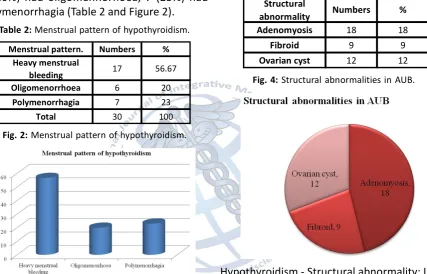
Hypothyroidism - Menstrual pattern: The frequent menstrual abnormality in women with hypothyroidism (30 women) was heavy menstrual bleeding in 17 (56.67%) women, 6 (20%) had oligomennorhoea, 7 (23%) had polymenorrhagia (Table 2 and Figure 2).
Table 2: Menstrual pattern of hypothyroidism.
Menstrual pattern. Numbers % Heavy menstrual
bleeding 17 56.67
Oligomenorrhoea 6 20 Polymenorrhagia 7 23
Total 30 100
Fig. 2: Menstrual pattern of hypothyroidism.
Hyperthyroidism - Menstrual pattern: Out of 18 women with hyperthyroidism, 10 (55.56%) had heavy menstrual bleeding, 4 (22.22%) had oligomenorrhoea, 4 (22.22%) had polymenor-rhagia (Table 3 and Figure 3).
AUB - Structural abnormalities: In a total of 100 patients with AUB, 39 (39%) had structural ab-normalities in uterus and ovaries. 18 (18%) had adenomyosis, 12 (12%) had ovarian cysts, 9 (9%) had the fibroids (Table 4 and Figure 4).
Table 3: Menstrual pattern of hyperthyroidism.
Menstrual pattern. Numbers % Heavy menstrual
bleeding 10 55.56
Oligomenorrhoea 4 22.22 Polymenorrhagia 4 22.22
Total 18 100
Fig. 3: Menstrual pattern of hyperthyroidism.
Table 4: Structural abnormalities in AUB. Structural
abnormality Numbers %
Adenomyosis 18 18
Fibroid 9 9
Ovarian cyst 12 12 Fig. 4: Structural abnormalities in AUB.
Hypothyroidism - Structural abnormality: In 30 women with hypothyroidism, 7 (23.33%) had adenomyosis and 3 (10%) had fibroid.
DISCUSSION
Irregular menstrual with thyroid abnormality are very common in women and even precede the onset of thyroid abnormalities that is both hypo and hyperthyroidism [8]. Menstrual irregulari-ties ranges from oligomenoorhoea to menor-rhagia [9].
et al. (2012) (22% hypo, 14% hyper, 64% euthy-roid) [10].
Thyroid abnormality - Menstrual pattern: Among 42 women with thyroid abnormality, heavy men-strual bleeding was seen in 21 (50%) women, 11 (26.19%) had Polymenorrhagia, 10 (23.81%) had Oligomenorrhoea (Table 1 and Figure 1) which is near to study done by Padmaleela et al. and Byna P et al [11, 12].
In present study group HMB was found in 17 (56.67%) women, 6 (20%) had oligomennorhoea, 7 (23%) had polymenorrhagia in hypothyroid women which is closely related to study done by Padmaleela et al. (HMB in 53.3%, polymenorrhagia in 20%, oligomenorrhoea in 20%) [11]. In present study group HMB was found in 10 (55.56%) of hyperthyroid women which is related to study done by Padmaleela et al. (HMB in 42.8%). 4 (22.22%) had oligomen-orrhoea, 4 (22.22%) had polymenorrhagia [11]. In Dipak Lahiri et al. study of 189 hypothyroid women to find out their menstrual pattern and fertility status, as many as 91 patients (71.09%) had subclinical hypothyroidism; 46.87% had nor-mal menstrual pattern. Menstrual aberrations included mainly oligomenorrhoea, hypomen-orrhoea, menorrhagia and secondary amenor-rhoea. Oligomenorrhoea was the commonest menstrual abnormality found mainly in early age group women. Menorrhagia was commoner in later age group. In this study author has commented that “as majority of cases are subclinical, it is essential to evaluate thyroid function in all women with intractable menstrual disorders, infertility and recurrent pregnancy loss [11].
In present study group 39 (39%) had structural abnormalities in uterus and ovaries but in the Nellore region Byna P et al found only 11 (20%) had structural abnormalities in uterus and ovaries. In the present study 18 (18%) had adenomyosis, a study done by Bhavani et al. [14] in that they found 8.3% adenomyosis, Byna P et al [12] found 9%.
In present study 9 (9%) patients had fibroids but in the Nellore region study done by Byna P et al [12] showing 5.4% and in Gowri M et al. [15] found 2.4% and 12 (12%) patients were resent with ovarian cyst, Byna P et al [12] showing 5.4% had ovarian cyst and in Gowri M et al. [15], 1.7%
showed which are lesser than my findings. In present study group, 7 (23.33%) women with hypothyroidism had adenomyosis and 3 (10%) had fibroid. But in the study done by Byna P et al. from Nellore region they found 25% women with hypothyroidism had adenomyosis and 8.33% had fibroid [12].
CONCLUSION
Thyroid dysfunction should be considered as an important associated factor for menstrual abnormalities even in premenopausal women. It is important to screen all women for thyroid abnormality who are presenting with AUB especially with non-structural causes of AUB. Correction of thyroid abnormalities also relieves AUB. This will avoid unnecessary hormonal treatment and surgery.
REFERENCES
[1]. Berek JS, Adarshi EY and Hillard PA. In endocrine disorders. Novaks Gynaecology, 12th Edn. William
& Wilkins, Gopson paper Ltd., Noida. 2001; pp.864. [2]. Rebecca Abraham, V Srinivasa Murugan Et al., :Thy-roid disorders in women of Puducherry, Indian jour-nal of clinical biochemistry.2009:24:52-9.
[3]. Danese MD, Powe NR, Swain CT, Ladenson PW. Screening for mild thyroid failure at the periodic health examination. A decision and Cost effective analysis. JAMA 1996; 276: 285.
[4]. John W. Ely M.D.,MSPH, Colleen M. Kennedy, MD, MS, Elizabeth C. Clark, MD et al.,:Abnormal uterine bleed-ing: A management algorithm. Department of Ob-stetrics and Gynaecology, University of Iowa Carver College of Medicine, Lowa Cirty.IA, Pg. 1-17. [5]. Joschi JV, Bhandarkar SD, Chadha M, Balaiah D,
Shah R. Menstrual irregularities and lactation fail-ure may precede thyroid dysfunction on goiter. J Postgrad Med 1993; 39(3): 137-41.
[6]. Wilansky DL, Griesman B. Early hypothyroidism in patients with menorrhagia. Am J Obstet Gynaecol. 1989; 160:673-7.
[7]. Jayadey Mukherjee and NN Roy Chowdhary.A review of 70 cases of puberty menorrhagia. J Obst and Gynaec of India. 1986 pp.121.
[8]. Pushpa S, BikhaRam D, Razia MA, ZulfiquarAli SS, Tarachand D, Ishrat B. Impaired thyroid functions in patients with menstrual disturbances (An expe-rience of a private clinic). World Appl Sci J. 2009;7(4):538-42.
[9]. Sruthi T, Shilpa SB, Gopal N. Prevalence of hypothy-roidism in patients with provisional diagnosis of DUB. J Evol Med Dent Sci. 2014;3(11):2967-72. [10]. Sharma N, Sharma A. Thyroid profile in menstrual
How to cite this article: Anita Ramesh Annaldasula, Shivakrishna Gouroju. CONSIDERATION OF THYROID DYSFUNCTION FOR MENSTRUAL ABNORMALITIES IN PREMENOPAUSAL WOMEN. Int J Intg Med Sci 2018;5(6):650-654. DOI: 10.16965/ijims.2018.116
[11]. Padmaleela K, Vimala T, Lavanya KM, Kiranmai D. Thyroid disordrs and dysfunctional uterine bleed-ing (DUB) among reproductive age group women. A cross sectional study in a tertiary care hospital in Andhra Pradesh, India. Int J Med Pharm Sci. 2013;4(1):41-6.
[12]. Byna P, Siddula S, Kolli S, Shaik MV. Thyroid abnor-mality in perimenopausal women with abnormal uterine bleeding. Int J Res Med Sci 2015;3:3250-3. [13]. Dipak Lahiri, Anian Dasgupta, Sarmila Kundu.
Men-strual pattern and fertility status of hypothyroid women. J Obst and Gynaec of India 1996; 47: 663.