ON A CRITERION FOR MULTIVALENT HARMONIC FUNCTIONS
T. HAYAMI1 §
Abstract. For normalized harmonic functions f(z) = h(z) +g(z) in the open unit disk, a criterion on the analytic parth(z) forf(z) to bep-valent and sense-preserving is discussed. Furthermore, several illustrative examples and images off(z) satisfying the obtained condition are enumerated.
Keywords: Harmonic function, Multivalent function, Univalent function. AMS Subject Classification: 30C45, 58E20.
1. Introduction and Definitions
For a fixed p (p = 1,2,3,· · ·), a meromorphic function f(z) in a domain D is said to bep-valent (or multivalent of order p) inD if for each w0 the equation f(z) = w0 has at mostproots inDwhere the roots are counted in accordance with their multiplicity and if there is somew1 such that the equationf(z) =w1 has exactlyproots inD. In particular,
f(z) is said to be univalent in Dwhen p= 1. A complex-valued harmonic function f(z) inDis given by
f(z) =h(z) +g(z) (1.1) where h(z) and g(z) are analytic in D. We call h(z) and g(z) the analytic part and co-analytic part of f(z), respectively. A necessary and sufficient condition for f(z) to be locally univalent and sense-preserving inDis|h′(z)|>|g′(z)|for allz∈D(see [2] or [8]). LetH(p) denote the class of functions f(z) of the from
f(z) =h(z) +g(z) =zp+ ∞ ∑
n=p+1
anzn+ ∞ ∑
n=p
bnzn (1.2)
which are harmonic in the open unit diskU={z∈C:|z|<1}. We next denote bySH(p) the class of functionsf(z)∈ H(p) which arep-valent and sense-preserving inU. Then, we say thatf(z)∈ SH(p) is a p-valently harmonic function in U.
In the present paper, we discuss a sufficient condition abouth(z) forf(z)∈ H(p) given by (1.2), satisfying
g′(z) =zm−1h′(z) (1.3) for somem(m= 2,3,4,· · ·), to be in the classSH(p).
1 Department of Mathematics, Kinki Universiy, Higashi-Osaka, Osaka 577-8502, Japan, e-mail: ha ya [email protected]
§ Submitted for GFTA’13, held in I¸sık University on October 12, 2013.
TWMS Journal of Applied and Engineering Mathematics, Vol.4, No.1; c⃝I¸sık University, Department of Mathematics 2014; all rights reserved.
⌊ ⌋ is the floor function, the equation
F(t) = 2kπ (2.2)
has at most a single root in[−π, π) and for all k∈K there exist exactly2p+m−1 such roots in [−π, π), then the harmonic function f(z) =h(z) +g(z) with g′(z) =zm−1h′(z)
belongs to the class SH(p) and maps Uonto a domain surrounded by 2p+m−1 concave curves with 2p+m−1 cusps.
Remark 2.1. If we take p= 1 in Theorem 2.1, then we readily arrive at the univalence criterion for harmonic functions due to Hayami and Owa[5, Theorem 2.1](see also [10]).
3. Some Illustrative Examples and Image Domains
We discuss harmonic functions f(z) =h(z) +g(z) which satisfy the conditions of The-orem 2.1 and their image domains.
Example 3.1. Let h(z) =zp. Then we easily see that the equation (2.2)becomes
(2p+m−1)t= 2kπ
(
k= 0,±1,±2,· · · ,±⌊2p+m+ 1
2 ⌋
)
(3.1)
which satisfies the conditions of Theorem 2.1. Hence, the function
f(z) =h(z) +g(z) =zp+ p
p+m−1z
p+m−1 (g′(z) =zm−1h′(z)) (3.2)
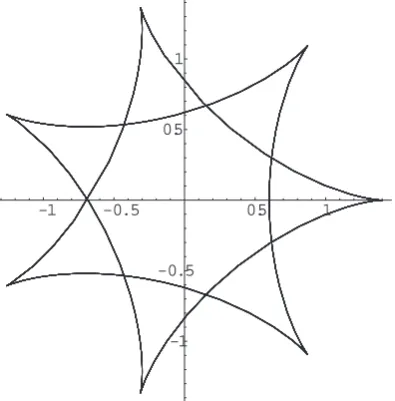
belongs to the classSH(p) and it mapsU onto a domain surrounded by2p+m−1concave curves with 2p+m−1 cusps. Taking p = 2 and m = 4 for example, we know that the function
f(z) =z2+2 5z
5 (3.3)
is a 2-valently harmonic function in U and it maps U onto the domain surrounded by 7
concave curves with7 cusps as shown in Figure 1.
Remark 3.1. Since it follows that
F(t) = (2p+m−1)t+ 2Im(logH(eit)) (3.4)
where F(t) is given by (2.1), we obtain that
F′(t) =m+ 1 + 2Re (
eith′′(eit)
h′(eit) )
-1 -0.5 0.5 1
-1 -0.5
0.5 1
Figure 1. The image off(z) =z2+2
5z
5.
which implies thatF(t) is increasing if
Re (
1 +zh ′′(z)
h′(z) )
>−m−1
2 (z∈U). (3.6)
By the above remark, we derive the following exapmle.
Example 3.2. Let h(z) = zp+ c
p+ 1z p+1
(
|c| ≤p− 2p
2p+m+ 1 )
. Then the equation
(2.2)becomes
F(t) = (2p+m−1)t+ 2 arg(p+ceit). (3.7)
Noting
Re (
1 +zh ′′(z)
h′(z) )
> p+ 1− p
p− |c| ≥ − m−1
2 (z∈U), (3.8)
F(−π) =−(2p+m−1)π−2 arctan (
|c|sinθ p− |c|cosθ
)
(3.9)
and
F(π) = (2p+m−1)π−2 arctan (
|c|sinθ p− |c|cosθ
)
(3.10)
where 0 ≤ θ = arg(c) < 2π, we see that F(t) satisfies the conditions of Theorem 2.1. Hence, the function
f(z) =h(z) +g(z) =zp+ c
p+ 1z
p+1+ p
p+m−1z
p+m−1+ c
p+mz
p+m (3.11)
belongs to the classSH(p) and it mapsU onto a domain surrounded by2p+m−1concave
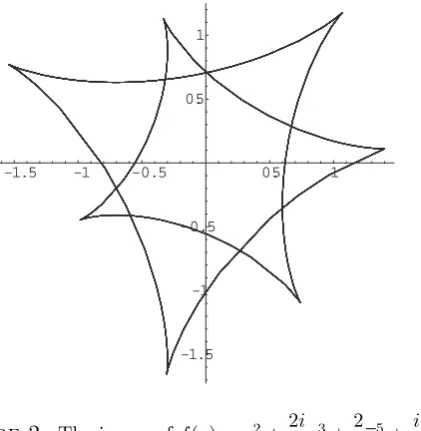
curves with2p+m−1 cusps. Putting p= 2, m= 4 and c= 2 3i
(
|c| ≤ 14
9 )
, we know
that the function
f(z) =z2+2i 9z
3+ 2 5z
5+ i 9z
-1.5 -1 -0.5 0.5 1
-1.5 -1 -0.5
Figure 2. The image off(z) =z2+2i
9z
3+2
5z
5+ i
9z
6.
In consideration of the process of proving Theorem 2.1, we obtain the following inter-esting example.
Example 3.3. If we consider special functions h(z) and g(z) given by
h′(z) = pz p−1
1 +z2p+m−1 and g′(z) =
pzp+m−2
1 +z2p+m−1 (
g′(z) =zm−1h′(z)), (3.13)
then the function
f(z) =h(z) +g(z) = ∫ z
0
pζp−1
1 +ζ2p+m−1dζ+ ∫ z
0
pζp+m−2
1 +ζ2p+m−1dζ (3.14)
is a member of the class SH(p) and it maps U onto a domain surrounded by 2p+m−1
straight lines with2p+m−1 cusps. Indeed, setting p= 2 and m= 2, we know that
f(z) = ∫ z
0 2ζ
1 +ζ5dζ+ ∫ z
0 2ζ2
1 +ζ5dζ (3.15)
is a 2-valently harmonic function and it maps U onto a star as shown in Figure 3. Fur-thermore, if we take p= 1 in (3.14), then we see that the function
fm+1(z) =h(z) +g(z) = ∫ z
0 1
1 +ζm+1dζ+ ∫ z
0
ζm−1
1 +ζm+1dζ (3.16)
-1 -0.5 0.5 1
-1 -0.5
0.5 1
Figure 3. The image off(z) =
∫ z
0
2ζ
1 +ζ5dζ+ ∫ z
0
2ζ2
1 +ζ5dζ
4. Appendix
Finally, we recall here the following theorem due to Mocanu [9].
Theorem 4.1. Let h(z) and g(z) be analytic functions in a domain D. If h(z) is convex in D and |g′(z)| < |h′(z)| for z ∈ D, then the harmonic function f(z) = h(z) +g(z) is univalent and sense-preserving inD.
In other words, if h(z) and g(z) satisfy
g′(z) =w(z)h′(z) (z∈D) (4.1)
and
Re (
1 +zh ′′(z)
h′(z) )
>0 (z∈D) (4.2)
for some analytic functionw(z)in Dsatisfying|w(z)|<1 (z∈D), thenf(z)is univalent and sense-preserving inD.
Bshouty and Lyzzaik [1] have shown the next theorem which is closely related to The-orem 2.1 and Remark 3.1 with p= 1 and m = 2 as the stronger result of the conjecture of Mocanu [10].
Theorem 4.2. If h(z) and g(z) are analytic in U, with h′(0)̸= 0, which satisfy
g′(z) =zh′(z) (4.3)
and
Re (
1 +zh ′′(z)
h′(z) )
>−1
2 (4.4)
for allz∈U, then the harmonic function f(z) =h(z) +g(z) is univalent close-to-convex in U.
References
[1] Bshouty, D. and Lyzzaik, A., (2011), Close-to-convexity criteria for planar harmonic mappings, Com-plex Anal. Oper. Theory, 5, 767-774.
[2] Clunie, J. and Sheil-Small, T., (1984), Harmonic univalent functions, Ann. Acad. Sci. Fenn. Ser. A I Math., 9, 3-25.
[3] Duren, P. L., (2004), Harmonic Mappings in the Plane, Cambridge University Press, Cambridge. [4] Goodman, A. W., (1983), Univalent Functions, Vol. I and Vol. II, Mariner Publishing Company,
Tampa, Florida.
[5] Hayami, T. and Owa, S., (2011), Hypocycloid of n+ 1 cusps harmonic function, Bull. Math. Anal. Appl., 3, 239-246.
[6] Hayami, T., (2012), Coefficient conditions for harmonic close-to-convex functions, Abstr. Appl. Anal., 2012, Article ID 413965, 12 pp.
[7] Hayami, T., (2013), A sufficient condition for p-valently harmonic functions, Complex Var. Elliptic Equ., Published online. DOI : 10.1080/17476933.2013.826656.
[8] Lewy, H., (1936), On the non-vanishing of the Jacobian in certain one-to-one mappings, Bull. Amer. Math. Soc., 42, 689-692.
[9] Mocanu, P. T., (1981), Sufficient conditions of univalency for complex functions in the classC1, Rev. d’Anal. Nume´er. et de Th´eorie Approx., 10, 75-81.
[10] Mocanu, P. T., (2009), Three-cornered hat harmonic functions, Complex Var. Elliptic Equ., 54, 1079-1084.