Iran University of Medical Sciences
____________________________________________________________________________________________________________________
1. (Corresponding author) PhD of Speech-Language Pathology, Department of Speech Therapy, School of Rehabilitation, Iran University of
Medical Sciences, Tehran, Iran. [email protected]
2. MD, Associate Professor, Department of Neurology, Iran University of Medical Sciences, Tehran, Iran. [email protected] 3. MD, Professor, Department of Basic Sciences in Rehabilitation, School of Rehabilitation, Iran University of Medical Sciences, Tehran, Iran.
4. PhD, Professor, Department of Linguistics, Human Sciences and Cultural Education Institute, Tehran, Iran. [email protected] 5. PhD, Associate Professor, Department of Basic Sciences in Rehabilitation, Iran University of Medical Sciences, School of Rehabilitation
Sciences, Tehran, Iran. [email protected]
Developing the Persian version of the homophone meaning
generation test
Mona Ebrahimipour*1, Mohammad Reza Motamed2, Hassan Ashayeri3
Yahya Modarresi4, Mohammad Kamali5
Received:16 May 2015 Accepted:26 September 2015 Published:22 February 2016
Abstract
Background: Finding the right word is a necessity in communication, and its evaluation has always been a challenging clinical issue, suggesting the need for valid and reliable measurements. The Homophone Meaning Generation Test (HMGT) can measure the ability to switch between verbal concepts, which is required in word retrieval. The purpose of this study was to adapt and validate the Persian version of the HMGT.
Methods: The first phase involved the adaptation of the HMGT to the Persian language. The se-cond phase concerned the psychometric testing. The word-finding performance was assessed in 90 Persian-speaking healthy individuals (20-50 year old; 45 males and 45 females) through three nam-ing tasks: Semantic Fluency, Phonemic Fluency, and Homophone Meannam-ing Generation Test. The participants had no history of neurological or psychiatric diseases, alcohol abuse, severe depression, or history of speech, language, or learning problems.
Results: The internal consistency coefficient was larger than 0.8 for all the items with a total Cronbach’s alpha of 0.80. Interrater and intrarater reliability were also excellent. The validity of all items was above 0.77, and the content validity index (0.99) was appropriate. The Persian HMGT had strong convergent validity with semantic and phonemic switching and adequate divergent validity with semantic and phonemic clustering.
Conclusion: The Persian version of the Homophone Meaning Generation Test is an appropriate, valid, and reliable test to evaluate the ability to switch between verbal concepts in the assessment of word-finding performance.
Keywords: Homophone Meaning Generation Test, Language, Naming, Neuropsychological As-sessment, Verbal Fluency.
Cite this article as:Ebrahimipour M, Motamed MR, Ashayeri H, Modarresi Y, Kamali M. Developing the Persian version of the homo-phone meaning generation test.Med J Islam Repub Iran2015 (22 February). Vol. 29:335.
Introduction
Word retrieval is an ability composed of two components: Lexical knowledge, and a search process within existing lexical knowledge (1). Word-finding is usually evaluated through picture naming tasks such as Peabody Picture Vocabulary Test (2), in which each picture corresponds to one word. In picture naming tasks,
exami-nees are supposed to search in their brain to identify the required lexical item; and when it is identified, the search is finished. Therefore, this is a type of mental activity which mostly addresses word knowledge, but executive search strategies receive less attention (1).
Verbal fluency is another test which is used frequently in neuropsychological
sessments (3). It has two subtests, semantic fluency and phonemic fluency, in which the participant is asked to generate as many words as possible in 60 seconds. The words are within a semantic category in the se-mantic fluency subtest, or start with a spe-cific letter in the phonemic fluency subtest (4). Unlike picture naming tests, verbal flu-ency covers both the lexical storage and the ability to access word storage by its two components which are known as clustering and switching (1).
Clustering represents the production of words within the semantic or phonemic subcategories, and switching reflects the ability to shift between clusters (1,3).
Verbal fluency test with its qualitative evaluation method (clustering and switch-ing) was adapted to the Persian language by Ebrahimipour et al. in 2008. This test was used to evaluate clustering and switching in the semantic and phonemic fluency per-formances in patients with multiple sclero-sis (MS), Parkinson’s disease (PD), and amyotrophic lateral sclerosis (ALS). The psychometric properties of the Persian ver-bal fluency test were also determined and normalized for Persian-speaking children and adults aged 7-69 years. In short, the Persian Verbal Fluency Test is a valid and reliable instrument which can reveal verbal fluency deficits in patients with MS, PD, and ALS (5-8).
Homophone meaning generation is a test assessing retrieval flexibility. In this test, the examinee is asked to generate multiple meanings for each homophone. The Eng-lish version of this test includes eight hom-ophones: Tick, tip, slip, form, plain, bored, right, and sent (9,10). It seems that HMGT requires more searching strategies than the previous two tests (i.e., picture naming and verbal fluency) since after the first retrieval attempt, the examinee needs to continue to search using more complicated techniques (1,9,10). Warrington (2000) suggests that HMGT measures the ability to switch be-tween alternative verbal concepts, and pa-tients with anterior brain lesions were found to be more impaired on the HMGT
than patients with posterior lesions (9). There is also a Hebrew language version of HMGT. Kavé et al. (2007) translated and adapted this test to the Hebrew language and she also studied the correlation be-tween HMGT and verbal fluency. She maintained that HMGT is highly correlated with the total score, switching, and cluster-ing in semantic and phonemic fluency tasks except phonemic cluster size (11). One year later, Castner et al. used the English version of HMGT to evaluate homophone meaning generation in patients with Parkinson’s dis-ease. They proposed that these patients had fewer scores on HMGT than healthy con-trols (12). Moreover, Kavé et al. (2010) evaluated word finding abilities in 207 normally developing Hebrew-speaking children aged 8-17 using picture naming, phonemic and semantic fluency, and HMGT. She found no sex effect, but found a positive correlation between age and the-se three tests. This correlation was weakest for the naming test and strongest for the HMGT. Therefore, the more executive de-mands required by a test, the steeper the slope of performance increase on this test (1).
The evaluation of word finding perfor-mance and searching strategies to find a proper word requires an appropriate in-strument. This instrument should be equally natural and acceptable in the target lan-guage and culture. The main purpose of this study was to provide a valid and reliable tool for clinicians to evaluate homophone meaning generation in Persian-speaking adults. Therefore, the focus of this study was on adapting HMGT to Persian lan-guage and ensuring the adequacy of the test in the Persian-speaking population. The influence of demographic characteristics on the Homophone Meaning Generation per-formance in normal Persian-speaking adults was also examined.
Methods
Participants
Ninety Persian-speaking individuals par-ticipated in this study. All participants (45
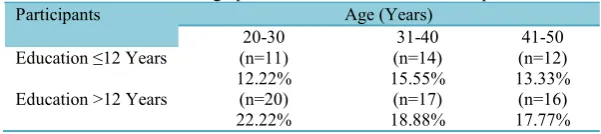
males and 45 females) were literate, aged 20-50 years, right-handed and acquired Persian as their first language. The mean age of the participants was 34.30 years with a standard deviation of 7.98 with the mean (SD) years of formal education of 13.73 years (±3.27). Demographic information is presented in Table 1. In this table, partici-pants were divided into six groups to illus-trate the sample distribution based on age and formal education.
Exclusion criteria were as follows: Histo-ry of head trauma in the last 10 years, stroke, and epilepsy, history of other neuro-logic or psychiatric diseases, alcohol abuse, severe depression and history of speech, language, or learning problems.
The Persian version of the Beck Depres-sion Inventory-II (BDI-II-Persian) was used to screen depressed participants. Partici-pants with the score of 29-63 in BDI-II-Persian were labeled as severely depressed and were excluded from the study (13,14).
Procedure
The Persian version of the verbal fluency test was administrated to examine the con-struct validity (convergent and divergent validity) of the Persian version of HMGT. Convergent and divergent validities were estimated using correlation coefficients. The verbal fluency test was composed of semantic fluency and phonemic fluency subtests. The semantic fluency subtest had two tasks (i.e., categories), and the phone-mic fluency subtest had three (i.e., catego-ries). In the semantic fluency subtest, par-ticipants were asked to say as many words as possible from the animal and fruit cate-gories; and in the phonemic fluency sub-test, they had to say as many words as pos-sible that begin with the letters (/s/س,/a/آ, /f/ف).
The time limit for each task was 60 se-conds. The following scores were obtained in the phonemic and semantic fluency tests: (1) Number of words produced, excluding errors and repetitions; (2) Mean cluster size, and (3) Number of switches. Detailed rules for scoring cluster size and switches for both fluency tasks have been provided in Troyer's article published in 1997 (3,6). In addition to verbal fluency test, the partic-ipants were evaluated by the homophone meaning generation test. For this purpose, the HMGT was adapted to the Persian lan-guage. First, all Persian homophones, each having at least three possible meanings (5), were extracted from the Dictionary of Con-temporary Persian (15). Then 16 homo-phones were selected based on their fre-quency, and evaluation was made by four professional experts (PhD linguists). The 16 selected homophones were زﺎــﮔ /gaz/, شود/duŝ/,ﺮﯿﺳ/sir/,ﻦﺗ/ton/,ﯽﺗرﺎﭘ/parti/, سﺎـﭘ /pas/, رﻮـﺷ /ŝur/, کﺮـﺗ /tærk/, ﻪـﺟو /væǰh/, ﺎـﻨﯿﻣ /mina/, رﺎـﺑ/bar/, زﺎـﺑ /baz/,ﺮـﯿﺗ /tir/,مﻮﺑ/bum/,اﻮھ/hæva/, andراﺮﻗ/qærar/. The possible number of meanings for the homophones ranged from 3 to 8 with the mean (SD) of 5.31 (1.77). The selected homophones were randomly mixed in one list, and the same list was administrated to all participants. Each examinee was tested individually, and all responses were written verbatim. There was no time constraint to proceed to the next stimulus word. Every distinct meaning was given one point, and the sum of distinct meaning generated for 16 homophones was considered the total test score.
Statistical Analysis
The reliability of this test was studied through test-retest, inter-raters, internal consistency, and split-half analysis. The Table 1. Demographic Information of the Two Groups
Participants Age (Years)
20-30 31-40 41-50
Education ≤12 Years (n=11)
12.22% 15.55%(n=14) 13.33%(n=12) Education >12 Years (n=20)
22.22% 18.88%(n=17) 17.77%(n=16)
test-retest interval was within 14 days (in a subsample of 30 subjects). To evaluate the inter-rater reliability, the Persian HMGT was scored the same day by two examiners whose degrees of expertise differed. Both were speech-language pathologists, one with a PhD degree and the other with a Bachelor’s degree. In the split-half analy-sis, all items were randomly divided into two sets of homophones. Each half was la-beled, A and B, and then were given to dif-ferent examinees in difdif-ferent orders. More-over, Content validity and construct validi-ty of Persian HMGT was determined. An acceptable CVR (Content Validity Ratio) value for eight professional experts (four speech-language pathologists and four PhD linguists) was 0.7 (16); and the meaningful Alpha level was considered 0.8 and higher.
Finally, the influence of sex, age and edu-cation on the score of Persian HMGT was analyzed. The mean and standard deviation were calculated for each item. The effect of sex on the Persian HMGT was examined using independent t-test and the effect of age and education on the Persian HMGT was studied by the Pearson correlation co-efficients. SPSS v.20 was used for data processing.
This survey was conducted according to the ethical rules of the National Public Health Institute, and the investigations were performed in accordance with the Declara-tion of Helsinki. Moreover, this study was
approved by The Ethics Committee of Iran University of Medical Sciences. Also, it should be noted that informed consent was obtained from the participants and they were ensured about the anonymity of their information.
Results
A Kolmogorov- Smirnov test applied to the distribution of HMGT scores revealed that HMGT scores were normally distributed (p= 0.52). Among the homophones, the participants produced the least number of different meanings for the homophone کﺮﺗ / tærk/, and the most number of different meanings for the homophone زﺎـﺑ /baz/. In other words,کﺮـﺗ / tærk/ was the most dif-ficult, and زﺎـﺑ/ baz/ was the easiest homo-phone. None of the homophones were left unanswered. In total, the mean (SD) of the HMGT score in the 90 examinees was 37.72 (5.90). Table 2 illustrates the number of possible meanings and the mean number of the produced meanings by the partici-pants in each Persian homophone.
Reliability
The internal consistency of scores on the HMGT was examined using Cronbach’s Coefficient Alpha (α) which was 0.80 for the items designed to assess the ability to generate meanings of the homophones. In-ter-item correlation indicated a positive re-lationship between items (r=0.22-0.57). Table 2. The Number of Possible Meanings per Target on the Persian HMGT and the Mean
Number of Distinct Meanings Generated Per Target across Healthy Controls
Target No. of Possible Meanings Mean no. of Distinct Meanings Generated
زﺎﮔ / gaz/ 4 2.55
شود / duŝ/ 4 2.73
ﺮﯿﺳ / sir/ 4 2.34
ﻦﺗ / ton/ 3 2.48
ﯽﺗرﺎﭘ / parti/ 3 1.95
سﺎﭘ / pas/ 8 2.81
رﻮﺷ / ŝur/ 7 2.34
کﺮﺗ / tærk/ 3 1.61
ﻪﺟو / væǰh/ 6 1.67
ﺎﻨﯿﻣ / mina/ 4 2.38
رﺎﺑ / bar/ 8 2.27
زﺎﺑ / baz/ 6 2.83
ﺮﯿﺗ / tir/ 7 2.75
مﻮﺑ / bum/ 5 2.65
اﻮھ / hæva/ 7 1.97
راﺮﻗ / qærar/ 6 2.31
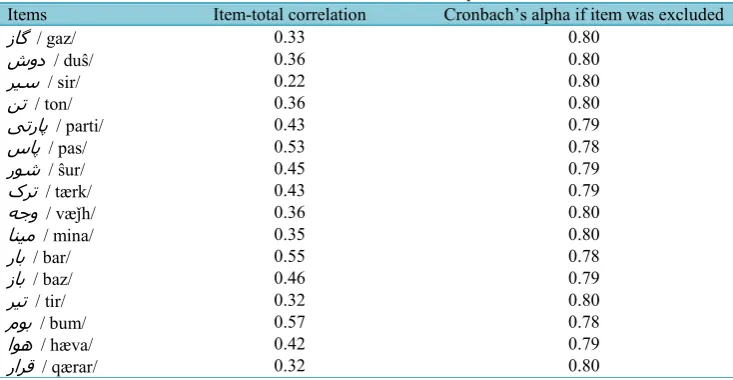
Moreover, when each homophone was ex-cluded from the analysis, the alpha reliabil-ity of the scale was not improved. Table 3 displays item-total correlation coefficients (correlation between each item and total score), and alpha values when each item was excluded.
The test-retest analysis indicated high re-liability (α=0.98, r=0.97). Furthermore, there was a considerable agreement be-tween the two scorers on the HMGT total score (intra class correlation coeffi-cient=0.99, standard error of measure-ment=1.71). Reliability was further demon-strated through a Guttman split-half relia-bility coefficient of 0.75. The items in the form of A were /gaz/, /duŝ/, /sir/, /ton/, /parti/, /pas/, /ŝur/, and /tærk/, and form B composed of /væǰh/, /mina/, /bar/, /baz/, /tir/, /bum/, /hæva/, and /qærar/.
Validity
In addition to reliability, validity of HMGT test was also examined. CVR of the items were all above the cut-off value pre-sented in Lawshe Table (0.75); and there-fore, all items were retained for the next stage. In addition to the CVR, CVI (Con-tent Validity Index) was calculated. The results revealed that all the items were ac-cepted since the CVI values were greater than 0.79.
In order to examine the construct validity, convergent and divergent validity were analyzed. In other words, the correlations
of HMGT with semantic and phonemic to-tal score, clustering and switching were ex-amined. This correlation was significant for the total score and switches in both seman-tic and phonemic fluency tests, but not for semantic or phonemic clustering at the 0.01 level as presented in Tables 4 and 5.
Effects of Demographic Characteristics
Sex had no significant effect on HMGT scores (p=0.59). There was also no signifi-cant correlation between age and perfor-mance on the homophone generation test (r=0.00, p=0.99). However, the correlation between HMGT score and level of educa-tion was highly significant (r=0.28, p=0.006).
Summary of Measurement Characteris-tics of the Persian HMGT
The reliability of the Persian HMGT was estimated using Cronbach’s alpha and split-half method. The alpha value obtained (0.80) indicates that the Persian HMGT has an acceptable level of reliability. Further-more, inter-rater and intra-rater reliability was also high. These results are consistent with those of the study conducted by Craw-ford and Warrington (10).
Furthermore, content and construct validi-ty of the Persian HMGT were determined in this study, and it can be concluded that it is a highly valid test like its English version (10). Three demographic characteristics were also controlled and studied in the Per-Table 3. Item-Total correlation coefficients and Cronbach’s alpha when each item was excluded
Items Item-total correlation Cronbach’s alpha if item was excluded
زﺎﮔ / gaz/ 0.33 0.80
شود / duŝ/ 0.36 0.80
ﺮﯿﺳ / sir/ 0.22 0.80
ﻦﺗ / ton/ 0.36 0.80
ﯽﺗرﺎﭘ / parti/ 0.43 0.79
سﺎﭘ / pas/ 0.53 0.78
رﻮﺷ / ŝur/ 0.45 0.79
کﺮﺗ / tærk/ 0.43 0.79
ﻪﺟو / væǰh/ 0.36 0.80
ﺎﻨﯿﻣ / mina/ 0.35 0.80
رﺎﺑ / bar/ 0.55 0.78
زﺎﺑ / baz/ 0.46 0.79
ﺮﯿﺗ / tir/ 0.32 0.80
مﻮﺑ / bum/ 0.57 0.78
اﻮھ / hæva/ 0.42 0.79
راﺮﻗ / qærar/ 0.32 0.80
sian HMGT. Sex and age had no effect on this test; however, education was positively correlated with participant’s performance in this test. These findings are consistent with the previous study conducted by the test developer (9).
Discussion
The first aim of this study was to adapt English HMGT to Persian version and to establish the reliability and validity of this instrument. Then the nature of the test and its required strategies were investigated. Generally, there was a positive correlation between HMGT and semantic and phone-mic fluency tests in a group of Persian-speakers. As a result, some similarities be-tween underlying processes in these three tests are predictable.
HMGT was originally designed by War-rington (2000) to evaluate executive func-tion as a measure of frontal lobe dysfunc-tion (9). It is hypothesized that HMGT re-quires two processes: Directed search and flexibility, and manipulation of various conceptual representations (9-11). In fact, finding different meanings of a homophone requires searching within and between ex-isting conceptual categories (11).
Based on previous studies, semantic flu-ency is highly dependent on lexical knowledge, and phonemic fluency is deeply affected by mental flexibility (17). These findings can unfold this significant correla-tion between HMGT and fluency tests since HMGT requires both lexical knowledge (like semantic fluency) and mental flexibil-ity (like phonemic fluency). Moreover, all these three tests are sensitive to frontal lobe dysfunction, making this correlation even more sensible and predictable (9,18).
Qualitative analysis of fluency tests fur-ther clarifies the underlying word finding processes in fluency tests. Troyer posits that clustering reflects the semantic organi-zation in the brain, and switching is an ex-ecutive function, including strategic search, shifting, and mental flexibility (3,19). Our findings revealed that clustering and switching scores in both fluency tasks cor-relate positively with HMGT scores. How-ever, HMGT score is more highly related to the number of switches than to the mean cluster size across the two fluency tasks. The present results are consistent with the study conducted by Kavé et al. in 2007. She and her colleagues found the same pattern except in correlation between HMGT and phonemic mean cluster size which was not correlated with the HMGT at all. Similarly, this correlation in the present study is too weak that it can hardly be considered posi-tive (r=0.05, p=0.44) (11).
Switching between semantic and phone-mic subcategories requires strategic search, shifting, and mental flexibility. Thus, the correlation between switching and homo-phone meaning generation is reasonable since both of them are considered an execu-tive function (3,9,19,20). However, the cor-relation between the HMGT and the seman-tic and phonemic cluster size was smaller than the correlations with the number of switches especially for phonemic clusters. Phonemic clusters are made based on simi-larities of sounds, while semantic clusters manifest organization of knowledge into conceptual categories. This semantic organ-ization is also required in homophone meaning generation, but the similarities of sounds cannot help meaning generation (3,9,19,20). Consequently, HMGT was Table 4. Correlation of HMGT with the Semantic Fluency Scores
Semantic Fluency Semantic Switching Semantic Clustering
HMGT R=0.54 R=0.36 R=0.22
p<0.001 p<0.001 p=0.03
Table 5. Correlation of HMGT with the Phonemic Fluency Scores
Phonemic Fluency Phonemic Switching Phonemic Clustering
HMGT R=0.65 R=0.58 R=0.05
p<0.001 p<0.001 p=0.44
more correlated with semantic clustering than phonemic clustering. This finding is in agreement with that of Kavé et al. (2007) study which showed that the shared con-ceptual representation component is neces-sary for successful performance on both semantic clustering and homophone mean-ing generation (11). However, this correla-tion is relatively low (r=0.22; p=0.03); and this may be due to the difference between semantic clustering and homophone mean-ing generation.
A semantic cluster is composed of words belonging to a similar conceptual subcate-gory (3), while Persian homophones’ mean-ings are mostly not semantically related. For instance, the Persian homophone ﺮﯿﺷ/ ŝir/ means lion, water taps, and milk. This does not apply to English homophones since many of them may have semantically related meanings. As a case in point, one word can be both a noun and a verb. As a result, it seems that semantic processes re-quired in semantic clustering are not com-pletely the same as the activation of seman-tic representations in HMGT in the Persian language.
This study suffers from all of the limita-tions inherent in any nonrandomized sam-pling. In this context, the sample size of the data set available was not large enough to permit the normalization process. These troublesome methodological issues remain to be dealt with in future researches.
Conclusion
In conclusion, this study proposes that Persian HMGT is a valid and reliable in-strument which shares many underlying mental processes with verbal fluency tests. HMGT is an easy test to score, user-friendly and efficient in assessing word finding performance, especially lexical search and manipulation of various concep-tual representations with no time con-straints. Based on these evidences, we sug-gest that the Persian HMGT be used for language evaluation in clinical settings and research studies.
Acknowledgment
This study was supported by Iran Univer-sity of Medical Sciences. We would like to acknowledge Mr. Payam Mihanparast for his help with data collection and compila-tion. We also would like to thank volun-teers for their involvement in this study.
References
1. Kavé G, Kukulansky-Segal D, Avraham A, Herzberg O, Landa J. Searching for the right word: Performance on four word retrieval tasks across childhood. Child Neuropsychol 2010;16(6):549-63.
2. Dunn LM, Dunn DM. Peabody Picture Vo-cabulary Test. Fourth Edition Pearson; San Anto-nio, TX: 2007.
3. Haugrud N, Crossley M, Vrbancic M. Cluster-ing and switchCluster-ing strategies durCluster-ing verbal fluency performance differentiate Alzheimer's disease and healthy aging. J Int Neuropsychol Soc 2011; 17(6):1153-7.
4. Villodre R, Sánchez-Alfonso A, Brines L, Núñez AB, Chirivella J, Ferri J, et al. Verbal flu-ency tasks in a Spanish sample of young adults (20-49 years of age): normative data of clustering and switching strategies. Neurologia 2006; 21(3):124-30.
5. Ebrahimipour M, Shahbeigi S, Jenabi MS, Amiri Y, Kamali M. Verbal Fluency Performance in Patients with Multiple Sclerosis. Iranian Journal of Neurology 2008;7(1):138-42.
6. Ebrahimipour M. Verbal Fluency Test. Teh-ran: Ghalam e elm; 2014.
7. Mardani N, Jalilevand N, Ebrahimipour M, Kamali M, Baghban K, Naderifar K. Comparison of semantic fluency performance in patients with amyotrophic lateral sclerosis and healthy control group. Journal of Speech-Language & Communi-cation Disorders 2013; 3(2):1-5.
8. Seyedin S, Namdar M, Mehri A, Ebrahimipour M, Jalaei SH. Normative data of semantic fluency in adult Persian speakers. Journal of Modern Rehabilitation 2013;7(2):13-21.
9. Warrington EK. Homophone meaning genera-tion: A new test of verbal switching for the detec-tion of frontal lobe dysfuncdetec-tion. J Int Neuropsy-chol Soc 2000;6(6):643-8.
10. Crawford JR, Warrington EK. The homo-phone meaning generation test: Psychometric properties and a method for estimating premorbid performance. J Int Neuropsychol Soc 2002;8(4):547-54.
11. Kavé G, Avraham A, Kukulansky-Segal D, Herzberg O. How does the homophone meaning generation test associate with the phonemic and semantic fluency tests? A quantitative and
tive analysis. J Int Neuropsychol Soc 2007;13(3):424-32.
12. Castner JE, Copland DA, Silburn PA, Coyne TJ, Sinclair F, Chenery HJ. Subthalamic stimula-tion affects homophone meaning generastimula-tion in Parkinson’s disease. J Int Neuropsychol Soc 2008;14(5):890-4.
13. Fischer A, Schröder J, Vettorazzi E, Wolf OT, Pöttgen J, Lau S, et al. An online programme to reduce depression in patients with multiple scle-rosis: a randomised controlled trial. Lancet Psy-chiatry 2015;2(3):217-223.
14. Ghassemzadeh H, Mojtabai R, Karamghadiri N, Ebrahimkhani N. Psychometric properties of a Persian-language version of the Beck Depression Inventory--Second edition: BDI-II-PERSIAN. De-press Anxiety 2005;21(4):185-92.
15. Sadri Afshar G, Hakami N, Hakami N. Far-hang Moaser Shorter Dictionary Persian-Persian. Tehran: Kalame Publishers. 2008.
16. Murphy KR. Models and methods for evalu-ating reliability and validity. In Cartwright S,
Cooper CL, editors, The Oxford handbook of per-sonnel psychology. Oxford: Oxford University Press. 2008. P.278.
17. Rogers TT, Ivanoiu A, Patterson K, Hodges JR. Semantic memory in Alzheimer’s disease and the frontotem-poral dementias: A longitudinal study of 236 patients. Neuropsychology 2006; 20(3):319-35.
18. Henry JD, Crawford JR, Phillips LH. Verbal fluency performance in dementia of the Alz-heimer’s type: A meta-analysis. Neuropsychologia 2004;42(9):1212-22.
19. Nieto A, Galtier I, Barroso J, Espinosa G. Verbal fluency in school-aged Spanish children: normative data and analysis of clustering and switching strategies.Rev Neurol 2008 Jan 1-15;46(1):2-6.
20.Hirshorn EA, Thompson-Schill SL. Role of the left inferior frontal gyrus in covert word re-trieval: neural correlates of switching during verbal fluency. Neuropsychologia 2006;44(12):2547-57.