Aggregation and Security in Wireless Sensor Networks: A Survey
Kirti Jain
1and Shashank Singh
21Associate Professor, Electronics and Communication Engineering, Rajarshi Rananjay Sinh Institute of Management and Technology, Amethi (U.P.), India. Email: [email protected]
2Assistant Professor, Electronics and Communication Engineering, Rajarshi Rananjay Sinh Institute of Management and Technology, Amethi (U.P.), India. Email: [email protected]
Article Received: 25 October 2017 Article Accepted: 27 December 2017 Article Published: 12 January 2018
1.INTRODUCTION
Wireless sensor networks are emerging technologies that have a wide range of potential applications such as habitat
monitoring, burglar alarms, inventory control, medical monitoring, emergency response and battlefield
surveillance [1]. We envision sensor networks will consist of hundreds or thousands of low power, low cost
wireless nodes deployed en masse to monitor and effect the environment.
Research on sensor networks generally assumes a trusted environment, but in many likely sensor network
applications, the network will be deployed in situations where an adversary may be motivated to disrupt the
function of the network. An adversary may be able to position several intruder nodes within the network and use
them to transmit false messages. Further, an adversary may compromise a node in the network and gain access to
its key material [2, 4, 5]. This opens the risk that a single compromised sensor device can render the network
useless, or worse, mislead the operator into trusting a false reading.
Nodes that compose a WSN are typically small and have very limited communication, computation, storage and
power capabilities. To keep costs low, most sensors are not tamper-resistant, which impacts security. Limited
computing and storage capabilities make modular arithmetic with large numbers difficult and thus asymmetric
(public key) cryptography unsuitable. In particular, the classical Diffie-Hellman (DH) key exchange protocol is
excluded. Even low exponent variations of the Rivest, Shamir and Adleman (RSA) scheme are prohibitively
expensive for a sensor. Extremely low-cost mechanisms that do not require processor intensive operations are
needed. Therefore, the energy impact of the added security feature should be considered when implementing a A B S T R A C T
Wireless sensor networks form a particular class of ad hoc network that operate with little or no infrastructure. It often consists of a large number of low-cost sensor nodes that have strictly limited sensing, computation, storage, power and communication capabilities. Due to resource restricted sensor nodes, it is important to minimize the amount of data transmission so that the average sensor lifetime and the overall bandwidth utilization are improved. Data aggregation is the process of summarizing and combining sensor data in order to reduce the amount of data transmission in the network. The main goal of data aggregation algorithms is to gather and aggregate data in an energy efficient manner so that network life time is enhanced. As wireless sensor networks are usually deployed in remote and hostile, unattended environments to transmit sensitive information, sensor nodes are prone to node compromise attacks and security issues such as data confidentiality and integrity are extremely important. Hence data aggregation protocol must be designed with security. This paper presents a review of secure data aggregation protocols. It relates security and data aggregation process in wireless sensor networks.
cryptographic technique for securing data aggregation in the WSN. For example, data authentication in TinyOS
increases the consumed energy by almost 3% while data authentication and encryption puts 14% [10].
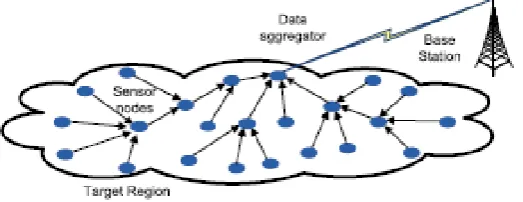
Figure 1: Data Aggregation
A major limitation of sensor devices is their limited battery life. Wireless communication is a major source of
energy consumption, whereas computation is relatively less energy consuming. Also, sending a bit is roughly 102
times more expensive than executing a processor instruction. Moreover, the only way to manage and control the
network is via wireless communication which makes any physical operation such as battery replacement difficult.
One of the major objectives in configuring networks of sensors for large scale data collection is to achieve longer
lifetime for the sensor network deployment by keeping the energy consumption at the minimum while maintaining
sufficiently high quality and resolution of the collected data to enable a meaningful analysis.
The data transmitted can be reduced by using data aggregation, i.e. combining data (values) at the nodes. Therefore
to conserve power, intermediate network nodes should aggregate results from individual sensors. In WSN the
benefit of data aggregation increases if the intermediate sensor nodes perform data aggregation incrementally when
data are being forwarded to the base station. This improves the bandwidth and energy utilization but affect other
performance metrics such as delay, accuracy, fault-tolerance and security.
We cannot encrypt messages using a unique key shared between each device and the base station since each
intermediate node needs to understand the received messages to perform aggregation. We cannot risk storing the
same key on every device to enable encryption or authentication, since an adversary who recovers the key from a
single device would then be able to control the entire network. Therefore it is necessary to implement data
aggregation and security together.
The primary security challenges for wireless sensor networks lie in addressing the conflict between limited
resources (energy, computational overhead, memory etc.) and security requirements. In this paper we look at the
data aggregation problem from the security perspective by giving a review of literature survey and evaluate each
2.DATAAGGREGATIONINWSN
To reduce the power consumed in forwarding messages, researchers have identified the importance of data
aggregation [7]. Aggregation collects results from several sensors and calculates a smaller message that
summarizes the important information from a group of sensors. For example, suppose the operator is interested in
the average sensor reading for some value in the network. An inefficient way to find this would be for every sensor
node to send its reading to the base station (possibly over multiple forwarding hops), and for the base station to
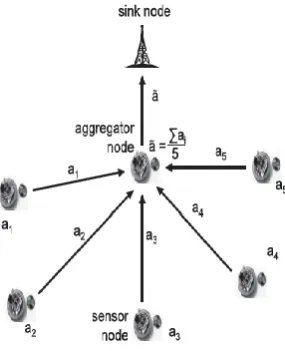
calculate the average of all readings received. A more efficient way to collect the same information would be for
intermediate nodes to forward the calculated average value of the readings they receive along with a count of the
number of readings it incorporates. Each node then calculates the average for all of its descendents and only need
send that value and the number of descendants to its parent.
Another example is sensor nodes can combine sensor values to compute the location and velocity of a moving
object, or aggregate data to avoid false alarms in real world event detection. Depending on the architecture of the
WSN, aggregation may take place in many places in the network. All aggregation locations must be secured.
Figure 2: Aggregation Node
Several recent research efforts have explored different aggregation protocols for sensor networks assuming a
trusted enviornment including directed diffusion [8], LEACH [12], Greedy aggregation [13] and Cougar [14]. In
[7] Fasolo et al. defines in network aggregation is the global process of gathering and routing information through
a multi-hop network, processing data at intermediate nodes with the objective of reducing resource consumption
(energy) therby increasing network lifetime. The aggregation shifts the focus from the traditional address centric
approaches for networking (finding short routes between pairs of addressable end-nodes) to a more data centric
approach (finding routes from multiple sources to a single destination that allows in-network consolidation of
TAG [9] is an in-network aggregation service for TinyOS motes that support a SQL – like language for expressing
aggregation queries over streaming sensor data.
3.SECUREAGGREGATION
Message aggregation can reduce communication overhead significantly, but message aggregation makes security
more difficult. Each intermediate node can modify, forge or discard messages, or simply transmit false aggregation
values, so one compromised node is able to significantly alter the final aggregation value. Further, aggregation
interferes with message encryption.
Security is sometimes viewed as a standalone component of a system’s architecture, where a separate module
provides security. This separation is however, usually a flawed approach to network security. To achieve a secure
system, security must be integrated into every component, since component designed without security can become
a point of attack. A secure system requires Secrecy and authentication: Like traditional networks, most sensor
network application requires protection against eves dropping, injection, and modification of packets.
Cryptography is the standard defense.
Key establishment and trust setup: When setting up a sensor network, one of the first requirement is to establish
cryptographic keys for later use. Key establishment techniques need to scale to networks with hundreds or
thousands of nodes. Moreover, the communication patterns of sensor networks differ from traditional networks;
sensor nodes may need to set up keys with their neighbors and with data aggregation nodes.
Resilience to node capture: One of the most challenging issues facing sensor networks is how to provide resiliency
against node capture attacks as sensor nodes are likely to be placed in locations readily accessible to attackers.
These requirements should be fulfilled when designing a secure aggregation protocol. There is a strong conflict
between security and data aggregation protocols. Security protocols require sensor nodes to encrypt and
authenticate any sensed data prior to its transmission and prefer data to be decrypted by the base station[15,16].On
the other hand data aggregation protocol prefer plain data to implement data aggregation at every intermediate node
so that energy efficiency is maximized. Moreover, data aggregation results in alterations in sensor data and
therefore it is a challenging task to provide source and data authentication along with data aggregation. Due to these
conflicting goals, data aggregation and security protocols must be designed together so that data aggregation can be
performed without sacrificing security.
4.DESCRIPTIONANDCOMPARISONOFTHESECUREAGGREGATIONPROTOCOLS
The first secure data aggregation SDA was proposed by Hu and Evans [15] who studied the problem of data
aggregation when one node is compromised in the network. The authors propose security mechanisms to detect
node misbehavior (dropping, modifying or forging messages, transmitting false aggregate value). The key idea of
next hop, messages are forwarded unchanged over the first hop and then aggregated at the second hop. This
increases the transmission cost, but enables integrity for networks where two consecutive nodes are not
compromised. This is achieved using a key chain; the base station periodically broadcast authentication keys. It
uses µTESLA protocol SPINS [3] which is a suit of security protocols optimized for resource constrained
environment, and it achieves asymmetry from clock synchronization and delayed key disclosure. Hence, sensor
nodes need to buffer the data to authenticate it once the authentication key is broadcasted by the base station. The
proposed protocol ensures data integrity; however it does not provide data confidentiality. In addition, if a parent
node and its child are compromised nodes, then data integrity is not guaranteed either.
SIA a Secure Information Aggregation by Przydatek et al.[17] is a framework for WSNs called
aggregate-commit-prove. This framework provides resistance against a special type of attack called stealthy
attacks aggregate manipulation where the attacker’s goal is to make the user accept false aggregation results
without revealing its presence to the user. It consists of three node categories: a home server, a base station, and
sensor nodes. SIA assumes that each sensor has a unique identifier and shares a separate secret cryptographic key
with both the home server and the aggregator. The keys enable message authentication and encryption if data
confidentiality is required. Moreover it assumes that the home server and base station can use a mechanism, such as
µTESLA by Perrig et al. [3] to broadcast authentic messages. SIA consist of three parts: collecting data from
sensors and locally computing the aggregation result, committing to the collected data, and reporting the
aggregation result while proving the correctness of the result. SIA offers data integrity, authentication, data
freshness, and confidentiality.
Secure DAV by Mahimkar & Rappaport [16] improved the data integrity vulnerability in SDA by signing the
aggregated data. In Secure DAV, each sensor within a cluster will have its share of its secret cluster key and then it
will be able to generate a partial signature on the aggregated data. Once an aggregator receives sensor readings in
the same cluster, it aggregates them and broadcasts the average value of the readings. Each sensor in the cluster
compares its readings with the average value received from the aggregator. Then, it partially signs the average
value only, if the difference between the received average value and its reading is less than a certain value
(threshold). Then, the aggregator (cluster head) combines partial signatures to form a full signature of the
aggregated results and sends it to the base station. Secure DAV provides data confidentiality, data integrity, and
authentication. The drawback is it requires high communication costs on data validation, and supports only AVG
aggregation function.
A witness based data aggregation scheme WDA for WSNs is proposed by Du et al. [18]. The witness nodes of each
data aggregator also perform data aggregation and compute MACs of the aggregated data. Witness nodes do not
send their aggregated data to the base station. Instead, each witness node sends its MAC of the aggregated data to
the data aggregator. The data aggregator collects and forwards the MACs to the base station. Those MACs that are
data aggregators. This enhances the assurance of data aggregation. In order to prove the validity of the aggregated
data , each data aggregator has to provide proofs from several witnesses. Because the data validation is performed
at the base station , the transmission of false data and MACs up to base station affects adversely the utilization of
sensor network resources. The proposed protocol offers only integrity property to the data aggregation security.
Yang et al. [19] proposed a secure hop by hop data aggregation protocol SDAP that can tolerate more than one
compromised node. SDAP is based on two principles: divide -and-conquer and commit-and-arrest. In order to
reduce the damage caused by compromising an aggregator at a high level in the per hop aggregation scheme, SDAP
uses the divide-and-conquer principle to divide the network tree into multiple logical subtree which increases the
number of aggregators and reduces the number of nodes in each subtree. Consequently, the damage caused by
compromising an aggregator of a subtree is reduced. The other principle, that is commit-and-arrest, enhances the
ordinary hop-by hop aggregation scheme by adding a commitment property, and helps the base station to prove the
correctness of the aggregated data. Once an aggregator of a logical subtree commits its aggregation result, it can not
deny it later on. This scheme needs to send much data to ensure reasonable level of security.
Sanli et al. [21] developed a new data aggregation technique SRDA Secure Reference-Based Data Aggregation
scheme that sends only the difference between sensed data and the reference value (called differential value)
instead of raw data. Deference value is taken as the average value of previous sensor readings. In SRDA scheme,
each sensor computes the differential data ( sensed data- reference value ), encrypts it, and then sends it to the
cluster head. The authors claim that the security level of the network should be gradually increased as the data is
traveled to higher level cluster- heads. Therefore a cryptographic algorithm RC6 is used with adjustable parameters
such as the number of rounds, to achieve different level of security in the WSN. Increasing or decreasing the
number of rounds changes the security strength of the RC6 that can be measured by the security margin. The
security margin is the deviation of the actual number of rounds from the minimum number of rounds for which the
algorithm is considered to be secured. The SRDA uses a higher security margin at higher level cluster-heads
compared to low level cluster - head.
The problem of aggregating encrypted data in the WSN is being addressed by Westhoff et al. [6]. The proposed
protocol CDA Concealed Data Aggregation uses an additive and multiplicative homomorphic encryption scheme
that allows the aggregator to aggregate encrypted data. According to authors the security level is still reasonable
and the privacy homomorphism (PH) helps to increment encryption in the WSN. However the encryption in CDA
is very expensive and adds between 0%-22% additional data overhead as compared to RC5 which increases the
power consumption of the sending nodes. CDA provides only data confidentiality.
A new secure data aggregation scheme EDA proposed by Castelluccia et al. [20] is based on homomorphic
encryption. This allows an aggregator to execute the aggregation function and aggregate the encrypted data that are
addition instead of the XOR (Exclusive- OR) operation that is found in the stream ciphers. Thus, even if an
aggregator is being compromised, original message can not be revealed by an attacker. The privacy protection by
this scheme is comparable to the privacy protection that is provided by a scheme that performs end to end
encryption with no aggregation. However it generates significant overhead if the network is unreliable since
sensors identities of non responding nodes must be sent together with the aggregated result to the base station. It
ensures only data confidentiality.
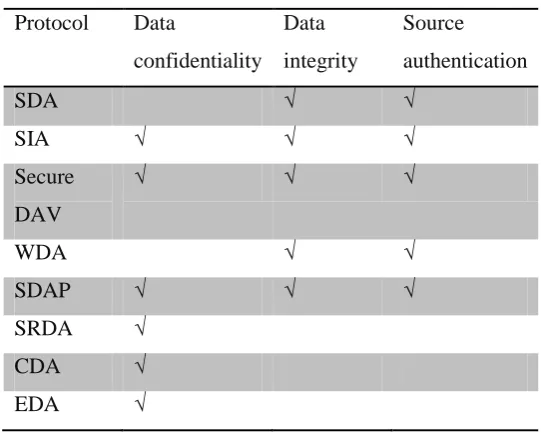
Table 1: Comparison of secure data aggregation protocols.
Protocol Data
confidentiality Data
integrity
Source
authentication
SDA √ √
SIA √ √ √
Secure
DAV
√ √ √
WDA √ √
SDAP √ √ √
SRDA √
CDA √
EDA √
5.CONCLUSION
The severe constraints and demanding deployment environment of WSNs make security for these systems more
challenging than the conventional networks. Since WSNs are still in their early design and research stage, we have
the opportunity to architect security solutions in to these systems from the outset. In this paper we present a
comprehensive overview of secure data aggregation concept in WSN. We surveyed data aggregation protocols
based on network topology and security. It addresses many problems associated with the data aggregation process,
especially from security point of view. In the future it is planned to evaluate more secure schemes for security in
WSN.
REFERENCES
[1] David Culler, Deborah Estrin, Mani Srivastava, Overview of sensor networks, IEEE Computer Society,
August 2004.
[2] Adrian Perrig, John Stankovic, and David Wagner, Security in wireless sensor networks, Communications of
[3] A.Perrig, R.Szewczyk, V.Wen, D.Culler, and J.Tygar, SPINS:Security protocols for sensor networks, J.
Wireless Nets. 8, 5 (Sept. 2002), 521–534.
[4] Lidong Zhou and Zygmunt J. Hass, Securing ad hoc networks, IEEEE Network Magazine, 1999.
[5] M. Acharya, J. Girao, D. Westhoff, Secure Comparison of Encrypted Data in Wireless Sensor Networks, 3rd
WiOpt, April 2005.
[6] D. Westhoff, J. Girao, M. Acharya Concealed Data Aggregation for Reverse Multicast Traffic in Sensor
Networks: Encryption Key Distribution and Routing Adaptation, IEEE Transactions on Mobile Computing, 2006.
[7] E. Fasolo, M. Rossi, J. Widmer, and M. Zorzi, In-Network Aggregation Techniques for WirelessSensor
Networks: A Survey, IEEE Wireless communication 2007.
[8] Chalermek Intanagonwiwat, Ramesh Govindan, Deborah Estrin, John Heidemann, and Fabio Silva, Directed
Diffusion for Wireless Sensor Networking, IEEE Trans.Netw.,Vol 11,2003.
[9] S. Madden, M. Franklin, J. Hellerstein, and W. Hong, TAG: a Tiny AGgregation service for ad-hoc sensor
networks, In 5th Annual Symposium on Operating Systems Design and Implementation (OSDI), December 2002,
Pages: 131-146.
[10] C.Karlof, N.Sastry, D.Wagner, TinySec: A link layer security architecture for wireless sensor networks, ACM
2004.
[11] Conference on Distributed Computing Systems, November 2001.
[12] Yong Yao and J. E. Gehrke. The Cougar Approach to In-Network Query Processing in Sensor Networks.
Sigmod Record, Volume 31, Number 3, September 2002.
[13] L. Hu, D. Evans, Secure aggregation for wireless networks, in: Proceedings of the Workshop on Security and
Assurance in Ad Hoc Networks, Orlando, FL, 28 January 2003.
[14] A. Mahimkar, T.S. Rappaport, SecureDAV: a secure data aggregation and verification protocol for wireless
sensor networks, in: Proceedings of the 47th IEEE Global Telecommunications Conference (Globecom),
[15] B. Przydatek, D. Song, A. Perrig, SIA: secure information aggregation in sensor networks, in: Proceedings of
SenSys’03, 2003, pp. 255– 265.
[16] W. Du, J. Deng, Y.S. Han, P.K. Varshney, A witness- based approach for data fusion assurance in wireless
sensor networks, in: Proceedings of the IEEE Global Telecommunications Conference (GLOBECOM’03), 2003,
pp. 1435–1439.
[17] Y. Yang, X. Wang, S. Zhu, G. Cao, SDAP: a secure hop-by-hop data aggregation protocol for sensor
networks, in: Proceedings of the ACM MOBIHOC’06, 2006.
[18] C. Castelluccia, E. Mykletun, G. Tsudik, Efficient aggregation of encrypted data in wireless sensor networks,
in: Proceedings of the Conference on Mobile and Ubiquitous Systems: Networking and Services, 2005, pp.109–
117.
[19] H.O. Sanli, S. Ozdemir, H. Çam, SRDA: secure reference based data aggregation protocol for wireless sensor
networks, in: Proceedings of the IEEE VTC Fall Conference, Los Angeles, CA, 26–29 September 2004, pp. 4650–