ISSN: 2334-2986 (Print), 2334-2994 (Online) Copyright © The Author(s). All Rights Reserved. Published by American Research Institute for Policy Development DOI: 10.15640/jea.v3n1a4 URL: http://dx.doi.org/10.15640/jea.v3n1a4
Single-Family Residential Architecture for Tropical Climate: Recommendations for
the City of Fortaleza, Ceará, Brazil
Rodrigo Porto Oliveira
1Abstract
This article is defined as a study describing the climate of Fortaleza (CE) in order to contribute to the development of guidelines about design for single-family homes in hot and humid climate of low latitude. Thus, through literature review and research for projects located indifferent districts of the city, we tried to determine the bioclimatic strategies applicable to residential buildings to the region under study.
Keywords: EnvironmentalComfort; Fortaleza’s Climate; Bioclimatic Study; Tropical climates
1.Introduction
The lack of appropriate architectural solutions for the optimization of comfort conditions (or less discomfort) of buildings in tropical climate ultimately results in thermally harsh environments. The consequences are often drastic: in buildings that have large energy consumption for air conditioning, or situations where just being in the environment, be it work or living, it becomes a very unpleasant experience, from the point of view of comfort for their occupants. Therefore, it is wise to say that the architect acts to conceive pleasant spaces, seeking to capture the benefits of climate and protect its rigor, pursuinga better use of natural resources and the appreciation of the place. A building designed for the climate in which it operates is considered comfortable, if it facilitates natural ventilation, the entry of sunlight to filter unwanted sunlight, saving electricity. It is therefore essential to perform a climatic characterization of the region where the building will be designed, since the evaluation of thermal performance, energy, acoustics and luminosity is directly related between the built environment and the external environment. According to Smith et al (2005), to evaluate the thermal performance, it is necessary to know how to vary the air temperature, relative humidity, the direction and the wind speed and solar radiation, not only along the seasons, but also their time strings. The Brazilian NBR 6401: 1980 has recommended values of air temperatures and maximum temperatures of dry and wet bulb, for the conditions of summer and winter, according to the type of environment (home, business, etc.) and purpose (shops, short time of occupancy, etc.). In relation to human comfort requirements in a building, the ASHRAE standards 55: 1992 and ISO 7730: 1984 consider the need for 80% of the occupants express satisfaction with the internal environmental comfort conditions, this limit also accepted in Brazil.
Assessing the importance of thermal indices that consider the adaptive nature to thermal sensations developed by men, Roriz (2003) tested the changes proposed by Humphreys and Nicol in Fanger equations, applying them in two Brazilian cities: Campos do Jordão (SP) and Fortaleza (CE), in an attempt to show that in situations where adaptive opportunities are possible and appropriate, the comfort zone can be enlarged. It was observed that the air speed invariable climate provides further improvements in the thermal comfort condition. In the case of Fortaleza (CE) latitude is responsible for intense heat stroke rates, which can promote high temperatures, which added to the urbanization factor, can lead to an increased thermal discomfort in more densely populated areas. It occurs in Fortaleza an approximate 50% reduction in wind speed variation (XAVIER, 2001) and the difference in that reduction comes to the order of 3m / s in more urbanized sectors of the city (Maia et al, 1996).
1
Therefore, thermal comfort in Fortaleza will be treated in this article with a view to contribute to a coherent design process with the hot and humid climate of low latitude. The study will reference the work of ARAÚJO, MARTINS, ARAÚJO (1998), which divides the climate of the city of Natal (RN) in two distinct periods. Assuming that the climate of that city is quite similar to that of Fortaleza (CE), the city under study, because they have the same latitude and similar urbanization. Climate and architectural variables will be based and analyzed.
2. Methodology
This article is defined as a study to characterize the climate of Fortaleza (CE), in order to provide information for the development of project guidelines for the climate of the study area. Thus, to develop the climate study, we used the work of Araújo, Martins, Araújo (1998) to characterize Brazil’s northeastern climate. Araújo, Martins, Araújo 1998). It is observed that the lines of action of the strategies listed for each region may vary according to the characteristics of each building, as usage pattern, equipment and occupation, materials, among other conditions. In Fortaleza (CE), most of the existing research to address bioclimatic architecture focus on the urban context, or even on computer simulations, addressing variables that influence the results of the software. Thus, by analyzing single-story residential buildings projects located in different neighborhoods in the city of Fortaleza (CE), and reviewing recommendations collected from the existing literature with recommendations of bioclimatic strategies in hot and humid climate, it is possible to identify the material surroundings and orientation of the building and its effects on the extent of thermal comfort situation.
3. Setting the Context
3.1. The Climate of Fortaleza
Being located in a tropical region, along the coast of the Atlantic Ocean, the city of Fortaleza has a hot and humid climate with high air temperatures throughout the year, with little seasonal variation. The city is at a latitude near 4 ° South, or almost on the equator and, particularly, with the shoreline in the northwest-southeast direction. This means that the winds bring to the mainlan the fresh sea breeze, in a peculiar situation, swirling over the dunes located east of the city, and thus better refresh the inhabited area (Figure 01).
Figure 01: Satellite Photo of the Urban Sprawl of the City of Fortaleza, and its Prime Coastal Location
Source: Adapted from Google Earth (2011)
Also, according to study by Roriz (2003), there is an average temperature of 25 ° C in Singapore from June to September, and an average of 28ºC in the months from October to May. The study is consistent with the hypothesis of Araújo, Martins, Araújo (1998), raised for the city of Natal (RN). With the characterization of the climate of the region under study, an investigation of the main architectural design variables that will be held directly influence the range of thermal comfort situation in hot and humid climates of low latitudes, especially in single-family homes located in Fortaleza (CE).
3.2. Principles for Improved Thermal Performance for hot and Humid Climate
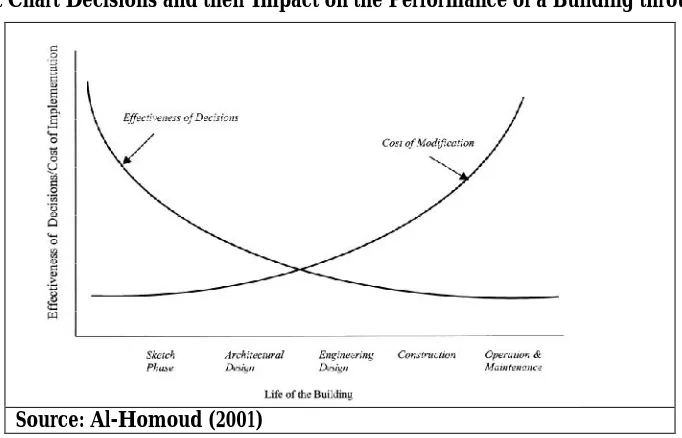
According Corbellas and Yannas (2009), the purpose of bioclimatic architecture design is to promote the environmental comfort of the built environment, in order to minimize the consumption of conventional energy and especially the physical well-being of its occupants. Thus, the first decisions relating to the design process can determine the thermal performance of a building. SZOKOLAY (2004) argues that buildings for hot and humid climates should always have lower internal temperatures than external. Therefore, knowledge of technical properties of the materials to be used in the project for the future building is necessary. The figure below shows how necessary is this knowledge by proposing an increase in costs of a building when the building is not designed according to bioclimatic guidelines (Figure 02).
Figure 02: Cost Chart Decisions and their Impact on the Performance of a Building throughout its time
Source: Al-Homoud (2001)
Two important points are the control of radiation and the use of ventilation. For climates like that of Fortaleza, when combined with dry bulb temperature of the air with the air speed can be comfortable in most times of the year due to the acceleration of convective heat exchange between the human body and the environment and promoting evaporative cooling of the body. Thus, Oliveira (2010) states in equatorial climates, climatic variations are very small, and the requirements for the building characteristics are similar year-round. The prevalence of high humidity and temperature calls for an increase in air speed in order to force evaporation of sweat on the surface of human skin, soothing the sensation of thermal discomfort. The author proposes the following requirements for buildings in hot and humid climate of low latitude:
• Protect from the sun, rain and insects; • Provide efficient ventilation of the building;
• preventing the increase of temperature during the day and to ensure minimization overnight;
3.3. Variables of the Architectural Design
The design variables can be defined as the characteristics of the building that can be modified, altering the thermal situation. According to Oliveira (2010), these variables, are the envelope that the architectural decisions that have greater impact on the thermal performance of buildings, because through this, the heat flow can be controlled by regulating the loss or gain from this. However, we can mention other variables that influence building performance, such as plot orientation, shaded surroundings, vertical and / or horizontal neighborhood. The envelope of a building can be defined as the set of devices that limit the indoor environment from the outside. These components of the envelope are different in terms of their behavior in relation to solar radiation incident short wave and are divided basically into two groups. They are opaque and transparent closures and openings closures. The first is defined as an element that obstructs the passage of short wavelength solar radiation. Examples are the walls, partitions, floors. Since the transparent and apertures are defined as elements which allow visual and physical connection to the outside, allowing the passage of solar radiation, particularly shortwave. This is evidence for the presence of openings for the passage of air or glass and translucent areas, such as skylights, and zenithal openings.
3.3.1 Orientation in Relation to the North / South / East / West
The literature contains many studies evaluating the influence of the architectural variables in the distribution of the air flow internally, generating recommendations based on the results of experiments conducted usually in wind tunnels. Givoni (1976) correlated dimensions of the inlet and outlet openings of the angle of incidence of the wind, testing different combinations of openings with angles of 90 ° and 45 ° of the wind in relation to the facade (Figure 03).
Figure 03: Internal Speed Depending on the size Ratio of the openings and Direction of Winds to 45 and 90
Source: Adapted from Givoni (1976)
Givoni (1976) recommends that the facades face the prevailing winds at least an angle of 60 °, so that ventilation is captured. The openings positioned leeward will be used as output ventilation, thereby promoting the cross effect. Therefore, the results showed that the speed of the internal flow is not directly related to the size of the apertures. In addition to the different size of the inlet and outlet openings (smaller inlet openings towards the outlet provide higher air velocities). For climates like that of Fortaleza, a fairly common type of opening are the hollow elements, or cobogós. They allow for constant ventilation of the building interior, besides offering a combination of low cost, safety and porosity of the walls. However, it is necessary to consider the influence of these elements in the internal airflow, because depending on the geometry, the air can be directed unwanted into the environment. Thus, the following recommendations are made:
b) Study of sun exposure of facades and sun protection elements: the facades and openings should be protected from solar radiation, with the use of brises, cobogós, pergolas, eaves, canopies, balconies or other protective elements against solar radiation.
c) Analysis of natural ventilation of indoor environments: the position of the openings must allow cross ventilation in indoor environments where the internal temperature is higher than the outside, to ensure the thermal comfort of users and the withdrawal of hot air. The openings in the higher parts of the building remove the heat by natural convection, improving the thermal conditions in the interiors. The openings should be small, with an area between 10 and 15% of the floor area.
3.3.2. Envelope Materials for Homes in hot and Humid Climate
In Fortaleza, the structural system in masonry has been widely used in construction. This system features a streamlined process, plus an economic and speedy execution. It is recommended for buildings in the climate study to use light colors on the outside walls, because they reasonably reflect solar radiation, as compared to dark hues. Thus, a white color can greatly increase the comfort of environment conditions, to increase the thermal mass of the wall, since it slows down the passage of heat flow to the indoors. It is also necessary to analyze the building rooftops. This element receives maximum solar radiation in low-latitude climates because the sunlight in this case falls almost perpendicular to the Earth's surface. Therefore, it is important to provide a suitable structural solution and the use of sufficient thermal inertia material with absorption coefficients and emissivity reflection resulting in a heat flux attenuation into the enclosure (Ferreira, 1965). Also according to Ferreira (1965), the rooftops must be reflective as well. The outer shadow and the reflection of the radiation are means for reducing the flow of heat penetrating the same. Reflection can be achieved through the use of certain types of paint, because some of them may reflect 85-95% of visible radiation (light colors to help reflection: aluminum color, plain white paint, lime). There is a worldwide campaign called One Degree Less (Grade A Minus), by the entity Green Building Council, which promotes sustainable technologies and solutions, and recommends that if about 40% of people paint the roofs of their houses white, the temperature of the planet would be reduced by 1 degree, indoors, 6 degrees (Figure 04). That way SZOKOLAY (2004) suggests important recommendations for building deigns located in hot and humid climate: • For indoor; the use of reflective surfaces, with spaces separating the cover liner (attic), ventilated attic, insulation
reflective insulation and covered under the resistive over the liner;
• For openings; no windows in the east and west facades, thus avoiding sunlight to penetrate at low sun angles;
Figure 04: Condominium Homes Photo where the roof is Light-Colored Source: Ecopore of Brazil
Figure 05: Scheme of possible forms of Infiltration in a Residence. Source: Ecopore of Brazil
4. Case Studies
We will analyze the following two examples of single-family homes located neighborhoods in different deployment scenarios.
4.1. Case 01
Case 01 refers to the house type 01, the Residential Condominium Grand Ville, located in the municipality of Eusebio. With its 46,000 inhabitants, according to the last census of Brazil’s Census Bureau, the city has received several top rank gated communities, catered to people who are settling in the city in search of a better quality of life. It can be reached by HighwayCE-040. The house is characterized by a focus on regional materials such as rooftops in dark colonial tiles, and apparent Timber. However, the frames are in high-tech style, glass and PVC. The envelopes are dyed in white, with solutions in masonry (Figures 6 and 7).
Figure 06: House type Perspective 01 and neighboring houses Source: Viva Imóveis
Figure 07: House type Perspective 01 and neighboring houses Source: Viva Imóveis
Figure 08: Ground floor Ground floor of the House Type 01 Source: Viva Imóveis
Figure 09: Ground floor of the House Superior type 01 Source: Viva Imóveis
Figure 10: Angles in PVC and glass used in the project case 01
Source: Personal archive
Figure 11: Miter PVC Brise Soleil Source: Solar Technical Protections
According to the aerodynamic characteristics, the housing unit has an advantage because it is a property located in a relatively plain region. This fact increases the intensity of the winds, and the regularity in its east-southeast incidence. Thus, it facilitates the design process, since the openings can be really useful when it comes to attracting ventilation. Finally, it is worth noting the dark colonial tile. The material is quite effective, but the color does not offer maximum efficiency. A roofing with the same material, but in a light color, such as gray or beige, could substantially reduce the internal temperature of this residence, since, according to SZOKOLAY (2004), the sun's rays in hot and humid climates fall perpendicularly to the terrestrial surface, making the indoor main architectural element cause the internal temperature to rise. It follows, then, that case 01 is represented by a residence with a good architectural design, requiring adjustments to achieve the optimum degree of efficiency.
4.2 Case 02
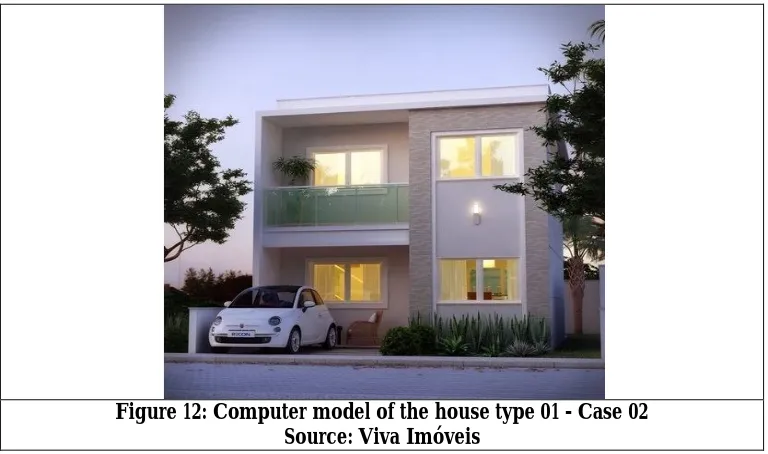
Case 02 refers to the house type 01 (Figure 12 and 13), the Residential Condominium La Fiori located in the city of Fortaleza (CE). It is located in Vicente Pinzon neighborhood, better known as Dunas. The neighborhood is known for its large houses and its predominantly horizontal urbanization. The Dunas name comes from the fact that the neighborhood has grown on top of a dune on Praia do Futuro. This peculiarity brings the place plenty of winds, as it sits high, and very close to one of the largest urban coastal tracks of Fortaleza. Thus, it is expected that residential projects for this neighborhood, are ventilated spaces and provided with efficient bright light. Unlike the previous case, this residence does not use the conventional style of Brazilian northeastern construction. The option is the fascia, window frames, glass and facades without eaves.
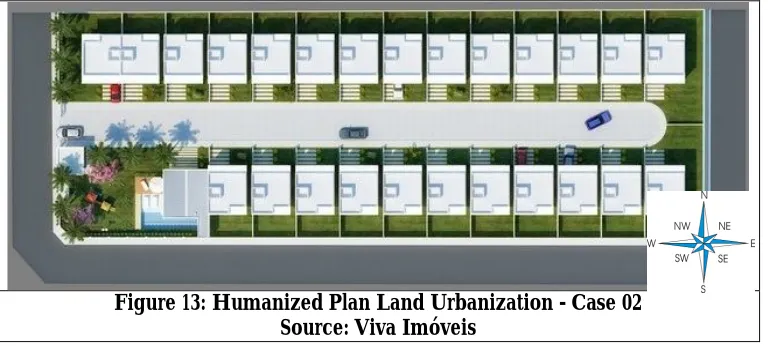
Figure 13: Humanized Plan Land Urbanization - Case 02 Source: Viva Imóveis
According to the urbanization humanized plan in Figure 13, it is observed that the main façades - front and rear - face north and south respectively. Thus, authors such as Corbellas and Yannas (2009) believe that for the buildings in hot and humid climate of low latitude, the larger openings must face North and South, East and Southeast in accordance with the cross ventilation scheme. It happens that the ventilation openings (East and South) of this residence are located only in oneroom on the top floor of residence (Figures 14 and 15). There are no east or southeast openings in the ground floor. Coupled with this fact, the west side setback is non-existent, and eastward setback is 1.20 m, in accordance with design provided by Viva Real Estate. Rooftops in plat band demand for the creation of solar protection mechanisms, if the conventional system is done by the eaves colonial coverings. In addition to the eaves, it is recommended to use brises soleil for openings in homes located in hot and humid weather. The house analysis uses roofs in plat band with aluminum top. Studies by Sevegnani (1994) show that clay tile is the most suitable for mild climates due to its porosity. However, the high cost of it has led builders to an increased use of aluminum tiles ,due to their the lower cost.
Figure 14: Floor plan ground floor - If 02 Source: Viva Imoveis
Figure 15: Ground floor upper deck - If 02 Source: Viva Imoveis
As in the previous case, the architectural design of house type 01 - Case 02 provides for the use of PVC frames and green glass. In this case, their use is even less recommended, since the same project does not provide for most of the facades’ sun protection shaped marquise or otherwise, so that the solar radiation will befall directly on these openings some months of the year, requiring the use of internal curtains to filterthe rays. The heat will penetrate, without being able to leave. Again, the use of flags is recommended, this time only to soothe, since the design is in a very critical situation from the point of view of thermal comfort.
6. Final Considerations
In addition to the soaring real estate market, one may observe the exaggerated multiplication of at he large number of housing units on the land acquired, that the side, rear and front setbacks have diminished in disregard to the efficient capture of natural ventilation, an indispensable component for achieving thermal comfort in single-family residences in hot and humid climate of low latitude. It was observed that Case 01 was more thermally efficient than Case 02. The use of conventional materials such as ceramic colonial rooftops becomes more efficient for the climate of the area in question, due to its porosity. The fascia system combined with the frames of glass is not recommended, since the sun rays can penetrate inside the building, causing increased internal temperature radiation. We used such recommendations found in literature review directed to building projects in hot and humid climate of low latitude.
7. Bibliographical References
ABNT, 1980. Associação Brasileira de Normas Técnicas, NBR 6401/80. Instalações centrais de ar condicionado para conforto - parâmetros básicos de projeto. Rio de Janeiro, Brasil.
ABNT, 1998. Associação Brasileira de Normas Técnicas. Projeto 02: 135.07- 003. Desempenho térmico de edificações - Parte 3: Zoneamento bioclimático brasileiro e diretrizes construtivas para habitações de interesse social. Rio de Janeiro, Brasil.
AL-HOMOUD, M. S. Computer-aided building energy analysis techniques.Building and Enviroment [S.I.].v. 36. n. 4. p. 421-433. 2001
ARAÚJO, E. H. S.; MARTINS, T. L. F.; ARAÚJO V.M.D. Dias climáticos típicos para o projeto térmico de edificações em Natal/RN. Natal, EDUFRN, 1998.
CORBELLAS, O., YANNAS, S. Em busca de uma arquitetura sustentável para os trópicos: conforto ambiental. 2 ed. Rio de Janeiro: Revan, 2009.
FERREIRA, Philomena Chagas. Alguns dados sobre o clima para a edificação em Brasília. Dissertacão de Mestrado em Arquitetura, FAU - UnB, Brasília, 1965. 103 pp. cópia reprográfica.
GIVONI, B. Man, Climate and Architecture. New York: Van Nostrand Reinhold, 1976
GROSSO, Mario. Il Raffrescamento Passivo degliEdifici. Maggioli Editore, Rimini, 1997. pp. 265-280.
IPT - INSTITUTO DE PESQUISAS TECNOLÓGICAS. Avaliação de Desempenho de Habitações Térreas Unifamiliares. Caderno 4: conforto Higrotérmico. Documento Preliminar. São Paulo, SP, 1981. 60 pp. cópia reprográfica
MAIA, L.P et al. Alterações climáticas na região de Fortaleza causada por fatores naturais e antrópicos. Revista de Geologia UFC. Fortaleza, vol. 9, p.111- 121, 1996.
MENDONÇA, F.A. O clima e o planejamento urbano de cidades de porte médio e pequeno: proposição metodológica para o estudo e sua aplicação à cidade de Londrina/PR. .(Tese de Doutorado). São Paulo: FFLCH/USP - Programa de Pós Graduação em Geografia, 1994,
OLIVEIRA, R. P. Utilização de um aplicativo de simulação computacional na avaliação de desempenho térmico de protótipo de habitação de interesse social (HIS). Dissertação de Mestrado.Universidade Federal do Rio Grande do Norte. Centro de Tecnologia. Departamento de Arquitetura. Natal, RN, 2010.
RORIZ, M. Flutuações horárias dos limites de conforto térmico: uma hipótese de modelo adaptativo. In: Anais do VII Encontro Nacional sobre Conforto no ambiente Construído (ENCAC). Curitiba, PR. 2003.
SEVEGNANI, K. B.; GUELFI FILHO, H.; DA SILVA, I.J.O. Comparação de vários materiais de cobertura através de índices de conforto térmico. Sci. Agric (Piracicaba, Braz) vol. 51 no. 1 Piracicaba Jan/Apr. 1994
SIQUEIRA, T. C. P. A., AKUTSU, M., LOPES, J. I. E., SOUZA, H. A. de. Dados climáticos para avaliação de desempenho térmico de edificações. REM: R. Esc. Minas, OuroPreto, 58 (2): 133-138, abr. jun. 2005
SZOKOLAY, S. V. Introduction to Architectural Science: the basis of sustainable design. Bullington, Great Britain: Architectural Press, 2004.
SZOKOLAY, S. V., DOCHERTY, M. (eds.) Climate Analysis.Passive and Low Energy Architecture International Design Tool and Techniques. Brisbane: PLEA in association with Department of Architecture, The University of Queensland, p. 56, Passive and Low Energy Architecture International Design Tools and Techiquesed. 1999.