ISSN: 2372-4951 (Print), 2372-496X (Online) Copyright ©The Author(s). All Rights Reserved. Published by American Research Institute for Policy Development DOI: 10.15640/smq.v3n3a7 URL: http://dx.doi.org/10.15640/smq.v3n3a7
Emerging Environmental Sustainability Practices In Msme's
Dr. Luis Roberto Domínguez-A.
1Ing. Israel Lozano Jiménez
2Rosa Elvia Sánchez Quiñones
3Guadalupe Elizabeth Ruiz Ulloa
4Abstract
This article intends to show the results of the review of literature of studies of emerging environmental sustainability practices in micro, small and medium enterprises (MSMEs) in the last five years (2010-2015) . The method used to review and evaluate the literature was based on the seven-step synthesis for research: problem formulation, literature search, obtaining information of studies assessing the quality of studies, analysis and integration results, interpretation of evidence and presentation of results. We evaluated 16 studies from 15 different countries, with a sample of more than 300 different companies. The findings suggest the existence of at least five emerging practices that promote environmental sustainability in MSMEs.
Key words: MSME´s, sustainability, environment, emerging practices, social
responsibility
Introduction
Sustainability has been seen as development that meets present needs without compromising the ability of future generations to meet their own needs(Comisión Brundtland, 1987) and is known for some time that the companies have always kept between the economic imperative and care for the environment, so that environmental sustainability has depended, among other factors, of the care that organizations have in finding business activities that are less harmful to the environment (Tilley & Fuller, 2000).
1Full Professor, Division ofresearch and posgraduate, Instituto Tecnológico, Superior de Puerto
Vallarta, [email protected]
2Full Professor, Division of research and posgraduate, Instituto Tecnológico, Superior de Puerto
Vallarta, [email protected]
3Student of the Bachelor of Administration, Centro Universitario de la Costa de la, Universidad de
Guadalajara, [email protected]
4Student of the Bachelor of Administration, Centro Universitario de la Costa de la, Universidad de
The challenges in organizations has gone changing from, find activities that do not affect the environment to engage in processes of change in which the exploitation of resources, the direction of investments, technological orientation, development, growth and organizational change are in harmony, improving the current and future potential to meet human needs and aspirations, combining the concept of sustainable development(Wheeler & Beatley, 2004).
These challenges have highlighted the importance of supporting sustainable and safe methods that can reduce environmental degradation (Galbreath, 2009)(Choi & Gray, 2008) and the opportunity is to create business models or strategies that, integrate social responsibility business, assuming that companies have an important responsibility to work for the protection of the environment (Heledd, 2008) following non-conventional processes to minimize pollution and other negative social or environmental impacts(Choi & Gray, 2008).
Micro, small and medium enterprises (MSME´s) are organizations that, for its quantity, become critical to the economies of the countries, as they could be up 99% of total registered companies and, are often considered the engine of economic growth (Roxas, Lindsay, Ashill, & Victorio, 2009). However, it has also been documented that become part of the environmental problem, since, they become responsible for 60% of the production of carbon dioxide and 70% of the total of contamination (Parker & Roffey, 1997). In addition, these business activities may have a potential negative impact on the environment, as they consume energy and produce waste and other products derived from its core operations (Roxas, Lindsay, Ashill, & Victorio, 2009).
Therefore, it is important to analyze emerging practices that MSMEs in the world has found, and that contribute to protecting the environment without sacrificing for growth of the company, considering the sustainable development of their economies, in an attempt to identify significant trends able to provide greater insight into potential opportunities for improve environmental sustainability practices that can be implemented in these kind of organizations.
Method
The first step was supported by the preliminary review of the literature, in which was observed of diversity of factors, categories and concepts of environmental sustainability practices in MSMEs.
The second step was carried out though a thorough review of the following databases: Ebsco, Wos and Emerald, the terms used in the search process included subject headings of MSMEs with keywords such as: corporate social responsibility, sustainability, companies sustainable.
Additionally, studies identified in the same articles that appeared in the initial search were taken. The criteria used to determine the articles to be included in the present study were to: 1) they were published in English between 2009 and 2015, 2) that the findings reported were from empirical investigations, and 3) they have examined emerging sustainability practices in MSME´s.
The electronic search has yielded a total of 322 articles, for review by way of keywords. After reviewing the abstracts of these 322 articles only 22 were relevant for the purposes of this review and 16 matched with the inclusion criteria. Studies were excluded if they were no empirical studies, or if they did not contain sustainability practices.
The reference list of 22 detailed studies were reviewed, in order to identify any additional studies that might contain sustainability practices not seen in the articles. However, not one emerged, that for its theme, reveal additional practices. The entire search process, has yielded a total of 16 articles included for review work.
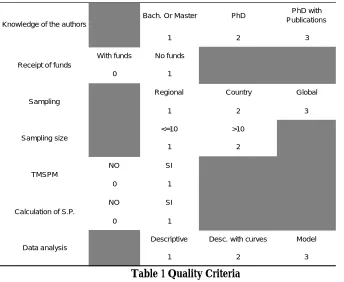
Also was assigned Score of 1 to research that has funds or 0 if they have not. Sampling was assigned score by geographical scope that the study had. If this was done in a particular state or region it was assigned 1 point, if developed in a country was assigned 2 points and 3 points if the research was conducted in several countries. With regard to the number of units in the sample it was considered with a score of 1 point if the sample was less than 10 units, and 2 points if the sample was equal to or greater than 10 units. In terms of methodology, it was assigned 0 points if the work in their methodology did not describe how to perform the measurement of sustainability practices in MSMEs and 1 point if the study finds methods or approaches for measuring practices of sustainability in MSMEs.
Table 1 Quality Criteria
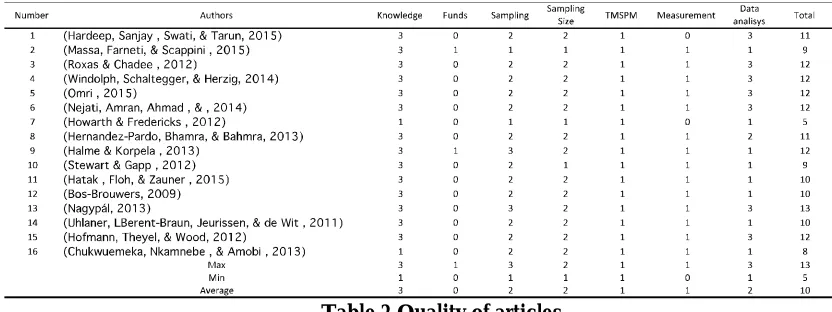
The methodology was evaluated based on the inclusion of calculating the emerging practices of sustainability in MSMEs with a score of 0 if it was not describe a specific methodology for calculating emerging sustainability practices in MSMEs and a rating of 1 if the study described application methods or approaches for calculating sustainability practices in MSMEs. The quality of the data analysis was rated as 1 if the analysis included only descriptive statistics, such as 2 if a descriptive analysis was made besides including other methods of evaluating emerging sustainability practices in MSMEs and a 3 if regressions are reported or other high-level statistical models. The ratings of the reviewed studies ranged from 5 to 13. Table 2 shows the quality of the studies reviewed.
Bach. Or Master PhD PhD with
Publications
1 2 3
With funds No funds
0 1
Regional Country Global
1 2 3
<=10 >10
1 2
NO SI
0 1
NO SI
0 1
Descriptive Desc. with curves Model
1 2 3
Knowledge of the authors
Receipt of funds
Sampling
Data analysis Sampling size
TMSPM
The last of the three steps -analysis and integration of results of studies, interpretation of evidence and the presentation of results- are presented in Section data Analysis and results.
Table 2 Quality of articles
Data analysis and results
In the analyzed studies are displayed terms like corporate social responsibility, corporate social responsibility, sustainability, environmental practices, sustainability and corporate sustainability. this so obvious by the search process. However, sustainability was the term that showed more articles in this process (43.75% of the articles in the review).
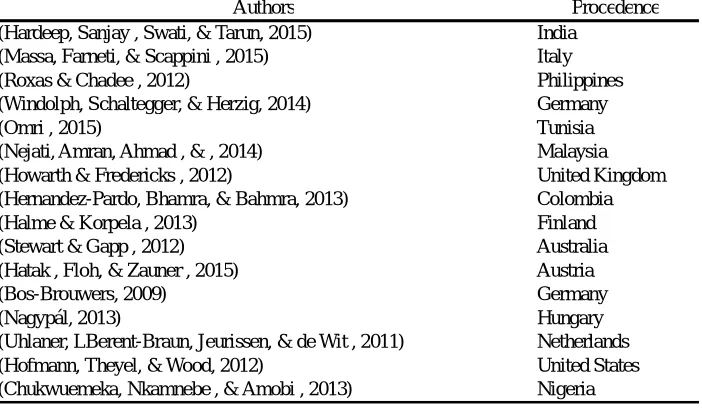
Table 3 Procedence of articles
These studies were conducted in 15 different countries in different companies with different types of practices of environmental sustainability. Of these, many general comments can be made. First, the studies reviewed examined the different sustainability practices applied in micro, small and medium enterprises that included factories, non-governmental organizations (NGOs), government organizations and service companies, where the main or dominant focus was the management practices of environmental sustainability.
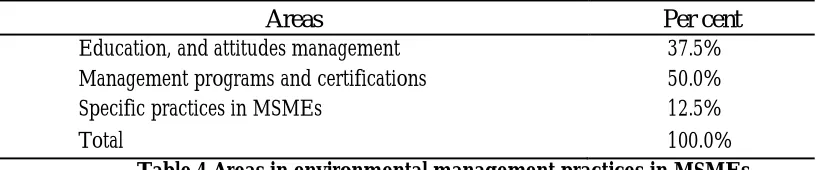
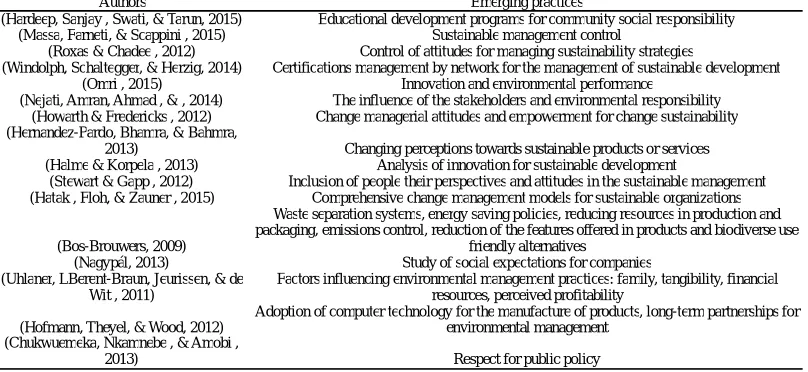
In the 16 studies three areas were found that include practices to improve environmental sustainability in a framework of sustainable development and that can be seen in Table 4. 37.5 percent of the analyzed studies indicate the first area containing practices that use education, and attitudes management (Hardeep, Sanjay , Swati, & Tarun, 2015)(Roxas & Chadee , 2012)(Howarth & Fredericks , 2012)(Hernandez-Pardo, Bhamra, & Bahmra, 2013)(Stewart & Gapp , 2012)(Nagypál, 2013), the second area from 50% of the studies contain management programs including certifications, management models and adoption of technology for management, in pursuit of the careful management of the environment (Massa, Farneti, & Scappini , 2015)(Windolph, Schaltegger, & Herzig, 2014)(Omri , 2015)(Nejati, Amran, Ahmad , & , 2014)(Halme & Korpela , 2013)(Hatak , Floh, & Zauner , 2015)(Uhlaner, LBerent-Braun, Jeurissen, & de Wit , 2011)(Hofmann, Theyel, & Wood, 2012), and finally the specific practices in MSMEs (Bos-Brouwers, 2009)(Chukwuemeka, Nkamnebe , & Amobi , 2013) that they include waste separation systems, energy saving policies, reducing resources in production and packaging, emissions control, reduction of the features offered in products and biodiverse use friendly alternatives.
Authors Procedence
(Hardeep, Sanjay , Swati, & Tarun, 2015) India
(Massa, Farneti, & Scappini , 2015) Italy
(Roxas & Chadee , 2012) Philippines
(Windolph, Schaltegger, & Herzig, 2014) Germany
(Omri , 2015) Tunisia
(Nejati, Amran, Ahmad , & , 2014) Malaysia
(Howarth & Fredericks , 2012) United Kingdom
(Hernandez-Pardo, Bhamra, & Bahmra, 2013) Colombia
(Halme & Korpela , 2013) Finland
(Stewart & Gapp , 2012) Australia
(Hatak , Floh, & Zauner , 2015) Austria
(Bos-Brouwers, 2009) Germany
(Nagypál, 2013) Hungary
(Uhlaner, LBerent-Braun, Jeurissen, & de Wit , 2011) Netherlands
(Hofmann, Theyel, & Wood, 2012) United States
Areas
Per cent
Education, and attitudes management 37.5%
Management programs and certifications 50.0%
Specific practices in MSMEs 12.5%
Total 100.0%
Table 4 Areas in environmental management practices in MSMEs
It can be summarized that these types of organizations worldwide are making efforts oriented attitudes management and management models as key measures to achieve environmental sustainability and have derived concrete practices for balance between economic sustainability efforts and environmental sustainability.
Community education schemes were found encouraging organizations to become units, socially responsible, and careful environmental, implementing effective communication programs to provide information relating to the environment, raising awareness of green environment, use of green products, saving energy and compliance with standards for pollution control, as can be seen in Table 5.
Table 5 Emerging practices
Furthermore, activities are manifested in small businesses related to environmental management, where waste separation systems, waste collection or processing by outside companies, energy saving projects in very small proportion but also are mentioned, these projects mainly focus on the use of machinery or changing in the behavior of employees related to energy use in its facilities. Activities to reduce the use of materials, or the use of more environmentally friendly alternative materials for packaging products and recycled resources in their production process are also reflected.
Conclusion
Global efforts to reduce pollution remains somewhat elusive, if environmental laws are not enabled to punish organizations of any size in complement with the law of environmental management. Apparently the micro, small and medium enterprises to better respond to management actions dedicated to environmental care if possible sanction for actions which contribute to its degradation. The legislation is an important driver of environmental action (Chukwuemeka, Nkamnebe , & Amobi , 2013). Although it is also important that governments consider financial weaknesses and strategic skills in micro and small enterprises to generate support programs to strengthen measures for the protection of the environment by such organizations.
It has been proven that micro, small and medium enterprises are able to implement such measures, but apparently the medians are better able to formalize these actions than smaller enterprises, but that, does not block small business to hold informal actions to this effect. The results presented above show that most companies operating in management actions are strengthened by academic or government programs.
Authors Emerging practices
(Hardeep, Sanjay , Swati, & Tarun, 2015) Educational development programs for community social responsibility
(Massa, Farneti, & Scappini , 2015) Sustainable management control
(Roxas & Chadee , 2012) Control of attitudes for managing sustainability strategies
(Windolph, Schaltegger, & Herzig, 2014) Certifications management by network for the management of sustainable development
(Omri , 2015) Innovation and environmental performance
(Nejati, Amran, Ahmad , & , 2014) The influence of the stakeholders and environmental responsibility (Howarth & Fredericks , 2012) Change managerial attitudes and empowerment for change sustainability (Hernandez-Pardo, Bhamra, & Bahmra,
2013) Changing perceptions towards sustainable products or services
(Halme & Korpela , 2013) Analysis of innovation for sustainable development
(Stewart & Gapp , 2012) Inclusion of people their perspectives and attitudes in the sustainable management (Hatak , Floh, & Zauner , 2015) Comprehensive change management models for sustainable organizations
(Bos-Brouwers, 2009)
Waste separation systems, energy saving policies, reducing resources in production and packaging, emissions control, reduction of the features offered in products and biodiverse use
friendly alternatives
(Nagypál, 2013) Study of social expectations for companies
(Uhlaner, LBerent-Braun, Jeurissen, & de Wit , 2011)
Factors influencing environmental management practices: family, tangibility, financial resources, perceived profitability
(Hofmann, Theyel, & Wood, 2012)
Adoption of computer technology for the manufacture of products, long-term partnerships for environmental management
(Chukwuemeka, Nkamnebe , & Amobi ,
Midsize companies show more progress in systematizing management than small companies and focus on training, employee satisfaction, working conditions, health and safety. (Bos-Brouwers, 2009).
This study makes three important contributions to literature of corporate social responsibility. First, in this study all emerging practices that were used in 16 studies in 15 countries with a sample of more than 300 companies from various organizations were reviewed. Secondly, this study shows a proportion the relevant interests to the academic community of the issue of environmental sustainability in MSMEs. And thirdly provides organizations clues to develop practices that potentially contribute to improving the environment. The results of this study will allow researchers to better understand what are the variables that can be studied to verify the impact of such practices in organizations.
References
Bos-Brouwers, H. E. (2009). Corporate Sustainability and Innovation in SMEs: Evidence of Themes and Activities in Practice. Business Strategy and the Environment (19), 417-435.
Choi, Y. D., & Gray, R. E. (2008). Socially Responsible Entrepreneurs: What do they do toCreate and Build Their Companies? Business Horizons, 51, 341-352.
Chukwuemeka, E. I., Nkamnebe , A. D., & Amobi , D. S. (2013). Public Policy and SMEs’ Adoption of Environmental Sustainability Orientation in Enugu, Nigeria. African Journal of Business and Economic Research, 8 (1), 11-31.
Clarke, J. (2004). Rade Associations: An Appropriate Channel for Developing Sustainable Practice in SMEs? . Journal of Sustainable Tourism, 12 (3).
Comisión Brundtland. (1987). Nuestro Futuro Común, Informe de la Comisión Mundial sobre el Medio Ambiente y Desarrollo. Comisión Mundial sobre Medio Ambiente y Desarrollo, Desarrollo y Cooperación Internacional: Medio Ambiente.
Cooper, H. M. (2009). Research Synthesis and Meta-analysis: A Step-by-stepApproach. (Sage, Ed.) Los Angeles, CA, USA: Sage Publications, Inc.
Galbreath, J. (2009). Building corporate social responsibility into strategy. European Business Review, 21 (2), 109-127.
Hardeep, C., Sanjay , M., Swati, R., &Tarun, S. (2015). A comprehensive model of business social responsibility (BSR) for small scale enterprises. Journal of Small Business and Enterprise Development , 22 (2).
Hatak, I., Floh, A., &Zauner , A. (2015). Working on a dream: sustainable organizational change in SME susing the example of the Austrian wine industry . Review of Managerial Science(9), 285-315.
Heledd, J. (2008). A ‘business opportunity’ model of corporate social responsibility for small- and medium-sized enterprises. Business Ethics. A European Review, 18 (1), 21-36. Hernandez-Pardo, R. J., Bhamra, T., & Bahmra, R. (2013). Exploring SME Perceptions of
Sustainable Product Service Systems . IEEE TRANSACTIONS ON ENGINEERING MANAGEMENT , 60 (3), 483-495.
Hofmann, K. H., Theyel, G., & Wood, C. H. (2012). Identifying Firm Capabilities as Drivers of Environmental Management and Sustainability Practices – Evidence from Small and Medium-Sized Manufacturers . Business Strategy and the Environment(21), 530-545.
Howarth, R., & Fredericks , J. (2012). Sustainable SME practice. Management of Environmental Quality: An International Journal , 23 (6), 673-685.
Massa, L., Farneti, F., & Scappini , B. (2015). Developing a sustainability report in a small to medium enterprise: process and consequences . Meditari Accountancy Research , 23 (1), 62-91.
Nagypál, N. C. (2013). Corporate social responsibility of Hungarian SMEs with good environmental practices . Industrielle Beziehungen, 19 (3), 327-347.
Nejati, M., Amran, A., Ahmad, H., & . (2014). Examining stakeholders’ influence on environmental responsibility of micro, small and medium-sized enterprises and its outcomes . Management Decision, 52 (10), 2021-2043.
Omri, W. (2015). Innovative behavior and venture performance of SMEs: them oderating effect of environmental dynamism . European Journal of Innovation Management , 18 (2), _.
Roxas, B., & Chadee, D. (2012). Environmental sustainability orientation and financial resources of small manufacturing firms in the Philippines . Social Responsibility Journal , 8 (2), 208-226.
Roxas, H., Lindsay, V., Ashill, N., & Victorio, A. (2009). Economic accountability in the context of local governance in the Philippines: A structural equation modeling approach. Asia Pacific Journal of Public Administration, 31 (1), 17-37.
Stewart , H., & Gapp , R. (2012). Achieving Effective Sustainable Management: A Small-Medium Enterprise Case Study. Corporate Social Responsibility and Environmental Management (21), 22-64.
Studer, S., Tsang, S., Welford, R., & Hills, P. (2008). SMEs and voluntary environmental initiatives: a study of stakeholders’ perspectives in Hong Kong . Journal of Environmental Planning and Management, 51 (2), 285-301.
Tilley, F., & Fuller, T. (2000). Los métodos de prospectiva y su papel en la investigación de las empresas pequeñas y sostenibilidad. Futuro (32), 149-161.
Uhlaner, L. M., LBerent-Braun, M. M., Jeurissen, R. J., & de Wit , G. (2011). BeyondSize: Predicting Engagement in Environmental Management Practices of Dutch SMEs . Journal of Business Ethics (109), 411-429.
Wheeler, S., & Beatley, T. (2004). El desarrollo urbano sostenible lector de Nueva York. Routledge .