Open Access
Study protocol
The Tehran Eye Study: research design and eye examination
protocol
Hassan Hashemi
1,2, Akbar Fotouhi*
3,2and Kazem Mohammad
3Address: 1Farabi Eye Hospital, School of Medicine, Tehran University of Medical Sciences, Tehran, Iran, 2Noor Vision Correction Center, Tehran,
Iran and 3Epidemiology and Biostatistics Department, School of Public Health, Tehran University of Medical Sciences, Tehran, Iran
Email: Hassan Hashemi - [email protected]; Akbar Fotouhi* - [email protected]; Kazem Mohammad - [email protected]
* Corresponding author
Abstract
Background: Visual impairment has a profound impact on society. The majority of visually impaired people live in developing countries, and since most disorders leading to visual impairment are preventable or curable, their control is a priority in these countries. Considering the complicated epidemiology of visual impairment and the wide variety of factors involved, region specific intervention strategies are required for every community. Therefore, providing appropriate data is one of the first steps in these communities, as it is in Iran. The objectives of this study are to describe the prevalence and causes of visual impairment in the population of Tehran city; the prevalence of refractive errors, lens opacity, ocular hypertension, and color blindness in this population, and also the familial aggregation of refractive errors, lens opacity, ocular hypertension, and color blindness within the study sample.
Methods Design: Through a population-based, cross-sectional study, a total of 5300 Tehran citizens will be selected from 160 clusters using a stratified cluster random sampling strategy. The eligible people will be enumerated through a door-to-door household survey in the selected clusters and will be invited. All participants will be transferred to a clinic for measurements of uncorrected, best corrected and presenting visual acuity; manifest, subjective and cycloplegic refraction; color vision test; Goldmann applanation tonometry; examination of the external eye, anterior segment, media, and fundus; and an interview about demographic characteristics and history of eye diseases, eye trauma, diabetes mellitus, high blood pressure, and ophthalmologic cares. The study design and eye examination protocol are described.
Conclusion: We expect that findings from the TES will show the status of visual problems and their causes in the community. This study can highlight the people who should be targeted by visual impairment prevention programs.
Background
Visual impairment is a global public health problem. Worldwide, an estimated 45 million people are blind, and an additional 135 million have severe visual impairment. [1,2] The prevalence of blindness in developing countries
is 10–40 times higher than in developed countries, and close to three quarters of the world's blindness is either curable or preventable. The majority of blind people on earth reside in the developing nations of Africa, Asia, and Latin America. [3] There are several studies on the
Published: 15 July 2003
BMC Ophthalmology 2003, 3:8
Received: 28 January 2003 Accepted: 15 July 2003
This article is available from: http://www.biomedcentral.com/1471-2415/3/8
prevalence of visual impairment in the world [4–35] and Eastern Mediterranean countries. [3,7,31–33] Popula-tion-based data on frequency and causes of visual impair-ment are useful for identifying needs for treatimpair-ment and rehabilitation services, planning and implementing blindness prevention programs, and determining research priorities for different populations.
There are very few published studies concerning this issue in the Iranian population. [36] Iran's National Health Sur-vey provides data on visual impairment in this country. [37] These data, based on self-reporting, have some limi-tations. The goal of the present project is to describe the prevalence and causes of visual impairment in the popu-lation of Tehran city.
Specific Objectives
To determine the prevalence of visual impairment (low vision and blindness) in Tehran population.
To evaluate the determinants of visual impairment within the study sample.
To determine the prevalence of refractive errors, lens opac-ity, ocular hypertension and color blindness in Tehran population.
To describe the familial aggregation of refractive errors, lens opacity, ocular hypertension, and color blindness within the study sample.
Methods/Design
The Tehran Eye Study has been designed as a cross-sec-tional survey in the population of the urban area of Tehran city.
Population and sampling strategy
Tehran population
The Tehran region, which is a part of Tehran province, includes the cities of Tehran, Karaj, Savejbolagh, Shahryar, Shemiran, Rey, Eslamshahr and Varamin. On account of common borders and due to close economic and social links, this area is called "the Tehran region". These various cities became a collective entity in 1966, and their links have become more intensified since 1976. The 1996 cen-sus recorded Tehran region's population as 9.4 million, 6.8 million of which belonged to Tehran city alone.
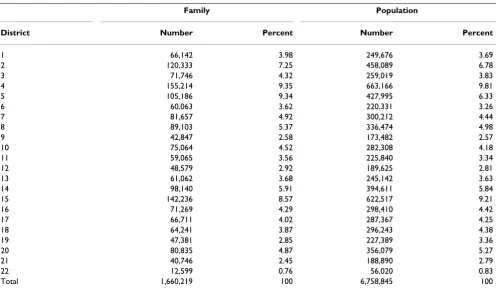
The sampling frame is considered the population of the urban area of Tehran city. Table 1 shows the distribution of Tehran population and families in the 22 municipal districts according to the 1996 census. It is estimated that the present total population in this area is nearly 7.5 mil-lion, but there is no evidence suggesting any change in the
distribution. So we will distribute our clusters on the basis of the population size of each district in 1996.
Number of Households in Tehran City
Census 1996 statistics showed that there were 1,660,219 households in Tehran city. Table 1 presents the number of households within each district of Tehran city. House-holds averaged 4.3 people in 1996.
Sample Size
For sample size calculation, the objective we have consid-ered is to estimate the prevalence of variables with propor-tions as little as 0.02 (P). On this assumption, for a 95% confidence interval (Z1-α/2 = 1.96) and precision of 0.005
(d), the sample size is calculated as follows:
Considering a design effect of 1.5 and a response rate of 85%, total sample size is calculated by the following equation:
n = 3010 × 1.5 × 1/0.85 ≈ 5300.
Sampling Plan
This study follows a stratified cluster sampling strategy with proportional allocation within strata. The target pop-ulation is all urban non-institutionalized citizens, of all ages, who reside in Tehran city in the year 2002. The strat-ification of the sample according to the 22 municipal dis-tricts of Tehran city is incorporated in the sampling process. Proportional to the number of households in the 22 districts (table 1), the appropriate number of clusters is assigned to each district (table 2). A total of 160 clusters are randomly selected based on blocks enumeration of the national census of 1996 by the Iranian Statistics Center. The decision about the number of clusters is based on total sample size; mean household members; and logistical facilities for subject enumeration, transport, and examination. For each cluster, a team of 2 interviewers (one male and one female) approaches the index house-hold, which is specified through the aforementioned ran-dom selection of clusters, and continues the enumeration in 10 neighbor households in a systematic manner by pro-ceeding round in a clock-wise direction. If more than one household inhabits a building, one will be randomly selected. They introduce themselves by presenting their identification cards. Then they describe the project to the present members of the households. At the end, all household members (people who have lived together in a housing unit for 6 months or more over the past year) are invited for a complete eye examination at Noor Vision Correction Center. They receive an invitation card in
n Z P P
d
= − − =
2 1 2
2 1
which the date and time of visit are clarified. The house-hold members are informed that they will be transported to the clinic by the project staff. The enumeration teams approach clusters on Mondays and Tuesdays, and partici-pants are examined on Thursdays and Fridays (formal weekend in Iran). Nine clusters are covered, and nearly 240 participants are visited weekly.
Non-response
Enumerated subjects who do not attend the examination process following the initial invitation will be contacted twice in subsequent weeks. Those who fail to appear even after the third invitation will be considered non-respond-ent.
Examination Protocol
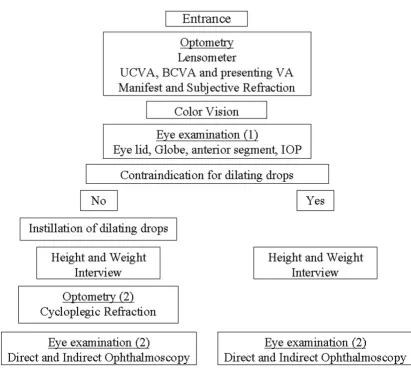
The examination protocol includes lensometry; uncor-rected, best corrected and presenting visual acuity meas-urements; manifest, subjective and cycloplegic refraction; color vision test; Goldmann applanation tonometry; examination of the external eye, anterior segment, media, and fundus; and an interview about demographic charac-teristics, history of eye diseases, eye trauma, diabetes mel-litus, high blood pressure, and ophthalmologic cares (Figure 1).
Visual Acuity and Refraction
An optometrist determines the visual acuity by using a NIDEK chart projector (CP – 670 20/10–20/400; Nidek Co, Gamagori, Japan) with tumbling E letters at a distance of 4 meters. Best spectacle corrected and uncorrected vis-ual acuity tests are performed separately for each eye (one eye at a time). Presenting visual acuity is measured with the participant's habitual distance correction. Lensometry is performed by an optometrist for those who use glasses. Visual acuity is recorded as the smallest line in which the patient can read the four letters correctly. If the person is unable to read the largest E letters in the chart (20/400 E letters) at 4 meters, then finger counting is done at 1 meter. The examiner stands one meter in front of the par-ticipant and asks if the parpar-ticipant can see his/her hand. The examiner slowly waves his/her hand and asks the par-ticipant if he/she can see what the hand is doing. If the participant is able to see the examiners hand moving, "hand motion" is recorded on the exam form. If the par-ticipant cannot see the examiner's hand, a penlight is held in front of the participant's eye and he/she is asked if he/ she can tell when the light is on. If the participant can cor-rectly identify when the light is on, "light perception" is recorded on the exam form. If the participant is unable to see the light, "no light perception" is recorded. Care will
Table 1: Distribution of Tehran population in the 22 municipal districts (1996 census).
Family Population
District Number Percent Number Percent
1 66,142 3.98 249,676 3.69
2 120,333 7.25 458,089 6.78
3 71,746 4.32 259,019 3.83
4 155,214 9.35 663,166 9.81
5 105,186 9.34 427,995 6.33
6 60,063 3.62 220,331 3.26
7 81,657 4.92 300,212 4.44
8 89,103 5.37 336,474 4.98
9 42,847 2.58 173,482 2.57
10 75,064 4.52 282,308 4.18
11 59,065 3.56 225,840 3.34
12 48,579 2.92 189,625 2.81
13 61,062 3.68 245,142 3.63
14 98,140 5.91 394,611 5.84
15 142,236 8.57 622,517 9.21
16 71,269 4.29 298,410 4.42
17 66,711 4.02 287,367 4.25
18 64,241 3.87 296,243 4.38
19 47,381 2.85 227,389 3.36
20 80,835 4.87 356,079 5.27
21 40,746 2.45 188,890 2.79
22 12,599 0.76 56,020 0.83
Examination process flowchart Figure 1
Examination process flowchart. UCVA = uncorrected visual acuity; BCVA = best-corrected visual acuity; VA = visual acuity; IOP = intraocular pressure.
Table 2: Number of clusters in the 22 municipal districts of Tehran.
District Number of clusters District Number of clusters
1 6 12 5
2 12 13 6
3 7 14 9
4 15 15 14
5 10 16 7
6 6 17 6
7 8 18 6
8 9 19 4
9 4 20 8
10 7 21 4
be taken to ensure that the unexamined eye is adequately covered with the palm or cloth and not pressed.
Refraction is done on all participants of five years of age and over using a Topcon automated refractometer (Top-con KR 8000, Top(Top-con Corporation, Tokyo, Japan) by an optometrist. The optometrists act according to the instruction manual of Topcon KR 8000. Results from autorefraction are used as a starting point for a full subjec-tive and manifest refraction. If autorefraction is not possi-ble (especially due to a media opacity) manual manifest and subjective refraction is attempted. On the judgment of an ophthalmologist, if there is no contraindication, cycloplegic refraction is done. In this case, cyclopentolate 1%, 2 drops are instilled 30 and 25 minutes before refrac-tion. The participants are warned about the symptoms of cyclopentolate.
Color vision test
Using Farnsworth D-15 test, an optometrist tests color vision in all participants of at least 7 years of age. The Farnsworth D-15 test consists of 15 colored papers selected from the hue circle mounted in plastic caps. The participant is given the tray and allowed 2 minutes to arrange the hue in serial order according to their colors.
Eye Examination
Eyelid, globe, and anterior segment examination is per-formed at the first ophthalmologic visit. Presence of globe is recorded. In order to assess defective eyelid closure, the participant is asked to close the eyes. In cases of lagoph-thalmos, ectropion, loss of lid margin, etc, the lid may not come into apposition. Then the condition is specified.
For all participants of five years of age and over, a slitlamp examination is done (Topcon slitlamp, Topcon Corpora-tion, Tokyo, Japan). The participant is seated comfortably at the slitlamp with his/her chin firmly on the chin rest and forehead against the headrest. The examiner then examines the anterior segment of each eye adjusting the beam width, magnification, and beam angle to achieve the best view of all the structures in the anterior segment. In viewing the cornea, the presence of arcus and the amount of involvement, any corneal scars, lesions, or abnormalities are recorded. The sclera, conjunctiva, and iris are all inspected for the presence of any lesions and abnormalities. The presence of pinguecula and pyterigia are recorded. A pyterigium is distinguished from a pingueculum if it crosses the limbus.
Iris color determination
Iris color is determined by viewing the participant's iris with the pupil undilated using a penlight. The color is compared to a color standards developed on the basis of the standards used in Beaver Dam Eye Study. Although
the choices on the form are "gray or blue", "yellow or green", "light brown", "medium brown" and "dark", the amount of pigment in the iris is taken into account rather than the actual color. When an iris has more than one color, the grade is assigned based on the color which is 50% or more.
Intraocular pressure
The intraocular pressure (IOP) is measured using a Gold-mann applanation tonometer. A drop of tetracain is instilled in each eye of the participant and tear is stained with fluorescein. The tonometer is swung into place on the slitlamp, the blue filter put into place, and the beam width opened to its fullest height. The beam angle should be about 45–60 degrees to the side of the tonometer and should illuminate the end of the prism head. The exam-iner should be aware of possible contact of the tonometer with the lids, lashes, or beard; all of which may cause a "high" reading. If IOP is >30 mmHg, it is rechecked after dilation. If IOP is >40 mmHg, the ophthalmologist pre-scribes appropriate treatment for the participant and informs him / her about the disease. Time of IOP meas-urement is recorded. The participant is asked whether he or she is currently taking medication for glaucoma. If the answer is affirmative, the drug is recorded.
Angle assessment
The angle of the anterior chamber is evaluated to deter-mine the risk of occlusion upon dilation. The exadeter-miner assesses the angle by viewing it nasally and temporally with a narrow beam directed at an angle of about 45 degrees. If the ophthalmologist feels the chamber angle to be occludable, dilating drops are not administered. When the examiner is in doubt, another examiner will be con-sulted. If the chamber does not appear occludable, dilat-ing drops are administered followdilat-ing the intraocular pressure test.
Clinical lens opacities grading
The ophthalmologist grades cortical and posterior sub-capsular opacities, nuclear opalescence and color by vis-ual comparison with a standard photograph (the Lens Opacities Classification System III, LOCS III) [38] through the biomicroscopic ophthalmic exam by a Top-con slitlamp (TopTop-con Corporation, Tokyo, Japan).
Direct and Indirect ophthalmoscopy
age-related maculopathy, retinitis pigmentosa, vascular retinopathy, Drusen, retinal detachment, and different types of diabetic retinopathy, which are recorded on the exam form if present.
Definitions
Visual impairment
The 10th edition of the International Classification of
Dis-eases (ICD10) defines visual impairment as a visual acuity of less than 6/18 (20/60, 0.3) in the better eye with the best correction. [39] Visual impairment is categorized to blindness and low vision. Blindness is a visual acuity of less than 3/60 (20/400, 0.05) in the better eye with the best correction. Low vision is defined as a best corrected visual acuity of less than 6/18 (20/60, 0.3) but not less than 3/60 (20/400, 0.05) in the better eye. The cause of visual impairment is identified by an ophthalmologist. Using the best judgment, the ophthalmologist will deter-mine one cause for each eye thought to be the principal cause in either eye. When multiple disorders are present, the ophthalmologist attempts to identify the disorder causing the greatest limitation of vision. If there are any other contributory causes, the ophthalmologist specifies that as a second cause. In cases with different causes of vis-ual reduction in the patient's two eyes, the diagnosis in the less affected eye is used. Cataract is considered the main cause of severe low vision if the fundus is obscured by lens changes, or if no evident fundus abnormalities are observed in eyes with significant cataract. Regarding the results of exams, the ophthalmologist specifies whether the participant needs any action and specifies the type of needed action.
Observers Training and quality assurance
All observers (including enumerators, optometrists and ophthalmologists) take part in a comprehensive training course, which has been developed for conducting the pro-tocol. The course includes a full spectrum of education to ensure that all investigators have a broad based knowl-edge of the study process, study purposes, data forms, and technical skills needed to conduct the protocol in a scien-tifically sound manner. All staff must complete the train-ing course prior to getttrain-ing involved in the study. The program director and manager directly supervise the staff training process.
All observers receive regular quality control visits from the project manager who checks their performance. In addi-tion, the data are reviewed periodically, and feedback is given to the observers weekly.
Pilot and reliability study
In order to assess the protocol, sampling process, partici-pants' transport, data forms, equipment, and interob-server agreement, a pilot study is done one month before
starting the study. The pilot study is done on 3 clusters in different districts outside those selected for the main study. To determine the reliability coefficient for visual acuity and refraction, the procedures are repeated twice by two series of observers. The agreement rates are calculated.
Humanity and ethics
The study is approved by the Research and Ethics mittee of Noor Vision Correction Center and Ethics Com-mittee of the National Research Center for Medical Sciences. All subjects included in this study will be informed about the project and the procedures in their native language before being enrolled. They will be informed that their participation is entirely voluntary and they may decide to withdraw from the study at any time. The participants' agreement for examination will be obtained verbally. The confidentiality of all study partici-pants will be protected in accordance with a good epide-miological practice.
Data handling and statistical analysis
Data entry
During the enumeration process, as data on each house-hold is completed, a supervisor will do a quick check to see that all data is collected properly. Similarly, during the eye examination at the clinic, as each person completes the eye exam, the supervisor checks all data forms to ensure that all relevant data has been collected. Missing data and mistakes are rectified after consulting the con-cerned person.
Data editing
During data entry, the forms will be checked for complete-ness and consistency by the data entry software. If the forms are not filled in completely, the concerned person will be consulted to fill in the missing data or clarify an inconsistent data. All changes and coding will be made in ink by crossing out the original data and recording the new data beside it. It will be signed and dated by the per-son making the changes. Overwriting will be avoided.
Statistical analysis
In calculating standard errors and the 95% confidence interval for categorical and continuous variables, the clus-ter sampling design is taken into account and adjusted for. [40] In addition to descriptive analyses, odds ratios are calculated with multivariate logistic regression in order to control potential confounding variables, and account for cluster design effects.
given person k does not. To adjust for possible confound-ing variables, we will use the second-order generalized estimating equations (GEE2) approach to logistic regres-sion that simultaneously models the risk of a person hav-ing myopia and the familial associations. [41,42] In order to assess the degree of familial association for quantitative variables (e.g., spherical equivalent and cylindrical power) we computed Pearson correlation coefficients for all possible pairs of siblings. All analyses will be done using STATA statistical software, version 6.0 (STATA Cor-poration, TX).
Discussion
This study protocol describes the study design and eye examination of a cross-sectional population-based study in Tehran population. We expect that findings from the TES will show the status of visual problems and their causes in the community. This study will highlight the people who should be targeted by intervention programs for prevention of visual impairment.
List of abbreviations used
VA = visual acuity
UCVA = uncorrected visual acuity
BCVA = best corrected visual acuity
IOP = intraocular pressure
ICD10 = The International Classification of Diseases, 10th
edition
LOCS III = The Lens Opacities Classification System III
Competing interests
None declared.
Authors' contributions
HH, the director of the project, participated in the design of the study and the examination protocol, and he will supervise the examination process. AF, the manager of the project, participated in the design of the study and will coordinate the study. He drafted the manuscript and will participate in the statistical analyses. KM participated in the design of the study and will participate in the statisti-cal analyses. All authors have read and approved the final manuscript.
Acknowledgements
Special thanks are given to Dr Ronald Klein, the Beaver Dam Eye Study; Dr Rupert Bourne, the National Blindness and Low Vision Prevalence Survey of Bangladesh; Dr Leon Ellwein and Dr Praveen K Nirmalan, the Tirunelveli eye survey; Dr Montserrat Martin-Baranera, Survey of blindness in Bioko, Equatorial Guinea, all who kindly have provided us the protocols and data
forms of their studies. We also thank Dr Kamran Hojat Jalali and Dr Azam Alimardani for their helps in preparation of the eye examination protocol.
This project is supported in part by Noor Vision Correction Center, and a grant from the Iranian National Research Center for Medical Sciences. The selection of clusters is done based on blocks enumeration of the national census of 1996 by the Iranian Statistics Center.
References
1. Thylefors B: A mission for visionLancet 1999, 354(Suppl):SIV44. 2. Thylefors B, Negrel AD, Pararajasegaram R and Dadzie KY: Global
data on blindnessBull World Health Organ 1995, 73:115-121. 3. Tabbara KF: Blindness in the eastern Mediterranean countries
Br J Ophthalmol 2001, 85:771-777.
4. Klein R, Klein BEK, Linton KLP and De Mets DL: The Beaver Dam Eye Study: visual acuityOphthalmology 1991, 98:1310-1315. 5. Attebo K, Mitchell P and Smith W: Visual acuity and the causes
of visual loss in Australia. The Blue Mountains Eye Study Oph-thalmology 1996, 103:357-364.
6. Rahmani B, Tielsch JM, Katz J, Gottsch J, Quigley H, Javitt J and Som-mer A: The cause-specific prevalence of visual impairment in an urban population. The Baltimore Eye SurveyOphthalmology
1996, 103:1721-1726.
7. Mansour AM, Kassak K, Chaya M, Hourani T, Sibai A and Alameddine MN: National survey of blindness and low vision in Lebanon
Br J Ophthalmol 1997, 81:905-906.
8. Rubin GS, West SK, Munoz B, Bandeen-Roche K, Zeger S, Schein O and Fried LP: A comprehensive of visual impairment in a pop-ulation of older assessment The SEE Study. Salisbury Eye Evaluation Project. Americans Invest Ophthalmol Vis Sci 1997,
38:557-568.
9. Taylor HR, Livingston PM, Stanislavsky YL and McCarty CA: Visual impairment in Australia: distance visual acuity, near vision, and visual field findings of the Melbourne Visual Impairment ProjectAm J Ophthalmol 1997, 123:328-337.
10. Klaver CCW, Wolfs RCW, Vingerling JR, Hofman A and de Jong PT:
Age-specific prevalence and causes of blindness and visual impairment in an older population: The Rotterdam Study
Arch Ophthalmol 1998, 116:653-658.
11. Lee DJ, Gomez-Marin O and Lam BL: Prevalence of uncorrected binocular distance visual acuity in Hispanic and non-Hispanic adultsOphthalmology 1998, 105:552-560.
12. Zhao J, Jia L, Sui R and Ellwein LB: Prevalence of blindness and cataract surgery in Shunyi county, ChinaAm J Ophthalmol 1998,
126:506-514.
13. Pokharel GP, Regmi G, Shrestha SK, Negrel AD and Ellwein LB: Prev-alence of blindness and cataract surgery in Nepal Br J Ophthalmol 1998, 82:600-605.
14. Munier A, Gunning T, Kenny D and O'Keefe M: Causes of blindness in the adult population of the Republic of Ireland Br J Ophthalmol 1998, 82:630-633.
15. See JLS, Wong TY and Yeo KT: Trends in the Pattern of Blind-ness and Major Ocular Diseases in Singapore and AsiaAnn Acad Med Singapore 1998, 27:540-546.
16. He M, Xu J, Li S, Wu K, Munoz SR and Ellwein LB: A survey of blind-ness and cataract surgery in Doumen County, China Ophthal-mology 1999, 106:1602-1608.
17. Weih LM, VanNewkirk MR, McCarty CA and Taylor HR: Age-spe-cific causes of bilateral visual impairmentArch Ophthalmol 2000,
118:264-269.
18. Van der Pols JC, Bates CJ, McGraw PV, Thompson JR, Reacher M, Prentice A and Finch S: Visual acuity measurements in a national sample of British elderly peopleBr J Ophthalmol 2000,
84:165-170.
19. Murthy GVS, Gupta S, Ellwein LB, Munoz SR, Bachani D and Dada VK:
A population-based eye survey of older adults in a rural dis-trict of RajasthanOphthalmology 2001, 108:679-685.
20. VanNewkirk MR, Weih LA, McCarty CA and Taylor HR: Cause-spe-cific Prevalence of Bilateral Visual Impairment in Victoria, AustraliaOphthalmology 2001, 108:960-967.
Publish with BioMed Central and every scientist can read your work free of charge "BioMed Central will be the most significant development for disseminating the results of biomedical researc h in our lifetime."
Sir Paul Nurse, Cancer Research UK
Your research papers will be:
available free of charge to the entire biomedical community
peer reviewed and published immediately upon acceptance
cited in PubMed and archived on PubMed Central
yours — you keep the copyright
Submit your manuscript here:
http://www.biomedcentral.com/info/publishing_adv.asp
BioMedcentral
22. Buch H, Vinding T and Nielsen NV: Prevalence and Causes of Vis-ual Impairment According to World Health Organization and United States Criteria in an Aged, Urban Scandinavian Population, The Copenhagen City Eye StudyOphthalmology
2001, 108:2347-2357.
23. Michon JJ, Lau J, Chan WS and Ellwein LB: Prevalence of visual impairment, blindness, and cataract surgery in the Hong Kong elderlyBr J Ophthalmol 2002, 86:133-139.
24. Moser CL, Martin-Baranera M and Vega F: Survey of blindness and visual impairment in Bioko, Equatorial GuineaBr J Ophthalmol
2002, 86:257-260.
25. Dandona R, Dandona L, Srinivas M, Giridhar P, Prasad MN, Vilas K, McCarty and Rao GN: Moderate visual impairment in India: the Andhra Pradesh Eye Disease StudyBr J Ophthalmol 2002,
86:373-377.
26. Munoz B and West SK: Blindness and visual impairment in the Americas and the CaribbeanBr J Ophthalmol 2002, 86:498-504. 27. Nirmalan PK, Thulasiraj RD, Maneksha V, Rahmathullah R,
Ram-akrishnan R, Padmavathi A, Munoz SR and Ellwein LB: A population based eye survey of older adults in Tirunelveli district of south India: blindness, cataract surgery, and visual outcomes
Br J Ophthalmol 2002, 86:505-512.
28. Kocur I and Resnikoff S: Visual impairment and blindness in Europe and their preventionBr J Ophthalmol 2002, 86:716-722. 29. Evans JR, Fletcher AE, Wormald RPL, Siu-Woon Ng E, Stirling S,
Smeeth L, Breeze E, Bulpitt CJ, Nunes M, Jones D and Tulloch A:
Prevalence of visual impairment in people aged 75 years and older in Britain: results from the MRC trial of assessment and management of older people in the community Br J Ophthalmol 2002, 86:795-800.
30. Zainal M, Ismail SM, Ropilah AR, Elias H, Arumugam G, Alias D, Fathi-lah J, Lim TO, Ding LM and Goh PP: Prevalence of blindness and low vision in Malaysian population: results from the National Eye Survey 1996Br J Ophthalmol 2002, 86:951-956.
31. Khandekar R, Mohammed AJ, Negrel AD and Al Riyami A: The prev-alence and causes of blindness in the Sultanate of Oman: the Oman Eye Study (OES)Br J Ophthalmol 2002, 86:957-962. 32. Amansakhatov S, Volokhovskaya ZP, Afanasyeva AN and Limburg H:
Cataract blindness in Turkmenistan: results of a national surveyBr J Ophthalmol 2002, 86:1207-1210.
33. Rodriguez J, Sanchez R, Munoz B, West SK, Broman A, Snyder RW, Klein R and Quigley H: Causes of Blindness and Visual Impair-ment in a Population-based Sample of U. S. Hispanics Oph-thalmology 2002, 109:737-743.
34. Bourne RRA, Dineen B, Ali SM, Noorul Hug DM and Johnson GJ: The national blindness and low vision prevalence of Bangladesh: research design, eye examination methodology and results of pilot studyOphthalmic Epidemiol 2002, 9:119-132.
35. Thulasiraj RD, Rahmathulla R, Saraswati A, Selvaraj S and Ellwein LB:
The Sivaganga Eye Survey: I. Blindness and cataract surgery
Ophthalmic Epidemiol 2002, 9:299-312.
36. Mohammad K, Joghatai MT, Syiadati S and Rahgozar M: A national survey of visual disturbances In IranJ Medical Council of IRI 2001,
19:203-209.
37. Noorbala AA and Mohammad K: National Health Survey of Iran
The National Research Center for Medical Sciences 2001.
38. Chylack LT Jr, Wolfe JK, Singer DM, Leske MC, Bullimore MA, Bailey IL, Friend J, McCarthy D and Wu SY: The Lens Opacities Classifi-cation System III. The Longitudinal Study of Cataract Study GroupArch Ophthalmol 1993, 111:831-836.
39. World Health Organization: International Statistical Classifica-tion of Diseases and Related Health ProblemsGeneva 1992. 40. Bennett S, Woods T, Liyanage WM and Smith DL: A simplified
method for cluster sample surveys of health in developing countriesWorld Health Statistics Quarterly 1991, 44:98-106. 41. Liang KY and Beaty TH: Measuring familial aggregation by using
odds-ratio regression modelsGenet Epidemiol 1991, 8:361-370. 42. Qaqish BF and Liang KY: Marginal models for correlated binary
responses with multiple classes and multiple levels of nesting
Biometrics 1992, 48:939-950.
Pre-publication history
The pre-publication history for this paper can be accessed here: