S H O R T R E P O R T
Open Access
The effects of a novel bicarbonate loading
protocol on serum bicarbonate
concentration: a randomized controlled
trial
Adam Marcus
1, Amerigo Rossi
1,2*, Andrew Cornwell
2, Steven A. Hawkins
3and Nazareth Khodiguian
2Abstract
Background:Previous studies have shown that sodium bicarbonate ingestion may enhance intense exercise
performance, but may also cause severe gastrointestinal distress. The purpose of this study was to determine whether a modified sodium bicarbonate (SB) ingestion protocol would elevate serum bicarbonate concentration more than previous methods without causing gastrointestinal distress.
Methods:In randomized order, seven (5 men, 2 women) elite middle-distance runners ingested either placebo,
Modified SB (600 mg·kg−1over 19.5 h), or Acute SB (300 mg·kg−1) in opaque gelatin capsules. Baseline and post-ingestion blood samples were analyzed for bicarbonate, pH, sodium, hematocrit, and lactate. Repeated measures ANOVA (2 time points × 3 conditions) were analyzed to determine differences in serum bicarbonate, lactate, sodium, blood pH, and hematocrit. Gastrointestinal distress was assessed via self-report on a Likert scale of 1–10. Simple (condition) and repeated (time) within-participant contrasts were used to determine the location of any statistically significant main and interaction effects (p≤0.05).
Results:Both Modified SB (7.6 mmol·L−1,p< 0.01) and Acute SB (5.8 mmol·L−1,p< 0.01) increased serum bicarbonate concentration compared to the placebo (p≤0.05). Post-ingestion serum bicarbonate concentration was significantly higher for the Modified SB (34.7 ± 2.2 mmol·L−1, 28.0% increase) trials than the Acute SB (33.5 ± 2.0 mmol·L−1, 20.9% increase) trials (p= 0.05). There was no reported severe GI distress in the Modified SB trials, but two cases in the Acute SB trials.
Conclusions:Modified SB elevated serum bicarbonate concentration more than Acute SB, without any severe
gastrointestinal side effects. Consequently, it is recommended that future experimentation involving SB by researchers and athletes use the novel ingestion protocol described in this study due to its potential for improved effectiveness and reduced gastrointestinal impact.
Trial registration:ClinicalTrials.gov,NCT03813329. Registered 23 January 2019 - Retrospectively registered,
Keywords:Ergogenic, Running, Elite, Bicarbonate, Lactate, Buffer, Nutrition, Supplement
© The Author(s). 2019Open AccessThis article is distributed under the terms of the Creative Commons Attribution 4.0 International License (http://creativecommons.org/licenses/by/4.0/), which permits unrestricted use, distribution, and reproduction in any medium, provided you give appropriate credit to the original author(s) and the source, provide a link to the Creative Commons license, and indicate if changes were made. The Creative Commons Public Domain Dedication waiver (http://creativecommons.org/publicdomain/zero/1.0/) applies to the data made available in this article, unless otherwise stated. * Correspondence:[email protected]
1
Division of Athletic Training, Health and Exercise Science, Long Island University Brooklyn, Brooklyn, NY 11201, USA
2School of Kinesiology and Nutritional Science, California State University Los Angeles, 5151 State University Boulevard, Los Angeles, CA, USA
Introduction
Sodium bicarbonate has been shown to increase blood al-kalosis and bicarbonate levels, as well as exercise capacity [1–3]. Several studies have investigated the effect of so-dium bicarbonate (SB) ingestion on exercise performance [4], with mostly equivocal findings. One systematic review had found that SB ingestion was one of the most effective ergogenic aids for middle distance running [5], whereas a more recent systematic review found that sodium bicar-bonate was found to be an effective ergogenic aid in 11 out of 20 randomized controlled trials of performance lasting less than 4 minutes [6]. Considering that the differ-ence between 1st and 12th place in the most recent men’s Olympic 1500 m race in Athletics (2016) was only 1.73 s (0.75% of the total time), and sodium bicarbonate may im-prove high-intensity running performance in trained ath-letes by 2–3% [7], investigating optimal SB ingestion protocols may be of high importance.
The discrepancy in previous findings may be due to side effects of typical dosing strategies. Most studies of the effects of SB on performance have administered a standard acute dosages of sodium bicarbonate (300 mg·kg−1body weight), which may cause gastrointestinal (GI) distress [8–10] and potentially minimize any ergogenic effect of the bicarbonate ingestion [11]. For example, Saunders et al. [12] observed improvements in high-intensity cycling, but only in those that did not experience GI distress. Larger acute doses of SB (i.e. 500 mg·kg−1) elevate serum bicarbonate concentration to a greater extent [11,13], indicating a dose response [13], but may also cause more severe GI distress [14].
Because higher serum SB may have a greater ergogenic effect on performance, but larger doses induce greater GI distress, several studies have attempted to administer rela-tively small doses over several days [15–17] in order to significantly elevate blood bicarbonate without inducing GI distress. While these protocols, ranging from 3 to 10 days, avoided causing GI distress, they only increased blood bi-carbonate concentration approximately 10%, which is much less than what typically been found in acute ingestion pro-tocols [9,18,19]. More research needs to be conducted to determine the most effective chronic dosing strategy [6].
The primary purpose of the present study, therefore, was to evaluate the effect of a novel 1-day SB ingestion protocol on serum bicarbonate and GI distress. It was hypothesized that this novel protocol would significantly elevate serum bicarbonate concentration and produce less GI distress than typical acute SB ingestion.
Methods
Study design
Blood samples were collected at baseline and following placebo (CaCO3), acute sodium bicarbonate (AcuteSB) ingestion, and modified sodium bicarbonate (ModSB) ingestion protocols to determine the effects on serum
bicarbonate, sodium and lactate concentrations, as well as on serum pH and blood hematocrit. The study design was a randomized double-blind crossover. The order of ingestion protocols was counter-balanced using a Latin square to minimize the potential of a learning effect. All tests were administered between 8 and 11 AM, and were conducted at the same time of day for each participant. A period of 7–10 days was allowed between trials to ensure the ingested substances had returned to baseline prior to the subsequent trial [17]. Participants were instructed to maintain their normal training patterns throughout the study, and to refrain from intense training for at least 48 hours prior to each test. Participants were also instructed to eat the same high-carbohydrate breakfast approxi-mately 3 hours prior to each post-ingestion assessment.
Participants
Ten elite middle-distance runners (6 men, 4 women) from running teams in the Los Angeles area volunteered to participate. Inclusion criteria were: 1). Peak oxygen consumption greater than 60 ml·kg−1·min−1 (men) or 50 ml·kg−1·min−1 (women); 2). Currently training, de-fined as at least 5 days·week−1of running; 3). Elite-level performance (750 or more points on the International Associations of Athletics Federations Scoring Table) for an 800 m–5000 m race during the preceding 6 months. Elite athletes were selected because they are a sample population that would actually utilize sodium bicarbonate supplementation.
Preliminary testing
Ingestion protocols
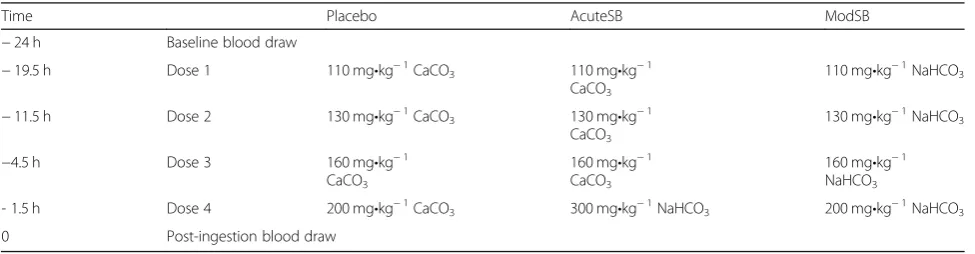
The ModSB protocol consisted of 4 progressively larger doses of SB administered with progressively shorter time intervals between doses consumed during the 19.5-h period prior to post-ingestion testing (Table 1). This protocol was developed in order to deliver a maximum amount of sodium bicarbonate in smaller individual doses that would not cause GI distress (≤ 200 mg·kg−1), while maintaining short total consumption time to minimize sodium consumption. Calcium carbonate was chosen as the placebo because it had repeatedly been used successfully in previous sodium bicarbonate research [22]. The calcium carbonate ingestion protocol (placebo) simu-lated the ModSB protocol. In order to maintain the double-blind design of the study, the first three doses of the Acute SB protocol contained the placebo, and only the last dose contained 300 mg·kg−1of SB.
For each trial, participants arrived at the lab 24 h prior to the post-ingestion test to have a baseline blood draw and receive 4 doses of the substance(s) to be ingested in numbered sealed bags with a detailed ingestion schedule and a 750 ml bottle of water. Beginning 19.5 h prior to the post-ingestion test, participants ingested each dose with 750 ml of water according to the ingestion sched-ule. Participants were asked to record the timing of each ingested dose for confirmation. The same number of capsules was used per dose across trials for each partici-pant and doses were encased in opaque gelatin capsules (size “00”) to mask the flavor and granularity of the re-spective substances.
Participants self-reported their respective levels of GI distress on a Likert scale of 1–10 (1 = no GI distress, 10 = worst possible GI distress). The data were classified a priori as 1–3 equal to limited GI distress, 4–7 as mod-erate GI distress, and 8–10 as severe GI distress.
Blood analysis
Ten ml of blood was drawn via forearm venipuncture twice for each condition. Baseline blood draws occurred 24 h prior to the post-ingestion test in order to minimize
the effect of diurnal variations in hematocrit, plasma sodium and bicarbonate concentrations [23]. The post-ingestion blood draws were taken 78 ± 7 minutes follow-ing the 4th dose.
Two capillary tubes were immediately filled from the blood samples to be tested for hematocrit via the micro-hematocrit method [24] in order to evaluate changes in blood composition following the ingestion protocols. The remaining blood was allowed to coagulate at room temperature for 25 minutes and was then spun in a re-frigerated centrifuge for 10 min. The serum was pipetted into three small vials, one of which was placed in a− 80 °C freezer for later analysis of serum sodium and lac-tate concentrations. The serum in one vial was immedi-ately analyzed for pH (Orion 720A+, Thermo Electron Corporation, Waltham, MA) and the other was used to measure bicarbonate concentration in duplicate with a carbon dioxide liquid stable reagent method (TR28321, Thermo Electron Corporation, Waltham, MA) using a spectrophotometer (Lambda 20, PerkinElmer, Waltham, MA) [25]. Once all the participants had been tested, the frozen samples were thawed and analyzed for sodium (Vitros DT60 II, Ortho-Clinical Diagnostics, Rochester, NY) and lactate concentrations (Vitros DT60 II, Ortho-Clinical Diagnostics, Rochester, NY) [26].
Statistical analysis
Means and standard deviations were calculated (X ± SD) for all measurements. Repeated measures ANOVA with factorial design (2 time points × 3 conditions) were ana-lyzed to determine significant interactions between time (baseline, post-ingestion) and condition (Placebo, AcuteSB, ModSB) for blood parameters. Simple (condi-tion) and repeated (time) within-participant contrasts were used to determine the location of any significant differences. Paired-sample t-tests were analyzed to deter-mine differences in blood parameters at baseline. In order to evaluate differences following the ingestion of AcuteSB and ModSB, effect sizes were calculated for each variable. Because of the small sample size,
Table 1Timing and Dosages of the Three Ingestion Protocols
Time Placebo AcuteSB ModSB
−24 h Baseline blood draw
−19.5 h Dose 1 110 mg•kg−1CaCO3 110 mg •kg−1 CaCO3
110 mg•kg−1NaHCO3
−11.5 h Dose 2 130 mg•kg−1CaCO3 130 mg•kg−1 CaCO3
130 mg•kg−1NaHCO3
−4.5 h Dose 3 160 mg•kg−1 CaCO3
160 mg•kg−1 CaCO3
160 mg•kg−1 NaHCO3
- 1.5 h Dose 4 200 mg•kg−1CaCO3 300 mg•kg−1NaHCO3 200 mg•kg−1NaHCO3
0 Post-ingestion blood draw
corrected effect sizes were calculated using Hedge’s g. All data analyses were performed with SPSS 25.0. Statis-tical significance was established atp≤0.05.
Results
It was hypothesized that this novel protocol would signifi-cantly elevate serum bicarbonate concentration and pro-duce less GI distress than typical acute SB ingestion. Serum bicarbonate and GI distress were primary out-comes. Hematocrit, pH, serum sodium, and serum lactate were secondary outcomes.
Ten participants enrolled in the study. Three partici-pants dropped out for reasons unrelated to the study (2 participants were injured during training and 1 withdrew for undisclosed personal reasons) and were not included in the data analysis. Characteristics of the remaining seven participants (5 men, 2 women) are summarized in Table 2. There were no significant differences for any of the blood parameters at baseline between conditions.
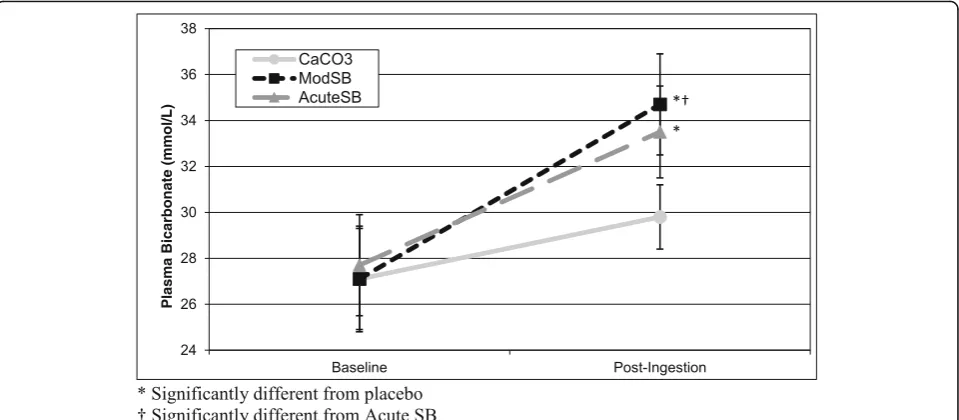
There was a significant interaction effect between con-dition and time (F = 9.52,p< 0.01) for serum bicarbonate concentration (Fig.1). Although the placebo trials induced a small (2.7 mmol·L−1) but significant (p< 0.01) increase in serum bicarbonate concentration, contrasts revealed that there were significantly greater increases in serum bi-carbonate concentration for the AcuteSB (5.8 mmol·L−1, p< 0.01) and ModSB (7.6 mmol·L−1, p< 0.01) conditions compared to the placebo from Baseline to post-ingestion. Furthermore, post-ingestion serum bicarbonate concen-tration was significantly higher (p= 0.05) for the ModSB condition (34.7 ± 2.2 mmol·L−1) than the AcuteSB condi-tion (33.5 ± 2.0 mmol·L−1).
Two of the seven participants reported severe (8 and 9 out of 10) gastrointestinal distress following the inges-tion of the last dose during the Acute SB ingesinges-tion protocol, whereas none of the participants reported se-vere GI distress following the ModSB or placebo inges-tion protocols.
There was a statistically significant interaction effect for pH (F = 6.03, p= 0.02) from baseline to post-ingestion. Analysis of the contrasts indicated that the results for pH paralleled those for serum bicarbonate concentration. There was a significantly greater increase in pH from baseline to post-ingestion in the AcuteSB (0.11 units, p= 0.04) and the ModSB (0.09 units, p< 0.01) trials compared to the placebo trials (0.04 units).
There was also a significant interaction effect for sodium (F = 5.54, p= 0.03). However, contrasts revealed that neither AcuteSB (1.4 mmol·L−1, p= 0.10) nor ModSB
(1.6 mmol·L−1, p= 0.06) protocols significantly chan-ged serum sodium concentrations compared to the placebo (−1.6 mmol·L−1).
There was a significant interaction effect between condition and time for hematocrit (F = 8.86, p< 0.01). Contrasts revealed that there were significant differences in the amount of change in hematocrit from baseline to post-ingestion between the ModSB (−2.8 units,p< 0.01) and AcuteSB (−1.6 units, p= 0.03) compared to the placebo (+ 0.6 units).
There was a significant main effect of time on lactate (p= 0.01), with an increase in all groups, but no inter-action effect (p= 0.15).
There was a significant main effect of time on body weight (p= 0.020), with body weight increasing in all three groups slightly following the ingestion protocols. However, there were no significant interaction effects (p> 0.20).
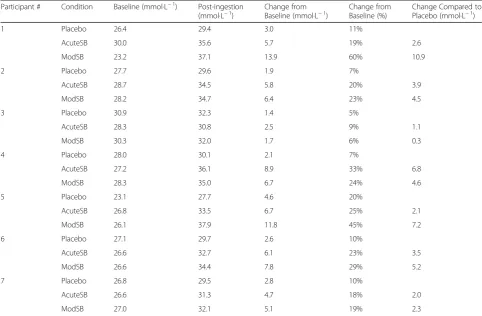
Detailed values for each of the serum variables at each time point are summarized in Table 3, and individual participant values for serum bicarbonate are presented in Table4.
Discussion
The primary purpose of this study was to investigate if a novel sodium bicarbonate ingestion protocol (ModSB) would elevate serum bicarbonate concentration more ef-fectively than previous protocols that have typically been employed (AcuteSB). We found that ModSB elevated serum bicarbonate concentration 30% more than AcuteSB, without any associated severe GI distress.
To the best of our knowledge, this was the first study to report a significantly greater increase in serum bicarbon-ate concentration compared to the changes elicited by typ-ical sodium bicarbonate ingestion protocols. Previous studies have typically administered an acute dose (300 mg·kg−1of body weight) of sodium bicarbonate approxi-mately 90 minutes prior to exercise, which has led to a ~ 20% elevation of serum bicarbonate concentration [9,18, 19]. In the present study, a similar protocol, AcuteSB, elic-ited a similar elevation of serum bicarbonate concentra-tion (20.9%). The ModSB ingesconcentra-tion protocol resulted in a significantly greater (28.0%) increase in serum bicarbonate concentration, supporting the hypothesis that oral admin-istration of smaller but progressively incremental doses of sodium bicarbonate is more effective in increasing serum bicarbonate concentration.
Since each dose (110 mg·kg−1 - 200 mg·kg−1), was sig-nificantly lower than the dose known to cause GI distress (≥ 300 mg·kg−1), ModSB trials did not induce severe GI
Table 2Participant Characteristics (N= 7; Mean ± SD)
Age (yrs) Height (cm) Weight (kg) Body fat (%) VO2peak(ml·kg−1·min−1) HRmax(bpm) Running (km·wk.−1)
distress in the present study. The AcuteSB ingestion, on the other hand, induced severe GI distress in two of the seven participants (29%). Other studies that have adminis-tered a 300 mg·kg−1dose also reported mild to severe GI distress in some participants [8, 9, 27], which may have had ergolytic effects.
In the present study calcium carbonate (CaCO3) was used as the placebo because of its widespread use as placebo in previous studies [9, 19]. However, the results of the present study indicated a 10% increase in serum bicarbonate concentration as a result of CaCO3 ingestion. Because the first three doses of the AcuteSB ingestion protocol contained progressively larger doses of the placebo (CaCO3), it is likely that some of the increase in serum bicarbonate concentra-tion following AcuteSB trials actually resulted from the ingestion of placebo.
More sodium was ingested during the ModSB (~ 11, 500 mg for 70 kg athlete) than the Acute SB trials (~ 5750 mg for 70 kg athlete), and none was con-sumed during the placebo trials. Correspondingly, there was a significant interaction effect and serum sodium concentration was increased, albeit insignifi-cantly, in the two bicarbonate trials compared to the placebo. Hematocrit decreased significantly more in the two bicarbonate trials than in the placebo. Hematocrit and body mass can be used to estimate plasma volume [28]. The data from this study sug-gest that sodium bicarbonate insug-gestion and the asso-ciated increase in serum sodium concentration in the ModSB trial may have led to an increased plasma volume of approximately 6%. It has been shown that high sodium ingestion ~ 60–90 minutes prior to exercise increases plasma volume ~ 4% in men
Fig. 1Serum Bicarbonate Concentration at Baseline, Post-ingestion. * Significantly different from placebo.†Significantly different from Acute SB
Table 3Mean (± standard deviation) Blood Hematocrit, and Serum Bicarbonate (HCO3−), pH, Sodium (Na+), and Lactate
Placebo AcuteSB ModSB
Baseline Post-ingestion Baseline Post-ingestion p-value Baseline Post-ingestion p-value Effect size (Hedges’g)
HCO3−(mmol·L−1) 27.1 (±2.3) 29.8 (±1.4) 27.7 (±1.3) 33.5 (±2.0) < 0.01 27.1 (±2.2) 34.7‡(±2.2) < 0.01 0.53
pH 7.60 (±.04) 7.64 (±.05) 7.56 (±.06) 7.67 (±.08) 0.04 7.58 (±.05) 7.67 (±.04) < 0.01 −0.18
Na+(mmol·L−1) 138.8 (±1.3) 137.2 (±1.0) 139.7 (±2.3) 140.3 (±1.8) 0.10 138.8 (±1.3) 140.0 (±1.5) 0.06 0.32
Hematocrit (%) 45.9 (±3.5) 46.5 (±2.8) 46.8 (±2.2) 45.0 (±2.9) 0.03 46.2 (±3.5) 43.4 (±1.7) < 0.01 −0.57
Lactate (mmol·L−1) 1.6 (±0.7) 1.7 (±0.2) 1.6 (±0.1) 2.0 (±0.3) NS 1.4 (±0.2)
1.9 (±0.5) NS 0.21
p-value indicates significantly different change from baseline compared to placebo (p≤0.05) Effect size reflects the difference in baseline to post-ingestion change between AcuteSB and ModSB
‡Significantly higher than AcuteSB (p≤0.05)
[29] and women [30]. However, since plasma volume was not directly assessed in this study, these findings should be interpreted with caution and investigated further.
There was also a significant main effect of time on weight, caused by an increase in weight across all condi-tions following the ingestion protocols of 0.4–0.9 kg. However, since there were no differences in body weight between conditions, the increase in weight was most likely due to the larger than normal total water consumption (3 L) during the ingestion protocol. Many participants noted that they were unaccustomed to consuming such large quantities of water.
One major strength of the current study is the use of only elite athletes in the protocol, increasing the generalizability of the findings to the intended popula-tion. The primary limitation, however, is the small sam-ple size. Despite this limitation, the findings are strong enough to indicate the potential of a novel method for bicarbonate ingestion that is more beneficial and less detrimental that previous trials in elite athletes.
Conclusions
The novel sodium bicarbonate ingestion protocol uti-lized in the present study elevated serum bicarbonate
more than the conventional ingestion protocol without causing any associated severe gastrointestinal distress. To maximize the potential ergogenic effect and minimize the gastrointestinal side effects, athletes should try ingesting sodium bicarbonate according to the ingestion protocol utilized in this study.
Abbreviations
AcuteSB:Acute Sodium Bicarbonate; GI: Gastrointestinal; IRB: Institutional Review Board; ModSB: Modified Sodium Bicarbonate; SB: Sodium Bicarbonate
Acknowledgements
The authors would like to acknowledge the commitment and effort of all the athletes who participated in this study.
Authors’contributions
AM completed the data analysis, manuscript writing, and revision. AR was involved in all aspects of the study design, data collection, data analysis, and manuscript preparation. AC contributed to the design of the study, randomization of the participants and manuscript preparation. SAH contributed to the study design and development of data collection. NK contributed to the study design, IRB submission, participant recruitment, data collection, and manuscript preparation. All authors read and approved the final manuscript.
Funding
There was no funding for this study.
Table 4Individual serum bicarbonate values for each participant at baseline and post-ingestion
Participant # Condition Baseline (mmol·L−1) Post-ingestion
(mmol·L−1) Change fromBaseline (mmol·L−1) Change fromBaseline (%) Change Compared toPlacebo (mmol·L−1)
1 Placebo 26.4 29.4 3.0 11%
AcuteSB 30.0 35.6 5.7 19% 2.6
ModSB 23.2 37.1 13.9 60% 10.9
2 Placebo 27.7 29.6 1.9 7%
AcuteSB 28.7 34.5 5.8 20% 3.9
ModSB 28.2 34.7 6.4 23% 4.5
3 Placebo 30.9 32.3 1.4 5%
AcuteSB 28.3 30.8 2.5 9% 1.1
ModSB 30.3 32.0 1.7 6% 0.3
4 Placebo 28.0 30.1 2.1 7%
AcuteSB 27.2 36.1 8.9 33% 6.8
ModSB 28.3 35.0 6.7 24% 4.6
5 Placebo 23.1 27.7 4.6 20%
AcuteSB 26.8 33.5 6.7 25% 2.1
ModSB 26.1 37.9 11.8 45% 7.2
6 Placebo 27.1 29.7 2.6 10%
AcuteSB 26.6 32.7 6.1 23% 3.5
ModSB 26.6 34.4 7.8 29% 5.2
7 Placebo 26.8 29.5 2.8 10%
AcuteSB 26.6 31.3 4.7 18% 2.0
ModSB 27.0 32.1 5.1 19% 2.3
AcuteSBAcute sodium bicarbonate ingestion trial
Availability of data and materials
The datasets used and/or analysed during the current study are available from the corresponding author on reasonable request.
Ethics approval and consent to participate
The methods and procedures of the present study were approved by an the California State University Los Angeles Institutional Review Board (IRB) and were performed in accordance with the ethical standards from the 1964 Declaration of Helsinki. All participants provided IRB-approved written informed consent prior to study initiation.
Consent for publication Not applicable.
Competing interests
The authors declare that they have no competing interests.
Author details
1
Division of Athletic Training, Health and Exercise Science, Long Island University Brooklyn, Brooklyn, NY 11201, USA.2School of Kinesiology and Nutritional Science, California State University Los Angeles, 5151 State University Boulevard, Los Angeles, CA, USA.3Department of Exercise Science, California Lutheran University, 60 West Olsen Road, Thousand Oaks, CA, USA.
Received: 31 January 2019 Accepted: 4 September 2019
References
1. Heibel AB, Perim PHL, Oliveira LF, McNaughton LR, Saunders B. Time to optimize supplementation: modifying factors influencing the individual responses to extracellular buffering agents. Front Nutr. 2018;5:35. 2. Mueller SM, Gehrig SM, Frese S, Wagner CA, Boutellier U, Toigo M. Multiday
acute sodium bicarbonate intake improves endurance capacity and reduces acidosis in men. J Int Soc Sports Nutr. 2013;10(1):16.
3. Krustrup P, Ermidis G, Mohr M. Sodium bicarbonate intake improves high-intensity intermittent exercise performance in trained young men. J Int Soc Sports Nutr. 2015;12:25.
4. Carr AJ, Hopkins WG, Gore CJ. Effects of acute alkalosis and acidosis on performance: a meta-analysis. Sports Med. 2011;41(10):801–14.
5. Schubert MM, Astorino TA. A systematic review of the efficacy of ergogenic aids for improving running performance. J Strength Cond Res. 2013;27(6):1699–707. 6. Hadzic M, Eckstein ML, Schugardt M. The impact of sodium bicarbonate on
performance in response to exercise duration in athletes: a systematic review. J Sports Sci Med. 2019;18(2):271–81.
7. Van Montfoort MC, Van Dieren L, Hopkins WG, Shearman JP. Effects of ingestion of bicarbonate, citrate, lactate, and chloride on sprint running. Med Sci Sports Exerc. 2004;36(7):1239–43.
8. Kozak-Collins K, Burke ER, Schoene RB. Sodium bicarbonate ingestion does not improve performance in women cyclists. Med Sci Sports Exerc. 1994; 26(12):1510–5.
9. Stephens TJ, McKenna MJ, Canny BJ, Snow RJ, McConell GK. Effect of sodium bicarbonate on muscle metabolism during intense endurance cycling. Med Sci Sports Exerc. 2002;34(4):614–21.
10. Carr AJ, Slater GJ, Gore CJ, Dawson B, Burke LM. Effect of sodium bicarbonate on [HCO3-], pH, and gastrointestinal symptoms. Int J Sport Nutr Exerc Metab. 2011;21(3):189–94.
11. McNaughton LR. Bicarbonate ingestion: effects of dosage on 60 s cycle ergometry. J Sports Sci. 1992;10(5):415–23.
12. Saunders B, Sale C, Harris RC, Sunderland C. Sodium bicarbonate and high-intensity-cycling capacity: variability in responses. Int J Sports Physiol Perform. 2014;9(4):627–32.
13. Douroudos II, Fatouros IG, Gourgoulis V, Jamurtas AZ, Tsitsios T, Hatzinikolaou A, et al. Dose-related effects of prolonged NaHCO3 ingestion during high-intensity exercise. Med Sci Sports Exerc. 2006;38(10):1746–53. 14. Siegler JC, Midgley AW, Polman RC, Lever R. Effects of various sodium
bicarbonate loading protocols on the time-dependent extracellular buffering profile. J Strength Cond Res. 2010;24(9):2551–7.
15. Durkalec-Michalski K, Zawieja EE, Podgórski T, Zawieja BE, Michałowska P,
Łoniewski I, et al. The effect of a new sodium bicarbonate loading regimen on anaerobic capacity and wrestling performance. Nutrients. 2018;10(6): E697.
16. Joyce S, Minahan C, Anderson M, Osborne M. Acute and chronic loading of sodium bicarbonate in highly trained swimmers. Eur J Appl Physiol. 2012; 112(2):461–9.
17. Oliveira LF, de Salles Painelli V, Nemezio K, Gonçalves LS, Yamaguchi G, Saunders B, et al. Chronic lactate supplementation does not improve blood buffering capacity and repeated high-intensity exercise. Scand J Med Sci Sports. 2017;27(11):1231–9.
18. Portington KJ, Pascoe DD, Webster MJ, Anderson LH, Rutland RR, Gladden LB. Effect of induced alkalosis on exhaustive leg press performance. Med Sci Sports Exerc. 1998;30(4):523–8.
19. McNaughton LR. Sodium bicarbonate ingestion and its effects on anaerobic exercise of various durations. J Sports Sci. 1992;10(5):425–35.
20. Bentzur KM, Kravitz L, Lockner DW. Evaluation of the BOD POD for estimating percent body fat in collegiate track and field female athletes: a comparison of four methods. J Strength Cond Res. 2008;22(6):1985–91. 21. Wilmore JH, Vodak PA, Parr RB, Girandola RN, Billing JE. Further
simplification of a method for determination of residual lung volume. Med Sci Sports Exerc. 1980;12(3):216–8.
22. Carr AJ, Slater GJ, Gore CJ, Dawson B, Burke LM. Reliability and effect of sodium bicarbonate: buffering and 2000-m rowing performance. Int J Sports Physiol Perform. 2012;7(2):152–60.
23. Boning D, Schweigart U, Kunze M. Diurnal variations of protein and electrolyte concentrations and of acid-base status in plasma and red cells of normal man. Eur J Appl Physiol Occup Physiol. 1974;32(3):239–50. 24. Kobos RK, Abbott SD, Levin HW, Kilkson H, Peterson DR, Dickinson JW.
Electrochemical determination of hemoglobin, hematocrit, and hemolysis. Clin Chem. 1987;33(1):153–8.
25. Silva JF, Pannall PR. Hydrogen ion homeostasis: blood gas levels. Clinical chemistry in diagnosis and treatment. London: Lloyd-Luke; 1979. p. 78–113. 26. Department of Health and Human Services. 510k Substantial Equivalance
Determination Decision Summary (k093611). 2007.
27. McNaughton LR, Gough L, Deb S, Bentley D, Sparks SA. Recent developments in the use of sodium bicarbonate as an ergogenic aid. Curr Sports Med Rep. 2016;15(4):233–44.
28. Rotstein A, Bar-Or O, Dlin R. Hemoglobin, hematocrit, and calculated plasma volume changes induced by a short, supramaximal task. Int J Sports Med. 1982;3(4):230–3.
29. Sims ST, van Vliet L, Cotter JD, Rehrer NJ. Sodium loading aids fluid balance and reduces physiological strain of trained men exercising in the heat. Med Sci Sports Exerc. 2007;39(1):123–30.
30. Sims ST, Rehrer NJ, Bell ML, Cotter JD. Preexercise sodium loading aids fluid balance and endurance for women exercising in the heat. J Appl Physiol. 2007;103(2):534–41.
Publisher’s Note