Pragmatic cluster randomised
double-blind pilot and feasibility trial of an
active behavioural physiotherapy
intervention for acute non-specific neck
pain: a mixed-methods protocol
Taweewat Wiangkham ,1,2 Sureeporn Uthaikhup,3 Alison B Rushton 4,5
To cite: Wiangkham T, Uthaikhup S, Rushton AB. Pragmatic cluster randomised double-blind pilot and feasibility trial of an active behavioural physiotherapy intervention for acute non-specific neck pain: a mixed-methods protocol. BMJ Open 2019;9:e029795. doi:10.1136/ bmjopen-2019-029795
►Prepublication history for this paper is available online. To view these files please visit the journal online (http:// dx. doi. org/ 10. 1136/ bmjopen- 2019- 029795).
Received 12 February 2019 Revised 08 August 2019 Accepted 04 September 2019
For numbered affiliations see end of article.
Correspondence to Dr Taweewat Wiangkham; taweewatw@ nu. ac. th © Author(s) (or their employer(s)) 2019. Re-use permitted under CC BY-NC. No commercial re-use. See rights and permissions. Published by BMJ.
AbstrACt
Introduction Non-specific neck pain causes pain and disability and contributes substantial socioeconomic burden internationally. Up to 50% of adults experience neck pain annually, leading to reduced the quality of life. An active behavioural physiotherapy intervention (ABPI) may be feasible to manage patients with acute non-specific neck pain to prevent transition to chronicity. A recent pilot and feasibility trial investigating an acute whiplash-associated disorder population found potential value of the ABPI with 95% of participants fully recovered (Neck Disability Index: NDI ≤4, compared with 17% in the standard physiotherapy arm);
supporting a definitive trial. Qualitative findings from the physiotherapists supported the potential of the ABPI in a non-specific neck pain population.
Methods and analysis Two phases: (1) Pragmatic cluster randomised double-blind, parallel 2-arm (ABPI vs standard physiotherapy intervention) pilot and feasibility trial to evaluate the procedures and feasibility of the ABPI for the management of acute non-specific neck pain. Six physiotherapy departments from six public hospitals in Thailand will be recruited and cluster randomised by a computer-generated randomisation sequence with block sampling. Sixty participants (30 each arm, 10 per hospital) will be assessed at baseline and 3 months following baseline for NDI, Numerical Rating Scale for pain intensity, cervical range of motion, fear-avoidance beliefs questionnaire and EuroQol-5 dimensions 5 levels outcomes, and (2) Embedded qualitative study using semistructured interviews to explore acceptability of the ABPI to participants (n=12) and physiotherapists (n=3). Descriptive analysis of the quantitative data and interpretative phenomenological analysis to code and analyse qualitative data (deductive and inductive) will inform feasibility for a future definitive trial.
Ethics and dissemination This trial is approved by the Naresuan University Institutional Review Board (NUIRB_0380/61).
trial registration number and
status TCTR20180607001; Recruiting commenced 1 February 2019.
IntroduCtIon
background and rationale
Neck pain is the fourth cause of disability1
and the second biggest contributor to disabil-ity-adjusted life years among musculoskeletal disorders in the world.2 Each year,
approxi-mately 50% of adults experience neck pain,3
leading to a reduced quality of life (QoL).4
Furthermore, the pain and disability associ-ated with neck pain has a substantial impact contributing to social and economic burden (eg, healthcare utilisation, work absen-teeism and lost productivity).1 5 In the USA,
the healthcare spending on the neck and back pain is approximately US$86.7 billion, following diabetes and ischaemic heart disease.6 For sickness absence in the UK,
strengths and limitations of this study
► This trial is the first investigation of the active be-havioural physiotherapy intervention (ABPI) in patients with acute non-specific neck pain after finding potential benefits in patients with acute whiplash-associated disorder (WAD) in the previous Acute Whiplash Injury Study trial.
► A mixed-method (quantitative and qualitative) trial will be performed to evaluate the procedures, fea-sibility and acceptability of the ABPI in managing acute non-specific neck pain within the Thai public hospitals.
► The quantitative phase will be conducted using a cluster randomised double-blind (participants and assessors) design to avoid treatment contamina-tions and for administrative convenience.
► The qualitative phase is designed to explore the treatment perceptions from all stakeholders, specif-ically patients and physiotherapists.
► Although the ABPI was originally developed for man-aging patients with acute WAD, it may be helpful in patients with acute non-specific neck pain owing to the similar characteristics of both conditions.
on September 22, 2020 by guest. Protected by copyright.
approximately 31 million days were lost due to muscu-loskeletal problems (mostly neck and back pain) among workers in 2016.7 In Thailand, the fourth greatest health
problem is musculoskeletal diseases (n=22 million people in 2015),8 and up to 50% of these individuals’ problems
can be caused by neck pain,8 9 leading to a socioeconomic
burden of approximately 11 billion Thai baht.10
There-fore, an effective intervention for managing neck pain is required to improve QoL and reduce socioeconomic burden.
Physical (eg, pain and disability)1 2 and psychological
(eg, anxiety, depression and fear avoidance)11–13
prob-lems are observed in patients with non-specific neck pain. The current clinical guidelines14 15 and low-to-moderate
quality evidence16 17 suggest that manual and exercise
therapy may be useful in managing patients with non-spe-cific neck pain. However, high recurrence and chro-nicity among the patients with non-specific neck pain are reported, suggesting limited success of existing interven-tions.1 2 18 19 For drug therapy, the recent systematic review
and meta-analysis of randomised placebo controlled trials found that there were no effects of paracetamol for pain reduction, reducing disability and improving QoL,20 and
no clinical importance of non-steroidal anti-inflamma-tory drugs (NSAIDs) for spinal pain.21 Additionally, the
use of paracetamol (3000–4000 mg total) and NSAIDs (the median duration of included trial=7 days) are docu-mented to contribute a 4 times increase in abnormal liver function20 and 2.5 times increased the risk of
gastrointes-tinal reactions, respectively.21 Owing to these unwanted
side effects from pharmacological management, non-spe-cific neck pain is commonly managed by physiothera-pists,14 15 22 and effective conservative management in the
acute stage (≤4 weeks)11 23 is required to prevent the
tran-sition to chronicity and recurrence.
According to the current evidence, non-specific neck pain is a complex biopsychosocial disorder.1 2 11–13
Subse-quently, the management of patients with non-specific neck pain can be complex, encompassing both phys-ical and psychologphys-ical perspectives. All individuals with acute non-specific neck pain can be variously impacted by psychological problems, which can lead to poor recovery.11
Unfortunately, using multimodal therapy or multifac-eted implementation strategies to date have not been useful.24 Although whiplash-associated disorders (WAD)
and non-specific neck pain can be different in the mech-anism of injury and severity, their conditions and clinical characteristics are similar.24–27 An active behavioural
phys-iotherapy intervention (ABPI) may, therefore, be useful in managing patients with non-specific neck pain based on the findings of the previous Acute Whiplash Injury Study (AWIS) pilot and feasibility trial.28–32 The findings
demonstrated that 95% of the patients who received the ABPI fully recovered at 3 months follow-up, whereas approximately 17% of the patients who received standard physiotherapy fully recovered using a cut-off on the Neck Disability Index (NDI) ≤4.30–32 This suggests that the ABPI
could prevent chronicity among the patients with WADII
(≥3 months is classified as chronic stage).33 Moreover, the
ABPI appeared better than standard physiotherapy in terms of pain reduction (Visual Analogue Scale for pain intensity), cervical range of motion (CROM) (CROM device), pressure pain threshold (digital pressure algom-eter) and general health status (EuroQol-5 dimensions 5 levels (EQ-5D-5L)). Furthermore, the number of physio-therapy sessions and the costs of management in the ABPI arm were lower than standard physiotherapy.32 The ABPI
was acceptable to physiotherapists and patients, leading to the possibility for it enhancing physiotherapy practice in the future.31
Originally, the ABPI was developed through a sequen-tial multiphase project using rigorous, precise and trans-parent methodologies in order to manage the patients with acute WAD.28–32 The ABPI is a flexible complex
inter-vention combining active physiotherapy and behavioural intervention (underpinned by social cognitive theory focusing self-efficacy enhancement).28–31 It contains
logical concept and phases (ie, understanding, maturity, stamina and coping) covering both physical and psycho-logical management,29–31 which seems to be suitable
to address the problems in the patients with non-spe-cific neck pain. Owing to no report of WAD as a health problem in Thailand but non-specific neck pain being a substantial problem34 and possible value of the ABPI, the
ABPI is, therefore, first investigate as a pilot and feasibility clinical trial in order to manage the patients with acute non-specific neck pain in a public Thai physiotherapy setting.
AIM
To evaluate procedures, feasibility and acceptability of an ABPI for the management of patients experiencing acute non-specific neck pain in a Thai public physio-therapy setting in order to inform the design and sample size requirements for a future definitive randomised controlled trial (RCT).
objectives
► To evaluate the feasibility of procedures for a cluster RCT in the public physiotherapy sector in Thailand (ie, randomisation, recruitment, data collection, adherence, trial management and follow-up).35–38 ► To explore the acceptability of the ABPI among
Thai physiotherapists (eg, ABPI contents, barriers to use, distinctiveness and acceptance) and patients (eg, received treatment and acceptance) with acute non-specific neck pain.36
► To synthesise parameters to inform the sample size of an adequately powered definitive trial.36–40
MEthods
trial design and setting
The protocol follows the Standard Protocol Items: Recom-mendations for Interventional Trials to ensure adequate transparency.41 This protocol contains two phases: (1) a
on September 22, 2020 by guest. Protected by copyright.
quantitative study to evaluate the procedures and feasi-bility of the ABPI will follow research methods and reporting in line with the Consolidated Standards of Reporting Trials (CONSORT) 2010 statement: exten-sion to cluster randomised trials42 and the CONSORT
2010 statement: extension to randomised pilot and feasi-bility trials43; and (2) an embedded exploratory
qualita-tive study to investigate the acceptability of the ABPI of patients and physiotherapists in the ABPI arm will follow research methods and reporting of the Consolidated criteria for Reporting Qualitative research: a 32-item checklist for interviews and focus groups.44 Subsequent
deviations of the protocol will be submitted to the Nare-suan University Institutional Review Board for an amend-ment and reported in the full trial.
Phase I: pilot and feasibility trial
A pilot and feasibility trial of a pragmatic cluster randomised double-blind (assessors and participants), parallel two-arm design, comparing ABPI with standard physiotherapy intervention (SPI), will be conducted to evaluate the procedures and feasibility of the ABPI for acute non-specific neck pain management. Six physio-therapy departments from the six public hospitals in Thailand will be recruited. The cluster randomisation design has several benefits in terms of reducing treatment contamination, enhancing participant adherence,42 45–47
participant blinding,42 administrative convenience45 and
logistical conveniences.45
The heads of six physiotherapy departments or their hospital directors will be invited to participate by signing consent forms (cluster-level consent) prior to cluster randomisation.42 One physiotherapist and one blinded
assessor (another physiotherapist who will be familiar with and trained for outcome measurements) will be provided by our research team in each hospital. Only physiotherapists, who will treat participants, will be informed their intervention arm. However, they will not be allowed to talk or discuss any concepts/treatments with the assessors, colleagues or other physiotherapists/ people during the trial to ensure blinding assessors and participants. The physiotherapists can discuss with other physiotherapists within their intervention arm to provide an opportunity to exchange their experiences. Following randomisation, consecutive potential participants will be screened and recruited by physiotherapists. The partic-ipant information sheet and consent form will be given to potential participants. The recruiting physiotherapists will then discuss any issues relating to the trial, provide an opportunity to ask questions, confirm eligibility and obtain written consent (individual-level consent). After giving informed written consent, participants will be assessed on all outcome measures by blinded assessors at each site using the standardised instruments with established measurement properties. Assessments will be performed at this baseline and at 3 months follow-up postbaseline. All outcome assessments will be indepen-dent from treatment sessions to ensure the blinding of
the assessors from treatment allocation. Additionally, the assessors will not be permitted to ask any question related to participants’ received treatment from participants and treating physiotherapists throughout the trial. Both asses-sors and participants will not know to which intervention arm the participants are allocated. To evaluate blinding, at the end of the 3-month follow-up, participants and assessors will be asked which intervention they/their department have been allocated to in order to consider the blinded procedures of definitive phase III trial. The participants will receive a reminder 2 days prior to the 3-month follow-up appointment using email, message or telephone calling depending on their preference.
Phase II: qualitative semistructured interviews
An embedded qualitative study using the interpreta-tive phenomenological analysis (IPA)48 will explore the
acceptability of the ABPI for participants (n=12) and physiotherapists (all physiotherapists, n=3) in the ABPI arm.30 There are several advantages of the IPA in terms
of exploring personal experience, concerning personal perception, producing an objective statement and empha-sising an active role for a research in dynamic process.49
For convenience to interviewer and interviewees, semi-structured interviews will be conducted by TW (a key person with physiotherapy background in developing the ABPI) who is the key to data quality from the interviews. His previous experiences and involvements are seen as positive rather than negative (eg, understanding of the context or the experiences of the interviewees).50 Topic
guides adapted from the AWIS trial30 will be pilot tested
2–3 times prior to conducting the first interview. Poten-tial participants will be recruited via telephone. The infor-mation sheet and consent form will be sent to them via email or post, depending on their preference in order to provide an opportunity to decide whether they wish to complete the consent form in advance. Demographic characteristics of the participants (eg, age, gender, occu-pation and ethnicity) will be recorded and reported.44
The participants will be interviewed for 30–90 min in a private room of their local hospital. In the Thai context, we are not sure that the interviewees can provide a private room for the interviews in their homes. However, the interviewees will be paid for their journey to ensure that they are reimbursed for any expenses that they incur. The interviews will be recorded using a digital recorder.
Participants
Participants will be recruited from the physiotherapy departments of six public hospitals. Demographic charac-teristics, including age, gender, present medications and information regarding non-specific neck-pain symptoms, will be collected by the blinded assessors at the baseline assessment.
Eligibility criteria for clusters
Physiotherapy departments in public hospitals in Thailand.
on September 22, 2020 by guest. Protected by copyright.
Inclusion criteria
Participants aged 20–60 years presenting with non-spe-cific neck pain within the previous 4 weeks.11 23
Exclusion criteria
Signs and symptoms WAD or traumatic neck pain,51
upper cervical instability,52 cervical artery dysfunction,53
suspected serious spinal pathology, active inflammatory arthritis, tumours, infection of the skin and soft-tissue, bleeding disorders or using anticoagulant medication,52
any current or previous treatment from any other third party, or presenting with any serious injuries, history of cervical surgery,54 previously symptomatic degenera-tive diseases of the cervical spine or neck pain within 6 months prior to the recruitment,55 neurological
condi-tions, alcohol abuse,55 56 dementia,55 56 serious mental
diseases,55 56 psychiatric diseases,57 58 osteoporosis, serious
medical conditions (eg, severe diabetes and hyperten-sion), pregnant and/or non-Thai speaking and reading.
Interventions
Intervention details are provided in line with the Template for Intervention Description and Replication.59
All participants will attend face-to-face physiotherapy for up to 10 sessions in a physiotherapy department based on their physiotherapist’s clinical judgement. The frequency of appointment will depend on their physiotherapists’ strategies but each session will be limited to 30 min. A minimum of a bachelor degree in physiotherapy with 5 years of postregistration experience will be required for the qualifications of all physiotherapists. TW will randomly select treatment sessions to observe and eval-uate treatment fidelity. Also, this will enable provide an opportunity to monitor and provide a feedback regarding the intervention to the treating physiotherapists.30
Standard physiotherapy intervention
Patients will be managed according to current practice reflecting the recommendations provided in the non-spe-cific neck pain clinical guidelines.14 19 23 60 The SPI will consist of cervical or thoracic mobilisation/manipulation, exercises (eg, stretching, coordination, strengthening and endurance), upper quarter and nerve mobilisa-tion, appropriate advice (eg, remain active as possible, restore their neck movement as pain allows using neck range of motion exercises, correct poor posture, sleep with one pillow which provides lateral support and also gives support to hollow of the neck), simple analgesia and other physiotherapy interventions (eg, manual therapy and modalities). All physiotherapists in the control arm will be trained and updated for the existing clinical guide-lines to reach the standard physiotherapy management. Appropriate interventions will be selected depending on the physiotherapist’s decision-making for the indi-vidual patient based on the examination findings and clinical reasoning.53 Treatment sessions and notes will be randomly observed by TW to ensure adhering to the
guidelines. Feedback and discussion will be provided throughout the trial.
Active behavioural physiotherapy intervention
The ABPI has been developed through a systematic review,28 a modified Delphi study internationally,29
use of social cognitive theory focusing on self-efficacy enhancement61 and has been tested for WAD patients
in an AWIS pilot and feasibility trial.30 Full details of the
ABPI (eg, concept, phases and strategies) are provided by the previous published articles.29 30 The ABPI is
deliv-ered within a flexible framework, and will be modified to manage individuals with acute non-specific neck pain based on the clinical examination findings. The intervention will focus on reducing psychological stress and increasing confidence in exercises and/or home programmes using the self-efficacy enhancement at the beginning prior to improving physical functions based on the concept, phases and strategies of the ABPI.
Physiotherapists in the experimental arm will be trained to deliver the ABPI in advance of data collection. Training will consist of a group tutorial (1 day) and work-shop followed by individual training sessions (4 weeks) to enable them to tailor the intervention to an indi-vidual patients with acute non-specific neck pain based on the findings from the patient history and physical examination data, and their evidence-informed clinical reasoning.53 Physiotherapists and their treatment notes
will be randomly observed by TW during data collection to ensure fidelity of the intervention and to provide feed-back throughout the trial. Treatment fidelity will also be assessed by interviews from all physiotherapists (n=3) and participants (n=12) in the experiment group in an embedded qualitative study (phase II of this study).
outCoMEs
Planned definitive trial primary outcome measure
The NDI is a patient-reported questionnaire with 10 sections to evaluate pain intensity and functional activities (eg, personal care, lifting, reading, headache, concen-tration, work, driving, sleeping and recreation).62 Each
section is scored from 0 to 5 (the highest score repre-senting the greatest disability). The NDI is a valid, reliable and responsive tool in assessing pain and disability in both acute and chronic neck problems.62–65 The level of
partic-ipant’s disability will be indicated by the overall score.62
The NDI version Thai has been reported as a reliable tool (Cronbach α=0.85, intraclass correlation coefficient (ICC)=0.85) in assessing the patients with neck pain, and will be used in this trial.66 The minimum clinically
impor-tance difference (MCID) of the NDI in patients with neck pain is 8.66–68
secondary outcome measures
Numerical Rating Scale for pain intensity
Pain will be measured using a 0 (no pain) to 10 (worst possible pain) by the Numerical Rating Scale (NRS).69 70
on September 22, 2020 by guest. Protected by copyright.
It is a simple and the preferred tool for assessing pain intensity, with high validity and reliability (ICC=0.76).71–74
The MCID of NRS for patients with mechanical neck pain without upper limb symptoms is 1.5.75
Cervical range of motion
A common problem among the patients with neck pain is decreased cervical mobility.76 In this trial, CROM will be
measured using the CROM device.77 The CROM device
is reported as a highly valid and reliable (ICC3,3 ranging 0.89–0.98 for all neck movement directions) device in assessing CROM.78 In the assessment process,
partici-pants will sit on a comfortable chair with both hips and knees flexed to 90° and be attached by the CROM device to the head.79–81 The average of three measurements will
be performed for data analysis. The MCID of CROM for non-specific neck pain is 10°.82
Fear-Avoidance Beliefs Questionnaire
Fear-Avoidance Beliefs Questionnaire (FABQ) is a valid and reliable tool to predict prolonged disability in patients with neck pain.83 84 It consists of 16 items (each scored
0–6) covering both work and physical activity.85 The FABQ
has been translated into several languages (eg, Chinese, Persian and Greek) for patients with neck pain.86–88 In
Thailand, the translation and cross-cultural adaptation of the FABQ were conducted and tested the psycho-metric properties for Thai patients with non-specific neck pain (n=129) by TW and his colleagues. The findings reveal that the FABQ version Thai is a valid (Cronbach α=0.80–0.87 for all items) and reliable (ICC2,1=0.98) tool (preparing for publication) to quantify fear and avoid-ance beliefs in patients with non-specific neck pain. The minimum detectable change of the Thai version is 5.85. Unfortunately, the MCID of the FABQ is not available for patients with non-specific neck pain.
EuroQol-5 dimensions 5 levels
The EQ-5D-5L is a valid and reliable self-report QoL questionnaire.89–91 It is recommended as a useful tool for
measuring generic QoL in order to provide information for cost-effectiveness analysis.92 The EQ-5D-5L has been
translated into many languages including Thai and is valid and reliable tool (ICC2,1=0.70).93–95 Unfortunately,
the MCID of the EQ-5D-5L for non-specific neck pain is not available.
Assessment of outcome
All participants will be assessed at baseline and at 3 months postbaseline. Participants who continue with symptoms and problems after 3 months will be defined as chronic.23
The number of fully recovered patients with non-specific neck pain at 3 months will be evaluated using a cut-off of NDI ≤4.62 Telephone contact will be used by assessors in
case of participants do not attend the 3-month follow-up assessment and they will be asked if they would like to make a new appointment. When participants cannot make a new appointment, the assessors will ask them to complete the NDI, NRS, FABQ and EQ-5D via telephone
interview; however, these outcomes have established reli-ability and validity via telephone.96–98
Feasibility of cost-effectiveness analysis
In order to assess the feasibility of data collection for the planned cost-effectiveness analysis in the definitive trial, direct and indirect medical costs will be collected and recorded. The diary pocket book of the previous AWIS trial30 will be modified to Thai in order to record any
activities related to non-specific neck pain management such as using medication, consulting other health profes-sionals; along with any healthcare costs they incurred, and days of sick leave. The information will be collected by the blinded assessors each week replacing self-record, which was unsuccessful in the previous trial.31 Furthermore,
general information of participants (eg, work status, income and distance between home and hospital) will be collected at the baseline assessment. Costs related to phys-iotherapy management will be collected from the physio-therapy departments throughout the trial. Training costs of physiotherapists in the ABPI arm will be also included.
sample size
According to a pilot and feasibility trial, a power calcula-tion is not required and targeted sample sizes for pilot/ feasibility trials is still controversial.36 However, 30
partic-ipants can be safely assumed to be normal distribution. Therefore, 60 participants (30 per arm, 10 from each department) will be recruited in order to provide param-eters for designing a high quality of a definitive RCT.99
randomisation
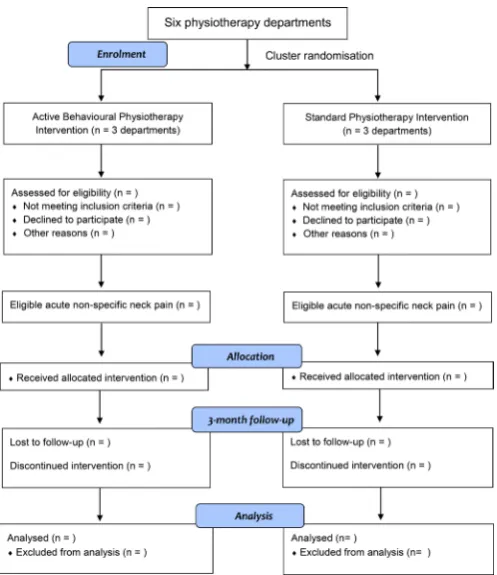
Stata software V.12 with block sampling will be used by TW to randomise six physiotherapy departments to either SPI (n=3 departments) or ABPI (n=3 departments) in order to minimise selection bias at cluster level. The allo-cation will be concealed before assignment and only TW will involve in the process. Cluster randomisation will be performed prior to participant recruitment (figure 1).
data analysis
Phase I
Quantitative data will be analysed and summarised to evaluate eligibility, recruitment and follow-up rates, using IBM SPSS V.22. The feasibility of the ABPI for non-specific neck pain management will be assessed using descrip-tive statistics (eg, frequencies, percentages, means, SD, medians and IQR depending on data).37
Intention-to-treat analyses will be used in this trial and missing data will be reported descriptively. The evaluation of the number of fully recovered participants will be performed by consideration of NDI ≤4 at 3-month follow-up.62 The
ICC will be provided to calculate the sample size within a clustered definitive trial. The analyses and findings of the trial will be discussed with the research team at each stage, and by the trial steering and data monitoring committee.
After trial completion, the following are the possible decisions for progressing to a definitive trial: (1) stop if the main trial is not possible or valuable, (2) continue
on September 22, 2020 by guest. Protected by copyright.
Table 1 Considerations for a future definitive trial
Objectives Criteria for success
To evaluate the feasibility of procedures for a cluster
randomised controlled trial in the public physiotherapy sector in Thailand (ie, randomisation, recruitment, data collection, adherence, trial management and follow-up).
Feasible to conduct a phase III trial
► No major obstruction issue and/or serious adverse event (assessed by trial monitoring).
► Feasible for the type of study (randomised design) (assessed by trial monitoring).
► Feasible for procedures of data collection, trial management and follow-up (assessed by trial monitoring).
► At least three participants a month per hospital. To explore the acceptability of the ABPI among Thai
physiotherapists and patients with acute non-specific neck pain.
► The ABPI can be acceptable to Thai physiotherapists and patients with acute non-specific neck pain (explored by qualitative study).
► Acceptable rate ≥60% of participants in each group. To estimate sample size in order to conduct an adequately
powered definitive trial. ► All parameters can be provided to calculate sample size for an adequately powered definitive trial.
ABPI, active behavioural physiotherapy intervention.
Figure 1 CONSORT flow diagram (adapted from CONSORT
2010). CONSORT, Consolidated Standards of Reporting Trials.
but modify the protocol if the main trial is possible and valuable, (3) continue without modifications but monitor closely if the main trial is possible and valuable with close monitoring and (4) continue without modifications if the main trial is possible and valuable.37 Table 1 shows the
criteria to consider a future definitive trial.
Phase II
All interviews will be transcribed verbatim and analysed in line with IPA.48 All participants will be anonymous using
a pseudonym. Transcripts will be read a number of times to enable familiarisation. Qualitative data will be coded and grouped by TW and a coder to minimise potential bias. Related themes of the acceptability of the ABPI for non-specific neck pain management will be identi-fied by QRS NVivo V.10. The analyses will be performed case by case in both deductively (to identify themes) and inductively (to identify additional themes).100 101 After
the completion of the initial coding, similarities of the themes between coders will be examined. Then, a table of emergent themes will be established. The process will be used throughout the study. The analysis and findings from the qualitative data will be reviewed and discussed with the research team and the trial management group to ensure the accuracy of data analysis and provide other interpretations and suggestions.
trial management and monitoring
The trial management group (combing the trial steering committee and the data monitoring committee consistent with the pilot and feasibility nature of the trial) consisting of TW (the lead researcher), ABR (the experienced trialist), SU (the neck expert), a non-specific neck pain patient, an external member and an independent chair will meet at the start of recruitment, after 3 months of recruitment, and at the completion of the data collection.
Adverse events
This trial can be considered as a low-risk trial for adverse event owing to no reporting of any adverse/serious adverse event by using the ABPI in physiotherapy setting of the previous AWIS trial.30 31 Moreover, patients with
non-specific neck pain have reported less severity than the patients with WAD. Both interventions are conservative treatments without existing reporting of serious adverse events in managing neck pain.31 102–104 From the
litera-ture, the most common adverse event after physiotherapy
on September 22, 2020 by guest. Protected by copyright.
intervention is muscle soreness and it can recover within 1–2 days.105
serious adverse events
Serious adverse event can be evaluated as a very low risk owing to the nature of patient pathology and treatment management. This trial is designed to exclude patients with high severity using experienced physiotherapists who will be trained further in screening participants. Further-more, the International Federation of Orthopaedic Manipulative Physical Therapists cervical framework,53
which has provided guidance for clinical reasoning to identify the risk of adverse events regarding vascularity and instability of the neck, will be used to inform exam-ination for eligibility. However, a serious adverse event will be defined if the participants have worsening symp-toms within 3 days and have been admitted to the hospital due to non-specific neck pain problems.30
Procedures for reporting adverse and serious adverse events
An adverse event reporting form will be provided to all physiotherapy departments. Participants will be required to report any unpleasant symptoms to their physiother-apists by completing the form. Then, physiotherphysiother-apists will report any event to TW within 24 hours, and TW will report to the trial steering committee within 24 hours to enable analysis of the event and any required action. Any unexpected serious adverse events (eg, a life-threatening situation, inpatient hospitalisation and/or significant disability) will be immediately reported with a written form and verbal contact by physiotherapists to TW. Subse-quently, TW will report any event to the trial steering committee; immediately to discuss for an action.
data management
A participant’s data will be assigned an ID code, and the key relating participant to ID code will be stored securely and separately to the project files. All information of the participants will be preserved safely from any third party to maintain the participants’ privacy at the Faculty of Allied Health Sciences, Naresuan University. All collected documents will be stored in a secure place and electronic data will be confidentially stored in a password-protected computer. Only members of the research team can access the data. All data will be securely destroyed after being kept for 10 years.
Patient and public involvement
The trial is designed by a team of researchers using a part of the results from the previous pilot and feasibility trial, in which a patient was a member of the trial steering committee.30 32 A patient will be planned to involve in this
trial as a member of the trial management group. He/ she will be thanked in the contributorship statement/ acknowledgements in a full article.
dissemination
The findings of the trial (completely unattributable format or at an aggregate level) will be submitted to the
medical journals and presented at the international and/ or local conferences/lectures.
dIsCussIon
The findings of the previous AWIS trial reported that the ABPI was feasible for acute WADII management to prevent the transition to chronicity (eg, 95% of the participants fully recovered by the ABPI within 3 months, whereas approximately 17% by the standard physiotherapy) and was acceptable to physiotherapists and patients.30 31 Furthermore, physiotherapists have
applied the ABPI to manage other neck pathologies and regions owing to the possible success of this manage-ment approach.31 According to the similarity of the
situ-ations and symptom characteristics between the WAD and non-specific neck pain populations,25 27 it is
inter-esting to investigate if the ABPI is feasible for managing non-specific neck pain in the acute stage to prevent chro-nicity. Therefore, this phase II trial will be conducted to evaluate the feasibility and acceptability of the ABPI for acute non-specific neck pain in a Thai physiotherapy setting and/or to prepare information in designing an adequately powered, high-quality definitive trial.
This trial is designed to prevent potential problems resulting from some limitations of the previous AWIS trial.30–32 First, this trial will provide one blinded assessor
at each site to accelerate the recruitment rate and logis-tical convenience. Second, the trial will use individual semistructured in-depth interviews to explore the accept-ability of the participants replacing a focus group. In the previous trial, only one participant could attend the focus group (three participants verbally agreed previously) although the research team tried to use several strategies (eg, contacting all participants, arranging based on their preference and convenience, reminding (2 days) for the date and location of the meeting prior to the date of the focus group and providing convenient facilities (eg, the nearest parking area and meals). Subsequently, the focus group was modified to an individual interview. Third, the qualitative data will be analysed using two independent coders to establish higher trustworthiness.
In Thailand, neck pain is a substantial health problem among musculoskeletal disorders leading to socioeco-nomic burden. Owing to the similar conditions and clin-ical characteristics between WAD and non-specific neck pain25 27 and the findings of the AWIS trial,31 32 the ABPI
may be potentially effective intervention to manage acute non-specific neck pain. Thus, this trial will be conducted to evaluate the feasibility of the ABPI in patients with acute non-specific neck pain and its procedures. This trial is the first investigation of the ABPI in Thai clinical setting and the first time in conducting a cluster randomised design in Thai physiotherapy setting.
Author affiliations
1Exercise and Rehabilitation Sciences Research Unit, Faculty of Allied Health
Sciences, Naresuan University, Phitsanulok, Thailand
on September 22, 2020 by guest. Protected by copyright.
2Department of Physical Therapy, Faculty of Allied Health Sciences, Naresuan
University, Phitsanulok, Thailand
3Department of Physical Therapy, Faculty of Associated Medical Sciences, Chiang
Mai University, Chiang Mai, Thailand
4Centre of Precision Rehabilitation for Spinal Pain (CPR Spine), University of
Birmingham, Birmingham, UK
5School of Sport, Exercise and Rehabilitation Sciences, University of Birmingham,
Birmingham, UK
Contributors TW is the chief investigator and guarantor leading to drafting the
initial manuscript, protocol development, analyses and dissemination. TW, SU and ABR contributed to clinical and methodological decisions to ensure the trial quality and will contribute to data interpretation, conclusions and dissemination. All authors read and agreed the final manuscript.
Funding The trial is funded by the Thailand Research Fund (grant number:
MRG6180069). The authors thank the Naresuan University and University of Birmingham for the sponsorship.
Competing interests None declared.
Patient consent for publication Not required.
Ethics approval The trial will be conducted in accordance with the Declaration of
Helsinki and the ethical guidelines for medical human research and is approved by the Naresuan University Institutional Review Board (NUIRB_0380/61).
Provenance and peer review Not commissioned; externally peer reviewed.
open access This is an open access article distributed in accordance with the
Creative Commons Attribution Non Commercial (CC BY-NC 4.0) license, which permits others to distribute, remix, adapt, build upon this work non-commercially, and license their derivative works on different terms, provided the original work is properly cited, appropriate credit is given, any changes made indicated, and the use is non-commercial. See: http:// creativecommons. org/ licenses/ by- nc/ 4. 0/.
orCId ids
Taweewat Wiangkham http:// orcid. org/ 0000- 0003- 4115- 704X Alison B Rushton http:// orcid. org/ 0000- 0001- 8114- 7669
rEFErEnCEs
1. Hoy D, March L, Woolf A, et al. The global burden of neck pain:
estimates from the global burden of disease 2010 study. Ann
Rheum Dis 2014;73:1309–15.
2. Kassebaum NJ, Arora M, Barber RM, et al. Global, regional, and
national disability-adjusted life-years (DALYs) for 315 diseases and
injuries and healthy life expectancy (HALE), 1990-2015. Lancet
2016;388:1603–58.
3. Hogg-Johnson S, van der Velde G, Carroll LJ, et al. The burden and
determinants of neck pain in the general population. Eur Spine J
2008;17:39–51.
4. Nolet PS, Côté P, Kristman VL, et al. Is neck pain associated with
worse health-related quality of life 6 months later? a
population-based cohort study. The Spine Journal 2015;15:675–84.10.1016/j.
spinee.2014.12.009
5. Manchikanti L, Singh V, Datta S, et al. Comprehensive review of
epidemiology, scope, and impact of spinal pain. Pain Physician
2008;12:E35–70.
6. Dieleman JL, Baral R, Birger M, et al. Us spending on personal
health care and public health, 1996-2013. JAMA 2016;316:2627–46.
7. Freeman B. Total of 137 million working days lost to sickness and injury in 2016. UK national statistics. Available: https://www. ons. gov. uk/ news/ news/ tota lof1 37mi llio nwor king days lost tosi ckne ssan dinj uryi n2016 [Accessed 1 Oct 2018].
8. National Statistics of Thailand. Number and rates of out-patients according to 21 groups of causes from health service units. secondary number and rates of out-patients according to 21 groups of causes from health service units 2015, 2015. Available: http:// service. nso. go. th/ nso/ nso_ center/ project/ search_ center/ 23project- th. htm [Accessed 1 Oct 2018].
9. Chaiklieng S, Nithithamthada R. Factors associated with neck, shoulder, and back pain among dental personnel of government
hospitals in Khon Kaen Province. J Public Health 2016;46:42–56.
10. Janwantanakul P, Pensri P, Jiamjarasrangsri V, et al. Prevalence of
self-reported musculoskeletal symptoms among office workers.
Occup Med 2008;58:436–8.
11. Wirth B, Humphreys BK, Peterson C. Importance of psychological factors for the recovery from a first episode of acute non-specific
neck pain - a longitudinal observational study. Chiropr Man Therap
2016;24.
12. Lee H, Hübscher M, Moseley GL, et al. How does pain lead to
disability? A systematic review and meta-analysis of mediation
studies in people with back and neck pain. Pain 2015;156:1–97.
13. Ortego G, Villafañe JH, Doménech-García V, et al. Is there a
relationship between psychological stress or anxiety and chronic nonspecific neck-arm pain in adults? A systematic review and
meta-analysis. J Psychosom Res 2016;90:70–81.
14. Blanpied PR, Gross AR, Elliott JM, et al. Neck pain: revision 2017:
clinical practice guidelines linked to the International classification of functioning, disability and health from the orthopaedic section of
the American physical therapy association. J Orthop Sports Phys
Ther 2017;47:A1–A83.
15. Bier JD, Sandee-Geurts JJW, Ostelo RWJG, et al. Can primary
care for back and/or neck pain in the Netherlands benefit from stratification for risk groups according to the start back tool
classification? Arch Phys Med Rehabil 2018;99:65–71.
16. Gross AR, Paquin JP, Dupont G, et al. Exercises for mechanical
neck disorders: a cochrane review update. Man Ther
2016;24:25–45.
17. Fredin K, Lorås H. Manual therapy, exercise therapy or combined treatment in the management of adult neck pain – a systematic
review and meta-analysis. Musculoskeletal Science and Practice
2017;31:62–71.
18. Luime JJ, Koes BW, Miedem HS, et al. High incidence and
recurrence of shoulder and neck pain in nursing home employees
was demonstrated during a 2-year follow-up. J Clin Epidemiol
2005;58:407–13.
19. Childs JD, Cleland JA, Elliott JM, et al. Neck pain: clinical practice guidelines linked to the International classification of functioning, disability, and health from the orthopedic section of the American
physical therapy association. J Orthop Sports Phys Ther
2008;38:A1–A34.
20. Machado GC, Maher CG, Ferreira PH, et al. Efficacy and safety of
paracetamol for spinal pain and osteoarthritis: systematic review
and meta-analysis of randomised placebo controlled trials. BMJ
2015;350:h1225.
21. Machado GC, Maher CG, Ferreira PH, et al. Non-Steroidal
anti-inflammatory drugs for spinal pain: a systematic review and
meta-analysis. Ann Rheum Dis 2017;76:1269–78.
22. Castle D. Impact of NHS reforms on musculoskeletal physiotherapy
- Health and Social Care Bill, Lords Report Stage briefing CSP. UK: Chartered Society of Physiotherapy, 2012.
23. Dziedzic K, Doyle C, Huckfield L, et al. Neck pain: management
in primary care. secondary neck pain: management in primary care, 2011. Available: http://www. arthritisresearchuk. org/ health- professionals- and- students/ the- professional- network. aspx [Accessed 1 Oct 2018].
24. Suman A, Dikkers MF, Schaafsma FG, et al. Effectiveness of
multifaceted implementation strategies for the implementation of back and neck pain guidelines in health care: a systematic review.
Implementation Sci 2015;11.
25. Anstey R, Kongsted A, Kamper S, et al. Are people with
whiplash-associated neck pain different from people with nonspecific neck
pain? J Orthop Sports Phys Ther 2016;46:894–901.
26. Jull G, Kenardy J, Hendrikz J, et al. Management of acute
whiplash: a randomized controlled trial of multidisciplinary stratified
treatments. Pain 2013;154:1798–806.
27. Castaldo M, Catena A, Chiarotto A, et al. Association between
clinical and neurophysiological outcomes in patients with
mechanical neck pain and Whiplash-associated disorders. Clin J
Pain 2018;34:95–103.
28. Wiangkham T, Duda J, Haque S, et al. The effectiveness of
conservative management for acute whiplash associated disorder (WAD) II: a systematic review and meta-analysis of randomised
controlled trials. PLoS One 2015;10:e0133415.
29. Wiangkham T, Duda J, Haque MS, et al. Development of an active
behavioural physiotherapy intervention (ABPI) for acute whiplash-associated disorder (WAD) II management: a modified Delphi study.
BMJ Open 2016;6:e011764.
30. Wiangkham T, Duda J, Haque MS, et al. Acute whiplash injury study
(AWIS): a protocol for a cluster randomised pilot and feasibility trial of an active behavioural physiotherapy intervention in an insurance
private setting. BMJ Open 2016;6:e011336.
31. Wiangkham T. Development and evaluation of a novel intervention
for rehabilitation following whiplash injury. University of Birmingham, 2017.
on September 22, 2020 by guest. Protected by copyright.
32. Wiangkham T, Duda J, Haque MS, et al. A cluster randomised, double-blind pilot and feasibility trial of an active behavioural physiotherapy intervention for acute whiplash-associated disorder
(WAD)II. PLoS One 2019;14:e0215803.
33. TRACsa. Clinical guidelines for best practice management of acute
and chronic whiplash associated disorders: clinical resource guide. Adelaide: Trauma and Injury Rocovery, 2008.
34. Wiangkham T. Physiotherapy management of acute
whiplash-associated disorder II. Thai Journal of Physical Therapy
2018;40:31–40.
35. Lancaster GA, Dodd S, Williamson PR. Design and analysis of
pilot studies: recommendations for good practice. J Eval Clin Pract
2004;10:307–12.
36. Arain M, Campbell MJ, Cooper CL, et al. What is a pilot or feasibility
study? A review of current practice and editorial policy. BMC Med
Res Methodol 2010;10:67.
37. Thabane L, Ma J, Chu R, et al. A tutorial on pilot studies: the what,
why and how. BMC Med Res Methodol 2010;10:1.
38. Whitehead AL, Sully BGO, Campbell MJ. Pilot and feasibility studies: is there a difference from each other and from a
randomised controlled trial? Contemp Clin Trials 2014;38:130–3.
39. Gould AL. Planning and revising the sample size for a trial. Stat Med
1995;14:1039–51.
40. Coffey CS, Muller KE. Properties of internal pilots with the univariate
approach to repeated measures. Stat Med 2003;22:2469–85.
41. Chan A-W, Tetzlaff JM, Gøtzsche PC, et al. Spirit 2013 explanation
and elaboration: guidance for protocols of clinical trials. BMJ
2013;346:e7586.
42. Campbell MK, Piaggio G, Elbourne DR, et al. Consort 2010
statement: extension to cluster randomised trials. BMJ
2012;345:e5661.
43. Eldridge SM, Chan CL, Campbell MJ, et al. Consort 2010
statement: extension to randomised pilot and feasibility trials. BMJ
2016;355:i5239.
44. Tong A, Sainsbury P, Craig J. Consolidated criteria for reporting qualitative research (COREQ): a 32-item checklist for interviews and
focus groups. Int J Qual Health Care 2007;19:349–57.
45. Edwards SJL, Braunholtz DA, Lilford RJ, et al. Ethical issues in the
design and conduct of cluster randomised controlled trials. BMJ
1999;318:1407–9.
46. Siebers AG, Klinkhamer PJJM, Grefte JMM, et al. Comparison of
liquid-based cytology with conventional cytology for detection of
cervical cancer precursors. JAMA 2009;302:1757–64.
47. Wyatt JC, Paterson-Brown S, Johanson R, et al. Randomised trial
of educational visits to enhance use of systematic reviews in 25
obstetric units. BMJ 1998;317:1041–6.
48. Eatough V, Smith JA. Interpretative phenomenological analysis the
SAGE Handbook of qualitative research in psychology. 179, 2008. 49. Smith JA, Osborn M. Interpretative phenomenological analysis.
Doing social psychology research 2004:229–54.
50. McGrath C, Palmgren PJ, Liljedahl M. Twelve tips for conducting
qualitative research interviews. Med Teach 2018:1–5.
51. Spitzer WO, Skovron ML, Salmi LR, et al. Scientific monograph
of the Quebec Task Force on Whiplash-Associated Disorders: redefining "whiplash" and its management. Spine 1995;20(8 Suppl):1s–73.
52. Tough EA, White AR, Richards SH, et al. Myofascial trigger point
needling for whiplash associated pain – a feasibility study. Man Ther
2010;15:529–35.
53. Rushton A, Rivett D, Carlesso L, et al. International framework for
examination of the cervical region for potential of cervical arterial
dysfunction prior to orthopaedic manual therapy intervention. Man
Ther 2014;19:222–8.
54. Crawford JR, Khan RJK, Varley GW. Early management and outcome following soft tissue injuries of the neck—a randomised controlled trial. Injury 2004;35:891–5.
55. Rosenfeld M, Gunnarsson R, Borenstein P. Early intervention in whiplash-associated disorders: a comparison of two treatment
protocols. Spine 2000;25:1782–7.
56. Rosenfeld M, Seferiadis A, Carlsson J, et al. Active intervention
in patients with whiplash-associated disorders improves
long-term prognosis: a randomized controlled clinical trial. Spine
2003;28:2491–8.
57. Richter M, Ferrari R, Otte D, et al. Correlation of clinical findings, collision parameters, and psychological factors in the outcome
of whiplash associated disorders. J Neurol Neurosurg Psychiatry
2004;75:758–64.
58. Lamb SE, Gates S, Underwood MR, et al. Managing injuries of
the neck trial (MINT): design of a randomised controlled trial of
treatments for whiplash associated disorders. BMC Musculoskelet
Disord 2007;8:7.
59. Hoffmann TC, Glasziou PP, Boutron I, et al. Better reporting of
interventions: template for intervention description and replication
(TIDieR) checklist and guide. BMJ 2014;348.
60. Bier JD, Scholten-Peeters WGM, Staal JB, et al. Clinical practice
guideline for physical therapy assessment and treatment in patients
with nonspecific neck pain. Phys Ther 2018;98:162–71.
61. Bandura A. Self-Efficacy: toward a unifying theory of behavioral
change. Psychol Rev 1977;84:191–215.
62. Vernon H, Mior S. The neck disability index: a study of reliability and
validity. J Manipulative Physiol Ther 1991;14:409–15.
63. Pietrobon R, Coeytaux RR, Carey TS, et al. Standard scales
for measurement of functional outcome for cervical pain or
dysfunction: a systematic review. Spine 2002;27:515–22.
64. Vernon H. The neck disability index: state-of-the-art, 1991-2008. J
Manipulative Physiol Ther 2008;31:491–502.
65. MacDermid JC, Walton DM, Avery S, et al. Measurement properties
of the neck disability index: a systematic review. J Orthop Sports
Phys Ther 2009;39:400–C12.
66. Uthaikhup S, Paungmali A, Pirunsan U. Validation of Thai versions of the neck disability index and neck pain and disability scale in
patients with neck pain. Spine 2011;36:E1415–E1421.
67. Carreon LY, Glassman SD, Campbell MJ, et al. Neck Disability
Index, short form-36 physical component summary, and pain scales for neck and arm pain: the minimum clinically important difference
and substantial clinical benefit after cervical spine fusion. The Spine
Journal 2010;10:469–74.
68. Young BA, Walker MJ, Strunce JB, et al. Responsiveness of the
neck disability index in patients with mechanical neck disorders.
The Spine Journal 2009;9:802–8.10.1016/j.spinee.2009.06.002
69. Downie WW, Leatham PA, Rhind VM, et al. Studies with pain rating
scales. Ann Rheum Dis 1978;37:378–81.
70. Hjermstad MJ, Fayers PM, Haugen DF, et al. Studies comparing
numerical rating scales, verbal rating scales, and visual analogue scales for assessment of pain intensity in adults: a systematic
literature review. J Pain Symptom Manage 2011;41:1073–93.
71. Ferreira-Valente MA, Pais-Ribeiro JL, Jensen MP. Validity of four
pain intensity rating scales. Pain 2011;152:2399–404.
72. Farrar JT, Troxel AB, Stott C, et al. Validity, reliability, and clinical importance of change in a 0-10 numeric rating scale measure of spasticity: a post hoc analysis of a randomized, double-blind,
placebo-controlled trial. Clin Ther 2008;30:974–85.
73. Cleland JA, Childs JD, Whitman JM. Psychometric properties of the neck disability index and numeric pain rating scale in
patients with mechanical neck pain. Arch Phys Med Rehabil
2008;89:69–74.
74. Karcioglu O, Topacoglu H, Dikme O, et al. A systematic review
of the pain scales in adults: which to use? Am J Emerg Med
2018;36:707–14.
75. Young IA, Dunning J, Butts R, et al. Reliability, construct validity, and responsiveness of the neck disability index and numeric pain rating scale in patients with mechanical neck pain without upper
extremity symptoms. Physiother Theory Pract 2018;28:1–8.
76. Stovner LJ. The nosologic status of the whiplash syndrome:
a critical review based on a methodological approach. Spine
1996;21:2735–46.
77. Hole DE, Cook JM, Bolton JE. Reliability and concurrent validity of two instruments for measuring cervical range of motion: effects of
age and gender. Man Ther 1995;1:36–42.
78. Audette I, Dumas J-P, Côté JN, et al. Validity and between-day
reliability of the cervical range of motion (CROM) device. J Orthop
Sports Phys Ther 2010;40:318–23.
79. Malmström E-M, Karlberg M, Melander A, et al. Zebris versus Myrin:
a comparative study between a three-dimensional ultrasound movement analysis and an inclinometer/compass method: intradevice reliability, concurrent validity, intertester comparison, intratester reliability, and Intraindividual variability. Spine
2003;28:E433–40.
80. Williams MA, McCarthy CJ, Chorti A, et al. A systematic review
of reliability and validity studies of methods for measuring active
andPassive cervical range of motion. J Manipulative Physiol Ther
2010;33:138–55.
81. Williams MA, Williamson E, Gates S, et al. Reproducibility of the
cervical range of motion (CROM) device for individuals with
sub-acute whiplash associated disorders. Eur Spine J 2012;21:872–8.
82. Fletcher JP, Bandy WD. Intrarater reliability of CROM measurement of cervical spine active range of motion in
persons with and without neck pain. J Orthop Sports Phys Ther
2008;38:640–5.
83. Landers MR, Creger RV, Baker CV, et al. The use of fear-avoidance
beliefs and nonorganic signs in predicting prolonged disability in
patients with neck pain. Man Ther 2008;13:239–48.
on September 22, 2020 by guest. Protected by copyright.
84. Lee K-C, Chiu TTW, Lam T-H. The role of fear-avoidance beliefs in patients with neck pain: relationships with current and future
disability and work capacity. Clin Rehabil 2007;21:812–21.
85. Waddell G, Newton M, Henderson I, et al. A Fear-Avoidance beliefs
questionnaire (FABQ) and the role of fear-avoidance beliefs in
chronic low back pain and disability. Pain 1993;52:157–68.
86. Lee K-C, Chiu TTW, Lam T-H. Psychometric properties of the
Fear-Avoidance beliefs questionnaire in patients with neck pain. Clin
Rehabil 2006;20:909–20.
87. Askary-Ashtiani A, Ebrahimi-Takamejani I, Torkaman G, et al.
Reliability and validity of the Persian versions of the fear avoidance beliefs questionnaire and Tampa scale of Kinesiophobia in patients
with neck pain. Spine 2014;39:E1095–102.
88. Georgoudis G, Papathanasiou G, Spiropoulos P, et al. Cognitive
assessment of musculoskeletal pain with a newly validated Greek
version of the Fear-Avoidance beliefs questionnaire (FABQ). Eur J
Pain 2007;11:341–51.
89. Haywood KL, Garratt AM, Fitzpatrick R. Quality of life in older people: a structured review of generic self-assessed health
instruments. Qual Life Res 2005;14:1651–68.
90. Janssen MF, Pickard AS, Golicki D, et al. Measurement properties
of the EQ-5D-5L compared to the EQ-5D-3L across eight patient
groups: a multi-country study. Qual Life Res 2013;22:1717–27.
91. Bilbao A, García-Pérez L, Arenaza JC, et al. Psychometric
properties of the EQ-5D-5L in patients with hip or knee
osteoarthritis: reliability, validity and responsiveness. Qual Life
Res 2018;27:2897–908.
92. Rabin R, de Charro F, Charro Fde, Fd C. EQ-5D: a measure of
health status from the EuroQol group. Ann Med 2001;33:337–43.
93. Luo N, Li M, Chevalier J, et al. A comparison of the scaling
properties of the English, Spanish, French, and Chinese EQ-5D
descriptive systems. Qual Life Res 2013;22:2237–43.
94. Kimman M, Vathesatogkit P, Woodward M, et al. Validity of the Thai
EQ-5D in an occupational population in Thailand. Qual Life Res
2013;22:1499–506.
95. Pattanaphesaj J, Thavorncharoensap M. Measurement properties of the EQ-5D-5L compared to EQ-5D-3L in the Thai diabetes patients.
Health Qual Life Outcomes 2015;13:14.
96. Hallal PC, Simoes E, Reichert FF, et al. Validity and reliability of the telephone-administered international physical activity questionnaire
in Brazil. J Phys Act Health 2010;7:402–9.
97. Bijur PE, Latimer CT, Gallagher EJ. Validation of a verbally administered numerical rating scale of acute pain for use in the
emergency department. Acad Emerg Med 2003;10:390–2.
98. McPhail S, Lane P, Russell T, et al. Telephone reliability of the
Frenchay activity index and EQ-5D amongst older adults. Health
Qual Life Outcomes 2009;7:48.
99. Hertzog MA. Considerations in determining sample size for pilot
studies. Res Nurs Health 2008;31:180–91.
100. Ayala GX, Elder JP. Qualitative methods to ensure acceptability of
behavioral and social interventions to the target population. J Public
Health Dent 2011;71:S69–S79.
101. Bos C, Van der Lans IA, Van Rijnsoever FJ, et al. Understanding
consumer acceptance of intervention strategies for healthy food
choices: a qualitative study. BMC Public Health 2013;13:1073.
102. Bronfort G, Evans R, Anderson AV, et al. Spinal manipulation,
medication, or home exercise with advice for acute and subacute
neck pain: a randomized trial. Ann Intern Med 2012;156:1–10.
103. Lamb SE, Gates S, Williams MA, et al. Emergency department
treatments and physiotherapy for acute whiplash: a
pragmatic, two-step, randomised controlled trial. The Lancet
2013;381:546–56.
104. Michaleff ZA, Maher CG, Lin C-WC, et al. Comprehensive
physiotherapy exercise programme or advice for chronic whiplash
(promise): a pragmatic randomised controlled trial. The Lancet
2014;384:133–41.
105. King J, Anderson CM. Patient safety and physiotherapy: what
does it mean for your clinical practice? Physiotherapy Canada
2010;62:172–5.
on September 22, 2020 by guest. Protected by copyright.