R E S E A R C H A R T I C L E
Open Access
Chemo-sensors development based on
low-dimensional codoped Mn
2
O
3
-ZnO nanoparticles
using flat-silver electrodes
Mohammed M Rahman
1,2*, George Gruner
1,3, Mohammed Saad Al-Ghamdi
4, Muhammed A Daous
5,
Sher Bahadar Khan
1,2and Abdullah M Asiri
1,2Abstract
Background:Semiconductor doped nanostructure materials have attained considerable attention owing to their electronic, opto-electronic, para-magnetic, photo-catalysis, electro-chemical, mechanical behaviors and their potential applications in different research areas. Doped nanomaterials might be a promising owing to their high-specific surface-area, low-resistances, high-catalytic activity, attractive electro-chemical and optical properties. Nanomaterials are also scientifically significant transition metal-doped nanostructure materials owing to their extraordinary mechanical, optical, electrical, electronic, thermal, and magnetic characteristics. Recently, it has gained significant interest in manganese oxide doped-semiconductor materials in order to develop their physico-chemical behaviors and extend their efficient applications. It has not only investigated the basic of magnetism, but also has huge potential in scientific features such as magnetic materials, bio- & chemi-sensors, photo-catalysts, and absorbent nanomaterials.
Results:The chemical sensor also displays the higher-sensitivity, reproducibility, long-term stability, and enhanced electrochemical responses. The calibration plot is linear (r2= 0.977) over the 0.1 nM to 50.0μM 4-nitrophenol concentration ranges. The sensitivity and detection limit is ~4.6667μA cm-2μM-1and ~0.83 ± 0.2 nM (at a Signal-to-Noise-Ratio, SNR of 3) respectively. To best of our knowledge, this is the first report for detection of
4-nitrophenol chemical with doped Mn2O3-ZnO NPs using easy and reliable I-V technique in short response time. Conclusions:As for the doped nanostructures, NPs are introduced a route to a new generation of toxic chemo-sensors, but a premeditate effort has to be applied for doped Mn2O3-ZnO NPs to be taken comprehensively for large-scale applications, and to achieve higher-potential density with accessible to individual chemo-sensors. In this report, it is also discussed the prospective utilization of Mn2O3-ZnO NPs on the basis of carcinogenic chemical sensing, which could also be applied for the detection of hazardous chemicals in ecological, environmental, and health care fields.
Keywords:Doped Mn2O3-ZnO nanoparticles, Wet-chemical method, Powder X-ray diffraction, 4-nitrophenol, I-V technique, X-ray photoelectron spectroscopy, Sensitivity
* Correspondence:[email protected] 1
Center of Excellence for Advanced Materials Research (CEAMR), King Abdulaziz University, P.O. Box 80203, Jeddah 21589, Saudi Arabia 2
Chemistry Department, Faculty of Science, King Abdulaziz University, P.O. Box 80203, Jeddah 21589, Saudi Arabia
Full list of author information is available at the end of the article
Introduction
Semiconductor codoped nanomaterials have received significant interest due to their electronic, optoelectro-nic, magnetic, catalytical, electro-chemical, mechanical behaviors and their potential applications in different re-search areas. Semiconductor nanomaterials might be a promising due to their high-specific surface-area, low-resistances, high-catalytic activity, attractive electro-chemical and optical properties [1,2]. Nanomaterials are also scientifically important codoped nanostructure ma-terials owing to their extraordinary mechanical, optical, electrical, electronic, thermal, and magnetic characte-ristics. Lately, it has attained significant attention in manganese doped-semiconductor materials in order to develop their physic-chemical behaviors and extend their efficient applications [3-5]. It has not only investigated the basic of magnetism, but also has huge potential in scientific features such as magnetic materials, bio & chemi-sensors, photo-catalysts, and absorbent nanoma-terials [6-9]. Recently, very few articles are published based on transition-metal doped semiconductor nano-materials synthesis and investigated the magnetic be-haviors and potential applications only [10-13]. Here, it is prepared codoped Mn2O3-ZnO NPs by easy, facile,
economical, non-toxic, repeatable, and reliable low-tem-perature wet-chemical technique. The nanostructure and morphology of the codoped Mn2O3-ZnO NPs were
examined and potentially applied for the enhancement of higher-sensitive 4-nitrophenol chemo-sensor at room condition. Generally, chemo-sensing exploration have been developed with the transition-metal oxides nano-structures for the recognition and quantification of vari-ous toxic-chemicals such as phenyl-hydrazine, methanol, formaldehyde, ethanol, chloroform, dichloromethane etc., which are not ecologically safe and friendly [14-18]. The sensing mechanism with doped semiconductor metal oxides thin-film used primarily the properties of meso-porous thin-film generated by the physi-sorption and chemisorptions methods. The hazardous chemical detec-tion is depended on the current responses of the fabri-cated thin-film, which cause by the presence of chemical components in the reaction-format in aqueous phase [19-21]. The key efforts are based on recongnition the least amount of 4-nitrophenol necessary for the fabricated Mn2O3-ZnO NPs chemo-sensors for electrochemical
investigation.
Phenolic compounds have attained significant interest in last decade owing to their eco-toxic effects on human health, ecological, and environmental fields. These toxic compounds (i.e., 4-nitrophenol) are prepared using a number of polluting techniques, such as industry-related ways of plastic, pesticides, paint, drugs, composites, an-tioxidant, petroleum, and paper production [22]. The 4-nitrophenol is recognized for its hazardous nature,
carcinogenetic, toxicity, and persistence in the environ-ment, which is become a common pollutant in nature and waste water [23]. Because of its high solubility and stability in water, it has been also found in freshwater, sea environments and has been detected in industrial wastewaters and is difficult to degrade by conventional method. It is concerned in most of the degradation path-ways of organo-phosphorous pesticides, which are de-composed in soil and water to form 4-nitrophenol as an intermediate or final-product in the reaction systems [24,25]. Therefore, 4-nitrophenol is integrated in the En-vironmental Protection Agency List of Priority Pol-lutants (EPALPP) [26]. Therefore, it is straight away desirable to fabricate a chemo-sensor for the detection of organic pollutants to accumulate the environment and human health. There is focused a significant atten-tion for the development of simple, reliable, and ultra-sensitive in various detection methodology based on codoped nanomaterials. Generally, the detection of toxic 4-nitrophenol is consummated using chromatographic techniques, such as gas-chromatography [27,28], high-performance liquid chromatography [29,30], liquid chro-matography connected with mass-spectroscopy [31], and capillary-electrophoresis [32]. Electrochemical technique, which can offer fast, reliable, and direct real-time mo-nitoring is one of the most utilized methods in the determination of nitro-phenolic stuffs. Electro-analytical techniques have been performed for 4-nitrophenol de-tection and quantification with a modified glassy carbon electrode [33,34] hanging mercury drop electrode [35] and boron-doped diamond electrode [36]. The analytical signal is derived from the four-electron reduction of the nitro-group [37] or by the direct two-electron oxidation of phenol to the corresponding o-benzoquinone [38-40]. Electrochemical chemo-sensors have attained huge inte-rest in the recognition and quantification of environ-mental unsafe chemicals due to their reliable and fast response and determination [41-44]. Chemo-sensor tech-nology plays a significant task in ecological protection that usually caused by environmental contamination and unin-tended seepage of harmful chemicals, which is a huge-menace for eco-systems. Thus for the attention of ecological and health monitoring, it is important to fabricate easy, simple, reproducible, reliable, and inex-pensive chemo-sensors to detect toxic chemicals in aqueous systems. The sensitivity and low-detective of electrochemical chemo-sensor energetically dependent on the size, structure and properties of fabricated elec-trode doped nanomaterials. Hence doped nanostructure materials have received much attention and have widely been used as a redox mediator in chemo-sensors [45-48].
conventional chemical methods in term of large-surface area for examining in medical, health-care and envi-ronmental fields [49-56]. In general electro-analytical technique, it was executed the slower responses, sur-face-fouling, noises, flexible-responses, and smaller dy-namic-range and lower-sensitivity with bared codoped nanomaterials surfaces for chemical recognition. There-fore, the modification of the chemo-sensor surface with doped metal oxides nanostructure materials is urgently required to achieve higher sensitive, repeatability, and stable responses. Therefore, an easy and reliable I-V elec-trochemical approach is immediately needed for relatively simple, appropriate, and economical instrumentation which displays higher-sensitivity and lower-detection limits compared to general techniques. Here, a con-sistent, large-scale, and highly responsive I-V method is applied for detection of 4-nitrophenol chemical by codoped Mn2O3-ZnO NPs. The present approach
rep-resents a consistent, sensitive, low-sample volume, ease to handle, and specific electrochemical methods over the existing UV, CV, LC-MS, LSV, FL, and HPLC methods [57-60]. The simple coating technique for preparation of nanomaterials thin-film with conducting coating agents is developed for the fabrication of doped Mn2O3-ZnO NPs
films. Here, low-dimensional doped Mn2O3-ZnO NPs
films with conducting coating agents are synthesized and detected 4-nitrophenol in phosphate buffer solution (PBS) phase by reliable I-V method. To best of our knowledge, this is the first report for detection of 4-nitrophenol chem-ical with doped Mn2O3-ZnO NPs using easy and reliable
I-V technique in short response time.
Experimental sections Materials and methods
Manganese chloride (MnCl2.4H2O), zinc chloride (ZnCl2),
4-nitrophenol, ammonium hydroxide (25%), Ethyl cel-lulose (EC), Disodium phosphate, Butyl carbitol ace-tate (BCA), Ethanol, Monosodium phosphate, and all chemicals utilized were of analytical grade and obtained from Sigma-Aldrich Company. Stock solution of 1.0 M 4-nitrophenol was synthesized in double distilled water. The doped Mn2O3-ZnO NPs was investigated with UV/visible
spectroscopy (Lamda-950, Perkin Elmer, Germany). FT-IR spectra were recorded for Mn2O3-ZnO NPs with a
spec-trophotometer (Spectrum-100 FT-IR) in the mid-IR range, which was acquired from Perkin Elmer, Germany. Raman station 400 (Perkin Elmer, Germany) was exploited to investigate the Raman shift of Mn2O3-ZnO NPs using
ra-diation source (Ar+ laser line, λ: ~513.4 nm). The XPS measurements were executed on a Thermo Scientific K-Alpha KA1066 spectrometer (Germany). Monochro-matic AlKα x-ray radiation sources were used as exci-tation sources, where beam-spot size was kept in 300.0 μm. The spectrum was recorded in the fixed
analyzer of transmission mode, where pass-energy was kept at 200.0 eV. The scanning of the spectra was per-formed at lower pressures (<10−8Torr). The X-ray powder (XRD) diffraction prototypes were measured with X-ray diffractometer (XRD; X’Pert Explorer, PANalytical diffract-ometer) prepared with Cu-Kα1 radiation (λ= 1.5406 nm) by a generator voltage (~40.0 kV) and current (~35.0 mA) applied for the measurement. Morphology of codoped Mn2O3-ZnO NPs was evaluated on FE-SEM instrument
(FESEM; JSM-7600 F, Japan). Elemental analysis (EDS) was investigated for doped Mn2O3-ZnO NPs using from
JEOL, Japan. I-V technique was used for sensing NPs modified sensor electrode by Electrometer (Kethley, 6517A, Electrometer, USA) at room conditions.
Synthesis and growth mechanism of codoped Mn2O3-ZnO NPs
Initially manganese chloride (MnCl2.4H2O) and zinc
chloride (ZnCl2) were gradually dissolved into the
de-ionized water to prepare 0.1 M concentration separately at room temperature. After addition of NH4OH into the
mixture of metal chloride solution, it was stirred slowly for several minutes at room condition. Mn2O3-ZnO NPs
have been synthesized by adding equi-molar concentra-tion of manganese chloride and zinc chloride as starting (reducing) materials into reaction-cell (in Teflon-line auto-clave) for 12 hours. Then the solution pH is attuned (at 10.5) by using prepared NH4OH and put
into the auto-clave cell. The starting materials of MnCl2
and ZnCl2 were employed without further purification
for co-precipitation method to codoped Mn2O3-ZnO
na-noparticles composition. Again reducing agent (NH4OH)
was added drop-wise into the vigorously stirred MnCl2
and ZnCl2 solutions mixture to produce a significant
doped precipitate.
The growth mechanism of doped Mn2O3-ZnO NPs
can be explained based on chemical reactions and nu-cleation, and growth of doped Mn2O3-ZnO crystals. The
probable reaction mechanisms are anticipated for achie-ving the codoped Mn2O3-ZnO nanomaterials, which are
appended in below.
ZnC12ð Þs→Znaq2þþ2C1aq ð1Þ
MnC12ð Þs→Mnð Þ2aqþ þ2c1ð Þaq ð2Þ
NH4OHð Þaq→NH4þþOH ð3Þ
4Mn2þ
aq
ð Þþ2ZnHð Þ2aqþ þ80Hð Þaq→2Mn2O3ZnOð Þs þ4H2O
ð4Þ
The precursors of MnCl2and ZnCl2are soluble in
al-kaline medium (NH4OH reagent) according to the
equa-tion of (i) - (iii). After addiequa-tion of NH4OH into the
stirred for several minutes at room temperature. The reaction is development gradually according to the equa-tion (iv). Then the resultant soluequa-tion was washed sys-tematically with ethanol, acetone and kept for drying at room temperature. During the total preparative proced-ure, NH4OH acts a pH buffer to control the pH value of
the solution and slow donate of OH– ions. When the concentrations of the Mn2+, Zn2+, and OH- ions are reached above the critical value, the precipitation of doped Mn2O3-ZnO nuclei begin to start. As there is
higher concentration of Zn2+ion in the solution, the nu-cleation of doped Mn2O3-ZnO crystals become easier
due to the lower-activation energy barrier of heteroge-neous nucleation. However, as the concentration of Zn2+ subsistence, a number of larger doped Mn2O3-ZnO
crys-tals with a spherical particle-shape morphology form in nano-level. The shape of codoped Mn2O3-ZnO NPs is
approximately consistent with the growth pattern of codoped Mn2O3-ZnO crystals [61,62]. Finally, the
as-grown codoped Mn2O3-ZnO NPs products were
cal-cined at 400.0°C for 4 hours in the furnace (Barnstead Thermolyne, 6000 Furnace, USA). The calcined doped nanomaterials were synthesized in detail in terms of their morphological, structural, optical properties, and applied for 4-nitrophenol chemical sensing.
Fabrication of AgE using doped Mn2O3-ZnO NPs
Phosphate buffer solution (PBS, 0.1 M, pH 7.0) is ar-ranged by properly mixing Na2HPO4 (0.2 M) and
NaH2PO4(0.2 M) solution in 100.0 mL de-ionize water.
Flat AgE is fabricated by doped Mn2O3-ZnO NPs with
butyl carbitol acetate (BCA) and ethyl cellulose (EC) as conducting coating agents. Subsequently, the fabricated electrodes are transferred into the oven at 65.0°C for 12 hours until the film is totally dry, consistent, and stable. An electro-chemical cell is prepared with co-doped Mn2O3-ZnO NPs coated silver electrode as a
working electrode and palladium wire is employed as a counter electrodes. 4-nitrophenol (~1.0 M) is diluted at different concentration in DI water and used as a target chemical. Amount of 0.1 M PBS is kept constant in the small-beaker as 10.0 mL during the chemical analysis. Analyte solution is made with various concentration of 4-nitrophenol from 1.0 nM to 1.0 M. The sensitivity is calculated from the current-slope vs. analyte concentra-tion from the calibraconcentra-tion stature by considering the ac-tive surface area of doped Mn2O3-ZnO NPs fabricated
chemo-sensors. Electrometer is properly utilized as a voltage sources for reliable I-V method in two electrodes assembly. With high-mechanical strength, good-conduc-tivity, highly stability, large-surface area, and extremely miniaturized dimension of codoped Mn2O3-ZnO NPs
have been extensively used in chemo-sensor modifi-cation and fabrimodifi-cation of 4-nitrophenol detection. The
codoped Mn2O3-ZnO NPs were applied for the
detec-tion of 4-nitrophenol in liquid-phase system at room conditions. Initially, the NPs thin-film was prepared using conducting binders (EC and BCA) and embedded on the flat AgE electrode. The development and fabrica-tion techniques are exhibited in the schematic diagram (Figure 1). The PdE and doped Mn2O3-ZnO NPs
fa-bricated AgE is used as counter and working electrodes respectively, which is presented in Figure 1a-b. The 4-nitrophenol was employed as a target analytes in PBS buffer phase. The proposed electrical signals in presence of 4-nitrophenol chemical have been presented using I-V technique according to the Figure 1c. The physi-sorption etiquettes (abphysi-sorption/adphysi-sorption) and detec-tion method of doped Mn2O3-ZnO NPs are presented in
the Figure 1d. Here the target analyte chemicals are adsorbed/absorbed onto the developed doped Mn2O3
-ZnO NPs surfaces in huge amount owing to the meso-porous natures and large-active surface area of NPs in buffer phase respectively.
Results and discussions Optical properties
The optical behavior of the codoped Mn2O3-ZnO NPs is
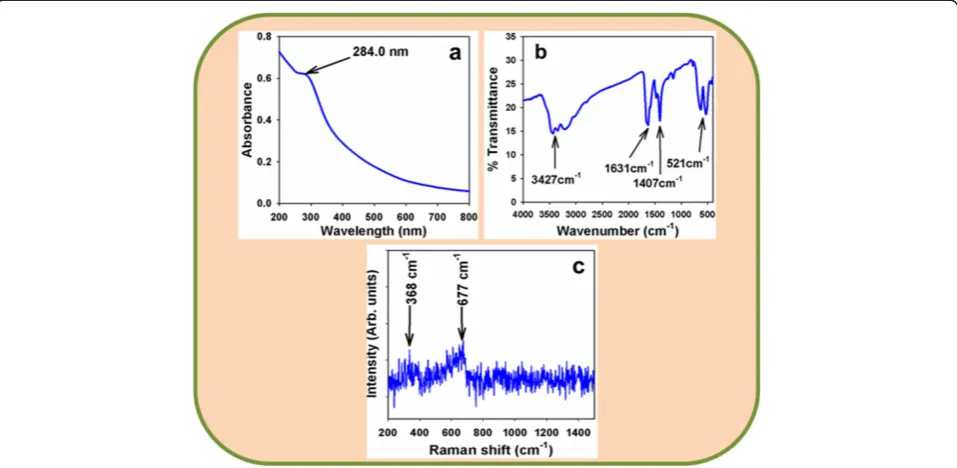
one of the important features for the evaluation of its photo-catalytic property. The optical absorption spectra of NPs are investigated by UV-visible spectrophotometer in the visible range (200.0 to 800.0 nm). From the absorption spectra, it has been investigated the absorbance of the doped Mn2O3-ZnO NPs is about ~284.0 nm, which is
presented in Figure 2a. Band gap energy (Ebg) is executed
based on the most absorption band of NPs and originated to be ~4.50704 eV, according to following formula (v).
Ebg¼ 1240
λ ð ÞeV ð5Þ
Where Ebg is the band-gap energy and λmax is the
wavelength (~284.0 nm) of the doped Mn2O3-ZnO NPs.
No extra peak related with contaminants and structural defects were found in the spectrums, which confirmed that the prepared NPs control crystallinity of codoped Mn2O3-ZnO NPs [63,64].
The codoped Mn2O3-ZnO NPs are also investigated
from the atomic and molecular vibrations. To investigate the vibration of materials, FT-IR spectrum mostly in the area of 450.0-4000.0 cm-1is measured. Figure 2b displays the FT-IR spectrum of the Mn2O3-ZnO NPs. It represents
band at 521.0, 1407.0, 1631.0, and 3427.0 cm-1. These exe-cuted wide vibration band (at 521.0 cm-1) could be as-signed as metal-oxygen (Mn-O and Zn-O modes) stretching vibrations [65,66], which verified the pattern of doped Mn2O3-ZnO NPs. The additional experimental
(3427 cm−1), C-O stretching vibration (1631.0 cm−1), and O-H bending vibration (1407 cm−1). The absorption bands at 1407, 1631 and 3427 cm-1usually displays from water and carbon dioxide, which generally semiconductor nanostructure materials absorbed from the surroundings owing to their meso-porous nature. Finally, the resultant vibration bands at lower-frequencies areas recommended the formation of codoped Mn2O3-ZnO NPs.
Raman spectroscopy is a spectroscopic method em-ploys to reveal vibrational, rotational and other low-frequency phases in Raman active compounds. Figure 2c confirms the Raman spectrum, where key features of the wave number are accomplished at about ~368.0 cm-1 and 667 cm-1for metal-oxygen (Mn-O and Zn-O) stret-ching vibrations. These bands can be allocated to a co-doped Mn2O3-ZnO NPs [67].
Figure 2Investigation of optical properties for doped Mn2O3-ZnO NPs at room conditions.(a) UV/visible (range, 200.0 ~ 800.0 nm), (b) FT-IR spectroscopy (range, 450.0 ~ 4000.0 cm-1), and (c) Raman spectrum (200.0 ~ 1450.0 cm-1).
Figure 1Fabrication process and detection mechanism of 4-nitrophenol using codoped Mn2O3-ZnO NPs coated AgE.(a) PdE used
Structural properties
Crystallinity and crystal phases of the doped Mn2O3
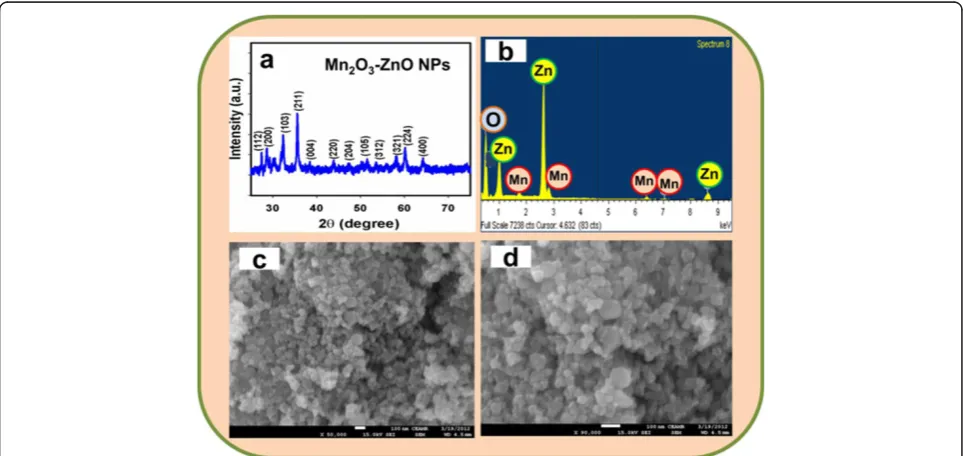
-ZnO NPs were investigated. X-ray diffraction outlines of codoped NPs are presented in Figure 3a. The Mn2O3
-ZnO NPs samples were examined and exposed as con-ventional tetragonal structure. The as-grown doped Mn2O3-ZnO NPs was calcined at 400.0°C in
muffle-furnace to start the formation of nano-crystalline phases. Figure 3a shows distinctive crystallinity of the doped Mn2O3-ZnO NPs and their aggregative crystal
arrange-ment. The reflection peaks in this proto-type were insti-gated to correspond with Mn2O3-ZnO NPs phase having
tetragonal geometry [JCPDS # 01-024-1133]. The phases employed the key characteristic peaks with indices for calcined crystalline NPs at 2θ values of (112), (200), (103), (211), (004), (220), (204), (105), (312), (321), (224), and (400) degrees. The tetragonal lattice space group is l41/amd. Finally, the powder X-ray prototype is corresponded to doped Mn2O3-ZnO NPs, which may be
featured to the lattice site of NPs semiconductor nanomaterials [68-70]. Further, no other impurity peak was found in the XRD prototype screening the codoped Mn2O3-ZnO NPs phase formation.
The electron dispersive spectroscopy (EDS) evaluation of calcined Mn2O3-ZnO NPs assigns the existence of Mn,
Zn, and O composition in the pure calcined Mn2O3-ZnO
materials. It is clearly employed that NP materials con-trolled with only manganese, zinc, and oxygen elements, which is shown in Figure 3b. The composition of Mn, Zn, and O is 33.07%, 18.81%, and 48.12% respectively. No
other peak related with any impurity has been found in the EDS, which demonstrates that the doped Mn2O3-ZnO
NPs are composed only with Mn, Zn, and O. High reso-lution FESEM images of calcined Mn2O3-ZnO NPs are
exhibited in Figure 3c-d. The FESEM images displayed of codoped materials with aggregated nano-particles shapes. The average diameter of doped Mn2O3-ZnO NPs is
calcu-lated in the range of 22.7 nm to 50.0 nm, which is close to ~37.5 nm. It is displayed noticeably from the FESEM im-ages that the simple wet-chemical method of prepared crystalline nanomaterials are nanostructure of codoped Mn2O3-ZnO NPs, which executed in aggregated shape,
higher-density, and attained nanostructure in spherical nano-particle shapes. It is also suggested that nanomaterials composed in spherical particle-like morph-ology of the combined codoped Mn2O3-ZnO NPs [71,72].
Chemical analysis
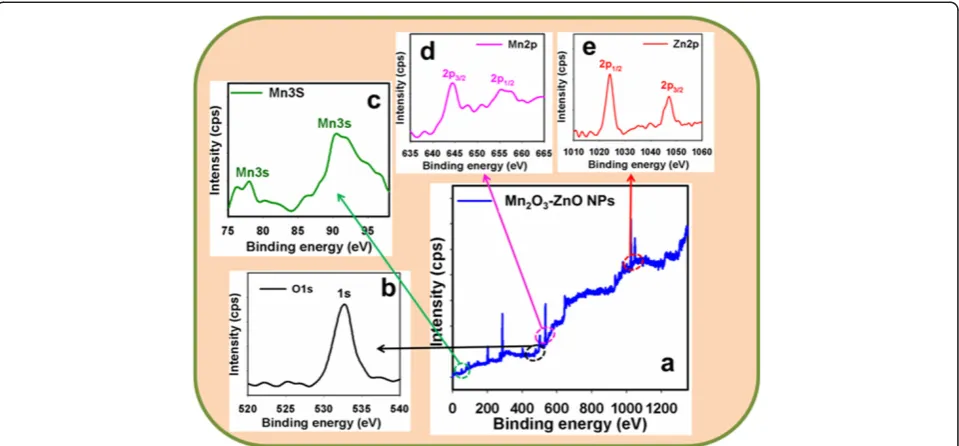
X-ray photoelectron spectroscopy (XPS) is a quantitative spectroscopic method that determines the elemental-composition, empirical-formula, chemical-state and electronic-state of the elements that present in nano-materials. Here, XPS measurements were employed for doped Mn2O3-ZnO NPs to examine the chemical states
of Zn, Mn, and O atoms. The full XPS spectra of Zn2p, Mn3s, Mn2p, and O1s are displayed in Figure 4a. The O1s spectrum employs a major-peak at 532.9 eV in Figure 4b. The peak at 532.9 eV is assigned to lattice oxygen, may be shown to oxygen (i.e, O2-) in presence
in the doped Mn2O3-ZnO NP nanomaterials [73]. In
Figure 3c, the peaks of the Mn3s binding energy for all the samples displayed at around 77.3 eV and 91.8 eV re-spectively, which is in excellent conformity with the ref-erence data for Mn [74]. Figure 4d also shows the XPS spectra (spin-orbit doublet peaks) of the Mn2p(3/2) and
Mn3p(1/2) regions found with semiconductor doped
Mn2O3-ZnO NPs. The binding energy of the Mn3p(3/2)
and Mn3p(1/2)peak at 644.7 eV and 655.3 eV respectively
indicates the existence of Mn since their bindings ener-gies are similar [75]. In Figure 4e, the spin-orbit peaks of the Zn2p(1/2) and Zn2p(3/2) binding energy for codoped
Mn2O3-ZnO NPs appeared at around 1025.7 eV and
1048.9 eV respectively, which is in good conformity with the reference data for Zn [76].
Applications: detection of 4-nitrophenol using codoped Mn2O3-ZnO NPs
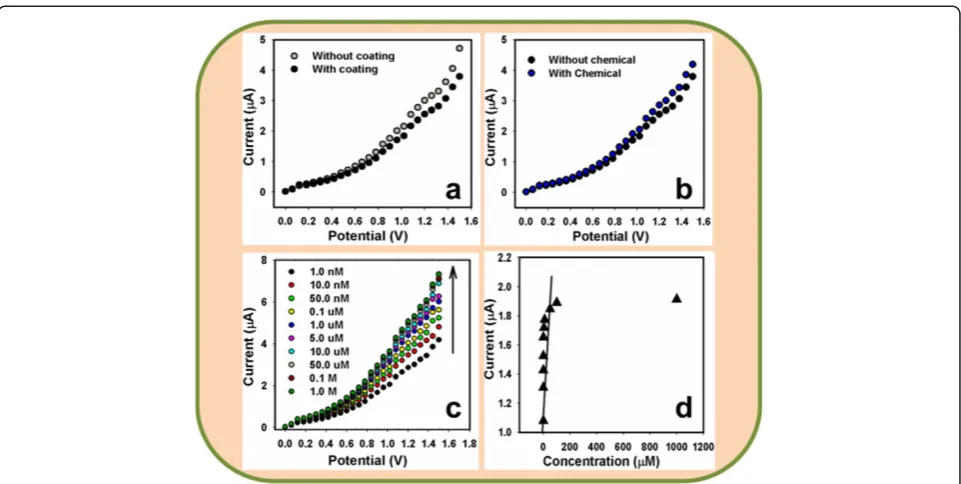
Figure 5a exhibits the current responses un-coated (gray-dotted) and coated (dark-dotted) AgE working electrode with doped Mn2O3-ZnO NPs at room
condi-tions. With doped NPs fabricating surface, the current-signal is reduced compared to without fabricated surface, which reveals the surface is slightly inhibited with doped NPs. The current changes for the codoped Mn2O3-ZnO
NPs modified flat-electrodes before (dark-dotted) and after (blue-dotted) injection of 50.0 μL 4-nitrophenol (~1.0 nM) in 10.0 mL PBS (0.1 M) solution, which is presented in Figure 5b. These considerable changes of surface current are measured in every injection of the target 4-nitrophenol into the electrochemical solution by Keithley electrometer. 10.0 mL of 0.1 M PBS solution is initially transferred into the electrochemical-cell and
added the low to high concentration of 4-nitrophenol drop-wise from the stock chemical solution. I-V re-sponses with Mn2O3-ZnO NPs modified electrode
surface were evaluated from the various concentrations (1.0 nM to 1.0 M), which was revealed in Figure 5c. It displays the current changes of developed films as a function of 4-nitrophenol concentration at room con-ditions. It was also observed that with increasing the concentration of analyte, the resultant currents also en-hanced considerably, which corroborated that the re-sponse was a surface-process. It shows the rere-sponse of codoped Mn2O3-ZnO NPs as a role of analyte
concen-tration at room conditions. A large concenconcen-tration range of 4-nitrophenol concentration was selected to study the probable investigative parameters, which was calculated in 1.0 nM to 1.0 M. The calibration curve was drawn from the variation of 4-nitrophenol concentrations, which was presented in Figure 5d. It was exhibited a calibration curve for the response current versus 4-nitrophenol concentration of developed doped Mn2O3
-ZnO NPs on AgE electrode. It was measured from the calibration plot that as the concentration of target ana-lyte enhances, the current response also increased and finally at high 4-nitrophenol concentration, the current achieves at a saturated level, which proposes that the active surface sites of doped NPs saturated with ana-lyte units [77]. The sensitivity is manipulated from the calibration-curve, which is close to ~4.6667 μA cm-2 μM-1. The linear dynamic range of this chemo-sensor exhibits from 0.1 nM to 50.0 μM (linearity, r2= 0.977) and the detection limit was calculated as ~ 0.83 ± 0.2 nM (at an SNR of 3).
Usually, the resistance value of the codoped Mn2O3
-ZnO NPs modified electrodes/chemo-sensors are de-creased with enhancing active-surface area, owing to the essential characteristics of the semiconductor materials [78-80]. In fact, oxygen adsorption (O2) displays a
con-siderable liability in the electrical features of the doped NPs (n-type semiconductor) structures. Oxygen ion (O2-)
adsorption eradicates the conduction electrons and en-hances the resistance of doped Mn2O3-ZnO NPs. Active
oxygen species (i.e., O2− and O−) are adsorbed onto
ma-terial surfaces at room condition, and the quantity of such chemo-sorbed oxygen species strongly depend on the structural properties. At room condition, O2− is
chemo-sorbed, while in NPs morphology, both O2− and
O− are chemo-sorbed, and the O2− vanishes rapidly
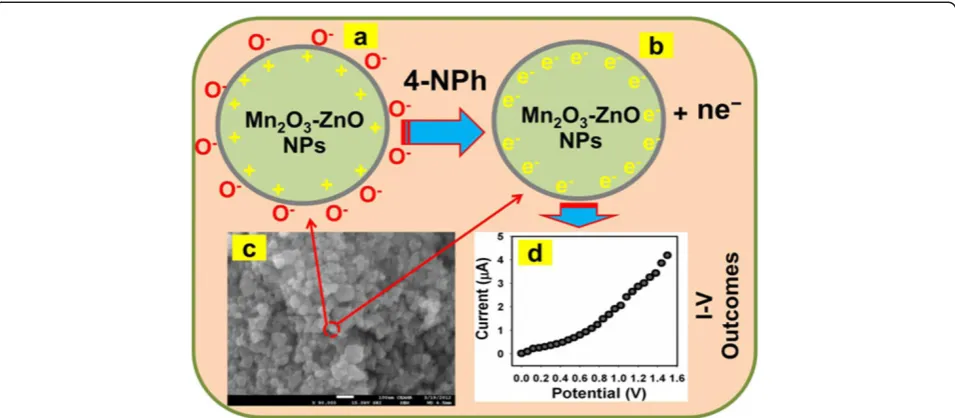
[81,82]. Here, 4-nitrophenol sensing mechanism of doped Mn2O3-ZnO NPs chemo-sensor is based on the
semiconductors metal oxides, which is held owing to the oxidation/reduction of the semiconductor NPs. According to the dissolved O2in bulk-solution or
surface-air of the neighboring atmosphere, the following reac-tions (vi) & (vii) are accomplished in the reaction medium.
eðNPsÞ þO2→O2 ð6Þ
eðNPsÞ þO2→2O ð7Þ
These reactions are consummated in bulk-system/air-liquid interface/neighboring atmosphere owing to the
small carrier concentration, which increased the re-sistance. The 4-nitrophenol sensitivity towards doped Mn2O3-ZnO NPs could be ascribed to the
higher-oxygen lacking conducts to enhance the higher-oxygen adsorp-tion. Larger the amount of oxygen adsorbed on the doped NPs-sensor surface, higher would be the oxidizing potentiality and faster would be the oxidation of 4-nitrophenol. The activity of 4-nitrophenol would have been extremely big as contrast to other toxic chemical with the surface under indistinguishable conditions [83-85]. When 4-nitrophenol reacts with the adsorbed oxygen (by producing electrons) on the chemo-sensor surface, it oxidized to 4-hydroxylaminophenol and water. Later, the oxidation of 4-hydroxylaminophenol takes place to convert to 4-nitrosophenol and the subsequent reversible reduction, which released free electrons (2e-) into the conduction-band (C.B.). This phenomenon could be elucidated through the following proposed re-actions (viii-x).
2O→O2þ2e ð8Þ
HOPhNO2þ4e þHþ→HOPh
NHOHþH2O
ð9Þ
HOPhNHOH→HOPhNo þ2eHþðC:B:Þ
ð10Þ
These reactions related to oxidation of the reducing carriers in presence of semiconductor doped Mn2O3
ZnO NPs. These techniques improved the carrier con-centration and hence reduced the resistance on exposure to reducing liquids/analytes. At the room condition, the incorporating of metal oxide surface to reduce liquid/ analytes results in a surface interceded adsorption pro-cess. The abolition of iono-sorbed O2enhances the
elec-tron communication and hence the surface conductance of the thin-film [86,87]. The reducing analyte offers elec-trons co-doped Mn2O3-ZnO NP surfaces. Accordingly,
the resistance is slightly reduced, where conductance is amplified. For this reason, why the analyte response (current) intensified with increasing resultant potential. Thus, the electrons are contributed for quick enhance in conductance of the thin-film. The codoped Mn2O3-ZnO
NPs unusual regions dispersed on the surface would im-prove the ability of nanomaterial to absorb more O2
species giving higher resistances in air ambient, which is presented in Figure 6.
The response time was approximately 10.0 s for the doped Mn2O3-ZnO NPs coated-electrode to attain
saturated-steady state current. The outstanding sen-sitivity of NPs chemo-sensor can be accredited to good absorption (porous-surfaces coated with conducting binders) and adsorption ability (large-surface area), higher-catalytic activity, and good bio-compatibility of the codoped Mn2O3-ZnO NPs [88]. Due to large surface
area, NPs are proposed a favorable nano-environment for the 4-nitrophenol exposure and gratitude with excep-tional sensitivity. The sensitivity of codoped Mn2O3-ZnO
NPs affords high-electron communication characteristics, which improved the direct electron communication be-tween the active sites of NPs and chemo-sensor electrode
Figure 6Mechanism of 4-nitrophenol detection using doped Mn2O3-ZnO NPs coated AgE at room conditions.(a) reduction of NPs/AgE,
(b) reaction of 4-nitrophenol onto the reduced NPs/AgE, (c) FESEM image of NPs, and (d) real I-V outcome for 4-nitrophenol detection with NPs/AgE.
Table 1 Comparison the performances of 4-nitrophenol detection based on doped Mn2O3-ZnO NPs using various reported methods
Materials Methods LDR DL Sensitivity Linearity (r2) Ref
CuO Nanohybrides I-V 1.0 nM to 1.0 mM 0.67 nM. 4.50μAcm-2mM-1 0.7941 [93]
Poly(safranine) Film Electrode
CV/LSV 8.0 × 10⁻⁸to
4.0 × 10⁻⁵M 3.0 × 10 −8
M – 0.9880 [94]
Mn-Doped ZnS QDs Chemilumine-scence (CL) 0.1 to 40μM 76.0 nM – – [95]
Immunoassay Fluorescence Spectroscopy (FL)
5 and 1000μg/L 3.5 nM 5.7 mg/L – [96]
Graphene Oxide sensors CV 0.1 to 120μM 0.02μM – – [97]
B-doped diomond Electrodes
SWV – 8.4 mM 0.3943 0.9991 [98]
Doped Mn2O3-ZnO
NPs/AgE
I-V method 0.1 nM to 50.0μM
surfaces [89,90]. The modified thin NPs fabricated-film had a better consistency and reliability. However, owing to large-dynamic surface area, the codoped Mn2O3-ZnO
NPs were entailed productive surroundings for the 4-nitrophenol chemical detection (by adsorption) with huge-amount [91,92]. To check the repeatability and storage stabilities, I-V response for codoped Mn2O3
-ZnO NPs coated chemo-sensor was investigated (up to two weeks). After every experiment, the fabricated chemo-sensor was washed carefully with the PBS buf-fer solution and executed no considerable reduced on the current responses (recovery, ~95.2%). The sensi-tivity was retained almost same of initial sensisensi-tivity up to week, after that the response of the developed doped Mn2O3-ZnO NPs sensor gradually decreased.
In Table 1, it is contrasted the performances for 4-nitrophenol recognition based doped Mn2O3-ZnO
NPs using various modified electrode materials.
Conclusions
By reliable I-V techniques for fabricating, assembling and integrating structural semiconductor doped Mn2O3
-ZnO NPs onto conductive flat-silver electrodes has been investigated in details for the detection of toxic 4-nitrophenol compound. Codoped Mn2O3-ZnO NPs
fab-ricated sensor executed the potential applications in providing 4-nitrophenol chemo-sensors and encouraging improvement has been consummated in this investiga-tion. Besides the development of codoped nanomaterials, there are still a number of significant subjects that are required for additional examination before this nano-material can be moved into the profitable uses for the mentioned applications. As for the doped nanostruc-tures, NPs are introduced a route to a new generation of toxic chemo-sensors, but a premeditate effort has to be applied for doped Mn2O3-ZnO NPs to be taken
compre-hensively for large-scale applications, and to achieve higher-potential density with accessible to individual chemo-sensors.
Competing interests
The authors declare that they have no competing interests.
Authors’contributions
MMR made a significant contribution to preparation and characterization of doped nanomaterials, and data collection and their analysis and application as well as writing the manuscript. GG has revised the manuscript for intellectual content and corrected accordingly. SAG made a significant contribution to survey the literatures and results. MAD revised the manuscript properly and surveyed the results. SBK participated in the synthesis of samples, collected the data, and contributed in the experimental work. AMA has revised the manuscript for intellectual content. All authors read and approved the final manuscript.
Acknowledgements
This paper was funded by King Abdulaziz University, under grant No. (31-3-1432/HiCi). The authors, therefore, acknowledge technical and financial support of KAU.
Author details
1
Center of Excellence for Advanced Materials Research (CEAMR), King Abdulaziz University, P.O. Box 80203, Jeddah 21589, Saudi Arabia.2Chemistry Department, Faculty of Science, King Abdulaziz University, P.O. Box 80203, Jeddah 21589, Saudi Arabia.3Department of Physics, University of California Los Angeles, 405 Hilgard Avenue, Los Angeles, California 90095, USA. 4Physics Department, Faculty of Science, King Abdulaziz University, P.O. Box 80203, Jeddah 21589, Saudi Arabia.5Chemical Engineering, Faculty of Engineering, King Abdulaziz University, Jeddah 21589, Saudi Arabia.
Received: 18 January 2013 Accepted: 19 March 2013 Published: 28 March 2013
References
1. Na CW, Park SY, Chung JH, Lee JH:Transformation of ZnO nanobelts into single-crystalline Mn3O4nanowires.ACS Appl Mater Interfac2012, 4:6565–6572.
2. InglerJr WB, Baltrus JP, Khan SUM:Photoresponse of p-type zinc-doped iron(III) oxide thin films.J Am Chem Soc2004,126:10238–10239. 3. Wang J, Chong PF, Ng SC, Gan LM:Microemulsion processing of
manganese zinc ferrites.Mater Lett1997,30:217–221.
4. Toberer ES, Löfvander JP, Seshadri R:Topo-chemical formation of mesoporous MnO crystals.Chem Mater2006,18:1047–1052.
5. Toberer ES, Schladt TD, Seshadri R:Macroporous manganese oxides with regenerative mesopores.J Am Chem Soc2006,128:1462–1463. 6. Deng H, Li X, Peng Q, Wang X, Chen J, Li Y:Monodisperse magnetic
single-crystal ferrite microspheres.Angewandte Chemie (Inter Ed)2005, 44:2782–2785.
7. Patrice R, Dupont L, Aldon L, Jumas JC, Wang E, Tarascon JM:Structural and electrochemical properties of newly synthesized Fe-substituted MnO2samples.Chem Mater2004,16:2772–2782.
8. Li H, Li J, Xu Q, Yang Z, Hu X:A derivative photoelectrochemical sensing platform for 4-nitrophenolate contained organophosphates pesticide based on carboxylated perylene sensitized nano-TiO2.Anal Chim ActaIn press. doi:http://dx.doi.org/10.1016/j.aca.2012.12.038.
9. Rahman MM, Khan SB, Marwani HM, Asiri AM:Selective iron(III) ion uptake using CuO-TiO2nanostructure by inductively coupled plasma-optical emission spectrometry.Chem Centr J2012,6:158.
10. Sampieri Á, Lima E:On the acid–base properties of microwave irradiated hydrotalcite-like compounds containing Zn2+and Mn2+.Langmuir2009, 25:3634–3639.
11. Mugumaoderha MC, Sporken R, Ghijsen J, DeGroot FMF, Dumont JA:Phase transitions at the Mn/ZnO (0001¯) interface probed by high energy X-ray spectroscopies.J Phys Chem C2012,116:665–670.
12. Torres F, Amigó R, Asenjo J, Krotenko E, Tejada J, Brillas E:Electrochemical route for the synthesis of New nanostructured magnetic mixed oxides of Mn, Zn, and Fe from an acidic chloride and nitrate medium.Chem Mater
2000,12:3060–3067.
13. Feng D, Luo W, Zhang J, Xu M, Zhang R, Wu H, Lv Y, Asiri AM, Khan SB, Rahman MM, Zheng G, Zhao D:Multi-layered mesoporous TiO2thin films with large pore and highly crystalline frameworks for efficient photoelectrochemical conversion.J Mater Chem A2013,1:1591–1599. 14. Rahman MM, Jamal A, Khan SB, Faisal M:Characterization and applications
of as-grownβ-Fe2O3nanoparticles prepared by hydrothermal method.
J Nanopart Res2011,13:3789–3799.
15. Wu KL, Wei XW, Zhou XM, Wu DH, Liu XW, Ye Y, Wang Q:NiCo2Alloys: controllable synthesis, magnetic properties, and catalytic applications in reduction of 4-nitrophenol.J Phys Chem C2011,115:16268–16274. 16. Rahman MM, Khan SB, Faisal M, Asiri AM, Alamry KA:Highly sensitive
formaldehyde chemical sensor based on hydrothermally prepared spinel ZnFe2O4nanorods.Sens Actuator B Chem2012,171–172:932–937. 17. Rahman MM:Fabrication of mediator-free glutamate sensors based on
glutamate oxidase using smart micro-devices.J Biomed Nanotech2011, 7:351–357.
18. Rahman MM, Jamal A, Khan SB, Faisal M:Fabrication of chloroform sensors based on hydrothermally prepared low-dimensionalβ-Fe2O3
nanoparticles.Superlatt Microstruc2011,50:369–376.
20. Rahman MM, Khan SB, Faisal M, Asiri AM, Tariq MA:Detection of aprepitant drug based on Low-dimensional Un-doped iron oxide nanoparticles prepared by solution method.Electrochim Acta2012,75:164–170. 21. Rahman MM, Khan SB, Marwani HM, Asiri AM, Alamry KA, Al-Youbi AO:
Selective determination of gold (III) ion using CuO microsheets as a solid phase adsorbent prior to ICP-OES measurements.Talanta2013, 104:75–82.
22. Frenzel W, Frenzel JO, Moeler J:Spectrophotmetric determination of phenolic compounds by flow-injection analysis.Anal Chim Acta2006, 261:253.
23. Penalver A, Pocurull E, Borrull F, Marce RM:Separation and determination of nitrobenzenes by micellar electrokinetic chromatography and high-performance liquid chromatography.J Chromatogr A2002,953:79. 24. Castillo M, Domingues R, Alpendurada MF, Barcelo D:Persistence of selected pesticides and their phenolic transformation products in natural waters using off-line liquid solid extraction followed by liquid chromatographic techniques.Anal Chim Acta1997,353:133.
25. Dzyadevych SV, Chovelon JM:A comparative photodegradation studies of methyl parathion by using Lumistox test and conductometric biosensor technique.Mater Sci Eng C2002,21:55.
26. ATSDR:Toxicity FAQs nitrophenols; Agency for Toxic Substances and Disease Registry.2001.
27. Wang SP, Chen HJ:Separation and determination of nitrobenzenes by micellar electrokinetic chromatography and high-performance liquid chromatography.J Chromatogr A2002,979:439.
28. Kontsas H, Rosenberg C, Pfaeffli P, Jappinen P:Gas chromatographic–mass spectrometric determination of chlorophenols in the urine of sawmill workers with past use of chlorophenol-containing anti-stain agents.
Analyst1995,120:1745–1749.
29. Brega A, Prandini P, Amaglio C, Pafuni E:Determination of phenol, m-, o- and p-cresol, p-aminophenol and p-nitrophenol in urine by high-performance liquid chromatography.J Chromatogr A1990, 535:311–316.
30. Makuch B, Gazda K:Occurrence and determination of organic pollutants in tap and surface waters of the Gdańsk district.J Chromatogr A1996, 733:171.
31. Wissiack R, Rosenberg E:Universal screening method for the determination of US Environmental Protection Agency phenols at the lower ng l−1level in water samples by on-line solid-phase
extraction–high-performance liquid chromatography–atmospheric pressure chemical ionization mass spectrometry within a single run.
J Chromatogr A2002,963:149.
32. Kaniansky D, Krcmova E, Madajova V, Masar M, Marek J:Determination of nitrophenols by capillary zone electrophoresis in a hydrodynamically closed separation compartment.J Chromatogr A1997,772:327. 33. Luz RDS, Damos FS, DeOliveira AB, Beek J:Voltammetric determination of
4-nitrophenol at a lithium tetracyanoethylenide (LiTCNE) modified glassy carbon electrode.Talanta2004,64:935.
34. Hu SS, Xu CL, Wang GP, Cui DF:Voltammetric determination of 4-nitrophenol at a sodium montmorillonite-anthraquinone chemically modified glassy carbon electrode.Talanta2001,54:115.
35. Barek J, Ebertova H, Mejstrik V, Zima J:Determination of 2-Nitrophenol, 4-Nitrophenol, 2-Methoxy-5-nitrophenol, and 2,4-Dinitrophenol by Differential Pulse Voltammetry and Adsorptive Stripping Voltammetry.
Collect Czech Chem C1994,59:1761.
36. Ni Y, Wang L, Kokot S:Simultaneous determination of nitrobenzene and nitro-substituted phenols by differential pulse voltammetry and chemometrics.Anal Chim Acta2001,431:101.
37. Lawrence NS, Pagels M, Meredith A, Jones TGJ, Hall CE, Pickles CSJ, Godfried HP:Electroanalytical applications of boron-doped diamond
microelectrode arrays.Talanta2006,69:829.
38. Liu Y, Deng Y, Sun Z, Wei J, Zheng G, Asiri AM, Khan SB, Rahman MM, Zhao D:Hierarchical Cu2S Microsponges Constructed from Nanosheets for Efficient Photocatalysis.Small, doi:http://dx.doi.org/10.1002/smll.201300197. 39. Pedrosa VA, Codognoto L, Machado SAS, Avaca LA:Is the boron-doped
diamond electrode a suitable substitute for mercury in pesticide analyses? A comparative study of 4-nitrophenol quantification in pure and natural waters.J Electroanal Chem2004,573:11–18.
40. Garbellini GS, Salazar-Banda GR, Avaca LA:Sonovoltammetric determination of 4-nitrophenol on diamond electrodes.J. Braz. Chem. Soc.2007,18:1095–1099.
41. Rahman MM, Gruner G, Al-Ghamdi MS, Daous MA, Khan SB, Asiri AM: Fabrication of highly sensitive phenyl hydrazine chemical sensor based on as-grown ZnO-Fe2O3Microwires.Inter. J. Electrochem. Sci.2013, 8:520–534.
42. Lund H, Baizer MM (Eds):Organic electrochemistry: an introduction and a guide.New York: Marcel Dekker; 1991:411.
43. Khan SB, Akhtar K, Rahman MM, Asiri AM, Seo J, Alamry KA, Han H:Thermally and mechanically stable green environmental composite for chemical sensor applications.New Journal of Chemistry2012,36:2368–2375. 44. Khan SB, Rahman MM, Jang ES, Akhtar K, Han H:Special susceptive
aqueous ammonia chemi-sensor: Extended applications of novel UV-curable polyurethane-clay nanohybrid.Talanta2011,84:1005–1010. 45. Khan SB, Faisal M, Rahman MM, Jamal A:Exploration of CeO2
nanoparticles as a chemi-sensor and photo-catalyst for environmental applications.Sci Tot Environ2011,409:2987–2992.
46. Cordero-Rando MD, Barea-Zamora M, Barber-Salvador JM, Naranjo-Salvador I:Electrochemical study of 4-nitrophenol at a modified carbon paste electrode.Microchim Acta1999,132:7–11.
47. Khan SB, Faisal M, Rahman MM, Jamal A:Low-temperature growth of ZnO nanoparticles: photocatalyst and acetone sensors.Talanta2011, 85:943–949.
48. Rahman MM, Umar A, Sawada K:Development of amperometric glucose biosensor based on glucose oxidase enzyme immobilized with multi-walled carbon nanotubes at Low potential.Sens Actuator B Chem2009, 137:327–333.
49. Rahman MM, Jamal A, Khan SB, Faisal M, Asiri AM:Highly sensitive methanol chemical sensor based on undoped silver oxide nanoparticles prepared by a solution method.Microchim Acta2012,178:99–106. 50. Rahman MM, Jamal A, Khan SB, Faisal M, Asiri AM:Fabrication of methanol
chemical sensor based on hydrothermally preparedα-Fe2O3codoped SnO2nanocubes.Talanta2012,95:18–24.
51. Rahman MM, Jamal A, Khan SB, Faisal M, Asiri AM:Fabrication of highly sensitive acetone sensor based on sonochemically prepared as-grown Ag2O nanostructures.Chem Engineer J2012,192:122–128.
52. Rahman MM, Jamal A, Khan SB, Faisal M:Cu-doped ZnO based nanostructured materials for sensitive chemical sensor applications.
ACS App Mater Inter2011,3:1346–1351.
53. Sadik OA, Zhou AL, Kikandi S, Du N, Wang Q, Varner K:Sensors as tools for quantitation, nanotoxicity and nanomonitoring assessment of engineered nanomaterials.J Environ Monit2009,11:1782–1800. 54. Su S, Wu W, Gao J, Lu J, Fan C:Nanomaterials-based sensors for
applications in environmental monitoring.J Mater Chem2012, 22:18101–18110.
55. Rahman MM, Jamal A, Khan SB, Faisal M:Fabrication of highly sensitive ethanol chemical sensor based on Sm-doped Co3O4nano-kernel by solution method.J Phys Chem C2011,115:9503–9510.
56. Rahman MM, Jamal A, Khan SB, Faisal M:Highly sensitive ethanol chemical sensor based on Ni-doped SnO2 nanostructure materials.Biosens Bioelectron2011,28:127–134.
57. Zhang L, Wang JQ, Li J, Zhang S, Jiang Z, Zhou J, Cheng J, Hu T, Yan W, Wei X, Wu Z:Regulation of magnetic behavior and electronic configuration in Mn-doped ZnO nanorods through surface modifications.Chem Mater2012,24:1676–1681.
58. Swierczewska M, Liu G, Lee S, Chen X:High-sensitivity nanosensors for biomarker detection.Chem Soc Rev2012,41:2641–2655.
59. Lord H, Kelley SO:Nanomaterials for ultrasensitive electrochemical nucleic acids biosensing.J Mater Chem2009,19:3127–3134. 60. Zhou L, Wu HB, Zhu T, Lou XW:Facile preparation of ZnMn2O4hollow
microspheres as high-capacity anodes for lithium-ion batteries.J Mater Chem2012,22:827–829.
61. Courtel FM, Abu-Lebdeh Y, Davidson IJ:ZnMn2O4nanoparticles synthesized by a hydrothermal method as an anode material for Li-ion batteries.Electrochim Acta2012,71:123–127.
62. Zhao J, Wang F, Su P, Li M, Chen J, Yang Q, Li C:Spinel ZnMn2O4 nanoplate assemblies fabricated via“escape-by-crafty-scheme”strategy.
J Mater Chem2012,22:13328–13333.
63. Bessekhouad Y, Robert D, Weber JV:Photocatalytic activity of Cu2O/TiO2, Bi2O3/TiO2and ZnMn2O4/TiO2heterojunctions.Catal Today2005, 101:315–321.
65. Duan J, Wang H, Wang H, Zhang J, Wu S, Wang Y:Mn-doped ZnO nanotubes: from facile solution synthesis to room temperature ferromagnetism.CrystEngComm2012,14:1330–1336.
66. Wang L, Liu B, Ran S, Wang L, Gao L, Qu F, Chen D, Shen G:Facile synthesis and electrochemical properties of CoMn2O4anodes for high capacity lithium-ion batteries.J Mater Chem A2013. doi:http://dx.doi.org/ 10.1039/C2TA00125J.
67. Li H, Song B, Wang WJ, Chen XL:Facile synthesis, thermal, magnetic, Raman characterizations of spinel structure ZnMn2O4.Mater Chem Phys 2011,130:39–44.
68. Kim SW, Lee HW, Muralidharan P, Seo DH, Yoon WS, Kim DK, Kang K: Electrochemical performance and ex situ analysis of ZnMn2O4 nanowires as anode materials for lithium rechargeable batteries.Nano Res2011,4:505–510.
69. Zhang G, Yu L, Wu HB, Hoster HE, Lou XW:Formation of ZnMn 2 O 4 ball-in-ball hollow microspheres as a high-performance anode for lithium-Ion batteries.Adv Mater2012,24:4609–4613.
70. Xiao L, Yang Y, Yin J, Li Q, Zhang L:Low temperature synthesis of flower-like ZnMn2O4superstructures with enhanced electrochemical lithium storage.J Pow Sour2009,194:1089–1093.
71. Deng Y, Tang S, Zhang Q, Shi Z, Zhang L, Zhan S, Chen G:Controllable synthesis of spinel nano-ZnMn2O4via a single source precursor route and its high capacity retention as anode material forlithium ion batteries.J Mater Chem2011,21:11987–11995.
72. Menaka SL, Samal KV, Ramanujachary SE, Lofland G, Ganguli AK: Stabilization of Mn(IV) in nanostructured zinc manganese oxide and their facile transformation from nanospheres to nanorods.J Mater Chem
2011,21:8566–8573.
73. Rahman MM, Khan SB, Faisal M, Rub MA, Al-Youbi AO, Asiri AM: Electrochemical determination of olmesartan medoxomil using hydrothermally prepared nanoparticles composed SnO2–Co3O4 nanocubes in tablet dosage forms.Talanta2012,99:924–931. 74. Zhang P, Li X, Zhao Q, Liu S:Synthesis and optical property of one
dimensional spinel ZnMn2O4 nanorods.Nanoscal Res Lett2011,6:323. 75. Zhao L, Li X, Zhao J:Fabrication, characterization and photocatalytic
activity of cubic-like ZnMn2O4.App Surf Sci. doi:http://dx.doi.org/10.1016/ j.apsusc.2012.12.078.
76. Lupan O, Emelchenko GA, Ursaki VV, Chai G, Redkin AN, Gruzintsev AN, Tiginyanu IM, Chow L, Ono LK, Cuenya BR, Heinrich H, Yakimov EE: Synthesis and characterization of ZnO nanowires for nanosensor applications.Mater Res Bull2010,45:1026–1032.
77. Marcelo G, Muñoz-Bonilla A, Fernández-García M:Magnetite-polypeptide hybrid materials decorated with gold nanoparticles: study of their catalytic activity in 4-nitrophenol reduction.J Phys Chem C2012, 116:24717–24725.
78. Song P, Qin HW, Zhang L, An K, Lin ZJ, Hu JF, Jiang MH:The structure, electrical and ethanol-sensing properties of La1−xPbxFeO3perovskite ceramics with x≤0.3.Sens Actuator B Chem2005,104:312–317. 79. Lee SR, Rahman MM, Ishida M, Sawada K:Fabrication of a highly sensitive
penicillin sensor based on charge transfer techniques.Biosens Bioelectron
2009,24:1877–1882.
80. Lee SR, Rahman MM, Ishida M, Sawada K:Development of highly sensitive acetylcholine sensor based on acetylcholine by charge transfer techniques esterase using smart biochips.Trends Anal Chem2009, 28:196–203.
81. Han N, Chai L, Wang Q, Tian Y, Deng P, Chen Y:Evaluating the doping effect of Fe, Ti and Sn on gas sensing property of ZnO.Sens Actuator B Chem2010,147:525–530.
82. Hsueh TJ, Hsu CL, Chang SJ, Chen IC:Laterally grown ZnO nanowire ethanol gas sensors.Sens Actuator B Chem2007,126:473–477. 83. Tao B, Zhang J, Hui S, Wan L:An amperometric ethanol sensor based on
a Pd-Ni/SiNWs electrode.Sens Actuator B Chem2009,142:298–302. 84. Wongrat E, Pimpang P, Choopun S:An amperometric ethanol sensor
based on a Pd-Ni/SiNWs electrode.App Surf Sci2009,256:968–972. 85. Umar A, Rahman MM, Kim SH, Hahn YB:Zinc oxide nanonail based
chemical sensor for hydrazine detection.Chem Commun2008:166–169. 86. Mujumdar S:Synthesis and characterization of SnO2films obtained by a
wet chemical process.Mat Sci Poland2009,27:123–128.
87. Pan B, Du W, Zhang W, Zhang X, Zhang Q, Pan B, Lv L, Zhang Q, Chen J: Improved Adsorption of 4-Nitrophenol onto a Novel Hyper-Cross-Linked Polymer.Environ Sci Technol2007,41:5057–5062.
88. Wunder S, Polzer F, Lu Y, Mei Y, Ballauff M:Kinetic analysis of catalytic reduction of 4-nitrophenol by metallic nanoparticles immobilized in spherical polyelectrolyte brushes.J Phys Chem C2010,114:8814–8820. 89. Hayakawa K, Yoshimura T, Esumi K:Preparation of gold−dendrimer
nanocomposites by laser irradiation and their catalytic reduction of 4-nitrophenol.Langmuir2003,19:5517–5521.
90. Zhang J, Chen G, Chaker M, Rosei F, Ma D:Gold nanoparticle decorated ceria nanotubes with significantly high catalytic activity for the reduction of nitrophenol and mechanism study.App Catal B Environ2013, 132–133:107–115.
91. Gangula A, Podila R, Ramakrishna M, Karanam L, Janardhana C, Rao AM: Catalytic reduction of 4-nitrophenol using biogenic gold and silver nanoparticles derived from breynia rhamnoides.Langmuir2011, 27:15268–15274.
92. Ahmaruzzaman M, Gayatri SL:Activated neem leaf: a novel adsorbent for the removal of phenol, 4-nitrophenol, and 4-chlorophenol from aqueous solutions.J Chem Eng Data2011,56:3004–3016.
93. Khan SB, Rahman MM, Akhtar K, Asiri AM, Alamry KA, Seo J, Han H:Copper oxide based polymer nanohybrid for chemical sensor applications.Int J Electrochem Sci2012,7:10965–10975.
94. Liu XY:A novel sensor based on electropolymerization poly(safranine) film electrode for voltammetric determination of 4-nitrophenol.Bull Korean Chem Soc2010,31:1182–1186.
95. Liu J, Chen H, Lin Z, Lin JM:Preparation of surface imprinting polymer capped Mn-doped ZnS quantum dots and their application for chemiluminescence detection of 4-nitrophenol in Tap water.Anal Chem
2010,82:7380–7386.
96. Nistor C, Oubiña A, Marco MP, Barceló D, Emnéus J:Competitive flow immunoassay with fluorescence detection for determination of 4-nitrophenol.Anal Chim Acta2001,426:185–195.
97. Li J, Kuang D, Feng Y, Zhang F, Xu Z, Liu M:A graphene oxide-based electrochemical sensor for sensitive determination of 4-nitrophenol.
J Hazard Mater2012,201–202:250–259.
98. Pedrosa VA, Codognoto L, Avaca LA:Electroanalytical determination of 4-nitrophenol by square wave voltammetry on diamond electrodes.
J Braz Chem Soc2003,14:530–535.
doi:10.1186/1752-153X-7-60
Cite this article as:Rahmanet al.:Chemo-sensors development based on low-dimensional codoped Mn2O3-ZnO nanoparticles using flat-silver
electrodes.Chemistry Central Journal20137:60.
Open access provides opportunities to our colleagues in other parts of the globe, by allowing
anyone to view the content free of charge.
Publish with
Chemistry
Central and every
scientist can read your work free of charge
W. Jeffery Hurst, The Hershey Company.
available free of charge to the entire scientific community peer reviewed and published immediately upon acceptance cited in PubMed and archived on PubMed Central yours you keep the copyright
Submit your manuscript here: