Issues and Ideas in Education Vol. 2, No. 2 September 2014 pp. 131–147
DOI: 10.15415/iie.2014.22010
Effect of Mnemonic Techniques on Learning
Acquisition in Relation to Cognitive Styles
and Self Concept
AVANISh KumAr
Assistant Professor, S.r.m. College of Education, Vill. Dandrawal, Tehsil raipur rani, Distt Panchkula, haryana-201204, India Email: [email protected]
received: August 5, 2014| revised: September 11, 2014| Accepted: September 14, 2014
Published online: September 25, 2014
The Author(s) 2014. This article is published with open access at www.chitkara.edu.in/publications
Abstract: The study was conducted on the sample of 500 students of Secondary School Students, as per the requirements of 3 * 2 * 2 factorial design in which the independent variables of mnemonic Techniques (m), Cognitive Styles (C) and Self Concept (S) were studied. Learning Acquisition on some concepts of Social Studies was taken as dependent variable. There were three levels of mnemonic Techniques and two levels each of the variables of Cognitive Styles and Self Concept. The study was experimental in nature in which mnemonic Techniques were studied with Illustrations (m1), without Illustrations (m2) and the third group consisted of the control group (mo). The results showed that F ratios were significant for the main effects of mnemonic Techniques, Cognitive Styles and Self Concept as also for the double interaction effects of m*C, C*S and m*S. however, the triple interaction effect of m * C * S was not significant even at .05 level of confidence.
Keywords: mnemonic Techniques, Learning Acquisition, Cognitive Styles & Self Concept
1. INTRODUCTION
Kumar, A. how well the information can later be remembered. The process of storing and retrieving information depends heavily on the representation and organization of the information. moreover, the utility of learning can also be influenced by how the information is structured.
2. LEARNING ACQUISITION
Learning Acquisition is integrally tied to how the mind organizes and represents information. Learning can be enhanced by considering the fundamental properties of human knowledge, as well as by the ultimate function of the desired information. Learning Acquisition is seen as going on all the time. It is concrete, immediate and confined to a specific activity; it is not concerned with general principles (rogers 2003: 18) examples include much of the learning involved in parenting or with running a home. Some have referred to this kind of learning as unconscious or implicit. rogers (2003: 21), however, suggests that it might be better to speak of it as having a consciousness of the task. In other words, whilst the learner may not be conscious of learning, they are usually aware of the specific task in hand. Learning acquisition is integrally tied to how the mind organizes and represents information. Learning can be enhanced by considering the fundamental properties of human knowledge, as well as by the ultimate function of the desired information.
3. MNEMONIC TECHNIQUES
Effect of mnemonic Techniques on Learning Acquisition in relation to Cognitive Styles and Self Concept They are creative aids to memory. They work best when they are products of
ones own imagination. mnemonics are methods for remembering information that is otherwise quite difficult to recall.
mnemonic Techniques are those techniques that help a person to accurate and quick learning, durable retention, quick recognition and accurate and quick recalling of things or subject matter. mnemonics are often verbal, are sometimes in verse form, and are often used to remember lists. mnemonics rely not only on repetition to remember facts, but also on associations between easy-to-remember constructs and lists of data, based on the principle that the human mind much more easily remembers data attached to spatial, personal or otherwise meaningful information than that occurring in meaningless sequences.
4. COGNITIVE STYLES
Cognitive styles describe how the individual acquires knowledge (cognition) and processes information (conceptualization). Cognitive styles are related to mental behaviors which individuals apply habitually when they are solving problems. In general, they affect the way in which information is obtained, sorted, and utilized. Cognitive style is usually described as a stable and persistent personality dimension which influences attitudes, values, and social interaction.
Cognitive Styles are often described as falling on the borderline between mental abilities and personality traits (Shuell, 1981). Cognitive Styles is a broad dimension of individual differences that extends across both perceptual and intellectual activities.
5. FIELD DEPENDENT-INDEPENDENCE COGNITIVE STYLES Witkin et. al. (1977) identified the field dependent-independence cognitive styles and they have been found to be directly responsible for wide variation in the way individual pupils react to learning situation. People who are field-dependent tend to perceive a pattern as a whole. They find it difficult to focus on any one aspect of a situation or to analyse a pattern into different parts. Field independent persons are more likely to perceive separate parts of a whole, and to be able to analyse a pattern according to its components.
6. SELF-CONCEPT
Kumar, A. hall and Lindzey (1957) point out two different meanings of self-concept. The first denotes the person’s attitudes, feelings perceptions and evaluation of him self. The second meaning involves a group of psychological processes, which govern behaviour, and adjustment of the person.
John (2000) defined that Self-concept is the product of one’s reflectivity; it is concept of the individual of himself as a physical, social and moral and existing being. The self-concept is sum total of the individual’s thoughts and feelings about him or herself as an object
7. OBJECTIVES OF THE STUDY
The study was undertaken keeping in view the following objectives:
To find out the differences in Learning Acquisition in respect of Field 1.
Independent and Field Dependent students at the secondary stage.
To study the differences in Learning Acquisition in respect of high and 2.
Low Self- Concept of students at the secondary stage.
To work out differences in Learning Acquisition in respect of the groups 3.
taught through mnemonic Techniques (with Illustrations and without Illustrations) and the Control group of students at the secondary stage. To work out the interaction effect of the variables of Cognitive Styles and 4.
Self- Concept on Learning Acquisition
To study the interaction effect of variables of Cognitive Styles and 5.
mnemonic Techniques on learning acquisition
To find out the interaction effect of the variables of Self- Concept and 6.
mnemonic Techniques on Learning Acquisition.
To study the triple interaction effect of the variables of Cognitive Styles, 7.
Self- Concept, and mnemonic Techniques on Learning Acquisition. 8. HYPOTHESES OF THE STUDY
The study was conducted on the basis of following hypotheses:
The Field Independent group of students will be significantly higher than 1.
the Field Dependent group of students in Learning Acquisition.
The students with high Self- Concept will be significantly higher in 2.
Learning Acquisition than the students with Low Self- Concept.
The Learning Acquisition of the students taught through mnemonic 3.
Effect of mnemonic Techniques on Learning Acquisition in relation to Cognitive Styles and Self Concept The interaction effect of the variables of Cognitive Styles and Self- Concept
4.
will yield significant results on Learning Acquisition.
The interaction effect of Cognitive Styles and mnemonic Techniques on 5.
Learning Acquisition will be significant.
The interaction effect of Self- Concept and mnemonic Techniques on 6.
Learning Acquisition will be significant.
There will be significant interaction effect of the variables of Cognitive 7.
Styles, Self- Concept, and mnemonic Techniques on Learning Acquisition.
8.1 Studies on Learning Acquisition and Mnemonic Techniques
Scruggs et. al. (2010) used mnemonic strategies to enhance learning and memory of students with mild disabilities. Different types of mnemonic strategies are prescribed like; the keyword method, the peg word method, and letter strategies were used and found significant effect of mnemonic strategies to enhance learning.
Dewitt (2010) introduced and developed supplementary English material for SAT vocabulary instruction by providing memory-enhancing strategies for students with and without disabilities. Overall findings revealed that students with disabilities performed significantly better on delayed cumulative post-test. Tenth grade students in the mnemonic condition performed descriptively higher on delayed cumulative post-test than eleventh and twelfth graders. The majority of students responded that, compared to traditional instruction, they preferred and enjoyed the use of mnemonic strategies as well as learned how to generalize their own learning preferences. Teacher attitudes varied but mostly favoured mnemonics.
Stalder et. al. (2011) used mnemonics to help students learn, enjoy, and become less apprehensive about statistics. undergraduates from two sections of a psychology statistics course rated 8 of 11 mnemonics as significantly memorable and helpful in learning statistics. undergraduates rated the 3 remaining mnemonics as helpful after excluding students who did not recall those mnemonics (beyond scale midpoint). Other measures indicated a relatively high regard for the overall use of statistical mnemonics.
Kumar, A. 8.2 Studies on Learning Acquisition and Cognitive Styles
Griffin and Franklin (2010) conducted a study on one hundred and forty-three subjects which were identified as Field Independent or Field Dependent based on their performance on the Group Embedded Figures Test (GEFT), a measure of cognitive style. results indicated that Field Independent students performed significantly better on course tests and had higher academic potential, as measured by the ACT, than Field Dependent students.
Tinajero and Paramo (2010) reviewed research into the possible effects of field dependence/independence on achievement at school, and found that field-independent subjects performed better than field-dependent subjects, whether in a specific discipline or across all subjects.
Nicolaou and Xistouri (2011) investigated that relationship between field dependence/independence cognitive style and problem-posing ability among sixth grade students. The 94 students’ sample was clustered into three groups, according to the cognitive-style field dependence/independence (field dependents, field mixed and field independents).
The results showed that field-independent participants outperformed field-mixed and field-dependent ones in both problem-posing ability and the complexity of the problems posed.
Wei and Sazilah (2012) through their study investigated the effects of visual cues in multiple external representations (mEr) environment on the learning performance of novices’ program comprehension. The result showed that Field independence group students have better achievement than that of field dependent group of learners.
8.3 Studies on Learning Acquisition and Self Concept
Graham (2009) investigated the impact of factors such as gender, socioeconomic status, racial socialization, and academic self-concept on the academic achievement of African American high school students. The findings revealed a significant statistical relationship between academic self-concept and academic achievement.
Ahmad and Ghazali (2011) conducted research with the purpose to study the relationship between self concept and ability to handle stress on academic achievement of student leaders in university Putra malaysia. The sample size consisted of 106 respondents the findings illustrated that there was significant relationship between self concept and academic achievement.
Effect of mnemonic Techniques on Learning Acquisition in relation to Cognitive Styles and Self Concept and their achievements in the Trends in International mathematics and Science
Study (TImSS) 2007. The findings demonstrated that students’ maths self-concept was positively associated with their achievement both in the united States and Japan.
9. RESEARCH METHODOLOGY AND PROCEDURE 9.1 Sample of the Study
A sample pool of 500 students was drawn from the students ofclass IX of C.B.S.E. affiliated schools of Chandigarh. It consisted of both boys and girls. The sample was random in nature and was drawn from five Senior Secondary Schools of Chandigarh. randomisation was done through the technique of multistage sampling in respect of the selection of the school and the sections within each school.
9.2 Design of the Study
The study was experimental in nature in which (3 * 2 * 2) factorial design. mnemonic Techniques remained the treatment variable. Cognitive Styles and Self- Concept were used as classifying variables and Learning Acquisition in Social-Studies acted as dependent variable. A Pre Test -Post Test design was used for conducting the study.
9.3 Tools Used
The following tools were used to conduct the present study:
Group Embedded Figure Test (GEFT) by Philip I K. Ottman, Evelyn 1.
raskin and herman, A. Witkin (1971) was used to identify the Cognitive Style of the students.
Personality word list (PWL) by Partibha Deo (1971) to test the Self- Concept. 2.
mnemonic Techniques with Illustration and without illustration (Developed 3.
by the Investigator)
Achievement Test for Learning Acquisition (Developed by the 4.
Investigator)
10. ANALYSIS AND INTERPRETATION
Kumar, A. Table 1: Summary Of 3 – Way Anova
Source of Variation Mean SS df MS F-Value SignificanceLevel of
Cognitive Styles
(C)
Field Independent
C1 36.3
541.738 1 541.738 19.64
* Significant at .01 level
Field Dependent
C2 27.4
Self- Concept
(S)
high Self
Concept S1 49.7
655.045 1 655.045 23.74
* Significant at .01 level Low Self
Concept S2 34.9 mnemonic Techniques
with Illustrations m1 102.6
2067.87 2 1033.93 37.48 * Significant at .01 level mnemonic Techniques
Without Illustrations m2 79.56 No Teaching mo 54.46
C x S 203.693 1 203.693 7.385 * Significant at .01 level
C x m 575.195 2 287.597 10.427 * Significant at .01 level
S x m 714.815 2 357.407 12.958 * Significant at .01 level
C x S x m 106.852 2 53.426 1.936 SignificantNot
Error in Groups or SSW 3640.824 132 27.582 *Significant at .01 level - 6.81 for 1/143 degrees of freedom *Significant at .05 level – 3.90 for 1/143 degrees of freedom **Significant at .01 level – 4.75 for 2/143 degrees of freedom **Significant at .05 level – 3.06 for 2/143 degrees of freedom
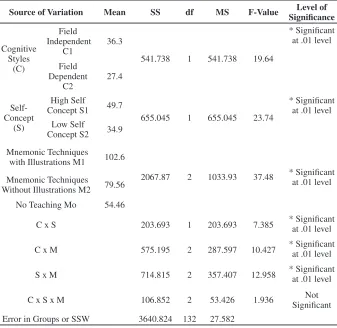
The F- ratio for Cognitive Styles is significant at .01 level. This implies that the differences between the Field Independent and Field Dependent groups of Cognitive Styles are significant. The mean value of Field Independent group of students (36.3) is higher than that of the mean value of Field Dependent group of students (27.4). It clearly shows that Field Independent group of students has significantly better Learning Acquisition than that of Field Dependent group of students.
Effect of mnemonic Techniques on Learning Acquisition in relation to Cognitive Styles and Self Concept
Figure 1: Bar diagram showing main and Interaction Effects of mnemonic Techniques,
Cognitive Styles and Self- Concept on the dependent variable Learning Acquisition
on Learning Acquisition. The mean value of high Self- Concept group of students (49.7) is higher than that of the mean value of Low Self-Concept group of students (34.9). It clearly shows that high Self-Concept group of students have significantly higher Learning Acquisition than that of Low Self Concept group of students.
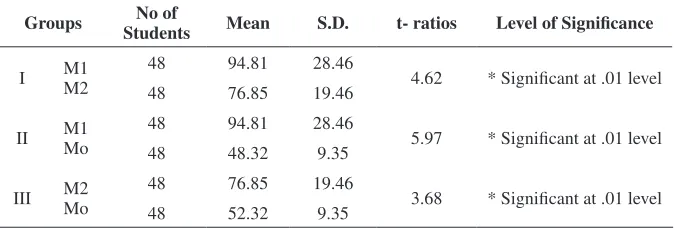
The F- ratio for the groups of mnemonic Techniques with Illustrations (m1), mnemonic Techniques without Illustrations (m2) and Control Group (m0) is significant at .01 level. This implies that the differences among the three groups have significant effect on Learning Acquisition of the students. To analyse these differences further t - ratios were computed which are presented in the table 2
The results of table 2 are interpreted as follows:
Table 2: t - ratios for the difference in means of two Experimental Groups of mnemonic
Techniques (with Illustrations, without Illustrations) and Control Group of Students
Groups StudentsNo of Mean S.D. t- ratios Level of Significance
I m1m2 48 94.81 28.46 4.62 * Significant at .01 level
48 76.85 19.46
II m1mo 48 94.81 28.46 5.97 * Significant at .01 level
48 48.32 9.35
III m2mo 48 76.85 19.46 3.68 * Significant at .01 level
48 52.32 9.35
Kumar, A. • The Learning Acquisition of the group taught through mnemonic Techniques with Illustrations (m1) is better than that of the group taught through mnemonic Techniques without Illustrations (m2) and also that of the Control Group (m0).
The Learning Acquisition of the group taught through
• mnemonic
Techniques without Illustrations (m2) is higher than that of that of the (m0).
The F-ratios for double interactions between Cognitive Styles x Self-Concept (C x S), Cognitive Styles x mnemonic Techniques (C x m) and Self - Concept x mnemonic Techniques (S x m) are significant at .01 level of confidence. This shows that double interaction (C x S, C x m and S x m) effects have significant bearing on Learning Acquisition of the students.
however, the F-ratio for triple interaction between Cognitive Styles x Self-Concept x mnemonic Techniques (C x S x m) is not significant even at .05 level of confidence. This shows that levels of Cognitive Styles, Self- Concept and mnemonic Techniques do not interact among themselves to produce significant effect on Learning Acquisition.
To find out the exact nature of differences due to the double interaction effects on Learning Acquisition, further analysis was done in terms of the computation of t-ratios.
10.1 Multiple Comparisons of Double Interaction Effects on Learning Acquisition in terms of t -ratios
The comparisons based on the double interaction effects of the three independent variables on Learning Acquisition are given below:
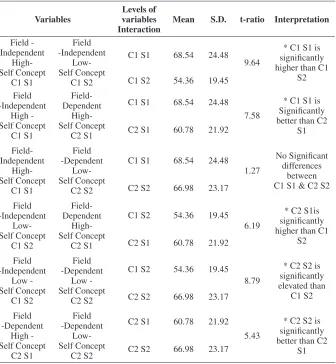
t - ratios based on the effect of Cognitive Styles x Self-Concept (C x S) on Learning Acquisition
The analysis of Cognitive Styles x Self-Concept (C x S) interaction is presented in table 3 given below:
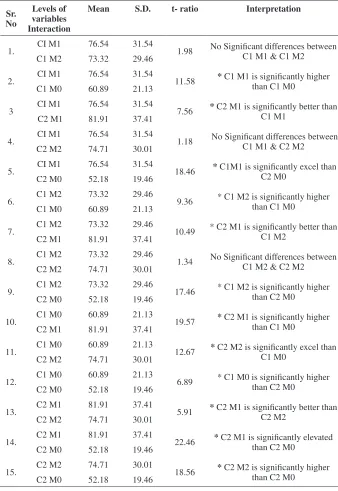
The analysis of Cognitive Styles x mnemonic Techniques (C x m) interaction is presented in table 4 given below:
The analysis of Self Concept x mnemonic Techniques (S x m) interaction is presented in table 5 given below:
11. DISCUSSION OF RESULTS
Effect of mnemonic Techniques on Learning Acquisition in relation to Cognitive Styles and Self Concept
Table 3: t- ratios for the effect of Cognitive Styles x Self-Concept (C x S) on Learning Acquisition
Variables variables Levels of
Interaction Mean S.D. t-ratio Interpretation Field -Independent high-Self Concept C1 S1 Field -Independent Low-Self Concept C1 S2
C1 S1 68.54 24.48 9.64
* C1 S1 is significantly higher than C1
S2 C1 S2 54.36 19.45
Field -Independent high -Self Concept C1 S1 Field- Dependent high-Self Concept C2 S1
C1 S1 68.54 24.48 7.58
* C1 S1 is Significantly better than C2
S1 C2 S1 60.78 21.92
Field- Independent high-Self Concept C1 S1 Field -Dependent Low-Self Concept C2 S2
C1 S1 68.54 24.48 1.27
No Significant differences
between C1 S1 & C2 S2 C2 S2 66.98 23.17
Field -Independent Low-Self Concept C1 S2 Field- Dependent high-Self Concept C2 S1
C1 S2 54.36 19.45 6.19
* C2 S1is significantly higher than C1
S2 C2 S1 60.78 21.92
Field -Independent Low -Self Concept C1 S2 Field -Dependent Low -Self Concept C2 S2
C1 S2 54.36 19.45 8.79
* C2 S2 is significantly elevated than
C1 S2 C2 S2 66.98 23.17
Field -Dependent high -Self Concept C2 S1 Field -Dependent Low-Self Concept C2 S2
C2 S1 60.78 21.92 5.43
* C2 S2 is significantly better than C2
S1 C2 S2 66.98 23.17
various related studies have also been compared with the results of present study. This has been done to make the study more meaningful.
The First hypothesis of the study states, “The Field Independent Group of students will be significantly higher than the Field Dependent Group of students in Learning Acquisition.”
Kumar, A. Table 4: t- ratios for the effect of Cognitive Styles x mnemonic Techniques (C x m )
on Learning Acquisition
Sr. No
Levels of variables Interaction
Mean S.D. t- ratio Interpretation
1. CI m1
C1 m2
76.54 31.54
1.98 No Significant differences betweenC1 m1 & C1 m2 73.32 29.46
2. CI m1
C1 m0
76.54 31.54
11.58 * C1 m1 is significantly higher than C1 m0 60.89 21.13
3 CI m1
C2 m1
76.54 31.54
7.56 * C2 m1 is significantly better than C1 m1 81.91 37.41
4. CI m1
C2 m2
76.54 31.54
1.18 No Significant differences betweenC1 m1 & C2 m2 74.71 30.01
5. CI m1
C2 m0
76.54 31.54
18.46 * C1m1 is significantly excel than C2 m0 52.18 19.46
6. C1 m2
C1 m0
73.32 29.46
9.36 * C1 m2 is significantly higher than C1 m0 60.89 21.13
7. C1 m2
C2 m1
73.32 29.46
10.49 * C2 m1 is significantly better than C1 m2 81.91 37.41
8. C1 m2
C2 m2
73.32 29.46
1.34 No Significant differences betweenC1 m2 & C2 m2 74.71 30.01
9. C1 m2
C2 m0
73.32 29.46
17.46 * C1 m2 is significantly higher than C2 m0 52.18 19.46
10. C1 m0
C2 m1
60.89 21.13
19.57 * C2 m1 is significantly higher than C1 m0 81.91 37.41
11. C1 m0
C2 m2
60.89 21.13
12.67 * C2 m2 is significantly excel than C1 m0 74.71 30.01
12. C1 m0
C2 m0
60.89 21.13
6.89 * C1 m0 is significantly higher than C2 m0 52.18 19.46
13. C2 m1
C2 m2
81.91 37.41
5.91 * C2 m1 is significantly better than C2 m2 74.71 30.01
14. C2 m1
C2 m0
81.91 37.41
22.46 * C2 m1 is significantly elevated than C2 m0 52.18 19.46
15. C2 m2
C2 m0
74.71 30.01
Effect of mnemonic Techniques on Learning Acquisition in relation to Cognitive Styles and Self Concept
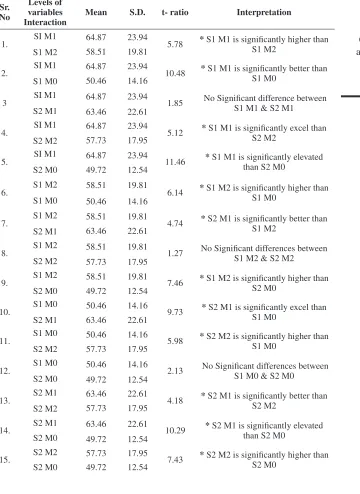
Table 5: t- ratios for the effect of Self Concept x mnemonic Techniques (S x m) on Learning Acquisition
Sr. No
Levels of variables
Interaction Mean S.D. t- ratio Interpretation
1. SI m1
S1 m2
64.87 23.94
5.78 * S1 m1 is significantly higher than S1 m2 58.51 19.81
2. SI m1
S1 m0
64.87 23.94
10.48 * S1 m1 is significantly better than S1 m0 50.46 14.16
3 SI m1
S2 m1
64.87 23.94
1.85 No Significant difference between S1 m1 & S2 m1 63.46 22.61
4. SI m1
S2 m2
64.87 23.94
5.12 * S1 m1 is significantly excel than S2 m2 57.73 17.95
5. SI m1
S2 m0
64.87 23.94
11.46 * S1 m1 is significantly elevated than S2 m0 49.72 12.54
6. S1 m2
S1 m0
58.51 19.81
6.14 * S1 m2 is significantly higher than S1 m0 50.46 14.16
7. S1 m2
S2 m1
58.51 19.81
4.74 * S2 m1 is significantly better than S1 m2 63.46 22.61
8. S1 m2
S2 m2
58.51 19.81
1.27 No Significant differences betweenS1 m2 & S2 m2 57.73 17.95
9. S1 m2
S2 m0
58.51 19.81
7.46 * S1 m2 is significantly higher than S2 m0 49.72 12.54
10. S1 m0
S2 m1
50.46 14.16
9.73 * S2 m1 is significantly excel than S1 m0 63.46 22.61
11. S1 m0
S2 m2
50.46 14.16
5.98 * S2 m2 is significantly higher than S1 m0 57.73 17.95
12. S1 m0
S2 m0
50.46 14.16
2.13 No Significant differences betweenS1 m0 & S2 m0 49.72 12.54
13. S2 m1
S2 m2
63.46 22.61
4.18 * S2 m1 is significantly better than S2 m2 57.73 17.95
14. S2 m1
S2 m0
63.46 22.61
10.29 * S2 m1 is significantly elevated than S2 m0 49.72 12.54
15. S2 m2
S2 m0
57.73 17.95
Kumar, A. Acquisition. The mean value of Field Independent group of students (36.3) is higher than that of the mean value of Field Dependent group of students (27.4).
The results of the present study reveal higher Learning Acquisition of the Field Independent Group of students than that of the Field Dependent Group. So, the first hypothesis of the study is accepted.
researches done earlier in the field of Cognitive Styles have shown Cognitive Styles as a main factor of correlation with students Learning Acquisition. It is evidenced by the research studies conducted by Griffin and Franklin (2010), Tinajero and Paramo (2010), Nicolaou and Xistouri, (2011) and Wei and Sazilah (2012) which showed significant effect of Cognitive Styles on Learning Acquisition.
The Second hypothesis of the study states, “The students with high Self- Concept will be significantly higher in Learning Acquisition than the students with Low Self- Concept.”
The F- ratio for self-concept vide table no -1 is significant at .01 level. This implies that the differences between the high and low groups of Self- Concept are significant on Learning Acquisition. The mean value of high Self- Concept group of students (49.7) is higher than that of the mean value of low self-group of students (34.9).
The results of the present study reveal higher Learning Acquisition of the high Self-Concept group of students than that of the Low Self-Concept group. So, the second hypothesis of the study is accepted.
research studies Graham (2009), Ahmad and Ghazali (2011), Yoshino (2012) supported the significant effect of Self-Concept on Learning Acquisition.
The Third hypothesis of the study states, “The Learning Acquisition of the students taught through mnemonic Techniques with Illustrations will be significantly higher than that of the students taught through mnemonic Techniques without Illustrations and that of the students of the Control group.”
The F- ratio for mnemonic Techniques (with Illustrations m1, without Illustrations m2 and Control Group mo) is significant at .01 level. This implies that the differences among the three groups of mnemonic Techniques with Illustrations m1, mnemonic Techniques without Illustrations m2 and Control Group mo are significant with respect to the Learning Acquisition of the students.
Effect of mnemonic Techniques on Learning Acquisition in relation to Cognitive Styles and Self Concept of the study is accepted. The result is supported by various research studies of
Scruggs et.al. (2010), Dewitt (2010), Stalder et. al. (2011), Carney and Levin (2012) which showed that students taught through mnemonic Techniques with Illustrations have higher Learning Acquisition than that of mnemonic Techniques without Illustrations and Control Group.
The Fourth hypothesis of the study states, “The interaction effect of the variables of Cognitive Styles and Self- Concept will yield significant results on Learning Acquisition.”
The interaction of Cognitive Styles and Self- Concept (C x S) influences the Learning Acquisition significantly. The F - ratio for interaction is 7.38, which is significant at .01 level of confidence, which shows that levels of Cognitive Styles interact with levels of Self-Concept to produce significant effect on Learning Acquisition. Thus, the fourth hypothesis of the study is accepted.
The Fifth hypothesis of the study states, “The interaction effect of Cognitive Styles and mnemonic Techniques on Learning Acquisition will be significant.”
The interaction of Cognitive Styles and mnemonic Techniques (C x m) influences the Learning Acquisition significantly. The F - ratio for interaction is 10.427, which is significant at .01 level of confidence, which shows that levels of Cognitive Styles interact with levels of mnemonic Techniques to produce significant effect on Learning Acquisition. Therefore, the fifth hypothesis of the study is accepted.
The Sixth hypothesis of the study states, “The interaction effect of Self- Concept and mnemonic Techniques on Learning Acquisition will be significant.”
The F - ratio for interaction between Self- Concept and mnemonic Techniques (S x m) is 12.958, which is significant at .01 level of confidence. This shows that levels of Self- Concept interact with the levels of mnemonic Techniques to produce significant effect on Learning Acquisition. Thus, the sixth hypothesis of the study is accepted.
The Seventh hypothesis of the study states, “There will be significant interaction effect of the variables of Cognitive Styles, Self- Concept, and mnemonic Techniques on Learning Acquisition.”
Kumar, A. 12. CONCLUSIONS
The results of the present study can benefit educators, administrators and instructional designers who can incorporate mnemonic Techniques in school curriculum that can prove to be effective teaching and learning strategies in the diversify subject areas. It is also suggested that while developing mnemonics in Social Studies or other school subjects, levels of Cognitive Style and Self Concept of students should be kept in mind so that the needs of both Field Independent and Field Dependent and high and Low Self Concept of students are catered to, thus assisting all students in the Acquisition of Learning concepts.
REFERENCES
Ahmad, J. & Ghazali, m. (2011). The relationship between Self Concept and response towards Students’ Academic Achievement among Students Leaders in university Putra malaysia (ED522690). International Journal of Instruction. 4, 23-38. retrieved from http.//www.eric.ed.gov.
Carney, r., & Levin, J. (2012). Facing Facts: Can the Face-Name mnemonic Strategy Accommodate Additional Factual Information? (EJ975937). Journal of Experimental Education. 80, 4, 386-404. retrieved from http. // www.eric.ed.gov/search.
http://dx.doi.org/10.1080/00220973.2011.630431
Deo, P. (1971). Personality Word List (PWL revised). Department of Education. Chandigarh: Panjab university.
Dewitt, K.C. (2010). Keyword mnemonic Strategy: A Study of SAT Vocabulary in high School English (ED519623). Pro Quest L.L.C, Ph.D. Dissertation, George mason university.
Graham, D. m. (2009). Examining the relationship between Selected Variables and the Academic Achievement of African American high School Students, (ED513773). Pro Quest L.L.C, Ph.D. Dissertation, Charlotte: university of North Carolina. Griffin, r. & Franklin, G. (2010). Can College Academic Performance Be Predicted using
a measure of Cognitive Style? (EJ5263442). Journal of Educational Technology Systems. 24, 4, 375-79. http://dx.doi.org/10.2190/Pmum-N6LT-97N8-2YWV hall, C. S., & Lindzey, G. (1957). Theories of personality. New York: holt, rinehart and
Winston Company Ltd. http://dx.doi.org/10.1037/10910-000
John, D. (2000). Self-concept. International review of Education. 58, 209. retrieved from http://www.cbt.wiu.edu.
Nicolaou, A. A. & Xistouri, X. (2011). Field Dependence and Independence Cognitive Style and Problem Posing, An Investigation with Sixth Grade Students. (EJ932921). Educational Psychology. 31, 5, 611-627.
http://dx.doi.org/10.1080/01443410.2011.586126
Effect of mnemonic Techniques on Learning Acquisition in relation to Cognitive Styles and Self Concept
Scruggs, T.E., mastropieri, K., margo, A., & marshak, L. (2010). mnemonic Strategies: Evidence-Based Practice and Practice-Based Evidence (EJ9021). Intervention in School and Clinic. 46, 2, 79. http://dx.doi.org/10.1177/1053451210374985
Shuell, T.J. (1981). Dimensions of Individual Difference. Psychology and Education. 65, 2, 57. retrieved from http. // www.eric.ed.gov.
Stalder, D.r., Olson, T. & Elizabeth, A. (2011). Technique for Two: using mnemonics to Teach Statistics (EJ952630). Journal Articles, Teaching of Psychology. 38, 4, 247-250. http://dx.doi.org/10.1177/0098628311421321
Tinajero, C. & Paramo, m.F. (2010). Field Dependence-Independence Cognitive Style and Academic Achievement. A review of research and Theory. (EJ586811). 3, 249-269. retrieved from http. // www.eric.ed.gov.
Wei, L.T. & Sazilah, S. (2012). The Effects of Visual Cues and Learners’ Field Dependence in multiple External representations Environment for Novice Program Comprehension. (EJ979123). Journal of Interactive Learning research. 23, 2, 165-189. retrieved from http. // www.eric.ed. gov.
Witkin, h.A., moore, C.A., Goodenough, D.r., & Cox, P.W. (1977). Field Dependent and Field Independent Cognitive Styles and their Educational Implications. review of Educational research .47, 1, 1–64. http://dx.doi.org/10.3102/00346543047001001 Witkins, h.A., Ottman, P.K.,raskin. E. and karp, S.A. (1971). A manual for the Embedded
Figures Tests. California : Consulting Psychologist Press. Inc.
Yoshino, m. (2012). The relationship between Self-Concept and Achievement in TImSS 2007, A Comparison between American and Japanese Students. (EJ962458). International review of Education. 58, 2, 199-219.