UNIVERSITY OF TRENTO
DEPARTMENT OF PSYCHOLOGY AND COGNITIVE SCIENCES
DOCTORAL SCHOOL IN
PSYCHOLOGICAL SCIENCES AND EDUCATION
Doctoral Dissertation
in the subject of Cognitive Sciences
Expectations of Obedience and the Development of Moral Reasoning
Advisor
Prof. Luca Surian
PhD candidate
Francesco Margoni
i
Contents
Page
GENERAL INTRODUCTION.……….1
1 The relational approach to the definition of morality……….3
1.1 Conformity and obedience to authority………4
1.2 Reacting to classical views…....………...………5
2 The functional approach to the definition of morality……..………..7
2.1 The concept of ‘balance’ in the moral domain…..………...7
2.2 Hierarchy and morality………..………...8
3 Two levels of morality………..11
4 The content of the present dissertation………...………..14
PART 1 – INFANCY: EXPECTATIONS OF OBEDIENCE.………19
Chapter 1: Infants distinguish between dominance and leadership………..21
PART 2 – CHILDHOOD: INTENTION-BASED MORAL REASONING...………45
Chapter 2: Children’s intention-based moral judgments of helping agents……….47
Chapter 3: Biocentric moral reasoning in preschool children………..95
ii
PART 3 – ADULTHOOD: INTENTION-BASED MORAL REASONING...……...……131
Chapter 6: How intentions, negligence and outcomes affect moral judgments...133
Chapter 7: Moral judgment in old age: Evidence of an intent-to-outcome shift……....157
GENERAL DISCUSSION AND PERSPECTIVES……….……...………..177
1 Main findings……….178
1.1 Expectations of obedience………..………..178
1.2 Intent-based moral reasoning in children……….179
1.3 Intent-based moral reasoning in adults………...……….182
2 Perspectives………183
3 Conclusion………..187
GENERAL INTRODUCTION
A Functional and Relational Perspective on Morality
In order to understand moral judgment and moral behavior from a psychological
standpoint, we should carefully consider the function of morality, and that, as a phenomenon,
morality is fundamentally relational. This statement is not trivial as may appear to be, and
here I insist on some main implications of it. In what follows, I first give a few coordinates to
delimit the ‘essence’ of morality. Second, I briefly review some recent evidence in
developmental and evolutionary psychology suggesting that both prosocial and aggressive
tendencies reflect important aspects of our socio-moral lives. Third, I argue that morality has
evolved in humans’ groups to serve the function of maintaining prosocial tendencies and
constraining aggressive ones, and moral ideals represent the actual balance between different
forces and individuals who are necessarily in a specific relationship. Within this view, the
obedience to authority and the acceptance of the hierarchical structure of society, along with
the internalization of basic principles of conduct, represent core aspects of morality. Finally, I
discuss the distinction between ‘autonomy’ and ‘heteronomy’ in moral development (Piaget,
1932; Kohlberg, 1969). Two main stages, levels or forms of morality will then be dissociated,
one that consists in the simple obedience to rules or authority’s mandates, and the other one
that consists in the internal motivation to comply either with the authority or with a set of
principles according to which we aim to live a morally good life. I argue that some aspects of
heteronomy (that is, the compliance with authority’s orders) remain, also in adulthood, an
important part of our morality.
The aim of this introduction is to discuss some core aspects of morality, also by
identifying the selective pressures that likely affected their evolution. This is done in order to
lay a basis for the understanding of the content of the present dissertation, that mainly
addresses questions regarding the development of core aspects of morality during infancy and
the ability to weigh agents’ intentions in producing a moral judgment. The latter ability is
linked with the child’s capacity to evaluate not only whether the actions outcomes represent a
violation of some rule or authority’s mandate, but also whether the individual possess a
mindset that will likely produce desirable or undesirable outcomes in the future.
1. The Relational Approach to the Definition of Morality
When studying the developmental aspects of humans’ morality, one may feel the need
to possess at least a rough or working definition of the phenomenon under consideration.
Here, I do not offer a clear-cut definition of morality. Instead, I insist on some core aspects
that would hopefully clarify the concept of morality and, as a result, it would help us to
understand which psychological aspects we should necessarily consider when we engage in
the endeavor of studying morality.
As suggested by the relational models theory (Fiske, 1991, 1992; but see also the
chapter on Ethics in Hegel, 1807/1977) and its recent extension (Rai & Fiske, 2011), ethics is
necessarily defined by the particular relationship that is in place between a certain set of
individuals who share a specific spatiotemporal context. For example, the morality within a
family setting can be dissociated from the morality within a group of pairs playing cards
together, and the latter is again different from the morality of a citizen of a democratic
European society. An individual who is a father could be also a card player, and could live in
a democratic society; however, when he is parenting his children he would likely endorse a
particular role and specific values that he does not necessarily endorse or prioritize in other
social situations. He would act more authoritatively with his children than with his cards
Of course, we do not need to posit as many moral faculties as the possible roles people
may have in the society. Though, it is important to acknowledge that the ‘moral faculty’ is
necessarily inserted in a specific social context, and it likely works to serve specific functions
within that context. Depending on how the relevant social relation is construed, actions that
we would typically judge as morally bad (like, for example, harming or killing an innocent
victim) could be perceived as morally worth, for example when such an action is
accomplished because of an authority’s mandate or because the majority of people wants so
(Fiske & Rai, 2014; Rai & Fiske, 2011).
1.1.Conformity and Obedience to Authority as Pillars of Morality
Social relationships are often part of a broader social context, where power
asymmetries exist and hierarchies are formed to handle and minimize conflicts among group
members, and, possibly, to manage between-group competitions. Within this frame, two main
elements are essential for every possible morality in a certain context. A first pillar is the
acceptance and the conformity to a minimum set of rules; as Piaget wrote in his 1932
influential book “all morality consists in a system of rules, and the essence of all morality is
to be sought for in the respect which the individual acquires for these rules.” A second pillar
is the obedience to the established authority and the acceptance of the hierarchies.
It might seem somewhat ‘Tory’ to posit that the obedience to authority’s rules and the
acceptance of power asymmetries are the basics of morality, and I hypothesize that this
feeling is related to our Western and democratic culture—citizens being educated (both
formally and informally) to think accordingly to an individualistic view. Especially after the
Cold War, but soon after the rise of modern state, people tended to resize the power of the
state by putting the individual (with its own set of rights) before the community. However,
number of individuals with different forces and subsequent positions within the system try to
live together as a group, seeking the best balance between everyone force and needs.
Traditionally, Western developmental psychologists have generally agreed upon the
view that morality evolves from an initial stage or phase where the child identifies the good
with the obedience to an authority that remains external to his or her conscience, to an
adult-like phase where morality is now internalized, and the respect for the rules is strictly related
to the mutual respect and the cooperation between individuals with equal rights. The
individual understands what are the reasons why society introduced the rule, and she or he
understands that rules and authorities (should) protect some abstract and generally valid
principles of justice and right (Kohlberg, 1969; Piaget, 1932).
Moreover, ‘domain theorist’ insisted in dissociating moral norms from social ones
(Turiel, 1978; Nucci, 1981; Killen & Smetana, 2015). According to their view, moral rules
reflect abstract and universally valid principles, and therefore do not depend upon any
authority’s mandate. By contrast, the prescriptive force of conventional norms depends
entirely on the social context or the authority. A host of studies reported that, by at least the
age of three, children can distinguish between moral and conventional rules, and
consequently they judge moral violations—harming an innocent victim—more harshly than
conventional transgressions, like wearing pajamas at school (e.g., Nucci, 1985; Smetana &
Braeges, 1990). Moreover, conventional but not moral rules are judged to be
authority-dependent.
1.2. Reacting to Classical Views
A solid reaction to the ‘classical’ views we mentioned has mainly come from studies
that analyzed the moral judgment and reasoning of non-Western populations. Overall, these
‘Untouchable’, who live in a society where the moral code of “community” prevails over the
Western-like moral code of “autonomy”; see Shweder, Much, Mahapatra, & Park, 1997)
judge some conventional transgressions as they were moral (Haidt, Koller, & Dias, 1993;
Nichols, 2004; Nisan, 1987; Shweder, Mahapatra, & Miller, 1987; but see also Astuti &
Bloch, 2015). For example, participants were asked to judge violations of cultural norms like
“The day after his father’s death, the eldest son had a haircut and ate chicken”. Indians judged
those actions wrong, serious, unalterable and universally binding. That is, violations that do
not imply harm were judged as they were moral violations. Moreover, there is evidence that
some moral transgressions are judged also by Western adults as they were conventional
violations (Kelly, Stich, Haley, Eng, & Fessler, 2007). Both these results undermine the view
that the moral-conventional distinction is universal.
Furthermore, the universal validity of the stage-like model of moral development has
also been criticized. For example, a recent study reported that adults living in small-scale
societies, ranging from hunter-gatherer to pastoralist to horticulturalist, compared to Western
individuals, when presented with a moral judgment task, take less into account the agents’
intentions and more the actions outcomes (Barrett et al., 2016). This finding is important
because it raises the suspect that at least some core aspects of morality (as developmental
psychologists have traditionally conceived morality) may be indeed the product of our culture
instead of the product of our phylogeny. Therefore, the emphasis that now researchers give to
individual rights—e.g., see the Smetana (2006)’s definition of moral transgressions as acts
that are “wrong because they have intrinsic effects for others’ right and welfare”, p. 121—
may actually sway the current understanding of the phenomenon. Community-like values,
such as the respect for authority and social hierarchies, or the respect for the common goods,
may have been central aspects of our morality and likely still play an essential but somewhat
2. The Functional Approach to the Definition of Morality
Now, not all rules are moral. To give an example, we can differentiate between
grammatical rules and moral rules. Both have normative power, but only the transgressions of
the latter elicit in us what we are used to call a moral condemnation. How then do we
distinguish between moral and amoral rules? The approach I follow here could be named
functional. Moral rules do not have a special nature or reality. However, they serve particular
functions, and by specifying those functions, we should be able to define morality.
2.1. The Concept of ‘Balance’ in the Moral Domain
Overall, morality can be conceptualized as the attainment of the right balance between
the forces in the field. If we consider that each individual in a society exerts some power over
others (e.g., he claims the right to work, in a modern society, or he aims to achieve a higher
reproductive status, in a ancient society and perhaps still today etc.), we also see that a
specific balance between forces would be in place in each context, and morality is either the
acceptance of this balance or the ideal balance towards which our actions and society
structures should approximate. As Stoic philosophers already suggested, morality is the
acceptance of the right or logical order between individuals in a relationship. Following this
line of reasoning, then, there is no morality outside a specific context or relationship, and
morality could be always defined by the best balance between individual forces.
Take for a moment the well-known distinction in philosophy and in moral psychology
between utilitarianism and deontology. According to utilitarianism, the morality of an action
depends on its outcomes; an action is good when it maximizes the common good. By
consistent with some abstract moral principles or norms. A question central to moral
philosophy is which view has to be preferred, while a question central to moral psychology is
whether people reason accordingly to utilitarian or deontological principles, or both.
However, what is clear to me is that both views may act in our society as distinct forces.
Different individuals will hold different moral principles, and the same individual may be
willing to switch his or her view depending on the particular context. According to our
definition of morality, we should consider that a compromise between the two positions will
likely occurs, as a results of a conflict between different interests, preferences and attitudes.
Ultimately, there should be a right balance between different forces, those who favor
utilitarianism and those who favor deontology, and this balance, that is the product of both
moral factors and factors external to the moral domain, is what we need to recognize as our
morality.
2.2. Hierarchy and Morality
However, I have not yet specified which criteria we should use to address the question
“best balance to pursue what aims?” This question is simply another way to ask which
functions morality serves. Overall, morality is functional to the enhancement of prosocial
tendencies and the constraining of egoistic and aggressive tendencies. From an evolutionary
standpoint, moral tendencies may have been selected for ensuring long-term
social-cooperative relationships between group members (Darwin, 1859/1982; Fiske, 1991; Joyce,
2006).
Human nature is neither intrinsically good nor bad. First, because it would be childlike
to judge nature with the vocabulary of morality. Second, and more relevantly here, because
humans show both a ‘bright’ and a ‘dark’ side, in the sense that we may claim that human
morally good and in the direction of some other goals that instead we consider morally bad.
On the one hand, we may advocate that in the natural condition of mankind the individual
tends to dominate aggressively and to prevail over others without any concern for their
rights―the idea of individual right being actually absent in such an original state. By
contrast, we may claim that human nature is fundamentally good, but it is actually corrupted
by our ‘evil’ cultural, social or political systems. These two opposing claims are of course
reported as clear and extreme views. However, evolutionary literature and, more recently,
infants’ cognition and developmental literature suggest that both tendencies are constitutive
of the human nature and are displayed from a very young age. It has also been proposed that
some core morally good and evil tendencies are indeed innate―being the product of our
phylogeny (Bloom, 2013; Wynn, 2008).
Human beings have been evolved as a social and cooperative animal species (Cosmides
& Tooby, 2013; Tomasello, 2014; Wilson, 2012). Already during early infancy, humans
possess a whole set of abilities to represent the complex social world around them
(Baillargeon, Scott, He, Sloane, Setoh, Jin, Wu, & Bian, 2015; Banaji & Gelman, 2013). In
the first year of life, infants possess the ability to distinguish between prosocial and antisocial
agents, they prefer helping agents over hindering or mean agents and also expect others to
hold the same preferences (Choi & Luo, 2015; Hamlin, Wynn, & Bloom, 2007; Lee, Yun,
Kim, & Song, 2015; Meristo & Surian, 2014). Moreover, infants show an early sense of
fairness. They prefer agents that distribute the resources in a fairly way rather than in an
unfairly way, and expect others to have the same preferences they hold (e.g., Geraci &
Surian, 2011; Schmidt & Sommerville, 2011; Sloane, Baillargeon, & Premack, 2012).
Further studies show that infants represent dominance hierarchies and conflicts over
resources (Mascaro & Csibra, 2012; Pun, Birch, & Baron, 2016; Thomsen, Frankenhuis,
authority but not to a bully that simply hits the subordinates in order to gain their respect
(Margoni, Baillargeon, & Surian, 2016).
A number of studies also reported that infants and toddlers spontaneously help others
that are in need and often share valuable resources with them (e.g., Brownell, Iesue, Nichols,
& Svetlova, 2013; Svetlova, Nichols, & Brownell, 2010; Warneken & Tomasello, 2006).
Overall, these results suggest that, very early in life, humans are able to represent prosocial
and antisocial actions; they prefer morally good and fair agents to mean and unfair agents;
and they show altruistic tendencies. These mental abilities and action tendencies might have
been functional in supporting the group cohesion and in maintaining the cooperation between
group members across the evolutionary trajectory of our species.
However, along with a ‘bright side’, humans also possess a resolute will to conflict and
compete for resources and often tend to dominate each other (Aureli & de Waal, 2000;
Darwin, 1859/1982; Lasker, 1907). The desires to overcome others and to possess more
resources than others characterize our psychology (Bloom, 2013). Samuel Johnson famously
stated, “[…] no two people can be half an hour together, but one shall acquire an evident
superiority over the other”. Both these egoistic and aggressive tendencies can be controlled
and constrained, and they have been, by establishing hierarchical social structures (Fiske,
1991; Heinrich & Gil-White, 2001, Sidanius & Pratto, 1999). At least after the introduction
of the agriculture and the increase of the population size, a hierarchical structuring became
the rule in humans’ societies (Boehm, 1999; Knauft, 1991; Nye, 2008).
Hierarchical social structures with leader-followers relationships, then, may have been
evolved to constrain egoistic and aggressive tendencies. At the same time, a rigid social
structure and a leader facilitate and maintain cooperation within the group. A current
hypothesis is that leaders may solve the problem of free-riders (King, Johnson, & Van Vugt,
effort without contributing) can undermine cooperation. A proposed solution to free-riders
was punishment. However, it is not clear how the punishment mechanism may have been
evolved, considering that punishment is a costly act (e.g., can represent a danger for the
punisher). A clever evolutionary solution may then be leadership. Leaders are often the
individuals who bear the cost of punishment. They may be willing to do that in return for
those privileges accorded to them. Further evidence from experimental psychology supports
this line of reasoning by showing that high level of cooperation is indeed achieved in the
situation in which only one individual is in charge of punishment (O’Gorman, Henrich, &
Van Vugt, 2009).
To sum up, then, morality may have been evolved to support and maintain cohesion
and collaboration between members of the same group, and to constrain aggressive and
egoistic tendencies into coordinated actions that will pursue shared goals or maximize the
group benefits in term of resources and capacity to defend the group against rival groups.
Morality dictates the right balance between individual forces engaging in specific
relationships, keeps in-group members together by enhancing fairness and collaboration, and
helps in maintaining the order within the group―that again is functional to the cooperation
maintenance―by constraining individuals to obey to current rules and to respect the
authority’s power and the social hierarchy.
3. Two Levels of Morality
The Kant (1788/2002)’s distinction between ‘heteronomy of the power of choice’ and
‘autonomy of the will’ was taken up again by Piaget (1932)’s work on the development of
concepts are distinct and identify two opposing ways to approach morality, but they also
characterize different stages in the development of moral reasoning.
In a first stage of the consciousness of the rules, the child submits completely in
intention to the rules given by an adult authority, but these moral rules remain external to her
or his conscience. This explains why the child considers the rules as sacred and, at the same
time, rules do not really guide or transform her or his moral practice. The child is still in a
stage characterized by a ‘heteronomous’ respect for the rules and a ‘moral realism’ or an
‘objective’ conception of responsibility, in which the child observes the letter more than the
spirit of the law. With regard to the moral judgment, when asked to choose which character is
the naughtiest and deserves to be punished―between a supposedly well-intentioned character
that accidentally caused serious material damage and a bad-intentioned one that accidentally
caused a less serious damage―children attend to outcomes and subsequently condemn the
well-intentioned character more than the bad-intentioned one. This is because they focus on
the moral violation and the letter of the law, regardless of the spirit of the moral rules and the
true intentions behind the agent’ action.
In a second stage of the consciousness of the rules, children develop the ‘autonomy’ of
the conscience. Moral rules and adults’ instructions are interiorized and generalized. The
child now understands why the rules exist in the first place, that is, because of maintaining
cooperation and order within the group. Children no longer consider rules as sacred. Instead,
they consider rules as based on a general agreement between individuals. Now is the spirit of
the law that matters, not the letter. Children’s conception of responsibility shifts from
‘objective’ to ‘subjective’, and they judge the morality of an action or an agent attending to
intentions rather than external outcomes.
According to recent evidence, the ‘realist’ outcome-based reasoning is typical in
already discussed, to some extent both the autonomous and the heteronomous ‘levels’ are part
of the adults’ moral experience. Kant (1788/2002) argued that heteronomy of the power of
choice “not only is no basis for any obligation at all but is, rather, opposed to the principle of
obligation and to the morality of the will” (p. 48). However, the obedience to authority and,
for example, the acceptance of the current laws of a State are de facto essential parts of
everyone’s morality―as it was clear to Descartes (1637/1970) when he presented his
rudimentary morality.
It is often argued that conformity and obedience to authority are not per se part of the
morality, also because these aspects of the human nature hide some dangerous pitfalls. At this
point, everyone immediately visualizes the appalling events occurred to Jews during the Nazi
regime. When the evilness of the actions is so clear, to condemn the Nazi hierarchs and the
soldiers who obeyed to the commands become a very easy task. However, no society or large
group of humans could survive or live in (relative) peace without conformity, respect for the
rules (either internal or external), and obedience to authority. That is why we sometimes
confront ourselves with the dilemma whether to obey an authority’s mandate that we deem
unfair or wrong. For example, should the soldier obey when his superiors order him to kill
innocent people because this is the only means to hit a strategic target?
Milgram (1974) conducted a number of experiments and overall reported that people
were willing to obey authority or experimenter’s instructions also when they were asked to
administer electric shocks that made helpless victims clearly suffering. Milgram and his
collaborators remained puzzled by the findings. They ended up interpreting the participants’
actions as determined by a conflict between external and constraining factors (“you should
obey to authority”) and participants’ internal values (“you should not harm innocent others”).
However, following our arguments, here we should rather claim that what occurred in
preserving others’ rights and the value, perhaps less available to consciousness but still
working in the participants’ mind, of obedience to authority. Then it should be very simple to
address the question why morality, that wins over everything, does not win over
authority―that is, because complying with the authority and respecting the rules are at the
very core of our morality, whether we like it or we do not.
4. The Content of the Present Dissertation
The present dissertation collects several works that are either published or submitted to
relevant journals in the field of developmental or experimental psychology. In the first
chapter, I report three experiments overall suggesting that 21-month-old infants are already
able to distinguish between social dominance (an asymmetry in which a dominant individual
prevails over subordinates in competitive situations, typically by exert force or coercion) and
authority or leadership (a social asymmetry in which the power of an authority over
subordinates is deemed rightful by the parties involved). Infants saw geometric-shaped
computer animations showing either a bully hitting a group of subordinates or a leader that
respected the subordinates. Both dominant figures gave orders to the subordinates, and
subordinates complied or violated their instructions. By using the violation-of-expectation
(VOE) paradigm, we found that infants expect subordinates to comply with a leader’s
instruction but not with a bully’s instruction, unless the bully closely controlled the
subordinates. These findings suggest that even 21-month-olds possess an understanding of
these complex dynamics of power, authority and obedience. I argue that this is an important
building block in the acquisition of moral knowledge.
In the second chapter, I present two experiments conducted on children between ages
children’s moral judgment of helping actions. Between ages 4 and 6, a crucial developmental
change from an outcome-based to an intent-based goodness judgment occurs. The verbal
judgments of children undergoes a shift from an ‘objective’ to a ‘subjective’ conception of
responsibility. To rely on the agents’ intentions rather than on actions outcomes is part of a
mature way to produce a moral judgment. In chapter six, indeed, I report evidence suggesting
that the variable of the agent’s intention explains most of the variability of adults’ moral
judgments of cases of both help and harm.
A related research question, also partially addressed in chapter two, is whether the
crucial outcome-to-intent shift occurring during preschool years reflects a conceptual change
within the moral domain or ancillary changes occurring outside the moral domain, for
example in executive functioning skills or in theory of mind. The data I present here
tentatively support a ‘continuous account’, that is, the hypothesis that changes in moral
judgment reflects changes occurring outside the moral domain, and that the (intent-based)
moral concepts remain unchanged during the lifespan. I took up again this issue in chapter
four, where I argue that changes in executive function are likely the best candidate to explain
the current finding regarding the outcome-to-intent shift in moral judgment. Indeed, studies
on infants’ socio-moral evaluations, which used spontaneous-response tasks rather than
elicited-response tasks, thus reducing the processing demands, show that, very early in life,
humans evaluate others’ actions taking into account the agents’ intentions (e.g., Dunfield &
Kuhlmeier, 2010; Hamlin, 2013; Lee et al., 2015). Therefore, it can be argued that
developmental differences result from changes in executive functioning skills (or theory of
mind skills, which however rely on executive function), and that the concept of moral
goodness or badness remains unchanged throughout our life.
A continuity hypothesis is further supported by the finding presented in the seventh and
and older adults (age range: 63―90) in the use of intention and outcome during the
production of a moral judgment. Participants rated the moral goodness or badness of helping
and harming actions. Results show that older adults’ moral evaluations rely less on agents’
intentions and more on actions outcomes compared to the moral evaluations on the younger
adults. Further analyses confirmed that this ‘intention-to-outcome shift’ taking place late in
life can be explained by ancillary changes occurring outside the moral domain.
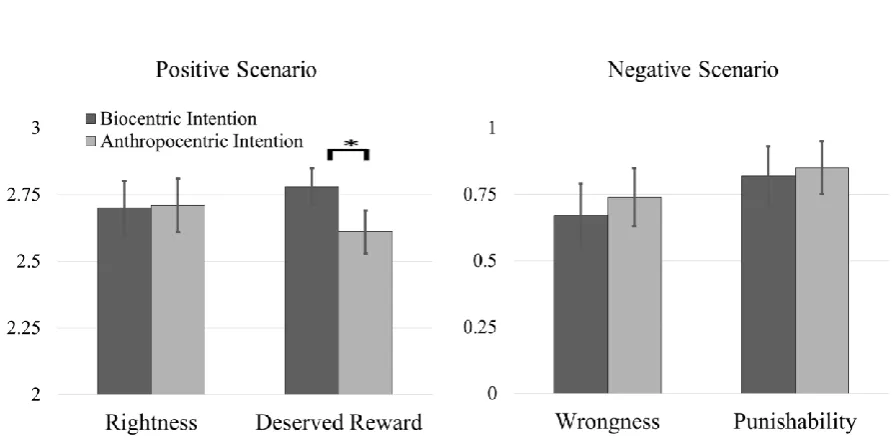
Then, in chapter three, two types of intention are dissociated, a biocentric intention (i.e.,
the agent preserves nature because of nature intrinsic value) and an anthropocentric intention
(i.e., the agent preserves nature because it helps human’s interests). The study aimed to
investigate whether preschool children, who start judging the morality of actions based on an
intention assessment, use this distinction between intention types in their moral evaluation
and, as a result, judge agents that acted with a biocentric intention more bad (when causing an
harm) or good (when helping others) than agents with anthropocentric intentions. The results
show only an emerging preference for biocentrism. Therefore, intentions that are associated
with different moral views (biocentrism and anthropocentrism) only partially affect the
emerging intent-based judgment of preschool children.
Finally, in chapter five, I present a brief review of studies on mental state reasoning in
the moral judgment of children and adults with autism spectrum disorder (ASD). This clinical
population is known for having theory of mind impairments, thus it proves useful in
understanding the role of factors external to the moral domain in determining the typical
developmental trajectory of moral judgment. The aim of the review was to clarify whether
ASD children develop the ability to judge the morality of an action or an agent by relying on
the agent’s intentions. Current evidence suggests that the impairment in theory of mind
hinders the development of a moral judgment based on the agents’ mental states in children
judgment when evaluating those cases where, for example, an intention to violate a moral
rule is followed by a negative consequence for the victim. However, this preserved capacity
is explained by the fact that ASD children mostly evaluate the outcome or other irrelevant
external factors such as the victim’s emotional reaction. Indeed, when presented with
ambiguous cases that require the analysis of the agent’s mental states (e.g., the case of a
failed attempt to harm), ASD individuals encounter some difficulties in producing an
intent-based moral judgment.
In conclusion, in the present dissertation, I report new findings on some developmental
aspects regarding both a first and core level of morality, i.e., the respect for rules and
authority figures, and a second level of morality, i.e., the understanding of the importance of
the spirit of the law and the use of the agents’ mental states during the production of a moral
judgment. I conclude that infants are already able to understand that individuals obey to
instructions given by authorities, but not by bullies. Moreover, I conclude that the crucial
period for children to show an intent-based judgment when presented with verbal tasks is
about ages 5-6. However, I argue that this development in moral judgment reflects changes
occurring outside the moral domain, so that changes in executive functioning skills determine
the emergence of a capacity to evaluate based on an intention assessment that is likely to be
already present during the early infancy. One future direction would be to collect evidence in
order to investigate whether both levels of morality are based on domain-specific, innate
PART 1
CHAPTER 1
Infants Distinguish Between Dominance and Leadership
This chapter is based on the following original article:
Margoni, F., Baillargeon, R., & Surian, L. (2016). Infants distinguish between leaders and
Abstract
Across three experiments, we investigated whether 21-month-olds distinguish between social
dominance and leadership. In the former, the dominant prevails over the subordinates in
competitive situations, whereas in the latter the power of the leader is deemed rightful by the
parties involved. Infants were presented with computer animations and were familiarized
with a bully that hit the subordinates or with a leader that did not hit subordinates. Both the
bully and the leader then gave orders to the subordinates. During the test phase, infants saw
the subordinates complying or violating the orders. In the absence of the dominant agent,
infants expected subordinates to obey to the leader, but not to the bully. However, they
expected the subordinates to obey when the bully did not leave the scene. These results
suggest that the ability to represent different forms of social power asymmetries develops
Infants Distinguish Between Dominance and Leadership
Human beings are among the most social and cooperative animal species (Tomasello,
2014; Wilson, 2012). Our particular evolutionary trajectory has provided us with
early-emerging mechanisms for representing others intentions, desires, beliefs and behaviors, along
with an early-developing ability to infer complex social relations among in-group members
(Fiske, 1991; Richerson & Boyd, 2006). Evidence of these early-emerging mental
representational mechanisms come from a number of recent studies on infants’ cognition
(e.g., Baillargeon, Scott, He, Sloane, Setoh, Jin, Wu, & Bian, 2015; Bloom, 2013; Hamlin,
Wynn, & Bloom, 2007; Surian, Caldi, & Sperber, 2007; Wynn, 2008).
Already in the first year of life, infants’ social expectations rely on others intentions and
they understand both successful and failed actions (Brandone & Wellman, 2009; Dunfield &
Kuhlmeier, 2010; Gergely & Csibra, 2003; Hamlin, 2013; Lee, Yun, Kim, & Song, 2015;
Margoni & Surian, 2016a; Woodward, 1998). In the second year of life, infants understand
that others may hold false beliefs, suggesting that they already possess a theory of mind
(Baillargeon, Scott, & He, 2010; Onishi & Baillargeon, 2005; Surian et al., 2007; Wellman,
2014).
Infants’ theory of mind skills inform also their socio-moral expectations and evaluations.
Within the first year of life, infants develop the ability to distinguish between prosocial and
antisocial agents, show to prefer helping agents to hindering agents, and expect that others
would hold these same moral preferences (Hamlin & Wynn, 2011; Hamlin et al., 2007;
Hamlin, Wynn, & Bloom, 2010; Lee et al., 2015; Meristo & Surian, 2014). Infants also
possess an early-emerging understanding of fairness, and prefer agents that distribute the
resources fairly rather than unfairly (e.g., Geraci & Surian, 2011; Schmidt & Sommerville,
Furthermore, studies on infants and toddlers’ behaviors reported that very early in life
humans show a spontaneous tendency to altruistically help others (Hepach, Haberl, Lambert,
& Tomasello, 2016; Over & Carpenter, 2009; Svetlova, Nichols, & Brownell, 2010;
Warneken & Tomasello, 2006) and to share resources with them (Brownell, Iesue, Nichols,
& Svetlova, 2013). An evolutionary account of these early-emerging mental abilities and
socio-moral behavioral tendencies would insist on their functional role in supporting group
cohesion and maintaining the collaboration among in-group members (e.g., Baumard, André,
& Sperber, 2013; Bloom, 2013; Greene, 2013; Tomasello, Melis, Tennie, Wyman, &
Herrmann, 2012). Within this standpoint, social bonds and morality itself can be explained as
functional to the pursuing of in-group interests, so that, as a result, today we still possess
moralities and religions that tended to systematically exclude out-group members (Bloom,
2012; Greene, 2013; see also Andrighetto, Baldissarri, Lattanzio, Loughnan, & Volpato,
2014).
Together with the prosocial tendencies related to the function of maintaining social
cohesion, human nature consists also in a fierce will to compete for resources within the
group and, as a result, humans show to be characterized by a tendency to dominate each other
(Aureli & de Waal, 2000; Darwin, 1859/1982; Hobbes, 1651/1982; Lasker, 1907; von
Clausewitz, 1832/1984). Egoistic motives and aggressive behaviors are widely spread in
social and non-social species, especially when individuals or groups compete for scarce
resources.
However, egoistic and aggressive tendencies had been usually controlled and constrained
by the development of hierarchical social structures (Berger, Rosenholtz, & Zelditch, 1980;
Fiske, 1991; Heinrich & Gil-White, 2001; Maslow, 1936; Sidanius & Pratto, 1999; Silk,
2007). In humans, this may have happened after the increase of population size and the
A hierarchical social structure helps coordination and cooperation among in-group members
in fundamental activities such as foraging, resource distribution and warfare (Axelrod &
Hamilton, 1981; Fiske, 2010; Overbeck, 2010; Tooby & Cosmides, 1992). Therefore,
subordinates’ obedience to dominants, leaders or legitimate authorities plays a crucial role in
generating and maintaining social relationships within the group, and determined the exit
from the Hobbesian ‘pure state of nature’ (Hobbes, 1651/1982).
Infants’ Representation of Social Dominance
A number of studies have been conducted on infants’ representations of dominance
relations. Ten-month-olds already rely on the agents’ relative size to predict the outcome of a
conflicting situation (Thomsen, Frankenhuis, Ingold-Smith, & Carey, 2011). When presented
with events in which two agents, a bigger and a smaller one, block each other’s path of
motion, infants expect that the smaller agent will clear the path for the bigger agent. A further
study revealed that by 6 months infants understand social dominance relationships and, in
particular, they are able to rely on numerical group size to predict the outcome of a
dominance relation (Pun, Birch, & Baron, 2016; see also Lourenco, Bonny, & Schwartz,
2016; Pietraszewski & Shaw, 2015). Six-month-olds expect that an agent from a numerically
larger group will prevail over an agent from a numerical smaller group.
Further studies reported that infants possess a sophisticated understanding of social
dominance relations, where dominance has been defined “the tendency to prevail when one’s
goals conflict with those of another agent” (Mascaro & Csibra, 2012; see also Dahl, 1957;
Hand, 1986; Russell, 1938; Weber, 1946). Fifteen-month-olds expect that an asymmetric
relation between a dominant agent and a subordinate will generalize to different time and
situations. However, they do not expect an agent that have been shown to be dominant over a
certain subordinate to be also dominant over a new agent, whose relation with the dominant is
relation rather than a stable individual property (Mascaro & Csibra, 2012). Moreover,
15-month-olds have been shown to be able to represent also social dominance hierarchies with
more than two individuals by combining incrementally representations of several dyadic
relations (Mascaro & Csibra, 2014), and they can infer dominance hierarchies by using a
transitive inference (Gazes, Hampton, & Lourenco, 2015). Overall, these results show that
humans develop very early in life the ability to represent important hierarchical aspects of our
social world.
Social Dominance vs. Leadership
In the evolutionary and adult literature, we find an important distinction between two
forms of dominance (Cheng, Tracy, Foulsham, Kingstone, & Henrich, 2013; Fiske, 1992;
Henrich & Gil-White, 2001; Hogan, Curphy, & Hogan, 1994; Milgram, 1974; Van Vugt,
2006; von Rueden, Gurven, & Kaplan, 2011). A simpler one, often referred as dominance, is
the capacity to prevail in competitive contexts. A more complex one, referred as leadership
or prestige, is a social asymmetry in which the leader’s position and powers are deemed
rightful or legitimate by the parties involved. Dominance relations are then handled by the
direct use of force or by intimidation. As we have seen, infants in the first year of life already
understand this simpler form of social asymmetry (Mascaro & Csibra, 2012; Pun et al., 2016;
Thomsen et al., 2011).
However, evidence showed that in some cases adults use both dominant and prestige or
leadership strategies to gain influence over others and attain social rank (Cheng et al., 2013),
though they prefer to compete for status not by bullying but by increasing the group
perception that they are competent, generous and committed to shared values and aims
(Anderson & Kilduff, 2009). Indeed, groups often punish aggressive members that use force
in order to gain influence over others, and conferred a higher status to competent individuals
Leadership or prestige relationships may have even evolved to serve a different function
than aggressive or dominant behaviors. Prestige or leadership may have evolved from
selection pressures to facilitate the imitation and cultural learning processes that permit group
members to acquire knowledge from the most skilled or competent individuals (Boyd &
Richerson, 1985; Laland & Galef, 2009). Leaders need to show a higher intelligence,
competence, group commitment and prosociality, and they are followed because they are
respected since they represent a value for the entire group (see Gebert, Heinitz, & Buengeler,
2016) and because subordinates can learn from them (Aidar, 1989; Berger, Cohen, &
Zelditch, 1972). By contrast, pure dominant individuals are simply able to win physical
conflicts, and when subordinates comply with their instructions is because of fear. Moreover,
a study of a small-scale Amerindian society revealed that individuals that have a
community-wide influence gain also more and different fitness payoffs compared to individuals that
simply show to be able to win physical conflicts (von Rueden et al., 2011).
Further studies argued that the leader-follower relation is fundamental to human
societies, but is different from the dominant-subordinate relation (King, Johnson, & Van
Vugt, 2009; Van Vugt, 2006; von Rueden & Van Vugt, 2015; see also Gülgöz & Gelman, in
press). No past or present human society is without leader-followers relations (Bass, 1990;
Boehm, 1999; Brown, 1991; Diamond, 1998; Lewis, 1974). This is because leaders serve the
fundamental function of generating and maintaining coordination between individuals to
achieve shared goals such as the group defense or resources distribution (Guinote & Vescio,
2010; Van Vugt, 2006), and they help the culture transmission by allowing others to imitate
their behaviors (Berger et al., 1972; Henrich & Gil-White, 2001). Consistently, Fiske (1992)
posits that all cultures rely on an ‘authority ranking’ model, that is, people attend to their and
others relative positions in some existing hierarchical social dimension and are motivated by
leaders have both privileges and a duty to protect and care for subordinates (Fiske & Haslam,
2005; Rai & Fiske, 2011).
The Present Research
By relying on the distinction between social dominance and leadership, for the first time
our study assessed whether infants expect subordinates to comply with a leader’s instruction
but not a bully’s instruction. Previous work showed that infants are able to represent social
dominance relations (Mascaro & Csibra, 2012; Pun et al., 2016; Thomsen et al., 2011), but to
the best of our knowledge no studies assessed whether they are also able to represent
leader-followers relations. We designed a violation-of-expectation task, presenting 21-month-olds
with a bully or a leader agent, and we asked whether infants expect subordinates to obey to
the dominant’s order even after she left.
Specifically, in Experiment 1 infants were familiarized either with a bullying agent (that
hit with a stick the subordinates and stole their ball) or, in a different condition, with a leader
(here the subordinates bowed to her and spontaneously offered her the ball). In the test events
of both conditions, the dominant agent ordered the subordinates, and they either obeyed or
disobeyed after she left. If infants understand the difference between a bully and a leader,
they should expect subordinates to comply with the leader’s instructions but should hold no
expectation about the subordinates’ behaviors in the bully condition. Indeed, we reasoned that
people feel no obligation to act as a bully says, and if they do, it is because of fear, but people
spontaneously feel the obligation to act as a leader or a legitimate authority commands them
to do. In Experiment 2, infants saw identical events to those showed in the bully condition
except that now the bully did not leave when subordinates obeyed or disobeyed. We
predicted that infants would now expect subordinates to obey since they fear the presence of
Lastly, in Experiment 3 infants were familiarized with an agent that acted friendly
towards the three subordinates without, however, being characterized as a leader. With this
experiment, we wanted to exclude the alternative hypothesis that infants in Leader condition
of Experiment 1 expected subordinates to comply because of a general positive interaction
between the figures, and not because of the dominant being characterized as a leader. We
predicted that infants would hold no expectations or that they would expect subordinates to
disobey because no power asymmetry was shown.
Finding that infants expect subordinates to comply with leader’s instructions in her
absence and with bully’s instructions only when the dominant is present may constrain the
current understanding of infants’ socio-moral expectations, showing that an early-developing
‘naïve sociology’ (see Hirschfeld, 1999) includes the ability to understand the different ways
in which individuals may exercise power and comply with it.
Experiment 1
Design. Infants were assigned to a leader or a bully condition. In the leader condition of
Experiment 1, we investigated whether 21-month-olds expect that subordinates would
comply with an order given by an authority. Infants watched computer animations of
interacting geometrical figures, a yellow leader with a stick and a hat, and three red
subordinates. In the character-familiarization event, infants watched three subordinates
playing with a ball until the leader arrived; the subordinates bowed to her and she bowed in
response saying “ohhh”, the subordinates offered her the ball, and the leader left the scene. In
the following instruction-familiarization event, infants watched the leader ordering the
subordinates to go to bed by saying “time for bed” and pointing to their house with her stick.
The infants received two character-familiarization trials and two more
maximum of four familiarization events. In each instruction-familiarization trial, infants
watched a repetition of a maximum of six events.
In the test events, infants were presented with the leader that ordered subordinates to go
to bed. In the disobedience event (D), the subordinates complied with the leader’s order and
entered in their small house while the leader watched, but disobeyed after she left. In the
obedience event (O), the subordinates continued to comply also after the leader left; they
entered in their house and they close their eyes. The infants received four test trials; half
group received a D-O-D-O test order, while the other half received an O-D-O-D order. In
each test trial, infants watched a repetition of a maximum of four events.
In the bully condition, infants were presented with identical events except that the leader
was replaced by a yellow oval agent carrying a stick. In the character-familiarization event,
the bully hit the subordinates with the stick and they said “auch, auch”, then she stole their
ball and left the scene. By adding the bully condition, we investigated whether 21-month-olds
Figure 1. Schematic depiction of the events showed in the familiarization trials (character-
and instruction-familiarizations) in leader (left side) and bully (right side) condition in
Experiment 1. Each infant saw two character-familiarization trials and two
Figure 2. Schematic depiction of the events showed in the test trials (disobedience and
obedience) in leader condition in Experiment 1. In bully condition, infants saw identical
events except that a bully ordered to go to bed. Each infant saw four test trials.
Method.
Participants. Participants were 32 healthy full-term infants, 16 male (20 months, 1 day to 23 months, 22 days, M = 21 months, 15 days). An additional 12 infants were excluded due to
fussiness (3), because they looked the maximum time allowed in all the test trials (7), or
because they had a test looking time over 3 standard deviations from the mean (2). Equal
numbers of infants were assigned to each condition (leader, bully). Infants’ parents provided
Materials and procedure. Infants sat individually on a parent’s lap centered in front of
an apparatus consisted of a display booth (201 cm high × 102 cm wide × 57 cm deep) with a
large opening (46 cm × 95 cm) in its front wall where a projection screen (x cm × x cm) were
inserted. Videos were projected onto the screen at eye-level to infants. Between trials, a
supervisor lowered a curtain in front of this opening. Two cameras captured both the image
of the events and the infants’ looking behavior. Parents were instructed to remain silent and
close their eyes during the test trial.
Each infant’s looking behavior was monitored on-line by two naïve observers hidden on
either side of the apparatus. The primary observer’s responses were used in the analysis.
Interobserver agreement was measured for 31/32 infants (only one observer was present for
the other infant) and averaged 96% per trial per infants. Observers were blind to test events’
order, and they guessed the right order at chance level (.47). In the Leader condition,
interobserver agreement was measured for 16 infants, and averaged 96%; observers guessed
the right order at chance level (.41). In the Bully condition, interobserver agreement was
measured for 15/16 infants and averaged 96%; observers guessed the right order at chance
level (.58).
Each trial began with an attention-getting still and smiling baby face. Each trial ended
when the infant (a) looked away for 2 consecutive seconds after having looked for at least 25
(first two familiarization trials) or 7 (third and fourth familiarization trials) or 15 (test)
cumulative seconds or (b) looked for a maximum of 75 (first two familiarization) or 35 (last
two familiarization) or 60 (test) cumulative seconds.
Preliminary analyses revealed no significant interactions of condition and trial with
infants’ sex or number of siblings, all Fs < 1; the data were therefore collapsed across these
factors in subsequent analyses.
Infants’ looking times during test trials were analyzed performing a 2 × 2 mixed design
ANOVA with trial (disobedience, obedience) as within-subjects factor and condition (bully,
leader) as between-subjects factor (Fig. 3). We found only a significant Trial × Condition
interaction, F(1, 30) = 8.52, p = .007. In the condition in which the leader was absent during
the test phase (leader condition), infants looked reliably longer at the disobedience event (M
= 44.6, SD = 11.4) than at the obedience event (M = 34.9, SD = 11.8), t(15) = 3.77, p = .002,
d = 1.01 (two-tailed); in the bully condition, instead, infants looked equally longer at the two
events, p = .34. The effect we found in the leader condition was due to a significant
difference in the second pair of test events, t(12) = 2.76, p = .016 (two-tailed), since in the
first pair infants looked equally long at the two test events, p = .29.
Non-parametric Wilcoxon signed ranks tests confirmed the results of the leader condition
(Z = 2.74, p = .006) and bully condition (Z = .98, p = .37). Moreover, performing an
ANCOVA using as covariate the infants’ looking times during the first two familiarization
Figure 3. Results from Experiment 1-3. Mean looking time of the test events as a function of
condition (Leader, Bully, Bully-present or Leader-control) and trial (Disobedience or
Obedience). Error bars show the magnitude of the standard errors. * denotes a significant
difference between trials within a condition, p < .05.
Discussion.
In the leader condition, infants looked reliably longer when subordinates did not comply
with the instruction than when subordinates obeyed. This result suggests that infants expect
subordinates to obey to the leader also in her absence. In the bully condition, infants looked
equally at the obedience and disobedience events. This null result suggests that infants have
no expectations when a dominant that use force to be followed commands to the subordinates
and leaves them alone. Together, the results of Experiment 1 suggest that 21-month-olds
distinguish from a simple form of dominance based of force (social dominance) and a more
complex form of dominance (leadership), and predict that subordinates will obey a leader but
not a bully in the absence of the dominant individual.
However, dominant individuals, which use force or intimidation, often succeed in
constraining others to comply with their instructions. In Experiment 2, we then asked whether
infants expect that subordinates will obey a bully that does not leave the scene. We predicted
that infants would expect subordinates to comply (possibly because of the fear to be beaten
again).
Experiment 2
Design. We asked whether 21-month-olds expect subordinates to comply with an order
given by a bully in her presence. Infants watched identical computer animations to those used
in bully condition of Experiment 1, except that the bully did not leave in test events. Test
Method.
Participants. Participants were 16 healthy full-term infants, 7 male (20 months, 1 day to 24 months, 1 day, M = 21 months, 19 days). An additional 6 infants were excluded due to
fussiness (3) or because they looked at the test events for the maximum time allowed (3).
Materials and procedure. The materials and procedure were identical to those used in Experiment 1. Interobserver agreement averaged 95% per trial per infants, and observers
guessed the right order at chance level (.44). No significant interactions between trial and
infants’ sex or number of siblings were found, all Fs < 1.
Results.
As predicted, infants looked reliable longer at the disobedience event (M = 44.1, SD =
15.7) than at the obedience event (M = 36.3, SD = 9.6), t(15) = 2.71, p = .016, d = .72
(two-tailed). As in leader condition of Experiment 1, the result was due to the difference between
looking time in the second pair of test events, t(13) = 3.93, p = .002, since no significant
difference was found in the first pair of test events, p = .95. A non-parametric Wilcoxon
signed ranks test confirmed the result, Z = 2.17, p = .03.
Discussion.
In Experiment 2, we found that infants looked reliably longer when subordinates disobey
to the bully’s order in her presence than when they obey. Infants expected that subordinates
would comply with the bully’s instructions if she remained into the scene to watch and
control them. Together with the results from Experiment 1, these findings suggest that
21-month-olds expect that subordinates will obey to the leader, also in her absence, but expect
that subordinates will comply with a bully’s instructions only in the case in which she is
present and watching.
However, an alternative hypothesis could be put forward to explain our results from
figures followed by a giving action from subordinates, but Bully familiarization involved a
negative interaction followed by a bully’s taking action (see Tatone, Geraci, & Csibra, 2015).
Therefore, infants’ expectations of obedience in Leader condition could have been formed
because of the positive interaction between characters and the giving action and not because
of the dominant agent being characterized as a leader. Experiment 3 aimed to address this
criticism by asking whether infants expect that subordinates will obey a friendly figure that
receive the ball but however is not a leader. We predicted that infants either would hold no
expectations or would expect disobedience.
Experiment 3
Design. We asked whether 21-month-old infants expect characters to comply with an
order given by a friendly agent that however was not characterized as a leader. Infants saw
identical computer animations to those used in bully condition of Experiment 1, except that,
in the character-familiarization event, the main agent came into the scene and said “hi” by
waving a little, and the three red ovals responded by saying “hi” waving in turn; subordinates
still gave the main character the ball and she left. Test events order was counterbalanced
between participants.
Method.
Participants. Participants were 16 healthy full-term infants, 6 male (20 months to 23 months, 5 days, M = 20 months, 28 days). An additional 4 infants were excluded due to
fussiness (2) or because they looked at the test events for the maximum time allowed (2).
Materials and procedure. Materials and procedure were identical to those used in Experiment 1. Interobserver agreement averaged 96% per trial per infants, and observers
guessed the right order at chance level (.47). No significant interactions between trial and
infants’ sex or number of siblings were found, all Fs < 2.39.
Infants tended to look longer at the obedience event (M = 43.1, SD = 15.6) than at the
disobedience event (M = 38.3, SD = 12.8), t(15) = 2.02, p = .061, d = .54 (two-tailed). The
result was due to the significant difference between looking time in the second pair of test
events, t(14) = 2.33, p = .035, since no significant difference was found in the first pair, p =
.87. A non-parametric Wilcoxon signed ranks test confirmed the result, Z = 1.89, p = .059.
Discussion.
In Experiment 3, we found that infants tended to look longer when subordinates obey to
the main character’s instructions. Infants tended to expect that subordinates would not
comply with the instructions of a main character who was not a leader although she was
friendly and received the ball from the subordinates.
Previous studies on infant cognition show that early in life humans are able to represent
positive and negative social interactions (e.g., Choi & Luo, 2015) and they interpret giving
but not taking actions as inherently social (Tatone et al., 2015). Because Leader condition
familiarization events in Experiment 1 differed from Bully condition familiarization events
by involving a positive social interaction and giving actions, it was possible to hypothesize
that infants’ expectations were indeed a product of these different features of the events rather
than being related to the leadership. However, in Experiment 3 we did not find that infants
expected subordinates to comply with the main character’s instructions. Therefore, a positive
social interaction between figures and giving actions are not sufficient to generate infants’
expectations of obedience.
General discussion
Across three experiments, we provided the first evidence suggesting that infants in the
second year of life are able to distinguish leadership from a different type of social
dominance based on force. We found that infants expect subordinates to comply with a
and who bowed down in response (leader condition of Experiment 1). The null result in the
bully condition of Experiment 1 helps us constraining our interpretation by showing that
infants do not expect subordinates to comply with anyone’s directives. Indeed, infants hold
no expectations when the bully commanded to go to bed (bully condition of Experiment 1).
Moreover, we assessed that an exception is made when the bully remained to watch the
subordinates complying with her instructions. Infants now expect again subordinates to
comply, possibly because they expected that the subordinates would act out of fear of the
bully (Experiment 2). Lastly, with Experiment 3 we rejected an alternative hypothesis that
explained infants’ expectations of obedience in Experiment 1 relying on contextual factors
rather than leadership. Together, these results provide evidence of an early-emerging capacity
to distinguish between two different forms of dominance, that is, social dominance by brute
force, or bullying, and leadership, and show this distinction in their expectations regarding
the obedient behavior of the subordinates.
Infants’ representation of dominance structures and their behavior.
Recently, a growing interest in how infants’ represent social dominance has lead
researchers to report evidence of a human early-emerging capacity to rely on both agents’
relative size and numerical group size to predict the outcome of a dominance relation. Infants
expect bigger individuals (Thomsen et al., 2011), and individuals associated with larger
groups (Pun et al., 2016), to prevail. Moreover, infants in their second year of life understand
dominance as a relation between at least two individuals and expect such relation to be stable
across different situations (Mascaro & Csibra, 2012).
Mascaro & Csibra (2012) showed that infants infer social dominance by witnessing the
outcomes of conflicts (i.e., subordinates’ deference) over the possession of an object or the
occupation of a place. In a sense, we did a step back, since in our study we asked whether
characterized either as physical coercive (bullying) or as respectful (leadership). Our findings
are consistent with previous results in suggesting an early-emerging capacity to represent
social dominance relations, but also add to previous studies by showing that infants can
understand a complex form of dominance such as leadership, and that they do not expect
subordinates’ obedience to an absent bully. By contrast, they expect that subordinates would
obey an absent leader.
Our results that 21-month-olds distinguished between a bullying strategy and a
leadership-followers relation can also be related to the studies on infants and toddlers’ actual
interactions with peers. In the second year of life, children’s conflicts are shown to be over
tangible resources such as toys (Bronson, 1975; Hay, 1984; Shantz, 1987), but nonetheless
these conflicts have a clear social nature and they are not simply instrumental (Caplan,
Vespo, Pedersen, & Hay, 1991; Cummins, 2006; Eckerman, Davis, & Didow, 1989; Hay &
Ross, 1982). At this age, children both cooperate during play and conflict over toys.
However, from the first to the second year of life, a developmental decrease in using force
during conflicts and an increase in resolving disputes in a prosocial way have been reported
(Caplan et al., 1991; see also Holmberg, 1980; Sackin & Thelen, 1984). Among the changes
that could explain the development in conflicts resolution and social coordination (e.g., see
Diamond, 2013, pp. 141-142; Onishi & Baillargeon, 2005), we can include toddlers’
increasing imitation of others’ actions, as, for example, in the ‘follow-the-leader’ game, in
which children imitate in turns others’ new play actions (Eckerman et al., 1989).
Given the rich and complex social life of children in their second year of life, where
children do not limit themselves to dominate with force one another, to find an
early-developing set of mental mechanisms responsible of representing simple as well as complex
forms of social dominance relations do not entirely surprise us. Moreover, these mechanisms