ISSN: 2146-4138 www.econjournals.com
66
Risks and Efficiency in the Islamic Banking Systems: The Case of Selected
Islamic Banks in MENA Region
Ali Said
Strayer University, United States.
Phone: 859-270-8755. Email: [email protected]
ABSTRACT: The present paper examined the correlation between risks and efficiency within Islamic banks in the MENA area. This paper used three stages of analyses. The first stage consisted of measuring the efficiency of those banks by employing the nonparametric technique, Data Envelopment Analysis (DEA) while the second stage involved analyzing risks by measure credit, operational, and liquidity risks using financial ratios. The third stage would be employing Pearson Correlation Coefficients to examine the correlation between credit, operational, liquidity risks to efficiency for the period of 2006 to 2009. The study results have revealed credit risk has negative relationship to efficiency, while operational risk has found to be negatively correlated to efficiency too. The liquidity risk showed insignificant correlation to efficiency in Islamic banks in MENA area.
Keywords: Efficiency; Liquidity Risk; Credit Risk; Operational Risk; Islamic Banks; MENA banking; Data Envelopment Analysis.
JEL Classifications: G01; G21; G24; G29
1. Introduction
Islamic banking started to expand widely in Arab and Islamic countries such as Iran, Pakistan, and Bangladesh and the first trace of an Islamic banking, system appeared in the early 1970s. The first Islamic bank was the Dubai Islamic Bank (DIB) in the United Arab Emirates followed by the establishment of the International Islamic Development Bank (IDB) in Jeddah, Saudi Arabia. Subsequently, many private and semiprivate commercial Islamic, banks were created in Egypt, Sudan, Kuwait, and Bahrain after 2005 (Iqbal and Molyneux, 2005). Islamic banks showed were able to finance their operations and even turn a profit while still observing the Shariah requirement of charging no interest.
Islamic banking has adapted the sharing of profit and loss through numerous ways. The first approach was through partnership (Musharaka), or the sharing of investments by the bank without being part of the management teams. Then there was Mudrabah approach, which was based on the mark-up for a resale or leasing contract, called ijara, which in Western banks works on interest (Bellalah and Ellouz, 2004).
Operating a bank in this manner would increases the stability of the banking system because it encourages banks to diversify their investments to minimize risk and increase profits. This practice in turn tends to attract more investors and thereby helps banks operate more efficiently. The Shariah banking systems conduct through four different business laws. The first is the principle of the lender and borrower sharing in the final profit and loss. The second is fix charges established beforehand. The third is assessing no interest, and the fourth is the lender-borrower alliance.
International Monetary Fund (2005) stated that Islamic banks were in constant growth and numbers of Islamic banking have increased from 75 institutions to about 300 institutions in 2005. In addition, the total asset of the Islamic bank industry were about $250billion during 2007, while the growth rate was about 15% per year, which is about three times the growth rates in the traditional Western, banking system (Parker, 2007).
67 Islamic banks Take on different business transactions and have to make investment decisions, which involve some degree of risk. According to Ariffin et al., (2009) Islamic banks face parallel risk to Western banks; however, there are variances in the level of the risks. Hussain and Al-Ajmi (2012) stated that credit, liquidity, and operational risk are found to be the most important risks facing Islamic banks. Therefore, the paper focuses on risks and how risks are correlated to efficiency in Islamic banks. There has been a few of academic studies that discusses risks and efficiency in Islamic banking. The paper is ordered as follows. Section 1 introduction, Section 2 research question and hypotheses, Section 3 reports literature review, Section 4 focuses on methodology and data collection and Section 5 findings and conclusion.
2. Research Question and Hypotheses
Does efficiency and risks are correlated in Islamic banking system?
H1O: There is no correlation between efficiency and credit risk in Islamic banks in the MENA area.
H1a: There is correlation between efficiency and credit risk in Islamic banks in the MENA area.
H2O: There is no correlation between efficiency and liquidity risk in Islamic banks in the MENA area.
H2a: There is correlation between efficiency and liquidity risk in Islamic banks in the MENA area.
H3O: There is no correlation between efficiency and operational risk in Islamic banks in the MENA
area.
H3a: There is correlation between efficiency and operational risk in Islamic banks in the MENA area.
3. Literature Review
There have been few studies discusses the risk and efficiency in Islamic banks. This section of this paper will discuss the liquidity, credit, operation risks and efficiency. Idries (2012) has defined that liquidity risk is the possible loss result from the Bank’s incapability to either to meet its responsibilities or to fund increases in assets as they fall due without incurring undesirable costs or losses. Bauer and Ryser (2004) showed bank’s hedging decision against any risk depend on initial debt ratio, the size of the liquidation costs, regulatory restrictions, the volatility of the risky asset and the spread between the riskless interest rate and the deposit rate. Siddiqui (2008) found that Islamic banks in Pakistan to be better performance in terms of assets and return established to improved risk management with keeping safe liquidity.
The next study by Muhammad et al., (2011) have investigated the liquidity risk management in Islamic banks in Pakistan and the findings were positive but insignificant relationship of size of the bank and net-working capital to net assets with liquidity risk in Islamic banks. In addition, return on assets in Islamic banks found to be a positive correlation to liquidity risk management. While the next study, by Muhammad et al., (2012) analyzed liquidity and credit risk and the findings, suggested profitability and liquidity management in conventional banking has performed better than Islamic banking. However, credit risk management and solvency maintenance, performance of Islamic banking is better than conventional banking sector.
According McNeil et al., (2005), has defined credit risk to be the change in portfolio due to the unpredicted shifts in the credit quality of the issuer or trading partner. According to Arunkumar and Kotreshwar (2005) that credit risk causes of 70% of the total risk in that, banks face while the other 30% is shared by market and operational risk. In addition, Khan (2003) stated that credit risk is source instability in the banking system. Abedifar et al. (2012) has investigates the risk and stability in Islamic banking for the period of 1999 to 2009. The study finding showed in terms of insolvency risk small Islamic banks have appeared more stable, and the loan quality of Islamic banks is less responsive to domestic interest rates compared to conventional banks.
While Operational risk is, the type of risk can cause direct or indirect loss caused by insufficient or unsuccessful internal practices, people, and technology or from external events’ (BCBS, 2001, p. 2). Al-Tamimi and Al-Mazrooei (2007) and Hassan (2009) have found that Islamic banks faced with similar credit risk and operating risk to other banks, and Ray and Cashman (1999) showed that operational risk would influence decision making in different ways.
68 Berger et al. (1997) found there was a negative relationship between cost efficiency and risk in failed banks.
Berger et al. (1997) offered explanations for this negative relationship that inefficient banks, as well as having problems of regulating their internal costs, might have problems in the valuation of the credit risk, so that a bad management of costs goes together with greater credit risk.
Alam (2012) examined the relationship between risk and efficiency within the two banking systems. In addition, the study showed that bank inefficiency and risk are positively correlated for conventional banks and inversely correlated for Islamic banks, which clearly highlight the inherent difference between risk–efficiency relationships between these two distinct bank types.
According to Beck et al., (2010), there was also reliable evidence of higher capitalization of Islamic banks and this capital cushion plus higher liquidity reserves explains the relatively better performance of Islamic banks during the recent economic troubles. Meanwhile, Abedifar et al., (2011) showed results on credit risk suggested that Islamic banks write-off credits more frequently or/and have lower loan recoverability compared to conventional banks. As well, the study showed that Islamic banks benefit less than conventional banks from the negative influence of asset size on both their credit and insolvency risks.
Ariffin et al., (2009) surveyed 28 Islamic banks in 14 countries by asking risk management teams for these banks about the risks that Islamic banks faced compared to banks in the traditional banking system. Ariffin et al. (2009) showed that Islamic banks faced the same risks as Western banks but used less technically advanced risk measurement techniques than their Western counterparts.
According to Srairi (2009), Islamic banks usually took on more risk than Western banks due to lack of experience and unfamiliarity with all the financial tools that could assist them. As a result, Islamic banks required more capital to manage this level of risk.
Johnes et al., (2009) measured the efficiency of Islamic versus Western banks through the Cooperation Council of the Arab States within the Gulf GCC area. Two tools were used to measure the efficiency, the financial ratios analysis, and the DEA. Data were collected for six banks in the GCC area for 2004 to 2007. Leaders of Islamic banks were less cost efficient but more revenue and profit efficient than Western banks.
4. Methodology 4.1. Research Design
The quantitative correlational research design was chosen for the paper. In correlational designs research design, researchers who involve in correlational research do not influence variables; rather, they gather data on existing variables and investigate relations between those variables (Creswell, 2009). Therefore, the study would be examining the correlation between risks and influences on efficiency of the Islamic banks in MENA banking sectors; this study utilizes the financial data of Islamic banks for MENA banking from the period of 2006 to 2009.
4.2. Data Envelopment Analysis
The DEA model is a common tools used to measure efficiency in the banking system. The DEA is a linear programming system designed to demonstrate whether a specific decision-making unit (DMU), or bank, is efficient or not efficient. The DEA system formed a standard set by the efficient banks for comparison with inefficient peers. In this system, banks received scores of either 0 or 1.
Efficient banks had a score of one, meaning that they had best output levels in compare to other banks in the sample. Charnes et al., (1978) developed the DEA model based on constant return to scale (CRS). The researchers intentionally designed a system that would generalize the single-input, single-output measure of a decision-making unit (DMU) to a multiple-input, multiple-outputs setting. Banker et al., (1984) extended the DEA system to include variable return to scale (VRS). According to Farrell (1957), the following formula is the simplest way to measure efficiency:
Efficiency = input/output. In addition, Farrell (1957) suggested that a bank could create multiple outputs using multiple inputs. The technique sets a standard for the most efficient DMU in compare to the less efficient banks by examining multiple outputs and inputs. Farrell suggested the following formula:
69 Yudistira (2004) DEA analysis procedure studied the N DMUs in the banking industry with all the inputs in a sample being characterized by n, and the outputs characterized by m. Therefore, the efficiency of banks would be calculated with the following equation where:
i = output
j = input
yis = amount of the i (output) produced
s = bank
xjs= amount of the j (input) used by the bank
ui= output weight
vj= input weight
According to Yudistira (2004), this efficiency ratio (es) was then maximized to select best significances as follows:
According to Charnes et al. (1978), this fractional linear system can be changed into an ordinary linear system in this way: Similarly, the system can be changed into the dual problem: minimize ξs
and 0 ≤ ξs ≤ 1.
ξs = overall technical efficiency score of bank with a value of 1 indicates the point on the frontier
T
H
The efficiency frontier is expressed as the maximum number of outputs that can be created for a given number of inputs. The DEA is structured with the best production function solely based on observed data, so statistical tests for significance of the parameters are not necessary. Several DEA models exist. The researcher employed the constant returns to scale (CRS) model by following Yudistira (2004) and uses an output-oriented model where DMUs are considered optimal when they produce the highest possible output from a given amount of input.
The researcher employed the CRS Model to assess the relative efficiency of its Islamic banks for the period of 2006 to 2009. Separate measures were calculated for each year. The researcher used the DEA Excel Solver developed by Zhu (2002), and all the variables were measured in U.S. dollars. Islamic banks tend to issue reports in the currency of their country of operations. The researcher hence, followed Pastor, Pérez, and Quesada (1997) by converting the Islamic banks’ local currencies into U.S. dollars by using the exchange rate on the first date of the study implementation.
m n
e
s=
∑u
iy
is/
∑v
jx
js, for i = 1, . . . , m and j = 1, . . . , n, (1)
i=1 j=1
m n
∑
u
iy
ir/
∑v
jx
j r≤
1, for r = 1, . . . , N and u
iand v
j≥
0, ( 2 )
i=1 j=1
N
∑
ϕ
ry
ir≥
y
is, i = 1, . . . , m;
r=1N
ξ
sx
js−
∑ϕ
rx
ir≥
0, j = 1, . . . , n; ϕ
r≥
0, (4)
r=1m m
70 4.3. Data Envelopment Analysis Variables
The researcher used the intermediation method to measure efficiency in Islamic banking using the DEA model because Islamic bank is considered an equity-based model. The input of the model was labor cost, fixed assets, and total deposits, and the output of the model was total loans, liquid assets, and other income.
4.4. Ratios and Pearson Correlation Coefficients
While the second stage of analyses would be calculating the liquidity, credit, operation risks using financial ratios (Table 1). The risks would be measured as followed:
Table 1. Risks
Risks Representations
Credit Risk Ratio of Total Debt to Total Assets Liquidity Risk Capital to Total Assets
(Equity/Assets)
Operational Risk Return on Total Assets (EBIT/Net Total Assets)
The third stage would be using the Pearson Correlation Coefficients to measure the correlation of risks to efficiency in Islamic banking during the period of 2006-2009. A correlation can vary in strength of the relationship (with the Pearson product-moment correlation coefficient that relationship is linear). Zero shows no relationship between the two measures variables (risks and efficiency) and r = 1.00 or r = -1.00 reveals a perfect relationship in the same or the opposite direction between risks and efficiency. Pearson Correlation Coefficients would be calculated with the following equation where:
(5) n= is the sample size
r= linear correlation coefficient x=efficiency score
y=risks
The analyzed data were interpreted to answer the research question (i.e., Does efficiency and risks are correlated in Islamic banking system). The coefficient of correlation can be used to find the probability that the data support the null hypothesis and this information can be used to support or reject the null hypothesis at a level of significance of p ≤ 0.05 to determine whether to reject or fail to reject the null hypotheses about the efficiency and risks in Islamic banking systems. The null and alternate statements of hypothesis are as follows:
H1O: There is no correlation between efficiency and credit risk in Islamic banks in the MENA area.
H1a: There is correlation between efficiency and credit risk in Islamic banks in the MENA area.
H2O: There is no correlation between efficiency and liquidity risk in Islamic banks in the MENA area.
H2a: There is correlation between efficiency and liquidity risk in Islamic banks in the MENA area.
H3O: There is no correlation between efficiency and operational risk in Islamic banks in the MENA
area.
H3a: There is correlation between efficiency and operational risk in Islamic banks in the MENA area.
4.5. Data
All data for the study were collected from the end-of-year balance sheets and income statements for the individual years 2006 to 2009, which are made available by the Islamic Banks and Financial Institutions Information database and banks websites. Based on Yudistira's (2004) research, the researcher assumed that the selected banks for the study were operating at an optimal level. 5. Statistical Results
71 Table 2. Descriptive Statistics
Banks Credit Risk Liquidity Risk
Operational
Risk Efficiency
Median 0.768 0.145 0.555 0.564
Standard Deviations 0.024 0.010 0.794 0.23
5.1. Pearson Correlation Coefficients
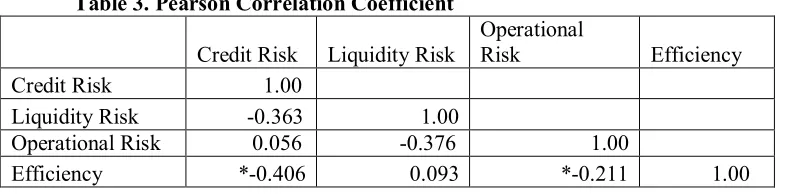
In addition, the values of Pearson Correlation Coefficients are reported in Table 3 indicates that the problem of multicolinearity does non-exist.
Table 3. Pearson Correlation Coefficient Credit Risk Liquidity Risk
Operational
Risk Efficiency
Credit Risk 1.00
Liquidity Risk -0.363 1.00 Operational Risk 0.056 -0.376 1.00
Efficiency *-0.406 0.093 *-0.211 1.00 *. Correlation is Significant at the 0.05 level (2-tailed)
5.2. Research Question and Hypotheses
The research question asked is Does efficiency and risks are correlated in Islamic banking system. The first hypothesis addressed the correlation between efficiency and credit risk in Islamic banks that operate in MENA area. The first null hypothesis predicted that, for the selected sample, there is no correlation between efficiency and credit risk in Islamic banks in the MENA area. To address this hypothesis, the researcher measured correlation between efficiency and credit risk. Table 5.1 displays the results of the correlation between efficiency and credit risk. The study result showed there were negative correlation between credit risk and efficiency at 5%. Thus, this study rejects the first null hypothesis and accepts the first alternative hypothesis.
While, the second null hypothesis was there is no correlation between efficiency and liquidity risk in Islamic banks in the MENA area and table 5.1 displays the result of the correlation between efficiency and liquidity risk. The result indicated there were insignificant correlation between liquidity risk and efficiency. Therefore, the study accepts the second null hypothesis and rejects the second alternative. The third null hypothesis predicted that, for the selected sample, there is no correlation between efficiency and operational risk in Islamic banks in the MENA area. Table 5.1 presents the result of the correlation between efficiency and operation risk. The result revealed there were negative correlations between efficiency and operation risk. Thus, the study rejects the third null hypothesis and accepts the third alternative hypothesis.
6. Conclusion and Recommendations
The study aimed to investigate the correlation between risks and efficient for selected Islamic banks for the MENA area for the period of 2006-2009. This study has employed DEA model to measure the efficiency of those banks, while the second stage were analyzed credit, liquidity, and operational risks thought financial ratios. The third stage was to examine the correlation between risk and efficiency by using Pearson Correlation Coefficients.
The study results answered the research question: Does efficiency and risks are correlated in Islamic banking system. Empirical results reported that the credit risk has negative relationship with efficiency, while operational risk is found to be negative correlated to efficiency. The liquidity risk was insignificant correlation to efficiency in Islamic banks in MENA area. The study is one of the few studies with a focus on the risks and efficiency in Islamic banks in MENA area.
72 correlated to the efficiency in Islamic banking system, therefore, helpful to the management of Islamic banks while making decisions about efficiency and risks.
References
Abedifar, P., Molyneux, P., and Tarazi, A. (2011). Risk and Stability in Islamic Banking. Bangor: Bangor Business School, University of Wales.
Abedifar, P., Molyneux, P., & Tarazi, A. (2012). Risk in Islamic Banking. SSRN eLibrary.
Alam, N. (2012). Efficiency and Risk-Taking in Dual Banking System: Evidence from Emerging Markets. International Review of Business Research Papers, 8(4), 94–111.
Al-Tamimi, H. A., & Al-Mazrooei, F. M. (2007). Banks’ risk management: a comparison study of UAE national and foreign banks. The Journal of Risk Finance, 8(4), 394-409.
Ariffin, N., Archer, S., & Karim, R. (2009). Risks in Islamic banks: Evidence from empirical research. Journal of Banking Regulation, 10(2), 153-163.
Arthur D Little (2009) Islamic Finance comes of Age. Report, April 2009.
Arunkumar, R., & Kotreshwar, G. (2005). Risk Management in Commercial Banks (A Case Study of Public and Private Sector Banks). SSRN eLibrary.
Bauer, W., & Ryser, M. (2004). Risk management strategies for banks. Journal of Banking & Finance, 28, 331–352.
BCBS, (Basel Committee on Banking Supervision) (2001). Operational Risk, consultative document, Basel: Bank for International Settlements.
Beck, T., Asli Demirguc-Kunt and Ouadra Merrouche, (2010). Islamic vs. Conventional Banking: Business Model, Efficiency, and Stability. Policy Research Working Paper.
Bellalah, M., & Ellouz S. (2004). Islamic finance, interest rates and Islamic banking: A Survey of the literature. Finance India: special issue, 18, 533-546.
Berger, A. N. and R. De Young (1997).Problem loans and cost efficiency in commercial Banks.
Journal of Banking and Finance 6(21), 849-870.
Charnes, A., W. W. Cooper and E. Rhodes (1978), Measuring efficiency of
decision making Units, European Journal of Operations Research, 6(3), 429-444.
Creswell, J. W. (2009). Research design: Qualitative, quantitative, and mixed methods approaches
(3rd ed.). Thousand Oaks, CA: SAGE publications.
Farrell, M. J. (1957), the measurement of productive efficiency, Journal of Royal Statistical Society Association, Series 120(A), 253-281.
Hussain, H., & Al-Ajmi, J. (2012). Risk management practices of conventional and Islamic banks in Bahrain. Journal of Risk Finance (Emerald Group Publishing Limited), 13(3), 215-239. Idries M., (2012).Evaluating the Riskiness of the Banking Sector of Jordan. European Journal of
Economics, Finance and Administrative Sciences, 48, 1-10.
International Monetary Fund. (2005). Islamic finance gears up. Finance and Development, 42(4). Retrieved from http://www.imf.org/external/pubs/ft/fandd/2005/12/qorchi.htm
Iqbal, M., & Molyneux, P. (2005). Thirty years of Islamic banking: History, performance and prospects. New York, NY: Palgrave Macmillan.
Johnes, Jill, Izzeldin, Marwan, & Pappas, Vasilleios. (2009). The efficiency of Islamic and conventional banks in the Gulf Cooperation Council (GCC) countries: An analysis using financial ratios and data envelopment analysis. Working Papers 006069, Lancaster University Management School, Economics Department.
Khan, T. (2003). Credit Risk Management: A Framework for Islamic Banking. Paper presented at the Islamic Banking: Risk Management, Regulation and Supervision, Jakarta, Indonesia.
Marliana A., Shahida S., Abdul I., (2011).Operational risk in Islamic banks: examination of issues.
Qualitative Research in Financial Markets, 3 (2), 131–151.
McNeil, A. J., Frey, R., & Embrechts, P. (2005). Quantitative Risk Management: Concepts, Techniques and Tools. Princeton: Princeton University Press.
73 Muhammad H., Mahvish T., Arshiya T., Wajeeh M., (2012). Comparative Performance Study of Conventional and Islamic Banking in Pakistan. International Research Journal of Finance and Economics, 83, 63-72.
Parker, M. (2007, January 01). Islamic banking in 2007 set for massive growth. Retrieved fromhttp://archive.arabnews.com/?page=6§ion=0&article=90559&d=1&m=1&y=2007. Pastor, J., Pérez, F., Quesada, J. (1997). Efficiency analysis in banking firms: An international
comparison. European Journal of Operational Research, 98(2), 395-407.
Ray, D., Cashman, E., (1999). Operational risks, bidding strategies and information policies in restructured power markets. Decision Support Systems, 24, 175–182.
Sharia calling. (2009,November14).The Economist, 50. Retrieved from http://www.economist.com/node/14859353
Siddiqui, A. (2008). Financial contracts, risk and performance of Islamic banking. Managerial Finance, 34 (10), 680-694.
Srairi, S. (2009). A comparison of the profitability of Islamic and conventional banks: The case of GCC countries. Bankers, Markets & Investors, 98, 16-27.
Yudistira, D. (2004). Efficiency in Islamic banking: An empirical analysis of eighteen banks, Islamic Economic Studies, 12(1), August, 1-20.