Uptake of NPK, Availability of NPK and Quality
Parameters of Bt Cotton (Gossypium hirsutum L.)
as Influenced by Different Bio-fertilizers and In-situ
Green Manuring under Irrigation
Thimmareddy K1,B.K.Desai2 and Vinoda Kumar S.N.3*
1, 2, 3Dept. of Agronomy, College of Agriculture, UAS, Raichur, Karnataka- 584 104, India
Email: [email protected]
Paper No. 161 Received: June 17, 2013 Accepted: August 21, 2013 Published: November 29, 2013
Abstract
A field experiment was carried out during kharif season of 2009-2010 at the Agriculture College Farm, Raichur, Karnataka (India) to study the response of Bt cotton to different fertilizer levels, bio-fertilizers and in-situ green manuring under irrigation. With respect to uptake and availability of NPK, application of sunnhemp in-situ green manuring found significantly higher N (128.27 kg ha-1 and 206.43 kg ha-1, respectively), P (30.63 kg ha-1 and 38.43 kg ha-1, respectively) and K (142.33 kg ha-1 and 342.14 kg ha-1, respectively) over no green manuring. Among different fertilizer levels and bio-fertilizers, 150 % recommended dose of fertilizers (RDF) recorded significantly higher uptake and availability of N (132.46 kg ha-1 and 212.48 kg ha-1, respectively), P (32.44 kg ha-1 and 39.21 kg ha-1, respectively) and K (147.21 kg ha-1 and 353.29 kg ha-1, respectively). Significantly higher ginning percentage and lint index were observed with sunnhemp in-situ green manuring (35.81 and 4.99, respectively) over no green manuring. Mean fibre length of Bt cotton was not significantly influenced by both use of in-situ green manuring and combined use of inorganic nutrients and bio-fertilizers.
Highlights
• Green manure, biofertilizers combinations with inorganics effects on Bt transgenic cotton hybrid were studied.
• Sunnhemp in-situ green manuring found significantly higher NPK uptake than no green manuring.
• Interaction effects was non significant for combined use of in-situ green manuring and inorganic nutrients and bio-fertilizers
Keywords: Bt cotton, in-situ green manuring, Bio-fertilizers, fertilizer levels and irrigation.
©2013 New Delhi Publishers. All rights reserved
DOI Number 10.5958/j.2230-732X.6.4.041
Bt cotton was first planted in India in 2002, following its success, the area under this crop and the number of farmers who adopted this technology increased significantly from year to year. The projection made in India for 2020 AD is around 47.5 million bales of lint to meet the anticipated domestic and export requirement. To fulfil this projected
requirement, the cotton production has to be increased by 15 % and it has to come mainly from increased productivity. Current stock of cotton in the country is estimated at 54 lakh bales as against 43 lakh bales during the year 2007-08. There is an encouraging response of farmers towards Bt cotton cultivation while replacing traditional varieties and
hybrids at stroke, just to escape bollworm menace and to achieve potential yield. But unfortunately there is no specific blue print regarding agronomic package for Bt cotton which has a tremendous yield potentiality by virtue of its resistance to bollworm on one hand and having an excellent canopy architecture, which supports huge number of bolls on the other. Fertilizer requirement is the most critical inputs as far as cotton cultivation is concerned as it is a long duration crop in black cotton soils under rainfed and irrigated conditions. Production and productivity increases of Bt cotton can be achieved through enhanced soil fertility. Soil fertility can only be sustained if the nutrients removed from soil are replenished by way of additions. By 2020, the projected requirement of cotton would be around 23 million bales. To produce this quantity, anticipated requirement of N, P and K are 1.2, 1.1 and 1.8 million tonnes, respectively (Kairon and Venugopalan, 2000). Supplying the entire quantity of nutrients required through fertilizers may not be possible, because other crops would compete for application, and shortfall in supplies. At present, there is a wide gap between the supply and removal by crops (Tandon and Narayan, 1990). Therefore, an integration of sources has to be done. Nutrient requirement of cotton, for that matter any crop would have to be met through organic sources in combination with mineral fertilizers. This led to the development of Integrated Nutrient Management System (INMS). Hence, a field study was conducted to find out a suitable fertilizer levels for Bt cotton hybrids which are being well accepted by farmers across the country and more so in black cotton soils of TBP and UKP areas in Karnataka.
Materials and Methods
Field experiment was carried out during kharif season of 2009-2010 at the Agriculture College Farm, Raichur, Karnataka (India) on deep black soil having 218.00, 35.0 and 345.00 kg ha-1 available N, P
2O5 and K2O respectively with pH of 8.20 and organic matter content of 0.70 %. There were 18 treatment combinations consisting of three
in-situ green manures in main plot were as follows: M1: Control (No green manuring), M2: Sunnhemp in-situ green manuring (Cotton + Sunnhemp in 1:2 row proportion) and M3: Dhaincha in-situ green manuring (Cotton + Dhaincha in 1:2 row proportion). Whereas in subplot six different fertilizer levels and bio-fertilizers are taken for study as follows: S1: RDF (150:75:75), S2: 125 % RDF, S3: 150 % RDF, S4: RDF + Seed treatment with Azotobacter @ 600 g ha-1 followed by soil application @ 2 kg ha-1, S
5: RDF + Seed treatment with Azospirillum @ 600 g ha-1 followed by soil application @ 2 kg ha-1 and S: RDF + Seed
treatment with Phosphobacteria @ 600g ha-1 followed by soil application @ 2 kg ha-1. The experiment was laid out in Split plot design and the treatments were replicated thrice. The crop was sown on 19th August 2009 with a plot size of 7.2 m × 6.0 m. All the growth, yield parameters, seed cotton yield, soil nutrient parameters and quality parameters were recorded and statistically analyzed.
Results and Discussion
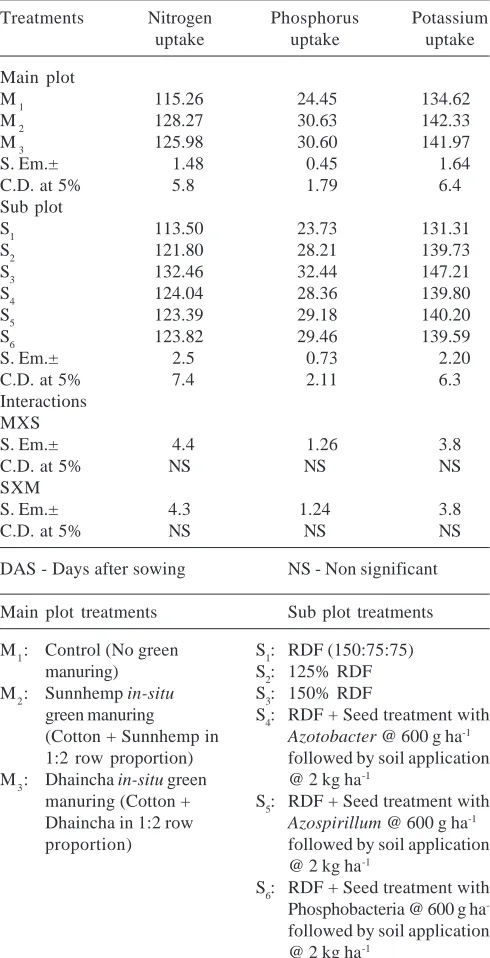
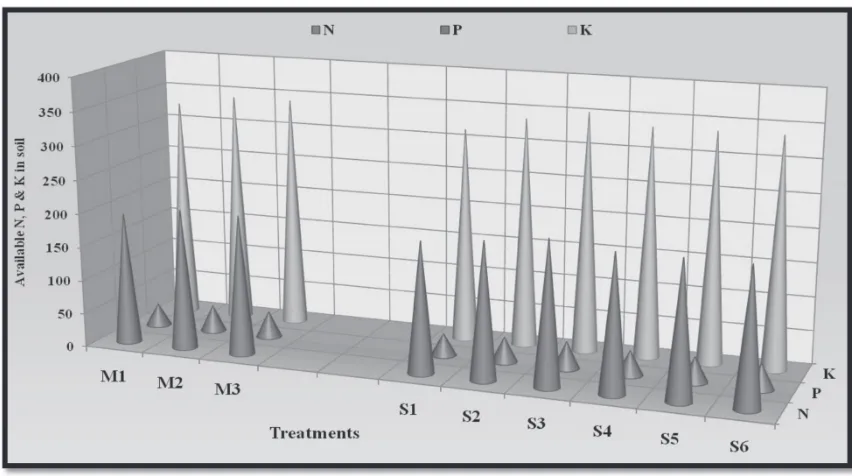
Uptake and Availability of NPK: NPK uptake and availability were significantly higher with sunnhemp and dhaincha in-situ green manuring over no manuring practice (Table. 1 and 2 and Fig. 1 and 2). This increased uptake may be attributed to the increased availability of nutrients in soil. Increased nutrient uptake with green manure treatments inturn resulted in higher dry matter production. Similar results were reported by Badole and More (2000), Katkar et. al. (2002) and also by Amit Kumar et. al. (2013) who reported higher NPK uptake by cotton with sunnhemp and dhaincha with green leaf and green manuring practices. Among main plot treatments sunnhemp in-situ green manuring recorded significantly higher uptake and availability of N (128.27 kg ha-1 and 206.43 kg ha-1, respectively), P (30.63 kg ha-1 and 38.43 kg ha-1, respectively) and K (142.33 kg ha-1 and 342.14 kg ha-1, respectively) as compared to no green manuring N (115.26 kg ha-1 and 193.50 kg ha-1, respectively), P (24.45 kg ha-1 and 32.05 kg ha-1, respectively) and K (134.62 kg ha-1 and 326.82 kg ha-1, respectively). Sunnhemp in-situ green manuring was on par with dhaincha in-situ green manuring with respect to uptake and availability of N (125.98 kg ha -1 and 205.82 kg ha-1, respectively), P (30.60 kg ha-1 and
respectively) and K (147.21 kg ha-1 and 353.29 kg ha-1, respectively) compared to rest of the treatments. This increase in uptake of nutrients may be attributed to higher total dry matter production. These results are in accordance with the findings of Hulihalli (2003), Amutha et. al., (2009a and 2009b) ;Kasturikasen Beura and Rakshit (2011), Hosmath, 2011; Blaise (2013) and Lu et. al., (2013).
Table 1: Uptake of nutrients (kg ha-1) by Bt cotton as influenced by
nutrient management practices
Treatments Nitrogen Phosphorus Potassium
uptake uptake uptake
Main plot
M1 115.26 24.45 134.62
M2 128.27 30.63 142.33
M3 125.98 30.60 141.97
S. Em.± 1.48 0.45 1.64
C.D. at 5% 5.8 1.79 6.4
Sub plot
S1 113.50 23.73 131.31
S2 121.80 28.21 139.73
S3 132.46 32.44 147.21
S4 124.04 28.36 139.80
S5 123.39 29.18 140.20
S6 123.82 29.46 139.59
S. Em.± 2.5 0.73 2.20
C.D. at 5% 7.4 2.11 6.3
Interactions MXS
S. Em.± 4.4 1.26 3.8
C.D. at 5% NS NS NS
SXM
S. Em.± 4.3 1.24 3.8
C.D. at 5% NS NS NS
DAS - Days after sowing NS - Non significant
Main plot treatments Sub plot treatments
M1: Control (No green S1: RDF (150:75:75)
manuring) S2: 125% RDF
M2: Sunnhemp in-situ S3: 150% RDF
green manuring S4: RDF + Seed treatment with (Cotton + Sunnhemp in Azotobacter @ 600 g ha-1
1:2 row proportion) followed by soil application M3: Dhaincha in-situ green @ 2 kg ha-1
manuring (Cotton + S5: RDF + Seed treatment with Dhaincha in 1:2 row Azospirillum @ 600 g ha-1
proportion) followed by soil application @ 2 kg ha-1
S6: RDF + Seed treatment with Phosphobacteria @ 600 g ha
-followed by soil application @ 2 kg ha-1
Table 2: Available nutrients (kg ha-1) in the soil at harvest as influenced
by nutrient management practices
Treatments Available Available Available Nitrogen Phosphorus Potassium
Main plot
M1 193.50 32.05 326.82
M2 206.43 38.43 342.14
M3 205.82 38.03 342.12
S. Em.± 2.72 0.73 3.13
C.D. at 5% 10.6 2.87 12.2
Sub plot
S1 192.87 32.21 316.44
S2 201.46 36.28 337.90
S3 212.48 39.21 353.29
S4 201.63 35.93 337.98
S5 201.79 36.52 337.81
S6 201.28 36.86 338.72
S. Em.± 2.80 0.76 4.2
C.D. at 5% 8.1 2.19 12.3
Interactions MXS
S. Em.± 4.8 1.31 7.3
C.D. at 5% NS NS NS
SXM
S. Em.± 5.2 1.40 7.4
C.D. at 5% NS NS NS
DAS - Days after sowing NS - Non significant
Main plot treatments Sub plot treatments
M1: Control (No green S1: RDF (150:75:75)
manuring) S2: 125% RDF
M2: Sunnhemp in-situ green S3: 150% RDF
manuring (Cotton S4: RDF + Seed treatment with Sunnhemp in 1:2 row Azotobacter @ 600 g ha-1
proportion) followed by soil application @ 2 kg ha-1
M3: Dhaincha in-situ green S5: RDF + Seed treatment with manuring (Cotton + Azospirillum @ 600 g ha-1
Dhaincha in 1:2 row followed by soil application
proportion) @ 2 kg ha-1
S6: RDF + Seed treatment with Phosphobacteria @ 600 g ha1
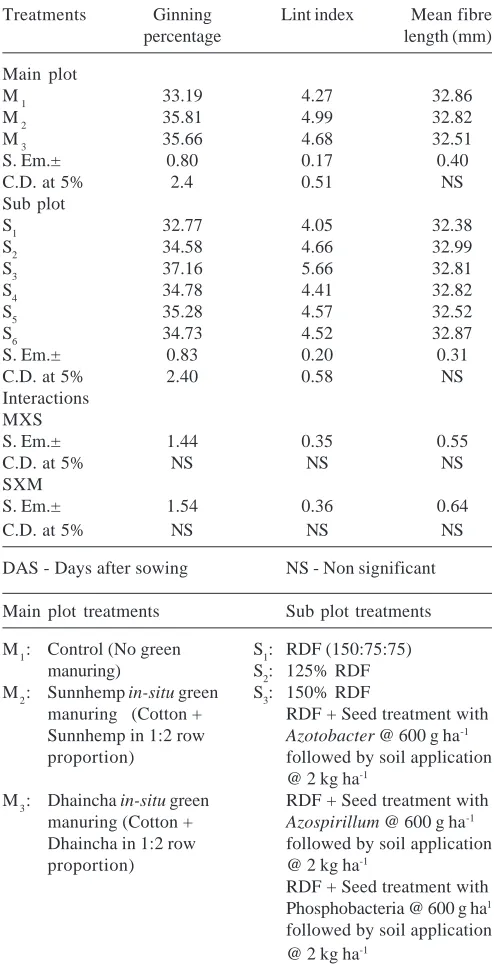
Quality parameters: Ginning percentage and lint index were significantly affected by both main plot treatments as well as sub-plot treatments. However, interaction effect was found to be non-significant (Table. 3). Among main plot treatments, sunnhemp in-situ green manuring (35.81) recorded significantly higher ginning percentage compared to no green manuring (33.19) and was on par with dhaincha
in-situ green manuring (35.66). Among sub-plot treatments,
significantly higher ginning percentage was recorded in 150 % RDF (37.16) which was on par with RDF + seed treatment with Azospirillum @ 600 g per ha followed by soil application @ 2 kg per ha (35.28), and RDF + seed treatment with Azotobacter @ 600 g per ha followed by soil application @ 2 kg per ha (34.78). There was no significant difference among RDF + seed treatment with
Azospirillum @ 600 g per ha followed by soil application
Fig. 1: Uptake of NPK (kg ha-1) by Bt cotton as influenced by nutrient management practices
@ 2 kg per ha (35.28), RDF + seed treatment with
Azotobacter @ 600 g per ha followed by soil application
@ 2 kg per ha (34.78), RDF + seed treatment with Phosphobacteria @ 600 g per ha followed by soil application @ 2 kg per ha (34.73) and 125 % RDF (34.58). Further RDF + seed treatment with Azotobacter @ 600 g per ha followed by soil application @ 2 kg per ha (34.78), RDF + seed treatment with Phosphobacteria @ 600 g per ha followed by soil application @ 2 kg per ha (34.73), 125 % RDF (34.58) and 100 % RDF (32.77) were found to be on par with each other. With respect to lint index, sunnhemp
in-situ green manuring (4.99) recorded significantly higher
lint index compared to no green manuring (4.27) and was on par with dhaincha in-situ green manuring (4.68). Further dhaincha in-situ green manuring (4.68) was on par with no green manuring (4.27). Among sub-plot treatments, significantly higher lint index was recorded in 150 % RDF (5.66) which was followed by 125 % RDF (4.66). 125 % RDF (4.66) was on par with RDF + seed treatment with
Azospirillum @ 600 g per ha followed by soil application
@ 2 kg per ha (4.57), RDF + seed treatment with Phosphobacteria @ 600 g per ha followed by soil application @ 2 kg per ha (4.52) and RDF + seed treatment with Azotobacter @ 600 g per ha followed by soil application @ 2 kg per ha (4.41). Further, there was no significant difference among RDF + seed treatment with
Azospirillum @ 600 g per ha followed by soil application
@ 2 kg per ha (4.57), RDF + seed treatment with Phosphobacteria @ 600 g per ha followed by soil application @ 2 kg per ha (4.52), RDF + seed treatment with Azotobacter @ 600 g per ha followed by soil application @ 2 kg per ha (4.41) and 100 % RDF (4.05). whereas, Mean fibre length of Bt cotton was not significantly influenced by both use of in-situ green manuring and combined use of inorganic nutrients and bio-fertilizers as well as their interaction effect. These results are in accordance with the findings of Bauer et. al. (1993), Biradar (2000), Hongal (2001) Ram prakash et. al. (2001), Ratnakumari and Subbaravamma, (2006), Srinivasulu
et. al,. (2006) Srinivasulu and Hema (2007).
Table 3: Ginning percentage, Lint index and mean fibre length (mm) of Bt cotton as influenced by nutrient management practices
Treatments Ginning Lint index Mean fibre
percentage length (mm)
Main plot
M1 33.19 4.27 32.86
M2 35.81 4.99 32.82
M3 35.66 4.68 32.51
S. Em.± 0.80 0.17 0.40
C.D. at 5% 2.4 0.51 NS
Sub plot
S1 32.77 4.05 32.38
S2 34.58 4.66 32.99
S3 37.16 5.66 32.81
S4 34.78 4.41 32.82
S5 35.28 4.57 32.52
S6 34.73 4.52 32.87
S. Em.± 0.83 0.20 0.31
C.D. at 5% 2.40 0.58 NS
Interactions MXS
S. Em.± 1.44 0.35 0.55
C.D. at 5% NS NS NS
SXM
S. Em.± 1.54 0.36 0.64
C.D. at 5% NS NS NS
DAS - Days after sowing NS - Non significant
Main plot treatments Sub plot treatments
M1: Control (No green S1: RDF (150:75:75)
manuring) S2: 125% RDF
M2: Sunnhemp in-situ green S3: 150% RDF
manuring (Cotton + RDF + Seed treatment with Sunnhemp in 1:2 row Azotobacter @ 600 g ha-1
proportion) followed by soil application @ 2 kg ha-1
M3: Dhaincha in-situ green RDF + Seed treatment with manuring (Cotton + Azospirillum @ 600 g ha-1
Dhaincha in 1:2 row followed by soil application
proportion) @ 2 kg ha-1
RDF + Seed treatment with Phosphobacteria @ 600 g ha1
followed by soil application @ 2 kg ha-1
Conclusion
Ginning percentage, lint index and mean fibre length were affected by use of green manuring and combined use of inorganic nutrients with bio-fertilizers. Significantly higher values were recorded in in-situ green manuring than no green manuring. Among sub plot treatments, application of 150 % RDF recorded significantly higher values than rest of the treatments. Similar results were obtained in Nitrogen, Phosphorus and potassium uptake at harvest (kg ha-1) and its availability in soil; and also it holds good for the economics of cotton.
References
Amit Kumar, Dipak Kumar Gupta and Mukesh Kumar, 2013. Green Manure Crops: A Boon for Agricultural Soil. International
Journal of Agriculture, Environment and Biotechnology 6:
193-.
Amutha, M., Alagar , M. and Chozhan, K. 2009b. Synergistic effects of Azospirillum brasilense (T) and Vesicular Arbuscular
Mycorrhiza (VAM- Glomus spp.) combined with organic and
inorganic fertilizers on the infestation of rice yellow stem borer
Scirpophaga incertulus Wlk. under rainfed condition. Journal
of Plant Protection and Environment 6(2):50-58.
Amutha, M., Alagar, M. and Chozhan, K.2009a. Synergistic effect of
Azospirillum brasilense, VAM, organic and inorganic fertilizers
on Scirpophaga incertulus Wlk. on Oryza sativa L.Annals of
Plant Protection Sciences 17(2) :375-379.
Badole, S. B. and More, S. D., 2000. Yield and nutrient uptake as influenced by integrated nutrient supply system in cotton.
Journal of Indian Society for Cotton Improvement 25(3):
161- 165.
Basavanagouda, K. H., 1998. Evaluation of perennial green manuring crops for their suitability as year long field covers in chilli (Capsicum annum L.). M.Sc. (Agri.) Thesis, University of
Agricultual Sciences. Dharwad.
Bauer, P. J., Camberato, J. J. and Roach, S. H., 1993. Cotton yield and fibre quality response to green manures and nitrogen.
Agronomy Journal 85: 1019-1023.
Bellakki, M. A. and Badanur, V. P., 1994. Effect of crop residue incorporation on physical and chemical properties of a vertisol and yield of sorghum. Journal of Indian Society Soil Science 7(4): 533-535.
Biradar, I. B., 2000. Studies on cover cropping in hybrid cotton under transitional tract of Dharwad. Ph.D. Thesis, University of
Agricultual Sciences. Dharwad.
Blaise, D., 2011. Tillage and green manure effects on Bt transgenic cotton (Gossypium hirsutum L.) hybrid grown on rainfed Vertisols of central India. Soil and Tillage Research 114 (2): 86-96.
Hongal, M. M., 2001. Effect of green manuring and levels of nitrogen on the performance of chilli + cotton intercropping system.
M. Sc. (Agri.) Thesis, University of Agricultual Sciences.
Dharwad.
Hosmath, J. A., Biradar, D. P. and Deshpande, S. K., 2011. Response of Bt Cotton to organic and inorganic nutrient management under rainfed and irrigated ecosystems. International Research
Journal of Plant Science 1(8): 244-248.
Hulihalli, U. K., 2003. Effect of in-situ moisture conservation and integrated nutrient management practices in rainfed herbaceum cotton. Ph.D Thesis, University of Agricultual Sciences. Dharwad.
Kasturikasen Beura and Rakshit, A. 2011. Effect of Bt cotton on nutrient dynamics under varied soil type. Italian Journal
of Agronomy 6(4):25-28.
Katkar, R. N., Turkhede, A. B. Solanke, V. M., Wankhade, S. T. and Sakhare, B. A., 2002. Effect of integrated nutrient management of organic manures and fertilizers on soil properties and yield of cotton. Journal of Cotton Research and Development 16(1): 89-92.
Lu, C., Chen, X., Shen, S., Shi, Y., Ma, J. and Zhao, M., 2013. Use efficiency and residual effect of 15N-labelled ryegrass green
manure over a 9-year field micro-plot experiment. Journal of soil science and plant nutrition. Epub 27-Ago-2013 Ram Prakash, Mangal Prasad and Pachauri, D. K., 2001. Effect of
nitrogen, chlormequat chloride and FYM on growth, yield and quality of cotton (Gossypium hirsutum L.). Annuals of
Agricultural Research 22(1): 107-110.
Ratnakumari, S. and Subbaravamma, P., 2006. Effect of FYM, chemical fertilizers and micronutrient on yield, economics and fibre properties of cotton. Journal of Cotton Research and
Development 20: 64-70.
Srinivasulu, K. and Hema, K., 2007. Effect of integrated nutrient management in enhancing and sustaining cotton (Gossypium
hirsutum L.) productivity. Journal of Cotton Research and Development 21(2): 218-221.
Srinivasulu, K., Hema, K., Prasad, N. V. V. S. D. and Krishana Rao, K. V., 2006. Performance of cotton hybrids under different spacings and N levels in black cotton soils of costal Andhra Pradesh under. Journal of Cotton Research and Development 20(1): 99-101.