Original Article
Journal of Advances in Medical Education & Professionalism
Self- directed learning barriers in a virtual environment: a
qualitative study
NOUSHIN KOHAN1, KAMRAN SOLTANI ARABSHAHI2, RITA MOJTAHEDZADEH3,
ABBAS ABBASZADEH4, TAYEBEH RAKHSHANI5, AMIRHOUSEIN EMAMI6*
1Department of Medical Education, Faculty of Medicine, Tehran University of Medical Sciences, Tehran, Iran; 2Department of Medical
Education, School of Medicine, Iran University of Medical Sciences, Tehran, Iran; 3Department of e-learning, Virtual School, Tehran
University of Medical Sciences,Tehran, Iran; 4Department of Nursing and Midwifery, Shahid Beheshti University of Medical Sciences,
Tehran, Iran; 5Nutrition Research Center, Shiraz University of Medical Sciences, Shiraz, Iran; 6Hematology and Oncology Department,
Imam Khomeini Hospital, Tehran University of Medical Sciences, Tehran, Iran
Introduction: There is a growing trend in online education courses in higher education institutes. Previous studies have shown that high levels of self-direction are essential for successful online learning. The present study aims to investigate challenges of and barriers to self-directed virtual-learning among postgraduate students of medical sciences.
Methods: 23 postgraduate virtual students of medical sciences in Iran, collected through maximum variation purposive sampling and semi-structured interviews, served as the sample of this study. The collected data were analyzed using the inductive content analysis method.
Results: Three themes and six sub-themes were identified as barriers to self-directed learning in virtual education, including cognitive barriers (information overload and lack of focus on learning or mind wondering), communication barriers (inadequate coping skills and inadequate writing skills) and educational environment barriers (heavy workload and role ambiguity).
Conclusion: By the importance of self-direction in online education, the present study results can be used by virtual education planners in the review and design of courses, so as to adequately equip students, obviate barriers to self-directed virtual education, and ultimately train highly self-directed learners in online medical education.
*Corresponding author:
Amir Housein Emami, Tehran University of Medical Sciences, Poursina alley, 16 Azar St., Tehran, Iran
Tel: +98-21-64053365
Email:
Please cite this paper as:
Kohan N, Soltani Arabshahi K, Mojtahedzadeh R, Abbaszadeh A, Rakhshani T, Emami AH. Self- directed learning barriers in a virtual environment: a qualitative study. J Adv Med Educ Prof. 2017;5(3):116-123.
Received: 20 December 2016 Accepted: 1 March 2017
Keywords: Medical education; Graduate medical education; Technology; Learning
Introduction
T
echnological innovations and digital communications have led to social changes, and have been the main stimulant of educational transformations in recent decades (1). The widespread use of digital communications has created countless e-learning opportunities for students of medical sciences throughout the world, who can now benefit and learn through teachers’ interactive education via thedevelopment of these courses, expectations of the latest clients of the education system (so-called digital natives) include increased autonomy via self-directed learning (6). In other words, virtual learners should be able to independently analyze, plan, implement, and assess their own learning activities, and thus be self-directed. Quoting Fisher-King, Knowles contends that self-directed learning is a process in which people identify their own learning needs, determine their own goals, find sources and subjects they need for learning, choose and implement appropriate learning strategies, and assess their own learning results with or without other people’s help, and thus take the initiative in their own hands (7). Many studies have emphasized the importance of fostering self-directed skills needed in virtual students to improve educational outcomes and increase academic achievement (8, 9). In their article titled “conceptual model for self-directed learning in online environment” Song & Hill (2007) concluded that self-directed learning is an important aspect of adult education and e-learning. In other words, self-directed learning is both the objective of adult education and a process that steers them toward successful learning (10). It has been shown that students are exposed to many challenges in the process of online learning (11, 12). There are some studies in the related literature conducted to assess if students understand challenges of and
barriers to the face-to-face environment (12, 13). However, the assessment of this issue in an online environment has less been addressed, especially in students of medical sciences (14). The present study aims to investigate understanding of postgraduate students of medical sciences on challenges of and barriers to self-directed virtual-learning. The present study was conducted using a qualitative approach because barriers to self-direction are formed in the social context as a result of the interaction of people involved in learning with social and cultural conditions. Methods
A qualitative content analysis approach was employed in the present study.
Participants
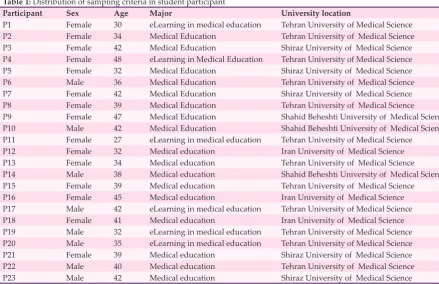
The participants were MA students of medical education and e-learning in medical education, studying in different universities of medical sciences in Iran in the academic year 2014/2015. The participants were recruited using the maximum variation purposive sampling technique. Inclusion criteria were set at the initiation of the research. They included: having studied for at least one academic semester at Master’s degree level, being willing to participate in the study and having deep experience of the subject matter. The distribution of sampling criteria is presented in Table 1.
Table 1: Distribution of sampling criteria in student participant
Participant Sex Age Major University location
P1 Female 30 eLearning in medical education Tehran University of Medical Science P2 Female 34 Medical Education Tehran University of Medical Science P3 Female 42 Medical Education Shiraz University of Medical Science P4 Female 48 eLearning in Medical Education Tehran University of Medical Science P5 Female 32 Medical Education Shiraz University of Medical Science P6 Male 36 Medical Education Tehran University of Medical Science P7 Female 42 Medical Education Shiraz University of Medical Science P8 Female 39 Medical Education Tehran University of Medical Science P9 Female 47 Medical Education Shahid Beheshti University of Medical Science P10 Male 42 Medical Education Shahid Beheshti University of Medical Science P11 Female 27 eLearning in medical education Tehran University of Medical Science
Data collection
The data were collected through semi-structured interviews to allow the participants to express their experience in a free manner. The interviewer was one PhD student in medical education (the first author) who went through training before starting the collection of data. The interviews were initiated with the general question of what students perceived to be challenges and barriers to self-directed learning in virtual environment. Some probing questions such as “How did you define a virtual environment?” were also asked. The probing questions were based on the participants’ answers to the general questions. The interviewer encouraged the participants to give more explanation about the issues. The participants were also invited to talk about issues in their minds not covered in the interview. The interviews were conducted in a quiet room, and recorded using a tape recorder. Each interview lasted between 35 and 65 minutes. The interviews were immediately transcribed and analyzed. Sampling and data collection continued until saturation of data, which was determined through immediate analysis of data after transcription of each interview. The data were saturated after coding and analyzing 20 interviews, while the researcher interviewed 23 participants for more confidence and the data were considered saturated when no new general, main and sub-theme were emerged.
Data analysis
The data were analyzed using the qualitative content analysis approach, which provides valuable information about people’s experiences and perceptions of the study phenomenon (15). We used inductive content analysis defined by Elo & Kyngas (2008) for data analysis. Inductive content analysis was employed in which themes and categories were extracted from content of the text data of participants without considering previous theoretical views (16).
All interviews were recorded on videotape, which were audio converted and literally transcribed. The transcripts were analyzed by one of the authors of this manuscript (first author) and an agreement was achieved with the research group. This process briefly included the following two stages: selecting the unit of analysis and make sense of the data in the preparation phase and open coding, creating categories, and abstraction in the organizing phase.
a) Preparation phase
To achieve immersion in the data, the researchers listened to the interviews closely
and read the written materials several times. This technique was useful for identifying unit of analysis. The unit of analysis in this article was defined word, sentence or paragraph.
b) Organizing phase
This phase included open coding, creating categories and abstraction. In the open coding, each interview was read line by line and all the words, sentences, and paragraphs including meaning units were coded in the margins to describe all aspects of the content. For categorization, a primary list of categories was prepared and continuously compared and grouped based on resemblance among headings. In the abstraction phase, 300 codes were put into the sub-categories grouped as six categories or subtheme and finally labeled as three main categories or themes.
Rigor
Four characteristics of credibility, confirmability, dependability, and transferability were used to ensure the accuracy and reliability of the data and findings in our study (17). The credibility of the findings was confirmed, using such techniques as member-checking and close communication with the participants. In order to increase the confirmability of the findings, external peer checking was used. Accordingly, part of the data and findings was sent to two experienced qualitative researchers and two PhD students of medical education to confirm the accuracy of the analysis and their useful recommendations were considered. To confirm dependability of the findings, the sampling technique was carried out with the maximum diversity in terms of gender, field of study, and university.
Ethical considerations
The present study was approved by Tehran University of Medical Sciences ethical committee (Code: IR.TUMS.MEDICINE.REC.1395.713). Explanations were provided to the participants regarding study objectives, collection of data, confidentiality of their details, and also ethical considerations observed in the e-mail and before the interviews. Informed consents for participation and permission to record interviews were obtained from the participants.
Results
27 to 48 years with the mean age of 38.17 years (Table 1).
Analysis of data revealed three themes and six sub-themes as self-directed learning barriers in virtual education including: a) cognitive barriers (information overload and lack of focus on learning or mind wondering), b) communication barriers (inadequate coping skills, inadequate writing skills) and c) educational and environmental barriers (heavy workload, role ambiguity) (Table 2). 1. Cognitive barriers
1-1 Information overload
This was the first barrier extracted from the participants’ statements. Most participants mentioned anxiety and concerns caused by mismanagement of the vast volume of information in e-learning environment. They believed that access to information sources was challenging, and equally availability of huge amounts of information retrieved from the Internet was problematic, hampering logical deciphering of data. In this regard, two participants expressed their views:
Student code 10: “I saw so many links during e-learning, some with contradictory information. You get a mental block. I wasn’t able to sum up the subject at all, so I got stressed and I had to leave my study and assignments altogether”.
Student code 3: “I’m generally unable to
filter out necessary or unnecessary information
when I’m on the net. Even though I expect to
find answers to my questions on the Internet and scientific sites, I get confused when I faced large
numbers of articles and topics. I doubt if they are actually helpful for my assignments”.
2-1 Lack of focus on learning (mind wondering) Another challenge in self-directed online learning was lack of focus on learning or “mind wondering”, which prevents students from concentrating and fulfilling their assignments. Students were therefore distressed and sought ways to prevent it. Mind wondering means diversion of attention and focus from the main task. Three students expressed their views about mind wondering:
Student code 18: “When studying, I inadvertently find myself wondering on unrelated sites, and I suddenly realize that I’ve lost so much time”.
Student code 23: “When doing my
assignments, although I’m aware of the deadline, and that I don’t have much time, I get so involved checking Facebook, LinkedIn, and e-mails or playing around on the mobile that I lose so much time without doing my work. This makes me feel so guilty”.
Student code 1: “In the beginning of a video lecture, I easily focused on its content, but when we approached the end of course, it became more difficult to do so. Sometime, I prefer to leave the course for a long time so that I can better concentrate on the content”.
Student code 3: “At home, when I’m listening to Podcast and professors’ recorded lecture, I suddenly find that I’ve missed part of the lecture as my mind is wondering, so I have to rewind and listen again”.
2. Communication barriers
2-1 Role uncertainly (Role ambiguity)
The results obtained showed inconsistency between expectations of virtual students and teachers and vice versa. This barrier is referred to as “role uncertainly or ambiguity” in the literature. It arises when the regulations in virtual school do not clearly define roles of students and teachers. Sometime this role is more different from face-to-face education, then it is unclear for the student. In this respect, two students commented:
Student code 18: “I had done my undergraduate studies in person. Entering a virtual course was very strange and stressful. I thought virtual learning means we come here and watch videotaped lectures instead of going to the classroom for professors’ regular lectures.”
Student code 19: “Teachers should be constantly in touch to see if we have any questions. But, they expect us to get in touch when we have a problem. The teacher doesn’t know if I have understood the lesson. It’s not like the classroom, where the teacher can see me or look at my face to see if I have understood the lesson.”
Student code 5: “Assignments should be clear enough, so we don’t have to constantly ask the teacher, and feedback on assignments should come through quickly. They should check and respond. Teachers believe that they cannot be at our service 24/7 to answer our questions”.
Some instructors think that self-directed
Table 2: Themes and subthemes of the study
Theme Subtheme
learning means that the students should learning on their own in a virtual environment without any support from their educators and school. The instructors misunderstand their role in receiving feedback from students and directing them toward self-directed learning. In this situation, students become more confused about their role, which leads to frustration, a reduction in their motivation for learning, and a decrease in their efficiency. For example:
Student code 1: “I think that as role of students changes in parallel with their course, the role of the instructor also needs to change. For example, the role of the instructor in semester 1 should be different from that in semester 4. I think that a student needs more consultation in semester 1.” Student code 3: “I thought that the instructor helped me in all of the assignments. In a hard assignment, I waited to get help from the instructor. However, I found out that I had to do it on myself.”
2-2 inadequate writing skills
According to the results, one of the challenges faced by students was lack of good writing skills: formulation of ideas and their effective textual expression. Students communicated with classmates and teachers through writing, hence their skills, speed and accuracy in writing are very important. For example:
Student code 5: “I think students should have good writing skills, and stick to an ordered system, but I didn’t, and I got a lower mark. It made me feel bad”.
Student code 6: “For success in virtual debates or forum discussions, I should be able to express myself well or write well. I can talk about my analysis well, but it becomes difficult when I come to put that in writing, and I cannot write what’s in my mind to send to my teacher”.
Student code 14: “Sometimes I have good information but I can’t organize them well into writing. It is very important for teachers to write a well-organized response.”
3- Educational environment barriers 3-1 inadequate coping skills
Many participants believed that entering virtual learning and the role changes from being an attending student to a virtual student means huge stress for them, and requires consolidation of adaptation skills and student support through student support systems and preparation for self-directed learning. In other words, many participating students lacked necessary preparations for adaptation to virtual student role. For instance:
Student code 5: “I didn’t know much in the first
semester. I was experiencing a new environment, I was disheartened and thought I couldn’t handle virtual learning. I needed some kind of support, from friends or teachers. With the stress I was experiencing, I felt unable to manage demands made by teachers, do assignments and hand them in on time, or deal with discussions in the forum”.
Student code 18: “I had done my undergraduate studies in person. Entering a virtual course was very strange and stressful. I thought virtual learning is watching videotaped lectures instead of going to the classroom for professors’ regular lectures.”
3-2 Heavy workload
The results obtained showed that the majority of students had trouble using limited opportunities. It is assumed that in virtual schools, successful students take maximum advantage of their limited time. Because of extensive tasks and assignments, many participating students considered online learning heavy and difficult, and that they may fail if they cannot find a solution to this problem. Many students also argued that they did not have enough time to explore additional resources.
Student code 18: “I tried to manage my time according to assignments, so I could send them within the deadline. But, it was often hard for me, especially in the first semester. Many teachers mark you down if you don’t send your assignments on time”.
Student code 10: “I think time management is much harder in virtual learning than in regular classes”.
The majority of participating students argued that the large volume of work assigned by different teachers at the same time and the short deadline given, and the large volume of some references and interaction of these factors, meant that they were unable to rethink their own learning process. In such circumstances, time management is often difficult for students. For instance:
Student code 2: “I think teachers should set fewer and more focused assignments for students. An effective assignment doesn’t need to be bulky”.
Student code 7: “Every teacher wants to finish his subject within a given deadline, and for a three-unit subject, he has to set 10 to 15 assignments throughout the semester. This much homework tires me out and I’m fed up”.
Discussion
is termination of learning for whatever reason (12). In the present study, obstacles to self-directed learning, for various reasons adversely affected students’ learning. One of the problems faced by virtual students was information overload. Although nowadays information and communication technology supports processes of teaching and learning by facilitating access to information through computer networks, information overload is a major problem created by its development (17-19). According to a study conducted by Chen et al. (2009), perceived information overload affects virtual students’ participation and cognitive processing level in virtual debates. They also showed that this phenomenon does not affect all students because many students have already learned how to deal with that (20). Thus, it is important to teach students how to manage this obstacle.
In the present study, “mind wondering” was another learning barrier faced by virtual students. “Mind wondering” is one of the most common barriers to all mental activities. It is estimated that mind tends to divert from the current situation to unrelated thoughts in 50% of our waking hours (21). Several studies have shown that this phenomenon is very common in online learning environments (22-24), and this was also experienced by a number of participants in the present study. For instance, this was reported in relation to watching a video recording of a lecture. To prevent mind wondering, many previous studies have recommended that online lectures be short, and take a maximum of 10 minutes because people are unable to maintain long-term concentration (22, 25). Use of technology (laptops, mobile, Facebook or other social media) is another important factor that diverts students’ thoughts during learning, and if this is not properly managed, it will lead to students’ academic failure (26, 27). Moreover, in online learning, technology itself is an important mind wondering factor (28).
The present study results identified “role ambiguity” as another barrier faced by students in online learning environment. This phenomenon indicates that the unclarity of student-teacher expectations in the online environment leads to unsociability because there are no agreed standards on role behaviors and functions. Examples of such behaviors include student’s request for help and effective feedback from teachers. Generally, in an online learning environment, students and teachers have conflicting role expectations, which ultimately lead to their anxiety and stress. Thus, interventions by virtual education institutes such as preparing students and empowering teachers
seem essential. Such strategies will provide students and teachers with the opportunity to become aware of their online role behaviors (29).
According to the present study results, adaptation to new learning environment is a necessary skill for virtual learning. Some studies have shown that student’s perception of the learning environment and their adaptation to this new environment is highly important, and will affect learning achievements (30, 31).
In fact, virtual students should be able to adapt to the new learning environment and technologies for successful learning. A study recommended the use of cognitive learning strategies such as computer-based data management, time management and self-regulation for students’ adaptation to computer technology (32).
In the present study, another barrier faced by students was inadequate time management caused by the large volume of assignments. Muller (2008) reported that rational and flexible scheduling of assignments positively affects learning in online students (33). Holder (2007) reported that students with effective study habits and ability to learn who insist on finishing their assignments are more successful in online courses (34). Students with heavy workload are more likely to experience academic failure and dropout (35). Furthermore, poor course design leads to shallow learning. Students’ heavy workload and inappropriate assessment methods, and limitation of students’ choice of educational activities and topics in virtual courses are indicative of poor course design, which motivates students by external factors such as score (36). According to Lizzio et al. (2002), students’ perception of heavy workload and improper assessment will encourage them toward shallow learning (37). In contrast, Bunn (2004) argues that heavy workload is not too problematic when virtual students manage their time properly and have real expectations of what is involved (38).
this type of communication, students should be able to type, read and write. Thus, students with no communication skills will have problems in communicating with others and learning (41). Conclusion
The present study results identified barriers to self-directed learning in postgraduate virtual students of medical sciences. These barriers include information overload, mind wondering, role ambiguity, inadequate coping skill, heavy workload, and inadequate writing skill. Identifying these barriers and finding ways to obviate them can lead to effective virtual learning, especially in students that mainly use this mode of education, and ultimately enhance the quality of learning.
Acknowledgements
This article is part of a dissertation thesis for PhD in medical sciences titled “A conceptual model and its assessment tool for self-directed learning in postgraduate virtual disciplines” from Tehran University of Medical Sciences by the first author. The authors wish to thank university officials and participating students and teachers for their cooperation.
Conflict of Interest: None declared.
References
1. Garrison DR. E-learning in the 21st century: A framework for research and practice. UK: Taylor & Francis; 2011.
2. George PP, Papachristou N, Belisario JM, Wang W, Wark PA, Cotic Z, et al. Online eLearning for undergraduates in health professions: A systematic review of the impact on knowledge, skills, attitudes and satisfaction. Journal of global health. 2014;4(1):1. 3. Cook DA. Learning and cognitive styles in web-based learning: theory, evidence, and application. Acad Med. 2005;80(3):266-78.
4. Mills J, Field J, Cant R. Rural and remote Australian general practice nurses’ sources of evidence for knowledge translation: a cross-sectional survey. International Journal of Evidence-Based Healthcare. 2011;9(3):246-51.
5. Allen IE, Seaman J. Going the distance: Online education in the United States, 2011. USA: ERIC; 2011. 6. Akçayır M, Dündar H, Akçayır G. What makes you
a digital native? Is it enough to be born after 1980?
Computers in Human Behavior. 2016;60:435-40. 7. Fisher MJ, King J. The self-directed learning
readiness scale for nursing education revisited: A
confirmatory factor analysis. Nurse Education Today.
2010;30(1):44-8.
8. Carson EH. Self-directed learning and academic achievement in secondary online students [dissertation]. Chattanooga: University of Tennessee at Chattanooga; 2012. Available from: http://pqdtopen.proquest.com/
doc/1038364482.html?FMT=ABS.
9. Ferrer Mico MT. Community of Inquiry (COI) and Self-Directed Learning (SDL) in Online Environments: An Exploratory, Correlational and Critical Analysis of MOOCs. Barcelona: University of Ramon Llull; 2016. p 377.
10. Song L, Hill JR. A conceptual model for understanding self-directed learning in online environments. Journal of Interactive Online Learning. 2007;6(1):27-42. 11. Randall JG. Mind Wandering and Self-directed
Learning: Testing the Efficacy of Self-Regulation
Interventions to Reduce Mind Wandering and Enhance Online Training [dissertation]. Houston: Rice University. 2015. Available from: https://scholarship. rice.edu/handle/1911/88440.
12. Read JM. Developing self-directed learning. Research and Practice in Human Resource Management. 2001;9(1):119-37.
13. Douglass C, Morris SR. Student Perspectives on Self-Directed Learning. Journal of Scholarship of Teaching and Learning. 2014;14(1):13-25.
14. Ibrahim DZ, Silong AD, editors. Barriers to self-directed learning in a virtual environment among adult students. 14th Annual Conference of the Asian Association of Open Universities; 2000; Manila. Manila: Phillippines; 2000.
15. Lichtman M. Qualitative Research in Education: A User’s Guide. California: Sage; 2012.
16. Elo S, Kyngäs H. The qualitative content analysis process. Journal of advanced nursing. 2008;62(1):107-15. 17. Burge L. Learning in computer conferenced contexts: The learners’ perspective. International Journal of E-Learning & Distance Education. 2008;9(1):19-43. 18. Vonderwell S, Zachariah S. Factors that influence
participation in online learning. Journal of Research on Technology in education. 2005;38(2):213-30. 19. Kear K, Heap NW. ‘Sorting the wheat from the chaff’:
investigating overload in educational discussion systems. Journal of Computer Assisted Learning. 2007;23(3):235-47.
20. Chen CY, Pedersen S, Murphy KL. The influence
of perceived information overload on student participation and knowledge construction in computer-mediated communication. Instructional Science. 2012;40(2):325-49.
21. Mooneyham BW, Schooler JW. The costs and benefits
of mind-wandering: a review. Canadian Journal of Experimental Psychology/Revue canadienne de psychologie expérimentale. 2013;67(1):11.
22. Koller D. Death knell for the lecture: Technology as a passport to personalized education [Internet]. New York: New York Times. 2011 [updated: 5 Dec 2011]. Available from: http://www.nytimes.com/.
23. Szpunar KK, Khan NY, Schacter DL. Interpolated memory tests reduce mind wandering and improve learning of online lectures. Proceedings of the National Academy of Sciences. 2013;110(16):6313-7.
24. Szpunar KK, Moulton ST, Schacter DL. Mind wandering and education: from the classroom to online learning. Frontiers in psychology. 2013;4:495. 25. Karvouniaris W. The One World Schoolhouse:
26. Junco R. The relationship between frequency of Facebook use, participation in Facebook activities, and student engagement. Computers & Education. 2012;58(1):162-71.
27. Wood E, Zivcakova L, Gentile P, Archer K, De Pasquale D, Nosko A. Examining the impact of off-task multi-tasking with technology on real-time classroom learning. Computers & Education. 2012;58(1):365-74. 28. Hollis RB, Was CA. Mind wandering, control failures, and social media distractions in online learning. Learning and Instruction. 2016;42:104-12.
29. Bork RH, Rucks Ahidiana Z. Role ambiguity in online courses: An analysis of student and instructor expectations. Columbia: Bill & Melinda Gates Foundation; 2013.
30. Gijbels D, Van de Watering G, Dochy F, Van den Bossche P. New learning environments and constructivism: The students’ perspective. Instructional science. 2006;34(3):213-26.
31. Entwistle N, Tait H. Approaches to learning, evaluations of teaching, and preferences for contrasting academic environments. Higher education. 1990;19(2):169-94. 32. Saunders NG. Learning Strategies for Coping with
Computer Technology in a Distance Learning Environment. USA: ERIC; 1998.
33. Müller T. Persistence of women in online
degree-completion programs. The International Review of
Research in Open and Distributed Learning. 2008;9(2): 1. 34. Holder B. An investigation of hope, academics,
environment, and motivation as predictors of persistence in higher education online programs. The Internet and higher education. 2007;10(4):245-60. 35. Park JH. Factors Related to Learner Dropout in Online
Learning. USA: ERIC; 2007.
36. Eastmond D. Enabling student accomplishment online: An overview of factors for success in Web-based distance education. Journal of Educational Computing Research. 2000;23(4):343-58.
37. Lizzio A, Wilson K, Simons R. University students’ perceptions of the learning environment and academic outcomes: implications for theory and practice. Studies in Higher education. 2002;27(1):27-52.
38. Bunn J. Student persistence in a LIS distance education program. Australian Academic & Research Libraries. 2004;35(3):253-69.
39. Boyd D. The characteristics of successful online students. New Horizons in Adult Education and Human Resource Development. 2004;18(2):31-9.
40. Lapadat JC. Written interaction: A key component in online learning. Journal of Computer-Mediated Communication. 2002;7(4):1.