Journal of Teaching Language Skills (JTLS)
38(1), Spring 2019, pp. 157-190- ISSN: 2008-8191
DOI:10.22099/jtls.2020.34843.2739
Developing EFL Learners' Oral Proficiency through Animation-based Instruction of English Formulaic
Sequences
Maryam Rajaei Najafabadi Yousef Bakhshizadeh **
Azizullah Mirzaei***
Abstract
The current pretest-posttest quasi-experimental study attempts, firstly, to probe the effects of teaching formulaic sequences (FSs) on the second or foreign language (L2) learners' oral proficiency improvement and secondly, to examine whether teaching FSs through different resources (i.e. animation vs. text-based readings) have any differentially influential effects in augmenting L2 learners' oral proficiency or not. To this end, a cohort of 60 young L2 learners of an immersion program school in the southwest of Iran was randomly divided into three groups, two experimental and one control. During 24 instructional sessions, one experimental group received the FSs instruction through animation, and the second experimental group noticed FSs through text-based readings. The control group was taught using the school mainstream L2 textbooks without any focus on FSs. The results indicated that both FSs groups outperformed the control group. Moreover, animation-based instruction significantly increased the efficacy of FSs instruction, pointing to the issue that educational technology is a better strategy for teaching FSs rather than the traditional way of reading.
Received: 14/04/2019 Accepted: 14/12/2019
M.A, Chabahar Maritime University- Email: [email protected], Corresponding author
Keywords: Animation-based instruction, Text-based readings, Formulaic sequences, Oral proficiency
Oral proficiency is one of the most essential aspects of foreign language (FL) learning for developing the communicative competence of L2 learners. Indeed, oral language is the main route of learners' communication and the central part of their L2 learning process. Research also suggests that proficient language users have the potential for applying their linguistic knowledge to a variety of settings or contexts for functional and accurate communication in the target language (Alsagoff, 2018; Omaggio, 1986). Students' effective communication, thus can influence their exchange of information, process and interpretation of knowledge, and critical evaluation of their language repertoire. As such, it is perhaps no surprise that with a high level of oral proficiency, L2 learners can improve other linguistic skills (Palmér, 2010). It is thought, therefore, that one’s level of oral proficiency indicates how well one can communicate in English at a given moment (Singh, 2015).
It is expected that proficient speakers of every language have mastery of the idiosyncratic phrasal knowledge or FSs of their society at some level to handle various discourses of their speech communities for decreasing oral breakdowns of natural communication. From a psycholinguistic perspective, native-like speech is not established unless the language user can demonstrate dominance in a vast repertoire of FSs. With regard to this, different studies have declared that the use of FSs is highly influential for improving speaking; thus, FSs implementation among EFL learners can help to better establish native-like speech (e.g., Boers, Eyckmans, Kappel, Stengers, & Demecheleer, 2006).
phrases (Nattinger & DeCarrico, 1992). The most comprehensive definition of FSs is proposed by Wray (2002). She believes that FS is “a sequence, continuous or discontinuous, of words or other elements, which is prefabricated: That is, stored and retrieved as a whole from memory at the time of use, rather than being subject to generation or analysis by the language grammar” (Wray, 2002, p. 9).
Despite the great endeavors for injecting FSs into language teaching, some studies have revealed that there are a few established strategies for teaching FSs (Jones & Haywood, 2004). Overall, however, the teaching of formulaic speech is not focused on in FL classes; therefore, English as a foreign language (EFL) students are weak in the use of FSs (Chan & Liou, 2005). This issue demands the interface between language teaching strategies and technology for introducing new trends to EFL educational system. The treatment of the current research was designed to examine the role of computerized resources (animation) for teaching FSs to young
(between the ages of 10 -12) Iranian L2 learners in comparison with the
traditional non-computerized way of text-based readings. Finally, their oral production was assessed with respect to their speaking proficiency. In this regard, this research examines if the animation can be used as a facilitating device for FSs instruction with the purpose of oral proficiency enhancement in young EFL learners.
Review of Literature
focusing on sequences of lexis instruction with the possibility of FSs contribution to speech proficiency development (Wray, 2002). In a parallel route, recent progress in the lexis-based view of language with the kernel concept of meaning-making in communication denotes a radical departure from traditional grammar-based views (Lewis, 1993). Although the generative nature of language grammar allows the production of an unlimited set of expressions, the output of native speakers includes specific chunks in which they have disregarded many grammatical utterances that would seem to be equally convenient to produce the same concepts (Lewis, 1997; Wray, 2002). In addition, within-corpus linguistics, it has received particular attention that natural language contains many prefabricated chunks or FSs in various linguistic settings as they are frequently used in daily speech of native speakers (Ellis, 1996, 2008; Kuiper, 2009; Pawley & Syder, 1983; Vihman, 1982; Wray, 2002). Hence, learners' oral proficiency can be enhanced by repetition of formulas in a run, use of multiple formulas to extend a run of speech, reliance on one formula or filler repeatedly, usage of self-talk and fillers, and exploitation of formulas as rhetorical devices (Wood, 2010).
1997). In this regard, Lewis (1993) contends that “language consists of grammaticalized lexis, not lexicalized grammar” (p. 89). He argues that mere attention to sentence grammar only affords the rules for language analysis, and it is not sufficient to provide a rich repertoire of ready-to-use lexicons for applying in different types of situations. As he declares, once learners memorize FSs, they can consequently recall those memorized chunks and map them onto future novel language contexts. Further, underlying assumptions of the Lexical Approach emphasized L1 and L2 resemblance as it declares that FSs or lexical phrases play a crucial role in the process of L2 learning (Hunston & Francis, 2000; Tomasello, 2000). Because of the similarities between linguistic and learning mechanisms of L1 and L2, exposure to highly frequent chunks or FSs of L2 is likely to affect L2 learners to master FL (as L1 mastery is established by exposure to L1 prefabricated chunks).
Wray and Fitzpatrick (2008) investigated L2 learners' capacity to improve their drilling activities through memorizing target language FSs. They claimed that the effective use of memorization could positively affect both beginners and more advanced learners. Their results showed that using memorized sentences for filling expected conversation slots is like a driving force to seem like a native speaker. To this end, they discovered that the use of FSs promotes fluency, reduces the panic of production without preparation, increases confidence to be comprehended by others, and provides proper materials for various contexts. So far, it has been assumed that the holistic nature of FSs retrieval from memory can help young learners to be orally competent in the early stages of L2 learning without taking the trouble of grammatical rule analysis (Bakhshizadeh, Rahimi, & Rajaei, 2015).
semi-fixed chunks, although they showed no improvement in their oral fluency features.
Nowadays, the interactive virtual world is interwoven with young people's lives. Therefore, the products of technology development can be adapted by the educational system, and teaching language can be better delivered by using technological capabilities and digital affordances, such as interactive whiteboards (IWB) and multimedia (e.g., animation). Further, computational linguistics or corpus technology should influence the syllabus content and sequence (Lewis, 1993; O’Keeffe, McCarthy, & Carter, 2007). Thereby, Hoogeven (1995) mentions that student experiences will be more fun, and learning will become an exciting activity by multimedia. In a parallel position, Dual Coding Theory proposed by Paivio (1986) recommends the use of visuals in instruction by asserting that learning and long-term retention in memory have inclined to a dual coding model that hypothesizes two independent codes for interrelating memory and learning: a verbal and a visual, one of them is activated by the words and the other one with the pictures. The retention of materials can be increased if the information is initially coded in two codes rather than one. Thus, presenting through visuals and verbal modes simultaneously can facilitate comprehension and memory formation (i.e., learning). To this aim, animation can help to merge multimedia into the language learning process for enhancing FL learning efficacy.
According to Rieber's (1989) taxonomy for animation in instructional design, the animation is not just a strategy of teaching classroom presentation; it can also be a source filling various roles, such as the examples below:
1. Presentation strategy: it can be used for direct instruction of language items, such as visualizing concepts and affording text for the examples;
2. Conceptualization: without representing new information, animation can remind the learned items of language;
3. Usage of a few attention-getting symbols; 4. A device for motivation;
5. As an attractive visual phenomenon;
The advantages of animation usage for pedagogical purposes are not limited to factors, as mentioned above. Rieber's (1990) study revealed that the use of animation enhances the memory of peripheral information.
In contrast with the traditional teaching strategies focused on explicit instruction, the learner takes the benefits from incidental exposure to language input in animation-based instruction. Despite the efforts of teaching FSs intentionally, the learners can acquire some peripheral proficiency, such as native-like accent, pronunciation, and some others (Bisson, van Heuven, Conklin, & Tunney, 2014). Therefore, the oral proficiency of the learners can be improved concerning fluency enhancement.
learning while it can be inspiring for children. While adults are much better able to make an intimate visual scene from a text and also enjoy better imagery ability, children are not entirely successful in developing this skill. After puberty, a person's imagery ability will extend more, and their learning will not be restricted to visuals.
Furthermore, animation provides an authentic context of target language presentation in academic atmospheres of EFL classrooms (Reiber's, 1989). McCarthy (1990) believes that a word learned in a meaningful context is assimilated and remembered in the best way. Based on the mentioned remarks, animation can have the potential to be an appropriate device for teaching language to children. FSs instruction is not an exception in this regard, and they can be represented in the context of animation, which is a vibrant and motivating source of an authentic oral model to help L2 learners.
Researchers have stressed teaching FSs or lexicon with the aim of language proficiency improvement (Lewis, 1993, 1997; Schmitt, 2004; Taguchi, 2008; Mirzaei, Hashemian, & Azizi Farsani, 2016). Further, various studies have witnessed computer application in language pedagogical system (Huemer, Landerl, Aron, & Lyytinen, 2008; Saine, Lerkkanen, Ahonen, Tolvanen, & Lyytinen, 2011). A majority of previous studies on both domains, however, have not overlapped. In other words, the programs for language instructions are based on representing isolated words, rather than natural language context or classroom environment (Karemaker, A., Pitchford, N. J., & O’Malley, C., 2010). Moreover, Saine, Lerkkanen, Ahonen, Tolvanen, and Lyytinen (2013) suggest that the majority of previous studies on computer-assisted language learning has not included control groups who receive conventional instruction rather than contributing to a researcher intervention program, and most of the studies do not consider effect sizes.
the mainstream of current syllabi of Iranian schools and institutions. Consequently, the following research question was formulated for the present research:
- Is there any statistically significant difference between the oral proficiency of young Iranian EFL students who receive FSs instruction and the oral proficiency of those who receive non-FSs instruction? If so, is it more useful to teach FSs via animation or the traditional way of text-based readings?
Method Participants
study, the content of the courses was taught in Persian during the morning from 8:00 a.m. to 12:00 p.m., and English was the medium of instruction for the same contents in the afternoon from 1 p.m. to 3 p.m. without any emphasis on FSs instruction.
Instruments and Instructional Materials
This study administered an American Council on the Teaching of Foreign Languages Oral Proficiency Interview (ACTFL OPI) as a standardized pretest and posttest for assessing speaking proficiency of both the experimental and control groups before and after the treatment. ACTFL primary levels are Advanced, Intermediate, and Novice, subdivided into High, Mid, and Low sublevels (Appendix A). The assessment was conducted in the form of face-to-face interviews, in which two expert interviewers assessed the speaking proficiency of every test taker by asking a series of questions in the context of a structured conversation. The questions were based on each test taker's interests as determined by a preliminary set of questions in the interview. They were adopted during the interview based on the test taker's speaking proficiency level.
Moreover, the scoring criterion was a rubric consisting of five general dimensions of L2 proficiency; function, content, context, accuracy, and
text types. 'Function' is what the learner can accomplish by the language.
'Content' refers to the various topics that the learner can handle with high
self-confidence. 'Accuracy' deals with the range of exact phonology and syntax, and 'text type' is how complex is the discourse, i.e., either the subject produces discrete words, broken sentences, or advanced paragraphs (Yoffe, 1997).
Company in 2010. The focus was on selecting an attractive and motivating animation that was appropriate for the age of the participants.
Some FSs-focused readings (containing some FSs similar to whatever there was in selected animation' dialogue) were distributed among the participants of the reading-based group. The researchers chose interesting readings which were appropriate for the level and age of the students, and also with the centrality of FSs instruction.
Besides, Statistical Package Software for Social Sciences (SPSS: Version 21) was used for data analysis of the current study. A one-way ANOVA was run on the PET scores to ensure the initial homogeneity of the participants in terms of general language proficiency. Then, a one-way analysis of covariance (ANCOVA) was conducted for data analysis of the study data. Since the participants of the study were not identical to their attributes, the scores on the pre-test are treated as a covariate to 'control' the pre-existing differences between the groups. Moreover, ANCOVA was used to evaluate the effects of the three types of instruction on the participants' oral proficiency improvement.
Procedure
In the process of teaching FSs via animation, the animation was synchronically played with its subtitle by an IWB (Appendix C). Prefabricated chunks were highlighted in running subtitles on IWB. In the next stage, the teacher drew students' attention to the fixed combination of words. Then, the students were asked to guess their meanings according to the contexts and the ongoing story events. Further, the teacher asked students to memorize the chunks of speech rather than the discrete words in order to bring the holistic nature of FSs into their attention. The instructor also skipped the grammatical analysis of prefabricated chunks (based on lexical approach assumptions). Accordingly, the learners were supposed to perceive the concordance between the holistic nature of FSs and the context of the played animation. In parallel, the teacher explained the unitary meaning of phrases explicitly by emphasizing their holistic nature against what they had learned before.
Later on, students were asked to write a summary of what happened in animation by using already learned lexical chunks in the animated movie. (Some examples of the participants' transcriptions are presented in Appendix D). By writing, the teacher elaborated on the accuracy of the unanalyzed chunks and checked the students' written summaries. Offering linguistic feedback is an effective way to provide oral focus-on-form in the EFL classroom (Doughty & Williams, 1998; Lyster & Ranta, 1997). Subsequently, the students worked on their summaries in groups by expressing their points of view and shared their comments on others' performance. The teacher observed the learners’ performance through their written summaries and assisted them in problematic occasions.
formula) was applied for calculating inter-rater reliability estimates. The results showed good agreement between the two sets of scores reported by the raters (r = .682, Adj = .79, p < .01).
Results
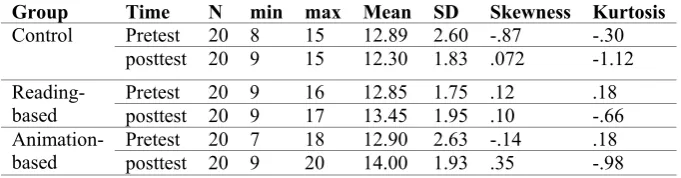
Efficacy of FS Instruction (animation-based vs. text-based reading) In order to compare the achievement of the learners in the animation-based, text-based reading, and control groups on the ACTFL OPI test from the pretests to the posttests, descriptive statistics were calculated. Descriptive statistics of the pretest and posttest oral proficiency scores in all three groups of the study are displayed in Table 1. As is evident in Table 1, the mean and standard deviation (SD) of the animation-based and reading-based groups' oral proficiency scores have highly improved during FSs instruction compared to the control group, which continued its usual traditional syllabus. As can be seen in Table 1, learners' scores on both pretest and posttest have satisfying normal distribution since Kurtosis and Skewness values of the learners' scores do not violate the range of ±1.5.
Table 1.
Descriptive Statistics of Pre- and Posttests Results
For the current study, a one-way ANOVA was run on the pre-test scores to ensure the initial homogeneity of the participants in terms of general language proficiency. Based on Levine's equality of error variance,
F (2, 57) = 2.6, p = .08, there was no significant difference across the three
Group Time N min max Mean SD Skewness Kurtosis
Control Pretest 20 8 15 12.89 2.60 -.87 -.30
posttest 20 9 15 12.30 1.83 .072 -1.12
Reading-based Pretest 20 9 16 12.85 1.75 .12 posttest 20 9 17 13.45 1.95 .10 .18 -.66
Animation-based
Pretest 20 7 18 12.90 2.63 -.14 .18
groups. Then, an analysis of covariance (ANCOVA) was applied to examine the effect of FSs instruction on young Iranian L2 learners' oral proficiency improvement. The scores on the pre-test are treated as a covariate to 'control' the pre-existing differences between the groups (because the participants of the study were not the same concerning their attributes). It was essential to be assured that the data can be analyzed using ANCOVA by considering the basic underlying assumption including homogeneity of the variances, regular distribution of the dependent variable (posttest scores) for every one of independent variables (group), and at last, no interaction between pretest scores and the treatment in different groups.
Table 2.
ANCOVA Results for Participants Oral Proficiency Improvement
Source Type III
Sum of Squares Degree of freedom (df) Mean
Square F Sig. Partial Squared Eta
Corrected
Model 207.610
a 3 113.537 34.29 .000 .648
Intercept 124.007 1 128.007 40.02 .000 .310
Group 147.794 2 49.897 48.19 .000 .334
Pretest 59.977 1 19.977 21.09 .000 .562
Error 125.573 56 .878 Total 1055.000 60
Corrected
Total 344.183 59
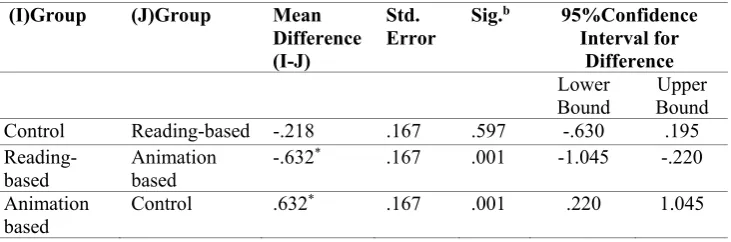
Also, a set of Bonferroni-adjusted comparisons was run to determine which instruction was more influential for oral proficiency improvement. The results are displayed in Table 3. Based on the post hoc (Bonferroni-adjusted) pairwise comparisons, both animation-based and reading-based instruction of FSs improved the oral proficiency of the students in comparison with the control group. Moreover, the results revealed that animation-based instruction had a more significant effect rather than the reading-based one.
Table 3.
Pairwise Comparisons between Different Groups Oral Proficiency
(I)Group (J)Group Mean
Difference (I-J)
Std.
Error Sig.
b 95%Confidence
Interval for Difference
Lower
Bound Bound Upper
Control Reading-based -.218 .167 .597 -.630 .195
Reading-based Animation based -.632
* .167 .001 -1.045 -.220
Animation
based Control .632
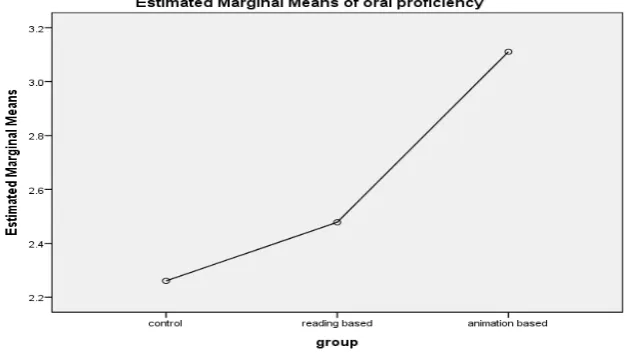
Moreover, Figure 1 demonstrates the higher oral proficiency of experimental groups in comparison with the control group. As it was elicited from the pretest scores, three groups were recognized as homogeneous samples, while the posttest mean scores showed remarkable
achievement due to FSs instruction in both experimental groups. Also, it reveals more excellent oral proficiency of animation-based group in comparison with both the reading-based and control group, which had no focus on FSs.
Figure 1.
Interaction Plot for the Groups’ Oral Proficiency Improvement through FSs Instruction
Discussion
non-lexis instructions of the school without any focus on the principles of the Lexical Approach. The underlying logic for this result is linked to the theoretical assumptions of FSs as they are fixed strings of words, saved in long-term memory as a lexicon, and act as idiosyncratic units of meaning that can be retrieved automatically. Due to their holistic nature of retrieval from memory, this lexicon can increase the pace of language production to reducing unnecessary pauses for analyzing the grammatical rules and making the appropriate cluster of words in early levels of language learning. This is what Lewis (1993; p, 89) had contended by the term of "grammaticalized lexis."
The results of this study concur with the research attempt by Bisson et al., (2014), who have explored the significance of multimedia exposure and incidental L2 learning. Despite the efforts for teaching FSs intentionally, the learners acquire some peripheral proficiency qualification, such as native-like accent and pronunciation. Therefore, posttest scores were highly improved in comparison with the pretest scores, while the interviewers reported that the experimental groups were more confident in articulating longer runs of word strings in the posttest in comparison with the pretest. It can be concluded that in terms of accuracy and fluency of speech, prefabricated chunks created a repertoire for EFL students' impetuous utterances. The learners could retrieve strings of words from their memory, and thus they could maintain a long run of speech. Moreover, the binary nature of incidental and intentional learning co-occurs in an animation-based instructional style, and the learners could benefit from both types of incidental and intentional learning strategies.
In this study, the FSs were represented in both Paivio's codes. The learners had virtual subtitles as their verbal codes displayed on IWB, as they were following the imaginable occurrence of FSs in the speech of animation characters. As Sundberg (1998) declares, animation builds a referential connection between inputs from these two codes. To this end, animation and IWB were useful devices for teaching FSs to EFL learners rather than other instructional methods, like reading. The findings of this study lent additional support to Lewis (1993) and O’keeffe et al. (2007), who have demonstrated the effects of computers and technology interface with the curriculum of language instruction. Based on the results of this study, animation as a digital resource has the potential to create integrative motivation for young learners.
of the characters. To avoid communication failure, the learners persevered with FSs learning, which signified sources of intrinsic motivation (Schmidt et al., 1996). Based on the reports prepared by the instructors, the learners of the animation-based group strived for learning whatever facilitated their understanding of the chosen animation. As they were involved in learning activities, they were tracing the path for integrating with the L2 community in terms of imitating a native-like oral speech. Based on the mentioned justification, animation has a powerful influence on both intrinsic and integrative motivation stimulation.
Moreover, the results of this investigation supported the perspective of Wood (2007), who believes that having a vast repertoire of FSs can speed up the rate of language production and consequently improve oral proficiency. Focusing on produced utterances in the posttest revealed that memorizing the words in chunks could increase the young learners' ability for predicting words occurrence in a fixed order. Therefore, the production of inappropriate and strange word combinations by these non-native learners was rare. Besides, the students did not need to learn complicated grammatical rules at an early age due to their repertoire of FSs with the holistic nature of retrieval from memory. Consequently, more accurate and fluent utterances were produced, and the learners became more proficient speakers.
as aptitude, learning strategies and styles, motivation, and processing ability) together for successful language learning. The growth of language knowledge by producing new representations continued by fluency improvement (which is a subfactor of oral proficiency) through accessing those representations.
Like any research, the current study suffers from some restrictions and leaves the research gates open for future researchers of related domains. Meanwhile, the empirical data of this study draws upon a small number of participants who belong to an immersion program school. Thus, larger samples of EFL from different language centers would be more representative. Although the aim of this study is having a clear picture of the implication of FSs to improve English oral proficiency in academic situations, the picture does not cover the entire broad spectrum of every young EFL student. Also, the matter of subjective judgment of the experienced judges can be questioned.
Conclusion
Furthermore, this research offers guidance for teachers and administrators during the process of curriculum and syllabus development to use formulaic language to improve oral communication during the early stages of EFL instruction. They can offer a contextualized course and attend to the teaching of FSs with the assistance of computers in their curriculum. The results will be beneficial for materials designers as well; for example, they can use animations to motivate the learners to facilitate their academic-based learning of L2.
Conducting studies like the present one is useful for opening new practical perspectives toward EFL instruction through computerized resources like animation and IWB and the effect of these resources on psycholinguistic and pedagogical matters of language learning. The results of the study may help the teachers to employ the approaches which are consistent with the motivations of their learners. Animation reduces the EFL students' boredom and motivates the learners to get involved in the learning procedure. Also, it vitalizes the disappointed teachers, adding interest to their classroom’s atmosphere.
The advantages of FSs instruction are more noticeable for immersion program school students who use language as a medium of understanding scientific content at young ages. At this age and level of knowledge, the students even do not know much about their own language's grammar. In this respect, FSs instruction can pave the way for the need of grammar for primary levels of EFL due to its holistic approach toward receptive and productive language learning skills.
It was conferred from the results that animation has the capability to teach new cognitive content in the field of language pedagogy as it can apply new linguistic codes (L2) mapped onto previously learned concepts. Although, there is a need for further investigations to devise practical strategies for its implication in an L2 pedagogical system.
proficiency. Besides, knowing about the pedagogical implications of FSs can be important for L2 practitioners (e.g., L2 teachers and students) in most of the L2 classes. Therefore, L2 learners and teachers should not only pay attention to the formulacity of language, but they should also consider the most valuable resource for FSs instruction.
References
AlHassan, L., & Wood, D. (2015). The effectiveness of focused instruction of formulaic sequences in augmenting L2 learners’ academic writing skills: A quantitative research study. Journal of English for
Academic Purposes, 17, 51– 62.
Appel, R., & Wood, D. (2016). Recurrent word combinations in EAP test-taker writing: Differences between high-and-low-proficiency levels.
Language Assessment Quarterly, 13(1), 55–71.
Alsagoff, L. (2018). Describing Proficiency. In John I. Liontas (Ed.), (Project Editor: Margo DelliCarpini; Volume Editor: Shahid Abrar-ul-Hassan), The TESOL Encyclopedia of English Language Teaching (Vol. 1, pp. 87-99). Hoboken, USA: John Wiley & Sons, Inc.
Bakhshizadeh, Y., Rahimi Domakani, M., & Rajaei, M. (2015). The effect of explicit instruction of formulaic sequences on oral proficiency improvement of young Iranian EFL students. International Journal
ofForeign Language Teaching and Research, 3(10), 44–52.
Bisson, M.-J., van Heuven, W. J. B., Conklin, K., & Tunney, R. J. (2014). The Role of Repeated Exposure to Multimodal Input in Incidental Acquisition of Foreign Language Vocabulary. Language Learning,
64(4), 855–877.
Chan, T. P., & Liou, H. C. (2005). Effects of web-based concordancing instruction on EFL students’ learning of verb-noun collocations.
Computer-assisted Language Learning, 18(3), 231–250.
Doughty, C & Williams, J (1998). Focus on form in classroom SLA. Cambridge, England: Cambridge University Press.
Ellis, R. (1994). The study of second language acquisition. Oxford: Oxford University Press.
Ellis, N. (1996). Sequencing in SLA: Phonological memory, chunking, and points of order. Studies in Second Language Acquisition, 18(1),
91–126.
Gardner, R. C. (1985). Social psychology and second language learning: The role of attitudes and motivation. London: Edward Arnold. Hall, I. & Higgins, S. (2005). Primary school students’ perceptions of
interactive whiteboards. Journal of Computer Assisted Learning 21, 102–117.
Huemer, S., Landerl, K., Aron, M., & Lyytinen, H. (2008). Training reading fluency among poor readers of German: Many ways to the goal. Annals of Dyslexia, 58, 115–137.
Hunston, S., & Francis, G. (2000.) Pattern grammar: A corpus-driven approach to the lexical grammar of English. Amsterdam, the Netherlands: John Benjamins.
Jones, M., & Haywood, S. (2004). Facilitating the acquisition of formulaic sequences. In N. Schmitt (Ed.), Formulaic sequences (pp. 269–292). Amsterdam, the Netherlands: John Benjamins.
Karemaker, A., Pitchford, N. J. & O’Malley, C. (2010). Enhanced recognition of written words and enjoyment of reading in struggling beginner readers through whole-word multimedia software. Computers and Education, 54, 199–208.
Keller, R. (1979). Gambits: Conversational strategy signals. Journal of
Kuiper, K. (2009). Formulaic genres. Basingstoke, England: Palgrave Macmillan.
Lewis, M. (1993). The lexical approach: The state of ELT and a way
forward. Hove, England: Language Teaching Publications.
Lewis, M. (1997). Implementing the lexical approach: Putting theory into practice. Hove, England: Language Teaching Publication.
Lewis, M. (2000). Learning in the lexical approach. In M. Lewis (Ed.),
Teaching collocation: further development in the lexical approach
(155–184). Hove, England: Language Teaching Publication.
Lynch, T. (2001). Seeing what they mean: Transcribing as a route to noticing. ELT Journal, 55(2), 124–132.
Lyster, R., & Ranta, L. (1997). Corrective feedback and learner uptake: Negotiation of form in communicative classroom, Studies in Second
Language Acquisition, 19 (1), 37–66.
McCarthy, M. (1990). Vocabulary. Oxford University Press.
Mirzaei, A., Hashemian, M., Azizi Farsani, M. (2016). Lexis-Based Instruction and IELTS Candidates’ Development of L2 Speaking Ability: Use of Formulaicity in Monologic Versus Dialogic Task. Journal of Teaching Language Skills, 35(2), 69-98. doi: 10.22099/jtls.2016.3816
Moudraia, O. (2001). Lexical approach to second language teaching. Eric Digest EDO-FL-01-02. Washington, DC: ERIC Clearinghouse on Languages and Linguistics. Retrieved from http:// www.cal.org/ericcll/digest/0102lexical.html
Nattinger, J. R., & DeCarrico, J. S. (1992). Lexical phrases and language
teaching. Oxford: OxfordUniversity Press.
O'Keeffe, A., McCarthy, M., & Carter, R. (2007). From corpus to
classroom: Language use and language teaching. Cambridge,
England: Cambridge University Press.
Paivio, A. (1986). Mental representations: A dual-coding approach.
Oxford, England: Oxford University Press.
Palmér, A. (2010). Muntligt i klassrummet- om tal, samtal och bedömning. Lund, Sweden: Studentlitteratur.
Pawley, A., & Syder, F. H. (1983). Two puzzles for linguistic theory: Nativelike selection and native-like fluency. In J. C. Richards & R. W. Schmidt (Eds.), Language and communication (pp. 191–226). London, England: Routledge.
Perera, N.S. (2001). The role of prefabricated language in young children’s second language acquisition. Bilingual Research Journal, 25(3), 327–356.
Rieber, L. P. (1989). A Review of Animation research in Computer-based Instruction. In Proceedings of Selected Research Papers presented at the Annual Meeting of the Association for Educational Communications and Technology. Dallas, Texas. (ERIC Document Service No. ED 308 832).
Rieber, L. P. (1990). Effects of animated visuals on incidental learning and motivation. Proceedings of Selected Paper Presentations at the Convention of the Association for Educational Communications and
Technology. (pp. 479-489).
Saine, N. L., Lerkkanen, M.-K., Ahonen, T., Tolvanen, A., & Lyytinen, H. (2011). Computer-assisted remedial reading intervention for school beginners at risk for reading disability. Child Development, 82, 1013–1028.
Saine, N. L., Lerkkanen, M.-K., Ahonen, T., Tolvanen, A., & Lyytinen, H. (2013). Long-term intervention effects of spelling development for children with compromised preliteracy skills. Reading and Writing Quarterly, 29, 333–357.
Schmitt, N. (2004). (Ed.). Formulaic sequences: Acquisition, processing,
Schmidt, R. (1990). The Role of consciousness in second language learning. Applied Linguistics, 11(2), 129–158.
Schmidt, R. (2010). Attention, awareness, and individual differences in language learning. In W. M. Chan, S. Chi, K. N. Cin, J. Istanto, M. Nagami, J. W. Sew, T. Suthiwan, & I. Walker, Proceedings of
CLaSIC 2010, Singapore, December 2-4 (pp. 721–737). Singapore:
the National University of Singapore, Centre for Language Studies. Schmidt, R., Boraie, D., & Kassabgy, O. (1996). Foreign language
motivation: Internal structure and external connections. In R. Oxford (Ed.), Language learning motivation: Pathways to the new century
(pp. 9–70). Honolulu: University of Hawaii Press.
Serrano, R., Stengers, H., & Housen, A. (2015). Acquisition of formulaic sequences in intensive and regular EFL programs. Language
Teaching Research, 1–18.
Singh, S. (2015). Self-assessment of oral proficiency among ESL learners.
ELT Voices - India’ International Journal for Teachers of English,
5(1), 1–7.
Sundberg, P. (1998). Animation in CALL: Learning to think in the fourth dimension. Paper Presented at CALICO '98 Symposium, San Diego, California. The University of Illinois at Urbana-Champaign
Taguchi, N. (2008). Building language blocks in L2 Japanese: Chunk learning and the development of complexity and fluency in spoken production. Foreign Language Annals, 41(1), 130–154.
Tomasello, M. (2000). The item-based nature of children’s early syntactic development. Trends in Cognitive Sciences, 4(4), 156–163.
Vihman, M. M. (1982). Formulas in first and second language acquisition, In L. K. Obler & L. Menn (Eds.), Exceptional language and
Linguistics (pp. 261–284, New York, NY: Academic Press.
Walker-Tileston, D., 2004. What every teacher should know about media
Wong-Fillmore, L. (1976). The second time around: Cognitive and social
strategies in second language acquisition. Unpublished doctoral
dissertation, Stanford University, Stanford, CA.
Wood, D. (2007). Measuring the link between formulaic sequences and speech fluency: Implications for the language classroom. Contact, 33 (2), 97 –117.
Wood, D. (2010). Formulaic language and second language speech
fluency: background, evidence, and applications. London, England:
Continuum.
Wray, A. (2002). Formulaic language and the lexicon. Cambridge, England: Cambridge University Press.
Wray, A., & Fitzpatrick, T. (2008). Why can’t you just leave it alone? Deviations from memorized language as. Phraseology in foreign
language learning and teaching, 123.
Yoffe, L. (1997). An overview of ACTFL proficiency interviews: A test of speaking ability. Shiken: JALT Testing & Evaluation SIG
Appendix A ACTFL Rating Scale
Appendix B
The subtitle of played animation episodes for current research (Containing FSs)
00:01:38,111 --> 00:01:39,976 - What are you doing here? - Get inside!
00:01:40,113 --> 00:01:42,911 - What are you doing out? - Get back inside!
00:01:45,452 --> 00:01:50,048 Hiccup! What is he doing...?
That's Stoick the Vast, chief of the tribe. 00:01:53,960 --> 00:01:58,829
When he was a baby, he popped. A dragon's head clean off its shoulders. 00:01:58,965 --> 00:02:01,092
Do l believe it? Yes, l do. 00:02:01,234 --> 00:02:02,258 What have we got?
00:02:02,402 --> 00:02:06,202 Gronckles. Nadders. Zipplebacks. Hoark was a Monstrous Nightmare. 00:02:07,674 --> 00:02:09,801 - Any Night Furies?
- None so far.
00:02:09,943 --> 00:02:11,035 Good.
00:02:11,178 --> 00:02:13,009 Hoist the torches!
00:02:18,685 --> 00:02:21,882 Nice of you to join the party! I thought you'd been carried off! 00:02:22,022 --> 00:02:26,857 Who, me? No, come on,
I’m Way too muscular for their taste. 00:02:26,993 --> 00:02:30,224 They wouldn’t know
Appendix C
Playing Animation via Interactive Board
Appendix D
2) In a country, there is a boy that name is Hiccup. The name of the village is Berk. Once night 6 or 7 dragons fired this village. The soldier try to kill dragons but every places fired and eyes didn't see. Hiccup's father says: what are you doing here?Get inside! Hiccup's father says: what are you doing out! Get back inside! Hiccup's father says: what is he doing…What are doing out?Get inside! Hiccup's friend says: nice of to you to join the party! I thought you'd been carried off! Hiccup says: who, me? No, come on, I'm way too muscular for the taste. Hiccup say: they wouldn't know what to do with all this.
3) My subject is how train your dragon. Berk is quiet land, and Wikings live in Berk. Hiccup grow up in Berk. One day, dragon attacked the Berk. Although dragon was strong but people resist. Hiccups father say: what are you doing here?! Get inside. What are you doing out?! Get back in side! Hiccup! What is he doing …? What are you doing out?! Get inside! Fathers Friend or Gabber say: nice of you to join the party! I thought you’d been carried off! Hiccup say: who, me? No, come on. I’m way too muscular for their taste. They wouldn’t know what to do with all this! This story is about how to train your dragon special person of story is hiccup .hiccup wanted help his father but he can’t father says what are you doing here get inside ! What are you doing out get back inside! Hiccup what is he doing what are you doing out get inside! Goberl says nice of you to going the party! I thought you’d been carried off! Hiccup says who me no come on I’m way too muscular for their taste they wouldn’t know what to do with all this.