Volume: 04, Issue: 01 (January- February, 2018)
Modeling of Two-Tier Cellular Network Using Channel Sub Rating CAC with
Queuing in Microcell
Pankaj Goel, D K Lobiyal
School of Computer and Systems Sciences, JNU, New Delhi
1[email protected], 2[email protected]
Abstract– Designing two-tier network is a challenging task with demanding quality of service by users. Call admission control scheme play important role in designing network. We are using channel sub-rating scheme with queuing in microcell to design the network. In this paper, M/M/c/k queuing model is used in microcell for handoff calls. Further, we have considered a cost optimization problem of two-tier cellular network with constraint as call blocking and call dropping probability. We have also taken care of voice degradation ratio in this work. Admission of class based new calls and handoff calls in Microcell and Macrocell has been modeled in one and two dimensional Markov chain. Results of optimization problem using genetic algorithm are compared with the results of the existing model.
Keywords–Cellular Network, Tier, Channel sub-rating
CAC, Genetic Algorithm, Simulated Annealing, Markov Chain, Queuing model.
INTRODUCTION
In recent years there is remarkable growth has been observed in the increase of mobile cellular users. It has been seen that many new network operators shown interest to buy new bandwidth from government. Some old networks are merge due to present scenario and government policies for example merger of Reliance communication and MTS brand operate in nine circles in India. India has become the third-largest Smartphone market in the world. The number of Smartphone users is expected to reach 340 million by 2018 and the cellular infrastructure should be developed accordingly [60]. In present scenario Quality of Service (QoS) become important agenda between the different mobile operators as some of the operators like reliance shut down existing CDMA based network and switch to 4G network. Different network operators are giving different offers to attract users. Quality of service play important role to select a mobile operator. Quality of Service becomes a challenging task due to limited frequency spectrum. For effective utilization of the spatial reuse of frequency spectrum, multi-tier architecture may be a good solution. In Two tier-cellular tier-cellular networks, whole area is cover by two layer macrocell and microcell respectively. Channels are distributed among cell according to quality of service parameter like transmission power, line of sight, low power uses, co-channel interference and spectrum size. Base station is present at each cell which transmits signal and communicates to the mobile switching center. Call blocking probability and call dropping probability are considered as essential quality of service measure to design two-tier cellular network. Population of metro city like Delhi is increasing tremendously and many people
come here daily for different purpose and require mobile services. Due to this demand for more channels is increasing for dealing with handoff process along with existing tariff load. Designing of two-tier network is become important issue for such changing situations. In this paper, we are using channel sub-rating call admission control policy with queuing model M\M\c\k. We have considered a two-tier cellular networks problem as an optimization problem to minimize the implementation cost of a network with the constraints as call blocking, call dropping probability, mean degradation ratio of the voice quality in microcells and macrocells, and number of microcells covered by a macrocell assumed as an odd integer. Further, this optimization problem is solved by using Genetic Algorithm. The remaining of the paper is as follows. Research work related to two-tier cellular network carried out in the literature is presented in section 2. The mathematical model developed in this work is explained in section 3. Genetic Algorithm used for solving the sub-rating CAC with queue optimization problem in Cellular Network (GASCN) is presented in section 4. Numerical results are discussed in section 5. Finally the conclusion of the work presented in this paper is presented in the last section.
RELATED WORK
India has become the third-largest Smartphone market in the world. The number of Smartphone users is expected to reach 340 million by 2018 and the cellular infrastructure should be developed accordingly. Splitting a cell into small cell may be one solution but it increases the handoff rate and cost of implementation also [1].Multi-tier cellular network may be a prospective solution to satisfy QoS and manage the large number of users [2]. Multi-tier cellular network provides high capacity and better coverage with respect to traditional cellular network. In a two-tier network, macrocell with radius around one km work as upper layer while microcell radius around 0.5 km work as lower layer. Heterogeneous Cellular Networks consider k
probability while call dropping probability satisfy minimum requirement. Xiaolong et al [7] proposed call sub-rating CAC using one and two dimensional Markov chain for microcell and macrocell respectively. Madhu Jain and Ragini Mittal [9] proposed a model with handoff priority and handoff guarantee service for integrated wireless cellular model. Wang, S. Arun kumaar and Wen Gu[11] proposed a channel assignment scheme such that minimum call interference exists and solved this using genetics algorithm. Salih, Fidanboylu[16] proposed a two-tier cellular network with queuing handoff calls.
MATHEMATICAL MODEL
In this paper, we considered a two-tier network where upper and lower tier consists of macrocells and microcells respectively. In this model two types of traffic is consider one is fast mobility with low bit rate user and other is slow mobility with high bit rate users. First type of users is directed to macrocell whiles other type is directed to microcell. New mobile and handoff users, who could not find channel in microcell, are overflowed to macrocell. If a handoff user request for channel in microcell and all channels are busy channel sub rating is applied. A FCFS queue with size 3 is used to handle the handoff calls in excess of sub-rated channel in microcell. M/M/c/k queuing model is used for modeling of Markov chain. In the designing of two tier cellular networks, it is important to determine the optimal number of microcells and macrocells to achieve the high performance. Therefore, in this paper we have formulated the network design as an optimization problem to estimate the cost of designing a two tier cellular network.
3.1 Model assumptions
For constructing mathematical model, we have made the following assumptions: Macocells and microcells both cover the service area separately. A macrocell consists of odd number of microcells. Macrocell have radius 1.5 km while microcell is with radius of 0.5 km. here are two mobility classes one as fast and low bit rate user while other as slow mobility with low bit rate user. First classes users are directed to macrocell while other to microcell. We assume that mean speed of both users is exponentially distributed and remain constant during the call duration. Channels are randomly distributed among the macrocells and microcells. The time spent by a user in a cell is called dwell time and calculated as given in [12]. Call arrival rates of both the class of users are exponentially distributed. When all channels are occupied by new calls and/or handoff calls, a full rate channel is temporarily divided into two channels called sub-rating channels. One to serves the existing call and other serves new incoming handoff call. Division of full rated channels into sub-rating channels is restricted to total no of channels in a particular cell. Only handoff calls use sub-rated channels. In a microcell if all channels are sub-rated than M/M/c/k queuing model with FIFO discipline and size thee is used . If queue is full than handoff calls are directed to over layered macrocell.
2.2 Model formulation and parameter 3.2.1 Performance analysis of microcell
Microcell layer of two-tier cellular network can be modeled in terms of one-dimensional Markov chain[6]. In this model we use M/M/c/k queuing and fixed number of serving channels and fixed sized of queue of 3.The mean queue time depends on mean cell dwelling time and maximum crossover distance m , over the overlapping zone between two cells. Mean queen time is shown as[16] Mean queue time
The variables used in modeling are defined as follows
:slow mobility call arrival rate in microcell
: Slow mobility asymptotic handoff rate in microcell
: Dwell time of the slow mobility user in Microcell
: Mean call duration
r :microcell radius
R: macrocell radius
:mean speed of slow mobility user
: number of channels in microcell
: call arrival rate per second per for slow mobility
user
: Microcell call blocking probability : Microcell call dropping probability
Where
A Markov chain for a microcell with n channels is presented in fig 1
2c c
0 a…... n
a b
(n+1)c
……..
2nc
(2n-1)c b
…….. a
Figure 1 Transition diagram of n channels microcell with sub-rated channel and queue size 3
2nc+d 2nc+2d 2nc+2d
…...
1 n 2n-1 b 2n b 2n+1 b 2n+2 b 2n+3
In figure 1 state corresponds to number of call served by a microcell. Each microcell has n number of channels. If number of free channels is less or equal to n only then new call or handoff call is accepted. A new call is blocked and transferred to macrocell, if number of busy channels is greater than n. If a handoff call comes and number of busy channels is greater than n, busy channel is divided into two sub-rated channels one serving existing call and other serving handoff call. There are (2n-i) full rate and 2(i-n) half rate channels available for If all channel
are sub-rated, M/M/k/c queue of size 3 channels are used by only handoff calls. When queue is full handoff call is blocked and overflowed to the macrocell. From the state diagram in fig-1 the steady state probabilities in microcell is given as follows: The steady state equation for state 1 is
so
The steady state equation for state 2 is
Volume: 04, Issue: 01 (January- February, 2018)
or
The steady state equation for state (n--1) is
The steady state equation for state n is
The steady state equation for state (2n-1) is
The steady state equation for state 2n is
The steady state equation for state 2n+1 is
The steady state equation for state 2n+3 is
After solving above equations we get
The Asymptotic handoff rate is calculated iteratively
until difference between two iterations is less than 0.0000005 using the following formula
The slow new calls in the microcell are blocked after all n channels are busy and calls are blocked. Therefore, the call blocking probability in microcell can be represented as
The slow handoff calls in the microcell are dropped, if all channels are sub rated. The call blocking probability
is given as
The blocked slow calls in a microcell overflowed to the macrocell with rate and dropped handoff calls
overflow to the macrocell with rate .The overflow call
rate and overflow handoff rate are given as
Where ,
Due to sub-rating of channels, voice quality degraded. Therefore, in the designing, while sub rating, voice quality parameter may be considered to allow permissible degradation of voice quality. It can be taken care of by calculating the degradation ratio of voice quality as given in [7]. The expected number of the busy channels in the microcell layer, is given as
The expected number of the sub-rated channels in
the microcell layer, is given as
The voice quality degradation ratio in
microcellis given as
3.2.1. Performance analysis of macrocell
Macrocell layer of two-tier cellular network can be modeled as a two-dimensional Markov chain[17]. The variables used in modeling are defined as follows
: Fast mobility call arrival rate in a macrocell
: Fast mobility asymptotic handoff rate in a Macrocell : Slow mobility asymptotic handoff rate once they
enter a macrocell
: Dwell time of the slow mobility user in the Macrocell : Dwell time of the fast mobility user in the Macrocell
Mean call duration
: Mean speed of a fast mobility user
: Number of channels in a macrocell
: Call arrival rate per second per for fast mobility
users
Call blocking probability in a macrocell Call dropping probability in a macrocell
Where
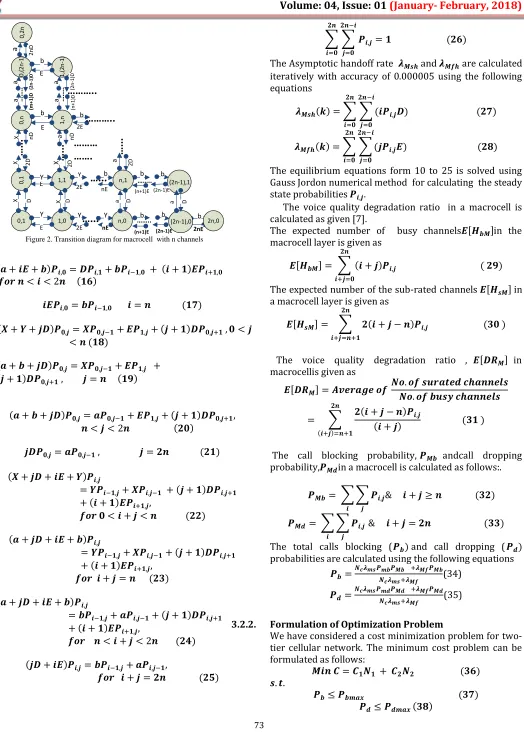
A Markov chain for a macrocell with n channels is presented in fig 2. In this figure a state corresponds to the number of fast users i and slow users j served by a macrocell. Using state transition diagram given in figure 2, the equilibrium equations can be written as follows
(2n-1)E 0,1 0 ,1 D X 2E 1,0 E Y …... nE Y b (n+1)E
…….. b
2nE 2n,0 (2n-1),0 b n,0 Y 2E 1,1 E Y …... nE b b (n+1)E
…….. b (2n-1),1
(2n-1)E
n,1 Y
X D a D a D
2
D
X
…
..
. nD
X a (m +1 )D … … .. a 0 ,2 n 0 ,( 2 n -1 ) a (2 n -1 )D 0 ,n 2 D X … .. . n D a a (n +1 )D … … .. 1 ,( 2 n -1 ) a (2 n -1 )D 1 ,n
a 2D
… .. . b b E 2E b E ……… ……. ………..
Figure 2. Transition diagram for macrocell with n channels
2 n D ………..
The Asymptotic handoff rate and are calculated
iteratively with accuracy of 0.000005 using the following equations
The equilibrium equations form 10 to 25 is solved using Gauss Jordon numerical method for calculating the steady state probabilities .
The voice quality degradation ratio in a macrocell is calculated as given [7].
The expected number of busy channels in the
macrocell layer is given as
The expected number of the sub-rated channels in
a macrocell layer is given as
The voice quality degradation ratio , in macrocellis given as
The call blocking probability, andcall dropping
probability, in a macrocell is calculated as follows:.
The total calls blocking ( and call dropping ( probabilities are calculated using the following equations
(34)
(35)
3.2.2. Formulation of Optimization Problem
We have considered a cost minimization problem for two-tier cellular network. The minimum cost problem can be formulated as follows:
Volume: 04, Issue: 01 (January- February, 2018)
Where C is total cost of designing a micro-macro cell system. The cost of designing one unit of microcell and macrocell are respectively. The number of
microcells and macrocells in the system are
respectively.
The radius of microcell and macrocell are represented
by and respectively. and are maximum
acceptable values of call blocking and call dropping probabilities respectively. and
are maximum acceptable mean degradation
ratio of the voice quality in microcell and macrocell respectively. C is the total cost of designing a system. Inequality constraints in equation (37) and (38) represent the call blocking and call dropping probabilities which should be less than the given limits. Inequality constraints in equation (39) and (40) represent mean degradation ratio of the voice quality that should be less than the given limit. Inequality constraints in equation (41) and (42) represent total coverage area. Inequality constraints in equation (43) represents that there should be integer number of covering microcells in a macrocell. We solve the above optimization problem by using a Genetic Algorithm.
GASCN ALGORITHM
The Genetic Algorithm to solve sub-rated Cellular Network (GASCN) optimization problem proposed in this work is given as follows:
Step-1:Initialized population
First we considered genes of 4 cell with field
Ch1 Ch2 r R
Where
Ch1 is number of channels in a microcell
Ch2 number of channels in a macrocell
r radius of a microcell
R radius of a macrocell
The population is initialized by generating randomly Ch1, Ch2 , r and R..For example a gene C1 can be as follows
17 13 488 1464
Using the fitness function population is accepted if R/r is an odd integer; otherwise again new population is generated. We have considered an initial population of 40 chromosomes.
Step-2:Mutation
Select a gene randomly from the feasible population and then select a random position p between 1-4 in the gene
If(p<=2) then
Generate that particular cell, i.e. 1 or 2 accordingly
Else if (3<= p <=4 ) then
Generate both cell 3 and 4 such that R/r is odd integer
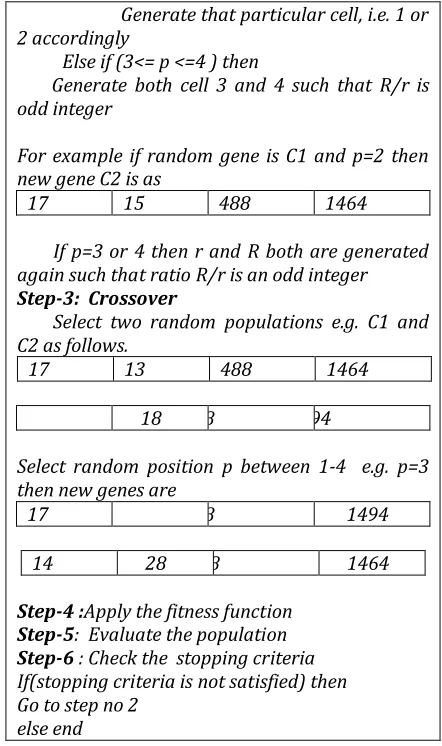
For example if random gene is C1 and p=2 then new gene C2 is as
17 15 488 1464
If p=3 or 4 then r and R both are generated again such that ratio R/r is an odd integer Step-3: Crossover
Select two random populations e.g. C1 and C2 as follows.
17 13 488 1464
14 18 498 1494
Select random position p between 1-4 e.g. p=3 then new genes are
17 13 498 1494
14 28 488 1464
Step-4 :Apply the fitness function Step-5: Evaluate the population Step-6 : Check the stopping criteria If(stopping criteria is not satisfied) then Go to step no 2
else end
EXPERIMENTATION AND RESULTS
The GASCN algorithm is used to solve the optimization problem described in 3.2.3 as follows. First an initial population of 40 is generated. Ch1 and Ch2 are randomly generated between (11,20). Let the radius of microcell(r) is approximately 0.5 km meters and the radius of macrocell (R) is between 800-1500 meters. Radius r and R are randomly generated between 100-600 and between 800-1500 respectively. We apply GASCN algorithm for the base problem using the parameters given in table 1. The results of the experiments are given in table 2.
Table -1
Parameters with their base values Parameter Base Value
1 m/s 8m/s
calls per sec per
calls per sec per
100 sec
10 cost unit 30 cost unit
A 50000
CS 7
0.001
0.005
0.005
150
Table -2
Values of decision parameters for the base problem
Parameter Result of queuing with sub-rated
C 87680
14
20
r 492m
R 1476m
R/r 3
6.6189x
2.9337x
1.0053x
7.1036x
Using queuing sub-rating CAC model, we obtained a total system cost of 87680 while using the same parameter with guard channels GACN [6] algorithm gives cost of 114240 and GA[5] gives cost 152060.This shows that our model gives better result than the result of GACN and GA. From the above results it can be observed that mean degradation ratio of the voice quality in microcell and macrocell are within the given threshold limit used in the modeling.
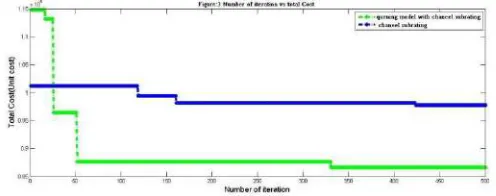
To observe the convergence of algorithm cost is evaluated for different iterations as shown in figure 3. Graph in figure 3 shows that in queuing with channel sub-rating, starting cost is 114790 and as the iteration increases ,the cost decreases. Starting iteration cost is sharply decreased but after 300 iteration it remains constant so we can say the algorithm converges. This graph also shows convergence of channel sub-rating model [17] for the same parameters but without queuing model .
Now we apply our problem on metro city. According to lifestyle of city we take slow mobility user speed as 20m/s and fast mobility user speed 200m/s. We get cost of system 84914 while radius of microcell and macrocell as 500m and 1500 m respectively. Now we study the change of speed of the fast moving users from 200m/s to 1100m/s and result for this shown in Figure 4 shows that when speed of fast mobility user increases, the cost of system also increase .When speed of fast mobility user increase than number of handoffs increases and thus more channels requires. Hence radius of the macrocell is decreased, therefore the number of macrocell as well as cost of the system increases. Figure 5 shows the change in number of macrocell as fast mobility speed changes.
Figure 5 shows that as fast mobility speed changes number of macrocells changes from 708 to 759. Now we take slow mobility and fast mobility speed as 20 m/s and 200 m/s respectively. For area of region 2000 , we get cost of
system is 35680. To study the effect of change of area on cost ,We change area from 1500 to 3000 taking
step size as 500 and the result of which is shown in figure 6
Figure shows that when we increase area of the region, cost is also increased.
The comparison of the results of channel sub-rated queuing model with Simulated annealing (SA), Grady search (GS) algorithm and GACN algorithm for base values and changed values of parameters are given in Table-3.The total cost obtained using Queuing sub-rating CAC is 87860, GACN algorithm is114240, SA algorithm is 152060 and by using GS is 155390. It shows that our model using Queuing sub-rating CAC gives better result in comparison to guard channel model using different algorithms. By conducting separate experiments, we have evaluated the total cost by changing total area, slow mobility user speed and slow and fast mobility arrival rate. The results of these experiments are presented in table 3.
CONCLUSION
Volume: 04, Issue: 01 (January- February, 2018)
We also applied our model for metro city like Delhi and find the cost .
Table 3
Result obtained with GACN, SA , GS & channel sub-rating with queuing in microcell
S.
N. description GACN SA GS
Queuing Channel Sub rating 1 Base problem 114240 152060 155390 87680
2 Area=1000 22980 30990 30380 17080 3 Area=50 1160 1550 1660 900
4 Slow mobility, speed =0.25
m/s 113210 147000 154050 86270 5 Slow mobility, speed = 3 m/s 116390 157200 161260 89130
6 speed = 5 m/s fast mobility, 115870 149900 154540 85920
7 speed = 20 m/s fast mobility, 113210 162440 165560 88400
8
Slow mobility, arrival rate=
2x 102960 112590 118280 88040
9 Slow mobility, arrival rate=
15x 116390 1955400 195860 90600
10
fast mobility, arrival rate=
5x 113730 76990 77380 84910
Comparison of results with guard channel based scheme using SA ,GS and GACN using different parameters are also presented. Our results show that queuing in microcell with channel sub-rating scheme provides better results in comparison to other schemes.
REFERENCES
[1]. X. Wu, B. Murherjee, and D. Ghosal, “Hierarchical architectures in the third-generation cellular network,”
IEEE Wireless Communications, vol. 11, no. 3, pp. 62 - 71, Jun. 2004.
[2]. A. Ganz,, C. M. Krishna, D. Tang, and Z. J. Haas, “On optimal design of multitier wireless cellular systems,”
IEEE communications Magazine, vol. 35, no. 2, pp. 88 - 93, Feb 1997.
[3]. H. S. Dhillon, R. K. Ganti, and J. G. Andrews, “Modeling
and Analysis of K-Tier Downlink Heterogeneous
Cellular Networks,” IEEE Journal on Selected Area in
Communications, VOL. 30, NO. 3, APRIL 2012.
[4]. W. H. Shan and P. Z. Fan, “Performance evaluation of a
hierarchical cellular system with mobile velocity-based bidirectional call-overflow scheme,” IEEE Transactions
on Parallel and Distributed System, Vol. 14, pp. 72-83, 2003.
[5]. Eylem Ekici and Cem Erosy , “Multi-tier cellular
networking dimensioning” ,Wireless Network
7,401-411,2001
[6]. P. Goel and D. K. Lobiyal. "Minimize the Cost of Two-Tier Cellular Network Using Genetic Algorithm", International journal of control Theory and Application, Vol. 10, No. 6,pp375-387,2017
[7]. Xiaolong WU, Min HE, Fei WANG, Jun ZHENG et al.,
“Performance Analysis of Sub-Rating for Handoff Calls
in HCN” ,I. J. Communications, Network and System
Sciences, Vol. 2 No. 1,pp 1-89,2009.
[8]. Martin Taranetz, Robert W. Heathand Markus Rupp,
“Analysis of urban two-tier heterogeneous mobile
networks with small cell partitioning”, IEEE
Transactions on wireless communication, Vol. 15, No. 10, Oct 2016.
[9]. Madhu Jain & Ragini Mittal, “Adaptive call admission
control and resource allocation in multi server
wireless/cellular network”, Journal of Industrial
Engineering International, March 2016, Volume 12,No.1 , pp 71–80.
[10]. Hossein Shokri-Ghadikolaei, Carlo Fischione, Gábor Fodor, Petar Popovskiand Michele Zorzi, “Millimeter Wave Cellular Networks: A MAC Layer Perspective”
IEEE Transactions on communications, Vol. 63, No. 10, OCTOBER 2015.
[11]. Lipo Wang, S. Arun Kumaar and Wen Gu, “ Genetic
algorithms for optimal channel assignment in mobile
communications”, Neural Information Processing,
2002. ICONIP '02. Proceedings of the 9th International Conference on18-22 Nov. 2002.
[12]. L. Orthigoza-Guerrero and A.H. Ahgvami, “On Optimal
spectrum partitioning in a microcell/macrocell layout
with overflow”, in: Proceedings of the IEEE Global
Telecommunications Conference (IEEE GLOBECOM’
97), Arizona (1997)
[13]. D. Bertsekkas and R. Gallager, Data Networks, 2nd ed.
(Prentice –Hall, Englewood Chiffs, NJ, 1992)
[14]. G. Boggia, P. Camarda, and N. Di Fonzo, “Tele traffic
analysis of hierarchical cellular communication
networks, ”IEEE Transactions on Vehicular Technology,
Vol. 52, pp.931-946, 2003.
[15]. X. Yang and M. Guizani, “Optimal paging load balance
with total delay constraint in macrocell-microcell
hierarchical cellular networks,” Vol. 5, No. 8, pp. 2202
-2209, 2006.
[16]. T. Salih, K. Fidanboylu, “Modeling and analysis of
queuing handoff calls in single and two-tier cellular
networks” Computer Communication, Vol.29,2006,pp
3580-3590.