36
A Novel Method by using Bipolar Merits for Mazhar-Eslam Variability frequency
Algorithm to assess HRV for diagnostic, prognostic, and therapeutic
determinations of Heart Diseases Diagnosis
Mazhar B. Tayel1, Eslam I AlSaba2
Electrical Engineering Department, Faculty of Engineering, Alexandria University, Alexandria, Egypt
1
[email protected], [email protected], [email protected]
Abstract- In 1987, the variability of heart rate
reported to have high prognostic value due to
higher morbidity and mortality in patient suffering
from myocardial disease. And this acts an
indication for increasing the risk of cardiovascular
events. One of the most important tests which used
for assessing the function of the autonomic nervous
system is the response of heart rate (HR) to the
autonomic nervous system. Different research
have demonstrated a link between Heart Rate
Variability (HRV) and poor prognosis after heart
attack, it approved that HRV measurements are
widely effective for risk prediction of future
cardiac events in heart attack survivors. For
previous causes, HRV has a periodicity for
monitoring and following up the cases. The present
work introduces a novel method which reliable to
analyze the linear and nonlinear behavior of heart
complex wave variability, as the heart complex
wave signal structure is not simply linear, but it
also involves nonlinear contributions, and the two
are correlated totally. In order to assess the use of
the HRV as a versatile tool for heart disease
diagnosis more ever introduce a declaration for
the concept of the Lyapunov Exponent (LE)
parameters to be used for HRV diagnosis and
proposes a modified algorithm for more sensitive
parameter computation. With giving a clear insight
about the merits for using the bipolar in
Mazhar-Eslam Variability Frequency (MVF).
Keyword:--- Bipolar, Diagnosis, Heart Rate
Variability (HRV), Mazhar-Eslam Variability
Frequency (MVF), Morbidity.
INTRODUCTION
RR- Variability is the other name for the variability of
the heart rate (HRV); it defined in simple words asthe
changes in the duration of consecutive cardiac cycles.
HRV evaluates the balancing act between (fight and
flight) and the (rest and digest), i.e. sympathetic and
parasympathetic nervous system [1]. Variety of linear,
non-linear, periodical and aperiodical oscillation
patterns are present in HR fluctuations. These patterns
can be quantified in time domain using statistical
analysis to calculate fluctuations in RR-intervals.
Also, the HRV can be studied in frequency domain to
analyze the energy content and its distribution within
the R-R intervals [2, 3, 4]. Both time domain and
frequency domain methods were studied assuming
that HRV signals are linear [5], however these
methods failed to fully quantify the dynamical
structure of the HR signals and to derive sensitive
diagnosis of HR diseases. In recent years, many
researchers have investigated the prognostic
implications of HRV in a variety of clinical
populations. Evidence suggests that reduced HRV has
prognostic significance for individuals with
myocardial infarction, chronic heart failure, and
diabetes mellitus [6, 7, 8, 9, 10, 11]; In contrast, a HR
37 to bestow a survival advantage [12]. The fact that
HRV is a result of both linear and nonlinear
fluctuations opened new Perspectives as previous
research was mostly restricted to linear techniques.
Some situations or interventions can change the linear
content of the variability, while leaving the nonlinear
fluctuations intact. In addition, the reverse can
happen: interventions. Which up till now have been
believed to leave cardiovascular fluctuations intact
based on observations with linear methods, can just as
well modify the nonlinear fluctuations. This can be
important in the development of new drugs or
treatments for patients. The introduced new algorithm
based on the Mazhar-Eslam algorithm considering
whole cases of linear and nonlinear behavior for the
HRV signal and pattern. It represents a Novel Method
for verification the importance of using the modified
Mazhar-Eslam algorithm as a most powerful indicator
for HRV diagnosis.
MAZHAR-ESLAM ALGORITHM MERITS
Mazhar-Eslam algorithm [13, 14] uses Discrete
Wavelet Transform (DWT) considering the merits of
DWT over that of FFT. Although the FFT has been
studied extensively, there are still some desired
properties that are not provided by FFT. There is some
different points lead to selection DWT instead of FFT.
The first one is hardness of FFT algorithm pruning.
When the number of input points or output points is
small comparing to the length of the DWT, a special
technique called pruning is often used [15]. However,
it is often required that those non-zero input data are
grouped together. FFT pruning algorithms does not
work well when the few non-zero inputs are randomly
located. In other words, sparse signal does not give
rise to faster algorithm. The other disadvantages of
FFT are its speed and accuracy. All parts of FFT
structure are one unit and they are in an equal
importance. Thus, it is hard to decide which part of
the FFT structure to omit when error occurring and the
speed is crucial. In other words, the FFT is a single
speed and single accuracy algorithm, which is not
suitable for sensitive dependence (SED) cases. The
other reason for not selecting FFT is that there is no
built-in noise reduction capacity. Therefore, it is not
useful to be used. According to the previous, the DWT
is better than FFT especially in the SED calculations
used in HRV, because each small variant in HRV
indicates the important data and information. Thus, all
variants in HRV should be calculated. Table 1 shows
the different results of the normal case among
Mazhar-Eslam, Wolf, and Rosenstein algorithms.
From this table it is seen that, the Rosenstein
algorithm has the lowest SED because of its quite high
error (D = 51.72 %) comparing to the optimum, while
the Wolf algorithm takes a computational place for
SED (D = 1 %). However, the Mazhar-Eslam
algorithm shows more sensitivity (D = 0.28 %) than
Wolf algorithm as shown in figure 1.The bar diagrams
in figure 2 shows the percentage deviation of the three
algorithms. From this figure it is seen that the
Mazhar-Eslam algorithm gives the best result as it has the
lowest percentage deviation (D = 14). At the same
time, when calculating the variance to determine the
accurate and best method, Mazhar-Eslam algorithm
gives the best value. Figure 3 shows the bar diagram
of the variance for normal control case using the HRV
for Wolf, and Mazhar-Eslam algorithms. It is clear
that the Mazhar-Eslam algorithm is more powerful
and accurate than Wolf, because its variance better
than Wolf by 0.0036. This result comes because the
Mazhar-Eslam considers all the variability mean
frequencies s unlike the Wolf method as it takes
38 well monitored and taken into account because the
variant in HRV is indication of cases.
Table1 Norman case Results
From the bar diagram in figure 3 it is seen that the
Mazahar-Eslam algorithm is most useful and sensitive
comparing to Wolf and Rosenstein algorithms.
DISCUSSION THE NOVEL APPROACH
The MVF " " divergence of initially nearby
trajectories in state-space coupled with folding of
trajectories. Therefore, the existence of a positive LVF
for almost all initial conditions in a
bounded dynamical system is the widely used
definition of deterministic chaos. To discriminate
between chaotic dynamics and periodic signals, the
MVF are often used. The trajectories of chaotic
signals in state-space follow typical patterns. Closely
spaced trajectories converge and diverge
exponentially, relative to each other. A negative MVF
means that the orbit attracts to a stable
fixed point or stable periodic orbit. Negative MVFs
are characteristic of dissipative or non-conservative
systems. Such systems exhibit asymptotic stability.
The more negative the MVF, the greater the stability.
Super stable fixed points and super stable periodic
points have a MVF tends to infinity i.e. = − ∞.
Generally, the HRV for healthy person has some
periodicity. While the HRV for the patient is usually a
periodic stochastic signal. Thus, for more periodic
variability signal (i.e. stochastic signal) the case will
stay in the same status and indicates to utmost
important information. Subsequently, the HRV
stochastic signal periodicity should be studied and
analyzed for prediction. The MVF is suitable and
sensitive tool for predicting the HRV, therefore it is
used to predict and verify the importance of HRV
stochastic periodicity. Consequently, to study the
stochastic periodicity and variation in the HRV the
negative and positive MVFs s should be taken in
account, as the positive part indicates case status and
the negative part indicates the stability and
periodicity. This explains the necessity to consider
both polarities (positive and negative) of the MVF,
(i.e. and ). Thus, a new approach
Bipolar Mazhar-Eslam Variability Frequency method
is introduced. Theoretically speaking, the introduced
Bipolar Mazhar-Eslam Variability Frequency
calculations for the ideal HRV that comes from ideal
Electrocardiograph (ECG) is 0.5 for positive MVF,
which indicates a healthiest case and – 1 for the
negative MVF that indicates for more HRV stochastic
periodic signal. Thence, the difference of the
introduced Bipolar Mazhar-Eslam Variability
Frequency is -0.5, and around this value, the case
is healthy. For the control case, the introduced Bipolar
Mazhar-Eslam MVFB is 0.4986 and – 0.9832. The
difference of the Bipolar MVF for normal control case
is – 0.4846, which is very close to – 0.5.
Consequently, the introduced Bipolar Mazhar-Eslam
Variability Frequency MVFB plays important role in
monitoring, predicting and diagnosing the HRV
stochastic signal. The Bipolar Mazhar-Eslam MVFB
has ability to monitor and follow up the patient case. It
shows the disease by the positive MVFB ( )
part and shows the periodicity by the negative MVFB
( ) part. To verify and show the benefits of the
MVFB some critical diseases data from MIT-BIH are
39 Mazhar-Eslam Variability Frequency MVFB in many
different cases from MIT-BIH and compares it with
Mazhar-Eslam, Wolf, and Rosenstein algorithms
results.
Figure 1 Deviation in Normal case.
Figure 2 normal case deviations in Percent.
Figure 3 Variance of Wolf and Mazhar-Eslam
Table 2 LVF results of different methods using
normal case and the MIT-BIH sample cases.
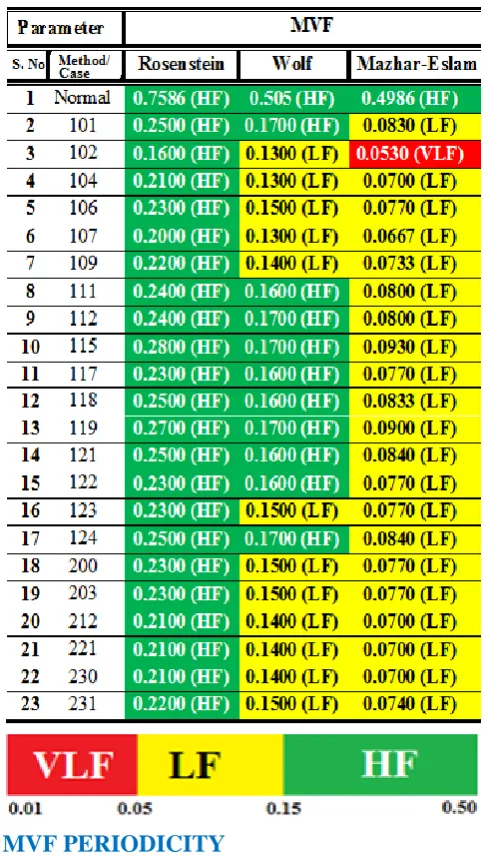
MVF PERIODICITY
To study and analyze table 2, it be order related to
field study. The results of the next proposal is based
on studding of fields is periodicity of MVF
algorithms.
STUDY OF PERIODICITY
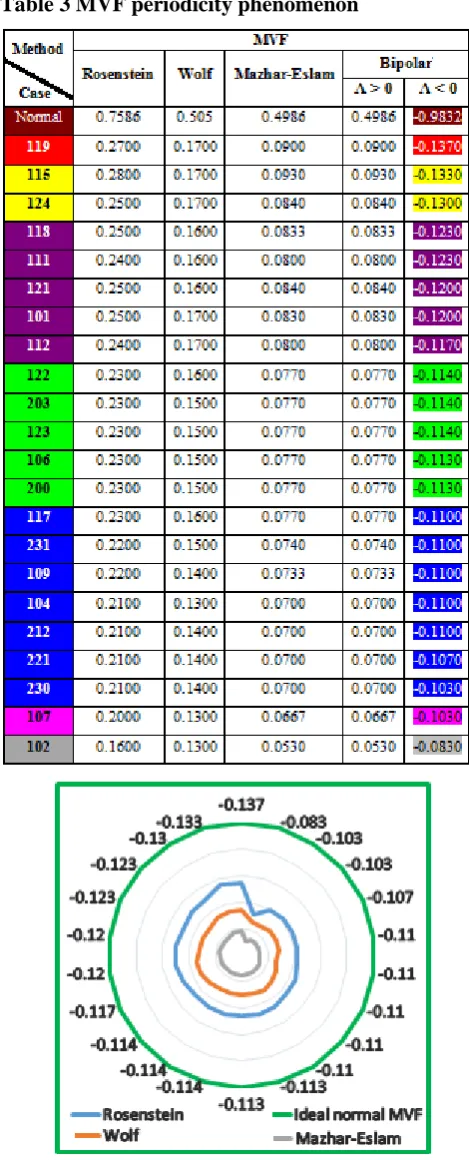
An important studying for results in the table 2 is the
periodicity phenomena. The periodicity is utmost
important for monitoring patient cases. Table 3
discusses this phenomenon. The periodicity comes
from unchanged values in R-R complex for more than
one interval. The case will be stable and healthy for
more unchanged HRV. The next table 3 shows the
periodicity phenomena benefit in the introduced
40 value of indicates to more periodic variability.
The low value of Mazhar-Eslam MVF indicates to
more patient and critical case and vice versa, higher
value of Mazhar-Eslam MVF indicates to
healthier. Thus, when studying the results in the
negative part of the introduced Bipolar Mazhar-Eslam
Variability Frequency MVFB ( ) , the value of
for critical case is close to zero, and it is mean there is
no periodicity in this case and it refers to unstable case
like case 102. The tends to more negative result
value in negative part of the introduced Bipolar
Mazhar-Eslam Variability Frequency MVFB for more
stable, healthier and more periodic signal. This
phenomenon of periodicity verify the accuracy of the
Mazhar-Eslam algorithm for MVF compare to Wolf
and Rosenstein algorithms and gives the new chapter
for monitoring and following up the cases by using the
introduced Bipolar Mazhar-Eslam Variability
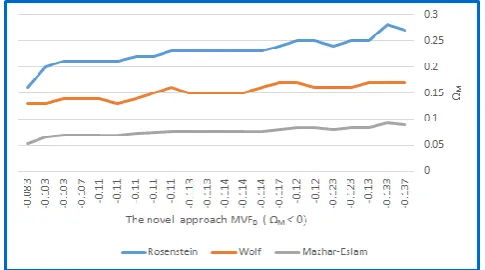
Frequency MVFB. The next figures 4, 5 present these
criteria.
Figure 4 MVF algorithms sensitivity by periodicity
criterion
The previous figures 6, 7 show how the
Mazhar-Eslam algorithm MVF is the most accurate and
sensitive. As mentioned before, the negative part of
the Novel approach Bipolar Mazhar-Eslam MVFB
indicates to periodicity.
Figure 5 bar diagram for MVF algorithms
sensitivity by periodicity criterion.
The figure 6, 7 is used to compare between Lyapunov
algorithms and shows which the most accurate and
sensitive on. Depending on the graphs in the figures 6,
7 the Mazhar-Eslam algorithm has more linearity in
periodicity than Wolf and Rosenstein algorithms that
because it has more periodic sensitivity. This
observation leads to the Mazhar-Eslam algorithm is
more sensitive beside its accuracy. The Wolf comes
after Mazhar-Eslam algorithm in sensitivity accuracy
perfection for HRV, and the Rosenstein is the worst
one. Figure 6 presents a new chapter of chart for
assessing and determining the periodicity.
Mazhar-Eslam chart measure the algorithm periodicity by how
the circulation of algorithm is Mazhar-Eslam
algorithm success to reach the most circulation for
MVF algorithms because it’s sensitive and periodicity
results unlike other algorithms Wolf and Rosenstein.
The Wolf takes the second place in the periodicity as
shown in figure 6. The Rosenstein is the lowest
periodic sensitive algorithm. Thus, the Mazhar-Eslam
algorithm is to be immense recommended algorithm
for MVF as a tool for HRV prediction.
MVF
BDIFFERENCE (SPAN)
To study and analyze table 2, it be order related to
field study. The results of the next proposal is based
41 Mazhar-Eslam Variability Frequency MVFB
difference (Span).
Table 3 MVF periodicity phenomenon
Figure 6 Mazhar-Eslam charts to assess the
periodicity criterion MVF algorithms sensitivity.
STUDY OF DIFFERENCE (SPAN)
Another important studying for results in the table 2 is
the difference of the introduced Bipolar
Mazhar-Eslam MVF. This different of the introduced Bipolar
Mazhar-Eslam MVF has ability to define the ECG
matter. Table 4 put the results in six groups regardless
the normal control case. The first group is normal
ECG and contains cases 101, 112, 122, 123, 203, 221,
and 109 and ordered ascending related to difference
and normality. The second group is pacing ECG and it
contains cases 111, 115, 104, 212, and 118.
Table 4 Span of the introduced Bipolar
Mazhar-Eslam MVF
The third group is ECG with bundle premature
ventricular and it contains cases 107, 121, 200, 106,
and 231. The fourth group is ECG with bundle branch
block and it contains 119 and 124. The fifth group is
bigeminy ECG and it contains 117 and 230. The last
case 102 is ECG with sustained ventricular
tachycardia. Thence, the Difference can classify the
42 CONCLUSION
Heart Rate Variability (HRV) is reported in several
cardio logical and non-cardio logical diseases. Also, it
has a prognostic value and is therefore very important
in modelling the cardiac risk. HRV is stochastic signal
that remains highly controversial. In order to have
utmost importance, HRV needs a sensitive tool to
analyze it. It is concluded that Mazhar-Eslam
variability mean frequency, is a better quantitative
measure of sensitivity than others. The Rosenstein
algorithm provided less sensitive estimates than
the Wolf algorithm to capture differences in local
dynamic stability from small gait data sets. The data
supported the idea that this latter outcome results from
the ability and inability of the Wolf algorithm and
Rosenstein algorithm, respectively, to estimate
adequately MVF of attractors with an important rate
of convergence as those in gait. Therefore, the
Mazhar-Eslam algorithm appears to be more
appropriate to evaluate local dynamic stability from
small gait data sets like HRV. Increase in the size of
data set has been shown to make the results of the
Mazhar-Eslam algorithm more suitable, although
other means as increasing the sample size might have
a similar effect. The Mazhar-Eslam algorithm takes
the same strategy of Rosenstein method for initial step
to calculate the lag and mean period, but it uses
Discrete Wavelet Transform (DWT) instead of Fats
Fourier Transform (FFT) unlike Rosenstein. After
that, it completes steps of calculating as Wolf
method. The Mazhar-Eslam method cares of all
variants especially the small ones like that are in
HRV. These variants may contain many important
data to diagnose diseases as R-R interval has many
variants. Thus, the Mazhar-Eslam algorithm for MVF
takes all of s. That leads it to be robust
predictor and that appear in different results among
Eslam, Wolf, and Rosenstein. The
Mazhar-Eslam algorithm represents a new idea for HRV
prediction. It contains a positive part for HRV as it is
stochastic signal and the negative part for periodicity.
The periodicity phenomenon supports to follow-up the
cases and it has the ability of monitoring.
Mazhar-Eslam algorithm takes the best place in periodicity
sensitivity and Wolf algorithm is the second one. The
Rosenstein algorithm is the worst algorithm for MVF
in sensitivity and periodicity. Thus, Mazhar-Eslam
algorithm MVF is the best MVF algorithm for
HRV predication.
REFERENCES
[1]. Backs RW. A comparison of factor analytic methods of obtaining cardiovascular autonomic
components for the assessment of mental
workload. Ergonomics. 1998; 41(5):733-45.
[2]. Aubert AE, Ramaekers D. Neurocardiology: the benefits of irregularity. The basics of
methodology, physiology and current clinical
applications. Acta cardiologica. 1999 Jun;
54(3):107-20.
[3]. Akselrod S, Gordon D, Ubel FA, et al. Power spectrum analysis of heart rate fluctuation: a
quantitative probe of beat-to-beat cardiovascular
control. Science. 1981 Jul 10; 213(4504):220-2.
[4]. Mortara A, La Rovere MT, Pinna GD, et al. Arterial baroreflex modulation of heart rate in
chronic heart failure clinical and hemodynamic
correlates and prognostic implications.
Circulation. 1997 Nov 18; 96(10):3450-8.
[5]. Hartikainen JE, Tahvanainen KU, Kuusela TA. Short-term measurement of heart rate variability.
In Clinical guide to cardiac autonomic tests 1998
43
[6]. Hon EH, Lee ST. The fetal electrocardiogram 3.
Display techniques. Am J Obstet
Gynecol. 1965;91:56–60
[7]. Weber F, Schneider H, Von Arnim T, Urbaszek W. Heart rate variability and ischaemia in patients
with coronary heart disease and stable angina
pectoris. Eur. Heart J. 1999 Jan 1; 20:38.
[8]. Konrady AO, Rudomanov OG, Yacovleva OI, Shlyakhto EV. Power spectral components of
heart rate variability in different types of cardiac
remodeling in hypertensive patients. Medical
Science Monitor. 2001 Jan; 7(1):58-63.
[9]. Scalvini S, Volterrani M, Zanelli E, et al. Is heart rate variability a reliable method to assess
autonomic modulation in left ventricular
dysfunction and heart failure: Assessment of
autonomic modulation with heart rate variability?
International journal of cardiology. 1998 Nov 30;
67(1):9-17.
[10]. Task Force of the European Society of Cardiology. Heart rate variability standards of
measurement, physiological interpretation, and
clinical use. Eur Heart J. 1996; 17:354-81.
[11].Lanza GA, Sgueglia GA, Cianflone D, et al. Relation of heart rate variability to serum levels of
C-reactive protein in patients with unstable angina
pectoris. The American journal of cardiology.
2006 Jun 15; 97(12):1702-6.
[12].Reed MJ, Robertson CE, Addison PS. Heart rate variability measurements and the prediction of
ventricular arrhythmias. Qjm. 2005 Feb 1;
98(2):87-95.
[13].Tayel MB, Al Saba E. I. A MODIFIED METHOD FOR PREDICTIVITY OF HEART
RATE VARIABILITY. Computer Science and
Information Technology (CS&IT) - CSCP 2015.
pp 67 – 77
[14].Tayel MB, Al Saba E. I. Robust and Sensitive Method of Lyapunov Exponent for Heart Rate
Variability. arxiv preprint arXiv, 5 Aug 2015.
[15].Rosenstein MT, Collins JJ, De Luca CJ. A
practical method for calculating largest Lyapunov
exponents from small data sets. Physica D:
Nonlinear Phenomena, May 15, 1993.