Unit 3
Gases
Elements that exist as gases at 250C
States of substances depends largely on:
1. The balance between the KE of the particles and
2. The
intermolecular forces of
Properties unique to Gases
Gases expand to fill their containerscompletely (constant random motion)
Gases are fluid (they flow past ea other) Gases have low density
1/1000 the density of the equivalent liquid or solid
Gases are compressible (when P applied, empty
space between particles)
Gases effuse and diffuse (due to KE)
Gases form homogeneous mixtures (equal
Gas Law Variables
• Volume: mL or L (Variable V)
• Temperature: (Variable T) Since temperature has a direct
relationship with KE, the Celsius scale does not work for gases. We need a new unit called Kelvin (K).
• Pressure: (Variable P) Force, created by the collisions of
gas particles against the walls of the container. The units are: mmHg, kPa, Pa, torr, atm
Pressure
• All units of pressure are related to 1 atm, which is known as
Standard Pressure.
• 1 atm = 760 torr = 760 mm Hg = 101.325 kPa = 101,325 Pa • STP = Standard Temperature and Pressure
• P = F/A (force over area) (N/m2 = Pa)
• Example Conversion: Convert 250 mmHg to atm
Answer: 0.33 atm
• Example Conversion: Convert 1.46 atm to torr
Sea level 1 atm
4 miles 0.5 atm
Volume
• Amount of space gases
take up.
• Remember 1 L = 1000 ml • Look for units in mL or L • Example: Convert 500 ml
Temperature
• Never use Celsius in gas law problems! Always give temperature in
Kelvin unless asked otherwise.
• Standard Temperature is a condition defined as 0 ºC or 273 K. • To convert K = 0 ºC + 273
• Remember that temperature and KE are directly related.
• AT THE SAME TEMP, ALL GASES HAVE SAME KE!!
Amount of Gas
• Moles = “n”
• Remember if grams of gas are given, you will
need to convert to moles by using molar mass conversions.
Example: convert
Standard Temperature and Pressure
“STP”
*Must Memorize these parameters, but values are on your equation packet!
P = 1 atmosphere, 760 torr or 1 atm
T = 0°C, 273 Kelvins
Ideal Gas Law
P
V
= nR
T
P = pressure in atm V = volume in liters n = moles
R = proportionality constant (gas constant) = 0.08206 L atm/ mol·K
T = temperature in Kelvins
The conditions 0 0C and 1 atm are called standard
temperature and pressure (STP).
PV = nRT
R = PV
nT = (1 mol)(273.15 K)(1 atm)(22.414L)
R = 0.082057 L • atm / (mol • K)
What is the volume (in liters) occupied by 49.8 g of HCl at STP?
PV = nRT V = nRTP
T = 0 0C = 273 K P = 1 atm
n = 49.8 g x 1 mol HCl
36.45 g HCl = 1.37 mol
V =
1 atm
1.37 mol x 0.0821 x 273 KL•atmmol•K
Standard Molar Volume
Equal volumes of all gases at the same temperature and pressure contain the same number of
molecules.
Another use for PV=nRT?
Identification of unknowns.
1. A sample of gas has a mass of 80 grams and is found to occupy 480 L at 1 atm
and 27°C. How many moles of gas are present?
• Mathematical relationship between
pressure, volume, temperature and amount of a gas (moles).
• Only 1 Gas Law given in your equation
packet, might need to derive the others. *Don’t need to know the names of each, just relationship and how to use each.
Should be able to use PV=nRT
This is the only gas law given. Need to be able to derive all other gas laws from this one!
P
1V
1= P
2V
2Boyle
’
s Law: The Press – Vol
Relationship
• Pressure is inversely proportional to volume when temperature is held
constant.
P a 1/V
P x V = constant
P1 x V1 = P2 x V2
Boyle’s Law
V
1= V
2T
1T
2Charles
’
s Law: Temp – Vol
Relationship
• The volume of a gas is directly
proportional to temperature when pressure is held
constant.
•
When temperature increases,
As T increases V increases
P
1= P
2T
1T
2Gay Lussac
’
s Law: Pres – Temp
Relationship *not in book!
• The pressure and temperature of a gas are directly related, provided that the volume remains constant.
The Combined Gas Law
The combined gas law expresses the
relationship between pressure, volume and temperature of a fixed amount of gas.
Boyle’s law, Gay-Lussac’s law, and Charles’ law
are all derived from this by holding a variable constant.
1 mole O2 at STP 1 mole He at STP 1 mole NH3 at STP 6.02x10²³ O
2 molecules 6.02x10²³ He atoms 6.02x10²³ NH3 molecules
Avogadro
’
s Law – Mole and
Volume Relationship
• For a gas at constant temperature and
pressure, the volume is directly proportional to the number of moles of gas.
• As moles are increased, volume increases.
A sample of chlorine gas occupies a volume of 946 mL at a pressure of 726 mmHg. What is the pressure of the gas (in mmHg) if the volume is reduced at constant
temperature to 154 mL?
P1 x V1 = P2 x V2 P1 = 726 mmHg
V1 = 946 mL
P2 = ?
V2 = 154 mL
P2 = P1 x V1
A sample of carbon monoxide gas occupies 3.20 L at 125
0C. At what temperature will the gas occupy a volume of
1.54 L if the pressure remains constant?
V1 = 3.20 L
T1 = 398 K
V2 = 1.54 L
T2 = ?
T2 = V2 x T1
V1 = 1.54 L x 398 K3.20 L = 192 K V1 /T1 = V2 /T2
Argon is an inert gas used in lightbulbs to slow the vaporization of the filament. A certain lightbulb
containing argon at 1.20 atm and 18 0C is heated to 85 0C
at constant volume. What is the final pressure of argon in the lightbulb (in atm)?
PV = nRT n, V and R are constant
nR
V = TP = constant P1
T1 = TP22
P1 = 1.20 atm
T1 = 291 K
P2 = ?
T2 = 358 K
P2 = P1 x T2
AP Practice Question
The pressure, in atm, exerted by 1.85 mol of an ideal gas placed in a 3.00 L container at 35.0°C is given by
which of the following expressions?
Theoretical Understanding?
Suppose we have gas confined to a cylinder w/ movable piston. Consider the following changes and indicate how each change affects the average distance between
molecules, the pressure of the gas, and the number of moles of gas in the cylinder.
1. Heat the gas from 298K to 360K at constant pressure.
Volume will increase
2. Reduce the volume from 1L to 0.5L at constant temperature.
Pressure will increase
3. Inject additional gas, keeping temperature and volume constant.
AP Practice Question
When a sample of oxygen gas in a closed con tainer of constant volume is heated until its abso lute tem pera ture is doubled, which of the follow ing is also dou bled?
A. The density of the gas B. The pressure of the gas
C. The average velocity of the gas molecules D. The number of molecules per cm3
AP Practice Question
A rigid metal tank contains oxygen gas. Which of the following applies to the gas in the tank when additional oxygen is added at constant
temperature?
A. The volume of the gas increases. B. The pressure of the gas decreases.
C. The average speed of the gas molecules remains the same.
D. The total number of gas molecules remains the same.
AP Practice Question
A sample of an ideal gas is cooled from 50.0oC to
25.0oC in a sealed container of constant volume.
Which of the following values for the gas will decrease?
I. The average molecular mass of the gas
II. The average distance between the molecules III. The average speed of the molecules
AP Practice Question
At standard temperature and pressure, a 0.50 mol sample of H2 gas and a separate 1.0 mol sample of O2 gas have the same
A. average molecular kinetic energy B. average molecular speed
C. Volume
The volume of a sample of air in a cylinder with a
movable piston is 2.0 L at a pressure P1, as shown in the diagram above. The volume is increased to 5.0 L as the temperature is held constant. The pressure of the air in the cylinder is now P2. What effect do the volume and pressure changes have on the average kinetic energy of the molecules in the sample?
A. The average kinetic energy increases. B. The average kinetic energy decreases.
C. The average kinetic energy stays the same.
Which of the following is the most likely cause for the increase in pressure observed in the container as the reaction reaches equilibrium?
A. A decrease in the strength of intermolecular attractions among molecules in the flask
B. An increase in the strength of intermolecular attractions among molecules in the flask
C. An increase in the number of molecules, which increases the frequency of collisions with the walls of the container D. An increase in the speed of the molecules that then collide
Density (
d
) Calculations
d = mV = PMRT m M is the molar mass of the gasis the mass of the gas in g
Molar Mass (M ) of a Gaseous Substance
dRT P
M = d is the density of the gas in g/L
M = Molar Mass P = Pressure
R = Gas Constant
T = Temperature in Kelvins
*Density depends on molar
A 2.10-L vessel contains 4.65 g of a gas at 1.00 atm and 27.0 0C. What is the molar mass of the gas?
dRT P
M = d = mV 4.65 g
2.10 L
= = 2.21 Lg
M = 2.21
g L
1 atm
x 0.0821 x 300. KL•atmmol•K
A.greatest in container A B.greatest in container B C.greatest in container C
Dalton’s Law of Partial Pressures
For a mixture of gases in a container,
PTotal = P1 + P2 + P3 + . . . This is particularly useful in calculating the pressure of gases collected over water.
Dalton
’
s Law of Partial Pressures
V and T
are
constant
Consider a case in which two gases, A and B, are in a container of volume V.
PA = nART
V
PB = nBRT
V
nA is the number of moles of A
nB is the number of moles of B
PT = PA + PB XA = nA
nA + nB XB =
nB
nA + nB
PA = XA PT PB = XB PT
A sample of natural gas contains 8.24 moles of CH4, 0.421 moles of C2H6, and 0.116 moles of C3H8. If the total
pressure of the gases is 1.37 atm, what is the partial pressure of propane (C3H8)?
Ppropane = Xpropane PT
Xpropane = 8.24 + 0.421 + 0.1160.116
PT = 1.37 atm
= 0.0132
A flask contains 2.00 moles of O2 and 8.00 moles of N2 gas. The total pressure of the flask is 200. kPa. What are the partial pressures of each gas?
PO2 = XO2PT
Xoxygen = 2.00 moles + 8.00 moles2.00 moles
PT = 200. kPa
=
PO2 = x 200 kPa = 40. kPa
Xnitrogen = 2.00 moles + 8.00 moles8.00 moles = PN2 = XN2PT
PN2 = x 200 kPa = 160. kPa
0.2
0.8
AP Practice Question
A flask contains 0.25 mole of SO2(g), 0.50 mole of CH4(g), and 0.50 mole of O2(g). The total
pressure of the gases in the flask is 800 mm Hg. What is the partial pressure of the SO2(g) in the flask?
AP Practice Question
A 2 L sample of N2(g) and a 1 L sample of Ar(g), each originally at 1 atm and 0°C, are combined in a 1 L tank. If the temperature is held constant,
what is the total pressure of the gases in the tank?
How can you collect gas?
2KClO3 (s) 2KCl (s) + 3O2 (g)
Bottle full of oxygen gas and water vapor
Gas of interest is not the only gas
collected, water vapor is also present. Must be accounted for using Dalton’s Law of Partial Pressures.
Example: Collecting gas over
water
A common way to make hydrogen gas in the lab is to place a metal such as zinc in
hydrochloric acid. The HCl reacts with Zn to produce H2 gas, which is then collected over water. Suppose a student carries out this experiment and collects a total of 154.4
Ex Cont’d
First find the PH2 from: PT = PH2 + PH2O
Then use PV = nRT to find n
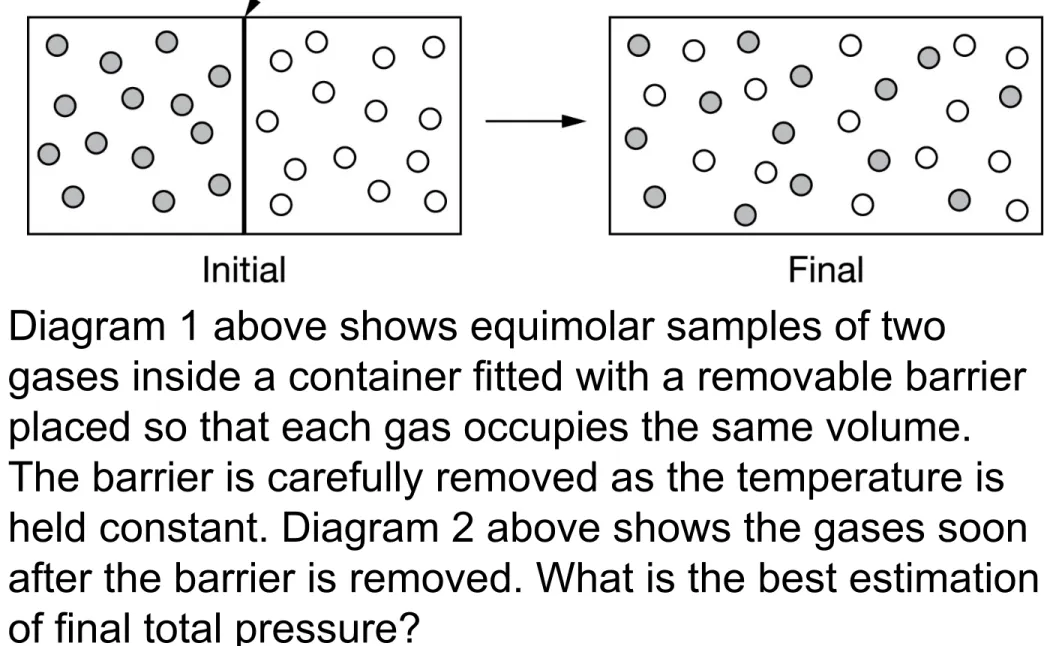
Diagram 1 above shows equimolar samples of two
gases inside a container fitted with a removable barrier placed so that each gas occupies the same volume.
The reaction between NO(g) and O2(g) to produce
NO2(g) in a rigid reaction vessel is represented in the diagram above. The pressure inside the container is recorded using a pressure gauge. What would be a
AP Practice Question
When 6.0 L of He(g) and 10. L of N2(g), both at 0oC and 1.0 atm, are pumped into an evacuated
4.0 L rigid container, the final pressure in the container at 0oC is
Interpret the Graph?
Make a prediction. What would happen if temperature was to decrease? Draw this as a dotted (----) line on your graph.
What did you draw?
Why? As Temp increases, KE increases, causes speed (or velocity) to increase, higher speeds able to be achieved (x-axis) area under curve larger and wider.
Lower T
The distribution of speeds for nitrogen gas molecules
at three different temperatures
The distribution of speeds of three different gases at the same temperature
5.7
urms = 3RT
M
Maxwell-Boltzmann Distribution
These graphs show the probability of the amount of gas particles that will travel at different speeds at a given temperature.
Lower mass, more possibility for speed
(lower, but longer peak)
The Meaning of Temperature
Kelvin temperature is an index of the
random motions of gas particles (higher T
means greater motion.)
(KE)
3
2
Kinetic Energy of Gas Particles
At the same conditions of temperature, all gases have the same average kinetic energy.
KE = 1
2
mv
2Root Mean Square μ
rmsGood approximation of the speed at which molecules travel (not their KE). This is a velocity, units are m/s.
R = 8.314 J / mol K 1 J = 1 kg m2 / s2
Example:
Calculate the rms speed of the molecules in a sample of N2 gas at 25°C.
Diffusion vs. Effusion
Effusion - how gases escape through a small pore or opening (balloons deflating)
When NH3 and HCl gases are mixed a white cloudy ppt of NH4Cl forms. If NH3 and HCl are placed on either side of a sealed tube, where would you expect the ppt to form?
NH3(g)
HCl(g)
Graham’s Law
Rates of Effusion and Diffusion
r1 r2 =
M2 M1
You may need to derive this formula from the KE formula!
Rate of effusion for gas 1
Rate of effusion for gas 2
21Example:
What is the rate of diffusion of ammonia gas compared to hydrogen chloride gas?
ANSWER: ammonia:~1.5 faster
Another Example:
Two gases are contained in a balloon. The rate of effusion of neon gas is 4.35 mol/min, while the rate of effusion of an unknown gas is 9.76
mol/min. Calculate the molar mass and identify the unknown gas inside the balloon.
You Try:
An unknown gas effuses 1.66 times more
rapidly than CO2. What is the molar mass of the unknown gas?
16.0 g/mol
Can you make a reasonable guess as to its identity? (It is suspected to be a
hydrocarbon)
AP Challenge Problem! r1 r2 M2 M1
=Nickel forms a gaseous compound of the formula Ni(CO)x. What is the value of x given that under the same
conditions methane (CH4) effuses 3.3 times faster than the compound?
r1 = 3.3 x r2
M1 = 16 g/mol
M2 = r1 r2
( )
2 x M1 = (3.3)2 x 16 = 174.2AP Sample Question
A 0.5 mol sample of He(g) and a 0.5 mol sample of Ne(g) are placed separately in two 10.0 L rigid containers at 25°C.
Each container has a pinhole opening. Which of the gases, He(g) or Ne(g), will escape faster through the pinhole and why?
A. He(g) will escape faster because the He(g) atoms are moving at a higher average speed than the Ne(g) atoms. B. Ne(g) will escape faster because its initial pressure in the
container is higher.
C. Ne(g) will escape faster because the Ne(g) atoms have a higher average kinetic energy than the He(g) atoms.
The diagram below shows the distribution of speeds for a sample of N2(g) at 25°C. Which of the following graphs shows the distribution of speeds for a sample
of O2(g) at 25°C (dashed line) ?
Ideal Gases(What you learned 10th grade)
Ideal gases are imaginary gases that perfectly fit all of the assumptions of the kinetic molecular Theory (KMT).
Gases consist of tiny particles that are far apart
relative to their size, a lot of empty space.
Collisions between gas particles and between
particles and the walls of the container are
elastic collisions (No KE lost in elastic collisions)
* Gas molecules exert neither attractive nor repulsive forces on one another.
Temperature proportional to KE of gas particles.
Kinetic Molecular Theory of Gases Details
1. A gas is composed of molecules that are separated from each other by distances far greater than their own
dimensions. The molecules can be considered to be
points; that is, they possess mass but have negligible volume.
2. Gas molecules are in constant motion in random directions, and they frequently collide with one
another. Collisions among molecules are perfectly elastic.
3. *Gas molecules exert neither attractive nor repulsive forces on one another.
4. The average kinetic energy of the molecules is
proportional to the temperature of the gas in Kelvins.
Can Real Gases Behave
Ideally?
• Under conditions of high
Temperature (high KE) and low Pressure
• High T keeps gas
particles spread away from one another
(minimizes
attractive/repulsive forces)
• Low P keeps gases
moving and able to spread out, less
• The ideal gas law does not explain the actual behavior of real gases.
• Deviations from the ideal gas law may result from
interparticle attractions among gas molecules,
particularly at conditions that are close to those resulting in condensation.
• Deviations may also arise from particle volumes,
particularly at extremely high pressures.
• We need to add correction factors to the ideal gas law to account for these factors.
Van der Waals equation
•
The actual volume the molecules
are free to move in, is less
because of particle size.
•
More molecules will have more
effect.
•
Because the molecules are
attracted to each other, the
pressure on the container will be
less than ideal.
Real Gases
corrected pressure corrected volume
Pideal Videal
Must correct ideal gas behavior when at
high pressure (smaller volume) and low temperature (attractive forces become important), collisions become inelastic.
Real vs. Ideal
This graph shows how real gases deviate from Ideal behavior.
Both water and Xe have extremely negative
deviations due to their
stronger IM forces. (Ideals do not have IM forces)
(water: H-bonding
Can you make predictions?
Which gas would produce the lowest
pressure with moles, T, and V constant?
H2O or CH4
A. The gas in sample 1 would deviate more from ideal behavior because the average distance an Xe atom travels before
colliding with another Xe atom is greater.
B. The gas in sample 2 would deviate more from ideal behavior because the Xe atoms are closer together, leading to an
increase in intermolecular attractions.
C. The gas in sample 2 would deviate more from ideal behavior because the average speed of the Xe atoms is less, leading to an increase in intermolecular attractions.
AP Practice Question
Which of the following best helps explain why the pressure of a sample of CH4(g) (molar mass 16g/mol) is closer to the pressure predicted by the ideal gas law than a sample of NH3(g) (molar mass 17g/mol) ?
A. NH3 molec are polar while CH4 molec are not, and the greater attractions between NH3 molec cause the molec to collide
with the walls of the container with less force.
B. NH3 molec have a greater molar mass than CH4 molec so the NH3 molec collide with the walls of the container with more force.
C. CH4 molec have more hydrogen atoms than NH3 molec so CH4 molec have more hydrogen bonding and greater intermolecular forces.
D. CH4 molec are larger than NH3 molecules, so the
AP Practice Question
The ideal gas law best describes the
properties of which of the following gases at 0°C and 1 atm?
Under which of the following conditions of temperature and pressure would 1.0 mol of the real gas CO2(g)
behave most like an ideal gas?