© 2015 Pearson Education, Inc.
The Earth formed
about 4.6 billion years ago.
Conditions on early Earth
made the origin of life possible
• Hot
• Thick with water vapor
• No Oxygen
• Lightning
• Volcanic action
First life forms
– bacteria about 3.8 billion
years ago
•
The earliest evidence for life on Earth comes from
3.5-billion-year-old fossils of
stromatolites
, built by ancient
photosynthetic prokaryotes still alive today.
•
Because these 3.5-billion-year-old prokaryotes used
The first life may have evolved
through four stages.
1. The abiotic (nonliving) synthesis of small organic
molecules such as amino acids and nitrogenous bases.
2. The joining of these small molecules into polymers, such as proteins and nucleic acids.
3. The packaging of these molecules into “protocells,”
membrane-enclosed droplets that maintained an internal chemistry different from that of their surroundings.
Oparin & Haldane (1920s)
• In the 1920s, the Russian chemist A. I. Oparin and the
British scientist J. B. S. Haldane independently proposed that conditions on early Earth could have generated
organic molecules.
• Early earth was much different from our modern
atmosphere is rich in O2 (which disrupts chemical bonds).
Miller & Urey (1950s)
• In 1953, graduate student Stanley Miller, working under
Harold Urey, tested the Oparin-Haldane hypothesis.
• Experiments show that the abiotic synthesis of organic
molecules is possible (under conditions of early earth)
• Miller identified a variety of organic molecules that are
common in organisms, including
• hydrocarbons (long chains of carbon and hydrogen) and
Figure 15.2
Sparks simulating lightning
1 2 3 4 Water vapor “Atmosphere” Electrode Condenser Cold water “Sea” Sample for chemical analysis NH3 CH4 H2
© 2015 Pearson Education, Inc.
Macroevolution
is the broad pattern of changes in life on Earth.
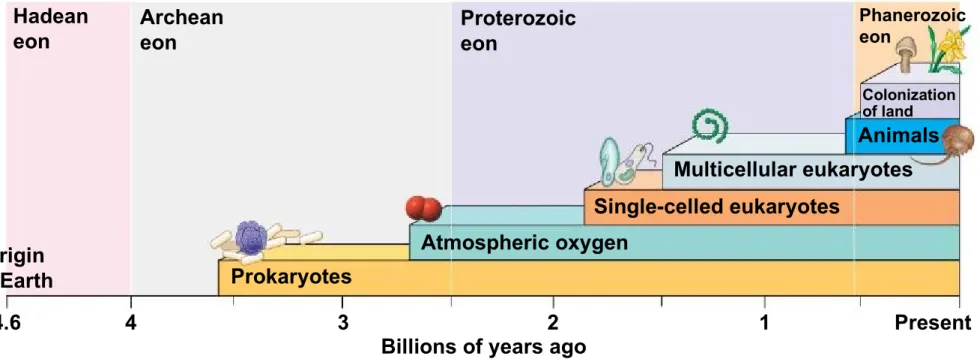
The entire 4.6 billion years of Earth’s
history can be divided into three eons
of geologic time.
•
The Archaean and Proterozoic eons lasted
about 4 billion years.
•
The Phanerozoic eon includes the last half
Figure 15.4-0 Hadean eon Archean eon Proterozoic eon Phanerozoic eon Origin
of Earth Prokaryotes
Atmospheric oxygen Single-celled eukaryotes Multicellular eukaryotes Animals Colonization of land Present Billions of years ago
Prokaryotes lived alone on Earth for 1.5 billion years, from 3.5 to 2 billion years ago.
• Bacteria were the first life forms
• During this time, prokaryotes transformed the atmosphere.
• Prokaryotic photosynthesis produced oxygen that enriched
the water and atmosphere of Earth.
• Aerobic cellular respiration allowed prokaryotes to flourish.
Eukaryotes = true nucleus and
membrane organelles
• The oldest fossils of eukaryotes are about 1.8 billion
years old.
• The common ancestor of all multicellular eukaryotes
lived about 1.5 billion years ago.
• The oldest fossils of multicellular eukaryotes are about
1.2 billion years old.
• The first multicellular plants and fungi began to colonize
The actual ages of rocks and fossils
mark geologic time
• Radiometric dating is based on the decay of radioactive isotopes.
• The rate of decay is expressed as a half-life, the time required for 50%
of the isotope in a sample to decay.
• Carbon-14 is useful for dating relatively young fossils—up to about
75,000 years old. Radioactive isotopes with longer half-lives are used to date older fossils.
• A fossil’s age can be inferred from the ages of the rock layers above
Figure 15.5
Time (thousands of years)
15.6 The fossil record documents the history of life
• The geologic record is based on the sequence and ages of fossils in
the rock strata.
• The most recent Phanerozoic eon
• includes the past 542 million years and
• is divided into three eras:
• Paleozoic,
• Mesozoic, and
• Cenozoic.