Chapter
VI
Non Parametric Test
...
Purpose of
Chapter
Nonparametric statistics or
distribution-free tests are those
that do not rely on parameter
estimates or precise assumptions
about the distributions of
variables.
Introduction
Nonparametric tests are sometimes called free distribution tests because they are based on fewer assumptions (e.g., they do not assume that the outcome is approximately normally distributed). Parametric tests involve specific probability distributions (e.g., the normal distribution) and the tests involve estimation of the key parameters of that distribution (e.g., the mean or difference in means) from the sample data. The cost of fewer assumptions is that nonparametric tests are generally less powerful than their parametric counterparts.
• Parametric Statistics are statistical techniques based on assumptions about the population from which the sample data are collected.
– Assumption that data being analyzed are randomly selected from a normally distributed population.
– Requires quantitative measurements that yield interval or ratio level data.
• Nonparametric Statistics are based on fewer assumptions about the population and the parameters.
– Sometimes called “distribution-free” statistics.
_ A variety of nonparametric statistics are available for use with nominal data, ordinal and even quantitative (convert to ordinal)
_ When the data is quantitative but does not meet the assumptions of normality and homogeneity, in the case of more than two groups.
Nonparametric statistics (or tests) based on the ranks of measurements are called rank statistics (or rank tests).
Analysis for Non Parametric Tests according to the number of samples and type of variable
Chi-Square
1 Sample Quantitative -
Qualitative
Binomial
Association variables
Independent Quantitative Mann-Whitney U
Quantitative Wilcoxon
Related
Before-After McNemar
Independent Quantitative Kruscal Wallis-H
Quantitative Friedman
Related
Qualitative Cochran's Q
C o m p ar e g ro u p s 2 Samples More than 2 samples
2 Samples Discrete or
categorical
Chi-Square Independent
Advantages and Disadvantages of non-parametric test
Advantages Disadvantages
Can be used when nothing known about population
– Therefore can’t break or violate crucial assumptions for confidence interval and hypothesis tests
Used with all scales. Can use nominal or ordinal data compared to interval or ratio data
– Nominal = names or labels, Eg. Gender (males, females)
Ordinal = imply some order or rank, Eg. Grade of study
Can be used with smaller samples
Sometimes there is no parametric alternative to the use of nonparametric statistics.
The computations on nonparametric statistics are usually
Less powerful even with same
sample size
– Prob. of type 2 error is larger for a given type 1 error prob.
Less efficient
Nonparametric tests can be wasteful of data if parametric tests are available for use with the data
Nonparametric tests are usually not as widely available and well know as parametric tests
less complicated than those for parametric statistics,
particularly for small samples. can be tedious
6.1 Chi Square Independent Test (c2) (Contingency Table Analysis)
A chi square (c2) statistic is used to investigate whether distributions of categorical variables differ from one another. Basically categorical variable yield data in the categories and numerical variables yield data in numerical form. Responses to such questions as "What is your major?" or do you have a car?" are categorical because they yield data such as "Business" or "no". In contrast, responses to such questions as "How tall are you?" it is numerical. Numerical data can be either discrete or continuous. The table below may help you see the differences between these two variables.
Data Type Question Type ResponsesPossible
Categorical What is your sex? male or female
Numerical - Discrete How many children do you have? 0 or 1 or 2 or…
Numerical - Continuous How tall are you? 72.4 inches
A test of independence assesses whether paired observations on two variables, expressed in a contingency table, are independent of each other (e.g. polling responses from people of different nationalities to see if one's nationality affects the response).
Important note: The data are assumed to be a random sample. The expected frequencies for each category should be at least 1. No more than 20% of the categories should have expected frequencies of less than 5."
Steps in Hypothesis Testing
1. Formulate the appropriate null and alternative hypothesis Ho: There is no relationship between variables
Ha: There is a relationship between the variables 2. Specify the desired level of significance (a)
a , (level of significance); typical values are .01, .05, or .10 3. Computing the Test Statistic
Calculate the chi-squared test across all the categories. Oij = observed frequency
eij = expected frequency
4. Making a Decision and Interpreting the Result of the Test
Look at the Sig. or P_value, if this value is less than the significance level (α = .05) we reject Ho.
Example 1
Table 6.1. Decision to purchase the services by customer’s age Decision to
purchase the
services Under 21 21-34
34
and over Total
Yes 120 262 237 619
No 41 103 237 381
Total 161 365 474 1000
Solution:
Step 1: Hypothesis
Ho: There is no relationship between the customer age groups and to make a decision to purchase the services.
Ha: There is a relationship between the customer age groups and to make a decision to purchase the services.
Step 2: Level of significance: α = 0.05
Step 3: Computing the Test Statistic
Step 4: Making a decision and interpreting the result
Step to pass the data to SPSS when we have contingence tables
For SPSS to successfully analyze this problem, enter the two variables “decision to purchase the services (service)” and “Customer Age (age)” as integer variables (no decimals). In the “decision” row (we’re still in the “Variable View” tab), click the cell in the “Values” column, as shown in the following figure. Decision to purchase:
Code Observation
1 Yes
2 No
Create the same for the second variable (for the variable in Column)
Age:
Finally enter the data in (Data view), as noted in the following table
Code for Decision
Code for
Age Frequency
1 1 120
1 2 262
1 3 237
2 1 41
2 2 103
2 3 237
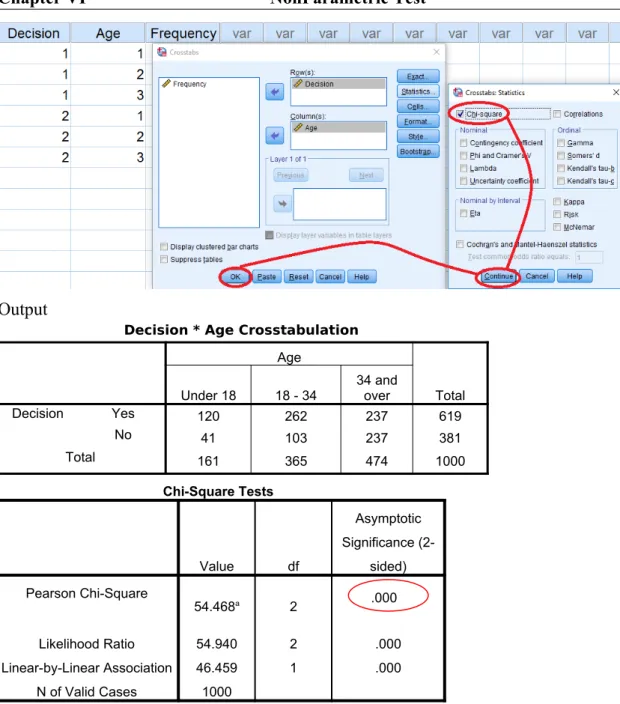
Since the data is in a frequency table, we must tell SPSS how to weigh the different cases; that is, we must tell SPSS that the Frequency variable records the frequency in each pair of categories listed by the Decision and Age variable. Use Data (from the menu) → Weight Cases to open the Weight Cases dialog. Make the changes as shown in the following figure:
Finally, let’s perform the Chi Square:
Output
Decision * Age Crosstabulation
Age
Total
Under 18 18 - 34 34 andover
Decision Yes 120 262 237 619
No 41 103 237 381
Total 161 365 474 1000
Chi-Square Tests
Value df
Asymptotic
Significance (2-sided)
Pearson Chi-Square
54.468a 2
Likelihood Ratio 54.940 2 .000
Linear-by-Linear Association 46.459 1 .000
N of Valid Cases 1000
Step 4. Making decision and interpret result: Since Sig. = .000 < .05, we can reject null hypothesis, In other words, there is a relationship between the age of the customer and to make a decision to purchase the services (So we reject the null hypothesis and conclude that the age groups differ in their decision to purchase the service).
Example 2.
In a sample of 103 people aged 25 to 50 years want to determine whether cough in the morning is associated with cigarette smoking.
Table 6.2. Smoke cigarettes and cough at morning Do you cough at
morning?
Do you smoke cigarettes?
Total
Yes No
Yes 45 24 69
No 15 19 34
Total 60 43 103
Step 1: Hypothesis
Ho: Coughing in the morning is independent of cigarette smoking Ha: Coughing in the morning is associated with cigarette smoking
Step 2: Level of significance: α = 0.05
Step 3: Computing the Test Statistic ꭓ2
= 4.17
Step 4: Making a decision and interpreting the result: The calculate c2 = 4.17, and Sig or p_value =
0.041. is less than .05, so we reject null hypothesis. At 5% of level of significance cough at morning is associated with cigarette smoking.
Example 3: Use the data of file that has the SPSS "demo.sav"
This is a hypothetical data file that concerns a purchased customer database, for the purpose of mailing monthly offers. Whether or not the customer responded to the offer is recorded, along with various demographic information.
Crosstabulation tables (contingency tables) display the relationship between two or more categorical (nominal or ordinal) variables. The size of the table is determined by the number of distinct values for each variable, with each cell in the table representing a unique combination of values. Numerous statistical tests are available to determine whether there is a relationship between the variables in a table. Step in SPSS:
Analyze < Descriptive Statistics < Crosstab < and follow the step that we show in the picture
Interpretation Results:
What factors affect the products that people buy?
Descriptive interpretation:
The cells of the table show the count or number of cases for each joint combination of values. For example,
455 people in the income range $25,000–$49,000 had own PDAs.
None of the numbers in this table, however, stand out in an obvious way, indicating any obvious relationship between the variables.
It is often difficult to analyze a cross tabulation simply by looking at the simple counts in each cell
Inferential interpretation:
Significance Testing for Crosstabulations
The purpose of a cross tabulation is to show the relationship (or lack thereof) between two variables. Although there appears to be some relationship between the two variables, is there any reason to believe that the differences in PDA ownership between different income categories is anything more than random variation?
A number of tests are available to determine if the relationship between two crosstabulated variables is significant. One of the more common tests is Chi-square. One of the advantages of chi-square is that it is appropriate for almost any kind of data.
Pearson chi-square tests the hypothesis that the row and column variables are independent. 1. Hypothesis
Ho: The variables Income and Owns PDA are independent. Ha: The variables Income and Owns PDA are related. 2. Level significance α = .05
3.Test Statistic: c2 = 37.677, Sig= .000
Output from SPSS
Chi-Square Tests
Value df Asymp. Sig.(2-sided) Pearson Chi-Square 37.677a 3 .000
Likelihood Ratio 37.313 3 .000
Linear-by-Linear
Association 36.537 1 .000
N of Valid Cases 6400
a. 0 cells (0.0%) have expected count less than 5. The minimum expected count is 228.73.
Interpretation: the percentage of people who had their own PDA increases as the income category increases.
Differences between independent groups 6.2 Mann-Whitney U-Test (orranked-sum)
The Mann-Whitney Test is the alternative test to the independent sample t test, also it is one of the most powerful of the nonparametric tests for comparing two independent groups when the dependent variable is either ordinal or continuous, but not normally distributed. For example, you could use the Mann-Whitney U test to understand whether attitudes towards pay discrimination, where attitudes are measured on an ordinal scale, differ based on gender (i.e., your dependent variable would be "attitudes towards pay discrimination" and your independent variable would be "gender", which has two groups: "male" and "female"). Alternately, you could use the Mann-Whitney U test to understand whether salaries, measured on a continuous scale, differed based on educational level (i.e., your dependent variable would be "salary" and your independent variable would be "educational level", which has two groups: "high school" and "university"). The Mann-Whitney U test is often considered the nonparametric alternative to the independent t-test although this is not always the case.
Nonparametric counterpart of the t test for independent samples • Does not require normally distributed populations
• May be applied to ordinal data
• Actual measurements not used – ranks of the measurements used
Assumptions
– Independent Samples – At Least Ordinal Data
Steps in Hypothesis Testing
1. Formulate the appropriate null and alternative hypothesis Ho: Both groups are the same (there is no difference) Ha: Both groups are not the same
2. Specify the desired level of significance (a)
a , (level of significance); typical values are .01, .05, or .10 3. Computing the Test Statistic
4. Making a decision and interpreting the result of the test
Reject Null Hypothesis if sig is less or equal than .05 (significant result)
Example 1
Is this sufficient evidence to indicate a difference in the average height of the groups? The data is in the following table:
Heights of males (cm) 193 188 185 183 180 178 170
Heights of females (cm) 175 173 168 165 163
Solution
Ho: Male and female students are the same height (the distribution of heights for the two groups are
equal)
Ha: Male and female students are not the same height (the distribution of heights for the two groups are
not equal)
Mann-Whitney U Rank Sum Test – Solution in SPSS
Use the data from the previous example, and enter the data into SPSS
Example 2
Consider the following data of the number of minutes needed by two groups of factory workers to learn how to build a chainsaw. Group A received classroom training, whereas Group B received only on –the-job- training.
Group A 35 39 51 63 48 31 29 41 55
Group B 85 28 42 37 61 54 36 57
We wish to decide whether the difference between the means is significant. Output from SPSS
Ranks
Group N Mean Rank Sum of Ranks
Time A 9 8.22 74.00
B 8 9.88 79.00
Total 17 Test Statisticsa
Time
Mann-Whitney U 29
Wilcoxon W 74
Z -0.674
Asymp. Sig. (2-tailed) 0.501 Exact Sig. [2*(1-tailed Sig.)] .541b
a. Grouping Variable: Group b. Not corrected for ties.
Making Decision and Interpreting the Result: Since Sig = .541 is more than .05, we do not reject the null hypothesis, at level of significance α=0.05, therefore is not significant differences between the means of these two groups.
Differences between dependent or related groups (Matched-Pairs)
Decision: Sig .010<.05 Reject Null Hypothesis at α= .05
Parametric Nonparametric
Compare two variables measured
in the same sample t-test for dependent samples
Sign test
Wilcoxon’s matched pairs test or Mc Nemar If more than two variables are
measured in same sample
Repeated measures
ANOVA Friedman’s two way analysis of variance
6.3. Wilcoxon Rank
The Wilcoxon Rank Test is a non-parametric statistical hypothesis test, used when comparing two related samples, matched samples, or repeated measurements on a single sample to assess whether their population mean ranks differ (i.e. it is a paired difference test). It can be used as an alternative to the paired Student’s t-test (before and after studies), Studies in which measures are taken on the same person or object under different conditions, studies of twins or other relatives or the t-test for dependent samples when the population cannot be assumed to be normally distributed.
Assumptions
Random Samples
Populations are continuous
Can Use Normal Approximation If ni ≥15 Steps in Hypothesis Testing
1. Formulate the appropriate null and alternative hypothesis
H0: both samples come from the same underlying distribution (there is no difference)
Ha: both samples are not come from the same underlying distribution
2. Specify the desired level of significance (a)
a , (level of significance); typical values are .01, .05, or .10 3. Determine the Critical value
4. Making decision and interpreting the result of the test
For your decision you see the Critical Value in the probabilistic table of “Wilcoxon”
Reject Null Hypothesis if Sig is less than .05 (significant result).
Don’t Reject Null Hypothesis if Sig is greater than .05 Example
The mayor of a city wants to see if pollution levels are reduced by closing the streets to the car traffic. This is measured by the rate of pollution every 60 minutes (8am - 22pm: total of 15 measurements) in a day when traffic is open, and in a day of closure to traffic, the data of air pollution is in the following table
Rate of pollution in different situation
With traffic: 214, 159, 169, 202, 103, 119, 200, 109, 132, 142, 194, 104, 219, 119, 234 Without traffic: 159, 135, 141, 101, 102, 168, 62, 167, 174, 159, 66, 118, 181, 171, 112
It is clear that the two groups are paired, because there is a bond between the readings, consisting in the fact that we are considering the same city (with its peculiarities weather, ventilation, etc.) albeit in two different days. Not being able to assume a Gaussian distribution for the values recorded, we must proceed with a non-parametric test, the Wilcoxon signed rank test.
Solution:
Ha: both samples are not come from the same underlying distribution
n = 15
a =0.05
Statistic Test:
Making a Decision and Interpreting the Result of the Test
Sig = .256, we cannot reject the null hypothesis Ho of equality of the means.
Therefore the closing roads to traffic did not bring any improvement in terms of rate of pollution.
Wilcoxon Rank Sum Test – Solution with SPSS
Wilcoxon Report in SPSS
Ranks Test Statisticsa
N
Mean Rank
Sum of Ranks
Without_traffic -With_traffic
Without_traff ic -With_traffic
Negative Ranks
9a 8.89 80
Z -1.136b
Positive
Ranks 6
b 6.67 40 Asymp. Sig.
(2-tailed) 0.256
Ties 0c a. Wilcoxon Signed Ranks Test
Total 15 b. Based on positive ranks.
a. Without_traffic < With_traffic b. Without_traffic > With_traffic c. Without_traffic = With_traffic
Since Sig.= 0.256>0.05, we can’t reject the null hypothesis, at α=0.05. There is no evidence of unequal distribution. Therefore, the closure of roads to traffic did not bring any improvement in terms of pollution rate.
Nonparametric Tests for Multiple Independent Samples
The nonparametric tests for multiple independent samples are useful for determining whether or not the values of a particular variable differ between two or more groups. This is especially true when the assumptions of ANOVA are not met.
When the assumptions behind the standard ANOVA are invalid or suspect, you should consider using the nonparametric procedures designed to test for the significance of the difference between multiple groups. They are called nonparametric because they make no assumptions about the parameters (such as the mean and variance) of a distribution, nor do they assume that any particular distribution is being used. The Kruskal-Wallis test is a one-way analysis of variance by ranks. It tests the null hypothesis that multiple independent samples come from the same population. Unlike standard ANOVA, it does not assume normality, and it can be used to test ordinal variables.
6.4 Kruskal-Wallis H
When a researcher wishes to compare three or more groups or populations and the data are ordinal, the Kruskal-Wallis test is the appropriate statistical technique, or when the data is numerical but the assumptions does not have to assume that the underlying populations are normally distributed or the equal variances.
It is used to test the null hypothesis that all populations have identical distribution functions against the alternative hypothesis that at least two of the samples differ only with respect to location (median), if at all.
For example, you could use a Kruskal-Wallis H test to understand whether exam performance, measured on a continuous scale from 0-100, differed based on test anxiety levels (i.e., your dependent variable would be "exam performance" and your independent variable would be "test anxiety level", which has three independent groups: students with "low", "medium" and "high" test anxiety levels). Alternately, you could use the Kruskal-Wallis H test to understand whether attitudes towards pay discrimination, where attitudes are measured on an ordinal scale, differed based on job position (i.e., your dependent variable would be "attitudes towards pay discrimination", measured on a 5-point scale from "strongly agree" to "strongly disagree", and your independent variable would be "job description", which has three independent groups: "shop floor", "middle management" and "boardroom").
Data types that can be analyzed with Kruskal-Wallis H
The data points must be independent from each other
the distributions do not have to be normal and the variances do not have to be equal
you should ideally have more than five data points per sample
all individuals must be selected at random from the population
all individuals must have equal chance of being selected
sample sizes should be as equal as possible but some differences are allowed
Steps in Hypothesis Testing
1. Formulate the appropriate null and alternative hypothesis Ho: Identical Distribution
Ha: At Least 2 Differ
2. Specify the desired level of significance (a)
3. Computing the Test Statistic
The H-statistic is calculated as follows:
Where:
Ri = Sum of the ranks of the ith group
ni = Sample size of the ith group
n = Combined sample sizes of all groups
4. Making a decision and interpreting the result of the test: If Hc < than the critical value; do not reject
null hypothesis at α=0.05
Example
An advertising agency employs three different film production companies to produce its television commercials. The advertising agency has taken a sample of five commercials from each of the population houses, and agency executives have ranked the production quality of the commercials from best quality (1) to lowest quality (15). These ranks are show in the next table. Notice that the advertising agency considered two commercials to be ranked of equal quality. Hence, rather than being ranked 3 and 4, the two commercials are each ranked 3.5. The data is in the following Table.
Solution
Ho: Identical Distribution Ha: At Least 2 Differ α = .05
df = p - 1 = 3 - 1 = 2 Test Statistic:
Ranked of the quality of commercials production Production company 1 Production company 2 Production company 3
9 6 1
5 13 7
3.5 10 15
14 2 12
8 3.5 11
R1=39.5 R2=34.5 R3=46
Solution with SPSS
Output
Ranks
Company N Mean Rank
Ranked of the quality of commercials production
Company 1 5 7.90
Company 2 5 6.90
Company 3 5 9.20
Total 15
Test Statisticsa,b
Ranked of the quality of commercials
production
Chi-Square .666
df 2
Asymp. Sig. .717
a. Kruskal Wallis Test
b. Grouping Variable: Company
Example with SPSS
Agricultural researchers are studying the effect of mulch color on the taste of crops. Strawberries grown in red, blue, and black mulch were rated by taste-testers on an ordinal scale of one to five (far below to far above average). The results are collected in the following table. Use the Kruskal-Wallis test to determine if taste varies by mulch color.
Customer Taste Color Customer Taste Color
1 1 1 13 3 1
2 3 2 14 4 2
3 2 3 15 5 3
4 1 1 16 4 1
5 2 2 17 3 2
6 4 3 18 3 3
7 2 1 19 3 1
8 4 2 20 3 2
9 4 3 21 3 3
10 2 1 22 2 1
11 4 2 23 3 2
12 3 3 24 5 3
Solution with SPSS
The Kruskal-Wallis test uses ranks of the original values and not the values themselves. That's appropriate in this case, because the scale used by the taste-testers is ordinal.
First, each case is ranked without regard to group membership. Cases tied on a particular value receive the average rank for that value. After ranking the cases, the ranks are summed within groups.
The Kruskal-Wallis statistic measures how much the group ranks differ from the average rank of all groups.
Ranks
Color N MeanRank
Taste Red 8 7.69
Blue 8 13.94
Black 8 15.88
The degrees of freedom for the chi-square statistic are equal to the number of groups minus one.
Making a Decision and Interpreting the Result: If H = 6.347 and Sig = .042 < .05; so we reject null hypothesis, at α = 0.05 there is evidence population distribution are different.
Nonparametric Tests for Multiple Related Samples
The nonparametric tests for multiple related samples are useful alternatives to a repeated measures analysis of variance. They are especially appropriate for small samples and can be used with nominal or ordinal test variables.
The Friedman procedure tests the null hypothesis that multiple ordinal responses come from the same population. As with the Wilcoxon test for two related samples, the data may come from repeated measures of a single sample or from the same measure from multiple matched samples.
The Cochran Q procedure tests the null hypothesis that multiple related proportions are the same. The Cochran test is a multivariate extension of the McNemar test used for two related samples.
6.5 Friedman Fr-Test
The Friedman’s test is the nonparametric test equivalent to the repeated measures ANOVA, and an extension of the Wilcoxon test.
– it allows the comparison of more than two dependent groups (two or more conditions)
Steps in Hypothesis Testing
1. Formulate the appropriate null and alternative hypothesis Ho: There are no differences between the groups.
Ha: There are differences between the groups.
2. Specify the desired level of significance (a)
a , (level of significance); typical values are .01, .05, or .10 3. Determine the Critical Region
Critical value depend how is level of significance (α) and how much is degree of freedom (df) Test Statisticsa,b
Taste
Chi-Square 6.347
df 2
Asymp. Sig.
.042
4. Computing the Test Statistic
Procedure
1. Assign Ranks, Ri = 1 – p, to the p treatments in each of the b blocks
Smallest Value = 1; Largest Value = p
Average Ties
2. Sum Ranks for Each Treatment 3. Compute Test Statistic
Where:
Ri = Sum of the ranks of the ith group
p = Number of treatment b = Number of block
4. Making a Decision and Interpreting the Result: Compare the value of Friedman (Fr) with the tables
of critical values χ2 of Pearson Chi-square
If the value Fr > χ2 we reject null hypothesis
Example
Three new traps were tested to compare their ability to trap mosquitoes. Each of the traps, A, B, and C were placed side-by-side at each five different locations. The number of mosquitoes in each trap was recorded. At the .05 level, is there a difference in the distribution of number of mosquitoes caught by the three traps?
Trap A Trap B Trap C
3 5 0
23 17 15
11 5 7
8 4 2
19 11 5
Solution
Ho: There are no differences between the groups. Ha: There are differences between the groups. α = .05
df = p - 1 = 3 - 1 = 2
Test Statistic:
Raw Data Ranks
Trap A Trap B Trap C Trap A Trap B Trap C
3 5 0 2 3 1
23 17 15 3 2 1
11 5 7 3 1 2
8 4 2 3 2 1
19 11 5 3 2 1
14 10 6
Mean rank 2.8 2 1.2
Fr= 6.4
b=5 P=3
Making a Decision and Interpreting the Result: Since Fr=6.4, and Sig = .041, we reject null hypothesis;
then at α=0.05 there is evidence population distribution are different. Result from SPSS:
Ranks Test Statisticsa
Mean Rank N 5
Trap1 2.8 Chi-Square 6.4
Trap2 2 df 2
Trap3 1.2 Asymp. Sig. 0.041
a. Friedman Test
Other techniques for Examining Associations 6.6 Spearman Correlation Coefficient Technique
The technique is appropriate when the degree of association between two sets of ranks (pertaining to two variables) is to be examined.
• Illustrative research question(s) this technique can answer.
Is there a significant relationship between motivation levels of salespeople and the quality of their performance?
Assume that the data on motivation and quality of performance are in the form of ranks, say, 1 through 20, for 20 salespeople who were evaluated subjectively by their supervisor on each variable.
Procedure
Measures Correlation Between Ranks
Corresponds to Pearson Product Moment Correlation Coefficient
Values Range from -1 to +1
Procedure
1. Assign Ranks, Ri , to the Observations of Each Variable Separately
2. Calculate Differences, di , Between Each Pair of Ranks
3. Square Differences, di 2, Between Ranks
4. Sum Squared Differences for Each Variable
5. Use Shortcut Approximation Formula
di = the difference between the ith sample unit's ranks on the two variables
n = the total sample size
Example: Quality of life
Association between quality of life and Percentage of New Residents
City
Quality of life
Percentage of New Residents
A 25 14 B 10 3
C 2 5
D 30 17 E 20 15 F 20 12 G 27 17 H 35 20 I 40 22 J 11 6 K 10 7 L 23 13
Hypothesis
Ho: There is no relationship between quality of life and percentage of new residents Ha: There is a relationship between quality of life and percentage of new residents
Solution
Correlations
Quality_life Percentage of
New Residents
Spearman's rho
Quality_life
Correlation Coefficient 1.000 .946**
Sig. (2-tailed) . .000
N 12 12
Percentage of New Residents
Correlation Coefficient .946** 1.000
Sig. (2-tailed) .000 .
N 12 12
Decision: Reject null hypothesis because Sig is < .05. These variables have a strong, positive association. The higher of quality of life score, the greater the percentage of new residents. The value of r2 is
(0.9462 = 0.895), which indicates that we will make 89.5% fewer errors when predicting rank on one
variable from rank on the other, as opposed to ignoring rank on the other variable.
Note: Spearman’s rho is an index of the strength of association between the variables: it ranges from 0 (no association) to +/- 1.00 (perfect association). A perfect positive association (
r
s = +1.00) would exist if there were o disagreements in ranks between the two variables. A perfect negative relationship (r
s = -1.00) would exist if the ranks were imperfect disagreement.For testing Spearman’s Rho for significance, when the number of cases in the sample is 10 or more, the sampling distribution of Spearman’s rho approximates the t distribution, and we will use this distribution to conduct the test.
Example: Industrial Marketing Firm
An industrial marketing firm has been hiring all its salespeople from among the graduates of 10 business schools in the vicinity of its headquarters.
The firm developed a subjective ranking of the perceived prestige levels of the 10 schools and the performance levels of the groups of graduates recruited from these schools
Question
What is the degree of association between the prestige levels of the schools and the sales performance levels of their graduates hired by this company?
Table 6.8. Association between Business School and Ranking of school's Prestige
Business School
Ranking of school's Prestige
Ranking of performance of
School's Graduates
Difference Between
Ranks
Squared Difference
1 10 8 2 4
2 7 3 4 16
3 9 7 2 4
4 1 2 -1 1
5 6 9 -3 9
6 2 4 -2 4
7 3 5 -2 4
8 8 10 -2 4
9 5 6 -1 1
10 4 1 3 9
Sum= 56
SPSS output
Correlations
Ranking of school's Prestige
Ranking of performance of School's Graduates
Spearman's rho
Ranking of school's Prestige
Correlation Coefficient 1.000 .661*
Sig. (2-tailed) . .038
N 10 10
Ranking of performance of School's Graduates
Correlation Coefficient .661* 1.000
Sig. (2-tailed) .038 .
N 10 10
*. Correlation is significant at the 0.05 level (2-tailed).
Decision: Since Sig = .038, we reject H0 and conclude that there is a true association between the prestige
of business schools and the job performance of its graduates. In other words, the sample correlation of rs= 0.661 is unlikely to have occurred because of chance.
Chapter review problems
1. Employees of Inyange Company were sampled at random from pay records and asked to complete an anonymous job satisfaction survey, yielding the tabulation shown. Research question: At α = .05, is job satisfaction independent of pay category?
Pay Type
Job Satisfaction
Satisfied Neutral Dissatisfied Total
Monthly salary 20 13 2 35
Hourly 135 127 58 320
Total 155 140 60 355
Ho: Pay Type and job satisfaction are independent factors. Answer: c2 = 4.543
2. A study was conducted, among 100 professors from 3 different divisions for the preference on beverages of 3 categories test if there is any relationship between the field of teaching and preference of beverage. Answer: c2 =4.445
Beverage
Field of teaching
Business SciencesSocial Psychology Total
Tea 20 10 10 40
Coffee 10 10 15 35
Cold drinks 10 8 7 25
Total 40 28 32 100
3. Suppose you have the following categorical data set. (Answer: c2 =125.516)
Incidence of three types of malaria in three tropical regions
Asia Africa South America Totals
Malaria A 31 14 45 90
Malaria B 2 5 53 60
Malaria C 53 45 2 100
Totals 86 64 100 250
For factory 1, the rates (% of capacity) are: 71, 82, 77, 92, and 88. For factory 2, the rates are: 85, 82, 94 & 97.
Do the factory rates have the same probability distributions at the .05 level? Answer: R1=19.5,
R2=25.5; U1=15.5, U2=4.5
5. The effectiveness of advertising for two rival products (Brand X and Brand Y) was compared. Market research at a local shopping centre was carried out, with the participants being shown adverts for two rival brands of coffee, which they then rated on the overall likelihood of them buying the product (out of 10, with 10 being "definitely going to buy the product"). Half of the participants gave ratings for one of the products; the other half gave ratings for the other product. The data are in the following table
Brand X Brand Y
Participant Rating Participant Rating
1 3 1 9
2 4 2 7
3 2 3 5
4 6 4 10
5 2 5 6
6 5 6 8
Is there a significant difference between the ratings given to each brand in terms of the likelihood of buying the product?.Answer: U=2
Ranks Test Statisticsa
Brand N Mean Rank Sum of Ranks Ratings
Ratings Brand X 6 3.83 23.00 Mann-Whitney U 2.000
Brand Y 6 9.17 55.00 Wilcoxon W 23.000
Total 12 Z -2.576
Asymp. Sig. (2-tailed) .010
6. Test the following hypothesis with Man-Whitney U
H0: The health service population is identical to the educational service population on employee
compensation
Ha: The health service population is not identical to the educational service population on employee
compensation
Health Service Educational Service
20.1 26.19
19.8 23.88
22.36 25.5
18.75 21.64
21.9 24.85
22.96 25.3
20.75 24.12
23.45
Answer: U=3
User Current New
Jeannette 9.98 9.88
Athanasie 9.88 9.86
Bonaventure 9.90 9.83
Jean Sauveur 9.99 9.80
Sylvére 9.94 9.87
Cyliak 9.84 9.84
Answer: T+ = 15, T- = 0; Z=-2.023. There is evidence New Package is faster.
n’ = 5 (not 6; 1 elim.)
8. As production manager, you want to see if 3 filling machines have different filling times. You assign 15 similarly trained & experienced workers, 5 per machine, to the machines. At the .05 level, is there a difference in the distribution of filling times?
Machine 1 Machine 2 Machine 3
25.4 23.4 20.0
26.31 21.8 22.2
24.1 23.5 19.75
23.74 22.75 20.6
25.1 21.6 20.4
Answer: H=11.58, critical value , df=number of group-1 (3-1=2)
9. We want to find out if students have a preference for one type of soda over others.
They are blindfolded and given a taste test. They are asked to take a sip of Brand X, Brand Y and Brand Z sodas and to rank order their preference for the three sodas where a 1 is the highest rank, a 2 the next highest and a 3 the least preferred soda. The data representing the rankings given by each participant to the three sodas are:
Participants’ Rankings of the Three Brands of Soda
Participant
Brand X
Brand
Y Brand Z
Alexis 2 1 3
Chantal 1 3 2
Eric 1 2 3
Fabrice 1 3 2
Désange 1 3 2
Joselyne 1 2 3
Gad Major 1 3 2
Alphonsine 1 2 3
Diogene 1 3 2
Samuel 2 1 3
Ho: There will be no difference in the participants’ rank ordered preferences for Brand X, Brand Y, or Brand Z sodas.
Ha: There will be a difference in the participants’ rank ordered preferences for Brand X, Brand Y, and Brand Z sodas.
(mg/1000)? in brain, heart and blood. The aim of the study was to determine if the concentration of the toxicant in the three organs is the same or different. The results obtained are:
Brain Heart Blood
164 96 51
105 115 41
150 100 46
145 75 79
139 88 52
144 64 70
139 97 46
98 101 52
Ho: There are no significant differences in the concentration of the toxicant in the brain, heart and blood.
Ha: There are significant difference in the concentration of the toxicant in the brain, heart and blood.
11. A psychologist believes that those who score high on a need-achievement test will likely have a high salary to match. To test this theory, the psychologist has given questionnaires to a random sample of 17 subjects and has ranked the data so that the highest value in each category has been assigned a 1.
Subject Need AchievementRank SalaryRank
A 1 3
B 8 7
C 4 2
D 10 12
E 12 9
F 2 1
G 13 11
H 6 6
I 16 17
J 11 13
K 14 15
L 3 5
M 9 10
N 7 8
O 15 14
P 17 16
Q 5 4
Compute the Spearman rank correlation coefficient and test it for significance at the .05 level. What conclusion may be reached? Answer: rs=0.949, sig. .000