© Strojniški vestnik (44) št. 7-8, str. 237-248, 1998 Tiskano v Sloveniji. Vse pravice pridržane.
UDK 621.577:621.574.013:62-52 Pregledni znanstveni članek
© Journal o f Mechanical Engineering (44) No. 7-8, pp. 237-248, 1998 Printed in Slovenia. All rights reserved. S V : 0 0 3 9 - 2 4 8 0 ( 9 8 ) 4 - R 3 UDC 621.577:621.574.013:62-52
Review scientific paper
Optimizacija delovanja absorpcijskega procesa z uporabo diskretnega
krmilnika
Optimization of Operation of the Absorption Process by Use of a Discrete
Controller
HENRIK GJERKEŠ - BRANKO GAŠPERŠIČ
Absorpcijske toplotne naprave so izpostavljene stalnim spremembam obratovalnih razmer. Razvili smo adaptivni krmilni sistem, ki se samodejno prilagaja razmeram pri procesu in ga preizkusili na enostopenjski laboratorijski absorpcijski toplotni črpalki z delovno raztopino H20-LiBr. Krmilni sistem se prilagaja na podlagi informacij, ki jih dobi iz dinamičnega modela procesa. Ta se ocenjuje
v realnem času z algoritmom rekurzivne parametrične identifikacije, v katerem je uporabljena metoda najmanjših kvadratov s spremenljivim faktorjem pozabljanja. Parametri regulatorja se na spremembo delovne točke procesa adaptirajo v skladu z ustreznim povratnozveznim krmilnim zakonom. V članku je prikazano delovanje kompenzacijskega krmilnika s predpisovanjem polov in ničel sistemske prenosne funkcije. Absorpcijska toplotna črpalka z adaptivnim krmilnim sistemom deluje v širokem območju delovnih točk brez bistvenih nihanj njenih lastnosti. Sistem se j e izkazal z dobrim kompenziranjem tako zunaj kakor znotraj samega procesa navzočih motenj različnih amplitud in frekvenc. Primeren je tudi za krmiljenje sorodnih procesov, saj vsebuje mehanizem za identifikacijo strukture modela in ne zahteva vnaprejšnjega znanja o fizikalnih lastnostih procesa. © 1998 Strojniški vestnik. Vse pravice pridržane.
(K lju č n e besed e: p ro ce si ab so rp cijsk i, čr p a lk e to p lo tn e , u g o ta v lja n je , sis te m i a d a p tiv n i k rm iln i)
Absorption heat devices are affected by varied operating conditions. An adaptive control system was developed, which adapts itself to the circumstances in the process, and implemented on the one- stage laboratory heat pump with a HfD-LiBr working pair. The control system was adapted on the basis o f the information on the process from the dynamic model o f the process. This was estimated in real time by recursive parametric identification using the least-squares method with a variable forgetting factor. The controller parameters were adjusted according to the appropriate closed loop control law, in which a cancellation controller with pole-zero placement was used. An adaptively controlled absorption heat pump is capable o f operating within a wide range o f working conditions without considerable oscillations o f its properties. The control system was distinguished by good compensation o f both external and internal disturbances o f different amplitudes and frequencies. It is suitable fo r the control o f similar processes, since it contains mechanisms fo r the identification o f model structure, and does not demand a priori knowledge o f the physical properties o f the process.© 1998 Journal of Mechanical Engineering. All rights reserved.
(K ey w o rd s: a b so rp tio n p ro ce ss, h ea t p u m p s, id en tifica tio n , a d a p tiv e co n tro l sy stem s)
0 UVOD 0 INTRODUCTION
Z razvojem absorpcijskih toplotnih naprav (ATN) seje razširilo področje njihove uporabnosti. Dosežki na področju spoznavanja in izboljševanja procesa so pripomogli k temu, da postajajo ATN vedno zanimivejše za uporabo, ne samo glede varče vanja s primarnimi viri energije, ampak tudi zaradi okoljevarstvenih razlogov [1] in [2], Razširjenost ATN v različnih vejah industrije [3] pa teija od njih optimalno delovanje tako pri polni kakor pri delnih obremenitvah.
ATN so odvisne od vsaj enega toplotnega vira iz narave, ki pa seveda nima stalnih lastnosti. Posledica teh naključnih nihanj delovnih razmer je lahko nepravilno in nepredvidljivo obnašanje ATN, zaradi česar jih je treba kompenzirati s primernim krmilnim sistemom. Pogosto uporabljeni način relejnega vodenja s prekinjanjem dovoda toplote v generatorje cenen, vendar z energetskega vidika slab način
The field of the use of absorption heat devices (AHDs) is expanding with their evolution. Much has been achieved, which regards learning about the process and improving it, with the result that AHDs are becoming more interesting for exploitation, not only because they reduce the consumption of primary energy sources, but also for reasons of environmental protection [1] and [2], The ramification of AHDs in different branches of industry [3] demands an efficient operation by absorption heat pumps with optimum performances at both full and partial loads.
ON-krmiljenja ATN. Razlog tiči v dejstvu, da v intervalu IZKLOP, koje dovod toplote v generator prekinjen, delovna raztopina neha vreti in se ohladi pod temperaturo nasičenja, zaradi česar se zmanjšajo tlačne razlike v absorpcijskem procesu. Ko se v naslednjem intervalu VKLOP toplota spet dovaja v generator, se določen čas dovedena toplota porablja za vzpostavitev potrebne količine akumulirane toplote v sistemu, ki zagotavlja ustrezne tlačne in temperaturne ravni v procesu. Toplotne izgube nastanejo torej med intervalom IZKLOP in so tem večje, čim bolj se dejanske razmere obratovanja ATN razlikujejo od načrtovanih [4],
Da bi dosegli optimalni učinek ATN v običajno motenem okolju, je treba izbrati krmilni sistem, ki spremlja dogajanje v procesu in se prilagaja na sprem em be v njegovi statičn i in dinam ični karakteristiki. Takšen krmilni sistem potrebuje model procesa, ki mu v primerni obliki sporoča sprotne informacije o stanju procesa in zanesljive ocene njegovega prihodnjega obnašanja. Primerna metoda je eksperimentalna analiza oziroma identifikacija, ki omogoča gradnjo matematičnega modela procesa v realnem času z merjenjem vstopnih in izstopnih signalov procesa. Identificirani model je del adaptivnega krmilnega sistema, ki prek njega zbira informacije o procesu in glede nanje in glede na izbran krmilni zakon spreminja svojo karakteristiko. Takšen krm ilni sistem se torej sprotno p rilag aja na spremenljive lastnosti procesa in se lahko adaptira na raznovrstne, tudi nemerljive motnje. Nekatere izvedbe pri podobnih procesih in sistemih so opisane v [5] do
U l
V članku je predstavljen razvoj primerne oblike adaptivnega krmilnega sistema in njegovega uvajanja na absorpcijsko toplotno črpalko (ATČ) ter analizirano delovanje adaptivno regulirane ATČ v spremenljivih in motenih obratovalnih razmerah.
1 ABSORPCIJSKA TOPLOTNA ČRPALKA
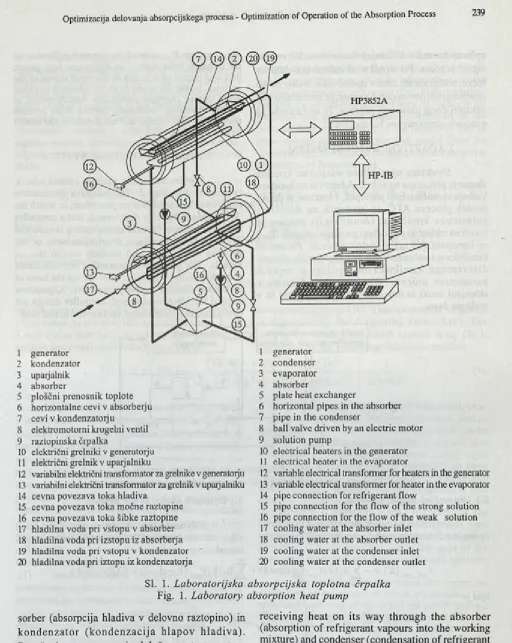
Laboratorijska absorpcijska toplotna črpalka z delovno raztopino H20-LiBr v vodi je prikazana na sliki 1 in podrobno opisana v [8], A lgoritem adaptivnega krmilnika teče na osebnem računalniku, ki dobiva izmerjene signale procesa prek merilnega sistema HP3852 in pošilja izračunane vstopne signale ustreznim izvršilnim členom, ki upravljajo parametre ATČ. Naprava je opremljena še z dodatnimi merilnimi in izvršilnimi členi, ki niso potrebni za krmilni sistem, omogočajo pa umetno motenje procesa in opazovanje vseh bistvenih parametrov procesa.
Učinek ATČ je dvig temperaturne ravni hladilne vode, ki se segreje na svoji poti skozi
ab-OFF strategy with intermittent heat input into the generator is an inexpensive, but from the energy viewpoint poor method for AHD control. The reason for this lies in the fact that when heat input into the generator is interrupted (OFF-mode), the mixture stops boiling and cools to below saturation temperature, which causes a reduction in the pressure difference in the absorption process. When heat input into the generator is switched on again (ON-mode), the heat input is used for a certain period of time to establish the necessary level of accumulated heat, thus ensuring the required pressure and temperature levels. Energy loss therefore occurs during the OFF interval, and is greater the more the operating conditions differ from the designed ones [4],
In order to achieve the optimum effect of an AHD in a usually disturbed environment, it is therefore necessary to choose a control system which follows the process and adapts to the changes in its static and dynamic characteristics. Such a control system needs an appropriate model which can provide on-line information on the current state and adequate estimates of the future behaviour of the process. An appropriate method is experimental analysis, i.e. identification, which enables the building of mathematical models of the process in real time by measuring input and output process signals. The identified model is part of an adaptive control system, which collects information on the process and changes its control laws accordingly. It simultaneously adapts to the variable properties of the process, and can also adapt to the operation of any disturbance, albeit unmeasurable. Certain similar implementations in related processes and systems can be seen in [5] to [7],
This paper describes the development of an appropriately designed form for an adaptive control system and its implementation on an absorption heat pump (AHP), and analyses the operation of an adaptively controlled AHP in variable and disturbed operating conditions.
1 ABSORPTION HEAT PUMP
A laboratory absorption heat pump with a H20-LiBr working mixture is shown in Figure 1 and described in detail in [8]. The algorithm of an adaptive control system runs on a PC, which receives measurements of process output signals through an HP3852 Data Acquisition and Control Unit and sends the calculated process input signals to the corresponding execution elements, which control the AHP. The device is equipped with additional measuring and execution elements, which are not important for the adaptive control system, but do allow for the artificial creation of disturbances and the observation of parameters in the AHP’s individual components.
1 generator 1 generator
2 kondenzator 2 condenser
3 upaijalnik 3 evaporator
4 absorber 4 absorber
5 ploščni prenosnik toplote 5 plate heat exchanger
6 horizontalne cevi v absorberju 6 horizontal pipes in the absorber
7 cevi v kondenzatorju 7 pipe in the condenser
8 elektromotorni krogelni ventil 8 ball valve driven by an electric motor
9 raztopinska črpalka 9 solution pump
10 električni grelniki v generatorju 10 electrical heaters in the generator 11 električni grelnik v uparj alniku 11 electrical heater in the evaporator
12 variabilni električni transformator za grelnike v generatorju 12 variable electrical transformer for heaters in the generator 13 variabilni električni transformator za grelnik v upaij alniku 13 variable electrical transformer for heater in the evaporator
14 cevna povezava toka hladiva 14 pipe connection for refrigerant flow
15 cevna povezava toka močne raztopine 15 pipe connection for the flow o f the strong solution 16 cevna povezava toka šibke raztopine 16 pipe connection for the flow o f the weak solution 17 hladilna voda pri vstopu v absorber 17 cooling water at the absorber inlet
18 hladilna voda pri izstopu iz absorberja 18 cooling water at the absorber outlet 19 hladilna voda pri vstopu v kondenzator 19 cooling water at the condenser inlet 20 hladilna voda pri iztopu iz kondenzatorja 20 cooling water at the condenser outlet
Sl. 1. L a b o ra to rijs k a a b so rp cijska to p lo tn a č rp a lk a F ig. 1. L a b o ra to ry absorption heat pum p
sorber (absorpcija hladiva v d elovn o raztopino) in
k o n d e n z a to r ( k o n d e n z a c ij a h la p o v h la d iv a ) .
Povečanje temperature je d olo čen o s temperaturo hladilne vode pri izstopu iz kondenzatorja tc w_out j zato
je bila ta veličina izbrana kot izstopni signal p r o c e sa .
N a temperaturo hladilne vod e pri izstopu iz
k o n d en za to rja tCw_om v p liv a jo r a z lič n i p r o c e sn i parametri. N aša analiza in tudi analize nekaterih drugih
avtorjev [4] in [9] kažejo, da im a dovod toplote v gen
erator P gen izmed vseh m ožnih krmilnih veličin največji
r e c e iv in g h eat on its w a y th rou gh the absorber (absorption o f refrigerant vapours into the working m ixture) and con d en ser (condensation o f refrigerant vapours). T he increase in temperature is determ ined by the tem p era tu re o f th e c o o lin g w ater at the condenser outlet tCw_uut; this quantity w as therefore defined as the output signal o f the p rocess.
vpliv na dinamiko ATČ inje bil zato izbran kot vstopni signal procesa. Pri odmiku od načrtovane delovne točke, bodisi zaradi zahtev uporabnika, bodisi zaradi spremenjenih obratovalnih razmer, se spremenijo tudi nekateri drugi parametri procesa. Te spremembe so v modelu obravnavane kot motnje.
2 ADAPTIVNI KRMILNI SISTEM
the generator Pgcn exerted the greatest influence on the dynamic behaviour of an absorption heat pump, and was therefore selected as the input signal of the process. In the deviation from the planned working point due to changed customers’ requirements or altered operating conditions, certain other process parameters also change and are treated in the model as disturbances.
2 ADAPTIVE CONTROL SYSTEM
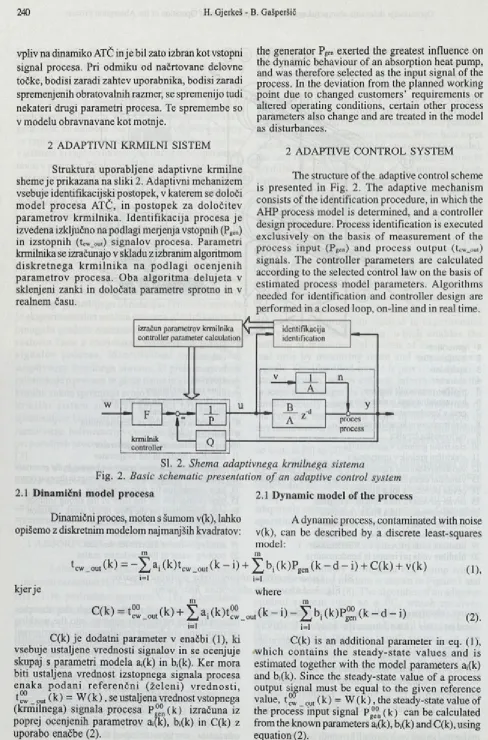
Struktura uporabljene adaptivne krmilne sheme je prikazana na sliki 2. Adaptivni mehanizem vsebuje identifikacijski postopek, v katerem se določi model procesa ATČ, in postopek za določitev parametrov krmilnika. Identifikacija procesa je izvedena izključno na podlagi merjenja vstopnih ( P gen) in izstopnih (t cw_out ) signalov procesa. Parametri krmilnika se izračunajo v skladu z izbranim algoritmom diskretnega krm iln ik a na podlagi ocenjenih param etrov procesa. Oba algoritm a delujeta v sklenjeni zanki in določata parametre sprotno in v realnem času.
The structure of the adaptive control scheme is presented in Fig. 2. The adaptive mechanism consists of the identification procedure, in which the AHP process model is determined, and a controller design procedure. Process identification is executed exclusively on the basis of measurement of the process input (Pgcn) and process output (t cw_out) signals. The controller parameters are calculated according to the selected control law on the basis of estimated process model parameters. Algorithms needed for identification and controller design are performed in a closed loop, on-line and in real time.
SI. 2. Shema adaptivnega krmilnega sistema
Fig. 2. Basic schematic presentation o f an adaptive control system
2.1 Dinamični model procesa 2.1 Dynamic model of the process
Dinamični proces, moten s šumom v(k), lahko opišemo z diskretnim modelom najmanjših kvadratov:
m
^•CW_OUt(^) ~ ~^~l, (k)t
i=l
kjer je
C(k) = C _
0
Ut(k) + X a i(k ) C
i=l
C(k) je dodatni parameter v enačbi (1), ki vsebuje ustaljene vrednosti signalov in se ocenjuje skupaj s parametri modela ai(k) in bi(k). Ker mora biti ustaljena vrednost izstopnega signala procesa enaka podani referenčni (želeni) vrednosti, 1 ™ _ out ( k ) - W ( k ), se ustaljena vrednost vstopnega (krmilnega) signala procesa P°e°n(k) izračuna iz poprej ocenjenih parametrov aj(k), bj(k) in C(k) z uporabo enačbe (2).
A dynamic process, contaminated with noise v(k), can be described by a discrete least-squares model:
m
where
m
<k - ') - 2 ) b, (k)P“ n (k - d - i) (2)
i=l
C(k) is an additional parameter in eq. (1), which contains the steady-state values and is estimated together with the model parameters ai(k) and bi(k). Since the steady-state value of a process output signal must be equal to the given reference value, t cw _ qut (k) = W ( k ) , the steady-state value of the process input signal Pg°e°n (k) can be calculated from the known parameters aj(k), bi(k) and C(k), using equation (2).
cw _out
( k - i j
+ ^ b j (k)P gen(k -
d- i) +
C (k)+ V(k)
Parametri krmilnika se prilagajajo trenutnim razmeram v procesu, zato mu mora dinamični model pošiljati informacije o procesu kontinuirano in v realnem času. To omogoča rekurzivna metoda, pri kateri se model izračuna iz parametrov v prejšnjem časovnem koraku in iz trenutnih podatkov o procesu. Novi podatki, običajno v obliki para vstopno-izstopnih signalov procesa, izboljšajo model iz prejšnjega koraka. Algoritem za rekurzivno ocenjevanje parametrov ima obliko:
The controller parameters are adapted to current circumstances in the process. The dynamic model must therefore provide information on the process continuously and in real time. In the recursive method, the model is calculated from its values in the previous step and from actual information on the process. New data, usually in the form of a pair of input-output signals improve the model from the previous step. The form of the algorithm for recursive estimation of parameters is
(3),
a a
r(k)vi/(k + l)
0(k + l) = 0(k) + ---=— =
---?i(k) + \|/T(k + l)r(k)\|/(k + l)
tcw out(k + l ) - v T(k + l)0(k)
kjer je where
(k) =[ - tcw out (k -
1 ) , -- t cw out (k -
m ),Pgen (k - d - l),...,Pgen (k - d -
m ), 1 ]vektor podatkov in
e (k) =
is a data vector and
ai(k),...,am(k),bi(k),...,bm(k),C(k)
vektor parametrov [10]. Časovno spremenljivo is a parameter vector [10]. Time-dependent weighting
uteževanje uravnava faktor pozabljanja À.(k). is regulated by the forgetting factor ?i(k). The
Kovariančna matrika £ , ki se pojavlja v enačbi (3), covariance matrix E(k), which appears in eq. (3), is
se izračuna z naslednjo rekurzivno enačbo: calculated by the following recursive equation:
I ( k +1) = I ( k ) -
r(k)\j/(k + l)\jr (k + l)r(k)
A,(k +
1
) + V|/ (k + l)r(k)\]/(k +
1
)
1
?i(k + l)
(4).Nelinearna dinamika, ki se spreminja s časom, je značilna za večino kemijskih procesov, zato je treba vključiti v ocenjevalni algoritem primeren adaptivni mehanizem, ki bo modelu omogočal zanesljivo sledenje procesu tudi pri hitrih in velikih spremembah delovne točke, ko linearizacija ni več zadovoljiva. Uporabili smo metodo časovno spremenljivega uteževanja starih podatkov [11]. V vsakem časovnem koraku se je faktor pozabljanja izračunal tako, daje ohranjal stalni delež informacij v ocenjevalnem algoritmu in tako preprečeval stalno izboljševanje ocen parametrov. To je bistveno, saj se stanje procesa stalno spreminja in bi stari podatki dajali napačne informacije.
Id en tifik ac ijsk i postopek obsega tudi ocenjevanje strukturnih parametrov modela. Osnovna strukturna parametra parametričnega modela sta red (m) in zakasnitev (d) modela. Oba smo ocenili z nerekurzivno metodo najmanjših kvadratov [10], Zakasnitev modela smo dodatno ocenjevali še z rekurzivno metodo [12], kar pa se je v primeru ATČ pokazalo kot nepotrebno, saj so rezultati pokazali, da je zakasnitev procesa invariantna pri izbranem vzorčnem času T. Tega smo izbrali po poprej določeni časovni konstanti (časovna konstanta regulirane ATČ je bila 164 s) tako, da ocenjevalni algoritem ni izgubljal informacij o procesu (predolg T) in da v kovariančni matriki T ni prihajalo do singularnosti (prekratek T).
Nonlinear dynamics, which varies with time, is characteristic of most chemical processes, and an appropriate adaptive mechanism should therefore be included in the estimator, so that the model will also be capable of following the process during rapid changes and large changes of the working point when linearisation is no longer satisfactory. An algorithm was used which includes variable weighting of past data [11], At each step a forgetting factor is calculated to m aintain a constant scalar m easure of the information content of the estimator. In this way, constant improvement of parameter estimations is prevented. This is essential, since the state of the process changes and old data would yield incorrect information.
Začetni pogoji za ocenjevanje parametrov procesa in krmilnika se določijo v predidentifikacijski fazi, med katero je proces vzbujan z dobro definiranim testnim signalom. Po določenem času se ocenjeni model verificira in zažene adaptivni krmilni mehanizem v sklenjeni zanki.
In order to set the initial conditions for parameter estimation and controller design the pre identification phase has to be performed, in which the process input is perturbed by a well-defined test signal for a definite time period. After a sufficient identification time, the estimated process model is verified and the parameter-adaptive control loop can be started in a closed loop.
2.2 Diskretni krmilnik
Diskretni krmilnik predpisuje obnašanje sklenjene zanke. Na podlagi informacij o procesu, ki jih dobi iz identifikacijskega procesa, algoritem za adaptacijo param etrov krm ilnika m inim izira predpisano kriterijsko funkcijo, katere oblika je odvisna od tipa krmilnika in želenega obnašanja procesa.
Za k rm iljenje ATČ smo uporabili kompenzacijski krmilnik s predpisanimi poli in ničlami sistemske prenosne funkcije [13]. Njegova značilnost je filtriranje referenčne vrednosti W in ločitev ničel krmilnika od ničel prenosne funkcije sklenjene zanke. Struktura krmilnika je shematično prikazana na sliki 2.
Kompenzacijski krmilnik s predpisanimi poli in ničlami ima obliko:
2.2 Discrete controller
Discrete controllers prescribe the behaviour of the closed loop. On the basis of information on the process obtained from the identification procedure, the algorithm for the adaptation of controller parameters minimizes the prescribed loss function, which depends on the type of the controller and the desired effect of the system.
A cancellation controller with pole-zero placement [13] was used in an adaptive control system of an AHP. This controller is characterized by filterin g of the reference value W and distinguishing the controller zeros from zeros of the closed-loop transfer function. Its structure is presented in schematic form in Fig. 2.
The control law of a pole-zero placement controller has the following form:
P (z _1 )u(z) = F(z~’ )w(z) - Q (z_1 )y(z) (5).
Sistemski prenosni funkciji Gw predpišemo obliko G :
A form Gm is prescribed to the systemic transfer function Gw:
Gw (z) = O * =----— ^(z ~' )B(Z~1 )z ~d = z -a
w(z) P (z- )A (z_1) + Q(z~ )B(z_1)z~d G m(z) (6),
s čimer predpišemo obnašanje celotnega sistema, thereby prescribing the behaviour of the entire
Prenosno funkcijo: system. The transfer function:
g j z - 1) r -d
v enačbi (6) smo izbrali na osnovi časovne konstante procesa, ojačanja procesa, intenzivnosti šuma, k ije motil proces, in želenega obnašanja ATČ.
in equation (6) was selected on the basis of the time constant, process gain, level of noise acting on the process and desired behaviour of the AHP.
3 REZULTATI
Opazovali smo vpliv spreminjanja dveh parametrov: temperaturo hladilne vode pri vstopu v proces tcwjn in masni tok delovne raztopine mSOi. Pri prvem parametru, k ije odvisen od razmer v okolici, so pri realno delujoči ATČ motnje stalno prisotne. Z drugim parametrom smo simulirali motnje v samem procesu, ki lahko izvirajo iz nepravilnega delovanja raztopinskih črpalk, lahko pa so posledica korozije ali zmanjšanja premera cevi zaradi nalaganja umazanije. Vpliva tretjega pomembnega parametra, tj. tempera ture v uparjalniku, zaradi specifične zgradbe laboratorijske ATČ nismo opazovali. V uparjalniku je namreč hladivo vrelo v luži in se je v uparjalnik dovajala
3 RESULTS
ustrezna stalna količina toplote, tako da se je temperatura v uparjalniku spreminjala glede na razmere v procesu.
Red in zakasnitev modela smo določili z nerekurzivno m etodo z iskanjem m inim um a kriterijske funkcije najm anjših kvadratov pri različnih vrednostih m in d. Pri ustreznih vzorčnih časih T = 1 5 s i n T = 2 0 s smo ugotovili, da za identifikacijo ATČ zadošča že preprost model prvega reda brez zakasnitve (m = 1, d = 0). Fizikalni razlog za to lahko najdem o v prevladujočem vplivu kondenzatorja na dinamiko procesa. Na spremembo dovoda toplote v generator se najhitreje odzove kondenzator, katerega moč je močno povezana z dinamiko temperature hladilne vode pri izstopu iz kondenzatorja (r(PCOn, tcw_0ut) = 0,888), medtem koje
specific design of the laboratory AHP. Pool boiling took place in the evaporator, whereby an appropriate, constant am ount of heat was delivered to the evaporator by electric heaters and the evaporating temperature changed with changes in the process.
The order and dead time of the model were determined by a non-recursive method by searching for the minimum of the loss function of the least- squares model at different values of m and d. For sample times of T = 15 s and T = 20 s, we found that a simple model with structural parameters of m = 1 and d = 0 suffices for the identification of an absorption heat pump. The physical reason for this can be found in a prevailing influence of the condenser on process dynamics. In the change of input power to the generator, the condenser responds most rapidly. Its p o w e r c o r r e la te s s tr o n g ly w ith th e tem perature of cooling w ater at the condenser
■ ■ ■ i ■ ' ■ ■ i ■ i ■ 1 ■ ■ i
--- a --- a_av !
-
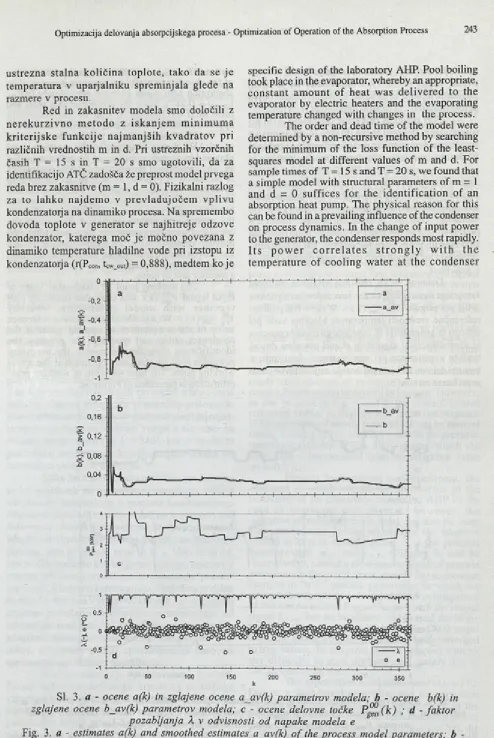
j|—yvr~y---SI. 3. a - ocene a(k) in zglajene ocene ajiv(k) parametrov modela; b - ocene b(k) in zglajene ocene b_av(k) parametrov modela; c - ocene delovne točke P™n (k ) ; d - faktor
pozabljanja X v odvisnosti od napake modela e
Fig. 3. a - estimates a(k) and smoothed estimates a_av(k) o f the process model parameters; b -
vpliv spreminjanja moči v absorberju precej šibkejši
(r(Pabs,
tcw_out)
= 0,217). Kondenzator pa je cevniprenosnik toplote, ki ga lahko v splošnem zadovoljivo aproksimiramo s prenosno funkcijo prvega reda.
Prvi preizkus prikazuje obnašanje ATČ pri spreminjanju delovne točke, ki smo jo spreminjali s koračnim spreminjanjem podane referenčne vrednosti W. Potek parametrov ocenjenega modela procesa je prikazan na slikah 3a in 3b. Z izbiro ustreznega zagonskega postopka v prvi identifikacijski fazi so parametri modela hitro konvergirali. Po sklenitvi zanke so ocene parametrov, kljub uporabi šumnega filtra, oscilirale. Zato smo uporabili nizkopasovni filter s premikajočim se povprečjem zadnjih petih ocen, da smo zgladili potek ocen parametrov, kar je posredno zmanjšalo tudi nepotrebno osciliranje dovoda toplote v generator.
Delovna točka, oziroma ustaljena vrednost vstopnega signala P°°n (k) seje ocenjevala implicitno [10], pri pogoju C _ out(k) = W (k ). Na podlagi referenčne vrednosti temperature hladilne vode pri izstopu iz generatorja in ocenjenega modela procesa je identifikacijski algoritem ocenil potrebni dovod toplote v generator pri stacionarnem delovanju v trenutni delovni točki. Potek ocenjevanja delovne točke je prikazan na sliki 3c.
outlet (r(Pcon) tcw.out) = 0.888), while the contribution of the absorber to useful temperature increase of an absorption heat pump changes very slowly (r (P abS,
tcw_om)
= 0.217). Since the condenser is a shell and tube heat exchanger, it can be satisfactorily approximated with a first-order transfer function.The first experiment presents the behaviour of an AHP during changing of the working point obtained by stepwise changes of the reference value W. The variation of the estimated model parameters is presented in Figures 3a and 3b. In the start-up procedure (pre-identification) with appropriate excitation of the process input signal, the parameters converge rapidly. Because of the influence of noise, the parameter estimates oscillated. To smooth the calculated controller parameters, a low-pass filter with moving average for the last 5 parameters estimates has proven useful, and enabled indirectly to decrease the unnecessary oscillation of power supply to the generator due to noise.
The working point or steady-state value of input signal P°°n (k) was estimated implicitly [10] to g eth er witn m odel p aram eters, w hereby C _ou«(k) = W (k ). On the basis of a reference value of the temperature of cooling water at the condenser outlet and model of the process, the identification algorithm estimated the necessary generator load for stationary operation at the actual working point. The time variation of working point estimation is presented in Figure 3c.
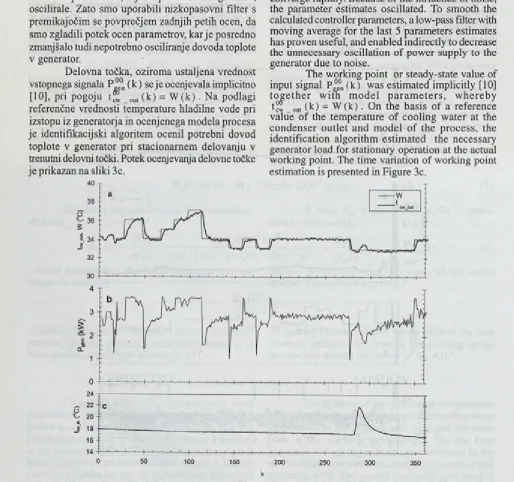
SI. 4. Adaptivno krmiljenje absorpcijske toplotne črpalke; model: m = 1, d = 0, t = 15 s; a -
referenčni W in izmerjeni izhodni (krmiljeni) signal procesa tcw_ou,; b - vhodni (krmilni) signal
procesa Pge„; c - temperatura hladilne vode pri vstopu v absorber tcwj„
Fig. 4. Adaptive control o f the absorption heat pump. Model: m = 1, d = 0, T = 15 s; a - reference W and measured process output tcw_out; b - corresponding process input Pgen; c - temperature o f the
Faktor pozabljanja X je bil izračunan na podlagi napake modela e. Na sliki 3d lahko vidimo,
daje bil X majhen v med spreminjanjem referenčne
vrednosti W, s čimer je omogočal hitro prilagoditev parametrov na novo delovno točko, medtem koje med nihanjem zaradi vpliva šuma X ostajal velik (=0,99). Na ta način je identifikacijski postopek dovoljeval spremem be ocen param etrov pri sprem em bah delovne točke procesa in preprečeval njihove spremembe zaradi šuma.
Potek izmerjenih parametrov procesa je prikazan na slikah 4a-c. Med zagonom krmilnega sistema, ki je trajal 5 min, je bila ATČ vzbujana s spremembami referenčne vrednosti za 0,5 K od trenutne ustaljene vrednosti, pri čemer je imel krmilnik ustrezne fiksne param etre. Po uspešni pred- identifikaciji se je sprožil m ehanizem sprotne prilagoditve parametrov v povratni zanki, ki je zagotavljala dobro in želeno vodenje ATČ v vseh delovnih točkah procesa.
Za simuliranje zunanje motnje smo pri k = 285 dvignili temperaturo hladilne vode pri vstopu v absorber za 5 K, slika 4c. Tovrstne motnje lahko vodijo k drastičnim spremembam ocen parametrov, ki ne izvirajo iz dinamike procesa in lahko močno pokvarijo obnašanje procesa. Kakor pa vidimo s slik 3 in 4, je krmilni sistem tudi pri takšni motnji ostal stabilen. Opaziti je mogoče le nekoliko počasnejšo konvergenco ocene ustaljene vrednosti med hlajenjem temperature hladilne vode pri vstopu v absorber na prvotno temperaturo (do k = 340), kar je imelo za posledico odstopanje krm iljenega signala od referenčne vrednosti do 0,2 K.
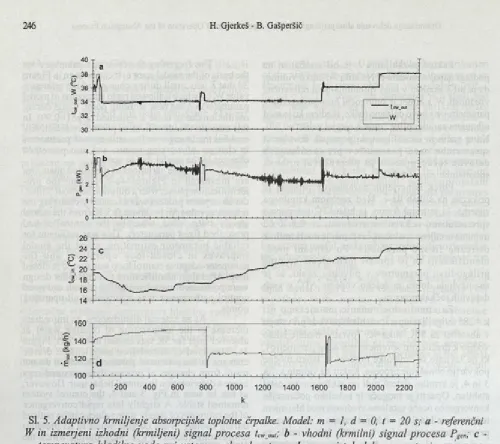
Slike 5a-d prikazujejo preizkus, pri katerem je bil poudarek na opazovanju obnašanja ATČ z adaptivnim krmilnikom v primeru kombiniranega delovanja različnih motenj, videti pa je mogoče tudi delovanje nadzorne zanke sistema. Predpogoj za zagon adaptivnega krmilnega sistema je ustaljeno delovanje procesa, zato je lezenje m soi in tcwjn, sliki 5c in 5d, povzročilo počasno konvergenco ocen parametrov v začetni fazi zaradi nenehnega spreminjanja “pravih” vrednosti, h katerim konvergirajo. Posledica je vidna na sliki 5a, kjer ima v prvih 400 korakih izstopni signal procesa povečano in pristransko odstopanje od referenčne vrednosti W. Pri stabilnem ocenjevanju adaptivni sistem tovrstne motnje kompenzira brez težav, predvsem zaradi uporabljenega časovno spremenljivega faktorja pozabljanja.
Nadzorna zanka je posredovala pri k = 750. Zaradi dobro nastavljenega krmilnika in slabega vzbujanja sklenjene zanke (ni sprememb referenčnega signala, ni zunanjih motenj) so pri k = 700 ocene parametrov začele nihati, kar je imelo za posledico nihanje tako vstopnega kakor izstopnega signala procesa (sl. 5a in 5b). Nadzorna zanka je zaznala težave s pozitivno definitnostjo kovariančne matrike
The forgetting factor X was calculated on the basis of the model error e. It can be seen in Figure 3d that X was small during changes of the reference value W, by which it allowed rapid adaptation of model parameters on the new working point, while during oscillation due to noise X remained large (=0.99). In this manner, the identification procedure selectively enabled the changes in the estimates of parameters in changes of working points, and also prevented changes in the model due to noise.
The time variations of measured quantities are presented in Figures 4a-c. During the pre identification phase, with a duration of about 5 min., the absorption process was excited by changing the reference value W by about 0.5 K from the actual steady state value, whereby the controller had prescribed fixed parameters. This was sufficient for reliable param eter estim ation, since the model im proves in clo sed -lo o p o p eratio n , and the parameter-adaptive control loop was started in closed loop. After that, identification and controller design were performed in each sampling period, and good control performance was achieved at all operating points.
As an external disturbances, an immediate increase in the tem perature of cooling water at absorber inlet for 5K was caused at k = 285, Figure 4c. This kind of disturbance may lead to drastic changes in the estimated parameters, which do not result from changes of process dynamics and may cause a deterioration in control behaviour. However, as can be seen in Fig. 3 and 4, the control system remained stable. A slightly less rapid convergence of the estimates of steady state values can be noticed during cooling of the cooling water to its previous temperature (down to k = 340), during which the controlled value deviated from the reference value up to 0.2 K.
Figures 5a-d present our experiment, the emphasis of which was on the observation of the behaviour of an adaptively controlled AHP in the case of com bined disturbances; how ever, the operation of the supervision level can also be seen. The precondition for the start-up of the adaptive control system is steady operation of the process, therefore drift m SOi and tcwjn, (Figures 5c and 5d respectively), caused a slow convergence of process parameters in the initial phase, mainly due to constant changes in “true” process parameters to which the estimation algorithm converged. The consequence of this can be seen in Figure 5a, in which the output signal tcw_out has an increased and biased deviation from the reference value W in the first 400 steps. Once the process model parameters had converged to true values, the adaptive system adapted without any difficulty to such disturbances, mainly due to the forgetting factor.
160
f 140
-g 120
100
Sl. 5. Adaptivno krmiljenje absorpcijske toplotne črpalke. Model: m - 1, d = 0, t = 20 s; a - referenčni W in izmerjeni izhodni (krmiljeni) signal procesa tCw_oui; b - vhodni (krmilni) signal procesa Pgen; c -
temperatura hladilne vode pri vstopu v absorber tcwjn; d - masni tok delovne raztopine m soi
Fig. 5. Adaptive control o f the absorption heat pump. Model: m - 1, d = 0, T = 20 s; a - reference W and measured process output tcw_out; b - corresponding process input Pgen; c - temperature o f the
cooling water at the absorber inlet tcwjn; d - mass flow o f the working solution m Soi
E, zato je s spremembami referenčne vrednosti W pri k = 750 kratkotrajno vzbujala proces. S pridobitvijo novih, bogatih informacij o procesu se je adaptivni sistem stabiliziral.
Na proces ATČ deluje šum, ki izvira iz naključnih napak pri merjenju signalov, iz spreminjanja zunanjih virov toplote in iz neustaljenih pogojev v samem procesu zaradi spremenljive omočenosti cevi v absorberju, spremenljive ravni hladiva v uparjalniku ipd. Adaptivni krmilni sistem je vse tovrstne težave uspešno kompenziral, kar se kaže v majhnem odklonu krmiljene temperature hladilne vode pri izstopu iz kondenzatorja od referenčne vrednosti. Standardno odstopanje tcW_out na sliki 4a med k = 200 do 270 je 0,07 K, in na sliki 5 azak = 800 do 1600 (trajanje 4,4 ure) 0,05 K.
definiteness of the covariance matrix E and excited the system with defined short-term changes in the reference value W at k = 750. By obtaining new and useful information on the state of the process, the adaptive system stabilized.
4 SKLEPI
A n alizirali smo p rim ern o st uporabe adaptivnega sistema za krmiljenje absorpcijske toplotne črpalke. Adaptivni mehanizem obsega identifikacijo procesa in izračun param etrov diskretnega krmilnika, ki se izračunajo na podlagi ocenjenega modela procesa. Oba algoritma tečeta v sklenjeni zanki, sprotno in v realnem času. Pri gradnji modela ni potrebno poznavanje fizikalnih lastnosti krmiljenega procesa, je pa mogoče z uporabo korelacij ad hoc iz ocenjenih parametrov procesa opazovati nekatere fizikalne zakonitosti v procesu.
Delovno točko absorpcijskega procesa smo spreminjali s spreminjanjem referenčne vrednosti izstopnega signala, s spreminjanjem temperature hladilne vode pri vstopu v proces in s spreminjanjem masnega toka delovne raztopine. Po obsežnem preskušanju smo ugotovili, daje adaptivno krmiljena absorpcijska toplotna črpalka zmožna delovati v vsaki delovni točki delovnega območja brez bistvenih nihanj svojih lastnosti. Sprotno prilagajanje krmilnika na dejanske delovne razmere zagotavlja želeno in umirjeno delovanje ATČ, k ije optimirano v trenutni delovni točki. Relativno gladko spreminjanje dovoda toplote v generator je ohranjalo stalno količino akumulirane toplote v procesu in preprečevalo izgube zaradi prevelikega nihanja toplotnih in masnih tokov.
Opisani krmilni sistem je bil zgrajen tako, da lahko identificira in regulira ne samo absorpcijske toplotne črpalke, ampak tudi preostale enostopenjske absorpcijske toplotne naprave. Za nadaljnjo optimizacijo učinkovitosti absorpcijskega procesa bo treba zgraditi adaptivni krmilni sistem z več vstopnimi in več izstopnimi signali procesa.
4 CONCLUSIONS
The suitability of an adaptive system for the control of absorption heat pumps was analyzed. The applied model identification adaptive mechanism consists of an identification procedure and a controller design procedure in which the controller param eters are calculated on the basis of the estimated process model. Both procedures took place in a closed loop, on-line and in real time. No knowledge of the physical properties of the controlled process is necessary to build the model, but it is possible to reversibly infer the behaviour of certain physical quantities by using ad hoc correlations.
The working point of the absorption process was varied by changing the reference value, by changing the temperature of cooling water at the process inlet and by changing the mass flow of the working mixture. After extensive testing, we have established that an adaptively controlled absorption heat pump is capable of operating at any working point in the operating range without considerable oscillations in its properties. With on-line adaptation of the controller to actual operating conditions, the AHP achieved the desired behaviour with low control effort, which was optimized at the current working point. A relatively smooth continuous heat flow input into the generator resulted in small fluctuations of heat and mass flows in the AHP, thus reducing loss in the process.
The adaptive control system described was constructed so as to be capable of identifing and controlling not only AHPs, but also other single stage AHDs. For further optimization of process efficiency and for multi stage AHDs, an adaptive control system with multi input-multi output configuration would need to be developed.
5 OZNAČBE 5 NOMENCLATURE
polinoma prenosne funkcije modela (reda m) A, B polynomials o f the model (order m)
koeficienti polinomov A , B, F, P in Q a i- b rfp P,- di coefficients o f polynomials A, B, F, P and Q
parameter ustaljenih vrednosti C(k) parameter o f steady state values
zakasnitev (mrtvi čas) procesa d dead time
napaka modela e(k) model error
polinom filtra referenčne vrednosti (reda m) F polynomial of the prefilter (order m -1 )
prenosna funkcija G transfer function
diskretna časovna enota, korak (k) discrete time unit, step
red modela m order o f the model
masni tok m (kg/h) mass flow
toplotni tok, signal procesa P ( W ) heat flow, process signal
polinoma prenosne funkcije krmilnika (reda m+d-1 ) P,Q polynomial o f the controllers (order m +d-1 )
interval vzorčenja T ( s ) sample time
temperatura, signal procesa t C’C ) temperature, process signal
odmik krmilnega signala od njegove ustaljene vrednosti
u(k) deviations o f the control signal from its steady state value
šum v(k) noise
odmik referenčnega signala od njegove ustaljene vrednosti
podana referenčna vrednost W(k) (“C) given reference value
odmik krmiljenega signala od njegove ustaljene y(k) deviations of the controlled signal from its
vrednosti steady state value
spremenljivka Z-transformacije z variable of the Z-transformation
vektor parametrov (reda 2m + l)
m
parameter vector of order 2m +1vektor podatkov (reda 2m + l) Hf(k) data vector o f order 2m +1
faktor pozabljanja
m
forgetting factorkvadratna kovariančna matrika (reda 2m + l) E(k) covariance quadratic matrix o f order 2m+l
Indeksi Subscripts and superscripts
ocenjena vrednost A estimated value
ustaljena vrednost 00 steady state value
absorber abs absorber
kondenzator con condenser
hladilna voda pri vstopu v proces (absorber) cw_in cooling water at the process (absorber) inlet hladilna voda pri izstopu iz procesa (kondenzatorja) cw_out cooling water at the process (condenser)
outlet
upaijalnik eva evaporator
generator gen generator
vodna raztopina litijevega bromida sol aqueous lithium bromide solution
6 LITERATURA 6 REFERENCES
[1] Alefeld, G., Kem, W., Scharfe, J., Riesch, R, Ziegler, F.: Advanced absorption cycles for environmental protection. Proceedings o f the XVUIlh International Congress o f Refrigeration, Montreal 1991,1029-1033.
[2] Demmel, S., Alefeld, G.: Reducing C 0 2 emissions with heat pump systems. Heat Recovery Systems & CHP, Voi. 14, 1994, 273-278.
[3] Lazzarin,R. M.: Heat pumps in industry-I. equipment. Heat Recovery Systems & CHP, Vol. 14,1994,581-597. [4] Butz, D., Stephan, K.: Dynamic behaviour o f an absorption heat pump. International Journal o f Refrigeration, Voi.
12, 1989, 204-212.
[5] Zaheer-Uddin, M.: Digital control o f a heat recovery and storage system. Heat Recovery Systems & CHP, Voi 10, 1990, 583-593.
[6] Madsen, H., Sejling, K., S0gaard H.T., Palsson, O.P.: On flow and supply temperature control in district heating systems. Heat Recovery Systems & CHP, Voi. 14, 1994, 613-620.
[7] Najim, K., Ruiz, V: Long-range predictive control o f an absorption packed column. Applied Mathematical Mo deling, Voi. 19,1995,39-45.
[8] Remec, J., Gjerkeš H., Gašperšič, B.: Absorption o f vapour into liquid film on horizontal tubes. ASHRAE Transactions 102, part 1, 1996, 973-979.
[9] Jeong, S., Kang, B.H., Lee, C.S., Kamg, S.W.: Computer simulation on dynamic behaviour o f a hot water driven absorption chiller. Proceedings o f the International Absorption Heat Pump Conference, New Orleans, 1994,333-338. [10] Isermann, R., Lachmann K.-H., Matko, D.: Adaptive control systems. Prentice Hall, United Kingdom, 1992. [11] Fortescue, T.R., Kershenbaum, L.S., Ydstie, B.E.: Implementation o f self-tuning regulators with variable forget
ting factors. Automatica, Vol. 17, 1981, 831-835.
[12] Kurz, H., Goedecke, W.: Digital parameter-adaptive control o f processes with unknown dead time. Automatica, Vol. 17,1981,245-252.
[13] Äström,K.J., Wittenmark, B.: Self-tuning controllers based on pole-zero placement. Proceeding IEEE 127,1980,120-DO.
[14] Isermann, R., Lachmann, K.-H.: Parameter-adaptive control with configuration aids and supervision functions. Automatica, Vol. 21, 1985, 625-638.
Naslov avtorjev: mag. Henrik Gjerkeš, dipl.inž. prof.dr. Branko Gašperšič, dipl.inž. Fakulteta za strojništvo
Univerze v Ljubljani Aškerčeva 6
1000 Ljubljana
Authors’ Address: Mag. Henrik Gjerkeš, Dipl.Ing. Prof. Dr. Branko Gašperšič, Dipl.Ing. Faculty o f Mechanical Engineering, University o f Ljubljana
Aškerčeva 6
1000 Ljubljana, Slovenia
Prejeto:
Received: 27.4.1997
Sprejeto: