* Corresponding author. E-mail address: [email protected] (S.Soltani).
Journal Homepage: ijmge.ut.ac.ir
Grade estimation of the Zu II Jajarm deposit by considering imprecise
variogram model parameters based on the extension principle
Saeed Soltani
a, *, Abbas Soltani
aand Emad Chamanifard
baDepartment of mining engineering, University of Kashan, Kashan, Iran
bDepartment of exploration and environmental geosciences, Lulea, Sweden
ABSTRACT
Nowadays, kriging has been accepted as the most common method of grade estimation in a mineral resource evaluation stage. Access to the crisp assay data and a variogram model are necessary tools of utilizing this method. Since fitting a crisp variogram model is generally difficult, if not impossible, the fitted theoretical model is usually tainted with uncertainty due to various reasons especially limitation in the number of drill holes. Although the geostatistical kriging model is incapable of taking into account the uncertainties, the fuzzy kriging method (presented based on the fuzzy concept) is capable of calculating the effects of uncertainties on the fitted model (and even on the assay data). To evaluate the Zu II Jajarm mineral resource, effort was made to use Bardossy’s fuzzy kriging method (proposed based on the extension principle) instead of ordinary kriging because of high uncertainties tainted with the fitted variogram model. Since no comprehensive software existed to be used for this method, the “FuzzyKrig” was developed for the required calculations. A key advantage of the fuzzy kriging method compared with the general, simple, ordinary, and log- kriging is that it presents, as a parameter, the width of the fuzzy number of every block as a criterion for the evaluation of uncertainties in the estimation process. The advantage of this parameter is that, unlike the estimation variance, it depends not only on the data arrangement, but also on the grade data, and therefore, can play a key role in risk management studies.
Keywords : Mineral Resource Evaluation, Kriging, Epistemic Uncertainty, Fuzzy variogram, Extension Principle, Jajarm Deposit
1.
Introduction
Grade estimation is a method to calculate the grade of an unsampled point with the weighted values of surrounding samples. Kriging, also known as the best linear unbiased estimator, is one of the common methods to find the weight of surrounding samples and the grade is estimated based on the spatial structure of data. Kriging calculates the sample weights in a way that estimation variance would be minimum [1]. Despite the fact that all methods that use a linear weighting approach are unbiased, the kriging method also calculates the estimation variance as a parameter for measuring the quality of estimation.
In the feasibility study, mine planning and operation stage, most of the important decisions are taken based on the results of grade estimation. Therefore, the quality of the model and its reliability is very important. Various factors such as the sampling size, precision in the sampling stage, preparing and analysis, structural analysis, etc. are effective on the reliability of model. It is not possible to change the number and weight of samples and the sampling method during the grade estimation step; therefore, it is essential to consider these imprecise parameters. Geostatistians treat the imprecision issue in several ways: 1) Imprecision is neglected, 2) a unique uncertainty function is defined for each parameter then they use Bayesian Kriging approaches[2], and 3) defining the imprecise parameters as a fuzzy number and then using fuzzy-kriging methods[3-6]. In most geostatistical studies, the first method is used because epistemic uncertainty of the variogram model parameters and data are insufficient. In Bayesian kriging methods, presence of epistemic uncertainty is
assessed through relating the primary subjective probabilities to every possible model [7, 8]. Despite all the advantages, it has two general objections: 1) it presents much more subjective probability information than what really exists and 2) since it presents the subjective and objective probability information related to two very different natures, their product (like what happens in the Bayes rule) is inconsistent [9]. The third way is using the fuzzy kriging method as a combination of geostatistics and fuzzy logic principles. The fuzzy kriging method is used in some geoscience and environmental fields such as mining [10-12], reservoir characterization [13, 14], hydrogeology [10, 15] and Environmental Management [16-18]. Until recently, there was no available software to be able to carry out the required computations of fuzzy kriging based on the Bardossy methods. Soltani-Mohammadi (2015) solved this problem by developing the Fuzzykrig toolbox in the MATLAB software [19]. Previous Fuzzy kriging applications are limited to two dimensional spaces (2D mesh grids and sample points), but the elevation of samples and estimation points (blocks) should be considered in mineral resource evaluation, therefore application of fuzzy kriging in this field should be carried out in a 3D space. This paper tries to expand the method based on the imprecision of variogram model parameters for 3D applications (3D block models and drill holes data) by the Fuzzykrig toolbox.
2.
Materials and Methods
2.1.Kriging
In General, estimation of a random variable Z in a block v based on data S={z1,z2,…,zn}[8, 14] gathered at points X={x1,x2, …, xn}s are defined
as[1]:
*( )
Z v
i iz (1)Where, Z*(v) is the estimated grade, is the weight of the quantity
for sample i and zi is the grade in sample i. Among different methods,
the kriging method of determining is more popular because, in addition to estimating the required parameter in each block, it can also present the factor of uncertainty related to each estimation using a parameter called “kriging variance”, which is defined as [1]:
𝜎𝑒2= 2 ∑ 𝛾̅(𝐵, 𝑠𝑖) − ∑ ∑ 𝜆𝑖𝜆𝑗𝛾̅(𝑠𝑖, 𝑠𝑗) − 𝛾̅(𝐵, 𝐵) (2) where∑ 𝛾̅(𝐵, 𝑠𝑖) is the weighted average of variogram values between the whole set of information points and the block being estimated,,∑ ∑ 𝜆𝑖𝜆𝑗𝛾̅(𝑠𝑖, 𝑠𝑗) is the weighted average of variogram values between all possible paired points, and 𝛾̅(𝐵, 𝐵)) is the average of variogram values of all possible paired points within the block being estimated[20].
2.2.Bardossy Fuzzy Kriging method
Generally, due to the lack of enough data or the behavior of experimented variogram, it is impossible to fit a variogram model with a complete precision. Therefore, the effects of imprecision in the results should be measured using the fuzzy kriging method. Two main fuzzy kriging methods have been presented: the Diamond method, which is based on a statistical basis, and the Bardossy method, which is based on the extension principle. Studies of Liquin and Dubois (2010) on Fuzzy kriging show that using imprecision in the Diamond method is not convincing and the Bardossy method is more fulfilling [9]. Bardossy et al. (1990a) modeled the parameters of an imprecise variogram model with fuzzy set numbers, and then based on the extension principle, the kriging equations were rearranged using the fuzzy kriging principles.
𝑧∗(𝑣) = 𝑓(𝑧(𝑥
1), … , 𝑧(𝑥𝑛), 𝑎̂, … , 𝑎1 ̂, 𝑣)𝑝 (3) where, 𝑎̂, … , 𝑎1 ̂𝑝are fuzzy parameters of the semi-variogram model. Therefore, if the variogram model parameters are defined in a fuzzy set values, for transferring the imprecision into p variogram parameters 𝑎̂ = {𝑎̂𝑗
،
𝑗 = 1،
…،
𝑝}, the membership value for any real number Z* resulting from the kriging equation (1) is defined as [3, 4]:𝜇𝑧̂0(𝑧∗(𝑣)) = sup 𝑧،𝑎:𝑧∗(𝑣)=𝑓0(𝑎،𝑧)
(𝜇𝑎̂𝑖(𝑎𝑖)) (4)
where 𝜇𝑎̂𝑖(𝑎𝑖)is the membership function for the fuzzy subset of variogram parameters.The kriging variance is defined as follows:
𝜎2= 2 ∑ 𝜆 𝑖𝛾̅(𝑥𝑖, 𝐵) 𝑛
𝑖=1 − 𝛾̅(𝐵, 𝐵) − ∑𝑛𝑗=1∑𝑛𝑖=1𝜆𝑗𝜆𝑖𝛾(𝑠𝑖, 𝑠𝑗)= 𝑔0(𝑎, 𝑧) (5) The membership value of any real number 𝜎2 for the kriging variance is defined as [3, 4]:
𝜇𝜎̂0(𝜎2) = sup 𝑧،𝑎:𝜎2=𝑔
0(𝑎,𝑧)
(𝜇𝑎̂𝑖(𝑎𝑖)) (6)
2.3.Defuzzification
In order to compare the fuzzy numbers, one should decrease the size of calculations and make a conclusion out of fuzzy outputs, and finally defuzzify the results. The center of area is the most common defuzzification method. In this method, the center of the area of output surface is located and projected on a horizontal axis[21]. Suppose a fuzzy number 𝑀̂ = (𝑎, 𝑏, 𝑐) in which a, b and c are minimum, most probable and maximum values of 𝑀̂, respectively. 𝑀̂ could be defuzzified to the crisp value M as:
𝑀 = 𝑎 +(𝑐−𝑎)+(𝑏−𝑎)
3 (7)
3.
Case Study
3.1.Study area and data
The Jajarm bauxite mine complex is located on 56.25 - 56.45 E longitude and 37.2 - 37.3 N latitude, 19km north of Jajarm in Northern
Khorasan Province. The most dominant geological formations are the Mobarak, Elika and Shemshak Formations. The bauxite layers are located in the border between the Mobarak-Elika, and Elika-Shemshak Formations. The shape of ore suggests that it is haa a Karst-Mediterranean style and the bauxite reserves are layered-lens shaped with an east-west direction. The Jajarm deposit is divided into 4 zones based on the Al2O3 anomalies: Lower Kaolin, Shale Bauxite (SB), Hard
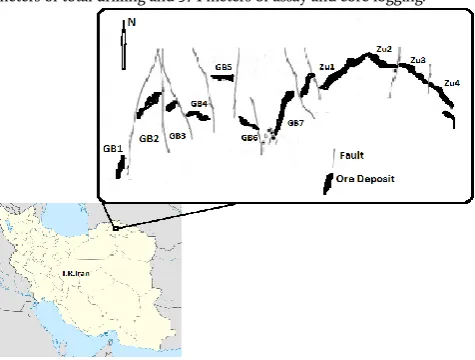
Bauxite (HB) and Top Kaolin (KB). The Hard Bauxite zone is the most important economic zone.Due to multiple faulting events in the area, the ore is divided into several blocks and the “Zu” block is the eastern part of the deposit. Zu is also divided into four subgroups (fig.1). Exploration project of Zu II includes 72 exploration boreholes, 4439 meters of total drilling and 574 meters of assay and core logging.
Figure 1- Geographic location of the Zu II deposit in the Jarajm Bauxite Complex The Hard bauxite zone is very thin, so the composite samples are defined based on geological properties. Table 1 shows the statistical parameters of the ore and figure 2 shows the histogram of SiO2 and
Al2O3 in HB zone of the Zu II deposit. The grade variables of SiO2 and
Al2O3 are assumed to be Gaussian, based on the shape of their histogram
(fig.2).
Table 1 – Statistical parameters of SiO2 and Al2O3 in composite samples Al2O3%
SiO2%
Statistic Parameters 91 91 Sample No. 41.62 14.86 Median 42.06 15.15 Mean 26.54 5.75 Min 63.15 26.89 Max 5.13 3.7 Standard Deviation 26.34 13.72 Variance 0.12 0.24 CV 0.84 0.61 Skewness 4.65 1.57 Kurtosis
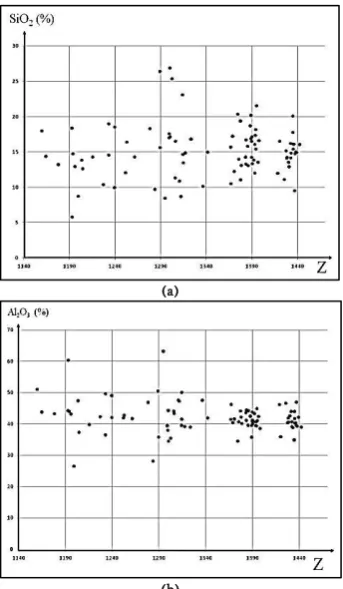
One of the issues which makes problem in geostatistical studies is the presence of trend in the sample values.Different geometric tests toward X, Y and Z axis (Fig. 3) indicates that SiO2 and Al2O3 values are free of
trend.
3.2.Fitting a fuzzy model to the experimental semivariogram
For structural analysis of variables SiO2 and Al2O3, the directional and
fitted variogram models. Afterward, by comparing the different fitted models based on the correlation coefficient and the mean squared error ratio (MSER) parameters (found from cross validation), the spherical theoretical model was found to be the most desirable case. Figure 4 shows the spherical fitted model on non-directional experimental variograms of Al2O3 and SiO2.
(a)
(b)
Figure 2 – histogram of composite samples a) SiO2 b) Al2O3
(a)
(b)
Figure 3-Vertical variation of a) SiO2 and b) Al2O3.
Table 2. Model parameters with mean squared error ratio for ordinary kriging of Al2O3 with spherical, Gaussian and Exponential variogram models.
Model Parameters Cross validation results
Model C0 Sill Range Mean
square error ratio R2 Spherical 5.494 20.882 244.7 2.58 0.492 Gaussian 5.494 20.882 95 2.63 0.476 Exponential 5.494 20.882 133 2.59
(a)
(b)
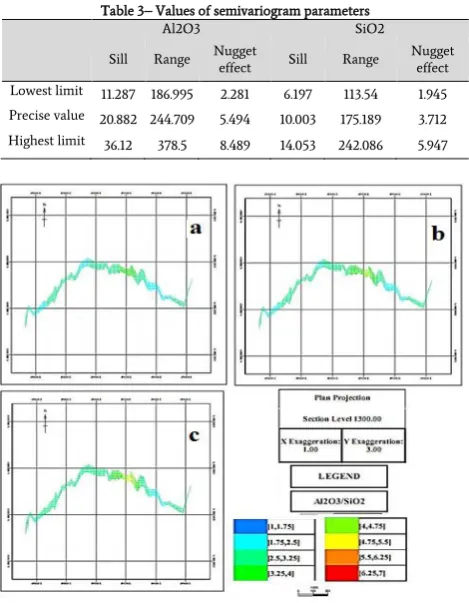
Figure 4 – Experimental variogram and its fitted model . a) Al2O3b) SiO2 As seen in figure 4, fitting a variogram model has a high epistemic uncertainty especially on parameters of the variogram model . Therefore, the fuzzy variogram models could be very useful in this matter. Instead of one fitted crisp model, three models were fitted on the lower limit, the mean, and the higher limit of the experimental semivariogram (Fig.5). Next, the variogram model parameters (nugget effect, sill and range) were determined for each of them (table 3). The higher and lower limits were spherically fitted to simplify the calculations of fuzzy kriging.
3.3.Fuzzy kriging grade estimation
The Fuzzykrig MATLAB toolbox was developed at University of Kashan for estimations of the Fuzzy kriging grade [19]. The input data are assays, the geological block model, parameters of fuzzy variogram model, the search volume, and the type of fuzzy kriging method. Only the variogram model parameters are tainted with uncertainty; therefore, Bardossy method was used.
The outputs of the program is the fuzzy grade block model, the fuzzy kriging variance and the width of fuzzy number. Although the program can draw the plots of a block model, in order to draw high quality maps and further processing, another software such as Datamine studio was used. Figure 6 shows the grade block model of the Al2O3/SiO2 ratio, for
(a)
(b)
Figure 5- The upper bound, mode, and lower bounds of a fuzzy spherical variogram model for the experimental variogram for AL2O3 and SiO2 grades.
Table 3– Values of semivariogram parameters
Al2O3 SiO2
Sill Range Nugget effect Sill Range Nugget effect
Lowest limit 11.287 186.995 2.281 6.197 113.54 1.945 Precise value 20.882 244.709 5.494 10.003 175.189 3.712 Highest limit 36.12 378.5 8.489 14.053 242.086 5.947
Figure 6- Estimated lower (a), mode (b) and upper (c) bounds for Al2O3/SiO2 module at the height of 1300 m
3.4.Defuzzification of results
In order to interpret the fuzzy estimates and compare them with crisp
estimates, SiO2 and Al2O3 fuzzy results were defuzzified by the center
gravity method. They were converted into real numbers and the block models were drawn in Datamine studio.
(a)
(b)
Figure7- 3D plot of block models of Al2O3 kriging variance a) ordinary kriging b) defuzzified fuzzy kriging
Comparing the estimations of ordinary kriging and fuzzy kriging shows that most difference between the two methods which occurs in the area with more imprecise input data. Fig 7 shows an example of fuzzy values for kriging variance of Al2O3. Deviation of kriging variance is sharper than the deviation of grade estimation, because in the fuzz kriging method, imprecision in the variogram model parameters effects the kriging variance.
To check the effects of fuzzy kriging on smoothing, the cross validation tool can be used. Figure 8 shows a comparison between the fuzzy kriging and the measurement results of Alumina grades . As shown, the smoothing effect in the results is quite obvious; MSER = 2.51% shows the presence of smoothing effects of the fuzzy kriging estimators. In this case study, since the fuzzy numbers were selected as triangular and symmetrical values, there was not any considerable difference between the validation results (after defuzzification) and those of ordinary kriging. However, the smoothing effect in the results of the ordinary kriging (MSER = 2.58%) is more than that of the fuzzy kriging.
4.
Conclusion
Parameters and input data participating in grade estimation methods always have uncertainty. In order to consider these uncertainties in the output of an estimation procedure, the combination of fuzzy logic and kriging estimation was used. In estimation of ore reserves, sampling and assay stages have a low imprecision in these steps that can be neglected, but usually the imprecision of the variogram model parameters is more effective and important. Therefore, in a fuzzy kriging method, the variogram model parameters are defined as a fuzzy subsets and are used instead of the crisp ones. In this study, after defining the fuzzy semi-variograms, the grade of each block was estimated as a fuzzy number by the Fuzzykrig software based on Barossy’s algorithm. Then, the imprecision of each block was determined based on their fuzzy width number. In fact, this ambiguity is directly related to the degree of asymmetry of samples’ locations,w= the grade variance of samples falling within a specified search volume, and inversely to the number of the samples. What results from a fuzzy estimation of a grade is that it is possible, based on the width of the fuzzy number, to increase the number of the samples at more ambiguous points to reduce the ambiguity. In addition, smoothing studies of the ordinary and fuzzy kriging results have revealed that smoothing is more common in ordinary kriging than the fuzzy one.
The results of this study can be used in grade estimation, mineral resource evaluation, and risk analysis. Furthermore, the fuzzy results were transformed into crisp number results by the center gravity method and were compared with estimated grades resulted from the ordinary kriging method.
Despite the fact that the fuzzy-kriging method increases the accuracy and considers the uncertainty in parameters, it needs a too many calculations and is very time consuming. Processing the Zu II sample values with 72 boreholes and 62214 blocks with 5*5*5 meters in size took 45 hours with a decent home PC (Core i5, 2.1 GH, 4GB RAM). Therefore, this caused difficulties in handling big datasets. It is strongly recommended that the algorithm should be reviewed in the future.
Acknowledgments
This work was supported by the University of Kashan (grant number 682666). The authors are indebted the anonymous reviewers for their valuable comments on an earlier draft of this paper.
REFRENCES
[1] Webster, R. and M.A. Oliver, Geostatistics for Environmental Scientists. 2007: Wiley.
[2] Handcock, M.S. and M.L. Stein, A Bayesian Analysis of Kriging. Technometrics, 1993. 35(4): p. 403-410.
[3] Bardossy, A., I. Bogardi, and W.E. Kelly, Kriging with imprecise (fuzzy) variograms. I: Theory. Mathematical Geology, 1990. 22(1): p. 63-79.
[4] Bardossy, A., I. Bogardi, and W.E. Kelly, Kriging with imprecise (fuzzy) variograms. II: Application. Mathematical Geology, 1990. 22(1): p. 81-94.
[5] Bardossy, A., I. Bogardi, and W.E. Kelly, Imprecise (fuzzy) information in geostatistics. Mathematical Geology, 1988. 20(4): p. 287-311.
[6] Diamond, P., Fuzzy kriging. Fuzzy Sets Syst., 1989. 33(3): p.
315-332.
[7] Samsonova, V.P., Y.N. Blagoveshchenskii, and Y.L. Meshalkina, Use of empirical Bayesian kriging for revealing heterogeneities in the distribution of organic carbon on agricultural lands. Eurasian Soil Science, 2017. 50(3): p. 305-311.
[8] Verdin, A., et al., A Bayesian kriging approach for blending satellite and ground precipitation observations. Water Resources Research, 2015. 51(2): p. 908-921.
[9] Loquin, K. and D. Dubois, Kriging and Epistemic Uncertainty: A Critical Discussion, in Methods for Handling Imperfect Spatial Information, R. Jeansoulin, et al., Editors. 2010, Springer Berlin Heidelberg. p. 269-305.
[10] Piotrowski, J.A., et al., Geostatistical regionalization of glacial aquitard thickness in northwestern Germany, based on fuzzy kriging. Mathematical Geology, 1996. 28(4): p. 437-452.
[11] Taboada, J., et al., Evaluation of the reserve of a granite deposit by fuzzy kriging. Engineering Geology, 2008. 99(1–2): p. 23-30.
[12] Verma, A.K., Application of fuzzy logic in mineral resource evaluation. 2002, National Library of Canada = Bibliothèque nationale du Canada: Ottawa.
[13] Consonni, A., R. Iantosca, and P. Ruffo, Interval and Fuzzy Kriging Techniques Applied to Geological and Geophysical Variables, in Soft Computing for Reservoir Characterization and Modeling, P. Wong, F. Aminzadeh, and M. Nikravesh, Editors. 2002, Physica-Verlag HD: Heidelberg. p. 73-103. [14] Korjani, M.M., et al., Reservoir Characterization Using Fuzzy
Kriging and Deep Learning Neural Networks. 2012, Society of Petroleum Engineers.
[15] Piotrowski, J.A., et al., Estimation of hydrogeological parameters for groundwater modelling with fuzzy geostatistics: closer to nature?, in Calibration and Reliability in Groundwater Modell. 1996: Colorado. p. 511-520. [16] Shad, R., et al., Predicting air pollution using fuzzy genetic
linear membership kriging in GIS. Computers, Environment and Urban Systems, 2009. 33(6): p. 472-481.
[17] Guo, D., R. Guo, and C. Thiart, Predicting air pollution using fuzzy membership grade Kriging. Computers, Environment and Urban Systems, 2007. 31(1): p. 33-51.
[18] Caha, J., L. Marek, and J. Dvorský, Predicting $$\text {PM}_{10}$$ PM 10 Concentrations Using Fuzzy Kriging, in Hybrid Artificial Intelligent Systems: 10th International Conference, HAIS 2015, Bilbao, Spain, June 22-24, 2015, Proceedings, E. Onieva, et al., Editors. 2015, Springer International Publishing: Cham. p. 371-381.
[19] Soltani-Mohammadi, S., FuzzyKrig: A Comprehensive Matlab Toolbox for Geostatistical Estimation of Imprecise Information. Earth Science Informatics, 2015.
[20]Journel, A.G.H.C.J., Mining geostatistics. 1978, London; New York: Academic Press.