Http://www.ijetmr.com©International Journal of Engineering Technologies and Management Research [15-19] IJETMR
STUDY AND PERFORMANCE OF PHOTOVOLTAIC CELLS WITH
VARIOUS TYPE OF PARAMETER
Dr. S. K. Mahobia 1, Prof. G. R. Kumrey 2, Swati Mahobia 3 1
Assistant Professor, Department of Physics, Rewa Engineering College, Rewa (M.P.), INDIA 2
Assistant Professor, Department of Electrical Engineering, Rewa Engineering College, Rewa (M.P.), INDIA
3
PhD Research Scholar, Govt. Model Science College, Jabalpur (M.P.), INDIA Abstract:
Photovoltaic cells are converts about 15% of the solar energy falling into the useful electricity. The increase in the temperature increases the resistance of these cell and in turns decreases the cell efficiency. So, cooling these panels is the effective way of increasing the cell efficiency. The performance of the solar panel increases by reducing the temperature. This cooling is done by air cooling or water cooling on the self-designed modified panel. The solar panels are cooled by passing air with the help of blower.
Keywords:
Photovoltaic, Cell efficiency, direct irradiation.
Cite This Article: Dr. S. K. Mahobia, Prof. G. R. Kumrey, and Swati Mahobia, “STUDY AND PERFORMANCE OF PHOTOVOLTAIC CELLS WITH VARIOUS TYPE OF PARAMETER”
International Journal of Engineering Technologies and Management Research, Vol. 3, No.
1(2016): 15-19.
INTRODUCTION 1.
Solar energy in the form of solar radiation has been identified as one of the promising source of energy to replace the dependency on other energy resources. About 86 % of the world’s energy supply comes from the fossil fuels. Moreover, the pollution hazard arising out of fossil fuel burning has become quite significant in recent years. The world is becoming acutely aware of the urgent need to resolve the many issues associated with energy consumption and climate change. The photovoltaic cell generates the electricity when exposed to the sun in the external environment. As these are exposed to the environment, the external factors and environment influences the performance and working of these panels. Temperature and irradiation intensity are two environmental factors that affects the performance and efficiency of these panels. So, thermal factor is the main factor that determines the maximum power output of the solar panel.
2. PHOTOVOLTAIC CELLS WORKING
Http://www.ijetmr.com©International Journal of Engineering Technologies and Management Research [15-19]
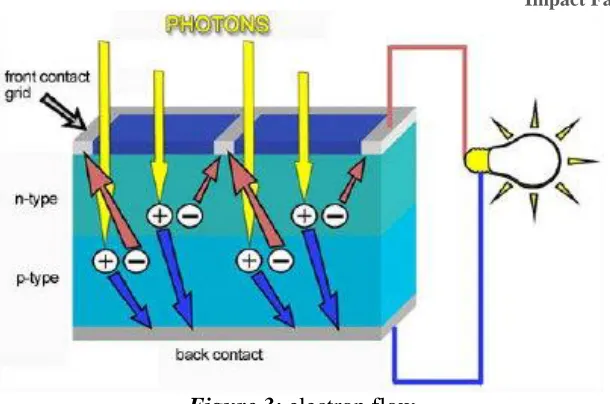
photons. A photon can be thought of as a packet of light and the energy of a photon is proportional to the wavelength of light.
3. PHOTOVOLTAIC CELL STRUCTURE
Figure 1: Photovoltaic Cell Structure
A. Encapsulate – This is made of glass or other clear material such clear plastic, seals the photovoltaic cell from the external environment.
B. Contact Grid- The contacted grid is made of a good conductor, such as a metal, and it serves as a collector of electrons.
C. the Antireflective Coating (AR Coating) - a combination of a favorable refractive index, and thickness, this layer serves to guide light into the photovoltaic cell.
D. N-Type Silicon - N-type silicon are created by doping (contaminating) the silicon with compounds that contain one more valence electrons than silicon does, such as with either phosphorus or arsenic. Since only four electrons are required to bond with the four adjacent silicon atoms, the fifth valence electron is available for conduction.
E. P-Type Silicon- P-type silicon is created by doping with compounds containing one less valence electrons than Si does, such as with boron. When silicon (four valence electrons) is doped with atoms that have one less valence electrons (three valence electrons), only three electrons are available for bonding with four adjacent silicon atoms, therefore an incomplete bond (hole) exists which can attract an electron from a nearby atom. Filling one hole creates another hole in a different Si atom. This movement of holes is available for conduction.
F. Back Contact - The back contact of a photovoltaic cell is made out of metal that covers the entire back surface and acts as a conductor.
4. PHOTON'S PATH THROUGH THE PHOTOVOLTAIC CELL
Http://www.ijetmr.com©International Journal of Engineering Technologies and Management Research [15-19]
growth antireflective layer. Once the photon passes the antireflective layer, it will either hit the silicon surface of the photovoltaic cell or the contact grid metallization. The metallization, being opaque, lowers the number of photons reaching the Si surface. The contact grid must be large enough to collect electrons yet cover as little of the photovoltaic cell's surface, allowing more photons to penetrate.
5. P-N JUNCTION
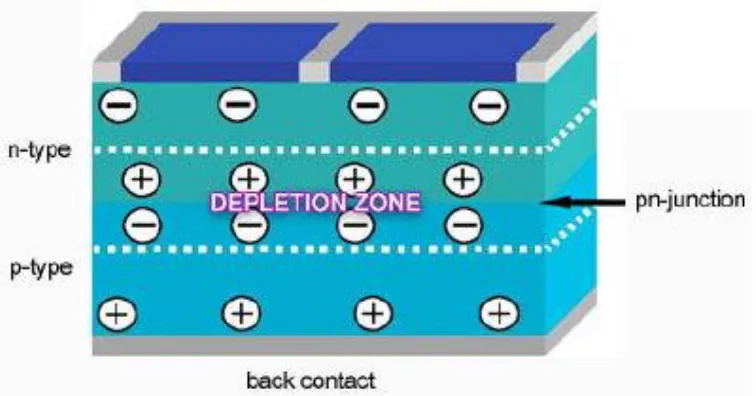
The region of photovoltaic cell where the n-type and p-type silicon layers meet is called the p-n junction. The p-type Si layer contains more positive charges, called holes, and the n-type Si layer contains more negative charges, or electrons. An interesting interaction occurs at the p-n junction of a darkened photovoltaic cell. Extra valence electrons in the n-type layer move into the p-type layer filling the holes in the p-type layer forming what is called a depletion zone. The depletion zone does not contain any mobile positive or negative charges. Moreover, this zone keeps other charges from the p and n-type layers from moving across it.
So, to recap, a region depleted of carriers is left around the p-n junction, and a small electrical imbalance exists inside the photovoltaic cell. This electrical imbalance amounts to about 0.6 to 0.7 volts. So due to the p-n junction, a built in electric field is always present across the photovoltaic cell.
Figure 2: p-n junction
Http://www.ijetmr.com©International Journal of Engineering Technologies and Management Research [15-19] Figure 3: electron flow
6. SOLAR CELL EFFICIENCY
Solar cell efficiency is the ratio of the electrical output of a solar cell to the incident energy in the form of sunlight. The energy conversion efficiency (η) of solar cells is the percentage of the solar energy to which the cell is exposed that is converted into electrical energy.
7. FACTORS AFFECTING ENERGY CONVERSION EFFICIENCY
Solar cells operate as quantum energy conversion devices, and are therefore subject to the "thermodynamic efficiency limit". Photons with energy below the band gap of the absorber material cannot generate a hole-electron pair, and so their energy is not converted to useful output and only generates heat if absorbed. For photons with energy above the band gap energy, only a fraction of the energy above the band gap can be converted to useful output. When a photon of greater energy is absorbed, the excess energy above the band gap is converted to kinetic energy of the carrier combination. The excess kinetic energy is converted to heat through phonon interactions as the kinetic energy of the carriers slows to equilibrium velocity.
8. REFERENCES
[1] K.E. Park, G.H. Kang, H.I. Kim, G.J. Yu, J.T. Kim, “Analysis of thermal and electrical
performance of semi-transparent photovoltaic (PV) module”, Energy, Vol.35, No.6, pp. 2681–2687,2010,.
[2] M.M. Aman , K.H.Solangi, M.S.Hossain, A.Badarudin, G.B.Jasmon, H.Mokhlis,
A.H.A.Bakar , S.NKazi, “A review of Safety, Health and Environmental (SHE) issues of solar energy system”, Renewable and Sustainable Energy Reviews,Vol. 41,pp. 1190-1204,2015.
[3] Lim Chee Ming, Tan Kha Sheng and M. Blundell, “Influence of Temperature on the
Http://www.ijetmr.com©International Journal of Engineering Technologies and Management Research [15-19]
[4] Mihai HOPÎRTEAN, Gilbert DE MEY, Vasile ŢOPA, Silviu ŞTEFĂNESCU,
“Temperature Influence on Conversion Efficiency in the Case of Photovoltaic Cells”, 10th International Conference on DEVELOPMENT AND APPLICATION SYSTEMS, Suceava , Romania ,pp. 1-4, 2010.
[5] J.L. Balenzategui, “Estimation of photovoltaic module yearly temperature and
performance based on Nominal Operation Cell Temperature Calculations», Renewable Energy, Vol. 29, No.12, pp. 9.
[6] M. Kempe, and N. Bosco, K. WhitefieldJ, N. Dhere,T. Zgonena. , “Evaluation of
High-Temperature Exposure of Photovoltaic Modules”, 34th IEEE Photovoltaic Specialists Conference, Philadelphia, Pennsylvania, pp.1-9, 2009.
[7] J.A. Palyvos, “On the temperature dependence of photovoltaic module electrical