INVESTIGATING METHODS OF ESTIMATING PARAMETERS IN COX
MODEL WITH TWO INCORRECTLY SPECIFIED RANDOM EFFECTS:
A SIMULATION STUDY
Olakiitan I. Adeniyi, Benjamin A. Oyejola
Department of Statistics, University of Ilorin, P.M.B 1515, Ilorin, Kwara State, Nigeria Corresponding Author: Olakiitan Adeniyi, [email protected]
ABSTRACT: Most observational data are found to be clustered. In situations like this, it is important to investigate whether there is variation in the predictor effect between the clusters. Such inter-cluster variation cannot be explained only by the heterogeneity of predictor effects across the cluster but also by heterogeneity of their baseline hazard risk. The aim of this work is to use the Penalized Partial likelihood method and Hierarchical likelihood to estimate the parameters of the model Cox model with two additive random effect when the random effect are wrongly specified via a simulation study for various cluster sizes, number of clusters, censoring percentages and magnitude of the random effect variance. The simulation study showed Hierarchical Likelihood estimates the random effects well than the Penalized Partial Likelihood but both methods estimates the fixed effect well.
KEYWORDS: Clustering, random effects models, censoring, penalized partial likelihood, hierarchical likelihood.
1. INTRODUCTION
Most observational, experimental and epidemiology data are found to be naturally clustered. Different form of clustering could be patients who are being treated in the same hospital or by the same medical practitioner. Another form of clustering that is of interest in survival analysis occur in situations where repeated, multiple or recurrence of an event is found in the same subject, such as repeated birth from a woman or recurrence of incidence of asthma in an asthmatic patient. In such cases the traditional proportional hazards model cannot be applied because of the inherent correlation of the event times. A possible solution to this problem is the use of conditional proportional hazards given the frailty which account for the inherent correlation between the event times within the subjects or the clusters ([Gut02]). Hierarchical data structure is of interest when the units at a lower level are nested in units of higher levels. Ignoring clustering or not adequately accounting for the hierarchical data structure may lead to biases of both regression coefficients and their standard errors. Also, standard errors of group-level
predictors may be underestimated if indeed clustering exists and it is ignored.
Many approaches have been applied to account for hierarchical data structure in survival analysis. The fixed effect model approach deals with hierarchical survival data by including the cluster as a categorical fixed effect in the model. This is achieved by arbitrarily setting one cluster as a reference group and a g-1 dummy variables representing the clusters can then be estimated using the Cox PH model where there are g clusters. This approach can be reasonable for a small number of clusters with no cluster-level predictors. But, with large number of clusters and small cluster size, the parameter estimation might become unstable and the efficiency of estimates may be affected (DMS09]). Also, estimate of the between-cluster effects cannot be made as they are absorbed into the cluster effects and inferences are specific to the actual clusters and not to the population of clusters that could be of interest.
The shared frailty approach assume that that subjects in a cluster share the same frailty which act proportionally on the baseline hazard, and this is why the model is called the shared frailty model. It was introduced by ([Cla78]) (who did not use the notion of ‘frailty’) and extensively studied in ([Hou00, TG00, D+02, D+03 and DJ04]). The lifetimes are assumed to be conditionally independent with respect to the shared (common) frailty. The limitation of this approach is that; it forces the unobserved factors to be the same within the cluster, which is generally not appropriate. Also, in most cases, shared frailty will only induce positive associations within the cluster. Whereas, in some situations, the survival times for subjects within the same cluster are negatively associated and the dependence between survival times within the cluster are based on marginal distributions of survival times.
model (i.e. a Cox model with two or more additive random effects at the cluster level) given as
(1)
Where and are jointly distributed and
represents respectively the random cluster and the random slope. is the observed predictor for subject
j in group i. This additive random effect model allows for the effect of a treatment at the individual level to vary between clusters (i.e. a random coefficient). 2. TWO ADDITIVE RANDOM EFFECTS COX
MODELS
Consider the case of a study of G-independent clusters i=1,…,G. Tij denotes the survival times for subject j
j=1,…,ni from group i and Cij is the corresponding right censoring time. Assuming the censoring times are independent of the survival times, the observations are and the censoring indicator . For each subject, the explanatory
variable is observed. The hazard for the jth subject
in the ith cluster with random group effect bi0 (i.e. hazard for the jth subject in the ith cluster that takes into account the correlation occurring in the data due to clustering with random cluster effects) is given by
(2)
where is the unspecified baseline hazard function at time t, β is the fixed effect parameter, is the random effect for the ith cluster. The random
effects are assumed to be independently and
identically distributed.
When variation between the cluster exists and is large, there is need to investigate whether there is variation in the predictor effect between the clusters. To achieve this, an extra random effect is added to model (2) which is the interaction between the observable and the unobservable variables. Then, the Cox model with two additive random effect models is expressed as;
(3)
where bi1 is the random predictor effect also known as
random coefficient or random interaction. The random effects are assumed to follow a multivariate normal distribution with mean 0 and a variance-covariance matrix Σ, with
.
The variance of the bi0 represents the heterogeneity
between the clusters of the overall baseline hazard and the variance of bi1 is the heterogeneity between clusters of the overall effect β1. If the variance is
null, then the observations from the same cluster are independent. A larger variance indicates greater heterogeneity across clusters and a greater correlation of the survival times for subjects belonging to the same cluster. A null implies no heterogeneity of the effect over clusters.
Given the random effects , observations
within cluster i are assumed to be independent. The full marginal log likelihood function for cluster i is given as;
The conditional likelihood function for cluster i is
(4)
where
Assuming the conditional independence of observation within a cluster and independence between clusters, the overall marginal likelihood function can be written as,
(5)
where
When the correlation structure for the two random effects is modelled by , we have
Hence, we obtain for :
With the cumulative hazard
function and
the conditional cumulative hazard function and and
The marginal log-likelihood in (5) cannot be used as it were to estimate the parameters of model (3) because of unspecified parameter of the baseline hazard which depends on integrations that cannot be solved analytically.
The focus of this paper is to investigate the methods of estimating the parameter of Cox model with two additive random effects given in (3) when the random effects are assumed be correlated but are wrongly specified. The random effects are assumed to follow a multivariate normal distribution with mean 0 and a variance-covariance matrix Σ,
with
. The covariance parameter
of the random effects is not assumed to be zero but wrongly assumed to be zero in estimating the parameters.
2.1. The Penalized Partial Likelihood
This estimation procedure was proposed by ([RP00]). ([RP00]) followed ([BC93]) in their approach for GLMM with normal random effects and applied Laplace’s method for integral approximation to (4) which leads to the approximate marginal log-likelihood by
(6)
where
If both Σ were known and were considered
fixed effects parameters, then the second line in (6) is penalized Cox full log likelihood ([Gre87]), while the last term in (6) is the penalty term penalizing for extreme values and , and are set of
parameters and a penalty term, it turns out that it can be maximized using penalized fixed effects partial likelihood (PPL),
where are the risk sets.
The estimation procedure is implemented in the coxme package for R software developed by ([The18]). ([ES12]) compare methods for fitting Cox model with two additive random effects using a simulated data built on real data set from veterinary science field.
2.2. Hierarchical Likelihood
The hierarchical likelihood approach was proposed by ([HLS01]) and can handle shared and nested frailty models with gamma and log-normal distributions. Given the common unobserved frailty for the ith unit
zi, the conditional hazard function is of the form
for the fixed covariates . The h-likelihood for
frailty model is defines by
where
is the sum of conditional log densities for tij and δij given zi, and
is the sum of log densities for
v
i
log
u
iwith parameter α. is a linear predictor forthe hazards and the baseline cumulative hazard function is given as;
Ha et al. ([HLS01]) proposed the use of the profile h-likelihood with eliminated, given by
where
does not depend on and
Are solutions of the estimating equations,
for k=1,…,l. is the number of events at and
is the risk set at
.
This estimation procedure is implemented in the frailtyHL package in R software ([HNL12).
3. PARAMETER SETTING OF THE SIMULATION STUDY
In order to investigate the Penalized Partial Likelihood and the Hierarchical likelihood, simulation studies from model (1.3) were conducted (with independent or correlated random effects). The magnitude of the heterogeneity variances set at σi0
2
=2, σi1
2=0.5; σ i0
2
=0.5, σi1
2=0.25; σ i0
2=0.25, σ i1
2
=0.025, for large, moderate and small variances respectively. The number of clusters and cluster sizes were varied to have the same number of cluster and cluster size (G=10, g=10); (G=100, g=5); (G=10, g=100), more cluster with fewer cluster size and fewer cluster with more cluster size. The specified censoring rates were 0%, 20%, 50% and 90%. The parameters of the fixed effects were set at β1=-1 for the categorical covariate
and β2=1 for the continuous covariate in both the
independent and correlated random effects. Gompertz baseline hazard distribution was used in generating the survival time with shape and scale parameter set at 0.1 and 0.05 respectively. 1000 observations were generated from the model using R version 3.4.4 software and the approach given in the package ‘simsurv’ by Brilleman ([Bri18]).
The performances of the estimation procedures were investigated based on bias, absolute bias, as well as mean square error (MSE) of the fixed and the random effect estimates. Let
ˆ
be the estimated parameter of
, then the
,
,
4. RESULTS OF THE SIMULATION
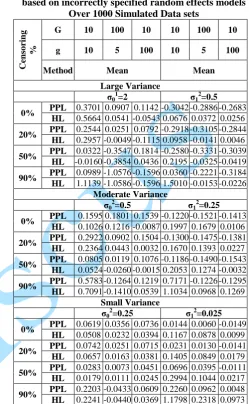
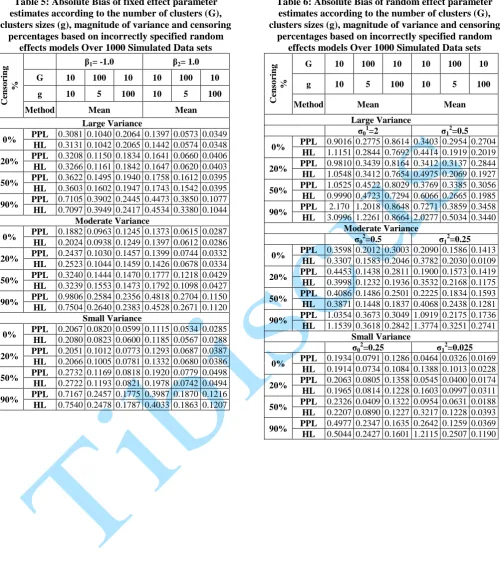
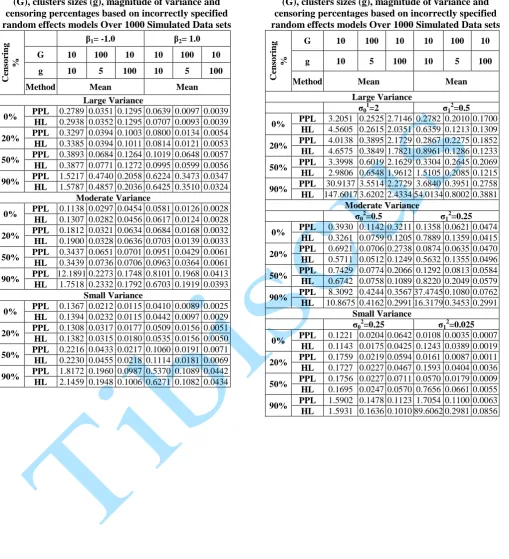
In the simulation study, the penalized partial likelihood did not show convergence problems but the Hierarchical likelihood did not reach convergence. The fixed effects were well estimated by both procedures. The result of the simulation studies are summarized in Tables 1-8.
4.1. Effect of the Censoring Rate
Table 1: Means of fixed effect parameter estimates according to the number of clusters (G), clusters sizes (g), magnitude of variance and censoring percentages based on incorrectly specified random effects models
Over 1000 Simulated Data sets
Ce
n
so
rin
g
%
β1= -1.0 β2= 1.0
G 10 100 10 10 100 10
g 10 5 100 10 5 100
Method Mean Mean
Large Variance
0% PPL -1.0959 -1.0029 -0.9732 1.0270 0.9904 0.9981
HL -1.1038 -0.9844 -0.9745 1.0424 1.0034 0.9992
20% PPL -0.9391 -0.9910 -0.9973 0.9903 0.9527 0.9867
HL -0.9417 -0.9729 -0.9993 1.0022 0.9627 0.9883
50% PPL -0.9452 -0.9156 -0.9778 0.9483 0.8415 0.9917
HL -0.9469 -0.9006 -0.9802 0.9568 0.8497 0.9938
90% PPL -0.8434 -0.6619 -0.8791 0.8273 0.6151 0.9402
HL -0.8975 -0.6572 -0.8875 0.8585 0.6120 0.9470
Moderate Variance
0% PPL -1.0057 -1.0361 -1.0030 1.0169 0.9811 0.9983
HL -0.9899 -0.9961 -1.0044 1.0291 1.0036 0.9999
20% PPL -1.0069 -1.0078 -0.9900 1.0055 0.9532 1.0029
HL -0.9963 -0.9667 -0.9915 1.0184 0.9720 1.0049
50% PPL -0.9810 -0.9524 -0.9990 0.9570 0.9009 0.9892
HL -0.9740 -0.9203 -1.0019 0.9719 0.9159 0.9924
90% PPL -0.7254 -0.8729 -0.9162 0.9298 0.7600 0.9378
HL -0.9933 -0.8692 -0.9272 0.9133 0.7653 0.9464
Small Variance
0% PPL -1.0272 -0.9976 -0.9950 1.0178 0.9990 0.9999
HL -1.0066 -0.9696 -0.9961 1.0245 1.0058 1.0019
20% PPL -1.0384 -1.0130 -0.9972 0.9920 0.9808 0.9982
HL -1.023 -0.9855 -0.9979 1.0005 0.9855 0.9999
50% PPL -0.9909 -0.9835 -1.0186 0.9911 0.9497 0.9804
HL -0.9773 -0.9578 -1.0195 1.0014 0.9517 0.9824
90% PPL -1.0933 -0.9057 -0.9828 0.9951 0.8530 0.9732
HL -1.161 -0.8977 -0.9847 1.0155 0.8564 0.9765
Table 2: Means of random effect parameter estimates according to the number of clusters (G), clusters sizes (g), magnitude of variance and censoring percentages based on incorrectly specified random effects models
Over 1000 Simulated Data sets
Ce
n
so
rin
g
%
G 10 100 10 10 100 10
g 10 5 100 10 5 100
Method Mean Mean
Large Variance
σ01=2 σ12=0.5
0% PPL 2.3701 2.0907 2.1142 0.1958 0.2114 0.2317
HL 2.5664 2.0541 1.9457 0.5676 0.5372 0.5256
20% PPL 2.2544 2.0251 2.0792 0.2082 0.1895 0.2161
HL 2.2957 1.9951 1.8885 0.5958 0.4859 0.5046
50% PPL 2.0322 1.6453 2.1814 0.2420 0.1669 0.1961
HL 1.9840 1.6146 2.0436 0.7195 0.4675 0.4581
90% PPL 2.0989 0.9424 1.8404 0.5360 0.2779 0.1816
HL 3.1139 0.9414 1.8404 2.0010 0.4847 0.4774
Moderate Variance
σ02=0.5 σ12=0.25
0% PPL 0.6595 0.6801 0.6538 0.1280 0.0979 0.1087
HL 0.6026 0.6216 0.4913 0.4497 0.4179 0.2606
20% PPL 0.7922 0.5902 0.6504 0.1200 0.1025 0.1119
HL 0.7364 0.5443 0.5032 0.4170 0.3893 0.2727
50% PPL 0.5805 0.5119 0.6076 0.1314 0.1010 0.0957
HL 0.5524 0.4740 0.4985 0.4553 0.3774 0.2468
90% PPL 1.0783 0.3736 0.6219 0.9771 0.1274 0.1205
HL 1.2091 0.3590 0.5539 1.3534 0.3468 0.3768
Small Variance σ0
2
=0.25 σ1 2
=0.025
0% PPL 0.3119 0.2856 0.3236 0.0394 0.0310 0.0101
HL 0.3008 0.2732 0.2894 0.1417 0.1128 0.0349
20% PPL 0.3242 0.2751 0.3240 0.0481 0.0380 0.0131
HL 0.3158 0.2663 0.2906 0.1655 0.1099 0.0451
50% PPL 0.2783 0.2573 0.2951 0.0946 0.0645 0.0139
HL 0.2679 0.2611 0.2745 0.3244 0.1294 0.0467
90% PPL 0.4703 0.2067 0.3109 0.2510 0.1212 0.0298
Table 3: Bias of fixed effect parameter estimates according to the number of clusters (G), clusters sizes (g), magnitude of variance and censoring percentages based on incorrectly specified random effects models
Over 1000 Simulated Data sets
Ce
n
so
rin
g
%
β1= -1.0 β2= 1.0
G 10 100 10 10 100 10
g 10 5 100 10 5 100
Method Mean Mean
Large Variance
0% PPL -0.0959 -0.0029 0.0268 0.0270 -0.0096 -0.0019
HL -0.1038 0.0156 0.0255 0.0424 0.0034 -0.0008
20% PPL 0.0609 0.0090 0.0027 -0.0097 -0.0473 -0.0133
HL 0.0583 0.0271 0.0007 0.0022 -0.0373 -0.0117
50% PPL 0.0548 0.0844 0.0222 -0.0517 -0.1586 -0.0083
HL 0.0531 0.0994 0.0198 -0.0432 -0.1504 -0.0062
90% PPL 0.1566 0.3351 0.1209 0.4473 -0.3850 -0.0598
HL 0.1025 0.3428 0.1125 -0.1415 -0.3880 -0.0530
Moderate Variance
0% PPL -0.0057 -0.0362 -0.0030 0.0169 -0.0189 -0.0017
HL 0.0101 0.0039 -0.0044 0.0291 0.0036 -0.0001
20% PPL -0.0069 -0.0078 0.0010 0.0055 -0.0468 0.0029
HL 0.0037 0.0333 0.0085 0.0184 -0.0280 0.0049
50% PPL 0.0190 0.0476 0.0010 -0.0430 -0.0991 -0.0108
HL 0.0260 0.0797 -0.0019 -0.0281 -0.0841 -0.0076
90% PPL 0.2746 0.1271 0.0838 -0.0702 -0.2400 -0.0622
HL 0.0067 0.1308 0.0728 -0.0867 -0.2347 -0.0536
Small Variance
0% PPL -0.0272 0.0024 0.0050 0.0178 -0.0010 -0.0001
HL -0.0066 0.0304 0.0039 0.0245 0.0058 0.0016
20% PPL -0.0384 -0.0130 0.0028 -0.0071 -0.0198 -0.0018
HL -0.0230 0.0145 0.0021 0.0005 -0.0145 -5.2E-05
50% PPL 0.0092 0.0165 -0.0186 -0.0090 -0.0503 -0.0196
HL 0.0227 0.0422 -0.0195 0.0014 -0.0483 -0.0176
90% PPL -0.0933 0.0943 0.0172 -0.0050 -0.1470 -0.0268
HL -0.1610 0.1023 0.0153 0.0155 -0.1436 -0.0235
Table 4: Bias of random effect parameter estimates according to the number of clusters (G), clusters sizes (g), magnitude of variance and censoring percentages based on incorrectly specified random effects models
Over 1000 Simulated Data sets
Ce
n
so
rin
g
%
G 10 100 10 10 100 10
g 10 5 100 10 5 100
Method Mean Mean
Large Variance
σ01=2 σ12=0.5
0% PPL 0.3701 0.0907 0.1142 -0.3042 -0.2886 -0.2683
HL 0.5664 0.0541 -0.0543 0.0676 0.0372 0.0256
20% PPL 0.2544 0.0251 0.0792 -0.2918 -0.3105 -0.2844
HL 0.2957 -0.0049 -0.1115 0.0958 -0.0141 0.0046
50% PPL 0.0322 -0.3547 0.1814 -0.2580 -0.3331 -0.3039
HL -0.0160 -0.3854 0.0436 0.2195 -0.0325 -0.0419
90% PPL 0.0989 -1.0576 -0.1596 0.0360 -0.2221 -0.3184
HL 1.1139 -1.0586 -0.1596 1.5010 -0.0153 -0.0226
Moderate Variance
σ02=0.5 σ12=0.25
0% PPL 0.1595 0.1801 0.1539 -0.1220 -0.1521 -0.1413
HL 0.1026 0.1216 -0.0087 0.1997 0.1679 0.0106
20% PPL 0.2922 0.0902 0.1504 -0.1300 -0.1475 -0.1381
HL 0.2364 0.0443 0.0032 0.1670 0.1393 0.0227
50% PPL 0.0805 0.0119 0.1076 -0.1186 -0.1490 -0.1543
HL 0.0524 -0.0260 -0.0015 0.2053 0.1274 -0.0032
90% PPL 0.5783 -0.1264 0.1219 0.7171 -0.1226 -0.1295
HL 0.7091 -0.1410 0.0539 1.1034 0.0968 0.1269
Small Variance σ0
2
=0.25 σ1 2
=0.025
0% PPL 0.0619 0.0356 0.0736 0.0144 0.0060 -0.0149
HL 0.0508 0.0232 0.0394 0.1167 0.0878 0.0099
20% PPL 0.0742 0.0251 0.0715 0.0231 0.0130 -0.0141
HL 0.0657 0.0163 0.0381 0.1405 0.0849 0.0179
50% PPL 0.0283 0.0073 0.0451 0.0696 0.0395 -0.0111
HL 0.0179 0.0111 0.0245 0.2994 0.1044 0.0217
90% PPL 0.2203 -0.0433 0.0609 0.2260 0.0962 0.0048
Table 5: Absolute Bias of fixed effect parameter estimates according to the number of clusters (G), clusters sizes (g), magnitude of variance and censoring
percentages based on incorrectly specified random effects models Over 1000 Simulated Data sets
Ce
n
so
rin
g
%
β1= -1.0 β2= 1.0
G 10 100 10 10 100 10
g 10 5 100 10 5 100
Method Mean Mean
Large Variance
0% PPL 0.3081 0.1040 0.2064 0.1397 0.0573 0.0349
HL 0.3131 0.1042 0.2065 0.1442 0.0574 0.0348
20% PPL 0.3208 0.1150 0.1834 0.1641 0.0660 0.0406
HL 0.3266 0.1161 0.1842 0.1647 0.0620 0.0403
50% PPL 0.3622 0.1495 0.1940 0.1758 0.1612 0.0395
HL 0.3603 0.1602 0.1947 0.1743 0.1542 0.0395
90% PPL 0.7105 0.3902 0.2445 0.4473 0.3850 0.1077
HL 0.7097 0.3949 0.2417 0.4534 0.3380 0.1044
Moderate Variance
0% PPL 0.1882 0.0963 0.1245 0.1373 0.0615 0.0287
HL 0.2024 0.0938 0.1249 0.1397 0.0612 0.0286
20% PPL 0.2437 0.1030 0.1457 0.1399 0.0744 0.0332
HL 0.2523 0.1044 0.1459 0.1426 0.0678 0.0334
50% PPL 0.3240 0.1444 0.1470 0.1777 0.1218 0.0429
HL 0.3239 0.1553 0.1473 0.1792 0.1098 0.0427
90% PPL 0.9806 0.2584 0.2356 0.4818 0.2704 0.1150
HL 0.7504 0.2640 0.2383 0.4528 0.2671 0.1120
Small Variance
0% PPL 0.2067 0.0820 0.0599 0.1115 0.0534 0.0285
HL 0.2080 0.0823 0.0600 0.1185 0.0567 0.0288
20% PPL 0.2051 0.1012 0.0773 0.1293 0.0687 0.0387
HL 0.2066 0.1005 0.0781 0.1332 0.0680 0.0386
50% PPL 0.2732 0.1169 0.0818 0.1920 0.0779 0.0498
HL 0.2722 0.1193 0.0821 0.1978 0.0742 0.0494
90% PPL 0.7167 0.2457 0.1775 0.3987 0.1870 0.1216
HL 0.7540 0.2478 0.1787 0.4033 0.1863 0.1207
Table 6: Absolute Bias of random effect parameter estimates according to the number of clusters (G), clusters sizes (g), magnitude of variance and censoring
percentages based on incorrectly specified random effects models Over 1000 Simulated Data sets
Ce
n
so
rin
g
%
G 10 100 10 10 100 10
g 10 5 100 10 5 100
Method Mean Mean
Large Variance
σ01=2 σ12=0.5
0% PPL 0.9016 0.2775 0.8614 0.3403 0.2954 0.2704
HL 1.1151 0.2844 0.7692 0.4414 0.1919 0.2019
20% PPL 0.9810 0.3439 0.8164 0.3412 0.3137 0.2844
HL 1.0548 0.3412 0.7654 0.4975 0.2069 0.1927
50% PPL 1.0525 0.4522 0.8029 0.3769 0.3385 0.3056
HL 0.9990 0.4723 0.7294 0.6066 0.2665 0.1985
90% PPL 2.170 1.2018 0.8648 0.7271 0.3859 0.3458
HL 3.0996 1.2261 0.8664 2.0277 0.5034 0.3440
Moderate Variance
σ02=0.5 σ12=0.25
0% PPL 0.3598 0.2012 0.3003 0.2090 0.1586 0.1413
HL 0.3307 0.1583 0.2046 0.3782 0.2030 0.0109
20% PPL 0.4453 0.1438 0.2811 0.1900 0.1573 0.1419
HL 0.3998 0.1232 0.1936 0.3532 0.2168 0.1175
50% PPL 0.4086 0.1486 0.2501 0.2225 0.1834 0.1593
HL 0.3871 0.1448 0.1837 0.4068 0.2438 0.1281
90% PPL 1.0354 0.3673 0.3049 1.0919 0.2175 0.1736
HL 1.1539 0.3618 0.2842 1.3774 0.3251 0.2741
Small Variance σ0
2
=0.25 σ1 2
=0.025
0% PPL 0.1934 0.0791 0.1286 0.0464 0.0326 0.0169
HL 0.1914 0.0734 0.1084 0.1388 0.1013 0.0228
20% PPL 0.2063 0.0805 0.1358 0.0545 0.0400 0.0174
HL 0.1965 0.0814 0.1228 0.1603 0.0997 0.0311
50% PPL 0.2326 0.0409 0.1322 0.0954 0.0631 0.0188
HL 0.2207 0.0890 0.1227 0.3217 0.1228 0.0393
90% PPL 0.4977 0.2347 0.1635 0.2642 0.1259 0.0369
Table 7: Mean square error (MSE) of fixed effect parameter estimates according to the number of clusters
(G), clusters sizes (g), magnitude of variance and censoring percentages based on incorrectly specified random effects models Over 1000 Simulated Data sets
Ce
n
so
rin
g
%
β1= -1.0 β2= 1.0
G 10 100 10 10 100 10
g 10 5 100 10 5 100
Method Mean Mean
Large Variance
0% PPL 0.2789 0.0351 0.1295 0.0639 0.0097 0.0039
HL 0.2938 0.0352 0.1295 0.0707 0.0093 0.0039
20% PPL 0.3297 0.0394 0.1003 0.0800 0.0134 0.0054
HL 0.3385 0.0394 0.1011 0.0814 0.0121 0.0053
50% PPL 0.3893 0.0684 0.1264 0.1019 0.0648 0.0057
HL 0.3877 0.0771 0.1272 0.0995 0.0599 0.0056
90% PPL 1.5217 0.4740 0.2058 0.6224 0.3473 0.0347
HL 1.5787 0.4857 0.2036 0.6425 0.3510 0.0324
Moderate Variance
0% PPL 0.1138 0.0297 0.0454 0.0581 0.0126 0.0028
HL 0.1307 0.0282 0.0456 0.0617 0.0124 0.0028
20% PPL 0.1812 0.0321 0.0634 0.0684 0.0168 0.0032
HL 0.1900 0.0328 0.0636 0.0703 0.0139 0.0033
50% PPL 0.3437 0.0651 0.0701 0.0951 0.0429 0.0061
HL 0.3439 0.0736 0.0706 0.0963 0.0364 0.0061
90% PPL 12.1891 0.2273 0.1748 0.8101 0.1968 0.0413
HL 1.7518 0.2332 0.1792 0.6703 0.1919 0.0393
Small Variance
0% PPL 0.1367 0.0212 0.0115 0.0410 0.0089 0.0025
HL 0.1394 0.0232 0.0115 0.0442 0.0097 0.0029
20% PPL 0.1308 0.0317 0.0177 0.0509 0.0156 0.0051
HL 0.1382 0.0315 0.0180 0.0535 0.0156 0.0050
50% PPL 0.2216 0.0433 0.0217 0.1060 0.0191 0.0071
HL 0.2230 0.0455 0.0218 0.1114 0.0181 0.0069
90% PPL 1.8172 0.1960 0.0987 0.5370 0.1089 0.0442
HL 2.1459 0.1948 0.1006 0.6271 0.1082 0.0434
Table 8: Mean square error (MSE) of random effect parameter estimates according to the number of clusters
(G), clusters sizes (g), magnitude of variance and censoring percentages based on incorrectly specified random effects models Over 1000 Simulated Data sets
Ce
n
so
rin
g
%
G 10 100 10 10 100 10
g 10 5 100 10 5 100
Method Mean Mean
Large Variance
σ01=2 σ12=0.5
0% PPL 3.2051 0.2525 2.7146 0.2782 0.2010 0.1700
HL 4.5605 0.2615 2.0351 0.6359 0.1213 0.1309
20% PPL 4.0138 0.3895 2.1729 0.2867 0.2275 0.1852
HL 4.6575 0.3849 1.7821 0.8961 0.1286 0.1233
50% PPL 3.3998 0.6019 2.1629 0.3304 0.2645 0.2069
HL 2.9806 0.6548 1.9612 1.5105 0.2085 0.1215
90% PPL 30.9137 3.5514 2.2729 3.6840 0.3951 0.2758
HL 147.6017 3.6202 2.4334 54.0134 0.8002 0.3881
Moderate Variance
σ02=0.5 σ12=0.25
0% PPL 0.3930 0.1142 0.3211 0.1358 0.0621 0.0474
HL 0.3261 0.0759 0.1205 0.7889 0.1359 0.0415
20% PPL 0.6921 0.0706 0.2738 0.0874 0.0635 0.0470
HL 0.5711 0.0512 0.1249 0.5632 0.1355 0.0496
50% PPL 0.7429 0.0774 0.2066 0.1292 0.0813 0.0584
HL 0.6742 0.0758 0.1089 0.8220 0.2049 0.0579
90% PPL 8.3092 0.4244 0.3567 37.4745 0.1080 0.0762
HL 10.8675 0.4162 0.2991 16.3179 0.3453 0.2991
Small Variance σ0
2
=0.25 σ1 2
=0.025
0% PPL 0.1221 0.0204 0.0642 0.0108 0.0035 0.0007
HL 0.1143 0.0175 0.0425 0.1243 0.0389 0.0019
20% PPL 0.1759 0.0219 0.0594 0.0161 0.0087 0.0011
HL 0.1727 0.0227 0.0467 0.1593 0.0404 0.0036
50% PPL 0.1756 0.0227 0.0711 0.0570 0.0179 0.0009
HL 0.1695 0.0247 0.0570 0.7656 0.0661 0.0055
90% PPL 1.5902 0.1478 0.1123 1.7054 0.1100 0.0063
4.2. Effect of the Magnitude of Variance
The bias, absolute bias and the MSE of both the fixed and random effect decreased as the magnitude of variance decreased for three methods of parameter estimation along this three different variance settings, this was the case for all the different censoring rates and the number of units considered.
4.3. Effect of the Number of Units
The bias, absolute bias and the mean square error (MSE) of the fixed effects parameter decreases with increasing samples size, the situation is opposite for the random effect parameter as the absolute bias and the MSE increases with increasing sample size. This was the case for the different censoring rate and the magnitude of variance considering three methods of estimation.
In estimating the random effect parameter, the HL gives a closer value to the true parameter specified compared to PPL.
5. CONCLUSION
The random effect of the additive random effects in the Cox model, with a random cluster effect and a random interaction were incorrectly specified and the performance of penalized partial likelihood and Hierarchical likelihood were investigated varying the cluster sizes, number of cluster, censoring percentages and the magnitude of the random effect variance. The performance of the estimation procedures were examined by simulating different data set that has these criteria could be present in real life data.
The estimation procedures estimated the fixed effect well under incorrectly specified random effects but Hierarchical likelihood gave a better estimate of the random effect than the Penalized partial likelihood. To this end, the Hierarchical likelihood is to be preferred when it is not known that the random effects are correlated if the interest is on the random effects than the fixed effect, but if the interest is estimating the fixed effect, both the Penalized partial likelihood and the Hierarchical likelihood could be used but the Penalized partial likelihood is computationally less intensive compared to Hierarchical likelihood.
LIMITATION OF THE STUDY
The study only implore simulated data set as there is no one dataset that could have all the varying criteria considered in this work.
REFERENCES
[Bri18] Brilleman S. – ‘simsurv’. A package for
simulating survival times. R package
version 0.2.2,
https://github.com/sambrilleman/simsurv, 2018.
[BC93] Breslow N., Clayton D. – Approximate inference in generalized linear models. Journal of the American Statistical Association, 88: 9-25, (1993).
[Cla78] Clayton D. – A model for association in bivariate life tables and its application in epidemiological studies of familial tendency in chronic disease incidence. Biometrika 65, 141- 151, (1978).
[DJ04] Duchateau L., Janssen P. – Penalized partial likelihood for frailties and smoothing splines in time to first insemination models for dairy cows.
Biometrics 60, 608 – 614, 2004.
[DJ08] Duchateau L., Janssen P. – The Frailty Model. New York Springer-Verlag., 2008.
[DMS09] Dohoo I., Martin W., Stryhn H. –
Veterinary Epidemiologic Research. 2nd edition, Charlottetown, VER – Inc, 2009. [D+02] Duchateau L., Janssen P., Lindsey P.,
Legrand C., Nguti R., Sylvester R. –
The shared frailty model and the power for heterogeneity tests in multicenter trials. Computational Statistics & Data Analysis, 40: 603-620, 2002.
[D+03] Duchateau L., Janssen P., Kezic I., Fortpied C. – Evolution of recurrent asthma event rate over time in frailty models. Journal of the Royal Statistical Society (B) 52, 355 – 363, 2003.
[ES12] Elghafghuf A., Stryhn H. – Comparison of methods for fitting Cox models with random herd and treatment-by-herd effects. The 12th Islamic Countries Conference on Statistical Sciences. 23, 367-374, 2012.
model. International Statistical 55, 245-259, 1987.
[Gut02] Gutierrez R. G. – Parametric Frailty and Shared Frailty Survival Models. The Stata Journal. 2(1): 22-44, 2002.
[Hou00] Hougaard P. – Analysis of Multivariate Survival Data. Springer-Verlag, 2000. [HLS01] Ha I. D., Lee Y., Song J. K. –
Hierarchical likelihood approach for frailty models. Biometrika, 88: 233-243 2001.
[HNL12] Ha I. D., Noh M., Lee Y. – ‘FrailtyHL’:
Frailty models using h-likelihood. URL
http://CRAN.R-project.org/package=frailtyHL. R
package version 1.1 28, 30, 2012.
[RP00] Ripatti S., Palmgren J. – Estimation of multivariate frailty models using penalized partial likelihood. Biometrics, 56: 1016-1022, 2000.
[The18] Therneau T. – ‘coxme’. A package for
mixed effects Cox models. R package version 2.2-7, URL http://cran.r-project.org/web/packages/coxme/. 2018. [TG00] Therneau T., Grambsch P. – Modelling
Survival Data, Extending the Cox model.
New York: Springer. 2000.
[Wie10] Wienke A. – Frailty Models in Survival Analysis. Chapman & Hall/CRC. 2010. [XB96] Xue X., Brookmeyer R. – Bivariate