1Ms. Nancy N. Patel 2Dr. Shweta Pachpute
CORRESPONDING AUTHOR
1Ms. Nancy N. Patel
Intern,
Sinhgad Society’s SKN College of Physiotherapy,
Pune, India.
Int J Physiother. Vol 2(4), 633-639, August (2015) ISSN: 2348 - 8336
ABSTRACT
Background: The ‘Otago exercise programme’ (OEP) is a strength and balance retraining programme
designed to prevent falls in older people living in the community. The aim of this study was to find the effects of Otago exercise programme for fall prevention in community dwelling elderly people.
Method: The sample comprised 30 community dwelling elderly around sinhgad road, pune (out of 30,
4 were dropouts) aged over 60 years both male and female falling under moderate fall risk measured by Tinetti Performance Oriented Mobility Assessment. The intervention consisted mainly strength and balance training. Intervention was done for 1 hr every day, 5 days per week for 6weeks. Outcome
measure assessment was done pre, 3rd week and post intervention. Pre and post comparison of following
three outcome measures was done.
Outcome measures: Tinetti Performance Oriented Mobility Assessment, 10RM and Chair stand test.
Result: Paired t-test was done. Results of p value for 10RM (p value = 0.00), Tinetti performance
oriented mobility assessment (p value = 0.00) and chair stand test (p value = 0.01) was found to be highly significant. Out of 26 subjects with moderate risk of fall pre intervention, 24 subjects showed low risk of fall during post intervention assessment of Tinetti Performance Oriented Mobility Assessment.
Conclusion: The Otago exercise programme is significantly effective increasing strength of lower limb
and improving in balance, gait and therefore ultimately preventing fall in community dwelling Indian elder people. Hence, Otago exercise protocol can be used in day to day clinical practice and also as a home exercise program.
Key words: Otago Exercise Programme, Strength, Balance, Elderly People, Fall, Tinetti Performance
Oriented Mobility Assessment, 10RM, Chair stand test
DOI: 10.15621/ijphy/2015/v2i4/67743
2Assistant Professor,
Sinhgad Society’s SKN College of Physiotherapy,
Pune, India. www.ijphy.org
INTRODUCTION
Fall- “an unexpected event in which the participants come to rest on the ground, floor, or lower level”.
Older population make up large and increasing percentage of population. As people grow older- they are increasingly at risk of fall and consequent injuries. Fall may be the first indication of undetected illness. The prevention of falls is of
major importance because they lead to
considerable mortality, morbidity and suffering for older people and their families, and incur social
costs due to hospital and nursing home admission.1
Older adults are hospitalized for fall-related injuries five times more often than they are for injuries from other causes. Falls are the leading cause of injury deaths among people 65yrs and
older; half occur in their own home.2
30% of people over 65 and 50% of those over 80 fall each year in the community. The prevalence of falls in Indian older adults ranges from 14% to
53%.3 Older adults who fall once are two to three
times as likely to fall again within a year; 10% of referrals to emergency - people over 65 who have fallen. 20-30% of those who fall suffer injuries that reduce mobility and independence and increase the risk of premature death. Somewhat fewer fallers who require medical attention suffer fractures.
Non injurious falls (75%-80%) are never reported to health professionals. It can still be fatal if the person is unable to get up from the floor and cannot summon help. Lying on the floor for more than 12 hours is associated with pressure sores, dehydration, hypothermia, pneumonia, and death. Almost 50% of people who fall require help to get up after at least one fall, but only 10% of falls result
in a lie of greater than one hour.4
Depression, fear of falling and other psychological problems – “post-fall syndrome” – are common effects of repeated falls. Loss of self-confidence as well as social withdrawal, confusion and loneliness
can occur, even when there has been no injury.5
Need of the study
Falls in the elderly are common in India. Lack of Exercise, fitness and nutrition leads to gradual decrease in muscle strength, decreased physical activity, therefore affects the balance, strength and
functional capacity which can result in fallsin the
elderly.6
There are many exercise interventions like balance
training 7, strengthening programme8 and
endurance training which have proved their effectiveness in improving physical fitness and
reducing the falls in the elderly in the community. 9,10,11,12,13
Otago intervention includes almost all the components for improving balance, strength and
functional capacity of elderly subjects 14, 15,16 It is a
set of exercises which is simple and can be
performed at home 17,18 by the elderly community
in India.
There are very few studies done to know the impact of Otago Interventions which has
components of balance 19, strengthening and
mobilityin the prevention of falls in the elderly
population in India.20
Hence Aims and Objectives of the study were as following,
AIM:
To find the effects of Otago exercise programme for fall prevention in elderly people.
OBJECTIVES:
1. To find increase in strength after giving Otago
exercise programme for fall prevention
2. To find balance improvement after giving
Otago exercise programme for fall prevention
3. To find effect of otago exercise programme for
fall prevention in elderly people using tinetti performance oriented mobility assessment scale
METHODOLOGY
Study Design- Pre and posttest experimental design Sample Size-30
Sampling Method- convenient sampling Treatment Duration- 6 weeks
Study Duration- 3 months
Inclusion criteria- Community dwelling elderly around sinhgad road
, Pune were included in the study. Subjects of 60 years and above having moderate risk of fall (tinetti performance oriented mobility assessment)
Exclusion criteria- People with recent fracture or surgeries, stroke, Parkinson’s disease, uncorrected visual impairments, multiple medications.
Outcome measures-
1. 10RM
2. chair stand test
3. Tinetti Performance Oriented Mobility
Assessment PROCEDURE
Pre-intervention outcomes like 10RM, chair stand test and Tinetti Performance Oriented Mobility Assessment will be assessed.
An older adult with moderate risk of fall according
to Tinetti Performance Oriented Mobility
Assessment scale is included in study.
Otago exercise intervention will be conducted for6
weeks.
Otago exercise intervention programme consists of lower limb strengthening exercises, balance training exercises, and endurance. Progression of exercises will be done by increasing the duration and then intensity. It starts with warm up, consisting of flexibility exercises for 5 min. STRENGTH TRAINING: 10 RM will be done to prescribe the intensity of weights for strengthening
programme for quadriceps hamstrings and hip
abductors. 50% of 10 RM will be taken for training and will be gradually progressed. Subjects are made to perform 8 to 10 good quality repetition before fatigue. Training begins with the subjects
performing the exercises for 30 min for 5 times a week. Progression will be given by increasing the sets to 2 or increasing the weight of the cuff. BALANCE TRAINING: The balance exercises are dynamic as opposed to static. They can help to maintain balance but will also improve the recovery of balance. Balance exercises progress from holding on to a stable structure to performing the exercise independent of support. Once the level is achieved, progress to next level.
WALKING: Subjects are advised to carry walking for at least 30 min 2 times a week.
Assessment using 10RM, chair stand test and Tinetti Performance Oriented Mobility Assessment
will be done after 3rd wk. At the end of the 6 weeks,
outcome measures which are done pre
intervention will be re-checked as post
intervention. Data analysis will be done using appropriate statistical analysis.
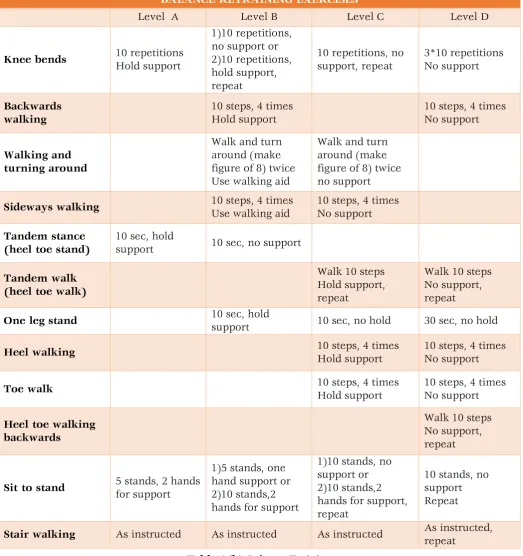
Table 1 (a) and (b) shows strength and balance training exercises.
EXERCISE PROTOCOL (Table 1)
STRENGTHENING BALANCE RETRAINING WALKING
Activities
5 leg muscle strengthening exercises, with up to 4 levels of difficulty*
12 balance retraining
exercises, with up to 4 levels of difficulty*
Advice about walking
Assessment
The amount of weight in ankle cuff should allow 8-10 repetitions before fatigue
Set each exercise at a level that the person can safely perform
Discuss the present walking activities
Intensity Moderate Moderate At own pace
Progression
Increase to 2 sets of repetitions or increase the weight of ankle cuff
From supported exercise to unsupported exercise
Frequency 5 times a week 5 times a week At least 2 times a
week
Duration
Approximately 30mins for flexibility , strength and balance exercises
30mins, can be broken down to 3*10mins walk throughout the day
STRENGTHENING EXERCISES
Knee extensors (front knee strength) Knee flexors(back knee strength) Hip abductors (side hip strength)
All 4 levels
Ankle cuff weights are used to provide resistance to muscles and 10 repetitions of each exercise are carried
out
Ankle plantarflexors (calf raises)
Level C 10 repetitions, hold
support, repeat
Level D
10 repetitions, no support, repeat
Ankle dorsiflexors (toe raises)
10 repetitions, hold support, repeat
10 repetitions, no support, repeat
BALANCE RETRAINING EXERCISES
Level A Level B Level C Level D
Knee bends 10 repetitions Hold support
1)10 repetitions, no support or 2)10 repetitions, hold support, repeat
10 repetitions, no support, repeat
3*10 repetitions No support
Backwards walking
10 steps, 4 times Hold support
10 steps, 4 times No support
Walking and turning around
Walk and turn around (make figure of 8) twice Use walking aid
Walk and turn around (make figure of 8) twice no support
Sideways walking 10 steps, 4 times
Use walking aid
10 steps, 4 times No support
Tandem stance (heel toe stand)
10 sec, hold
support 10 sec, no support
Tandem walk (heel toe walk)
Walk 10 steps Hold support, repeat
Walk 10 steps No support, repeat
One leg stand 10 sec, hold support 10 sec, no hold 30 sec, no hold
Heel walking 10 steps, 4 times
Hold support
10 steps, 4 times No support
Toe walk 10 steps, 4 times
Hold support
10 steps, 4 times No support
Heel toe walking backwards
Walk 10 steps No support, repeat
Sit to stand 5 stands, 2 hands for support
1)5 stands, one hand support or 2)10 stands,2 hands for support
1)10 stands, no support or 2)10 stands,2 hands for support, repeat
10 stands, no support Repeat
Stair walking As instructed As instructed As instructed As instructed, repeat
Table 1(b) Balance Training
RESULTS
Paired t-test was done. Results of p value for 10RM, Tinetti performance oriented mobility assessment and chair stand test was found to be very significant. Out of 26 subjects with moderate risk of fall pre intervention, 24 subjects showed low risk of fall during post intervention. Hence showing significant effect of otago exercise programme on Indian population
Figure 1
1.0833 1.5
0.189 0.4
0 0.2 0.4 0.6 0.8 1 1.2 1.4 1.6
pre
post
mean std dev
Table 2
Figure 1 and table 2 show results of 10RM. Figure 1 shows pre and post intervention difference in mean and standard deviation of 10RM while Table 2 shows p value of 10RM which is 0.00 i.e. highly significant.
s
Figure 2
Table 3
Figure 2 and table 3 show results of Tinetti Performance Oriented Mobility Assessment. Figure 2 shows pre and post intervention difference in mean and standard deviation of Tinetti Performance Oriented Mobility Assessment while Table 3 shows p value of Tinetti Performance Oriented Mobility Assessment which is 0.00 i.e. highly significant pre and post difference.
Figure 3
Table 4
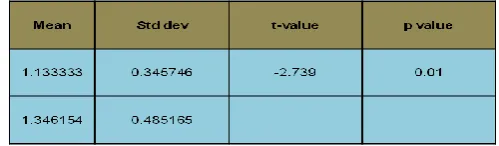
Figure 3 and table 4 show results of Chair Stand Test. Figure 3 shows pre and post intervention difference in mean and standard deviation of Chair Stand Test while Table 4 shows p value of Chair Stand Test which is 0.01 i.e. it shows significant pre and post difference.
DISCUSSION
Otago was developed, tested, and proven to be effective for preventing falls among adults 65 years of age and older in four randomized controlled trials in New Zealand. Otago has been shown to reduce falls by 35 percent among high risk individuals. It was most effective for adults 80 years of age or older, who have fallen within the last year, and who have moderate to severe decreased strength and balance due to multiple risk factors including arthritis, de-conditioning, and inactivity. Otago improves both strength and balance—two of the most readily modifiable risk factors for falls.
The nationwide implementation of effective fall prevention exercise programs i.e. Otago Exercise Program in India is limited. In contrast to an epidemiological approach, in this trial, we will conduct an intervention based on three major intrinsic fall risk factors (balance impairments, gait instabilities, and muscle weakness). This will allow the use of several extensive clinical measurement tools for evaluation purposes.
The Otago Exercise Program require relatively low supervision and material costs. Previous studies showed that combined balance and resistance training may positively affect physical (i.e., balance and strength), mental (i.e., quality of life and fear of falling), and functional performance (i.e., ADL). Uncertainty remains if resistance training alone is sufficient to prevent falls in older adults.
The purpose of this study was to determine whether there were measureable differences in strength and balance in a group of community dwelling elderly people over the age of 60 years participating in the Otago Exercise Programme for six weeks which consisted strengthening, balance and endurance training.
The outcome measures used to measure strength of lower limb were 10RM and chair stand test and
20.423 21.538
3.283 3.443
0 5 10 15 20 25
pre post
mean std dev
Tinetti Performance Oriented Mobility Assessment
1.133
1.346
0.345 0.485
0 0.2 0.4 0.6 0.8 1 1.2 1.4 1.6
pre post
mean std dev
to measure improvement in balance was Tinetti performance oriented mobility assessment.
A systematic review and meta-analysis on muscle weakness and falls in adults over the age of 65 years living in institutions or community dwelling, identified that while decreased strength is a risk factor for falls, more trials are needed to ascertain the effectiveness of strength training in falls prevention (Moreland et al 2004).Similarly a systematic review of resistance training in older adults over the age of 60 years concluded that resistance training does result in strength changes in older adults (Latham et al 2004) which is also consistent in our study.
Results showed that there was significant improvement in strength and balance in the
participants. In this study along with balance and
strength, gait improvement was also seen. Hence the Otago exercise programme is clinically significant in Indian elderly population.
CONCLUSION
The Otago exercise programme is significantly effective increasing strength of lower limb and improving in balance, gait and prevention of fall in elderly people in Indian elder people so it is effective for prevention of fall in elderly people. Hence, Otago exercise protocol can be used in day to day clinical practice and also as a home exercise programme to improve strength and balance which will ultimately result in prevention of fall in elderly population.
LIMITATIONS
1. Equal number of male and female were not
taken
FUTURE SCOPE OF THE STUDY
1. Study can be performed on large population
2. Study can be performed on specific population
eg: women
3. Study can be performed on specific conditions
eg: osteoporosis
4. Comparison of effectiveness of exercise
programme in male and female can be done ACKNOWLEDGEMENTS
A Sincere thanks to all the subjects from community dwelling elderly in Pune for their cooperation during the study. A special thanks to Dr. Prof. Ashok Patil, Principal Smt. Kashibai Navale College of Physiotherapy, Pune and the teaching staff for their everlasting support during and after the course of the study.
DECLARATION OF INTEREST
We declare that we have no conflict of interest.
REFERENCES
1. Jani, B., Rajkumar, C. Ageing and vascular
ageing. Postgrad Med J. 2006; 82(968): 357–362.
2. Dr. B. Krishnaswamy, Professor and Head, Dr.
Gnanasambandam Usha, Assistant Professor, Department of Geriatric Medicine, Madras Medical College and Government General Hospital, Chennai, Tamil Nadu- Falls in older people – National/ Regional review India.
3. SA Dsouza, B Rajashekar , HS Dsouza , KB
Kumar. Falls in Indian older adults: a barrier to active ageing. Asian Journal of Gerontology & Geriatrics .2014;9(1): 33-40.
4. NICE clinical guideline161, 2013.
5. National Center for injury prevention and
control, Atlanta, Georgia, 2008
6. Suraj Kumar, G Venu Vendhan, Dr Sachin Awasthi, Madhusudan Tiwari- Relationship Between Fear of Falling, Balance, Impairment and Functional Mobility in Community, Dwelling Elderly. IJPMR 2008 October.
7. Tracey E Howe Lynn Rochester, Fiona Neil,
Dawn A Skelton, Claire Ballinger -Exercise for improving balance in older people Editorial Group: Cochrane Bone, Joint and Muscle Trauma Group Published Online: 9 NOV 2011.
8. Takshashila S Mor1, Keerthi Rao, Dheeraj Shet,
Deepali Hande. Effectiveness of ten weeks of balance and strength training on dynamic balance of older adults. Romanian Journal of Physical Therapy.2012;18(30):48-55.
9. Preventing falls- how to develop community based fall prevention programme for older
adults, Cochrane review, Cochrane Library
2007.
10.Gillespie LD, Robertson M, Gillespie WJ,
Sherrington C, Gates S, Clemson LM, Lamb. Interventions for preventing falls in older people living in the community. Cochrane Database Syst Rev. 2009;15(2):CD007146
11.M. Gardner, M Robertson, and A Campbell.
Exercise in preventing falls and fall related injuries in older people: a review of randomised controlled trials. Br J Sports Med. 2000;34(1):7-17.
12.Gillespie LD, Gillespie WJ, Robertson MC,
Lamb SE, Cumming RG, Rowe BH-
Interventions for preventing falls in elderly people, Cochrane Database Systematic Rev. 2001;(3):CD000340.
13.Interventions for preventing falls in older
people in care facilities and hospitals. Cochrane Database Syst Rev. 2012;12:12:CD005465.
14.Liu-Ambrose T, Donaldson MG, Ahamed Y,
retraining improves executive functioning in older fallers: a randomized controlled trial. J Am Geriatric Soc. 2008; 56(10):1821-30.
15.Susie Thomas, Shylie Mackintosh and Julie
Halbert. Does the ‘Otago exercise programme’ reduce mortality and falls in older adults? a systematic review and meta-analysis. Age Ageing. 2010;39(6):681-7.
16.Does a home-based strength and balance
programme in people aged > or =80 years provide the best value for money to prevent falls? A systematic review of economic evaluations of falls prevention interventions. Br J Sports Med. 2010 Feb;44(2):80-9.
17.Robertson MC, Devlin N, Gardner MM,
Campbell AJ. Effectiveness and economic evaluation of a nurse delivered home exercise
programme to prevent falls, Randomised controlled trial. BMJ. 2001; 322(7288): 701.
18.Gardner MM, Robertson MC, Campbell AJ.
Exercise in preventing falls and fall related injuries in older people: a review of randomised controlled trials. Br J Sports Med. 2000;34:7–17.
19.Yang XJ, Hill K, Moore K, Williams S, Dowson
L, Borschmann K, Simpson JA, Dharmage SC.
Effectiveness of a targeted exercise
intervention in reversing older people's mild balance dysfunction: a randomized controlled trial. Phys Therapy. 2012; 92(1):24-37.
20.Robertson MC, Campbell AJ, Gardner MM,
Devlin N. Preventing injuries in older people by preventing falls: a meta-analysis of individual-level data. J Am Geriatric Soc. 50(5):905-11
Citation