1
Aliaa Rehan Youssef, PhD
2
Ahmed Moursi Ahmed Ibrahim, MSc
3
Khaled ElSayed Ayad, PhD
CORRESPONDING AUTHOR
1Aliaa Rehan Youssef, PhD
Faculty of Physical Therapy, Cairo University, Egypt.
Int J Physiother. Vol 2(5), 804-810, October (2015) ISSN: 2348 - 8336
ABSTRACT
Background: Patients with frozen shoulder suffer from significant pain and progressive limitation of
shoulder active and passive movements. Such clinical problems are primarily treated conservatively. Physical therapy is an integral part in treatment of frozen shoulder. Rehabilitation may include various manual mobilization techniques in order to relieve pain and restore mobility and function. Therefore, this study aimed at comparing the effects of two different mobilization techniques (Mulligan Mobilization with Movement and Maitland end range mobilization) on improving shoulder pain, function and mobility in patients with diabetic frozen shoulder.
Methods: Thirty patients were randomly and equally distributed into two groups: (1) Mulligan group
receiving mobilization with movement, and (2) Maitland group receiving end range oscillatory mobilization. Treatment was given 3 times per week, for 6 consecutive weeks. Patients were evaluated before and after treatment with regards to shoulder pain severity and functional disability using the Shoulder Pain and Disability Index as well as for shoulder flexion, abduction, external and internal rotation range of motion using a digital level inclinometer.
Results: Patients in the two groups showed significant improvement in all the measured variables
over the treatment period (p<0.01), however, patients who received the Mulligan technique showed greater improvement (p<0.05). Between group comparisons showed that patients in the Mulligan group significantly improved than those in the Maitland on all measured variables (p<0.05), except for the internal rotation range of motion (p>0.05).
Conclusion: Mulligan and Maitland end range mobilization are effective in decreasing shoulder pain
and dysfunction as well as in increasing shoulder mobility in all directions. However, the Mulligan mobilization is more effective when treating patients with diabetic frozen shoulder.
Keywords: Mobilization; Mulligan; Maitland; Diabetic frozen shoulder; Adhesive capsulitis; Shoulder
pain.
DOI: 10.15621/ijphy/2015/v2i5/78238
2 Faculty of Physical Therapy,
Cairo University, Egypt.
3 Faculty of Physical Therapy,
Cairo University, Egypt.
Received 2nd September 2015, revised 15th September 2015, accepted 29th September 2015
INTRODUCTION
Frozen shoulder or “Adhesive capsulitis” is commonly seen in middle-aged individuals;
particularly women and diabetic patients.1 It
affects 2–5% of non-diabetic population and 10– 20% of patients with non-insulin dependent
diabetes mellitus.1.2 Patients typically suffer from
significant pain and progressive limitation of
shoulder active and passive movements.3,4 Physical
therapy is the cornerstone in preventing the development of shoulder capsule contracture and
restoring shoulder motion.4-7 Common therapeutic
approaches include exercises and manual
glenohumeral mobilization. The most popular mobilization techniques used for this purpose are Maitland and Mulligan mobilization. Although these two techniques improved pain and restored function and mobility in patients with idiopathic frozen shoulder, yet Mulligan technique was
superior.8,9 However, to authors’ knowledge, the
effects of these techniques on pain, function and shoulder range of motion (ROM) in patients with diabetic frozen shoulder have never been compared. Thus, this study aimed at comparing the effects of the two mobilization techniques on diabetic frozen shoulder pain and dysfunction and shoulder active ROM. It was hypothesized that Mulligan technique would have a better outcome in terms of joint pain, ROM and function.
METHODS
This study was carried out at an outpatient clinic setting. All procedures were done in accordance to and were approved by the local ethical Committee. Subjects
Thirty patients diagnosed with diabetic frozen shoulder were eligible to participate in this study based on inclusion and exclusion criteria (Table 1).
Table 1: Inclusion and exclusion criteria
Inclusion Criteria Exclusion Criteria
Diagnosed with diabetic frozen shoulder
Had a painful and stiff shoulder for at least 3 months
Their age ranged between 45 and 65 years old
Had diabetes mellitus type II for at least five years
that was controlled at the time of conducting this study
The affected shoulder operated on
Any type of arthritis (such as rheumatoid
arthritis) affecting their upper extremities
Developed a painful stiff shoulder after a
severe trauma to the upper extremity
Previous fractures or dislocation of the
affected shoulder complex
Rotator cuff tendinitis or rupture
Previous Intra-articular steroid injection,
or surgical release
Procedures
First, patients were interviewed and assessed against the inclusion and exclusion criteria. Then, eligible patients who agreed to participate in the study signed an informed written consent.
Assessment procedures
Assessment was done at baseline and six weeks later (end of the study period). For shoulder pain and dysfunction, an Arabic translated and validated version of the Shoulder Pain And
Dysfunction Index was used.10 Each item was
scored on a 10-points scale, and a total percentage was calculated. Higher scores on the subscale
indicate greater pain and greater disability.11 The
lowest possible total SPADI percentage score is 0% indicating no disability; and the maximum possible
score is 100% indicating total disability.12 SPADI
was chosen as a primary outcome measurement in this study because of its appropriateness to the
symptoms experienced with shoulder capsulitis.13
In addition, it has content validity, good construct validity,12,14,15 internal consistency,12 and test-retest
reliability.16 The SPADI has been shown to
correlate negatively to shoulder ROM and is
sensitive to clinical changes.15,17 A 10-point change
on the SPADI has been identified as the minimal clinically important change needed to be confident
that a change has actually occurred.14
Also, shoulder active range of flexion, abduction, internal and external rotation was measured using
a digital level inclinometer18 (HUSKY, 2455 Paces
Ferry Rd, Atlanta, GA 30339, USA;). This inclinometer has an accuracy of ±0.029º for level, while the accuracy of digital display is ± 0.1º for
level and ± 0.2º for all angles.18 Measurements
were done three times and an average was calculated and used for further statistical analyses. Treatment procedures
received pendulum exercises in all directions for 5 minutes. All patients were given the same instructions and encouragement to practice pendulum exercises at home, and to participate in daily activities within pain limits.
Mulligan mobilization
The mobilization technique used was done as
described by Mulliagn, (2004).19 Briefly, therapist
applied passive accessory glide as the patient moved the arm actively in the desired direction within a pain free range. The mobilization was done in three sets of ten repetitions in each direction.
For shoulder abduction, therapist applied a posterolateral gliding force over the head of the humerus, while patient actively abducted his arm. For shoulder flexion, the therapist applied a posterolateral glide as patient flexed his shoulder. For shoulder internal rotation, therapist applied an inferior shoulder glide and stabilized the scapula as the patient internally rotated his shoulder, and adducted his upper arm. As the therapist pushed the shoulder into adduction in this way, the head of the humerus was distracted laterally. Therapist hand in the axilla acted as a fulcrum.
Maitland mobilization
Therapist applied Oscillatory end-range Maitland mobilization grade III or IV. Grade (III) refers to a large amplitude movement performed at the level where tissue resistance is encountered or up to the
limit of the available range whereas grade (IV)
implies a small amplitude movement performed
into tissue resistance.
The therapist applied oscillatory caudal glides to increase shoulder abduction, and posterior glide to increase shoulder flexion and internal rotation. To increase external rotation, an anterior glide was applied.
Statistical Analysis
Statistical analysis was done using SPSS for windows, version 21 (SPSS, Inc., Chicago, IL, USA) with the signficance level set at p<0.05. Unpaired t-test was used to compare the demographic characteristics at baseline between the two groups. Repeated Measures ANOVA test was used to compare flexion, abduction, internal and external rotation ROM as well as the total SPADI score between and within the two groups. Bonferroni correction was done to adjust for the repeated comparisons. All data are presented as means ± standard deviation.
RESULTS
A total of 30 male and female patients participated in this study. The mean age for patients in the
Mulligan group was 54.8±5.85 years, while it was 53.4±5.23 years for those in the Maitland group. The fasting blood glucose level was 128.46 ± 13.01 and 132.26 ± 8.92 mg/dl for the Mulligan and Maitland patient groups, respectively. Between
group comparison showed non-significant
difference regarding age and blood glucose level (p>0.05).
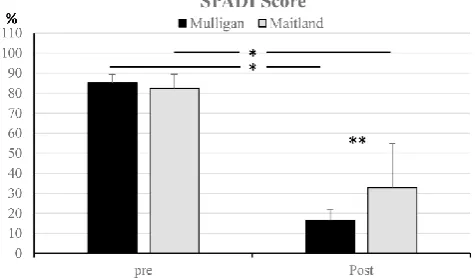
Shoulder pain and dysfunction (Table 2, Figure 1):
At baseline, patients in the two groups showed non significant difference in SPADI score (mean difference= 2.9 ± 2.2%; p= 0.19; 95% CI: 1.60 – 7.30). At the end of treatment period, the SPADI score of patients in the Mulligan group signficantly decreased compared to that of patients in the Maitland group (mean difference= 16.40 ± 5.90%; p< 0.01; 95% CI: 4.40 – 28.40). Within group comparisons showed that patients in the two groups significantly improved over the treatment period (p< 0.01). For patients in the Mulligan group, total SPADI score improved by 68.80 ± 3.70% (95% CI: 61.20 – 76.40), whereas that of patients in the Maitland group improved by 49.50 ± 3.70% (95% CI: 42.01 – 57.10).
Figure 1: SPADI shoulder pain and dysfunction score. There was a significant improvement in the Mulligan and Maitland patients groups over the treatment period (*, P<0.05), however, the Mulligan showed a more significant improvement than the Maitland group by the end of treatment (**, p<0.05)
For shoulder flexion ROM (Fig 2), patients in the the Mulligan significantly improved by 24.91 ± 9.69° compared to those in the Maitland group (p= 0.02; 95% CI: 5.05 – 44.77). Over the treatment period, patients in the Mulligan group improved by 91.54 ± 5.23° (p< 0.01; 95% CI: 80.81 – 102.26), whereas those in the Maitland group imrpoved by 66.58 ± 5.23° (p< 0.01; 95% CI: 55.86 – 77.31) For abduction ROM (Fig 2), patients in the Mulligan group signficantly improved by 21.84 ± 9.02° (p= 0.02; 95% CI: 3.36 – 40.32) compared to those in the Maitland group. Over the treatment period, patients in the Mulligan group improved by 94.34 ± 5.89° (95% CI: 82.27 – 106.41), whereas those in the Maitalnd group improved by 71.39 ± 5.89° (95% CI: 59.32 – 83.46).
For external rotation ROM (Fig 3), patients in the Mulligan group had a signficantly greater range than that of the Maitland group by 10.56 ± 4.14° (p= 0.01; 95% CI: 2.08 – 19.04). By the end of treatment, patients in the Mulligan group improved by 59.28 ± 5.31° (95% CI: 48.42 – 70.16), while those in the Maitland group improved by 48.30 ± 5.31° (95% CI: 37.43 – 59.17).
For internal rotaion ROM (Fig 3), patients in the Mulligan and Maitland groups showed a non signfiant difference (mean difference= 1.91 ± 2.52°; p= 0.46; 95% CI: 3.26 – 7.08). However, over the treatment period, the Mulligan group signficantly improved by 23.87 ± 1.68° (95% CI: 20.42 – 27.31) and those in the Maitland group improved by 21.83 ± 1.68° (95% CI: 18.38 – 25.27).
Figure 2: Shoulder Flexion and Abduction ROM. There was a significant improvement in the Mulligan and Maitland patients groups over the treatment period (*, P<0.05), however, the Mulligan showed a more significant improvement than the Maitland group by the end of treatment (**, p<0.05)
Figure 3: Shoulder Internal and external rotation ROM. There was a significant improvement in the Mulligan and Maitland patients groups over the treatment period (*, P<0.05). For external rotation range, the Mulligan group showed a significant improvement than the Maitland group at the end of treatment period (**, p<0.05). For the internal rotation range, no differences were found between the two groups (p>0.05)
Table 2: The mean ± standard deviation for ROM and SPADI scores of the two groups. * indicates significant difference (p-value < 0.05)
Variable Mulligan Maitland Mean
Difference P-value
95% CI
Lower Upper
SPADI Baseline 85.15 ± 4.24 82.30 ± 7.21 2.9 ± 2.2 0.19 1.60 7.30
Post 16.36 ± 5.68 32.76 ± 22.02 16.40 ± 5.90 <0.01* 4.4 28.40
Flexion Baseline 52.74 ± 10.51 52.78 ± 12.73 0.04 ± 4.27 0.99 8.69 8.77
Post 144.28 ± 22.23 119.36 ± 30.27 24.91 ± 9.69 0.02* 5.05 44.77
Abduction Baseline 39.46 ± 15.55 40.57 ± 19.69 1.11 ± 6.48 0.86 12.16 14.39
Post 133.80 ± 22.27 111.96 ± 26.91 21.84 ± 9.02 0.02* 3.36 40.32
External Rotation
Baseline 24.57 ± 11.16 25.01 ± 14.14 0.43 ± 4.65 0.93 9.10 9.96
Post 83.86 ± 6.38 73.30 ± 14.72 10.56 ± 4.14 0.01* 2.08 19.04
Internal Rotation
Baseline 45.60 ± 6.01 45.73 ± 5.44 0.13 ± 2.09 0.95 4.16 4.42
DISCUSSION
The purpose of this study was to compare the
effects of Mulligan versus Maitland end range
mobilization on shoulder pain and dysfunction as well as shoulder flexion, abduction, internal rotation and external rotation ROM in patients with diabetic frozen shoulder.
For shoulder pain and dysfunction, it was hypothesized that Mulligan would significantly improve shoulder pain and dysfunction than Maitland technique. This hypothesis was accepted as evident by significant pain alleviation and improvement in shoulder function in patients who received the Mulligan technique compared to those who received the Maitland technique. It should be emphasized that patients in the two groups showed significant improvement by the end of treatment. The mechanical stimulation associated with mobilization is believed to induce pain relief by a
direct stimulation of the dorsolateral
periaqueductal grey (dPAG) region of the brain; which gives off descending pathways that influence inhibitory interneurons at the spinal
level.20,21 It also, indirectly alleviates pain by
improving synovial fluid circulation and washing
out of pain metabolites.23 However, the superior
effect of Mulligan technique could be attributed to correction of positional faults and restoration of joint arthrokinematics, which in turn permits pain
free motion.24-26 Furthermore, the active
participatory nature of this technique stimulates
proprioceptors and inhibits pain.27
Regarding shoulder dysfunction, the improvement in shoulder function seen in patients within the Mulligan group could be a direct effect of pain relief associated with technique, which encouraged patients to use their affected arms in activities of daily living.
For shoulder motion, It was hypothesized that Mulligan mobilization would significantly improve shoulder range compared to Maitland technique. This hypothesis was accepted for all shoulder motions except for internal rotation. This finding could be explained that patients receiving the Mulligan’s mobilization felt more comfortable than those received the Maitland mobilization during application due to adjustment of moving articular
surfaces and restoration of shoulder kinematic.28
This is expected to reduce tension and trauma of neighboring soft tissue structures such as the capsule and ligament complex which are rich in mechanosensitive pain receptors. Such comfort and its associated pain relief could have encouraged the patients to actively move the shoulder in all directions. On the other hand,
Maitland end range mobilization technique
stretches joint capsule,23 which may be reflected
more on passive rather than active ROM.
The results of the current study are in agreement
with that of Shrivastava et al. (2011),8 who
compared the two mobilization techniques in 20 patients with idiopathic frozen shoulder and obtained similar results with regards to pain, function and shoulder motion. It should be emphasized that in this study it was not clear whether patients with diabetic frozen shoulder were included or not. Furthermore, patients were given active exercise and stretching beside the mobilization. Also, the current results are
consistent with that of Kazmi et al. (2013),9
although their results are not clear as the mean difference was only given and no p-value was declared.
On the other hand, current results are in disagreement with that of Goyal et al. (2013)who compared pain, function and active as well passive ROM after 3 weeks of receiving end range mobilization, Mulligan and combined mobilization
techniques.29 No differences were found at this
period between Mulligan and Maitland except for
external rotation range. However, the
disagreement could be attributed to the short treatment duration of three weeks. By this time, shoulder kinematic changes start to appear with
the use of Mulligan technique,28 and are expected
to continue improving afterwards.
Despite the significant effects evident by the results of this study, a few limitations exist. These include short follow up duration. Future studies are encouraged to investigate whether the superior effect of Mulligan will persist over longer period of time or not. Furthermore, this study assessed only active ROM, which is influenced by perceived pain and muscle strength. Future studies are encouraged to measure passive ROM, which reflects soft tissue flexibility.
CONCLUSION
Based on he results of current study, there is evidence supporting that Mulligan mobilization technique is superior to Maitland technique in relieving pain and improving shoulder function and active ROM in patients with diabetic frozen shoulder.
REFERENCES
1. Siegel, L. B., Cohen, N. J., & Gall EP. Adhesive
2. Carette S. Adhesive capsulitis—research advances frozen in time. J Rheumatol 2000;27(6):1329–31.
3. Sandor R. Adhesive capsulitis: optimal
treatment of ‘frozen shoulder'. Physician Sport Med 2000;28(9):23–9.
4. Neviaser, A. S., & Hannafin JA. Adhesive
Capsulitis, A Review of Current Treatment. Am J Sports Med. 2010;38(11):2346–56.
5. Boyles, R. E., Flynn, T. W., & Whitman JM.
Manipulation following regional interscalene anaesthetic block for shoulder adhesive
capsulitis: A case series. Man Ther.
2005;10(1):164–71.
6. Wadsworth CT. frozen shoulder. Phys Ther.
1986;66(12):1878–83.
7. Hannafin, J. A., & Chiaia TA. Adhesive
capsulitis: a treatment approach. Clin Orthop Relat Res. 2000;372:95–109.
8. Shrivastava, Ankit, Ashok K. Shyam, Shaila
Sabnis and PS. Randomised Controlled Study of
Mulligan’s Vs. Maitland’s Mobilization
Technique in Adhesive Capsulitis of Shoulder Joint. Indian J Physiother Occup Ther Int J. 2011;5:12–5.
9. Kazmi, S. A. M., Devi, J., Yamin, F., & Kumar
S. Comparative Study on the Efficacy of Maitland Technique (Grade IV) and Mulligan Technique in the Treatment of Frozen Shoulder. Pakistan J Rehabil. 2013;2(1):14–21.
10.Mohammed MA., Elnaggar IM., Sleem SE. and
EH. The combined effect of mobilization and
therapeutic exercises versus therapeutic
exercises in treatment shoulder impingement syndrome. (Unpublished Master Thesis, Cairo University). Cairo university, 2009.
11.Roddey TS, Olson SL, Cook KF, Gartsman GM,
Hanten W. Comparison of the University of California-Los Angeles Shoulder Scale and the Simple Shoulder Test with the shoulder pain and disability index: single-administration
reliability and validity. Phys Ther.
2000;80(8):759–68.
12.Roach, K. E., Budiman‐Mak, E., Songsiridej, N.,
& Lertratanakul Y. Development of shoulder pain and disability index. Arthritis Rheum. 1991;4(4):143–9.
13.Michener, L. A., & Leggin BG. Review of
self-report scales for the assessment of functional limitation and disability of the shoulder. J Hand Ther. 2001;14(2):68–78.
14.Heald, S. L., Riddle, D. L., & Lamb RL. The
shoulder pain and disability index: The construct validity and responsiveness of a region-specific disability measure. Phys Ther. 1997;77(10):1079–89.
15.Williams Jr, J. W., Holleman Jr, D. R., & Simel
DL. Measuring shoulder function with the Shoulder Pain and Disability Index. J Rheumatol. 1995;22(4):727–32.
16.Beaton, D. E., & Richards RR. Measuring
function of the shoulder: A cross-sectional comparison of 5 questionnaires. J Bone Jt Surg. 1996;78(6):882–90.
17.Carette S, Moffet H, Tardif J, Bessette L, Morin
F, Fremont P, Bykerk V, Thorne C, Bell M
BWBC. Intraarticular Corticosteroids,
supervised physiotherapy, or a combination of the two in the treatment of adhesive capsulitis of the shoulder. A placebo controlled trial. Arthritis Rheum. 2003;48(3):829–38.
18.Mullaney MJ, McHugh MP, Johnson CP, Tyler
TF. Reliability of shoulder range of motion comparing a goniometer to a digital level. Physiother Theory Pract. 2010;26(5):327–33.
19.Mulliagn B. Manual Therapy “Nags”, “Snags”,
“Mwm”, etc. 5th ed;2004.
20.Vicenzino B, Paungmali A, Buratowski S,
Wright A. Specific manipulative therapy treatment for chronic lateral epicondylalgia produces uniquely characteristic hypoalgesia. Man Ther. 2001;6(4):205–12.
21.Skyba D a., Radhakrishnan R, Rohlwing JJ,
Wright A, Sluka K a. Joint manipulation
reduces hyperalgesia by activation of
monoamine receptors but not opioid or GABA receptors in the spinal cord. Pain 2003;106(1-2):159–68.
22.Sterling M, Jull G, Wright A. Cervical
mobilisation: concurrent effects on pain, sympathetic nervous system activity and motor activity. Man Ther. 2001;6(2):72–81.
23.Maitland GD. Treatment of the glenohumeral
joint by passive movement. Physiotherapy 1983;69(1):3-7.
24.Fu, F. H., HARNER, C. D., & KLEIN AH.
Shoulder impingement syndrome: a critical review. Clin Orthop Relat Res. 1991;269:162– 73.
25.Flatow EL, Soslowsky LJ, Ticker JB, Pawluk RJ,
Hepler M, Ark J, et al. Excursion of the rotator cuff under the acromion. Patterns of subacromial contact. Am J Sports Med. 1994;22(6):779–88.
26.Kamkar, A., Irrgang, J. J., & Whitney SL.
Nonoperative management of secondary shoulder impingement syndrome. J Orthop Sport Phys Ther. 1993;17(5):212–24.
27.Kachingwe AF, Phillips B, Sletten E, Plunkett
SW. Comparison of manual therapy techniques with therapeutic exercise in the treatment of
controlled pilot clinical trial. J Man Manip Ther. 2008;16(4):238–47.
28.Yang J, Chang C, Chen S, Wang S-F, Lin J.
Mobilization techniques in subjects with frozen shoulder syndrome: randomized multiple-treatment trial. Phys Ther. 2007;87(10):1307– 15.
29.Goyal, M., Bhattacharjee, S., & Goyal K.
Combined Effect of End Range Mobilization
(ERM) and Mobilization with Movement (MWM) Techniques on Range Of Motion and
Disability in Frozen Shoulder Patients : A
Randomized Clinical Trial. J Exerc Sci Physiother 2013;9(2):74–82.
Citation
Aliaa Rehan Youssef, Ahmed Moursi Ahmed Ibrahim, & Khaled ElSayed Ayad. (2015). MULLIGAN MOBILIZATION IS MORE EFFECTIVE IN TREATING DIABETIC FROZEN SHOULDER THAN THE