DEMOGRAPHIC RESEARCH
VOLUME 29, ARTICLE 12, PAGES 307-322
PUBLISHED 22 AUGUST 2013
http://www.demographic-research.org/Volumes/Vol29/12/ DOI: 10.4054/DemRes.2013.29.12
Descriptive Finding
Mortality by marital status in a rapidly
changing society: Evidence from the
Czech Republic
Markéta Pechholdová
Gabriela Šamanová
© 2013 Markéta Pechholdová & Gabriela Šamanová.
This open-access work is published under the terms of the Creative Commons Attribution NonCommercial License 2.0 Germany, which permits use, reproduction & distribution in any medium for non-commercial purposes, provided the original author(s) and source are given credit.
1 Introduction 308
2 Data and methods 309
3 Results 310
3.1 Trends in life expectancy by marital status 310
3.2 Mortality differentials in time 311
3.3 Structural changes in marriage and their impact on mortality trends 312
4 Summary and discussion 317
5 Acknowledgement 318
Mortality by marital status in a rapidly changing society:
Evidence from the Czech Republic
Markéta Pechholdová1 Gabriela Šamanová2
Abstract
BACKGROUND
Married people tend to live longer than their unmarried counterparts, and the advantage in life expectancy enjoyed by married people relative to other groups has been increasing over time. The question of whether the benefits of marriage result from selection or protection continues to be debated. But even as this advantage has been increasing, the share of married people in the population has been declining.
OBJECTIVE
We explore the dynamics of marital status mortality differentials in the Czech Republic since 1961. We are interested in the selection environment before and after the abrupt political shift in 1989, which led to a great deal of social change.
METHODS
Unlinked all-cause death counts were combined with the census population by marital status. Changes in overall life expectancy at age 30 were decomposed into those associated with mortality change within marital statuses, and those attributable to changes in the marital status composition of the population.
RESULTS
CONCLUSIONS
While there has been an absolute improvement in mortality among unmarried men since 1991, the life expectancy gap between married and unmarried men has increased. A plausible explanation for this gap is that the benefits of marriage are now available to a more (positively) selected population. Further research is needed to confirm these findings.
1. Introduction
There is extensive evidence that married people live longer than people who are unmarried (Ben-Shlomo et al. 1993; Burgoa et al. 1998; Hu and Goldman 1990; Lillard and Panis 1996; Martikainen et al. 2005; Vallin, Meslé, and Valkonen 2001; van Poppel and Joung 2001), and that mortality differentials by marital status tend to increase with time (Hu and Goldman 1990; Murphy, Grundy, and Kalogirou 2007; Valkonen, Martikainen, and Blomgren 2004). The majority of the previous research has focused on Western Europe and North America. At present, however, the European countries in which the relationship between mortality and marital status is changing most rapidly are those of the former Eastern Bloc. Studies of differential mortality in some former Soviet Republics have found extreme variability by marital status (Jasilionis et al. 2007; Kalediene, Petrauskiene, and Starkuviene 2007), and have demonstrated that the abandonment of marriage is an important obstacle to health improvement (Jasilionis et al. 2012).
2. Data and methods
This study is based on unlinked cross-sectional mortality data and population data from the 1961, 1970, 1980, 1991, and 2001 censuses; data for the year 2010 are inter-censal estimates. We have distinguished four marital categories: married, divorced, widowed, and never-married (single and cohabiting). Three-year death count averages centred at the year of each census were computed for each age group to lower the risk of random deviations.
Marital status suffers from random and systematic misreporting issues: the status reported by the proxy informant on the death certificate (the numerator) may differ from the status reported by the person during the census (denominator) (Jasilionis et al. 2007; Shkolnikov et al. 2007; Valkonen 1993; Vallin and Nizard 1977). As there has so far been no study that has evaluated the accuracy of marital status certification in the Czech Republic, we checked the observed death rates up to the highest available age against two mortality models (logistic and Gompertz). Instances of possible misreporting were found only after age 75, and were more apparent in the non-census year 2010. Marital status-specific death rates at advanced ages were therefore modelled: assuming mortality deceleration in all marital statuses, we fitted the logit of the central death rate for age groups 60-64 up to 85-89 (up to 75-79 for the years 1970 and 1980, with 80+ as the last open age interval). Observed but likely erroneous mortality rates were then replaced by the model values for the age groups 80-84 and above.
3. Results
3.1 Trends in life expectancy by marital status
Specific health, economic, political, and social conditions during the 1960s (such as worsening dietary habits, increasing alcohol and tobacco consumption, and high levels of stress (Rychtaříková, Vallin, and Meslé 1989) led to declines in the overall life expectancy at age 30, with both men and women hitting post-war lows. This decrease was more pronounced in males than in females (1.6 versus 0.4 years, see Figure 1). The following two decades saw stagnation or a slight improvement in mortality, but since 1991 life expectancy at age 30 has greatly increased, by 5.4 years for men and by 4.4 years for women.
Figure 1: Life expectancy at age 30 by marital status since 1961 (with 95% confidence intervals)
32
36
40
44
48
52
56
1960 1970 1980 1990 2000 2010 1960 1970 1980 1990 2000 2010
Males Females
All Married Never-married Divorced Widowed
L
if
e
e
xp
e
ct
a
n
cy
a
t
a
g
e
3
0
These advances were not uniform across marital statuses (Figure 1). Married men and women universally experienced the lowest mortality rates. During the 1960s, married men were the least affected (male) group, while the mortality of married women actually improved slightly. Later on, the life expectancy of married people of both sexes has risen continuously since 1970. Of the eight-year gain that has been realized since then by both married men and women, one-third was achieved between 1970 and 1991, and two-thirds thereafter. Unmarried men, regardless of their reason for not having a spouse, experienced a significant worsening of survival during the 1970s. Among men who never married, this decline continued into the next decade as well: their mortality started to decline only after the collapse of the communist regime in 1989.
Among the female population, the only significant survival worsening occurred among the never-married during the 1960s. The life expectancy of all of the unmarried groups of women stagnated during the 1970s, but began to increase in the 1980s, with these improvements accelerating after 1991.
3.2 Mortality differentials in time
Table 1: Life expectancy differentials by marital status, reference category: Married
1961 1970 1980 1991 2001 2010
Males:
Never-married -3.08 -5.11 -6.59 -9.15 -8.76 -9.58
Divorced -3.63 -5.58 -7.34 -8.24 -7.47 -7.65
Widowed -3.54 -5.39 -7.44 -7.16 -7.24 -5.73
Females:
Never-married -3.26 -4.67 -5.50 -6.65 -7.57 -7.70
Divorced -2.46 -3.12 -3.49 -4.77 -4.67 -4.99
Widowed -1.31 -1.64 -2.39 -3.21 -4.04 -4.69
Until 1980, the excess mortality of all three categories of unmarried males was similar, without a clear gradient. Since then, the worst survival rates have been seen among never-married men, followed by divorced and widowed men. The same gradient was seen in females throughout the whole period of observation, although the gap between widowed and divorced women narrowed.
3.3 Structural changes in marriage and their impact on mortality trends
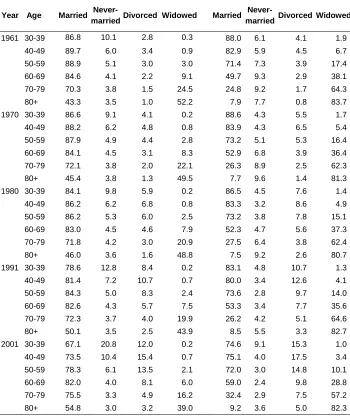
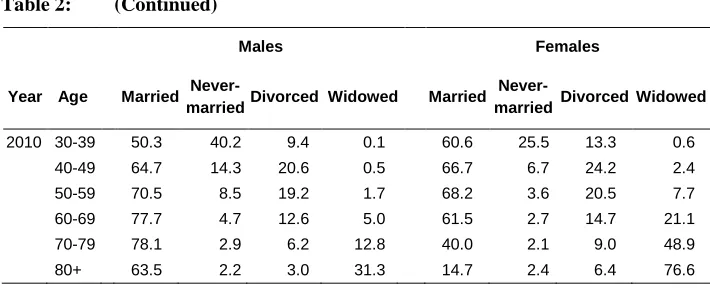
Table 2: Population structure by age, period, and marital status, in %
Males Females
Year Age Married
Never-married Divorced Widowed Married
Never-married Divorced Widowed
1961 30-39 86.8 10.1 2.8 0.3 88.0 6.1 4.1 1.9
40-49 89.7 6.0 3.4 0.9 82.9 5.9 4.5 6.7
50-59 88.9 5.1 3.0 3.0 71.4 7.3 3.9 17.4
60-69 84.6 4.1 2.2 9.1 49.7 9.3 2.9 38.1
70-79 70.3 3.8 1.5 24.5 24.8 9.2 1.7 64.3
80+ 43.3 3.5 1.0 52.2 7.9 7.7 0.8 83.7
1970 30-39 86.6 9.1 4.1 0.2 88.6 4.3 5.5 1.7
40-49 88.2 6.2 4.8 0.8 83.9 4.3 6.5 5.4
50-59 87.9 4.9 4.4 2.8 73.2 5.1 5.3 16.4
60-69 84.1 4.5 3.1 8.3 52.9 6.8 3.9 36.4
70-79 72.1 3.8 2.0 22.1 26.3 8.9 2.5 62.3
80+ 45.4 3.8 1.3 49.5 7.7 9.6 1.4 81.3
1980 30-39 84.1 9.8 5.9 0.2 86.5 4.5 7.6 1.4
40-49 86.2 6.2 6.8 0.8 83.3 3.2 8.6 4.9
50-59 86.2 5.3 6.0 2.5 73.2 3.8 7.8 15.1
60-69 83.0 4.5 4.6 7.9 52.3 4.7 5.6 37.3
70-79 71.8 4.2 3.0 20.9 27.5 6.4 3.8 62.4
80+ 46.0 3.6 1.6 48.8 7.5 9.2 2.6 80.7
1991 30-39 78.6 12.8 8.4 0.2 83.1 4.8 10.7 1.3
40-49 81.4 7.2 10.7 0.7 80.0 3.4 12.6 4.1
50-59 84.3 5.0 8.3 2.4 73.6 2.8 9.7 14.0
60-69 82.6 4.3 5.7 7.5 53.3 3.4 7.7 35.6
70-79 72.3 3.7 4.0 19.9 26.2 4.2 5.1 64.6
80+ 50.1 3.5 2.5 43.9 8.5 5.5 3.3 82.7
2001 30-39 67.1 20.8 12.0 0.2 74.6 9.1 15.3 1.0
40-49 73.5 10.4 15.4 0.7 75.1 4.0 17.5 3.4
50-59 78.3 6.1 13.5 2.1 72.0 3.0 14.8 10.1
60-69 82.0 4.0 8.1 6.0 59.0 2.4 9.8 28.8
Table 2: (Continued)
Males Females
Year Age Married
Never-married Divorced Widowed Married
Never-married Divorced Widowed
2010 30-39 50.3 40.2 9.4 0.1 60.6 25.5 13.3 0.6
40-49 64.7 14.3 20.6 0.5 66.7 6.7 24.2 2.4
50-59 70.5 8.5 19.2 1.7 68.2 3.6 20.5 7.7
60-69 77.7 4.7 12.6 5.0 61.5 2.7 14.7 21.1
70-79 78.1 2.9 6.2 12.8 40.0 2.1 9.0 48.9
80+ 63.5 2.2 3.0 31.3 14.7 2.4 6.4 76.6
Source: Census, Czech Statistical Office.
Two factors have therefore contributed to the increase in the heterogeneity of the Czech population since 1961: 1) widening gaps in the life expectancy of each sub-population; and 2) a diversification of the marital status structure. The decrease in the prevalence of marriage was, however, much more apparent in males than in females, and was limited to the age groups 70 and younger. The gradual rise in morality among the married elderly population has led to a decreasing prevalence of widowhood.
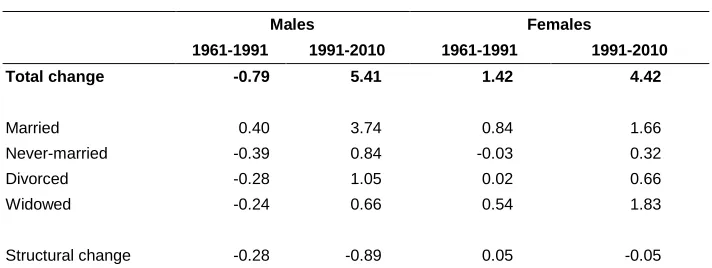
Table 3 Contributions of change in marital status-specific mortality and of structural change in the marital status distribution to change in total life expectancy between 1961, 1991, and 2010
Males Females
1961-1991 1991-2010 1961-1991 1991-2010
Total change -0.79 5.41 1.42 4.42
Married 0.40 3.74 0.84 1.66
Never-married -0.39 0.84 -0.03 0.32
Divorced -0.28 1.05 0.02 0.66
Widowed -0.24 0.66 0.54 1.83
Structural change -0.28 -0.89 0.05 -0.05
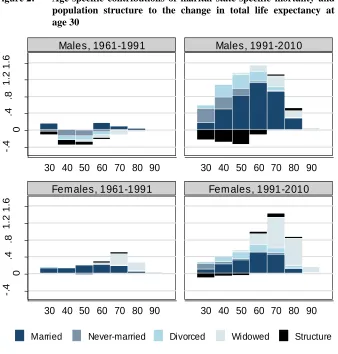
The gain in life expectancy of 5.4 years achieved after 1991 by the male population was due to progress in survival rates across all marital statuses. Although most of this increase (3.7 years) once again came from mortality improvements among married men, a full 2.5 years of the increase was due to mortality improvements among men who were not married. Because, however, trends in Czech society led more men to be unmarried in 2010, the gains in life expectancy were not as great as they would have been if the distribution by marital status among men had been the same as it was in 1991. Thus, almost a full year (0.9 years) of life expectancy was “lost” to the decline in marriage prevalence.
Among women, improvements in mortality experience among the married and the widowed were entirely responsible for the 1.4-year increase between 1961 and 1991, and the same two groups drove the post-transformation reversal in mortality, accounting for all but 0.9 years of the 4.4-year increase in life expectancy at age 30 among Czech women. The effects of the (less profound) changes in the marital structure among women were minimal in both periods.
Figure 2: Age-specific contributions of marital state-specific mortality and population structure to the change in total life expectancy at age 30
-.
4
0
.4
.8
1.2
1.6
-.
4
0
.4
.8
1.2
1.6
30 40 50 60 70 80 90 30 40 50 60 70 80 90
30 40 50 60 70 80 90 30 40 50 60 70 80 90
Males, 1961-1991
Males, 1991-2010
Fem ales, 1961-1991
Fem ales, 1991-2010
4. Summary and discussion
With the exception of the 1960s, the mortality of the married Czech population decreased continuously between 1961 and 2010, while the mortality of unmarried males increased until the beginning of the 1990s. Thus, large mortality differentials emerged between the married and the unmarried populations. A similar health crisis among unmarried middle-aged men was seen in Hungary (Hajdu, McKee, and Bojan 1995) and Poland (Watson 1995). As was noted in previous studies (Murphy, Grundy, and Kalogirou 2007), the recent increase in the mortality differentials cannot be fully explained by changes in selection. In the case of the Czech Republic, in 1961, when selection supposedly was the highest—i.e., marriage was universal, divorce was rare, and large portions of the never-married suffered from serious health disorders (Czech Statistical Office 1995)—the mortality differentials were by far the lowest. As the subsequent mortality increase during the 1960s among never-married men was not accompanied by changes in nuptiality patterns, whatever factors were making mortality worse for these men, they were not related to differences in the group’s composition. Changes in selection on health may have played a role for the divorced: according to statistics on reasons for divorce, as compiled by the Czech Statistical Office since 1960, the alcoholism of the husband was increasingly cited as the reason for marital dissolution (rising from 11.9% of cases in 1960 to 16.4% of cases in 1980). Thus, alcohol may have contributed to the higher mortality among the divorced population.
The selection environment changed considerably after 1989. The new trend of not getting married was more concentrated in less-educated social groups (Katrňák 2001). There has been a decrease in health-related reasons (habitual drinking and other health reasons) for marital dissolution. Instead, less serious reasons related to compatibility—referred to in the Czech statistical reports as “interest, nature, and opinion disharmony” (Czech Statistical Office 1995)—became predominant. These shifts, together with decreasing rates of remarriage after divorce, mean that today’s divorced population are probably healthier than ever before. Conversely, the population of those who married and have remained married increasingly consists of more educated and more harmonic couples.
Less severe health selection in all of the unmarried groups of both sexes and increasing pre- and post-marital cohabitation may therefore have contributed to the significant mortality decline after 1991, especially for the never-married and the divorced. The married population have, however, become more educated (due to the decline in marriage rates among the less educated), healthier (due to less alcoholism), and less stressed (due to a greater tendency for incompatible couples to divorce), and are thus more likely to benefit from “marital protection.” It also appears that the decline in the share of married people within the population can hinder further overall progress on mortality, at least for men. For women, the effects of shifts in the composition of the population by marital status are not in evidence.
The findings discussed above call for further investigation, especially for a cause-of-death analysis, since the attribution of changes in marital-specific mortality by age to the causes most plausibly related to the protective effects of marriage could strengthen some of our inferences. The causes of death by marital status can be extracted from individual death records. While an earlier study by Rychtaříková (1998) did so, the author could not analyse the new trends due to an early adoption of the 10th revision of the international classification of causes of death (ICD), and the difficulties that arose as a result of this revision. Recently, a solution to the problem of the Czech 10th ICD revision has been proposed (Pechholdová 2011), and the recent data can now be taken into account.
5. Acknowledgements
References
Andreev, E.M., Shkolnikov, V.M., and Begun, A.Z. (2002). Algorithm for decomposition of differences between aggregate demographic measures and its application to life expectancies, healthy life expectancies, parity-progression ratios and total fertility rate. Demographic Research 7(14): 499-522. doi:10.4054/DemRes.2002.7.14.
Andreev, E.M. and Shkolnikov, V.M. (2010). Spreadsheet for calculation of confidence limits for any life table or healthy-life table quantity. Rostock: Max Planck Institute for Demographic Research (MPIDR Technical Report; 2010-005).
Ben-Shlomo, Y., Smith, G.D., Shipley, M., and Marmot, M.G. (1993). Magnitude and causes of mortality differences between married and unmarried men. J Epidemiol Community Health 47(3): 200-205. doi:10.1136/jech.47.3.200. Burgoa, M., Regidor, E., Rodriguez, C., and Gutierrez-Fisac, V. (1998). Mortality
by cause of death and marital status in Spain. European Journal of Public Health 8(1): 37-42. doi:10.1093/eurpub/8.1.37.
Czech Statistical Office (1995). Marriage and Divorce in the Czech Republic between 1960 and 1994. Prague: Czech Statistical Office.
Hajdu, P., McKee, M., and Bojan, F. (1995). Changes in premature mortality differentials by marital status in Hungary and in England and Wales.
European Journal of Public Health 5(4): 259-264. doi:10.1093/ eurpub/5.4.259.
Hu, Y.R. and Goldman, N. (1990). Mortality differentials by marital status: An international comparison. Demography 27(2): 233-250. doi:10.2307/ 2061451.
Jasilionis, D., Andreev, E.M., Kharkova, T.L., and Kingkade, W. (2012). Change in marital status structure as an obstacle for health improvement: Evidence from six developed countries. European Journal of Public Health 22(4): 602-604.
doi:10.1093/eurpub/ckr065.
Kalediene, R., Petrauskiene, J., and Starkuviene, S. (2007). Inequalities in mortality by marital status during socio-economic transition in Lithuania. Public Health 121(5): 385-392. doi:10.1016/j.puhe.2006.09.026.
Katrňák, T. (2001). Structural causes of the decline in the number of marriages and the increase in the number of single women and men in the Czech Republic in the 1990s. Sociologický časopis 37(2): 225-239.
Lillard, L.A. and Panis, C.W. (1996). Marital status and mortality: The role of health. Demography 33(3): 313-327. doi:10.2307/2061764.
Lund, R., Due, P., Modvig, J., Holstein, B.E., Damsgaard, M.T., and Andersen, P.K. (2002). Cohabitation and marital status as predictors of mortality--an eight year follow-up study. Social Science and Medicine 55(4): 673-679.
doi:10.1016/S0277-9536(01)00219-2.
Martikainen, P., Martelin, T., Nihtila, E., Majamaa, K., and Koskinen, S. (2005). Differences in mortality by marital status in Finland from 1976 to 2000: Analyses of changes in marital-status distributions, socio-demographic and household composition, and cause of death. Population Studies 59(1): 99-115. doi:10.1080/0032472052000332737.
Murphy, M., Grundy, E., and Kalogirou, S. (2007). The increase in marital status differences in mortality up to the oldest age in seven European countries, 1990-99. Population Studies 61(3): 287-298. doi:10.1080/0032472 0701524466.
Pechholdová, M. (2011). The Impact of ICD10 on Cause-specific mortality trends: The case of the Czech Republic compared to West Germany and France.
Demografie 53(4): 360-380.
Rychtaříková, J. (1998). Mortality in the Czech republic by family status.
Demografie 40(2): 93-102.
Rychtaříková, J. (2004). The case of the Czech Republic. Determinants of the recent favourable turnover in mortality. Demographic Research S2(5): 106-138.
Scafato, E., Galluzzo, L., Gandin, C., Ghirini, S., Baldereschi, M., Capurso, A., Maggi, S., and Farchi, G. (2008). Marital and cohabitation status as predictors of mortality: A 10-year follow-up of an Italian elderly cohort.
Social Science and Medicine 67(9): 1456-1464. doi:10.1016/j.socscimed. 2008.06.026.
Shkolnikov, V.M., Andreev, E.M., Jasilionis, D., Leinsalu, M., Antonova, O.I., and McKee, M. (2006). The changing relation between education and life expectancy in central and eastern Europe in the 1990s. J Epidemiol Community Health 60(10): 875-881. doi:10.1136/jech.2005.044719.
Shkolnikov, V.M., Jasilionis, D., Andreev, E.M., Jdanov, D.A., Stankuniene, V., and Ambrozaitiene, D. (2007). Linked versus unlinked estimates of mortality and length of life by education and marital status: Evidence from the first record linkage study in Lithuania. Social Science and Medicine 64(7): 1392-1406. doi:10.1016/j.socscimed.2006.11.014.
Sobotka, T., Št’astná, A., Zeman, K., Hamplová, D., and Kantorová, V. (2008). Czech Republic: A rapid transformation of fertility and family behaviour after the collapse of state socialism. Demographic Research 19(14): 403-454.
doi:10.4054/DemRes.2008.19.14.
Valkonen, T. (1993). Problems in the measurement and international comparisons of socio-economic differences in mortality. Science and Medicine 36(4): 409-418. doi:10.1016/0277-9536(93)90403-Q.
Valkonen, T., Martikainen, P., and Blomgren, J. (2004). Increasing excess mortality among nonmarried elderly people in developed countries. Demographic Research S2(12): 305-330. doi:10.4054/DemRes.2004.S2.12.
Vallin, J., Meslé, F., and Valkonen, T. (2001). Trends in mortality and differential mortality. Strasbourg: Council of Europe Publishing.
Vallin, J. and Nizard, J.A. (1977). La mortalité par état matrimonial: Mariage sélection ou mariage protection. Population 32: 95-125. doi:10.2307/ 1531804.
van Poppel, F., and Joung, I. (2001). Long-term trends in marital status mortality differences in The Netherlands 1850-1970. Journal of Biosocial Science