DEMOGRAPHIC RESEARCH
VOLUME 30, ARTICLE 42, PAGES 1219-1244
PUBLISHED 15 APRIL 2014
http://www.demographic-research.org/Volumes/Vol30/42/ DOI: 10.4054/DemRes.2014.30.42
Research Article
Investigating healthy life expectancy using a
multi-state model in the presence of missing
data and misclassification
Ardo van den Hout
Ekaterina Ogurtsova
Jutta Gampe
Fiona E. Matthews
This publication is part of the Special Collection on “Multistate Event History Analysis,” organized by Guest Editors Frans Willekens and Hein Putter.
c
2 Statistical modelling 1222
2.1 Time-dependent hazards 1223
2.2 Missing data on state 1224
2.3 Misclassification 1225
3 Life expectancies 1226
4 Microsimulation from multi-state models 1227
5 Application 1228
5.1 CFAS data 1228
5.2 Models 1229
5.3 Model validation 1231
5.4 Life expectancies 1233
5.5 Inference usingMicMacmicrosimulation 1237
6 Discussion 1239
7 Acknowledgements 1240
Investigating healthy life expectancy using a multi-state model in the
presence of missing data and misclassification
Ardo van den Hout1
Ekaterina Ogurtsova2
Jutta Gampe3
Fiona E. Matthews4
Abstract
BACKGROUND
A continuous-time three-state model can be used to describe change in cognitive func-tion in the older populafunc-tion. State 1 corresponds to normal cognitive funcfunc-tion, state 2 to cognitive impairment, and state 3 to dead. For statistical inference, longitudinal data are available from the UK Medical Research Council Cognitive Function and Ageing Study.
OBJECTIVE
The aim is statistical analysis of longitudinal multi-state data taking into account missing data and potential misclassification of state. In addition, methods for long-term prediction of the transition process are of interest, specifically when applied to the study of healthy life expectancy.
METHODS
Cognitive function in the older population is assumed to be stable or declining. For this reason, observed improvement of cognitive function is assumed to be caused by misclas-sification of either state 1 or 2. Regression models for the transition intensities are for-mulated to incorporate covariate information. Maximum likelihood is used for statistical inference.
RESULTS
It is shown that missing values for the state at a pre-scheduled time can easily be taken into account. Long-term prediction is explained and illustrated by the estimation of
state-1Department of Statistical Science, University College London, UK. E-mail: [email protected]. 2Max Planck Institute for Demographic Research, Rostock, Germany.
specific life expectancies. In addition, it is shown how microsimulation can be used to further explore predictions based on a fitted multi-state model.
CONCLUSIONS
Statistical analysis of longitudinal multi-state data can take into account missing data and potential misclassification of state. With respect to long-term prediction, microsimulation is a useful tool for summarising and displaying characteristics of cognitive decline and survival.
1.
Introduction
Statistical models for multi-state processes can be found in many applications. In demog-raphy, the models can be used to study transition processes, such as change in marital status, relocating region of residence, or change of employment status. In biostatistics, multi-state models are used to study health-related processes. An illness-death model describes a process with two or more living states, which represent different stages of a condition or disease, and an absorbing state that corresponds to dead.
Practical applications of multi-state models face several complications, most of them relating to missing information. When individuals are followed up, they are usually not monitored continuously, but examined or interviewed at pre-scheduled times. If the state of a multi-state process is only observed intermittently, then the data are called panel data and times of transitions between states are interval-censored. When information on the state at the pre-scheduled times is missing for some individuals, then this should be taken into account in the data analysis.
actual state. The model that will be presented accounts for this kind of misclassification. Additionally, the model allows for missing data on state at pre-scheduled observation times by adopting a relatively simplemissing at random(Little and Rubin 2002) model, in which it is assumed that missingness may depend on observed states, but not on unob-served states.
Panel data are available for the study that will be presented. Times of transitions from state 1 to state 2 are interval-censored, but death dates (transitions to state 3) are known exactly. The presence of an absorbing state with known entry time is not essential to the presented methodology, but the fact that the process is observed via panel data is an intrinsic part of the model in this paper.
The risk of transitions between the three states in the model for cognitive decline and death depends on the age of the individual. We consider the process to be time continuous, and age is the time-scale in the model. Continuous-time multi-state models are formulated by specifying transition hazards. For human mortality, the Gompertz distribution, whose hazard is exponentially increasing, is known to be an appropriate model. We therefore specify the hazards for transitions into state 3 by a Gompertz model. Also, the transition from the cognitively intact to the impaired state (from state 1 to state 2) is modelled via a Gompertz hazard.
In addition to the age-specific hazards for the different transitions, effects of risk fac-tors are of importance. This leads to regression models for the transition intensities. In this paper we will incorporate sex, education and birth cohort as additional covariates. From the estimated models, remaining life expectancy at different ages (overall and in the two states of cognitive function) can be derived.
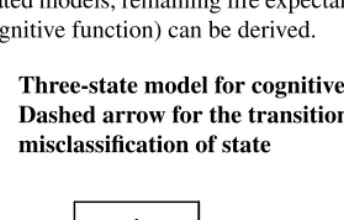
Figure 1: Three-state model for cognitive function in the older population. Dashed arrow for the transition that is observed only because of misclassification of state
1 Not Impaired (MMSE > 21)
3
Dead
The estimation of the multi-state model parameters is based on existing methodology, see Kalbfleisch and Lawless (1985), Satten and Longini (1996), and Jackson (2011). Sta-tistical inference is extended beyond the work in Van den Hout, Jagger, and Matthews (2009), and Van den Hout and Matthews (2010). Model fit is explored in more detail, and a comparison to alternative models is undertaken. The fitted model is used to compute life expectancies, which are investigated graphically to better illustrate the effect of risk factors.
Specific to the investigation of cognition, the model allows for misclassification of the living states: an observed state may not correspond to the underlying true state. For this reason, the initial state distribution is estimated using logistic regression.
Once the transition rates are estimated, additional results can be produced by mi-crosimulation. Fur this purpose, individual trajectories from the multi-state model are created by Monte Carlo simulation. The resulting virtual population can be analysed with respect to many additional features. This paper uses the microsimulation tool from the
MicMacsoftware (Zinn et al. 2009). This software was implemented to simulate
indi-vidual life courses from continuous-time multi-state models, with special emphasis on population projections (Willekens 2005). It provides various tools to summarise and dis-play characteristics of the virtual population, some of which are shown for the cognitive decline and death process.
The rest of the paper is organised as follows. Section 2 describes the statistical mod-elling, which includes the time-dependent hazards, the accommodation of missing state information, and the modelling of misclassification of states. The calculation of residual life expectancies is discussed in Section 3. Section 4 describes the microsimulation tool that is employed for producing additional results. The actual application is presented in Section 5, where data are analysed from the MRC Cognitive Function and Ageing Study (CFAS). A discussion in Section 6 complements the paper.
2.
Statistical modelling
The continuous-time multi-state model for panel data is discussed by Kalbfleisch and Lawless (1985). Methods for taking into account the availability of exact times of death can be found in Kay (1986). Satten and Longini (1996) and Jackson (2011) present models for dealing with misclassification of states. In case all transition times for the continuous-time process are observed (no interval-censoring), other methodology is avail-able, see, e.g., Putter, Fiocco, and Geskus (2007). This case will not be discussed.
model where interval-censored transitions from state 2 to state 1 are assumed to be the result of misclassification.
The models presented in this section can be fitted using the free R-packagemsm (Jackson 2011). Inmsm, the parameters in the multi-state models are estimated by max-imum likelihood, where the optimisation is undertaken by a call to theR-routineoptim. All the models in the application in Section 5 are fitted usingmsm, where the optimisa-tion byoptimis specified by the Broyden-Fletcher-Goldfarb-Shanno (BFGS) routine.
2.1 Time-dependent hazards
Continuous-time multi-state models can be specified by linking covariates to transition intensities. A transition intensityqrs(t)is the instantaneous risk (hazard) of moving from staterto statesat timet. In the three-state model that we consider in the application, there are three transition-specific hazards:q12(t),q13(t),q23(t), and age is the time scale
t. Since a hazard is non-negative, a log-link is used to relate the hazard to covariates. The loglinear model is given by
log[qrs(age)] =βrs.0+βrs.1age+βrs.2ybirth+βrs.3sex+βrs.4educ, (1)
whereageis age minus 75,ybirthis year of birth minus 1900,sexis gender (0=women, 1=men), andeducis education (0=less than ten year of education, 1=ten or more years of education).
The loglinear model (1) can also be written as
qrs(t) =λrsexp[γrst] exp[βrs.2ybirth+βrs.3sex+βrs.4educ], (2)
wheretisage. This formulation better illustrates that the multi-state model can be seen as an extension of the standard survival model (state 1 = alive, state 2 = dead). The baseline hazard in (2) is Gompertz with parametersλrs >0andγrs. Other choices are possible for the baseline hazard (such as the Weibull hazard or a piecewise-constant hazard), see, e.g., Van den Hout and Matthews (2008) who investigate the Weibull/Gompertz choice for a three-state survival model for cognitive function in the older population.
To calculate the individual contributions to the likelihood function, the Gompertz baseline hazards will be approximated using piecewise-constant hazards. The approxi-mation will vary across individuals and will be determined by the data. We explain this by an example.
If the observation times for individualiare given byti1, ti2, ti3, ti4, then the transition-specific hazards (2) are evaluated at the starting time of the intervals and are held con-stant throughout the intervals. That is, the hazards are held concon-stant during the interval
In our experience, defining the piecewise-constant hazards using the time midway zo the interval, i.e., usingqrs((tij+tij+1)/2), does not induce a difference that is relevant for practice. This is of course data dependent. An example in which using the time at the start of the interval may introduce bias is a setting where all individuals are of the same age at baseline, and for all individuals the first interval between observations is considerably longer than the later intervals. This may introduce bias in the approximation of the specified parametric shape.
Alternatively, a grid for the piecewise-constant approximation can be defined inde-pendently from the data, in which case, the observed times are embedded within this grid and hazards change from grid point to grid point (Van den Hout and Matthews 2008). This is not investigated in the current application.
In the constant approximation explained above, hazards change piecewise-constantly according to the parametric shape of the Gompertz hazard. This approximation of a parametric shape should be distinguished from a non-parametric piecewise-constant hazard model, where for each time interval in a grid, a separate parameter is estimated. The advantage of the latter is that it can approximate any shape. The disadvantage of the non-parametric approach is that it may require many parameters, and that prediction beyond the time of follow up is not straightforward.
2.2 Missing data on state
It is well know that ignoring missing data can lead to biased results. In longitudinal surveys, missing data are ubiquitous. Here we define a relative simple model to deal with missing states at pre-scheduled observation times. We explain it by an example. If observation times for individualiare given byti1, ti2, ti3, then the likelihood contribution for timesti1, ti2, ti3with missing state atti2is given by
P(Xti1, Xti3) =
X
x=1,2
P(Xti1, Xti2 =x, Xti3), (3)
where the sum is over all possible states at timeti2. This model assumes that the miss-ingness is independent from data that are not observed, but may depend on observed data (missing at random, Little and Rubin 2002). This is a strong assumption. In case it is assumed that the missingness is dependent on missing data, additional modelling has to be undertaken (Van den Hout and Matthews 2010).
states by undertaking a complete-data analysis underestimates the risk of moving from state 1 to state 2 and overestimates the risk of moving from state 1 to state 3.
A direct result of taking into account missing states via (3) is that it improves the piecewise-constant approximation of the hazards. By addingti2in the model, the grid in the piecewise-constant approximation for the data from individualiconsists of two inter-vals(ti1, ti2]and(ti2, ti3], instead of one interval(ti1, ti3]. Note that such an approach can also be used to improve the piecewise-constant approximation even when there are no missing states in the data.
2.3 Misclassification
We assume that cognitive function in the older population is stable or decreasing. How-ever, when cognitive function is measured over time, individual performance may vary from day to day and test scores may fluctuate accordingly. The three-state model assumes that a transition from the impaired state back to the non-impaired state is not possible and a misclassification model is used to deal with backward transitions. We see the mis-classification as a way to smooth the data: the measurement of cognition over time may result in a backward transition, but the underlying latent process is assumed to be stable or decreasing. Whether this assumption is realistic for cognitive impairment in the older population is a topic of an ongoing debate, see, e.g., Le Couteur et al. (2013).
Misclassification is taken into account by estimating
θrs=P(X∗=s|X =r) =P(Observed state=s|Latent state=r), (4)
for(r, s)∈ {(1,2),(2,1)}, which is the probability of observing statesgiven a latent true stater. Death is not misclassified. We assume that the misclassification is independent between individuals, and also independent across times of observation. As a result the likelihood contribution of individualifor timesti1, ..., tiniis given by
P(Xt∗i1, .., X
∗
tini) = X
P(Xt∗i1, .., X
∗
tini|Xti1, .., Xtini)P(Xti1, .., Xtini)
= XP(Xt∗ini|Xtini)×..×P(Xt∗i1|Xti1)P(Xti1, .., Xtini),
(5)
where the summation is over all possible paths of latent statesXti1, .., Xtini.
Using the first-order Markov assumption, P(Xt1, .., Xtni) in (5) becomes
P(Xtni|Xtni−1)×..×P(Xt2|Xt1)P(Xt1). Note that P(Xt1) is unknown and has to
standard logistic regression model can be used to estimateP(Xt1). We define
P(Xage= 2) =
exp[µ]
1 + exp[µ] (6)
µ = α0+α1age+α2sex.
The linear predictor can of course be extended by adding more covariates. Here we restrict the model by using onlyageandsex. This choice is partly driven by the aim for parsimony, but also because age and sex are important factors for the onset of cognitive impairment (see the analysis in Section 5.2). If there are more than 2 living states, multinomial logistic regression models can be applied in a similar manner.
3.
Life expectancies
We consider residual life expectancy (LE) at a given aget0. Given a fitted multi-state model, the estimation of LEs is established methodology, see, e.g., Izmirlian et al. (2000) and Van den Hout, Jagger, and Matthews (2009). This section provides the formulas and some extra explanation.
Total LE is expected stay in the living states, but also of interest is expected stay in a specific living state. In our model, LE in state 1 isimpairment-free life expectancyand LE in state 2 isimpaired life expectancy. We will show how LEs can be derived from the parameters of the multi-state model. This will be explained by a comparison with mean survival in a standard survival analysis.
In standard survival (state 1 = alive, state 2 = dead) LE is the expectation of the remaining years spent alive (U) given by
E(U|t0,Z) =
Z ∞
0
uf(u|t0,Z)du=
Z ∞
0
S(u|t0,Z)du
=
Z ∞
0
P(Xt0+u= 1|t0,Z)du,
whereZ is the covariate history which is assumed to be deterministic. This is called mean survival. In a multi-state survival model, LE is defined in a similar way. LE in state
sgiven stateratt0is given by
ers(t0) =
Z ∞
0
P(Xt+t0 =s|Xt0 =r,Z)dt. (7)
(2000). Approximation of the integral can thus be undertaken by numerical methods using the estimated parameters from the multi-state model.
Expected stay in a state is sometimes calledoccupancy timein the literature on stochas-tic processes, see for example Kulkarni (2011). Occupancy time is defined up to a given timeT. LE in a specified state in an illness-death model can therefore be seen as occu-pancy time in that state forT =∞.
It is useful to define marginal LE. For our three-state model, this is defined bye•s(t0) = P2
r=1P(Xt0 =r|Z)ers(t0). This is LE in statesirrespective of the state att0. Note that
the distribution of the living states (6) at aget0is needed to compute this quantity. Total LE at aget0is now given bye(t0) =P2s=1e•s(t0).
To extrapolate the uncertainty in the estimation of the model parameters to the estima-tion of LEs, we consider the multivariate normal distribuestima-tion with expectaestima-tion equal to the maximum likelihood estimate of the model parameter vector, and the covariance matrix equal to the estimated covariance matrix at the optimum. By drawing parameter values from this distribution and computing the LEs for each of the drawn values, the uncertainty in the estimation of the model parameters will be propagated (cf. Aalen et al. 1997).
4.
Microsimulation from multi-state models
While many characteristics of multi-state models can be derived from analytic expres-sions, still more detailed results can be obtained by Monte Carlo simulation from the estimated model. For a starting population with specified characteristics (that is, the age distribution of the individuals as well as the states they occupy) individual trajectories are simulated according to the stochastic process that the model describes. Commonly, such an approach is called microsimulation.
What is needed for this purpose, besides the estimated model, is a software tool that allows us to flexibly specify the model, to efficiently simulate a potentially large number of individuals, and some means to conveniently summarise the characteristics of interest from the simulated population (which is also called the virtual population). TheMicMac software, which was developed during the MicMac-project (see Willekens 2005, and www.micmac-projections.org), is based on a generic continuous-time multi-state model with transition intensities that can depend both on the age of the individuals and on cal-endar time.
MicMac-Core (Zinn et al. 2009) is implemented as a plug-in in JAMES II (JAva based Multipurpose Environment for Simulation), which is a multi-agent system and simula-tion platform, see Himmelspach and Uhrmacher (2007). In Secsimula-tion 5.5 we will use this microsimulation tool to illustrate and supplement analytical results of the model that was presented in Section 2. Using a fitted multi-state model and specified covariate values, transition intensities are derived for the age range, and fed intoMicMac. On the bases of this information,MicMacsimulates individual trajectories.
5.
Application
5.1 CFAS data
The MRC Cognitive Function and Ageing Study (CFAS, www.cfas.ac.uk) is a popula-tion-based longitudinal study of cognition and health conducted between 1991 and 2004 in the older population of England and Wales (Brayne, McCracken, and Matthes 2006). Data were collected in six centres, five in England and one in Wales. Here we analyse the CFAS subset defined by the data from rural Cambridgeshire with respect to cognitive function and survival. Using CFAS, Matthews et al. (2006) showed that there are regional differences in the UK in aspects of health. We would like to stress that results presented in this section pertain to the population of rural Cambridgeshire only. The states of the model are defined in Figure 1.
The sample size for rural Cambridgeshire is 2600, with 1493 women and 1107 men, who at the baseline of the study were aged 65 years or older. The frequencies of the five age categories (≤ 70,(70,75],(75,80],(80,85], > 85)at baseline are (861, 533, 569, 373, 264). In the sample there are 845 individuals who were observed once in the alive states, 611 were observed twice, 455 three times, and 612 four times. There are 77 individuals in the data who where not observed in state 1 or 2. Most of these individuals have a missing state at baseline followed by death before the next scheduled interview. The total number of records (including the ones with missing states, deaths, and right-censored states) is 10,525.
Table 1: State table for the CFAS data from rural Cambridgeshire. Number of times a pair of states is observed at successive observation times and at the end of the follow-up
To
From 1 2 Dead Missing Right-censored
1 2862 229 737 857 444
2 68 169 280 188 46
Missing 28 16 680 908 413
5.2 Models
This section will investigate three formulations of a three-state model for the data at hand. Models denoted with A are progressive models with misclassification. Model B is a model with misclassificationanda backward transition from state 2 to state 1. Model C is a model with a backward transition from state 2 to state 1, but without misclassification.
We start with the progressive model defined by (1), (4), and (6), and investigate restric-tions on the regression parameters. Model A01is the model with intercepts and onlyage
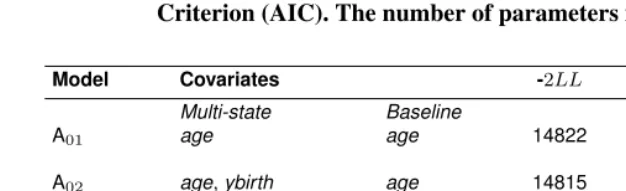
Table 2: Information criteria for the maximum likelihood estimation: -2
×maximised loglikelihood (-2LL) and the Akaike Information Criterion (AIC). The number of parameters is #p
Model Covariates -2LL #p AIC
Multi-state Baseline
A01 age age 14822 10 14842
A02 age,ybirth age 14815 13 14841
A03 age,ybirth,sex age,sex 14665 17 14699
A age,ybirth,sex,educ age,sex 14643 20 14683
Table 3: Parameter estimates for Model A. Estimated standard errors in parentheses
Multi-state model
Intercept β12.0 −3.720 (0.684) β13.0 −3.050 (0.273) β23.0 −2.873 (0.282)
age β12.1 0.164 (0.035) β13.1 0.050 (0.013) β23.1 0.082 (0.014)
ybirth β12.2 0.003 (0.033) β13.2 −0.031 (0.013) β23.2 0.029 (0.013)
sex β12.3 −0.693 (0.217) β13.3 0.844 (0.098) β23.3 0.455 (0.107)
educ β12.4 −0.657 (0.195) β13.4 −0.092 (0.090) β23.4 0.204 (0.113)
Logistic regression mode Misclassification model
Intercept α0 −2.032 (0.130) θ12 0.016 (0.003)
age α1 0.161 (0.012) θ21 0.172 (0.030)
sex α2 −0.349 (0.155)
Note that we cannot use the likelihood ratio test to compare Model B with Model A. Because of the restriction on the misclassification, the latter model is not a restricted version of the former.
We define Model C as Model B without misclassification. The likelihood ratio test cannot be used to compare Model C to a three-state model with misclassification. Models with misclassification include logistic regression models for the states at baseline, whereas Model C does not. The likelihood of a model with misclassification is a combined like-lihood of the three-state model and the logistic regression model. These two submodels are not independent; they share the parameters for the misclassification. In addition, the modelling of a missing baseline state for an individual is based on the whole observed trajectory for that individual, and is therefore not independent from the three-state model. Model C has 20 parameters (4 transitions with 5 parameters per transition). Estimated LEs using the models A, B, and C will be compared in the next section.
Note that a model without recovery and without misclassification is not possible for the CFAS data, since such a model cannot deal with observed interval-censored transitions from state 2 to state 1.
We briefly discuss the parameter estimates for Model A as presented in Table 3. All estimated coefficients for age are positive, which reflects the fact that with increasing age a transition to a next state becomes more likely - as was to be expected. The estimated effect of education implies that more education delays the onset of cognitive impairment but shortens the stay in the impaired state. This agrees with the results presented in Reuser, Willekens, and Bonneux (2011). Men are less likely to move to the impaired state than women but have a higher mortality rate. The estimated effect of year of birth for the transition from the impaired state to the dead state implies that the younger generation spends less time in the impaired state.
The estimated coefficients for the logistic regression model imply that the risk of impairment increases with age, and that women have a higher risk than men.
The estimated misclassification mainly indicates failure to detect an impaired state: there is a probability of 17% that an underlying impaired state is classified as a healthy state.
5.3 Model validation
Formal model validation for multi-state models with misclassification has not yet been developed. Aguirre-Hernandez and Farewell (2002) and Titman and Sharples (2010) pro-vide tests for a set of multi-state models, but this set does not include our model. However, Titman and Sharples also review less formal ways of model validation, and we use their basic ideas in the following validation of Model A.
ob-served baseline state. For the predicted survival, individual trajectories are predicted con-ditional on observed baseline state and baseline covariate values, where not-observed baseline states are imputed (once) using the fitted logistic regression model. The potential misclassification for all baseline states is taken into account by imputing (once) the latent state conditional on the observed state and the fitted misclassification model. In the pre-diction, age-dependent intensities are modelled as piecewise-constant on a one-year grid for all individuals. The piecewise-constant approach allows a direct computation of the transition probabilities from the time-dependent intensities.
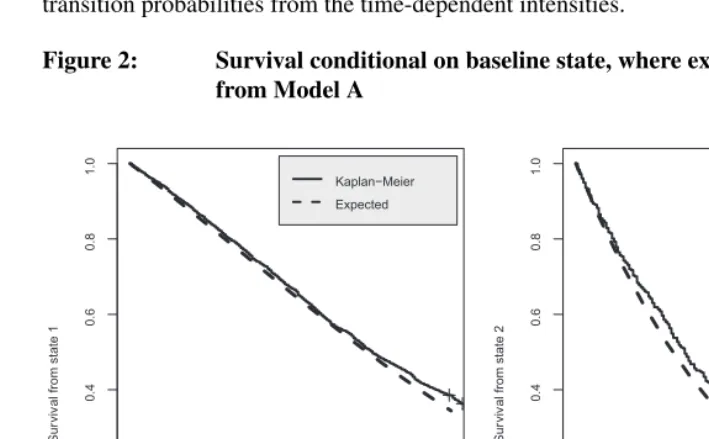
Figure 2: Survival conditional on baseline state, where expected is derived from Model A
0 2 4 6 8 10 12 14
0.0
0.2
0.4
0.6
0.8
1.0
Years since study entry
Sur
viv
al from state 1
Kaplan−Meier Expected
0 2 4 6 8 10 12 14
0.0
0.2
0.4
0.6
0.8
1.0
Years since study entry
Sur
viv
al from state 2
Kaplan−Meier Expected
Because single imputation is used, graphs differ slightly when the process is rerun, but differences are minor. The lack of large differences after rerunning the process was the motivation to impute only once. The comparison to predicted survival only addresses part of the model and should not be seen as a definite assessment of goodness of fit. Nevertheless, from Figure 2 we may conclude that Model A captures well the survival as observed in the data, although there is some difference between the curves near the end of the follow-up.
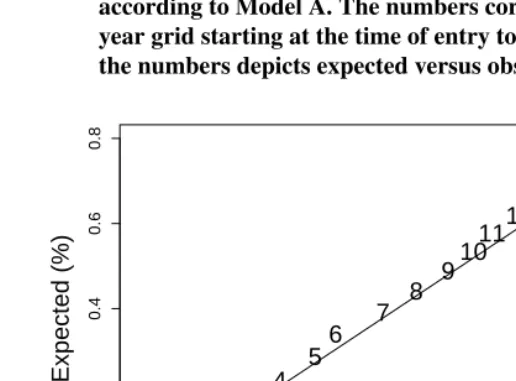
per-centages for the years since the start of the study (0 up to 14 years). At the start of the study, no deaths are observed and no deaths are expected. This is depicted by the 0 at location(0,0). Then, as the years accumulate, we see agreement between observed and expected deaths: the numbers for the subsequent years are close to the diagonal. Figure 3 is a coarser version of the information presented in Figure 2.
Figure 3: Observed versus expected prevalence with regard to death according to Model A. The numbers correspond to the year-to-year grid starting at the time of entry to the study. The location of the numbers depicts expected versus observed
0.0 0.2 0.4 0.6 0.8
0.0
0.2
0.4
0.6
0.8
Observed (%)
Expected (%)
0 1
2
3 4
56
7 8
910 1112
1314
The model being validated is not strictly first-order Markovian. More than current state is used to predict future states - current age and current covariate values are also taken into account. Better modelling may still be possible by including state-specific length of stay, but this is not investigated here, as Figure 2 shows good agreement between predicted survival and the Kaplan-Meier estimates.
5.4 Life expectancies
Figure 4 depicts estimated non-impaired LE and total LE for women (with 95% confi-dence intervals estimated using 100 iterations in the simulation). The LEs are conditional on being in the non-impaired state at specified age in 1990, and pertain to women with less than ten years of education. The integral in (7) is numerically approximated. The grid for this approximation also defines the piecewise-constant approximation of the intensities.
Figure 4: For women in the non-impaired state with less than ten years of education: estimated non-impaired LE and total LE (with estimated 95% confidence intervals) conditional on age in 1990 (Model A).MicMacresults depicted by “+”
65 70 75 80 85 90
0
5
10
15
Age in 1990
Residual Lif
e Expectancy
LE in state 1 Total LE
As can be deduced from the graph, time spent in the impaired state is fairly constant with age: the distance between the solid and the dashed curves does not change much along the age axis.
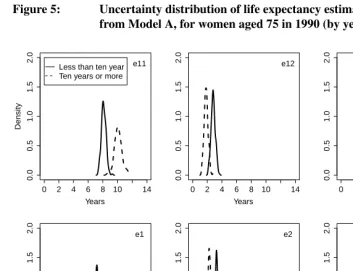
The effect of education can be investigated by plotting the distributions of estimated LEs. Figure 5 shows the distributions of estimated LEs for women aged 75 in 1990. LEs are functions of model parameters, and Figure 5 depicts the uncertainty in the estima-tion of the LEs as derived from the uncertainty associated with the maximum likelihood estimator of the model parameters.
Figure 5: Uncertainty distribution of life expectancy estimates resulting from Model A, for women aged 75 in 1990 (by years of education)
0 2 4 6 8 10 14
0.0 0.5 1.0 1.5 2.0 Years Density e11 Less than ten year Ten years or more
0 2 4 6 8 10 14
0.0 0.5 1.0 1.5 2.0 Years e12
0 2 4 6 8 10 14
0.0 0.5 1.0 1.5 2.0 Years e22
0 2 4 6 8 10 14
0.0 0.5 1.0 1.5 2.0 Years Density e1
0 2 4 6 8 10 14
0.0 0.5 1.0 1.5 2.0 Years e2
0 2 4 6 8 10 14
0.0 0.5 1.0 1.5 2.0 Years e
The effect of education is most pronounced fore11: the overlap of the (support of the) distributions is small. As there are no transitions from state 2 back to state 1, this effect of education is also present ine•1. In state 2, the effect of education is not strong: more
With a larger sample size, there would be less uncertainty in the estimation of model parameters, and this would lead to less uncertainty in the LEs estimation. Assessing the effects of risk factors by Figure 5 is, of course, conditional on the sample size of the study. Next we compare LEs estimated from Models A, B and C, see Table 4. Starting with Models A and B, we see that the total LEs are similar (taking into account the 95% con-fidence intervals), but that there are differences for the marginal LEs in the living states. The latter is understandable, since the assumptions for the possible transitions between the living states are different in the two models. Model B leads to longer estimated stay in the impaired state. This is the result of a higher estimated probability for misclassifying a latent state 2 as an observed state 1. Fitted Model B implies a higher unobserved preva-lence of cognitive impairment than fitted Model A, and this leads to longer estimated stay in the impaired state.
Given the estimated misclassification in Models A and B, it is understandable that Model C (without misclassification) estimates a shorter stay in the impaired state than Models A and B. Total LEs estimated using Model C are similar to the estimates using Model A and B when taking the 95% confidence intervals into account, although the point estimates using Model C are consistently slightly higher. The latter is probably caused by the estimated misclassification for Models A and B; assuming that there are more individuals in state 2 than observed leads to a higher (latent) prevalence in state 2, which implies poorer overall survival.
Table 4: Estimated life expectancies for women born in 1915 and with less than ten years of education. Comparison between models. Point estimates and 95% confidence intervals
To
Model A Model B Model C
Age 65
e1 13.80 (12.80,14.79) 13.37 (12.28,14.56) 14.43 (13.41,15.22)
e2 3.11 (2.46, 3.75) 3.55 (2.89, 4.36) 2.86 (2.49, 3.46)
e 16.91 (15.86,18.03) 16.92 (16.04,17.92) 17.28 (16.32,18.03)
Age 75
e1 7.14 (6.54, 7.83) 6.85 (6.32, 7.49) 7.74 (7.22, 8.31)
e2 3.27 (2.70, 3.77) 3.60 (3.06, 4.21) 2.88 (2.49, 3.28)
e 10.41 (9.98,10.86) 10.44 (9.98,10.91) 10.63 (10.16,11.05)
Age 85
e1 2.12 (1.52, 2.78) 2.28 (1.66, 2.99) 3.32 (2.58, 4.20)
e2 2.85 (2.19, 3.60) 2.92 (2.35, 3.72) 2.25 (1.71, 2.83)
e 4.97 (4.33, 5.50) 5.20 (4.62, 5.80) 5.57 (4.94, 6.19)
5.5 Inference usingMicMacmicrosimulation
In this section we illustrate how the fitted multi-state model can be exploited further by feeding the estimated transition rates into a microsimulation. In this particular application we used theMicMacmicrosimulation software (see Section 4).
As a first step, we replicated the calculation of the residual impairment-free LE and total LEs that was presented in Section 5.4. For this purpose we simulated 25 cohorts of individuals who were between 65 and 90 years old in 1990. Each of these cohorts consisted of 20,000 women and 20,000 men, and the individuals were submitted to the hazards estimated in Section 5.2 and were followed for 50 years. From the simulated life courses summary statistics, such as the average length of life and the average duration of stay in state 1 (non-impaired) can be calculated. With large enough sample sizes, deviations of these averages from the analytically derived LEs should be minor. Figure 4 includes the results obtained from the microsimulation for impairment-free LE and total LE, and clearly demonstrates the agreement of the two approaches.
state 2 (impairment) by age, and we determined the duration of how long the individuals remained in this state before dying. The results are summarised in Table 5 and Figure 6.
Figure 6: Duration of cognitive impairment by age at onset for women aged 65 in 1990 with less than ten years of education
[65,70] (70,75] (75,80] (80,85] (85,90] (90,95] >95
0
5
10
15
20
25
Age at onset of impairment
Years
Sojourn time in state ‘impaired’ by age at onset
Table 5: Age at onset and duration of cognitive impairment (CI) for the cohort of women aged 65 in 1990 with less than ten years of education
To
Age at onset [65,70] [70,75] [75,80] [80,85] [85,90] [75,80] >95 never
Proportion who 0.048 0.080 0.134 0.183 0.157 0.050 0.002 0.346
develop CI
Proportion who develop 0.048 0.088 0.170 0.293 0.401 0.346 0.121
CI among those surviving to age range Duration
Mean 8.36 6.29 4.62 3.30 2.44 1.81 1.24
Standard deviation 5.57 4.59 3.59 2.72 2.10 1.57 0.90
Model comparison in Section 5.3 indicated that the year of birth should be included in the final model. Later birth cohorts were estimated to have a similar risk of moving into the impaired state, but to suffer from a higher death rate out of this state (whereas the hazard of death for the non-impaired was estimated to decline with later birth years). In their joint effect, these different trends can have interesting consequences for the future prevalence of the cognitively impaired and the structure of the sub-population in state 2. These effects could be studied well by microsimulation, too, but this would need realistic assumptions about the cohort sizes arriving at age 65. This investigation is beyond the scope of the current paper and will be studied elsewhere.
6.
Discussion
A continuous-time three-state model was used to describe change in cognitive function in the older population. Observed improvement of cognitive function was assumed to be caused by misclassification. Estimation of state-specific life expectancies (LEs) was illustrated and microsimulation was utilised to further explore the implications of the fitted model.
Regarding the application to the CFAS data, the presented methods can be used to explore extended transition-specific regression models. The analysis in Section 5.2 is limited in this aspect, as only age and sex are used as explanatory variables. Another extension of the analysis would be to define regression models for the misclassification probabilities, see, e.g., Jackson (2011).
sense as need for care will be induced by the true latent state. However, when state-specific LEs for a given individual are the primary quantities of interest, estimation will need to take misclassification into account.
The comparison between the models A, B, C, i.e., between models with and without misclassification, was undertaken for the data at hand. The conclusions from that compar-ison are tentative. For more insight, the differences should be investigated in a simulation study where the models are assessed in various scenarios.
Model validation is very important, especially when a multi-state model is used for prediction as in the case when life expectancies are computed. The estimation of life expectancies implies extrapolation of the model beyond the age range in the data. For any model, be it parametric or non-parametric, this kind of extrapolation is not without danger and model validation is of specific interest. However, model validation is still a subject of research (Titman and Sharples 2010) and has not yet caught up with the current flexibility to create extended models. Nevertheless, some heuristic methods to assess model fit where presented in this paper.
The link between the software msm for the fitting of continuous-time multi-state models and theMicMac software for microsimulation has great potential. Both tools are available in the free programming environmentR(R Development Core Team 2012). The model formulation inmsmis very flexible. Using microsimulation based on a fitted model makes it relatively easy to compute additional quantities, such as duration in a state by age at entering that state.
7.
Acknowledgements
References
Aalen, O.O., Farewell, V.T., De Angelis, D., Day, N.E., and Gill, O.N. (1997). A Markov model for HIV disease progression including the effect of HIV diagnosis and treatment: application to AIDS prediction in England and Wales.Statistics in Medicine16: 2191– 2210. doi:10.1002/(SICI)1097-0258(19971015)16:19<2191::AID-SIM645>3.0.CO;2-5.
Aguirre-Hernandez, R. and Farewell, V.T. (2002). A Pearson-type goodness-of-fit test for stationary and time-continuous Markov regression models. Statistics in Medicine21: 1899–1911.doi:10.1002/sim.1152.
Brayne, C., McCracken, C., and Matthews, E.F. (2006). Cohort profile: the Medical Research Council Cognitive Function and Ageing Study (CFAS).International Journal of Epidemiology35: 1140–1145.doi:10.1093/ije/dyl199.
Folstein, M.F., Folstein, S.E., and McHugh, P.R. (1975). Mini-mental state. A practical method for grading cognitive state of patients for the clinician. Journal of Psychiatric Research12: 189–198.doi:10.1016/0022-3956(75)90026-6.
Himmelspach, J. and Uhrmacher, A.M. (2007). Plug ’n simulate. In:ANSS: Proceedings of the 40th Annual Simulation Symposium. Washington, DC, USA: IEEE Computer Society: 137–143.doi:10.1016/B978-0-12-378638-8.00023-3.
Izmirlian, G., Brock, D., Ferrucci, L., and Phillips, C. (2000). Active Life Expectancy from Annual Follow-Up Data with Missing Responses. Biometrics 56: 244–248.
doi:10.1111/j.0006-341X.2000.00244.x.
Jackson, C.H. (2011). Multi-State Models for Panel Data: The msm Package for R.
Journal of Statistical Software38.http://www.jstatsoft.org/v38/i08.
Kalbfleisch, J. and Lawless, J.F. (1985). The analysis of panel data under a Markov assumption. Journal of the American Statistical Association80: 863–871.
doi:10.1080/01621459.1985.10478195.
Kay, R. (1986). A Markov model for analysing cancer markers and disease states in survival studies. Biometrics42: 855–865.doi:10.2307/2530699.
Kulkarni, V.G. (2011).Introduction to Modeling and Analysis of Stochastic Systems. New York: Springer.
Little, R.J.A. and Rubin, D.B. (2002).Statistical Analysis with Missing Data. New York: John Wiley.
Matthews, F.E., Miller, L.L., Brayne, C., and Jagger, C. (2006). Regional differences in multidimensional aspects of health: findings from the MRC cognitive function and ageing study.BMC Public Health6. doi:10.1186/1471-2458-6-90.
Putter, H., Fiocco, M., and Geskus, R.B. (2007). Tutorial in biostatistics: competing risks and multi-state models.Statistics in Medicine26: 2389–2430.doi:10.1002/sim.2712.
R Development Core Team (2012). R: A language and environment for statistical com-puting. Vienna, Austria: R Foundation for Statistical Computing. http://www.R-project.org/.
Reuser, M., Willekens, F.J., and Bonneux, L. (2011). Higher education delays and short-ens cognitive impairment. A multistate life table analysis of the US Health and Retire-ment Study. European Journal of Epidemiology26: 395–403. doi:10.1007/s10654-011-9553-x.
Satten, G.A. and Longini, I.M. (1996). Markov chains with measurement error: estimat-ing the ’true’ course of a marker of the progression of human immunodeficiency virus disease (with discussion).Applied Statistics45: 275–309.doi:10.2307/2986089.
Titman, A.C. and Sharples, L.D. (2010). Model diagnostics for multi-state models. Sta-tistical Methods in Medical Research19: 621–651.doi:10.1177/0962280209105541.
Van den Hout, A., Jagger, C., and Matthews, F.E. (2009). Estimating life expectancy in health and ill health by using a hidden Markov model. Journal of the Royal Statistical Society: Series C (Applied Statistics) 58: 449–465. doi:10.1111/j.1467-9876.2008.00659.x.
Van den Hout, A. and Matthews, F.E. (2008). Multi-state analysis of cognitive ability data: a piecewise-constant model and a Weibull model. Statistics in Medicine 27: 5440–5455.doi:10.1002/sim.3360.
Van den Hout, A. and Matthews, F.E. (2010). Estimating stroke-free and total life expectancy in the presence of non-ignorable missing values. Journal of the Royal Statistical Society: Series C (Applied Statistics)173: 331–349. doi:10.1111/j.1467-985X.2009.00610.x.
Willekens, F. (2005). Biographic forecasting: Bridging the micro-macro gap in population forecasting.New Zealand Population Review33: 77–124.
Zinn, S., Himmelspach, J., Gampe, J., and Uhrmacher, A.M. (2009). MIC-CORE: a tool for microsimulation.Proceedings of the 2009 Winter Simulation Conference992–1002.