DEMOGRAPHIC RESEARCH
VOLUME 32, ARTICLE 52, PAGES 1421
−
1434
PUBLISHED 5 JUNE 2015
http://www.demographic-research.org/Volumes/Vol32/52/ DOI: 10.4054/DemRes.2015.32.52
Descriptive Finding
TFR for males in Denmark – calculation and
tempo-correction
Francisca Nordfalk
Ulla A. Hvidtfeldt
Niels Keiding
©2015 Francisca Nordfalk, U.A. Hvidtfeldt, and N. Keiding.
This open-access work is published under the terms of the Creative Commons Attribution NonCommercial License 2.0 Germany, which permits use, reproduction & distribution in any medium for non-commercial purposes, provided the original author(s) and source are given credit.
2 Methods 1422 2.1 Data and study population 1422
2.2 Parity 1423
2.3 Unknown parents 1423
2.4 Tempo-adjustment 1423
3 Results 1424
4 Discussion 1429
5 Acknowledgments 1430
References 1431
TFR for males in Denmark – calculation and tempo-correction
Francisca Nordfalk1Ulla A. Hvidtfeldt2
Niels Keiding3
Abstract
BACKGROUND
Studies of trends and tempo corrections of fertility have focused on female rather than male fertility; one reason being that the necessary detailed data are more widely available for mothers than for fathers.
OBJECTIVE
The objective is to present a demographic overview of the fertility trends of Danish men and women from 1980 to 2010. We review the differences in male and female fertility and perform separate tempo corrections for fathers and mothers.
METHODS
The material for this study consisted of basic data on male and female fertility. The data included all children born in the period, specified by birth year of the child and age and parity of the mother and father, respectively. We used standard demographic measurements of fertility, primarily the total fertility rate (TFR) and the tempo-corrections as proposed by Bongaarts and Feeney (1998).
RESULTS
The female fertility rates were generally higher than those for males, but the TFRs of both Danish men and women generally increased over the period. The unadjusted and the adjusted fertility rates had similar patterns for men and women. A negative tempo-effect was more evident for women than for men, and a vanishing tempo-effect for men at the end of the period was not similarly observed for women.
CONCLUSIONS
We have exemplified tempo corrections for male as well as female fertility, and have discussed specific problems in this context. Our study indicates that the postponement of childbearing is about to end for Danish men.
1. Introduction
Demographic fertility depends on males as well as females, but most practical statistics and further studies are phrased in terms of female fertility only, including the important literature on tempo-corrections of the standard fertility measure, the Total Fertility Rate (TFR).
The aim of this descriptive paper is to report how far it is possible to get with similar calculations on male fertility based on current official statistics in Denmark. We present a demographic overview of the fertility trends of Danish men from 1980 to 2010, with a review of both the differences in male and female fertility and of how the development in male fertility can be clarified by the tempo-adjusted fertility rate of Bongaarts and Feeney (1998).
2. Methods
2.1 Data and study population
This project was based on two tabulations. One tabulation consisted of all live-born children during the 31 years from 1980 to 2010. In order to compare the fertility of men and women, the data were classified separately by mother and father. The tabulation contained all children born in Denmark, totaling 1,946,415 children for the 31 years. The data were sorted by year of birth and age and parity of the parent. The fertile ages of the parents in this tabulation were defined as ages 13−99 years for fathers and ages 13−65 years for mothers. Under the assumption that births to parents are evenly distributed over the year, calculations of the mid-age of the parents were applied (e.g., age 29.5 years). This tabulation was based on the number of children born. Thus, multiple births resulted in registration of the actual number of children born, in accordance with standard practice in fertility calculations (Preston et al. 2001: 95).
The data for both tabulations were purchased from the Fertility Database of Statistics Denmark, where the data are collected annually from the Central Population Register (CPR), birth certificates (up to 1997), the Danish National Register of Patients (since 1997), and death certificates (by the National Board of Health). This information includes most demographic factors, including all births. Furthermore, the combination of information from the CPR and medical reports allows for crosschecking, which provides a high level of accuracy.
2.2 Parity
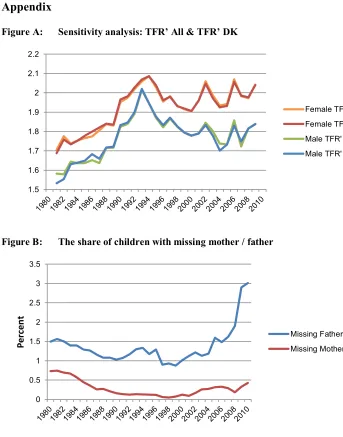
In addition to parity based on all previously born children, Statistics Denmark keeps track of a parity measure that includes only previous children born inside Denmark. Our main results are based on the first measure, which in our view is the natural one in this context. A sensitivity analysis of the two different ways of defining parity shows no significant difference in the final results (see Appendix Figure A).
2.3 Unknown parents
The number of children with unknown parents was 26,587 in total for unknown fathers, and 5,285 for mothers. This is equivalent to a share of 0.1%−0.75% of children with unknown mothers throughout the years and around 1%−1.5% of ‘fatherless’ children for most years. The share of children with unknown fathers did, however, increase from 2005 to 2010, ending just below 3% (see Appendix Figure B). We will return to a discussion of this increase. For our analysis we omitted the missing parents, since we had no information on neither the parity nor the age of the parent.
2.4 Tempo-adjustment
Our focus in this paper was on the data availability and possible differences between male and female TFRs.
We will be using the classical tempo-corrections as proposed by Bongaarts and Feeney (1998):
𝑇𝐹𝑅′(𝑡) =∑ 𝑇𝐹𝑅′(𝑡,𝑖)
where f(a,t,i) = age-specific fertility rates in year t, at age a, and parity order i. Denominators of this rate equal all men or women aged a at time t, regardless of their parity; and with
𝑟(𝑡,𝑖) =(𝑀𝐴𝐶(𝑡+1,𝑖)−2𝑀𝐴𝐶(𝑡−1,𝑖)) (2)
with Mean Age of Childbearing (MAC) defined as:
𝑀𝐴𝐶(𝑡,𝑖) = ∑ 𝑎𝑎 𝑓(𝑎,𝑡,𝑖)/𝑇𝐹𝑅(𝑡,𝑖) (3)
3. Results
The first interesting aspect was the evolution of the ages at which Danish men and women have their children.
Figures 1a and 1b show the age-specific fertility rates (ASFR) for men and women. As expected, the ASFR was somewhat higher for women in the lower ages and somewhat higher for men in the higher ages. Further, Figure 1a demonstrates that even though men have the potential to reproduce in older ages, they rarely do, and from the late 50s the ASFRs were close to zero. The figures also show a continuous postponement in age of fertility for both genders in this 31-year period.
Figure 1a: Danish male age-specific fertility rates, per 1000 men
Figure 1b: Danish female age-specific fertility rates, per 1000 women
The key tool in the Bongaarts-Feeney correction is the parity-specific MAC, which we review in Figures 2a and 2b.
0 20 40 60 80 100 120 140 160
14 18 22 26 30 34 38 42 46 50 54 58 62 66 70
Age
1980 1990 2000 2010
0 20 40 60 80 100 120 140 160
14 18 22 26 30 34 38 42 46 50 54 58 62 66 70
Age
Figure 2a: Danish male mean age of childbearing (formula 3)
Figure 2b: Danish female mean age of childbearing (formula 3)
Figures 2a and 2b illustrate how the MAC increased over the period 1980 to 2010. At each parity men were in general a few years older than women when becoming parents. For both men and women the first five parities have a smooth curve, but the curves for parity 6 and above were very uneven due to the small amount of data.
20 25 30 35 40 45 50
Parity 8+ Parity 7 Parity 6 Parity 5 Parity 4 Parity 3 Parity 2 Parity 1
20 25 30 35 40 45 50
However, there was indication that the increase in MAC for men might be leveling off by the end of the period.
This was more apparent when comparing MAC for all parities for men and women.
Figure 3: MAC for all parities for men and women 1980−2010
Figure 3 shows the MAC for all parities of both men and women throughout the period and how the distance between MAC for men and women decreased. At the beginning of the period the age difference was around 3.2 years (with a maximum of 3.24 years in 1980), whereas the age difference was around 2.5 years in the later years (with a minimum of 2.49 years in 2010).
From this, we calculated the Bongaarts and Feeney tempo-adjusted fertility rates (TFR’) and compared them with the TFRs.
Figures 4a and 4b show the TFR and the TFR’ for men and women. For men, the figure shows how the tempo-effect was negative for most years. This negative difference was especially evident for the years 1983 and 1993, where the difference between TFR and TFR’ was around 0.34. By contrast, for the more recent years the difference between the TFR and the TFR’ decreased, and in year 2007 the tempo-effect was (slightly) positive.
For women, the tempo-effect was similarly negative. This occurred for all of the years, with the largest negative effect around 0.34 at the beginning of the period. The tempo effect diminished for the later years, with the smallest negative effect at 0.09 in 2008.
24 26 28 30 32 34 36
Figure 4a: TFR and TFR’ in Danish men (formula 1)
Figure 4b: TFR and TFR’ in Danish Women (formula 1)
In general, both the TFR and the TFR’ had similar patterns for men and women. However, the negative tempo effect was more evident for women than for men, and the noticeable positive effect for men in the late 2000s was not observed for women. The male tendencies were direct consequences of the declining postponement in fertility
1 1.2 1.4 1.6 1.8 2 2.2
TFR' TFR
1 1.2 1.4 1.6 1.8 2 2.2
behavior, and, looking at the similar results for women, this might also be their future development.
Finally, a referee pointed out that the parity of the father is not necessarily the same as parity of the mother. To consider a possible ‘recirculation’ of parents, we acquired further tables from the Fertility Database of Statistics Denmark, combining fathers and mothers. From there we constructed cross tables of births by father’s parity and mother’s parity for selected years (see Appendix Tables A−D). The cross tables show how the share of children of the same parity of mother and father was constant throughout the period (approximately 84% in 1980, 83% in 1990, and 84% in 2000 and 2010). In general, there was slightly more evidence of recirculation for fathers than for mothers. However, considering only parities 1 and 2 (as most have only 1 or 2 children), the recirculation of mothers was slightly larger than for fathers. Our conclusion is that the share of children of equal parity of father and mother is remarkably large and stable over the period and therefore has no significant effect on the found tendencies.
4. Discussion
The results show how male fertility and female fertility in Denmark have developed over the last three decades.
Since we know neither the age of the missing parents nor the parity of their children, we cannot know the effect of the missing data. Fortunately the frequency of missing data is low throughout the period.
We chose the original approach by Bongaarts and Feeney (1998) for our tempo-correction, despite serious criticism of this approach (e.g., van Imhoff and Keilman (2000); Kohler and Ortega (2002); Bongaarts and Sobotka (2012)). Our main motivation was that the primary purpose of this short paper is to present proof of the concept that tempo ‘correction’ can also be performed for men, at least in Denmark, and secondly, as far as we know, at the moment there is no generally accepted alternative calculation. We did consider using the modification by Bongaarts and Sobotka (2012). However, although the concrete performance of this modification in their presented example was more satisfactory, it suffers from the difficulty that births of order i+1 are assumed independent of births of order i.
Returning to the results, for Danish men both the ASFR and the MAC stabilized towards the end of the studied period, and accordingly the TFR and the TFR’ converged during the years 2004 to 2010. In other words, the postponement of births for men seems to be about to end. For females the picture was somewhat different. Reviewing the ASFR for women, it appeared that the postponement of childbearing is still ongoing and the spacing between the unadjusted TFR and the tempo-adjusted TFR’ is continuing, if slightly decreasing.
In conclusion, we have demonstrated that the Danish official statistics registers also allow tempo corrections of male fertility. We have discussed some concrete problems in this connection and presented calculations based on the classical Bongaarts-Feeney approach.
5. Acknowledgements
References
Bongaarts, J. and Feeney, G. (1998). On the Quantum and Tempo of Fertility.
Population and Development Review 24(2): 271−291. doi:10.2307/2807974.
Bongaarts, J. and Sobotka, T. (2012). Demographic explanation for the recent rise in European Fertility. Population and Development Review 38(1): 83−120. doi:10.1111/j.1728-4457.2012.00473.x.
Danish Fertility Society (2014). Annual report 2013. www.fertilitetsselskab.dk.
Kohler, H.P. and Ortega, J.A. (2002). Tempo-adjusted period parity progression measures, fertility postponement and completed cohort fertility. Demographic
Research 6(6): 92–144. doi:10.4054/DemRes.2002.6.6.
Preston, S.H., Heuveline, P., and Guillot, M. (2001). Demography – Measuring and
Modeling Population Processes. US & UK: Blackwell Publishers.
Statistics Denmark (2013). Statistical Yearbook 2013. Copenhagen: Statistics Denmark.
Appendix
Figure A: Sensitivity analysis: TFR’ All & TFR’ DK
Figure B: The share of children with missing mother / father
1.5 1.6 1.7 1.8 1.9 2 2.1 2.2
Female TFR' All Female TFR' DK Male TFR' All Male TFR' DK
0 0.5 1 1.5 2 2.5 3 3.5
Per
cen
t
Table A: Cross table of births 1980: Percentages of children born by parity of parents
Table B: Cross table of births 1990: Percentages of children born by parity of parents
Parity of mother
Parity of father
1 2 3 4 5 6 7 8 Total
1 39.98 3.26 1.24 0.35 0.08 0.03 0.00 0.00 44.93
2 3.04 31.67 1.48 0.30 0.08 0.02 0.01 0.00 36.60
3 1.43 1.77 9.76 0.36 0.05 0.01 0.00 0.00 13.39
4 0.43 0.63 0.51 1.96 0.10 0.01 0.01 0.00 3.63
5 0.11 0.16 0.11 0.09 0.44 0.03 0.01 0.00 0.95
6 0.02 0.03 0.04 0.03 0.02 0.16 0.01 0.00 0.31
7 0.01 0.01 0.02 0.01 0.01 0.01 0.05 0.00 0.11
8 0.01 0.01 0.00 0.00 0.00 0.00 0.00 0.05 0.07
Total 45.02 37.53 13.15 3.10 0.78 0.26 0.09 0.05 100
Parity of mother
Parity of father
1 2 3 4 5 6 7 8 Total
1 41.41 3.44 1.33 0.22 0.04 0.01 0.00 0.00 46.44
2 3.09 29.56 1.53 0.39 0.07 0.01 0.00 0.00 34.65
3 1.46 2.10 9.37 0.31 0.07 0.01 0.00 0.00 13.32
4 0.40 0.89 0.58 1.92 0.07 0.01 0.00 0.00 3.87
5 0.10 0.22 0.23 0.11 0.36 0.02 0.00 0.00 1.05
6 0.01 0.06 0.08 0.05 0.04 0.13 0.00 0.00 0.37
7 0.01 0.01 0.02 0.02 0.00 0.01 0.04 0.00 0.11
8 0.00 0.01 0.01 0.01 0.01 0.00 0.01 0.02 0.07
Table C: Cross table of births 2000: Percentages of children born by parity of parents
Table D: Cross table of births 2010: Percentages of children born by parity of parents
Parity of mother
Parity of father
1 2 3 4 5 6 7 8 Total
1 38.84 3.02 1.36 0.27 0.05 0.01 0.00 0.00 43.55
2 2.75 31.88 1.45 0.42 0.10 0.02 0.00 0.00 36.62
3 1.41 2.00 10.42 0.34 0.07 0.02 0.01 0.00 14.27
4 0.33 0.78 0.54 2.06 0.04 0.02 0.00 0.00 3.78
5 0.11 0.22 0.17 0.10 0.49 0.02 0.01 0.00 1.12
6 0.02 0.05 0.05 0.04 0.03 0.18 0.00 0.00 0.38
7 0.00 0.02 0.03 0.02 0.02 0.01 0.06 0.00 0.15
8 0.01 0.01 0.02 0.01 0.01 0.01 0.00 0.06 0.13
Total 43.48 37.97 14.02 3.27 0.80 0.28 0.09 0.08 100
Parity of mother
Parity of father
1 2 3 4 5 6 7 8 Total
1 39.49 2.75 1.16 0.25 0.04 0.00 0.00 0.00 43.71
2 2.71 31.60 1.50 0.43 0.11 0.02 0.00 0.00 36.38
3 1.58 2.00 10.62 0.34 0.08 0.01 0.01 0.00 14.64
4 0.40 0.86 0.51 1.85 0.06 0.01 0.00 0.00 3.70
5 0.09 0.16 0.18 0.12 0.43 0.02 0.00 0.00 1.01
6 0.03 0.05 0.05 0.03 0.03 0.10 0.00 0.00 0.30
7 0.01 0.02 0.02 0.02 0.02 0.01 0.05 0.00 0.15
8 0.00 0.03 0.00 0.01 0.01 0.01 0.01 0.03 0.10