Patron: Her Majesty The Queen Rothamsted Research Harpenden, Herts, AL5 2JQ Telephone: +44 (0)1582 763133 Web: http://www.rothamsted.ac.uk/
Rothamsted Research is a Company Limited by Guarantee
Rothamsted Repository Download
A - Papers appearing in refereed journals
Dyke, G. V. 1956. The effect of date of planting on the yield of potatoes.
The Journal of Agricultural Science. 47 (1), pp. 122-128.
The publisher's version can be accessed at:
•
https://dx.doi.org/10.1017/S0021859600039848
The output can be accessed at:
https://repository.rothamsted.ac.uk/item/96wq8/the-effect-of-date-of-planting-on-the-yield-of-potatoes
.
© Please contact [email protected] for copyright queries.
THE EFFECT OF DATE OF PLANTING ON THE YIELD OF POTATOES
B Y G. V. DYKE
Eothamsted Experimental Station, Harpenden, Herte
(With Three Text-figures)
In the years 1948-50 officers of the National Agricultural Advisory Service carried out a survey of potato crops in forty counties of England and Wales. A general account of the results of the first two years has been given by Boyd & Dyke (1950); Dyke & Avis (1953) have described the relation between the estimates of yield issued by the Ministry of Agriculture and those obtained during the survey by sampling methods.
Boyd & Lessells (1954) have discussed the effect of seed-rate on yield, using both survey data and the results of experiments. The present paper presents a similar consideration of the effect of date of planting, and of the room for improvement in growers' practice.
THE EFFECT ON YIELD OF DELAY IN PLANTING
Fig. 1 illustrates the effect of date of planting for all experiments known to the author and likely to be relevant to modern maincrop potatoes in England and Wales (for sources and reasons for the exclusion of certain experiments see Appendix). The graphs represent total yields of potatoes of all grades, these often being the only measurement available.
A general decrease in yield for planting after early April is evident; to give this a more precise descrip-tion a single line has been obtained whose slope at any planting date represents the mean rate • of decrease indicated by all the experiments which included dates both before and after the date con-sidered (see Fig. 2). I t should be noted that this curve is based entirely on comparisons between crops grown on the same site, all conditions being similar except the dates of planting. The elimination of site to site differences (e.g. higher mean yields at sites where the mean planting date was earlier) is essential; this is illustrated by the calculation of Gregory (1944) based on comparisons between sites, which seriously overestimated the adverse effect of delay in planting.
The curve is not well determined near the left-hand end, as few of the experiments included March plantings, but the indication is that there is little
loss of yield due to delay in planting up till about 10 April. From that date onward there was a steady decline in yield, at the rate of about 0-3 ton per acre per week until mid-May and rather more rapid later. Although there is wide variation between the levels of yield of the individual experiments, eleven out of fifteen show losses for all delays after mid-April.
Fig. 2 presents also the estimates obtained from the survey of the effect on yield of date of planting.* The survey results agree with, the experiments in showing a general decrease of yield with late planting of 0-4-0-6 ton per acre per week, though the curves are much less regular in form. The flattening of the curves for each year between 14 and 24 April may perhaps be ascribed to random variation (the stan-dard error of the yield at each date of planting for a particular year is of the order of 0'4 ton per acre).
I t seems clear, however, that the losses due to delay were greater in 1948 than in 1949 or 1950. This is borne out by the Rothamsted experiments, in which the rate of loss in 1948 was considerably higher than in 1949 or 1950. At Sprowston and Sutton Bonington, however, the differences were less markedf (yields in 1948 being exceptionally high at all dates of planting). The most marked difference between the curves of the individual experiments is the smaller loss from late planting in experiments with generally low levels of yield.
The results obtained at Craibstone (mainly on Golden Wonder) are illustrated in Fig. 3. The loss of yield of total tubers per week's delay in planting between 11 April and 21 May is about 0-5 ton per acre—slightly greater than in the English experiments.
G. V. DYKE
123
DATE OF PLANTING: GROWERS' PRACTICE
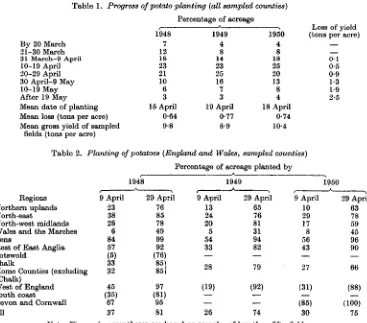
Table 1 shows the progress of planting on the sampled fields in 1948, 1949 and 1950. The right-hand column presents estimates of the loss of yield due to progressive delay, obtained from the mean curve of the experiments plotted in Fig. 2.
18 17 16 15 14
•JT13 fc 11 g 1 0
8
^ 8 o 7
aMethwold o Rothamsted • Sprowston ASutton Bonington
12 22 1 11 21 1 11 21 31 10 March April May June
Date of planting
Fig. 1. Experiments on date of planting potatoes.
1 11
1948 Survey
22
March
Fig. 2.
1
Effect
11 21 1 11
April Date of planting of date of planting
21
May
on yield.
Practically the whole of the acreage was planted in each year between mid-March and mid-May; although the spring of 1948 was exceptionally favourable to early planting, growers in general seem to have taken little advantage of the oppor-tunity. There were temporary shortages of fertilizer in spring 1948, and it may be that some growers delayed planting until fertilizer was delivered.
A loss of at least half a ton occurred on the fields planted after 19 April, which represented 40-50 % of the acreage; of this acreage about half,
represent-ing 20-25% of the acreage, was planted after 29 April and lost at least 1 ton per acre. The total loss due to delay was equivalent to 0-6-0-8 ton per acre over the whole acreage. Since average yields for a given date of planting in the experiments were rather higher than in the survey, this estimate should probably be reduced slightly. We may conclude that the loss of yield in England and Wales due to delay in planting was approximately 5 %.
The progress of planting varied much more from place to place than from year to year (Table 2). Areas where planting was well ahead of the average are Devon and Cornwall and the Fens. These were the only areas in which appreciably over half the acreage was planted by 9 April. In the Fens growers do seem to have taken advantage of the favourable season of 1948 to plant the bulk of their acreage in good time. Growers in the north-west midlands (including the noted potato areas of Staffordshire and Cheshire) planted rather later than the average
15 14
.10
2T 7 2 6 2 5 2 4!
Chitted
. Not chitted
1 16
March
1 16 June 1 16 1 16
April May Date of planting
Fig. 3. Effects of date of planting and of chitted seed at Craibstone.
(only 20-30 % being planted by 9 April), as did also the growers on the higher land of the north. In Wales and the adjacent foothills of Shropshire planting was extremely late, less than 10 % being planted by 9 April and at least half left till May.
EFFECT ON PERCENTAGE OF WARE
Figures for the percentage of ware are available for most of the experiments shown in Fig. 2. They indicate little effect of date of planting; there is a tendency for the percentage of ware to decrease very slightly with later planting (the greatest decrease recorded was 6 % in 6 weeks).
124
experiments (with more freely growing varieties). I t decreases from 47 % for early March to 39 % for mid-May planting. The percentage of ware and seed (i.e. in most years tubers over 1J in.) decreases only slightly in the same period.
DATE OF PLANTING IN RELATION TO THE EFFECTS OF OTHER FACTORS
(a) Manuring
The Rothamsted experiments give some information on the relation between date of planting and the effects of dung and fertilizers. A test of dung was included in each year. The rate of application in
sulphate of ammonia (0-6 cwt. N per acre) were made in all years, of superphosphate (0-6 cwt. P8OS)
in 1946 and 1948—50, and of muriate of potash (1-0 cwt. K2O) in all years except 1945. In 1945 in
addition, sprouted seed was compared with un-sprouted (the latter being used in the other experi-ments). The variety was Majestic throughout.
The results are summarized in the Rothamsted Annual Report for 1950 (pp. 116-118), from which much of the following paragraphs and of Table 5 has been abstracted.
In Table 4 all the experimental data is combined (small adjustments being made to the values at the two April plantings to allow for the omission of these
Table 1. Progress of potato planting (all sampled counties)
Percentage of acreage
By 20 March 21-30 March 31 March-9 April 10-19 April 20-29 April 30 April-9 May 10-19 May After 19 May Mean date of planting Mean loss (tons per acre) Mean gross yield of sampled
fields (tons per acre)
1948 7 12 18 23 21 10 6 3 15 April 0-64 9-8 1949 4 8 14 23 25 16 7 3 19 April 0-77 8-9 1950 4 8 18 25 20 13 8 4 18 April 0-74 10-4
Loss of yield (tons per acre)
0-1 0-5 0-9 1-3 1-9 2-5
Table 2. Planting of potatoes (England and Wales, sampled counties)
Percentage of acreage planted by
Regions Northern uplands North-east
North-west midlands Wales and the Marches Fens
Rest of East AngHa Cotswold
Chalk
Home Counties (excluding Chalk)
West of England South coast Devon and Cornwall All 9 April 23 38 26 6 84 57 (6) 33 32 45 (35) 67 37 1948 29 April 76 85 78 49 99 92 (76) 85) 85| 97 (81) 95 81 9 April 13 24 20 5 54 33 — 28 (19) — — 26 1949 29 April 65 76 81 31 94 82 — 79 (92) — — 74 9 April 10 29 17 8 56 43 27 (31) (85) 30 1950 29 April 63 78 59 45 96 90 66 (88) (100) 75
Note. Figures in parentheses are based on samples of less than fifty fields.
1945, 1947 and 1948 was 15 tons per acre (applied in the ridges) for the first planting, rates for later plantings being adjusted for the loss of weight during the subsequent storage; in 1946 all applications were at 15 tons per acre, the dung being drawn from adjacent parts of an undisturbed heap. I n 1949 and 1950 dung was ploughed in in spring at the same time for all plantings, at 15 tons per acre. Tests of
G. V. DYKE
125
all fell sharply when planting was delayed from early to late April, and again in the interval from mid-May to late May. Between 23 April and 12 May, however, the changes were smaller, whilst by con-trast, phosphate suffered its main loss of effect in this interval.
Table 5 shows the mean yield with and without nitrogen, with and without phosphate, and for the four combinations of dung and potash for the four experiments which included all these factors. Inter-actions (except that of dung and potash) were small and varied irregularly with planting date; they have been ignored in the following summary. The
at the first planting date to 5-2 at the second and thereafter more slowly, the value for planting in late May being 3-8 tons. Although the dressings used in these experiments were all profitable at all plantings (except for potash in the presence of dung at the last three dates), there is no doubt that the optimum rates of application decrease markedly with delay in planting. In this connexion it may be noted that in areas where planting is very late (e.g. the surveyed counties of Wales and West Shropshire) less fertilizer is used; there is probably little advan-tage to be gained from increased use of fertilizer unless planting dates are advanced.
Table 3. Effect of date of planting on percentage of (a) ware, (b) ware and seed (Craibstone)
Date of planting
Percentage ware 16 March43 Percentage ware and seed 93
Table 4. Mean date Mean yield Effects: Dung N P K 1 April 42 92
16 April 1 May 42 41 92 92
Date of planting potatoes, Rothamsted, 1945-50.
effects (total tubers, tons per acre)
3 April 10-04 3-59 1-80 0-80 2-07 23 April 9-15 2-97 1-02 0-78 0-61 12 Mav 8-66" 2-40 1-08 0-44 0-86 16 May 38 90 1 June 32 87
Mean yields and
31 May 7-32 1-68 0-72 0-42 0-38 16 June 27 81 Mean 8-79 2-66 116 0-61 0-98 Notes. (1) Values for 3 and 23 April have been adjusted for the missing values of 1947.
(2) The figures for 1945 are taken from plots planted with unchitted seed only.
Table 5. Mean yields of potatoes, Rothamsted 1946, 1948-50 (total tubers, tons per acre)
Mean date of planting
Manuring No nitrogen Nitrogen No phosphate Phosphate No dung, no potash Dung, no potash Potash, no dung Dung and potash
Mean 4 April 9-5 111 9-9 10-7 7-1 11-2 10-1 12-8 10-31 24 April 8-6 9-3 8-6 9-4 6-5 10-6 8-6 10-2 8-97 12 May 8-3 9-4 8-6 9 1 6-3 10-3 9-0 9-8 8-85 30 May 7-0 8-0 7-3 7-7 6-0 8-5 7-0 8-4 7-50 Loss per week 0-29 0-34 0-29 0-34 013 0-31 0-33 0-50 0-32
losses per week in the last column were calculated on the assumption of steady rates of decrease.
The effect of potash in the absence of dung decreased rapidly, but even at the last date of planting yielded 1 ton. When dung was applied, however, the addition of potash produced a response of 1-6 tons at the first date, but none whatever at later dates. The effects of nitrogen and phosphate in the same series of experiments fell off propor-tionately much more slowly than those of potash, and still gave appreciable responses at the last planting.
The combined effect of dung, nitrogen, phosphate and potash used together fell from 8-1 tons per acre
126
experiments in which each manure was applied to
only half the plots (as at Rothamsted in 1946, and
1948-50). If we assume that the plots receiving
potash (half with dung in addition, half without)
roughly correspond to commercial practice we arrive
at a loss per week of 0-41 tons per acre, compared
with 0-32, the mean for all combinations of manures.
The Methwold experiments included as a factor
a comparison of two rates of application of fertilizer*
(there were no plots without fertilizer). There was
no consistent response to the higher rate, and no
conclusion can be drawn regarding the effect of date
of planting on the response to fertilizers on fen soils.
Experiments at Boghall (Mukhtar Singh, 1952)
in 1946 and 1947 confirmed the Rothamsted finding
that fertilizer effects decrease sadly when planting
is delayed. In 1946 the loss of yield between plantings
on 10 April and 20 May was 3-2 tons per acre for
plots receiving 10 cwt. per acre of compound
ferti-lizer, but no loss was found on a subsidiary series
without fertilizers. In 1947 nitrogen and potash
were included factorially, but all plantings were
rather late. The effect of the higher level of nitrogen
(5 cwt. per acre of sulphate of ammonia) decreased
from 41 tons per acre (planted 7 May) to 3-1 tons
(4 June), while the effect of 2 cwt. of muriate of
potash per acre showed little change (1-2 and 1 • 0 tons
per acre for the first and last plantings). This last
result is at variance with the Rothamsted
experi-ments, where the potash response was more seriously
affected by late planting than the nitrogen response.
It should be noted, however, that the conditions of
the two sets of trials were very different.
(6) Varieties
The English experiments mostly contained only
one variety—Majestic. The five trials at Sprowston,
however, included Majestic and Arran Banner
Table 6. Comparison of varieties at Sprowston, 1948—52 (total tubers, tons per acre)
Approximate planting date
Majestic Arran Banner
Difference
22 March 14'1 13-3 0-8
12 April 13-7 133 0-4
7 Ma; 13-2 12-8 0-4
(Norfolk Agricultural Station, 1953), and the 1950 trial at Methwold included Majestic and Record. The Sprowston results varied widely from year to year, but on the whole Majestic lost more with late planting than Arran Banner (Table 6). The results obtained at Methwold in 1950 showed that the
* Sulphate Muriate of Super- of (cwt. per acre) ammonia phosphate potash
Medium rate 1 7 2 High rate 1£ 10J 3
Record stock yielded about 2 tons higher than the Majestic, and the loss due to delayed planting of Record was roughly double that for Majestic (0-5 ton per acre per week against 0-3).
The Craibstone results provide some information on the relation of Golden Wonder and other varieties occasionally included in the trials (Great Scott 3 years, Arran Banner 3 years, and Di Vernon 4 years; in two of the last group Majestic also was included and in one, Kerr's Pink; of these varieties Great Scott is a second early, Di Vernon a first early). There is an indication that the optimum date of planting for Golden Wonder is earlier than for the other varieties except Arran Banner; this is most marked for Di Vernon, which yielded over 2 tons per acre better when planted on 16 April than on 16 March, whilst Golden Wonder in the same trials yielded 1£ tons per acre more at the earlier date. The comparison between Arran Banner and Golden Wonder shows the two varieties to vary in much the same way with date of planting; the Arran Banner yields are generally higher by about 7 tons per acre and decrease rather more rapidly with late planting after mid-May.
These results seem to indicate that under Craib-stone conditions planting of ' early' varieties before mid-April is of no advantage in terms of ware potatoes, whereas the slower developing Golden Wonder will generally benefit (though slightly) from March planting. (N. Scot. Coll. Agric. 1931. 1936 and 1937.)
(c) Chitting
Only one of the English experiments on date of
planting included a comparison between chitted and
normal sets at each date of planting (Rothamsted,
1945).
Table 7 is quoted from the Rothamsted Report
for 1950 (p. 118).
There was no appreciable improvement in yield
due to chitting for the two earlier plantings, but
when planted on 11 May or 1 June unsprouted sets
yielded more than a ton less than the sprouted. The
comparison of chitted and 'ordinary' seed at the
two late dates is, however, somewhat artificial, as
even.the' ordinary' seed must have sprouted to some
extent by May.
The Craibstone series included chitting as a factor
every year. The results plotted in Fig. 3 show two
very smooth curves which are well determined
except at the earliest date of planting (which was
included in only four of the twenty experiments).
G. V. DYKE
127
shows that (under Craibatone conditions) for chitted seed there is a period of at least a month from mid-March to mid-April in which variations in date of planting have little average effect. There are, however, considerable differences between years, most years showing some gain for planting before mid-April but a few showing losses of a ton or more, with one case (1942) of a loss of over 6 tons.
For unsprouted seed, on the other hand, there was a general slight gain from planting at mid-March or early April with serious losses in a smaller proportion of years (the worst, in 1942, being a loss of 4-5 tons per acre).
The single Rothamsted experiment is at variance with the Craibstone series in showing practically no benefit from the sprouting of sets if planting is
about 11 April at the rate of about 0-4 tons per acre per week. The effect is rather greater in years with fine springs, and on high-yielding fields.
In Rothamsted experiments the responses to dung and fertilizers were all greatly reduced when planting was delayed; between early April and late May the effects of dung, nitrogen and phosphate were halved, while that of potash was reduced by about 8 0 % . The evidence on the responses of different varieties to early planting in English experiments is contradictory, except for an indica-tion that higher yielding varieties respond better. Data from Craibstone suggest that, if bulk yield is the only criterion, 'early' varieties which make rapid growth early in the season have a later optimum planting date than maincrop varieties.
Table 7. Mean yields of potatoes, Rothamsted, 1945 (total tubers, tons per acre) 30 March 20 April 11 May U u n e Mean
10-02 10-85 8-96 6-63 9-12 10-27 10-90 10-11 7-99 9-82 Effect of chitting 0-25 0-05 1-15 1-36 0-70 Ordinary seed
Chitted seed
early. In the absence of further experiments it is uncertain whether this important difference is due to the difference of situation or variety, or a chance effect of the 1945 season. Before a general recom-mendation is widely made to farmers it is desirable to have much more information relevant to condi-tions in England and Wales. I t may be that a satisfactory increase in yield could be obtained from commercial fields by encouraging earlier planting (at little expense), without asking growers to provide expensive chitting houses for their seed potatoes.
SUMMARY
Evidence obtained in the Agricultural Improve-ment Council Survey of Maincrop Potatoes 1948—50 and in experiments shows that yields in England and Wales are decreased by delay in planting after
The effect of chitting seed at Craibstone is to increase yields by 1-7 tons per acre for March plantings, and by 2-5 tons per acre for plantings in mid-April and later. There is negligible loss of yield from sprouted seed at Craibstone for plantings de-layed up to mid-April,but for unsprouted seed there is evidence of a gain from plantings a month earlier. Sprouted seed planted even as late as 1 May yielded as well as unsprouted planted two months earlier.
128
APPENDIX
Experiments on date of planting potatoes
I. Experiments used in compiling Figs. 1 and 2. (a) Methwold, three experiments, 1949, 1950, 1951 (unpublished). Results used by permission of the Fenland Experiments Committee, N.A.A.S. Eastern Province.
(6) Bothamsted, six experiments, annually 1945-50 (Rothamsted, 1939-47, 1948, 1949, 191945-50).
(c) Sprowston, five experiments, annually 1948-52 (1948 experiment: Harvey, 1949; 1951 experi-ment : Norfolk Agricultural Station, 1952; remainder unpublished, communicated by R. W. Shepherd and P. J. Jones).
(d) Sutton Bonington, one experiment, 1948 (Ivins & McDermott, 1949).
II. Earlier experiments in England, not discussed in the paper
(a) Cockle Park, six experiments, annually 1905/6-11 (Northumberland County Agricultural Experiment Station, 1906-11).
(6) Bedfordshire, one experiment, 1891 (Maiden, 1891).
These experiments were omitted from Figs. 1 and 2, and the discussion, since they were carried out with varieties which are no longer in large-scale cultiva-tion and under condicultiva-tions different from those of present-day potato-growing. At Cockle Park autumn planting was tried with some degree of success.
III. Experiments in Scotland discussed in the paper
(a) Boghall, two experiments, 1946, 1947 (Mukhtar Singh, 1952).
(o) Craibstone, twenty experiments, 1927-47 (except 1941) (1927-38, N. Scot. Coll. Agric, Craibstone, Aberdeen; 1939-40, 1942-7, unpub-lished, communicated by R. Bain).
REFERENCES
BOYD,D.A.&DYKE,G.V. (1950). N.A.A.S. Quart. Rev. no. 10, pp. 47-57.
BOYD, D. A. & LESSELLS, W. J. (1954). J. Agric. Sci. 44, 465-76.
CHURCH, B. M. (1952). Emp. J. Exp. Agric. 20, 257-70.
DYKE, G. V. & Avis, P. R. D. (1953). J. Agric. Sci. 43, 450-5.
GREGORY, P. H. (1944). Agriculture, 49-50, 557-9. HABVEY, P. N. (1949). Agriculture, 55, 543-4. IVINS, J. D. & MODERMOTT, N. (1949). Agriculture, 55,
452-3.
MAIDEN, G. (1891). J. R. Agric. Soc. 3rd series, 2, 864-9. MUKHTAB SINGH (1952). Emp. J. Exp. Agric. 20,
301-15.
Norfolk Agricultural Station (1952). Farm Guide. Norfolk Agricultural Station (1953). 44th Annual Rep.
1951-2.
N. Scot. Coll. Agric, Craibstone, Aberdeen (1928). Scot. J. Agric. 11, 82.
N. Scot. Coll. Agric, Craibstone, Aberdeen (1929). Scot. J. Agric. 12, 69-70.
N. Scot. Coll. Agric, Craibstone, Aberdeen (1930). Scot. J. Agric. 13, 79-80.
N. Scot. Coll. Agric, Craibstone, Aberdeen (1931). Scot. J. Agric. 14, 82-3.
N. Scot. Coll. Agric., Craibstone, Aberdeen (1932). Scot. J. Agric. 15, 79-80.
N. Scot. Coll. Agric, Craibstone, Aberdeen (1933). Scot. J. Agric. 16, 87-9.
N. Scot. Coll. Agric, Craibstone, Aberdeen (1934). Scot. J. Agric. 17, 85-7.
N. Scot. Coll. Agric, Craibstone, Aberdeen (1935). Scot. J. Agric. 18, 64-6.
N. Scot. Coll. Agric, Craibstone, Aberdeen (1936). Scot. J. Agric. 19, 64-5.
N. Scot. Coll. Agric, Craibstone, Aberdeen (1937). Scot. J. Agric. 20, 57-60.
N. Scot. Coll. Agric, Craibstone, Aberdeen (1938). Scot. J. Agric. 21, 169-71.
N. Scot. Coll. Agric, Craibstone, Aberdeen (1939). Scot. J. Agric. 22, 177-9.
Northumberland County Agricultural Experiment Station (1906-11 seriatim). Guide to Experiments. ROTHAMSTED . Results of the Field Experiments (1939-47,
2 and 1948, 1949, 1950).
YATES, F. (1949). Sampling Methods for Censuses and Surveys (2nd ed. 1953). London: Griffin.