An Experimental Study of Incentive Reversal
in Sequential and Simultaneous Games
Omolbanin Jalali1, Zahra Nasrollahi*2, Madjid Hatefi Madjumerd3
Received: April 29, 2018 Accepted: June 26, 2018
Abstract
t is commonly held that increasing monetary rewards enhance work effort. This study, however, argues that this will not ineludibly occur in team activities. Incentive Reversal may occur in sequential team productions featuring positive external impacts on agents. This seemingly paradoxical event is explained through two experiments in this article. The first experiment involves a sample of 182 college students who were paired in groups each playing 12 games that led to 2,184 observations. The second experiment involves a sample of 210 college students who were grouped into teams of three that involved 420 observations. The results of both experiments confirmed the occurrence of incentive reversals despite increasing monetary rewards.
Keywords: Incentive Reversal, Game Theory, Team Production, Experimental Economics, Behavioral Economy.
JEL Classification: C9,D23,J31,J33, J41, M12, M52. 1. Introduction
Team production is so common in modern economies that one can hardly locate an employee outside a team (Guillen et al., 2013). Teamwork is employed in both for-profit and non-profit organizations (Gershkov & Winter, 2014). As there are several levels of production in a team, finding solutions for increasing team efficiency is among important economic and managerial concerns. Motivations for exerting effort partly depend on the vocational environment for people working in a team (Smirnov & Wait, 2015). The economic structure
1. Faculty of Economics Management and Accounting, Yazd University, Yazd, Iran ([email protected]).
2. Faculty of Economics Management and Accounting, Yazd University, Yazd, Iran (Corresponding Author: [email protected]).
3. Faculty of Economics, University of Tehran, Tehran, Iran ([email protected]).
of companies include teams producing services and goods (Vranceanu et al., 2015), but managers cannot frequently determine the exact share of each employee in this process. As the result, many firms pay a portion of their gross production to their employees. Economists are uncertain about the merits of each employee in being awarded from the general rewards program: if an individual relies on her peers’ attempts and does less than she can, other employees might also do the same in an equilibrium and, consequently, production level will inevitably decrease. Several studies have investigated free riding in team members (Alchian & Demsetz, 1972; Holmstrom, 1982; McAfee & McMillan, 1991; Itoh, 1991; Kandel & Lazear, 1992; Legros & Matthews, 1993; Barron & Gjerde, 1997; Che & Yoo, 2001). More studies that are recent have extended their scope and examined cooperation or shirking both theoretically and experimentally. In fact, these studies tend toward incentive reversal in teams (Winter, 2009; Klor et al., 2014). Incentive reversal occurs when a monetary reward for all members leads to further attempt by only a few while others choose to shirk or free ride. As incentive reversal is probable in sequential team production, especially in the case of people, who merely aim to maximize their income, this study aims to explain the conditions and experimental results as arising from the circumstances that give rise to incentive reversal.
remove the threat in which agent j can continue shirking despite a boost in his/her reward.
The process is not as simple as this due to cognitive and other limitations, of course. When there is a boost in everyone’s reward, their effort might increase regardless of their peers. This reaction is facilitated when people are not able to or do not anticipate others to be able to follow the backward induction reasoning to incentive reversal. Even if there are no cognitive limitations, other-regarding preferences can eliminate incentive reversals. If a person who intends on shirking is aware that his/her peer, follows up his/her work regardless of the monetary reward and shirking, he/she will not shirk. Therefore, incentive reversal will not happen.
Team working is becoming increasingly popular in the Iranian economy, which leaves the predominance of incentive reversal to experimentation. Following the logic of global economy, more Iranian companies are redefining their activities through teamwork. Still workforce productivity remains an unresolved and serious challenge in production. This research argues that incentive reversal is among the reasons behind low productivity in this domain. As there has not been any studies exploring incentive reversal as a determinant of low productivity in Iranian workforce, this paper undertakes to investigate incentive reversal through simultaneous and consequential games including Complete Information, static and dynamic, as well as Perfect and Imperfect Information Games. In order to achieve these objectives, two independent controlled experiments will be administered on incentive reversals. Teams working on the same project participated in both experiments. They chose their effort level (according to effort cost) and the teams were rewarded by their joint effort. Both experiments presume situations that are sensitive to incentive reversal. Observing consistency in experiment environments (at the particular level of production technology), this study will explore how members will react to high and low rewards.
The second experiment includes a game between three people in a classroom. This is a monetary game where the result structure is not explicit but can be an extension on the basic rules. All decisions were simultaneously collected while the strategies selected by the second and third players depended on the one by the first. Incentive levels varied during the process through different effort costs instead of varying rewards.
The rest of the paper is organized as follows. Section 2 discusses the theoretical design, sections 3 and 4 present the experiments, and section 5 provides the concluding remarks.
2. Theoretical Framework
Winter (2009) constitutes the theoretical framework for our study. Winter (2009) has explored the possibility of incentive reversal in a general framework. He shows that when production technology exerts a positive externality on peers, and agents sequentially choose their effort, then the total effort will decrease in an equilibrium in the case that rewards are increased. This is primarily an effect of monetary incentives rather than behavioral influence or that of agents’ earning. In this framework, the technology function is stochastic in order to show how a project can succeed in increasing effort among its agents. This study also provides a description of major reasons behind the incentivereversal through deterministic technology as employed in an experimental design.
Imagine a group of two people working on a project. Agents will decide on effort or shirking as effort inevitably involves costs. ei
indicates this decision; when agent i exerts effort, then ei 1, and
when he/she shirks, then ei 0. Agents move sequentially and
information is perfect. The result function for agent i is,
) 1 (
Where rirepresents the reward that agent i receives for each unit of
production. P shows the total units produced as a function of total effort. And Ci is the positive cost for agent i due to his/her effort.
Assume that production function P as related to total effort is strictly convex; in other words, every agent’s effort increases the marginal
(e , e ) r (e e ) e
i i j i i j i i
productivity of other agent. The two-agent model implies that,
) 2 (
This conveys the complementarities between the agent’s effort and technology. Therefore, an agent’s effort has a positive externality on others effort.
Let’s presume a set of parameters as used in the first experiment. Suppose that P(2)=100, P(1)=70, P(0)=50 and C1=C2=1000. The
reward for each unit of production is r1=28 for the first agent and
r2=43 for the second. There is a unique Subgame-Perfect Equilibrium
for these parameters and both agents choose effort to reach at this equilibrium. As the result, the total effort is equal 2.
In another assumption, the rewards are increased to r1=31 and
r2=60, while other parameters (cost and production function) remain
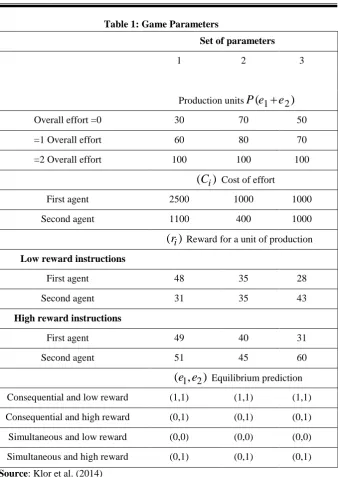
the same. In this case, exerting effort would be a dominant strategy for agent 2. When agent 1 comes to know about this, he/she decides on shirking on the equilibrium. Therefore, increasing rewards for both agents will result in decreasing effort (see equilibrium prediction as illustrated in table 1).
In the case of a low reward program, agent 1 should do his/her best to encourage agent 2 toward effort, as his /her effort will increase the marginal productivity of agent 2. Agent 2 is willing to exert his/her effort regardless of agent 1’s strategy. In this way, agent 1 will benefit from free riding on agent 2’s effort and will save the cost of his/her own effort. Therefore, in this new incentive program, shirking will be the equilibrating strategy for agent 1. Moreover, information about the effort of peers will be determining in the incentive reversal in the specific production technology. When agent 2 is not aware of agent 1’s strategic decision, the sequential game turns into a simultaneous game through information outlook. When the rewards are low, both agents will shirk in a unique equilibrium. Although a boost in rewards leads to decreasing overall effort in a sequential game, it increases overall effort in a simultaneous game.
(2) P(1) P(1) P(0)
Table 1: Game Parameters
Set of parameters
1 2 3
1 2
( )
P e e
Production units
Overall effort =0 30 70 50
Overall effort
=1 60 80 70
Overall effort
=2 100 100 100
Cost of effort (Ci)
First agent 2500 1000 1000
Second agent 1100 400 1000
Reward for a unit of production ( )ri
Low reward instructions
First agent 48 35 28
Second agent 31 35 43
High reward instructions
First agent 49 40 31
Second agent 51 45 60
Equilibrium prediction
1 2
( ,e e )
Consequential and low reward (1,1) (1,1) (1,1)
Consequential and high reward (0,1) (0,1) (0,1)
Simultaneous and low reward (0,0) (0,0) (0,0)
Simultaneous and high reward (0,1) (0,1) (0,1)
Source: Klor et al. (2014) 3. The First Experiment
games, each one of the two agents exert an ei effort. Its result is
determined through the equation (1) by the individual reward of ri,
personal cost of ci and the production function P. The games included
three different combinations of the production function, cost and two reward levels for each game and high rewards were larger than low rewards at the individual level. The parameters were selected in a way that the two levels of reward will lead to the incentive reversal in a sequential protocol. Besides, the second agent is aware of the first agent’s decision before making his/her decision. In other words, an equilibrium between the subgames of the two agents’ games shows the exertion of effort for low rewards, and it is only the second agent who exerts effort in the case of high rewards. In the case of simultaneous games, all conditions are similar to sequential games, only the two agents make their decisions at the same time. The total number of games was 12 (2 protocols, 3 parameter sets, 2 levels of rewards). Table 1 illustrates the experimental design and equilibrium predictions
Various groups of people participated in simultaneous and sequential protocols. Parameters and reward levels were varying, and each agent had 6 games in each protocol. All games followed an identical method. Roles of agent 1 or 2 were randomly allotted to people at the beginning of each session to which they adhered until the end of that session. Each session included 6 different rounds. In each round, subjects were randomly allotted a role; that is to say, they were coupled with a stranger. There is no feedback between these rounds to ensure the autonomy of the first subject’s decisions in each session. Everyone was informed about the parameters within a round at the beginning of each session. The sequential protocol was in the form of a tree game while the simultaneous protocol constituted a matrix. Although data might be affected by other factors, this will not change the results because the instructions were identical for all games and data was collected at different rounds and the average was reported for each individual.
were sampled out from among the educational courses at Yazd, Meybod and Mehriz Universities. This led to 2,184 observations. Each session allowed not more than 12 individuals to the laboratory and they received the instructions read to them by the experimenter. To ensure the elimination of any possible influence, individuals remained anonymous in separated cubicles. During the experimentation, no communication was allowed between the individuals. Each individual will receive a base payment of 300 experimental points at the beginning of each game (80 experimental points equal 1 NIS). Their following earnings were decided on through their payoffs as determined in a random round. Mean earning was 63 NIS. Each session lasted no more than 45 minutes.
3.1 Results
To study incentive reversal, first the number of times a subject exerts effort for high and low rewards is calculated. Fig. 1 illustrates the mean for the subjects’ inclinations toward exerting effort in the case of each protocol and reward level. First, the number of times a subject decides to exert effort at high and low rewards is calculated and then the mean for all subjects is calculated for each treatment.
Figure 1: Mean for Subjects’ Tendencies toward Exerting Effort in Various Game Modes
0 0.1 0.2 0.3 0.4 0.5 0.6 0.7 0.8 0.9
As it is the first subject’s decision that might lead to incentive reversal due to the research methodology and the structure of games, we first focus on their behavior. In both sequential and simultaneous structures, incentive reversal is observed in the first subject because as the reward increases, the mean for individual effort decreases in the case of the first subject. Optimal effort for low reward games was 54% and less than 50% for other games. The mean for effort varied between 54% in sequential games with low rewards and 41% in simultaneous games with high rewards. Effort was higher in low-reward rounds.
Result 1:
According to incentive reversal, an increase in rewards leads to a decrease in effort of first subject at both sequential and simultaneous structures.
This is in agreement with sequential games in Klor et al. (2014) while they did not witness any incentive reversal in simultaneous games.
Fig. 1 conveys that the incentive reversal does not appear in the case of the second subject because as the reward increases, the mean of effort also increases. The mean for effort varies between 55% for sequential low-reward games and 80% for simultaneous high-reward games, and the mean of effort is greater in the case of high-reward games. The reason is that effort is the dominant strategy for the second subject when rewards are high, but the first subject’s effort is the best response in circumstances when the reward is low. Therefore, the second subject shirks when he/she observes low rewards and the first subject’s shirking. In fact, on low-reward rounds, the behavior of the second subject depends on that of the first. If the first subject exerts effort, mean effort will be 0.63 but if he/she shirks, the mean will drop to 45%. A similar tendency occurs in high-reward rounds. If the first subject exerts effort, the mean will rise to up to 90% but if he/she shirks, the mean will drop to 53%. Although most subjects will choose effort, shirking is also occasionally selected. In the case of sequential structures, this can be interpreted as a sign for interaction between them.
shirking of the first subject in 51% of the cases in low reward games. This behavior cannot be safely attributed to intersubjective inclinations as pay-off maximization and reciprocity strategies have intersected. The best reaction for the second subject in the case of shirking on the part of the first is to duplicate shirking in low reward games. While shirking is not the most efficient behavior for the second subject in high reward games, it is still witnessed in 21% of the cases as a conspicuous sign of opposition.
Result 2:
When the reward is low, the second movers reciprocate the first mover’s actions. However, this attitude is less visible when the reward is high and effort is the dominant strategy for the second mover. In this case, from among the second movers, some will reciprocate shirking with shirking, but they mostly choose effort.
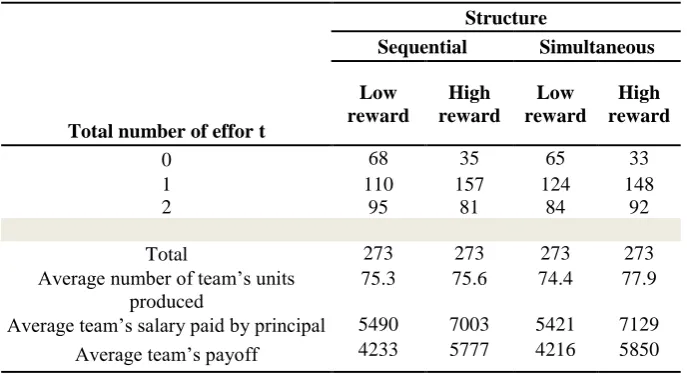
The results for the impact of personal rewards on team performance for games are illustrated in table 2 according to the frequency of subjects’ effort, mean team production, mean team income, and mean team profit. As table 2 shows for both high and low rewards in sequential treatments, subjects are more prone to synchronize at total team effort of one (that is to say, only one subject exerts effort in a team consisting of two individuals). Incentive reversal is not associated with team performance in the sequential structure because as the reward increases, team production also increases (from 75.3 in low-reward games up to 75.6 in high-reward games). This does not agree with Klor et al. (2014) as they have observed incentive reversal in sequential structures, too. Furthermore, comparing the team performance of individuals when they both exert effort reveals that their individual performance is higher at low rewards.
This is in agreement with Klor et al. (2014) as they did not observe incentive reversal in simultaneous structures. The mean team payment was 4,216 units at low rewards while it increased to 5,850 at high rewards. In other words, if the experimenter pays more, he/she will not receive more production units at high rewards. The comparison of individuals’ team performances when both subjects exert effort shows that their performance at high rewards is better than low rewards (comparison between 84 and 92 numbers).
Result 3:
As reward increases in sequential and simultaneous structures, team production and principals’ payoff also increase. In sequential structures, team participation is greater at low rewards, while in simultaneous structures it is greater at high rewards.
Table 2: Team Performance According to Game Structures Structure Simultaneous Sequential High reward Low reward High reward Low reward Total number of effor t
33 65 35 68 0 148 124 157 110 1 92 84 81 95 2 273 273 273 273 Total 77.9 74.4 75.6 75.3
Average number of team’s units produced
7129 5421
7003 5490
Average team’s salary paid by principal
5850 4216
5777 4233
Average team’s payoff
3.2 The Impact of First Subject’s Decision on That of the Second Subject in 12 Games
Equation (3) was used to determine the impact of the first subject’s decision on the second in both sequential and simultaneous games:
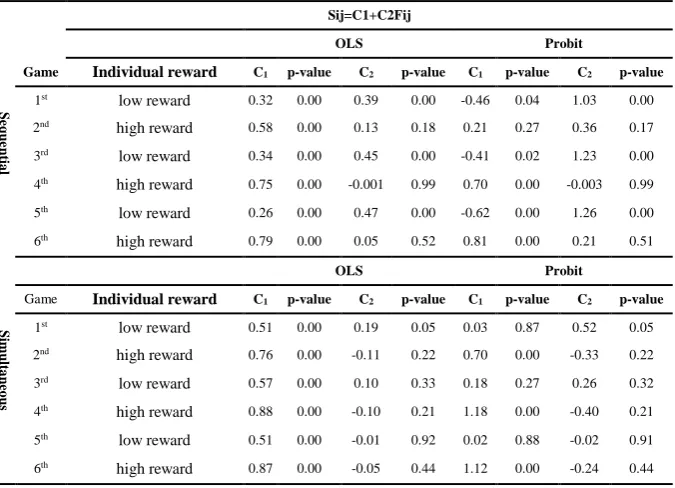
Where s and f are the decisions of the first and second subjects respectively; and i and j represent the 12 simultaneous and sequential games. The estimation results are illustrated in table 3:
Table 3: Estimation of Decision Impacts in 12 Games Sij=C1+C2Fij
S
eq
u
e
n
tia
l
OLS Probit
Game Individual reward C1 p-value C2 p-value C1 p-value C2 p-value
st
1 low reward 0.32 0.00 0.39 0.00 -0.46 0.04 1.03 0.00
nd
2 high reward 0.58 0.00 0.13 0.18 0.21 0.27 0.36 0.17
rd
3 low reward 0.34 0.00 0.45 0.00 -0.41 0.02 1.23 0.00
th
4 high reward 0.75 0.00 -0.001 0.99 0.70 0.00 -0.003 0.99
th
5 low reward 0.26 0.00 0.47 0.00 -0.62 0.00 1.26 0.00
th
6 high reward 0.79 0.00 0.05 0.52 0.81 0.00 0.21 0.51
S
im
u
lt
a
n
eou
s
OLS Probit
Game Individual reward C1 p-value C2 p-value C1 p-value C2 p-value
st
1 low reward 0.51 0.00 0.19 0.05 0.03 0.87 0.52 0.05
nd
2 high reward 0.76 0.00 -0.11 0.22 0.70 0.00 -0.33 0.22
rd
3 low reward 0.57 0.00 0.10 0.33 0.18 0.27 0.26 0.32
th
4 high reward 0.88 0.00 -0.10 0.21 1.18 0.00 -0.40 0.21
th
5 low reward 0.51 0.00 -0.01 0.92 0.02 0.88 -0.02 0.91
th
6 high reward 0.87 0.00 -0.05 0.44 1.12 0.00 -0.24 0.44
The reward was low in the first, third and fifth sequential games and this has reduced the penalty cost for the second subject. The second subject decides on effort on seeing the attempts of the first subject, which maximizes team benefits. However, if he/she observes the shirking of the first subject, he/she will decide on shirking in order to punish the first subject. This will make the first subject’s decision a determinant of that of the second subject in low-reward games. The individual reward, however, was high in the second, fourth and sixth games which increased the penalty for the second subject. High rewards compel the second subject to merely consider his/her vested interests and try to optimize his/her own benefits. In other words, his/her decisions will no longer depend on those of the first subject. As table 3 illustrates, C2 coefficient (that shows the second subject’s
subject is unaware of the first subject’s decision, hence cannot be influenced by it.
Result 4:
In his/her decision to exert effort, the second subject considers the first subject’s decision as low individual reward increases in sequential games. High reward in sequential games involving two players compels the second subject to ignore the first subject’s decision and merely focus on his/her own individual benefits.
3.3 The Impact of Game’s Structure and Reward on Subjects’ Decision-Making
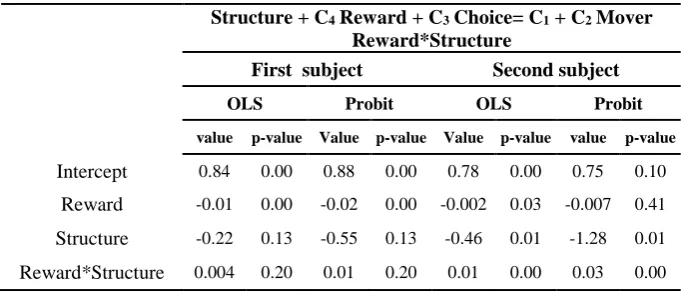
Table 4 employs regression analysis to certify the results. This study administered OLS and probit methods in order to validate the impact of (high and low) rewards, (sequential and simultaneous) structures as well as their reciprocal influence on two subjects. Reward has determined the decisions of the first player in both regressions and the results are significant, yet this impact on the second subject was only validated through OLS regression. Game’s structure does not determine the first subject’s decisions, but it does influence those of the second subject. This is because the first subject is always unaware of the second subject’s decisions. Reciprocal impact is significant only in the case of the second subject. These conclusions are summarized in result 5.
Table 4: The Impact of Game’s Structure and Reward on Subjects’ Decision-Making
Mover
2
C +
1
Choice= C
3
Reward + C
4
Structure + C
Reward*Structure
First subject Second subject
OLS Probit OLS Probit
value p-value Value p-value Value p-value value p-value
Intercept 0.84 0.00 0.88 0.00 0.78 0.00 0.75 0.10
Reward -0.01 0.00 -0.02 0.00 -0.002 0.03 -0.007 0.41
Structure -0.22 0.13 -0.55 0.13 -0.46 0.01 -1.28 0.01
Result 5:
According to incentive reversal, (i) an increase in rewards leads to a decrease in effort for the first subject. (ii) Game’s structure (simultaneous and sequential) does not determine decision-making for the first subject. (iii) The reciprocal impacts of reward and structure are only determining in the case of the second subject.
4. The Second Experiment
The second experiment was conducted with the participation of 210 economics, management and psychology students of Yazd, Meybod and Mehriz universities. The first experiment offered clear evidence supporting incentive reversal. A second experiment investigating sequential team production was arranged to complement the findings of the first. It involved teams of three people who were not given a graphic game but had to extrapolate it from the instructions. The experiment was conducted in a classroom. As the subjects were most likely acquainted, they remained anonymous and decisions were made instantaneously.
Parameter variations took place between classmates. The reward program and production function were consistent for all parameters while the cost of effort varied. Therefore, when the price for effort increased from low to high, incentive reversal occurred at high levels of effort. The game was designed as a simple monetary one and its regulations were explained in the instructions.
Each team received an initial earning of E equal to NIS30 (almost U.S. $8). The subjects moved sequentially. In the process, each subject can decide to exert effort (ei=1) or shirk (ei=0). Shirking does not impose any cost while effort imposes the fixed cost of ci, which varied in different games and for different individuals. Team reward was doubled for any team that chose to exert effort. This is a convex technology and implies the subjects’ effort were complimentary. The final reward included the total profits divided among team members. Accordingly, the agents’ final payoff is determined through:
.2K
i i i
E
c e n
Where K
nk1ek shows total effort by all team members.Production technology could lead to incentive reversal depending on the cost structure (low or high cost). This varies among different subjects.
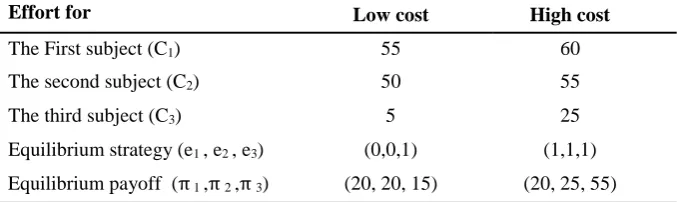
The cost programs were cL (55,50,5) and cH (60,55, 25). As
subjects move sequentially, they exert effort only if they witness that all previous subjects have exerted effort when the cost is high. In a unique SPE of the game, all subjects in a high-cost game will choose effort. On the contrary, when the effort cost is low, effort is the dominant strategy for the last subject. In a reversed solution to the game, the first two subjects decide on shirking and incentive reversal takes place. Table 5 summarizes the parameters and equilibrium predictions. Equilibrium strategies and payoffs varies for high and low cost levels. When the cost is low, the first two subjects will choose shirking, while the third subject exerts effort. When the cost is high, all three subjects decide on exerting effort.
Table 5: Objective and Equilibrium Predictions High cost Low cost
Effort for
60 55
)
1
The First subject (C
55 50
)
2
The second subject (C
25 5
)
3
The third subject (C
(1,1,1) (0,0,1)
)
3
, e
2
, e
1
Equilibrium strategy (e
(20, 25, 55) (20, 20, 15)
Equilibrium payoff (π 1 ,π 2 ,π 3)
Subjects were participated in the experiment in one day and none had taken part in the first experiment. The experiment took place at the end of a teaching session when students were asked to participate in a short experiment. The instructions were loudly recited to volunteers who had stayed back for the experiment. The instructions were written in neutral language; that is to say, they substituted doubling the reward for effort and shirking. Then, they were asked to answer controlled questions to make sure that they had totally grasped the structure. Afterwards, they checked their decisions on a predesigned form.
choose a set of information that constitutes a total of 8 decisions. After all forms were collected, the payoffs were calculated as follows: First subjects were randomly allocated to groups of three members and to play one of the three roles. Decisions are commensurate with roles and the previous subject’s decisions determines team member’s payoffs. Payments were confidential and people were identified from the last four digits of their identification number as written on their decision sheet. The mean paid payoff was NIS24 (almost I. R. Rials 260,000).
Table 6 illustrates the decisions of all subjects as depending on the previous subjects’ decisions.
To analyze the data, first, people’s reactions towards equilibrium were considered. According to the predictions of incentive reversal theory, it is anticipated that the first participant exerts less effort at low costs. The fact that the number of first participants who have exerted their effort is greater at high costs proves this prognostication. Under such conditions and at low costs, the first and second participants must shirk and 81.08% of decisions made in this experiment follow this. Similarly, the second participant exerts effort if he/she witnesses the effort of the first one at high costs. This is observed in 76.67% of cases in this experiment. In addition, the decisions made by the third participant towards equilibrium agree with the predictions: in 90% (42%) of cases, people exerted effort at low (high) costs. The results are in agreement with Klor et al (2014) and supports Winter’s theoretical article (2009).
Table 6: Distribution of Subjects’ Decision Strategies
Low price Number of
subjects 133
Percentage for the first participant
e1=0
78.72
e1=1
21.28
Percentage for the second
participant
e2=0
81.08
e2=1
18.92
e2=0
80.00
e2=1
20.00
Percentage for the third
participant
e3=0
10.00 e3=1
90.00 e3=0
14.29 e3=1
85.71 e3=0
12.5
e3=1
87.5 e3=0
0.00
e3=1
100.00
High cost Number of
subjects 133
Percentage for the first participant
e1=0
66.67
e1=1
33.33
Percentage for the second
participant
e2=0
76.67
e2=1
23.33
e2=0
60.00
e2=1
40.00
Percentage for the third
participant
e3=0
78.26 e3=1
21.74 e3=0
57.14 e3=1
42.86 e3=0
44.45 e3=1
55.55 e3=0
0.00
e3=1
100.00
Table 7: Distribution of Anticipated Effort, Cost, and Team Payoff High cost Low cost
Team percentage with team effort . . .
0.4 0.064 K=0 0.289 0.617 K=1 0.178 0.277 K=2 0.133 0.043 K=3 1.044 1.3
Anticipated team effort
46.43 25.75
Anticipated team cost (NIS)
82.71 82.36
Anticipated team production (NIS)
36.28 56.61
Anticipated team payoff (NIS)
As tables 6 and 7 convey, first participants who exert effort at high cost outnumber those who do so at low costs. Moreover, according to the convex production technology, the levels of total effort among different teams are different at high and low costs. The results convey that team productivity at high and low costs are not very different; that is to say, decreasing production costs leads to decreasing production units. Thus, decreasing effort costs leads to decreasing effort, hence decreasing production.
5. Conclusions
Incentive reversal was investigated through two experiments in this study. The results confirmed the occurrence of incentive reversal. Both experiments showed that as rewards increase or costs decrease, the last agent is less responsive to react. A preceding agent seems to expect effort from his/her subsequent agent in such conditions. As the result, the first agent resorts to shirking to enjoy free riding at the cost of his/her succeeding agents.
The first experiment showed that the first subject’s efficient attempts leading to the second subject’s decision-making do not necessarily provide a case for incentive reversal. The first agent can adopt to the behavior of the second in reiterations; therefore, incentive reversal do not occur. The second agent sacrifices a part of his/her payoff in order to punish the first agent for shirking at high rewards. This behavior is more probable when the reaction is stricter so that the first agent exerts effort in next rounds despite the reward. The same pattern recurred in the second experiment.
The results complement those of Winter (2009) and Klor et al. (2014) in their investigations of the impact of monetary rewards on individual behavior. Rationality, self-centeredness and money maximizing led to incentive reversal in this study. Incentive reversal in teams is in fact the emergence of second-degree incentives. This has a long pedigree in game theory and underlines the fact that people do not merely react to direct incentives and the reaction of their fellow members should be taken into account.
necessarily guarantee success. Political campaigns, business investment, inflow of investment, simultaneous decisions made by committees and their impositions on public and private sectors (Athias & Soubeyran, 2013) might all involve incentive reversal.
As incentive reversal is a rational phenomenon, this research’s findings can have behavioral implications, too. Team members do not tend toward effort when they observe their fellow members’ shirking. This indifference can greatly influence team performance. The results clarify that extravagant monetary rewards might not be effective enough as they can remove the validity of this potential threat. The results can also have more implications because they show that even increasing rewards might have adverse effects. For example, unconditional promises for rises and promotions can reduce effort cost; as the result, they might lead to incentive reversal instead of improving performance. Therefore, policy-makers should consider these in their employment and contracting strategies.
Acknowledgment
We would like to thank Esteban F. Klor, Sebastian Kube, Eyal Winter, Ro’i Zultan for their suggestions that helped improve the drafts.
References
Alchian, A. A., & Demsetz, H. (1972). Production, Information Costs, and Economic Organization. The American Economic Review, 62(5), 777-795.
Athias, L., & Soubeyran, R. (2013). Demand Risk Allocation in Incomplete Contracts: The Case of Public Private Partnerships.
Unpublished Manuscript, University of Lausanne.
Barron, J. M., & Gjerde, K. P. (1997). Peer Pressure in an Agency Relationship. Journal of Labor economics, 15(2), 234-254.
Che, Y. K., & Yoo, S. W. (2001). Optimal Incentives for Teams.
American Economic Review, 525-541.
Guillen, P., Merrett, D., & Slonim, R. (2014). A New Solution for the Moral Hazard Problem in Team Production. Management Science, 61(7), 1514-1530.
Holmstrom, B. (1982). Moral Hazard in Teams. The Bell Journal of
Economics, 13(2), 324-340.
Itoh, H. (1991). Incentives to Help in Multi-Agent Situations.
Econometrica: Journal of the Econometric Society, 59(3), 611-636.
Kandel, E., & Lazear, E. P. (1992). Peer Pressure and Partnerships.
Journal of Political Economy, 100(4), 801-817.
Klor, E. F., Kube, S., & Winter, E. (2014). Can Higher Rewards Lead to Less Effort? Incentive Reversal in Teams. Journal of Economic Behavior & Organization, 97, 72-83.
Legros, P., & Matthews, S. A. (1993). Efficient and Nearly Efficient Partnerships. The Review of Economic Studies, 60(3), 599-611.
McAfee, R. P., & McMillan, J. (1991). Optimal Contracts for Teams.
International Economic Review, 32(3), 561-577.
Selten, R. (1967). Die Strategiemethode Zur Erforschung Des Eingeschräncht Rationalen Verhaltens in Rahmen Eines Oligopolexperiments, In Beitraägge Zur Experimentellen Wirtschaftforschung (Ed.). H. Sauermann, Tübingen: Jcb Mohr.
Smirnov, V., & Wait, A. (2015). Innovation in a Generalized Timing Game. International Journal of Industrial Organization, 42, 23-33.
Vranceanu, R., El Ouardighi, F., & Dubart, D. (2015). Team Production with Punishment Option: Insights from a Real Effort Experiment. Managerial and Decision Economics, 36(6), 408-420.
Winter, E. (2009). Incentive reversal. American Economic Journal: