Measuring the Effectiveness of Preemptive Focus on Form through Uptake Sheets
Javad Gholami a
Assistant Professor, Urmia University, Urmia, Iran
Morteza Bassirian
Lecturer, Iran Language Institute, Qom, Iran
Received 20 July 2010; revised 3 May 2011; accepted 10 July 2011
Abstract
Uptake is believed to be an indication of the effectiveness of focus on form practices and a possible facilitator for language acquisition. All the accounts of uptake in the literature have been based on the observational data derived from the audio-recordings of the meaning-focused classes. The present study is a novel attempt to account for instances of uptake in 18 hours of meaning-focused instruction in an intact EFL class through an elicitation instrument called uptake sheet. To this end, all instances of teacher- and learner-initiated preemptive Focus on Form Episodes (FFES) and uptake moves following them were identified and coded in the recorded data. Then, the researchers cross-checked the audio-data findings with the ones in the uptake sheets. Compared to the oral uptake moves captured through the audio-data, the analyses revealed a significantly higher frequency of uptake moves in the uptake sheets following teacher-initiated FFEs, but a lower frequency of uptake moves was found in the case of learner-initiated FFEs. The findings would, hopefully, further clarify our conception of the nature
aEmail address: [email protected]
Corresponding address: Department of English, Urmia University, Val Fajr 2 Street, Urmia, Iran. Postal Code: 571984837, Tel/Fax: +984413369716
and rate of uptake and would pave the way for further research on exploring multiple instances of uptake not accounted for so far in the literature.
Keywords: Focus on form, Preemptive, Learner-initiated FFE, Teacher-initiated FFE, Uptake
Introduction
Long and Robinson (1998) define focus on form as “an occasional shift of attention to linguistic code features– by the teacher and/or one or more of the learners – triggered by perceived problems with comprehension or production” (p. 23). One way to evaluate the effectiveness of focus on form instruction is measuring the outcome of such instruction or what is learned. This is the approach undertaken by the product-oriented research. However, it has also been emphasized by SLA researchers that in addition to the product, the process of language learning is also of crucial importance. According to N. Ellis and Schmidt (1997):
SLA research aspires to understand acquisition, and acquisition results from dynamic processes occurring in real time. It is difficult to gain an understanding of learning and development from observations of the final state, when we do not have any record of the content of the learners’ years of exposure to language nor of the developmental course of their proficiencies. If we want to understand learning we must study it directly (p. 146).
One area of research, in which the ‘dynamic processes’ of learning are captured is the research done on the characteristics and the effects of ‘uptake’ which is defined as the learners’ subsequent spontaneous production of the targeted linguistic forms and is thought to be the best measure for the effectiveness of focus on form instruction (Loewen, 2005). However, obtaining data on uptake is often difficult (Williams, 2001). Moreover, although subsequent correct production could be considered an indication of the effectiveness of an FFE, a lack of production is not necessarily evidence of focus on form’s ineffectiveness. Rather, learners might simply not have the chance to use the linguistic form in focus (Loewen, 2005).
Due to this optional nature of uptake as well as the contextual restrictions posed on the production of uptake (i.e. learners might not always have the chance to produce uptake if, for instance, after an FFE, the teacher continues his/her turn) a lot of variations and sometimes sharp contradictions exist in the results reported by the previous studies.
Preemptive Focus on Form
Ellis (2001) classified focus on form into planned (proactive) vs. incidental focus on form (FonF). He also extended Long and Robinson's (1998) definition of incidental FonF to include preemptive as well as reactive FonF. Therefore, by definition, while reactive FonF involves a teacher's reaction of some sort to the erroneous production of learners, preemptive FonF occurs when either a learner or the teacher takes time-outs during meaning-focused activities to attend to issues of linguistic nature, prior to the occurrence of any errors. Later on, Ellis et al. (2001b), in their study of the characteristics of preemptive focus on form, made yet another distinction between learner-initiated and teacher-initiated preemptive FonF with the former occurring when a learner raises queries, during a meaning-focused activity, about a linguistic form because he/she felt a gap in his/her linguistic knowledge and the latter being when a teacher draws the learners' attention to a linguistic issue during a meaning-focused activity because he has felt a gap might have existed in the learners' linguistic competence.
While reactive FonF has been extensively investigated in different contexts, preemptive FonF remains an under-researched area. For instance, Ellis et al. (2001b) expressed great concern over lack of empirical studies on preemptive FonF and the necessity to investigate preemptive as well as reactive focus on form. Additionally, as Farrokhi and Gholami (2007) argued, if preemptive FonF is an understudied area in ESL contexts, its account is almost completely missing from EFL contexts. Therefore, since preemptive FonF needs to be given more attention, and it is an under-researched domain in focus on form studies, only the frequency of occurrence and the attributes of uptake following preemptive FonF were investigated in this study.
Uptake
The credit for the first mention of uptake goes to Chaudron (1977) who used the concept of uptake in relation to error correction or negative feedback, when he claimed that one measure of the "effectiveness of any type of corrective reaction would be a frequency count of the students' correct responses following each type" (p.42). Following this remark, Lyster and Ranta (1997), based on Austin's (1976) speech act theory, defined uptake as "a student's utterance that immediately follows the teacher's feedback and constitutes a reaction of sorts to the teacher's intention to draw attention to some aspect of the student's initial utterance" (p.49). Thus, uptake is a learner's reaction of some sort (often in the form of acknowledgement or the incorporation of the correct form in his subsequent utterances) to the corrective feedback provided by the teacher about a linguistic form that the learner has used incorrectly. Although the original definition of uptake was related to reactive FonF, Ellis et al. (2001a) extended the concept of uptake to cover preemptive FonF as well, by proposing the following definition:
1. Uptake is a student move.
2. The move is optional (i.e. a focus on form does not obligate the student to provide an uptake move).
3. The uptake move occurs in episodes where learners have demonstrated a gap in their knowledge (e.g. by making an error, by asking a question, or by failing to answer a teacher's question).
4. The uptake move occurs as a reaction to some preceding move in which another participant (usually the teacher) either explicitly or implicitly provides information about a linguistic feature (p. 286).
As the above-definition indicates, uptake is a voluntary move on the part of the learner therefore the learner may simply choose not to produce an uptake move even if he/she has the chance. Moreover, as Oliver (2000) states, learners may even have no opportunity to react to teachers' feedback if, for instance, the teacher continues his or her turn.
Most of the studies on uptake have tried to determine the frequency of uptake, most of them studying uptake following reactive focus on form, which have found differing rates of uptake moves in different learning environments (e.g. Egi, 2010; Lyster & Izquierdo, 2009; Nassaji, 2009; Reinders, 2009; Mohammadnia, & Gholami, 2008; Farrokhi & Gholami, 2007; Zhao & Bitchener, 2007; Farrokhi &
Gholami, 2006; Loewen, 2004a; Ellis et al., 2001a; Lyster, 1998; Lyster & Ranta, 1997; Ellis, 1994).
On the other hand, since preemptive focus on form has been a neglected corner of focus on form, studies on uptake occurring after preemptive focus on form, also, remain awfully in the minority (e.g. Ellis et al., 2001a, 2001b; Farrokhi & Gholami, 2005, 2007; Gholami, 2009; Loewen, 2004a, 2004b; Zhao & Bitchener, 2007). Moreover, most of the studies on the frequency of occurrence and characteristics of uptake following preemptive FonF have been conducted in ESL settings, resulting in very different and sometimes contradictory findings. Therefore, the study of uptake in preemptive FonF in EFL contexts seems to be a worthy research line to be taken more by the researchers in the field.
Studies on Uptake
In a study of Grade 4 French immersion classes in Canada, Lyster and Ranta (1997) found that 55% of the teacher feedback on the learners' errors led to uptake, where repair (successful uptake) occurred after only 27% of the feedback moves. In contrast to Lyster and Ranta, Ellis et al. (2001a) found much higher levels of uptake in their study of 12 hours of meaning-focused lessons in two ESL classes in a private language school in New Zealand. They found that learners produced uptake in 74.1% of the time out of the total 429 opportunities in which they could instigate uptake. Their results also demonstrated that 74% of the uptake moves were successful ones.
Contrary to the findings of Ellis et al. (2001a), Farrokhi and Gholami (2007), in a study of an EFL class in Iran, found a very low proportion of uptake (15%) and that uptake was more frequent after reactive FFEs. They argue that the context in which a study is carried out might be one of the factors responsible for this discrepancy in the rate of uptake identified in different studies. They suggest that these diverse findings may indicate that the benefit of incidental focus on form in terms of successful uptake may vary considerably depending on the context. They further suggest that since uptake is an optional move, this low frequency of uptake does not necessarily mean that learners in EFL classes do not benefit from focus on form. However, they reported that a detailed analysis of their data, including audio, video, and learner notes, indicated a substantial number of teacher-initiated and some instances of learner-initiated preemptive FFEs for which, though learners
chose not to acknowledge an uptake orally, they decided to note them down. On the basis of this latter analysis, Farrokhi and Gholami suggest that the current definition of uptake may not be a complete one. They also maintain that, in light of the recent critical notions on the role of uptake as a conducive factor to language acquisition and the conflicting findings in the literature on the rate of uptake moves, it seems essential to seek more accountable measures of focus on form instruction and its usefulness. SLA researchers, they argue, should look for finding some other measures or use multiple indices to investigate the effectiveness of focus on form.
Finally, in yet another study, Egi (2010) investigated the possible association between uptake and acquisition, by exploring the cognitive processes underlying learner responses. The results indicated that in recast episodes, where the learners produced uptake, their reports showed that they perceived the recasts as corrective feedback significantly more frequently compared to the cases where they did not produce uptake. Furthermore, it was found that in episodes where learners correctly repaired their errors, they were significantly more likely to report not only recognizing corrective recasts but also noticing the interlanguage–L2 mismatch. Egi also found that modified output was significantly related both to learners’ recognition of corrective recasts and to their noticing of the gap. He concluded that, given the developmental benefits commonly associated with noticing the gap, these findings may partly explain why repair and modified output are taken to be predictive of second language acquisition.
Significance of Uptake
The significance of uptake lies in the fact that it has the potential to facilitate second language acquisition. Although uptake is not a definite evidence of acquisition, Ellis et al. (2001a) argue that there are theoretical grounds for believing that uptake might contribute to acquisition. Lyster (1998) explains that one way in which uptake might aid acquisition is by giving learners opportunities to operationalize target language knowledge that they have already learnt in declarative form.
Another issue that is related to uptake is the role of output in second language acquisition. Previous research on comprehensible input has proved it to be insufficient in achieving high-level, native-like linguistic competence (Swain,
1985, 1995, 2000). This led some researchers to claim that ‘pushed output’ is the missing part and that it can facilitate acquisition by compelling learners to process language in a syntactic level rather than a semantic one by enabling them to alter their erroneous hypotheses about the target language (e.g. Swain, 1995; Swain & Lapkin, 1995, 2001). Thus, learners' attempts to use forms which they have either previously used incorrectly or have only received explicit information about can be taken as instances of pushed output. This also constitutes an instance of uptake.
Uptake also may be an indication of noticing, which is thought to be necessary for second language acquisition by some authorities (e.g. Schmidt, 1990, 1995) and the intended outcome of focus on form by others (e.g. Long & Robinson, 1998).
Elicited Uptake
It is widely accepted in the literature that one of the characteristics of uptake is that it is a voluntary move (Ellis et al., 2001a) and that learners might choose not to produce uptake. However, as it was discussed above, uptake is a very important index of communicative classrooms in that it can be an indication of noticing and might facilitate acquisition and so it seems necessary to find better ways to examine its frequency and attributes than the mere observation of its natural occurrence in L2 classes. This concern has been reflected, by some of the researchers in the field, (e.g. Farrokhi & Gholami, 2007) as they expressed their concern over the lack of a more accountable measure of uptake.
Another point which makes the development of a new instrument to assess the frequency of occurrence and the quality of uptake of grave importance is a problem, mentioned in the literature, with the natural observation of the occurrence of uptake. The problem is that in a lot of FFEs, learners do not have the opportunity to produce uptake. These cases are merely categorized as instances with ‘no opportunity for uptake’ by some researchers (e.g. Loewen, 2004a; Zhao & Bitchener, 2007).
To the best of our knowledge, no attempt has been made in the field before, to develop an instrument to elicit uptake to gain a more precise measure of its occurrence and qualities. The development and application of the think-aloud uptake sheet as an instrument for the elicitation of uptake is a major novelty of this study. It seems essential, however, to add that this instrument is employed not to
violate the above mentioned definition of uptake, that is, its voluntary nature, rather, to give learners more opportunities to produce uptake if they are willing to, above all the circumstances that restrain their chances of producing uptake.
Uptake Sheet
The concept of ‘uptake sheet’ as a method of data collection was first introduced following Allwright's (1984) study on learners' perceptions about what they learned in their language classes. He collected learners' reports about their learning which he termed ‘uptake’. It should be noted that this concept of uptake is totally different from the one adopted in focus on form research. Mackey and Gass (2005) explain that in classroom research, uptake sheets are often distributed at the beginning of the lesson, and the learners are asked to mark or note things on which the researcher or teacher is focusing.
An example of the incorporation of uptake sheets could be found in a study by Mackey et al. (2001) in which they asked learners to mark uptake sheets in order to answer research questions focusing on the relationship between the format of the uptake sheet and the quantity and the quality of learner reporting.
Research Questions
This study addressed the following questions:
Q1: Is there any significant difference in the frequency of oral uptake moves following learner-initiated and teacher-initiated preemptive FFEs in an intermediate EFL class?
Q2: Is there any significant difference between the frequencies of oral uptake moves and the written instances of uptake elicited through uptake sheets?
Method Design of the Study
The present study is an attempt to examine uptake following two subsets of preemptive focus on form, namely, learner-initiated and teacher-initiated episodes in a meaning-oriented EFL classroom. To investigate the research questions, a descriptive design was employed. The design of this study falls into what Ellis (2001b) categorizes as ‘exploratory-qualitative-statistical’ research, since it is an
exploratory study of a real classroom, the data consists of samples of classroom interaction and, finally, statistical procedures are used to analyze the data. A descriptive procedure was employed since the observational data were to be collected from an intact class. As Ellis et al. (2001b) argue, unlike planned focus on form, incidental focus on form cannot be studied using experimental methods since such research requires the pre-selection of linguistic features for investigation. Moreover, since incidental focus on form is, by definition, unpredictable it is not possible to apply a pre-test to control other variables at play.
Despite the above-cited limitations, Ellis (2005) strongly advocates employing such a design and method to investigate focus on form since it can "reinforce what critics of experimental studies have always argued, namely, that form-focused instruction cannot be viewed as a general phenomenon but must be seen as highly contextualized and variable" (p. 99).
Context of the Study
The data for the present study were collected in an intermediate EFL class in a private language institute in Qom, Iran. In this private institute, communicative language teaching is highly advocated. The course books are the Interchange series by Richards et al. (2005). The tasks and exercises used by the teachers are mostly meaning-oriented. This inclination towards communicatively-oriented language teaching is reinforced by the supervisory policy of the institute's board of management and also in-service training they regularly offer to their teachers.
Participants
An intermediate female EFL class was chosen as the most suitable site for data collection in this study. The participants were 12 female Farsi native speakers aged between 17 and 26 in this class, who were mostly senior high school or university students. They all paid tuition and were generally reasonably motivated (based on the anecdotal evidence from their teacher and the researchers’ observations) and attended the class regularly. Their male teacher had a BA degree in English language and literature with 7 years of experience in teaching English to Iranian EFL learners. He had also attended three TTC courses and a few workshops on ELT.
Instruments
Two mini-sized mp3 voice recorders were used to obtain observational data on the preemptive FFEs and the oral uptake moves that followed them. Also one of the researchers attended five sessions of the class in person and took extensive field notes. As it was explained previously, in order to eliminate the shortcomings of the current method of studying uptake, a think-aloud uptake sheet was also employed to elicit written instances of uptake moves following learner- and teacher-initiated preemptive FFEs. A sample uptake sheet used by Mackey et al. (2001) is presented in Figure 1:
Figure1: Uptake sheet (adopted from Mackey and Gass, 2005, p. 202)
Although the study by Mackey et al. (2001) pursued uptake in a totally different sense and for a different purpose, the uptake sheet they used seemed a reasonable platform from which to develop another one that would suit the objectives of this research on incidental focus on form. Therefore, the researchers decided first to utilize this instrument, with minor modifications in its structure, in a pilot study prior to the main phase of the study. The results of pilot study revealed, for instance, that since learners were asked to write their names on the top of the uptake sheets, they took them as an obligatory task to be done with extreme precision. They also reacted to the uptake sheets as they did to examination papers since they believed that they would be corrected and scored subsequently. This, however, violated the definition of uptake, which stated that uptake was an optional move. Thus, taking into consideration the results of the pilot study and the other aspects of incidental focus on form, and after making necessary revisions and modifications in the structure of the uptake sheets, the researchers came up with a final version of the uptake sheet that suited the research on incidental focus on
Who said it?
(check as many as you wish) Was it NEW to you? What are you
noticing about … Teacher Classmate Me Book Yes, new No, heard of it
No, knew it Pronunciation
Vocabulary
Grammar
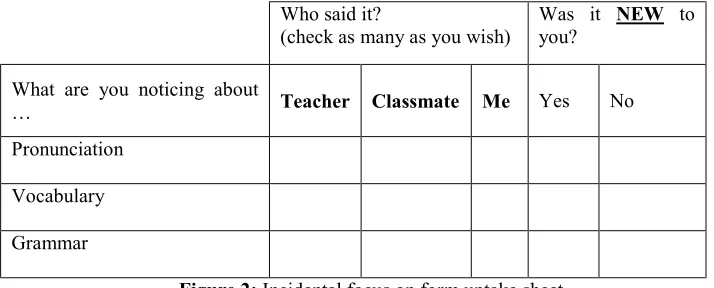
form and uptake. The final version of the uptake sheet, which was utilized in this study, is presented below in Figure 2 and two sample completed uptake sheets collected from the learners in the present study are given in the appendix.
Figure 2: Incidental focus on form uptake sheet
Procedure
The data were collected entirely from communicatively-oriented activities in a level 12 class in the aforementioned private institute. Two mini-sized wireless voice recorders were utilized to obtain the audio-data from the whole class interactions between learners and the teacher, one placed near the teacher, the other among the learners. This procedure only captured the teacher-whole class interactions, therefore the teacher-individual learner interactions and learner-learner interactions in pair works were not audible and thus excluded from the analysis. Therefore, all of the data transcription and quantification were carried out only on the interactions between the teacher and the learners which were audible to the whole class and thus intelligible to the researchers as well. After the completion of the data collection phase, the researchers listened to the audio-data transcribing the instances of learner- and teacher-initiated preemptive FFEs that were raised during meaning-focused activities, while excluding the parts where planned focus on form or traditional grammar instruction were employed.
In the end, a total amount of 18 hours of meaning-focused instruction were identified and analyzed for instances of preemptive FFEs and the oral uptake moves following them. Below is an example of learner-initiated preemptive FFE
Who said it?
(check as many as you wish) Was it you? NEW to
What are you noticing about
… Teacher Classmate Me Yes No
Pronunciation
Vocabulary
Grammar
which led to oral uptake, adopted from the data of the present study. The underlined part is an instance of oral uptake move.
Episode 75: Learner-initiated, uptake was observed. (Linguistic focus: Vocabulary)
S1: excuse me … aah… how about … aah … an exam with four choices? T: we call it a multiple choice examination.
S1: multiple … choice … exam (writes down).
T: multiple … choice … examination (writes on the board).
As regards the elicitation of data using uptake sheets, the researchers distributed uptake sheets among the learners at the beginning of every session and collected them immediately after the class was over. The reason why this particular procedure was followed was to ensure that the uptake sheets elicited immediate, on-the-spot uptake in order to keep up with the definition of uptake in the literature as the learners' immediate reaction to focus on form instruction.
The learners were instructed, on the first session of data collection, that they were to write in the appropriate row, the language forms which they notice in the class, whether they are presented by the teacher, other learners or the forms that they themselves had problems with and thus raised questions about. They were told, however, not to include the forms which they learned in the book. Moreover, they were instructed to indicate, by placing a check mark in the right cell, who raised each particular linguistic form: whether the teacher, other learners, or themselves. They were further asked to indicate whether the linguistic form was new to them or not.
The researchers also asked the learners not to write their names on the top of the sheets and ensured the learners that the uptake sheets were not to be corrected or graded and that they were merely a means of research. This was done to ensure that the learners produced uptake voluntarily so as to observe the second index of uptake defined by Ellis et al. (2001a). The learners were also reassured that their notes and the uptake sheets will be kept confidential and will be destroyed upon the completion of the analysis.
Finally, it should be noted that no effort was made to manipulate the frequency or the characteristics of preemptive FFEs or the uptake, whether the immediate oral
uptake or the uptake identified in the uptake sheets. The teacher was unaware that the researchers intended to examine preemptive FFEs in his class. He was merely told that the study was to analyze classroom interaction during communicative lessons. Thus, these observations can be representative of what normally occurs in such EFL classes. The learners were also unaware of the intention of the researchers in giving them the uptake sheets. They were simply told that the researchers are interested in exploring what linguistic forms they noticed in the class.
After the identification and transcription of the learner- and teacher-initiated FFEs and the instances of oral uptake, the researchers cross-checked the audio-data with the uptake sheets to identify the rate of the written acknowledgements of the learners noted down in the uptake sheets following the identified learner- and teacher-initiated preemptive FFEs. The uptake data derived both from the audio-recordings and the uptake sheets were then coded and analyzed using Chi-square analysis. Regarding the inter-coder reliability, 10% of the whole data was transcribed and coded by a third independent researcher where the Kappa measure of agreement indicated a coefficient of K=.91 which is regarded as a very good agreement.
Results and Discussion
Quantitative Results: Immediate Oral Uptake vs. Uptake-sheet-based Uptake
This study was primarily aimed at investigating the rate of uptake based on its occurrence evident in audio-recorded data and that of uptake sheets. Table 1 presents the frequency and the percentage of both oral uptake moves and uptake-sheet-based uptake moves following learner- and teacher-initiated preemptive FFEs in 18 hours of meaning-focused instruction.
Table 1
Uptake following learner-initiated and teacher-initiated preemptive FFEs based both on oral uptake and uptake sheets
Based on the findings, only 78 oral uptake moves occurred following preemptive FFEs in the intended EFL class, whereas the uptake sheets recorded a higher rate of the uptake moves, namely, 94 instances. That is to say, learners incorporated into their immediate oral production or otherwise acknowledged understanding of the linguistic forms that were highlighted preemptively in the class merely in 34% of the FFE cases, while uptake sheets indicated that 41% of the preemptive FFEs were followed by the learners' written acknowledgement
Total Uptake moves based
on Uptake Sheet Oral Uptake 54 100.0% 31.4% 23 42.6% 24.5% -6.5 31 57.4% 39.7% 6.5 Learner-initiated Count
% within Learner-initiated or Teacher-initiated % Between Learner-initiated & Teacher-initiated Residual 118 100.0% 68.6% 71 60.2% 75.5% 6.5 47 39.8% 60.3% -6.5 Teacher-initiated Count
% within Learner-initiated or Teacher-initiated % Between Learner-initiated & Teacher-initiated Residual 172 100.0% 100.0% 94 54.7% 100.0% 78 45.3% 100.0% Total Count
% within Learner-initiated or Teacher-initiated % Between Learner-initiated & Teacher-initiated
(written uptake moves). This indeed lends more support to the concern raised by Farrokhi and Gholami (2007) as they argued that the mere unobtrusive observation of uptake moves in L2 classes is not an accurate procedure through which to obtain a clear view of uptake. A likely reason for the higher rate of uptake obtained from the uptake sheets might be that uptake sheets provided a relatively more suitable condition for learners to produce uptake moves where they either did not get the chance or otherwise did not see fit to produce orally. However, this is not to say that, what is reported in this study is the ultimate rate of the forms that were noticed by the learners in the aforementioned EFL class. It is perfectly possible that the learners might have decided not to produce uptake following some FFEs for any possible reasons.
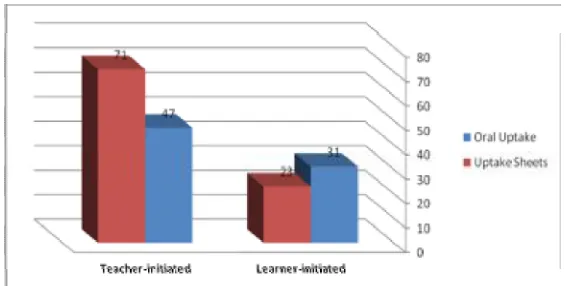
As far as the oral uptake moves are concerned, Table 2 demonstrates that while only 39.7% of all uptake moves occurred after learner-initiated FFEs, 60.3% of them followed teacher-initiated FFEs. On the other hand, data derived from the uptake sheets demonstrate that, 24.5% of the learners' written acknowledgement in the uptake sheets (i.e. written uptake moves) followed learner-initiated FFEs, while 75.5% occurred after teacher-initiated FFEs.
Interestingly, the new set of data driven from the uptake sheets is in complete agreement with the audio-data, demonstrating that teacher-initiated FFEs strongly come first regarding the uptake moves that followed them. Chi-square analysis, with an additional correction for continuity, also revealed a significant difference = 3.93 (1df, p<.05). The results concerning uptake moves based both on oral uptake and uptake sheets are further illustrated in Figure 3.
Figure 3: Uptake moves based on oral uptake and the uptake sheets
In their study of learner uptake in communicative ESL classes, Ellis et al. (2001a) found that uptake occurred in 74% of the FFE instances in these classes. They also found that uptake occurred more frequently after reactive and learner-initiated FFEs, whereas teacher-learner-initiated FFEs had significantly lower levels of successful uptake.
The results of the study by Ellis et al. (2001a) are in sharp contrast with the findings of the present study both in terms of the total rate of the uptake moves and the rate of uptake following learner-initiated and teacher-initiated FFEs; that is, in their study, Ellis et al. (2001a) found that 74% of all the FFEs resulted in uptake whereas in the present study only 34% of the FFEs were followed by the oral uptake (and 41% according to the uptake sheets) and while in their research, Ellis et al. (2001a) found that most of the uptake moves occurred after learner-initiated FFEs, the results of the present study indicated that uptake moves occurred more frequently following teacher-initiated FFEs. As it was demonstrated in Table1, the new results from the uptake sheets confirm those of the audio-data, demonstrating even more rigorously that teacher-initiated FFEs were favored more with learner uptake.
There are a number of reasons that might have contributed to this discrepancy. For one, different attitudes of the learners in ESL and EFL settings might have affected the rate of uptake moves. While in the ESL setting the learners receive input from a variety of sources (the supermarket, the bank, etc), in EFL setting the
teacher is the major source of knowledge for the learners. The learners in an EFL setting rely heavily on their teacher to provide them with materials, help them in realizing cultural differences between their native language and the target language, and also to correct their errors as well as to provide them with rich linguistic input. Therefore, while in an ESL setting the learners have multiple sources (an endless number of native speakers of the target language) to find out about their linguistic gaps, in EFL settings the learners are dependent solely upon their teacher as the provider of linguistic input or the corrective feedback. This has naturally led EFL learners to take their teacher as the best L2 speaker they have ever met and so to deem his teaching (including error correction) as the only correct way of learning the second language. This difference between the ESL and EFL settings may be a partial reason why Ellis et al. (2001a), found a low frequency of uptake following teacher-initiated preemptive FFEs while the results of the present study demonstrated, by far, a higher frequency of uptake occurring after teacher-initiated FFEs.
As for the difference between the results of this study on the frequency of uptake following learner-initiated FFEs and those of Ellis et al. (2001a), it should be noted that there are many factors at play which may have caused this discrepancy. Firstly, some scholars argue that while the production of successful uptake may be beneficial for learners (Ellis et al., 2001a; Lightbown, 1998) the discourse patterns of learner-initiated FFEs might make learners less inclined to produce successful uptake. Successful uptake was defined as an indication of understanding, and thus the mere acknowledgement or the simple repetition of the teacher's feedback does not count as uptake (Ellis et al., 2001b). However, it may be that when learners receive information following a learner-initiated FFE, it is not usual for them to repeat the information, thus they may simply respond with a nod or a thankful remark.
Secondly, the characteristics of the EFL contexts might be responsible for the lower rate of uptake following learner-initiated FFEs. As explained above, EFL learners, unlike ESL ones, have only their teacher to rely on as a completely reliable source of L2 input and the only source from which to receive proper negative feedback or any other type of linguistically-focused input. The belief that the teacher is the only source of the correct knowledge (and the peers' language knowledge is an incomplete one) has probably led to some sort of mistrust about what their peers say or bring up in the class. It is also the researchers' own
experience in the EFL classes that many learners feel that the time of the class should not be dedicated to discussing the linguistic problems of a single learner, since they believe (perhaps rightfully) that what one student brings up may not be of interest to the whole class, and that the teacher should be the one who decides what is best for all the students.
Such personal observations of the researchers are further justified by the assertions made by a number of authorities in the field among whom are Doughty and Varela (1998) and Zhao (2005) who have argued that learner-initiated preemptive focus on form can also be disadvantageous in that it can detract learners’ attention from the communicative activity. Moreover, they claim that a gap for one student may not be the gap for others. Thus, if a teacher addresses a single student's enquiry concerning a linguistic form, it may be a waste of time for others. They believe that this is also the reason why teachers may choose to refuse some of the students’ queries in class. The data provided by the uptake sheets also confirm this argument in that the rate of uptake recorded following learner-initiated FFEs in the uptake sheets (i.e. 24.5%) is far less than that of oral uptake moves following learner-initiated FFEs (i.e. 39.7%). One of the reasons for these differences in the data provided by the audio-recordings and the uptake sheets might be the fact that many of the queries that single learners brought up in the class were not a gap for the other learners and so they did not feel a need to produce uptake following them. That is to say, while single learners, who tried to initiate FFEs to bridge gaps in their linguistic knowledge, might have produced uptake orally upon the completion of the learner-initiated FFEs, the other learners did not always feel the same gap and thus did not produce the uptake move although the opportunity was given to them and they had the uptake sheets as well. These issues could be partial reasons why learners tended not to produce uptake very much after learner-initiated FFEs especially in the uptake sheets.
In the same vein, Farrokhi and Gholami (2007) found a very low proportion of uptake (only 15.2%) among 641 FFEs identified in 20 hours of instruction. This low rate of uptake contrasts with the findings of this study as the rate of (oral) uptake in the present study (i.e. 34%) was higher than their study by two folds. The reason of this very low frequency of uptake in Farrokhi and Gholami's research might be the very high rate of the preemptive FFEs.
Focus on form is, also, believed to be disadvantageous, though there are undeniable and significant functions assigned to it, in that it could be disruptive of the meaning-oriented flow of the classroom communication (e.g. Doughty & Varela, 1998; Ellis et al., 2002; Zhao, 2005). Some researchers also argue that teacher-initiated preemptive FFEs may not address an actual gap in the learners' linguistic knowledge, since it is based on the teacher's subjective evaluation, and thus might be more harmful than helpful, in that it might disrupt the flow of classroom communication (e.g. Ellis et al.).
On the basis of these pieces of evidence from the literature, and as some researchers in the field have also pointed out (e.g. Loewen, 2004a), there seems to be a need to define an ‘optimal rate’ for the integration of incidental focus on form in general and preemptive focus on form in particular into meaning-oriented activities. That is to say, optimal intervals should be defined for interrupting meaning-focused communication to attend to necessary linguistic forms in L2 classrooms. In other words, the interval from one FFE to the next should be long enough for the communication to recommence thus giving learners enough time and opportunities to produce uptake. It seems that in the study by Farrokhi and Gholami (2007) the teachers overused incidental focus on form techniques to the extent that there remained very few opportunities for the learners to process the new data and then produce uptake.
Qualitative Findings of the Study: A Brand New Visage of Uptake
To the best of our knowledge, earlier studies on uptake have only examined it in its categorical sense. That is to say whenever uptake was produced following an FFE, they tallied their coding sheets as one instance of uptake regardless of the number of learners who produced uptake (and with differing attributes) following that FFE. However, the rationale and objective behind measuring uptake is not just to assess a single learner's noticing and learning of the L2 forms and then generalizing it to others. Thus we cannot solely rely on the indication of uptake by only ‘one’ learner (or only treat uptake in a categorical sense) as a measure for the effectiveness of focus on form instruction, rather, we need to investigate the degree to which uptake (or an FFE) is facilitative of L2 features for ‘all’, or at least ‘most’ of the learners in a class when it occurs.
This being said, the uptake sheets revealed another very interesting fact regarding uptake. To the researchers' surprise, in many instances of preemptive FFEs, more than one learner produced uptake in their uptake sheets. We also observed that in some FFE cases, as many as 6 learners indicated uptake in their uptake sheets. This is undeniable evidence that the noticing of the form in focus has indeed occurred at a large scale rather than a single case. This is also indicative of the fact that such FFEs could contain special qualities, whether in the FFEs themselves or in the manner of their administration, that made them so noticeable that more learners produced uptake after them. This fact, which may hold the key to our understanding of the relationship between noticing, uptake, and acquisition, needs to be further investigated in the future.
According to the qualitative findings of the present study, it seems that as SLA researchers, we have neglected the fact that our evaluation of the effectiveness of focus on form should include its effectiveness as a means of helping all of the learners in a class to learn a second language more easily and accurately. That is to say, we have so far studied its effectiveness (i.e. uptake) regardless of how many learners benefitted from it in the class. The reason we insist on including all of the learners in a class, or at least as many of them as possible, in the study of uptake, is that a linguistic form which is raised in an FFE and is followed only by one learner's uptake move is not, and should not be considered, as effective and noticeable as the one which is followed by, for instance, five learners' uptake moves. The obvious reason is that when more than one learner produce uptake following an FFE, it is a sign that the form raised in that FFE is overwhelmingly more noticeable to the whole class and has potentials to address the linguistic gaps of more learners. Moreover, if we can identify, in subsequent research studies in this line, the characteristics of FFEs which make them so noticeable as to be followed by a lot of uptake moves from different learners, this could help us constitute a framework for integrating incidental focus on form in meaning-oriented activities in a way that incidental FFEs are more likely to be noticed by majority of the learners if not all.
Conclusion
The present study attempted to shed light on the attributes of uptake in EFL settings. It was argued that the current procedure of accounting for uptake may not be effective enough and that the most outstanding novelty of this study is its
attempt to develop and administer a think-aloud uptake sheet for the purpose of incidental focus on form research. The results authenticated this claim as it was revealed that the rate of uptake recorded in the uptake sheets was higher than the rate of uptake in the data. Furthermore, the findings based on both the audio-data and the uptake sheets confirmed that teacher-initiated FFEs were followed more by learner uptake. The qualitative results also indicated that the currently-held occur/not-occur view of uptake may not be an effective one and that we should take into account a deeper view of uptake which is how many learners benefit from a single FFE and thus produce uptake following them. Finally, in light of the new findings, it is suggested that an optimal interval for the integration of preemptive FFEs into meaning-oriented activities should be defined, in which learners would have enough opportunities to produce uptake.
Note on Contributors:
Javad Gholami is an assistant professor in TESOL from Urmia University, Iran. His research publications have been on integrating focus on form instruction and communicative language teaching, intralingual translation, and learner autonomy in ELT.
Morteza Bassirian, an MA graduate in TESOL, is a lecturer in Iran Language Institute, Iran. As an experienced EFL practitioner, his research interest is the integration of focus on form instruction and communicative language teaching in EFL settings.
References
Allwright, D. (1984). Why don't learners learn what the teachers teach? The interaction hypothesis. In D. Singleton & D. Little (Eds.), Language learning in formal and informal contexts (pp.3-18). Dublin: IRAAL.
Austin J. L. (1976). How to do things with words. Norwich, Great Britain: Fletcher & Son Ltd.
Chaudron, C. (1977). A descriptive model of discourse in the corrective treatment of learners’ errors. Language Learning, 27(1), 29–46.
Doughty, C., & Varela, E. (1998). Communicative focus on form. In C. Doughty & J. Williams (Eds.), Focus on form in classroom second language acquisition (pp.114–138). Cambridge: Cambridge University Press.
Egi, T. (2010). Uptake, Modified Output, and Learner Perceptions of Recasts: Learner Responses as Language Awareness. The Modern Language Journal, 94(1), 1-21.
Ellis, R. (1994). Uptake as language awareness. Language Awareness, 4(3), 147-160.
Ellis, R. (2001). Investigating form-focused instruction. Language Learning,51(1), 1-46.
Ellis, R. (2005). Principles of instructed language learning. Asian EFL Journal, 7(3). Retrieved from http://www.asian-efl-journal.com/sept_05_re.pdf
Ellis, R., Basturkmen, H., & Loewen, S. (2001a). Learner uptake in communicative ESL lessons. Language Learning, 51(2),281-318.
Ellis, R., Basturkmen, H., & Loewen, S. (2001b). Preemptive focus on form in the ESL classroom. TESOL Quarterly, 35(3),407-432.
Ellis, R., Basturkmen H., & Loewen, S. (2002). Doing focus on form. System, 30(4), 419-432.
Ellis, N., & Schmidt, R. (1997). Morphology and longer distance dependencies: Laboratory research illuminating the A in SLA. Studies in Second Language Acquisition, 19(2), 145-171.
Farrokhi, F., & Gholami, J. (2005). Preemptive language related episodes, corrective feedback, and uptake in an EFL class. Iranian Journal of Applied Linguistics (IJAL), 8(1), 23-45.
Farrokhi, F., & Gholami, J. (2006). Uptake and language related episodes in EFL classes. Proceedings of the International Conference on Conversation Analysis (ICCA06). Helsinki University, Finland, May 10-14.
Farrokhi, F., & Gholami, J. (2007). Reactive and Preemptive Language Related Episodes and Uptake in an EFL Class. The Asian EFL Journal, 9(2),58-92. Gholami, J. (2009). Incidental Focus on Form in English Language Teaching:
Reactive and Preemptive Focus on Form Practices, and Uptake in EFL Classes. Berlin: VDM Verlag.
Lightbown, P. M. (1998). The importance of timing in focus on form. In C. Doughty & J. Williams (Eds.), Focus on form in classroom second language acquisition (pp. 177-196). Cambridge, England: Cambridge University Press. Loewen, S. (2004a). Uptake in incidental focus on form in meaning-focused ESL
lessons. Language Learning, 54(1), 153-188.
Loewen, S. (2004b). The occurrence and characteristics of student-initiated focus on form. In H. Reinders, H. Anderson, M. M. Hobbs & J. Jones-Parry (Eds.), Supporting independent learning in the 21st century. Proceedings of the
inaugural conference of the Independent Learning Association (pp. 86-93). Auckland: Independent Learning Association Oceania. Retrieved from http://www.independentlearning.org/ila03/ila03_loewen%20.pdf
Loewen, S. (2005). Incidental focus on form and second language learning. Studies in Second Language Acquisition, 27(3),361-386.
Long, M., & Robinson, P. (1998). Focus on form: Theory, research and practice. In C. Doughty & J. Williams (Eds.), Focus on form in classroom second language acquisition (pp. 15-41). Cambridge: Cambridge University Press. Lyster, R., & Ranta, L. (1997). Corrective feedback and learner uptake:
Negotiation of form in communicative classrooms. Studies in Second Language Acquisition, 19(1),37-66.
Lyster, R. (1998). Negotiation of form, recasts, and explicit correction in relation to error types and learner repair in immersion classrooms. Language Learning, 48(2),183-218.
Lyster, R., & Izquierdo, J. (2009). Prompts versus Recasts in Dyadic Interaction. Language Learning, 59(2), 453-498
Mackey, A., & Gass, S., (2005). Second language research: methodology and design. Mahwah, New Jersey: Lawrence Erlbaum Associates, Inc, Publishers. Mackey, A., McDonough, K., Fujii, A., & Tatsumi, T. (2001). Investigating
learner's reports about the L2 classroom. Studies International Review of Applied Linguistics, 39(4),285-308.
Mohammadnia, Z., & Gholami, J. (2008). Incidental Focus on Form: Does Proficiency Matter? TELL, 2(6), 1-26.
Nassaji, H. (2009). Effects of recasts and elicitations in dyadic interaction and the role of feedback explicitness. Language Learning, 59(2), 411-452.
Oliver, R. (2000). Age differences in negotiation and feedback in classroom and pair work. Language Learning, 50(1), 119-151.
Reinders, H. (2009). Learner uptake and acquisition in three grammar-oriented production activities: Language Teaching Research, 13(2), 201-222.
Richards, J. C., Hull, J., & Proctor, S. (2005). Interchange Third Edition Student's Book 3. Cambridge: Cambridge University Press.
Schmidt, R. (1990). The role of consciousness in second language learning. Applied Linguistics, 11(2), 129-158.
Schmidt, R. (1995). Consciousness and foreign language learning: A tutorial on the role of attention and awareness in learning. In R. Schmidt (Ed.), Attention and awareness in foreign language learning (pp.1–63). Honolulu: University of Hawaii Press.
Swain, M. (1985). Communicative competence: Some roles of comprehensible input and comprehensible output in its development. In S. Gass & C. Madden (Eds.), Input in second language acquisition (pp. 235-253). Rowley, MA: Newbury House.
Swain, M. (1995). Three functions of output in second language learning. In G. Cook & B. Seildlhofer (Eds.), Principles and practice in applied linguistics: Studies in honor of H. G. Widdowson (pp.125-144). Oxford: Oxford University Press.
Swain, M. (2000). The output hypothesis and beyond: mediating the acquisition through collaborative dialogue. In J. Lantolf (Ed.), Sociocultural theory and second language learning (pp. 97-114). Oxford: Oxford University Press. Swain, M., & Lapkin, S. (1995). Problems in output and the cognitive processes
they generate: A step towards second language learning. Applied Linguistics, 16(3), 371-391.
Swain, M., & Lapkin, S. (2001). Focus on form through collaborative dialogue: exploring task effects. In M. Bygate, P. Skehan, & M. Swain (Eds.), Researching pedagogic tasks: Second language learning, teaching and testing (pp. 99–118). Harlow: Longman.
Williams, J. (2001). The effectiveness of spontaneous attention to form. System, 29(3), 325–340.
Zhao, Y. (2005). Incidental Focus on Form in T-L Interaction and L-L Interaction (Unpublished doctoral dissertation). Auckland University of Technology, Auckland, New Zealand.
Zhao, Y., & Bitchener, J. (2007). Incidental focus on form in teacher–learner and learner–learner interactions. System, 35(4),431–447.
Appendix
Sample uptake sheets collected from the learners