Reading Comprehension
Maryam Meshkat¹ & Ali Hassanzade²¹Corresponding author, Shahid Rajaee Teacher Training University, [email protected]
²Shahid Rajaee Teacher Training University, [email protected]
Received: 16/12/2013 Accepted: 13/02/2014
Abstract
Research shows a positive relationship between self-directed learning (SDL) and reading comprehension. The present quasi-experimental study attempted to expand the scope of SDL by investigating its effect on the components of reading comprehension. Sixty high school students took the reading comprehension part of PET as the pretest and the posttest. Over 16 weeks, the experimental group, consisting of 30 students, underwent instruction in SDL. Data from the pretest was analyzed using an independent samples t test. Results [t(1.158 = 0.157, p > 0.87)] indicated that the 2 groups were homogeneous before the treatment. After the treatment, the data from the posttest were analyzed using a one-way between-groups MANOVA. Results between the 2 groups on the combined dependent variables [F(5,54) = 0.72), p = .61], Wilk’s Lambda= .93, and partial eta squared =.06 displayed no significant difference, and this may be due the fact that SDL is not compatible with Iran’s system of education.
Keywords: Self-Directed Learning (SDL); Reading Comprehension; Components of Reading Comprehension
1. Introduction
computer-assisted language learning (CALL), and self-direct learning (SDL) has emphasized the role of the independent learner in the language learning process.
Based on the concept of andragogy, the art and science of helping adults learn (Knowles, 1968), SDL has been described as a process in which individuals take the initiative, with or without the help of others, in diagnosing their own learning needs, setting personal goals, making decisions on resources and learning strategies and assessing the value of the learning outcomes (Knowles, 1975). Costa and Kallick (2003) described self-directed learners as being managing, self-monitoring and self-modifying. Knowles and Tough (1991, as cited in Merriam, 2001) pointed out that the theory of SDL is viewed through two goals. The first goal is the development of the learner's capacity to be self-directed; the second goal is the fostering of transformational learning (Mezirow, 1986, as cited in Merriam & Cafferella, 1991). Transformational learning postulates that critical reflection by the learner is the core principle in the process of SDL (Mezirow, 1986).
As to reading comprehension, critical reflection may be closely related to the concept of content schemata and can help learners gain a better understanding of what they are reading. Reading comprehension is defined as a process in which readers combine information from a text and their own background knowledge to build reading—to gain an overall meaning of a text (Anderson, 2003). According to the schema theory, the complete meaning of a text is constructed by the combination of different information from different sources, for example, prior knowledge, linguistic, situational, and task context (Sapiro, 1983). Widdowson (1983) distinguishes two kinds of schematic knowledge: “Interpersonal” schemata, that is, knowledge about language structures/forms and “content schemata,” that is, “knowledge of conceptual content or topic area” (Widdowson, 1990, p. 104) as well as “topic familiarity, cultural knowledge, and previous experience with a field” (Li, 2007, pp. 18-19) The way readers use their prior knowledge to gain an overall meaning of a text may be closely related to the second view toward the theory of SDL, which is fostering critical reflection among learners. According to Knowles and Tough (1991, as cited in Merriam, 2001), this critical reflection is an “understanding of the historical, cultural, and biographical reasons for one's needs, wants, and interests.”
comprehension have been studied in order to see which ones will be affected by SDL. If SDL does enhance the components of reading comprehension, then it can affect the way reading comprehension is presented and taught.
2. Literature Review
In an English-language learning classroom, learners are different: They have different goals and learn in different ways (Brown, 1987). Then, the idea that a teacher can handle the whole process of teaching by himself or herself is far-reached. The teacher may not recognize or may not have the sufficient resources to handle all these differences. Hence, one way to solve this problem could be allowing the learners to accept the responsibility of their own learning which, according to Hiemstra (1994), is more expedient relative to other approaches and could lead to autonomy. In today’s world, change is rapid, new knowledge is continuously created, and an ever-widening access to information makes new strategies of learning necessary. As Hiemstra (1994) argues, “. . . much of this learning takes place at the learner’s initiative, even if available through formal settings” (p. 1). This learner-responsible outlook is named SDL.
2.1 Self-Directed Learning (SDL)
The concept of SDL has existed from ancient times. Great Greek philosophers like Socrates, Plato, and Aristotle, for example, and other historical examples like Alexander the Great, Caesar, Erasmus, and Descartes, were the first self-directed learners (Hiemstra 1991, cited in Canipe & Fogerson, 2006). However, the systematic investigation of the concept dates back to 1961 when Houle attempted to examine adults engaged in continuing education through interviews. Later, Knowles (1968) made a great contribution to the concept of SDL by demarcating learning by adults from learning by children. He suggested a concept called andragogy—the art and science of helping adults learn. This concept was completely different from pedagogy, or the art and science of helping children learn (Svedberg, 2010). The assumptions of andragogy are (p. 20):
· An adult’s self-concept moves from that of a dependent personality toward one of a self-directing human being as he or she matures.
· Adults accumulate experience which is a rich resource for learning. · The readiness of an adult to learn is closely related to the developmental
tasks of his or her social role.
· An adult is more problem centered than subject centered in learning.
Nevertheless, it does not necessarily mean learning in solitude (Hiemstra, 1994). Although SDL has its roots in adult learning, Carlson (1979) believes that SDL is an important learning model for everyone regardless of their age and their field of study. In the same line, Knowles (1975, as cited in Hiemstra, 1994) believes self-directedness is not bound to a certain learning situation, but it is probably something like a continuum or characteristic that exists to some extent in every human being. On the contrary, Raemdonck (2006) argues that self-directedness is a domain-specific concept. An individual may demonstrate a low level of self-directedness in writing skill, for example, but show, at the same time, a high level of self-directedness in reading comprehension. Related literature on the relationship between SDL and reading comprehension shows that the more self-directed the reader, the more opportunities they will be able to obtain for language learning.
2.2 Self-Directed Learning and Reading Comprehension
The effect of different models of SDL on reading comprehension ability of students with different proficiency levels has been studied. Kim (2010) found that the SMMIS model-based SDL improved 13 elementary and 14 middle school students’ academic achievement in Korean, English, mathematics, social studies, and science. This study, then, suggests that implementing a self-directed model with students can help them gain more opportunities for learning, irrespective of their age and field of study. SMMIS is a SDL model proposed by Choi and Kim (2010). It consists of five elements: self-motivation, motivation, metacognition, interaction, and self-reflection.
Phongnapharuk’s (2007) study involved the use of applied metacognitive strategies via CALL to enhance English reading and writing abilities. The participants were 25 students who registered in the first semester of an English reading and writing course. Phongnapharuk suggested that there is a significant correlation between metacognition, as one of the important elements of SDL in the SMMIS model, and students’ English reading abilities.
2.2.1 Studies on Self-Directed Learning in Iran
There has been a paucity of research on SDL in Iran. However, in recent years, two studies have been conducted concerning this issue. Zarei and Gahremani (2010) investigated the relationship between learner autonomy and reading comprehension ability. Khodabandehlou et al. (2011) sought to find the impact of SDL on the learners’ reading comprehension proficiency. The participants in both studies were adult L2 learners. In Zarei and Gahremani’s (2010) study, the participants were M.A. students, and in Khodabandehlou et al.’s (2011) study, they were upper-intermediate and advanced EFL learners in an IELTS class. Like Phongnapharuk (2007), Khodabandehlou et.al. (2011), applied metacognitive strategies in order to improve the reading comprehension proficiency of learners. Zarei and Gahremani (2010) and Khodabandehlou, et.al, (2011) also found that learner autonomy and SDL enhanced reading comprehension ability/proficiency of the L2 learners. These two studies, then, suggest that implementing SDL with adult and high-proficient L2 learners can be beneficial.
The present study is different from the abovementioned studies in two ways: First, the participants here were second grade high school students; second, the primary focus was to examine the effect of SDL on the components of reading comprehension, that is, main idea, specific information, scanning, detailed comprehension, lexicostructural patterns.
3. Methodology
3.1 Participants
In order to practically study the effect of SDL on the components of reading comprehension, the following participants were selected. Two classes in Shahid Beheshti High School were chosen as the experimental and control groups, each of which with 30 students, ranging in age between 15 and 16. The selection was nonrandomized because the researcher was not allowed to recruit the students.
3.2 Instrumentation
3.3 Procedure
The present study was conducted through a quasi-experimental pretest-posttest control and experimental group design. In the first step, the students in both groups were given a reading comprehension test to measure their reading comprehension before the treatment. Second, the students in the experimental group underwent instruction on SDL over 16 sessions. The class met once in a week, each session lasting for 90 min. In the treatment period, SDL strategies, taken from Abdullah (2001), were used, as in the following:
The teacher helped the learners in diagnosing their learning needs, setting their learning goals, applying appropriate strategies, and evaluating their learning outcomes. Through the whole treatment process, the teacher tried to raise the students’ awareness of their roles in learning, and the teacher involved the students in discussions on topics from the Self-Directed Learning Readiness Scale. The topics were “I know that I want to learn and that I am a learner, so if I want to learn something, I can, and I like to learn and to solve problems.” The students were, then, encouraged to participate in making decisions concerning what is to be learned, when and how it should be learned, and how it should be evaluated. Also, they were allowed to pursue their own interests so that learning would be facilitated. The teacher tried not to correct the students’ errors in order to encourage SDL among the students. This strategy led the students to develop a sense of security during learning. Subsequently, the teacher tried to establish the habit of self-monitoring by encouraging the learners to reflect on what they did. The teacher helped the students to think about their needs and abilities, to choose appropriate skills and strategies for their learning, and to alter their learning strategy if the strategy at hand had failed.
Third, in order to measure their reading comprehension ability after the treatment, all of the participants were given the same reading comprehension test as the posttest.
The data gathered from the pretest were analyzed using an independent samples t test to ensure that the students in the two groups were homogeneous. A one-way between-groups MANOVA was performed to investigate whether SDL affects the components of reading comprehension (i.e., main idea, specific information, scanning, detailed comprehension, lexicostructural patterns).
4. Results
difference between the experimental and control groups’ mean scores on the reading comprehension pretest:
Table 1. Descriptive Statistics on Reading Comprehension Pretest
Groups N Mean Std.
Deviation
Std. Error Mean
Scores Experimental 30 15.4000 4.09036 .74679
Control 30 15.2000 5.64098 1.02990
In Table 2, it is shown that the significance of Levene’s test for Equality of Variances is larger than .05.Thus, following the first row in Table 2 (i.e., Equal variances assumed), it can be seen that
Table 2. Independent Samples t Test of Reading Comprehension Pretest
Levene’s
Test
t Test for Equality of Means
F Sig t df Sig.
(2-tailed)
Equal Variances Assumed 3.963 .051 .157 58 .876
Equal Variances Not Assumed .157 52.89 .876
The results in Table 2, t(1,158) = 0.15), indicate that the two groups were homogeneous in terms of their reading comprehension ability before the treatment.
In order to examine the effect of SDL on the components of reading comprehension, a one-way between groups MANOVA was used. Preliminary assumption testing was conducted to check for univariate and multivariate normality and outliers, linearity, multicollinearity, and homogeneity of variance-covariance matrices, with no serious violations noted. Descriptive statistics on the components of the reading comprehension test are indicated in Table 3:
Table 3. Descriptive Statistics on the Components of Reading Comprehension
Groups Mean Std. Deviation
Main Idea Experimental 2.9333 1.11211
Control 2.6667 1.09334
Specific Information Experimental 1.6667 .84418
Control 1.6000 .81368
Scanning Experimental 2.7000 .63788
Control 2.7167 .72734
Detailed Comprehension
Experimental 2.6667 .84418
Control 2.5333 .89955
Lexicostructural Patterns
Experimental 2.6167 .96207
Table 3 shows the mean scores of the two groups on the components of the reading comprehension test. The minimum mean scores for both the experimental and control groups were on the specific information component of reading comprehension—1.66 and 1.60, respectively. The maximum mean score for the experimental group was 2.93 on the main idea component. For the control group, the maximum mean score was 2.71 on the scanning component. On four components (i.e., main idea, specific information, detailed comprehension, and lexicostructural patterns), the mean score is higher in the experimental group. On the other hand, for one of these components (i.e., scanning), the mean is higher in the control group, and this could be the result of the reading strategies implemented with the students in the control group. Table 4 demonstrates the Levene’s Test of Equality of Error Variances:
Table 4. Levene’s Test of Equality of Error Variances Sig.
Main Idea .588
Specific Information .457
Scanning .628
Detailed Comprehension .351
Lexicostructural .650
As shown in Table 4, in the Sig. column, there is no value that is less than 0.05. This indicates that none of the dependent variables (i.e., the components of reading comprehension) has violated the assumption of equality of variance. Table 5 shows the Multivariate Tests of significance:
Table 5. Multivariate Tests of the Components of Reading Comprehension
Effects Value Sig. Partial eta.
Squared Groups
Wilk’s Lambda .937 .611 .063
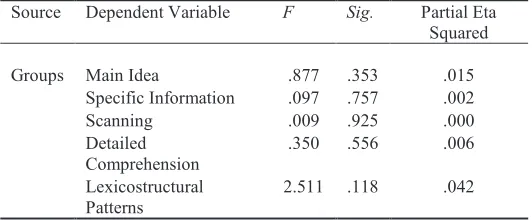
Table 6. Tests of Between-Subjects Effects for the Components of Reading Comprehension
Source Dependent Variable F Sig. Partial Eta
Squared
Groups Main Idea .877 .353 .015
Specific Information .097 .757 .002
Scanning .009 .925 .000
Detailed Comprehension
.350 .556 .006
Lexicostructural Patterns
2.511 .118 .042
Table 6 shows separate analyses conducted on each of the components of reading comprehension. In order to reduce the chance of a Type 1 Error, that is, “finding a significant result when there is not really one” (Pallant, 2010, p. 295), a Bonferroni adjustment was done; the original alpha level of .05 was divided by the number of dependent variables (i.e., 5). Therefore, a new alpha level of .01 was given.
The impact of SDL instruction on the components of reading comprehension is shown in the final column in Table 6. Starting with lexicostructural, the value of .042 indicates that 4.2% of the between subjects variance is accounted for by SDL. For main idea, a partial eta squared of .015 shows that 1.5% of the variance is accounted for by SDL instruction. Partial eta squared for specific information is .002. It indicates that .2% of the variance is accounted for by SDL. For scanning, partial eta squared is .000. It implies that the experimental group failed to get a higher score in that component of reading comprehension. Regarding detailed comprehension, the value of .006 indicates that .6% of the between subjects variance is accounted for by instruction on SDL.
5. Discussion
The results show that the components of reading comprehension appear not to be significantly affected by SDL—the difference between the components of reading comprehension in the control and experimental group was not significant. It may be because of multiple reasons: the course material, the number of students, students’ unfamiliarity with the concept of SDL, and students’ reluctance to subject themselves to SDL. The two groups did not display any significant difference on the components of reading comprehension. Yet, different components showed different levels of significance and different partial eta squared.
for 4.2% of the variance. This may be due to the fact that the school syllabus in Iran emphasizes grammar and vocabulary. This was also the reason for why the students complained to the principal: They believed they were not getting the necessary instruction in patterns that they needed. Hence, the students may have unconsciously applied the techniques of SDL to that component of reading comprehension which was considered important in their learning context—school.
One point to take into account is that the course materials in schools in Iran (such as the one in which this study was carried out) are controlled by the Ministry of Education. It was extremely difficult to encourage the students to engage in planning their own learning activities so that they might be motivated to take on responsibility for their learning. In Wichadee’s (2007) study, the learners were allowed to choose their own learning activities. The results revealed that they gained higher English reading mean scores and SDL ability, whereas in this study, the activities were based on the syllabus designed by the Ministry of Education. Therefore, small effect of SDL instruction on the components of reading comprehension maybe because of the fact that the students in the experimental group did not completely take control of their own learning.
Another factor that may possibly have affected the results of this research is the number of the students in the class, which was 30. If the number of students had been fewer, the teacher could have worked with each one individually and effectively and this could have yielded better results.
An important factor that may possibly have influenced the results of this study was the students’ unfamiliarity with the concept of SDL. The students were not familiar with these strategies of learning and had a tendency to resist them. The students in the experimental group went so far as to complain to the principal that grammar was not explicitly taught in class. This could be an indicator of the students’ reluctance to use SDL which is reflected in the result of the study, where no significant effect is found. These factors may possibly have all gone hand in hand to affect the results.
For scanning, a partial eta squared of .000 (see Table 6) implies that the experimental group failed to get a higher score in that component of reading comprehension. The reason could be that the students in the experimental group did not receive any reading comprehension strategies. In the control group, reading strategies might have been taught which were compliant with the components of reading comprehension. This is reflected in the results for scanning.
6. Conclusion
information, scanning, detailed comprehension, and lexicostructural patterns. However, the effect was not significant. It is important to note that reading comprehension may also be influenced by factors other than SDL. McNamara (2009), for instance, emphasizes the importance and effectiveness of reading strategies to improve reading comprehension. The students in the experimental group did not receive any reading strategies so that the effect of SDL on the components of reading comprehension may be investigated. Alderson and Banerjee (2002), as another example, assert that “reading is an interaction between a reader with all that the reader brings with him or her—background knowledge, affect, reading purpose, intelligence, first language abilities, and more—and the text, whose characteristics include topic, genre, structure, language (organization, syntax, vocabulary, cohesion)” (p. 84). This means that there are other factors that can influence reading comprehension of students. Based on these claims, thus, it will be too coldblooded to throw away SDL completely. However, the findings of the present study suggest that SDL may not be significantly effective for the learning of the components of reading comprehension. These findings also suggest that SDL may not be compatible with Iran’s system of education.
References
Abdullah, M. H. (2001). Self-directed learning [ERIC digest No. 169]. Retrieved on
January 10, 2009 from the World Wide Web:
http://www.education.com/reference/article/Ref_Self_Directed/
Alderson, J. C., & Banerjee, J. (2002).State of the art review: Language testing and assessment (part two). Language Teaching, 35(2), 25-50.
Anderson, N. (2003). Reading. In D. Nunan (Ed.), Practical English language teaching (pp. 67-86). New York: Mc Grow-Hill.
Brown, H. D. (1987). Principles of language learning and teaching. Englewood Cliffs, JC: Prentice Hall.
Canipe J. B., & Fogerson, D. L. (2006). The literature of self-directed learning: Dissertations. International Journal of Self-directed Learning, 3(2), 34-45.
Carlson, R. A. (1979). The time of andragogy. Adult Education, 30(1), 53-56.
Choi, S. W., & Kim, P. S. (2010). Self-directed learning development children. Seoul; Gyoyukgwahaksa.
Costa A., & Kallieks, B. (2003). Assessment strategies for self-directed learning. Thousand Oaks, C.A: Corwin
Davis, A. (2013). Explorations strategies for comprehension for informational texts. EC Licensing Pty Ltd: Published by Okapi Educational Publishing, Inc.
Hadley, A. O. (2003). Teaching language in context (3rd ed.). Boston: Heinle & Heinle.
Hiemstra, R. (1994). Self-directed learning. In T. Husen & T. N. Postlethwaite (Eds.), The international encyclopedia of education (2nd ed.), Oxford: Pergamon Press.
Kim, R. (2010). Self-directed learning management system: Enabling competency and self-efficacy in online learning environments. Unpublished doctoral dissertation, the Claremont Graduate University, Claremont, Los Angeles.
Khodabandehlou, M., Jahandar, S., Seyedi, G., & Mousavi Dolatabadi, R. (2011). The impact of self-directed learning strategies on reading comprehension. International Journal of Scientific & Engineering Research, 3(7), 1-19.
Knowles, M. (1968). Andragogy, not pedagogy. Adult Leadership, 16, 350-352.
Knowles M. (1975). Self-directed learning: A guide for learners and teachers. New York: Association Press.
Krashen, S. D. (1982). Principles and practices of second language acquisition. Oxford: Pergamon Press.
LI, X., Wu, J., & Wang, W. (2007). Analysis of schema theory and its influence on reading. US-China Foreign Language, 5(11), 18-21.
McNamara, D. S., (2009). The importance of teaching reading strategies. Retrieved March 30, 2012, from the World Wide Web: ftp://129.219.222.66/.../Te aching%20Reading
Merriam, S., & Caffarella, R. (1999). Learning in adulthood: A comprehensive guide (2nded.). San Francisco: Jossey-Bass.
Merriam, S. B. (2001). Andragogy and self-directed learning: Pillars of adult learning theory. New Directions for Adult and Continuing Education, 89, 3-13.
Pallant, J. (2010). SPSS survival manual: A step by step guide to data analysis using the SPSS program (4th ed.). Australia: The McGrow Hill Companies.
Raemdonck, I. (2006). Self-directedness in learning and career processes: A study in lower-qualified employees in Flanders. Unpublished doctoral dissertation, Gent University, Ghent, Belgium.
Sadoski, M., & Paivio, A. (2004). A dual coding theoretical model of reading. In R. B. Ruddell & N. J. Unrau (Eds.), Theoretical models and processes of reading (5th ed.; pp. 1329-1362). Newark, DE: International Reading Association.
Spiro, R. J. (1980). Schema theory and reading comprehension: New directions. Reading Technical Report, No. 191 University of Illinois at Urbana-Champaign.
Svedberg, M. K. (2010). Self-directed learning and persistence in online asynchronous undergraduate programs. Unpublished doctoral dissertation, Virginia Polytechnic Institute and State University, USA.
Tholin, J. (2008). Learner autonomy, self-directed learning, and assessment: A Swedish experience. Retrieved June 10, 2012 from the World Wide Web: http:// bada.hb.se/
Wichadee, S. (2007). Impacts of self-directed learning activities on students' English proficiency and self-directed learning ability. ICER, 23(2), 191-203.
Wichadee, S. (2011). Developing the self-directed learning instructional model to enhance English reading ability and self-directed learning of undergraduate students. Journal of College Teaching & Learning, 8(12), 43-52.
Widdowson, H. G., (1983). Learning purpose and language use. Oxford: Oxford University Press.
Widdowson, H. G., (1990). Aspects of language teaching. Oxford: Oxford University Press.